On the morning of August 23rd, 1972, a 20-year-old woman stood at the door of her family home in Bothell, Washington, and borrowed her little sister’s boots. They were Waffle Stompers, thick-soled hiking boots, the kind 12-year-old girls wore in the summer of 1972. She laced them up, kissed her family goodbye, and walked her white 10-speed bicycle out onto Winesap Road. It was a warm afternoon, sunny, the kind of Pacific Northwest summer day that feels like a gift.
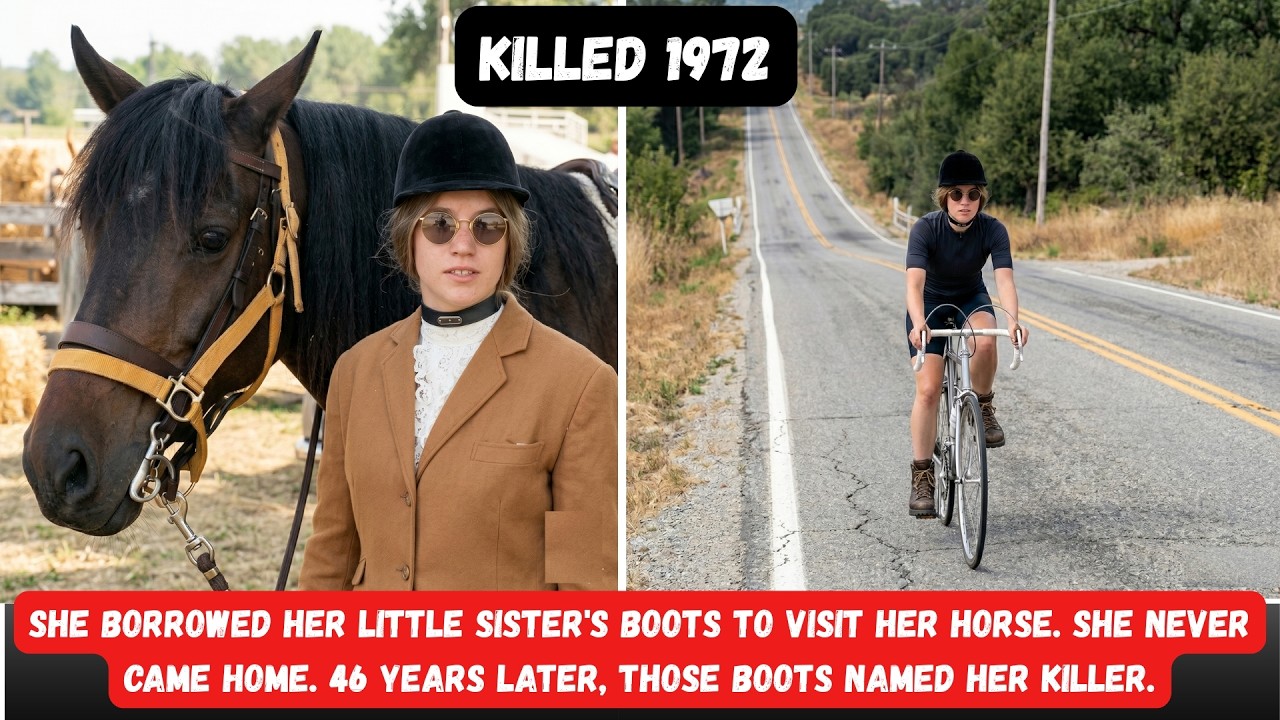
She had a horse she loved, a stable six miles away, and a dime in her pocket because her mother had reminded her to call home if she was going to be late. She never called. Within the hour, she was found in the woods, shot in the head, left like she was nothing. Her name was Judy Loomis, and those borrowed boots, her little sister’s boots, would sit in an evidence locker for the next 46 years.
What nobody knew, what nobody would know for nearly half a century, was that the man who killed her never left. He was five miles away. He had a wife, a business, a normal life. Five miles away for 46 years.
Judy Gwinn Loomis was born on June 5th, 1952, in Bothell, Washington. She grew up in a single-story home on Winesap Road, a quiet residential street sitting between the small communities of Mill Creek and Bothell in Snohomish County. The kind of neighborhood where people knew each other’s names, where kids rode bikes without being told to be careful, where summer afternoons felt like they could stretch on forever. Her parents were John and Rosemary Loomis.
She had a younger sister named Jana, eight years her junior, and a brother named John. By all accounts, the Loomis home was full. Full of people, full of animals, full of the particular kind of warmth that comes from a family that actually likes each other. Judy was the kind of person who left a mark on a room.
She was a budding artist, not in a casual, dabbling sense, but in the committed, obsessive sense that real artists operate. At some point, she decided that plain bedroom walls were not acceptable. So she painted them, floor to ceiling, a sweeping mural of running horses, hooves lifted, manes flying, captured mid-gallop across every wall of her room. That tells you something about Judy Loomis.
She didn’t see the world as it was; she saw what it could look like, and she made it look that way. She rescued hurt animals and spoke her mind with passion. Her sister Jana would later describe her with a simplicity that says everything. They were close, the kind of close that only sisters who share a home, share secrets, and share boots on a sunny afternoon can be.
And then there were the horses. Judy’s love for horses wasn’t a hobby; it was a defining feature of who she was. She owned a dark brown horse named Sady, boarded at a stable on Strum Road, six and a quarter miles from the house on Winesap Road. She went there as often as she could.
Most days, her parents drove her. The stable was too far to easily reach on a bicycle, or so the family had always assumed. In the summer of 1972, Judy was 20 years old. She had recently celebrated her birthday, June 5th, surrounded by her family.
She was living at home with her parents, her sister, her brother, and her fiancé. She had her whole life mapped out in front of her. On the afternoon of August 23rd, 1972, Judy decided that she wanted to visit Sady. Her parents weren’t available to drive her, so she made a decision she had never made before.
She would bike there herself. Six and a quarter miles, along familiar roads on a warm, sunny Pacific Northwest afternoon. Before she left, she realized she needed proper boots for riding. Her own weren’t at hand, so she did what sisters do.
She walked into Jana’s room and borrowed a pair of Waffle Stomper boots, thick-soled hiking boots, the kind 12-year-old girls wore in 1972. Her mother, Rosemary, stopped her at the door. She pressed a dime into Judy’s hand. “Call home if you’re going to be late.
”
Judy laced up her sister’s boots, walked her white 10-speed bicycle out onto Winesap Road, and pedaled away. Jana watched her go. About halfway into her ride, Judy paused to talk with a friend on 164th Street Southwest. A brief, ordinary conversation between two people on a summer afternoon, neither of them knowing it would be the last time they spoke.
A 14-year-old girl saw Judy a little further down the road riding east along Penny Creek Road, what is now Mill Creek Road, heading toward Sady, toward an afternoon she had been looking forward to. That was the last confirmed sighting of Judy Loomis alive. Back on Winesap Road, the afternoon turned to evening. The sky began to dim.
Rosemary Loomis started watching the clock. The girls had always been told the same thing: be home before dark. Judy didn’t come home. She didn’t call.
The dime was never used. When the detective knocked on the door that night, Rosemary Loomis collapsed where she stood. Her husband didn’t have time to catch her. The summer of 1972 ended that night on Winesap Road, and for the Loomis family, it never really became any other season.
Less than an hour after Judy Loomis was last seen riding east along Penny Creek Road, a young couple was driving through a wooded area east of the Bothell-Everett Highway. They saw something at the edge of the trees. They stopped. Judy was lying on the ground.
She had been shot in the head with a . 22 caliber weapon. She had been sexually assaulted. Her glasses were askew.
One of her sister’s boots was untied. A dime lay in the dirt nearby. She was still alive. The couple didn’t stop to think.
They lifted her into their vehicle and drove as fast as they could to Stevens Memorial Hospital in Edmonds. Judy Loomis died before they arrived. She was 20 years old. She had been on that road, in those woods, for less than an hour before someone found her.
Which means the man who did this didn’t need long. He didn’t plan for days or stalk her for weeks across the county. He saw her on a road she had never biked before, on a route she chose that afternoon on a quiet impulse, and he acted. Snohomish County Sheriff’s deputies arrived at the scene and began processing what little physical evidence remained.
The woods were rural in 1972, open fields, trees, the kind of terrain where people went for target practice on idle afternoons. There were no security cameras, no cell phones, no digital footprint of any kind. What investigators did have was a DNA sample. Semen had been recovered from the crime scene, specifically from the boots Judy was wearing, her sister Jana’s Waffle Stomper boots.
That evidence was collected, documented, and stored. And then the investigation began to stall. Detectives worked the case through the 1970s. They followed leads, interviewed witnesses, developed persons of interest.
None of it produced an arrest. The trail grew cold in the way that trails go cold when the technology of the era simply cannot do what the evidence requires. The DNA sat in storage, waiting for a world that didn’t exist yet. Meanwhile, on Winesap Road, the Loomis family tried to survive what had happened to them.
Judy’s leather purse stayed where she had left it. Her sister Jana would later recall that you could still smell the patchouli oil. Her bedroom walls still showed the mural she had painted, horses running, frozen mid-gallop, going nowhere. Her father and mother hurt in the way that parents hurt when a child is taken violently and nobody is ever held to account.
It is a specific kind of pain. It does not dull with time. It calcifies. Her father would die never knowing who killed his daughter.
The 1980s came, then the 1990s. The case file on Judy Loomis remained open, technically active, practically frozen. In 1984, 12 years after Judy’s murder, a new tool arrived in law enforcement: the FBI’s CODIS database, the Combined DNA Index System. It allowed investigators to upload DNA profiles from crime scenes and run them against a growing national database of convicted offenders.
Snohomish County uploaded the DNA from Judy’s case. No match came back. Whoever had killed Judy Loomis had never been convicted of a crime that required DNA collection. He was invisible to every tool law enforcement had available.
The decades continued to pass. In 2008, 36 years after Judy’s murder, the Snohomish County Sheriff’s Office made an unusual decision. They printed a deck of playing cards. Each card featured an unsolved case from Snohomish County: killings of men, women, and children, cases that had gone cold, cases that investigators refused to let die entirely.
The deck was distributed to prisons across the state. The idea was simple. Put the faces in front of people who might know something. Generate tips from the inside.
Judy Loomis was the oldest case in the deck. Her face appeared on the 10 of hearts. One photo showed her in riding gear standing beside Sady. A second gave a close view of her face, round tinted glasses, the particular quiet confidence of a young woman who painted murals on her bedroom walls and meant every brushstroke.
The cards generated tips. None of them led anywhere productive for Judy’s case. But they represented something important: a refusal by the investigators who worked this case to let Judy Loomis become a statistic. There are approximately 120,000 unsolved murders in America.
Each one is a cold case. Only 1% are ever solved. The detectives at Snohomish County had decided that Judy was going to be in that 1%. They just didn’t know yet what tool would get them there.
That tool was coming. In 2018, 46 years after Judy Loomis was killed in those woods, the Snohomish County Sheriff’s Office Cold Case Team made a decision that would change everything. They sent the DNA evidence, the sample recovered from Jana’s boots, to a company called Parabon NanoLabs. Parabon specializes in a technique called genetic genealogy.
It is, in simple terms, the combination of traditional DNA analysis with the kind of family tree research made famous by consumer services like 23andMe and Ancestry. com. Here is how it works. Parabon takes the DNA from the crime scene and converts it into a digital genetic profile.
That profile is then uploaded to GEDmatch, a public database where ordinary people voluntarily upload their own DNA results to find relatives and trace family history. The database doesn’t need to contain the suspect himself. It only needs to contain someone related to him. A cousin, a second cousin, someone who took a DNA test on a whim and uploaded their results without thinking twice about it.
When Judy’s case DNA was uploaded to GEDmatch, the database returned several promising matches: relatives of an unknown male whose DNA profile matched the crime scene. A genetic genealogist named Deb Stone was brought in to do what genealogists do, build the family tree, work backward from the matches, identify parents, identify siblings, narrow the field. The tree pointed to a family, a family with brothers, six brothers to be specific, any one of whom could theoretically match the DNA from the crime scene. Investigators now had a list.
They began working through the brothers methodically. Background checks, criminal histories, geographic locations in 1972. Who was in Snohomish County that August? Who had the opportunity?
One name kept rising to the surface. Terrence Miller. Miller had prior sex offenses on his record. He had been in the area in 1972.
And when investigators pulled his current address, they found something that made the room go quiet. Terrence Miller lived in Edmonds, Washington, five miles from where Judy Loomis’s body had been found. He had been there for decades, running a ceramic shop out of his garage with his wife, living a quiet, ordinary life in a quiet, ordinary neighborhood. Five miles away for 46 years.
But proximity and a family tree are not evidence. Investigators needed his DNA. They needed a direct match, Miller’s genetic profile against the sample from Jana’s boots. Getting that DNA without tipping him off required patience.
On August 29th, 2018, investigators followed Terrence Miller to a casino. They watched him order a drink. They watched him finish it. They watched him throw the cup into the trash, and then they retrieved it.
The cup went to the Washington State Patrol Crime Lab. Technicians extracted the DNA from the saliva on the rim and ran it against the profile from the boots. It was a match. After 46 years, the DNA that Judy Loomis’s borrowed boots had preserved through every decade of silence, through every cold lead, every failed tip, every card in a prison deck, had finally found its owner.
His name was Terrence Miller. He was 77 years old. He lived five miles away. On April 10th, 2019, 46 years, 7 months, and 18 days after Judy Loomis was killed in the woods east of the Bothell-Everett Highway, Snohomish County Sheriff’s detectives drove to a quiet neighborhood in Edmonds, Washington.
They knocked on a door. Terrence Miller answered. He was arrested without incident. Calm, cooperative, the way a man who has spent nearly 50 years convincing himself and everyone around him that he is an ordinary person might behave when the moment he has either dreaded or forgotten finally arrives.
He was charged with first-degree premeditated murder. Bail was set at $1 million. Sheriff Ty Trenary stood in front of cameras that afternoon and said something that deserves to be heard in full. “After more than 46 years of searching for her killer, we finally have some answers for Judy’s family.
” Some answers, not all of them. Some. Because here is what an arrest cannot give back: 46 years, a father who died not knowing, a mother who collapsed at the door and spent the rest of her life carrying that night, a 12-year-old sister who watched her ride away and spent the next five decades wondering why nobody could find who did it. An arrest is not justice.
It is the beginning of the attempt at justice. And the attempt was about to get complicated. When detectives had visited Miller’s home undercover in November 2018, before the arrest, during the quiet phase of the investigation when they were still building their case, his wife had invited them into the garage where the couple ran their ceramic shop. There was a newspaper on the work table, not tucked away, not discarded, sitting there open on the surface where Terrence Miller worked with his hands every day.
The front page story was about genetic genealogy. Specifically, how the same technique investigators were using to identify Judy’s killer had just been used to solve a similar local double murder, a case involving rape, a case involving gunshot wounds to the head. Terrence Miller had been reading about his own unraveling. Whether he knew it was coming for him specifically, we cannot say with certainty.
What we can say is this. The technology was in the news. The method was being discussed publicly, and a man with prior sex offenses and a secret he had carried for 46 years had that newspaper open on his work table. He kept working.
He kept running his ceramic shop. He kept living his ordinary life five miles away. Now, let’s go back to the beginning. Jana’s boots.
Those thick-soled Waffle Stomper hiking boots that a 12-year-old girl owned in the summer of 1972. The boots her 20-year-old sister borrowed on a warm August afternoon because she wanted to ride her horse and her own weren’t at hand. Those boots were collected as evidence on the night of August 23rd, 1972. They were stored, cataloged, preserved through every year of silence that followed, through the 1970s, the 1980s, the 1990s, the 2000s, through the playing card deck, through the CODIS uploads that returned nothing, through every dead end and every cold lead.
For 46 years, those boots sat in an evidence locker. And on those boots, on the material of a 12-year-old girl’s hiking boots borrowed on a sunny afternoon in 1972, was the DNA of the man who killed her sister, preserved, waiting, as if the boots themselves had refused to let it go. When Parabon NanoLabs processed that DNA and uploaded it to GEDmatch, when Deb Stone built the family tree and narrowed six brothers to one, when investigators followed Terrence Miller to a casino and retrieved a discarded coffee cup from a trash can, every single link in that chain led back to Jana’s boots, to a borrowed pair of shoes on a sunny afternoon in 1972. Jana Loomis Smith, that 12-year-old girl, now a grandmother living in Bothell, said something after the verdict that has stayed with everyone who heard it.
“We miss Jodi’s love, her sisterhood, and this pain is now part of our surviving life. Friends are there to help me, but they’re not my sister. ”
Terrence Miller pleaded not guilty. The trial proceeded through the autumn of 2020, 48 years after the crime.
Prosecutors faced the challenge that every cold case prosecution faces. Time destroys witnesses, erodes memories, and tests the patience of juries asked to convict based on evidence from a world that no longer exists. But the DNA was unambiguous. The coffee cup, the boots, the match that the Washington State Patrol Crime Lab had confirmed, the prior sex offenses, the geographic proximity.
The case was built, the jury was seated, the evidence was presented over two weeks of testimony. And then, on a Monday morning in November 2020, as jurors were assembling at the Snohomish County Courthouse to begin their second day of deliberations, Terrence Miller was found dead at his home in Edmonds. He had died by suicide. He was 78 years old.
He had been free on $100,000 cash bail throughout the trial. He had sat in that courtroom, heard the evidence laid out against him, watched prosecutors build the case that his DNA, his DNA retrieved from a coffee cup he threw away at a casino, matched the sample from a dead woman’s borrowed boots. And on the morning the jury came back to finish deliberating his fate, he was gone. What happened next is something that does not happen often in the American legal system.
The jury didn’t know Miller was dead. They came in that Monday morning, took their seats, and resumed deliberations. They reviewed the evidence. They discussed the case.
They did exactly what juries are supposed to do. Three hours later, they returned a verdict. Guilty. First-degree murder.
Terrence Miller was convicted of the 1972 murder of Judy Loomis after his death, by a jury that didn’t know he was already gone. Lead Detective Jim Scharf, who had worked this case for years, stood outside the courthouse and said, “I’m glad that we got to hear the verdict. I think that was good for the Loomis family. ” Prosecutor Craig Matheson put it plainly.
“We got an answer whether Mr. Miller was there or not. It does not diminish the verdict. ”
A dead man was found guilty of murder.
He never spent a single day in prison for what he did to Judy Loomis. He never had to.
