Dr. Vivien Rouso dabbed her forehead and fiddled with the desk fan in her tight office at the Louisiana Historical Archives. August in the city was unforgiving, but the climate-controlled vault housing the photographs stayed blessedly cool. She had devoted three months to cataloging the TME collection: hundreds of photographs, documents, and artifacts from one of America’s oldest African-American neighborhoods.
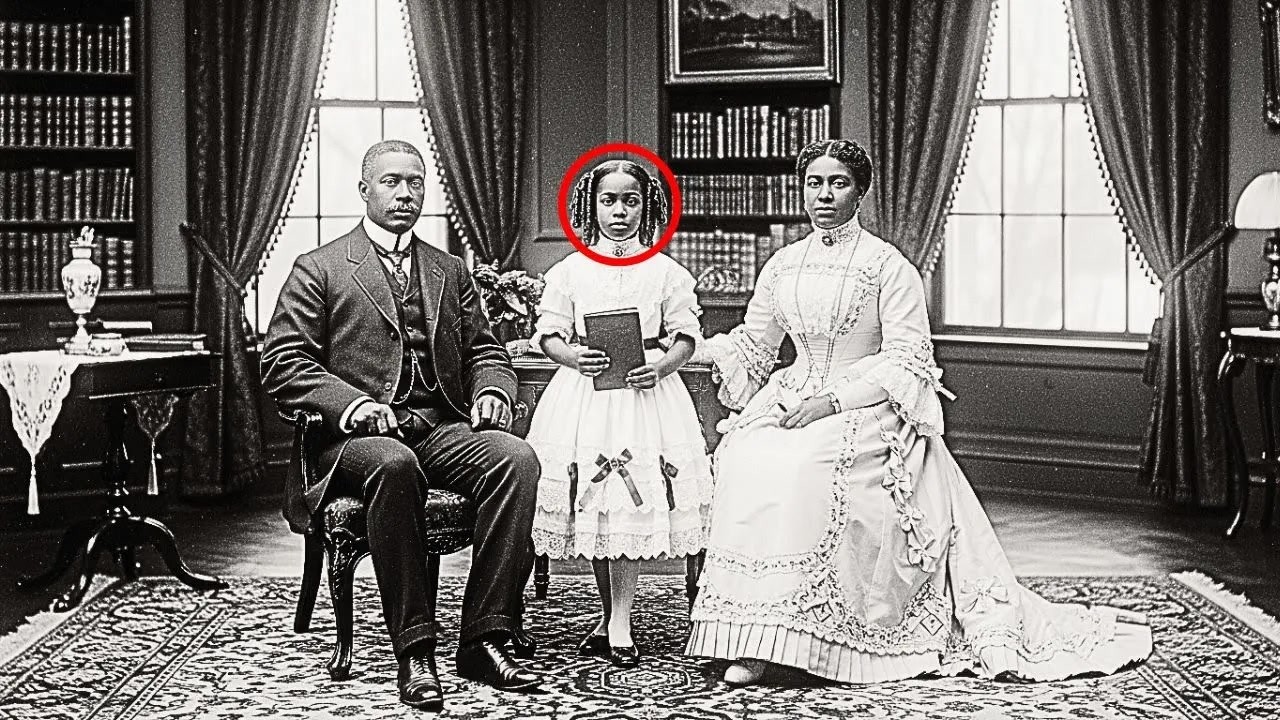
Most items had come from families clearing out attics and estate sales. Bits of history rescued from dumpsters and neglect. Vivien lifted the lid of a mahogany box lined with aged velvet. Inside lay a single photograph in an ornate gilt frame, remarkably well preserved.
The image showed three people posed in what looked like a prosperous parlor. Heavy curtains framed a window in the background, and a patterned rug covered polished wooden floors. The couple sat in upholstered chairs: the man in a fine dark suit with a watch chain visible across his vest, the woman in an elaborate dress with leg-of-mutton sleeves and intricate beading. Between them stood a girl of about ten wearing a white dress with layers of lace and ribbon.
Her hair was styled in careful ringlets, and she held a book in her small hands. The composition radiated pride and prosperity. This was not a casual snapshot but a formal portrait, the kind that cost significant money in 1895. Families commissioned such photographs to document their success, to prove their respectability, to create heirlooms.
Vivien turned the frame over carefully. A label on the back, written in flowing script, read: “The Bumont family, November 1895. Faraud, photography studio, Royal Street.” She recognized the studio name.
Armand Faraud had been one of New Orleans’ premier photographers in the late nineteenth century, known for his portraits of the city’s Creole elite. His clients included some of the wealthiest free people of color in the South. Vivien returned the photograph to proper lighting and examined it more closely with her magnifying glass. The details were exquisite.
She could see the grain of the wooden furniture, the texture of the fabrics, even the titles on the spines of books visible on a shelf behind the family. Then her eye caught something at the girl’s neckline: a shadow, or perhaps a mark, just visible above the lace collar. She adjusted her magnifying glass and leaned closer. What she saw made her hand freeze mid-movement, her breath catching in her throat.
Vivien set up the photograph under her high-resolution scanner, her hands moving with practiced precision despite the tremor of anticipation running through them. The device, acquired by the archives just six months earlier, could capture details far beyond what the human eye could perceive, revealing the hidden stories embedded in old images. She initiated the scan at maximum resolution, 4,800 dpi, and watched as the machine’s light bar moved slowly across the photograph’s surface. The process took nearly ten minutes.
When it completed, Vivien imported the massive file into her image analysis software. On her computer screen, the Bumont family appeared in stunning clarity. She zoomed in on the girl’s face and neck area, her heart beating faster as the image expanded. The white dress’s lace collar sat high on the child’s throat, covering most of her neck.
But where the fabric parted slightly, skin was visible, and on that skin were marks. Vivien enhanced the contrast and adjusted the lighting filters. The marks became clearer. Not shadows, not artifacts of the photographic process, but deliberate scarring: linear patterns, raised tissue forming specific shapes.
She could make out what appeared to be letters or numbers, though partially obscured by the collar and the angle of the photograph. Her stomach tightened. She had seen similar marks before in her research on slavery in the antebellum South. Enslaved people had sometimes been branded or scarred with their enslavers’ initials or identification numbers.
The practice had been brutal and dehumanizing, treating human beings as property to be marked like livestock. But this photograph was taken in 1895, thirty years after the Thirteenth Amendment abolished slavery. The girl in this portrait would have been born around 1885, two decades into freedom. No child born in that era should carry slave marks.
Vivien zoomed in further, examining every visible inch of the scarring. She could definitely make out the letter M and what might be the number seven or the letter J. The marks were old. The scar tissue appeared well healed, suggesting they had been made years before the photograph.
She sat back and stared at the full image again. The Bumonts looked prosperous, educated, respectable. The setting suggested wealth and social standing. Everything about the photograph proclaimed freedom, dignity, and success—except for those scars hidden just beneath a little girl’s collar.
Vivien opened her notes application and began typing: “Bumont family 1895. Possible slave markings on child born post-emancipation. Inconsistent with timeline. Need to investigate family history, child’s origin, legal records, adoption documents.
” She pulled up the Louisiana vital records database and began searching for birth certificates and family records. The name Bumont was common in New Orleans’ Creole community, but she needed specifics: first names, addresses, anything that could lead her to understand who this family was and where that little girl had come from. The Louisiana State Archives occupied a modern building in Baton Rouge, about eighty miles from New Orleans. Vivien made the drive on a Thursday morning, her car loaded with copies of the photograph and pages of preliminary research.
The vital records she needed—birth certificates, marriage licenses, death certificates from the 1890s—were stored here, many still not digitized. The research room was quiet, populated by a handful of genealogists and a graduate student working on a dissertation. Vivien requested all records related to anyone named Bumont in Orleans Parish between 1880 and 1900. An hour later, a clerk wheeled out three boxes of documents.
Vivien started with birth records. She found several Bumont children born in the 1880s, but matching them to the family in the photograph required cross-referencing addresses, parents’ names, and other identifying information. Most birth certificates from that era were sparse—just names, dates, and sometimes a parent’s occupation. Then she found something promising: “Bumont, Marie Claire, born November 3rd, 1885, to parents Etienne Bumont and Josephine Bumont, nee Navo, residence 427 Esplanade Avenue.
“
Vivien pulled out her copy of the photograph. The girl appeared to be about ten years old in 1895, which would make her birth year approximately 1885. The timing matched. She searched for more records on Etienne and Josephine Bumont.
Etienne appeared in the 1890 city directory as a merchant and property owner with a business address on Canal Street. Josephine’s name appeared in society notices in the New Orleans Daily Picayune: fundraising events for schools, church activities, charitable organizations. This was definitely a prominent family. But where had Marie Claire gotten those scars?
Vivien next asked for the adoption files. Louisiana had kept formal adoption records since the 1870s, though in the Creole community many such arrangements were settled quietly inside extended families, leaving the official paperwork patchy. Even so, she came across a document dated March 1891 that set her pulse racing: “Petition for adoption. Etienne and Josephine Bumont seeking to legally adopt Marie Claire, approximate age 6 years.
Presently in their care. Child’s origins unclear. Petition granted. April 1891.
”
The child’s origins were unclear. In 1891, at the age of six, Marie Claire had been formally adopted, even though an 1885 birth certificate already listed her as the couple’s own daughter. The pieces refused to fit together. Vivien photographed the page and kept looking.
She had to learn where Marie Claire had truly come from and how she had wound up with the Bumonts. In the property records she came across something else: a deed from January 1891 showing Etienne Bumont buying a small house in Plaquemine Parish, roughly seventy miles south of New Orleans. The price was recorded as $800, a hefty amount for what the property maps showed to be a modest building. Vivien jotted in her notes: “Adoption finalized April 1891.
Property purchased January 1891, 3 months earlier. Connection? Why would wealthy New Orleans merchant buy rural property in Plaquemine Parish? ”
She put in a request for every available Plaquemine Parish record from 1890–1891, aware that days would pass before they arrived.
In the meantime, another avenue opened up: the records of the Faraud photography studio, assuming any survived. Armand Faraud had run his studio on Royal Street from 1878 until his death in 1912. In the 1960s his granddaughter gave the business papers to the Historic New Orleans Collection: appointment books, client lists, financial ledgers, and, remarkably, a detailed log describing every photograph taken. Vivien passed an afternoon in the collection’s reading room, turning the pages of Faraud’s 1895 appointment book with great care.
The entries were meticulous, written in precise French: dates, times, clients’ names, type of portrait, and often short remarks about the sitting. She found the November 1895 entry: “Bumont family portrait. M. et Mme Etienne Bumont, daughter Marie Claire.
Full formal setting, three poses taken. Client requested highest quality, important family record. Payment: $25. ”
$25 was expensive, equivalent to perhaps $800 in modern currency.
The Bumonts had spared no expense. But it was Faraud’s personal notes, written in smaller script at the bottom of the entry, that made Vivien’s breath catch: “The child very still, well-behaved. Madame Bumont particular about the girl’s collar, adjusted it multiple times before allowing exposure. The child bears marks at the throat, visible despite careful positioning.
Did not inquire. Family’s private matter, but such marks on one so young trouble the conscience. ”
Faraud had seen the scars. He had noticed them being deliberately concealed, and he had been troubled enough to record his observation.
Vivien checked the studio’s financial records. In January 1891, the same month Etienne had purchased the Plaquemine property, there was an entry showing a payment to Faraud of $50 with the notation: “Special commission. Discretion required. No archive copies.
” $50—twice the cost of the formal family portrait. For what? What kind of photographic work required such discretion? Vivien’s mind raced with possibilities.
Had Faraud photographed Marie Claire when she first came to the Bumonts? Had he documented something that needed to be kept secret? The studio records indicated Faraud kept glass plate negatives of all his work, stored in chronological order. The collection’s curator had told Vivien that most plates from the 1890s survived, carefully preserved in acid-free storage.
She requested access to the January 1891 plates. Two hours later, she sat at a light table with a box of glass negatives, each one carefully sleeved and labeled. She worked through them chronologically. January 4th, 1891: a wedding portrait.
January 5th: a family with three children. January 9th: an elderly man in formal dress. Then, dated January 12th, 1891, a plate labeled only with a number: “Private commission 127. ” Vivien lifted the plate carefully and held it to the light.
The image was a portrait of a small child, perhaps five or six years old, standing against a plain backdrop. The child wore a simple dress, her hair uncombed and tangled, her expression haunted, eyes wide, face thin. And around her neck, clearly visible, were the scars: letters and numbers. M7J.
Vivien stared at the image, her hands trembling. This was Marie Claire before the Bumonts adopted her, before the fine dresses and careful hairstyling, before the lace collars that hid her scars. This was documentation of a rescued child. Vivien drove south on Highway 1, following the Mississippi River through Louisiana’s sugarcane country.
The landscape was flat and green, broken by occasional clusters of houses and the rusting remains of old plantation infrastructure. Plaquemine Parish was rural, its economy still tied to agriculture as it had been for centuries. The parish courthouse was a modest brick building in the town of Plaquemine. Vivien had called ahead, and the clerk, a woman named Dorothy who had worked there for thirty years, had pulled the records related to the property Etienne Bumont had purchased in 1891.
“It’s unusual,” Dorothy said, spreading documents across a table in the records room. “City folks didn’t typically buy property out here unless they had family connections or business interests. And this particular piece of land,” she pointed to a property map, “it wasn’t farmable. Just a small house and a few acres of scrub land.
”
Vivien examined the deed. The previous owner was listed as “estate of Jacques Mercier, deceased. ” A note indicated the property had been seized for unpaid taxes and sold at auction, with Etienne Bumont being the only bidder. “Do you have any records on Jacques Mercier?
” Vivien asked. Dorothy disappeared into the archives and returned with a slim folder. “Not much. He died in 1890.
No known heirs. The property went to the parish. But there’s this. ” She pulled out a sheriff’s report dated November 1890.
The report detailed a raid on Mercier’s property following complaints from neighbors. What the sheriff found shocked Vivien: “Upon investigation of the Mercier residence, discovered three negro children, ages approximately 4 to 8 years, being held in conditions of servitude. Children bore marks of branding and physical abuse. Mercier claimed children were apprenticed to him legally but could produce no documentation.
Children removed to parish custody. Mercier charged with unlawful detention and assault. ”
Three children. One of them must have been Marie Claire.
Vivien’s hands shook as she read further: “Children unable to provide information about their origins. Appear to have been taken at young ages with no memory of families. Scars indicate they may have been marked by previous captors. Investigation into broader trafficking operation recommended.
”
“What happened to Jacques Mercier? ” Vivien asked. Dorothy checked her notes. “Died in parish jail before trial.
Heart failure, according to the death certificate. The case was closed, and the children were placed in an orphanage in New Orleans. St. Mary’s Home for Colored Children.
”
Vivien felt the pieces fall into alignment. Marie Claire had been taken from Mercier’s house in late 1890, brought to an orphanage, and then adopted by the Bumonts in early 1891. Yet why had Etienne bought Mercier’s property? The answer surfaced in a legal document from February 1891: “Testimony of Etienne Bumont in the matter of children rescued from Jacques Mercier property.”
Mr. Bumont states that after learning of children held in Plaquemine Parish, he looked into the matter himself. He bought the Mercier property so that any evidence or documentation identifying the children or their origins would be secured. Among the items discovered in the house were ledgers showing that Mercier had belonged to a larger operation that kidnapped freeborn negro children and sold them into illegal servitude.
“
Etienne had purchased the property to uncover evidence. He had been working to solve the mystery of where these children came from. Once back in New Orleans, Vivien requested every available record from St. Mary’s Home for Colored Children.
The orphanage had shut down in 1924, and its records went to the Catholic Archdiocese. Hurricane Betsy had damaged most of them in 1965, but some ledgers and correspondence had endured. What she discovered was both heartbreaking and maddening in equal measure. The intake records from November 1890 listed three children brought from Plaquemine Parish:
“Child one: female, approximately 6 years, unable to state name, bears marking M7J on neck.
Child two: male, approximately 8 years, unable to state name, bears marking M4P on shoulder. Child three: female, approximately 4 years, unable to state name, bears marking M2K on back.”
The children had been so young when they were taken that they could not recall their own names or where they had come from. They had been reduced to numbers and letters branded into their skin.
Vivien came across correspondence from the orphanage director to various authorities, urgently attempting to identify the children and locate their families. One letter to the New Orleans Police Department, dated December 1890, spelled out the problem: “We believe these children were kidnapped from their families and held in servitude, part of a criminal enterprise that may involve numerous perpetrators across multiple parishes. The marks on their bodies suggest systematic identification, possibly indicating many more victims. We implore your department to investigate thoroughly.
“
The police reply was perfunctory: “Matter investigated. No evidence of broader conspiracy. Children likely orphaned by yellow fever or other epidemic, taken in by Mercier with good intentions. Unfortunate situation, but no crime proven.
“
No crime proven. Not despite the scars, not despite the conditions in which the children were found, not despite everything. But Etienne Bumont had refused to accept that conclusion. Vivien uncovered further evidence of his own investigation: letters he had sent to sheriffs throughout Louisiana asking about missing children, about similar cases, about anyone who might recognize the marking patterns.
One reply from a sheriff in St. James Parish, dated March 1891, offered a lead: “We had a similar case in 1888. Family reported their daughter taken from a church picnic. Girl, aged three, name of Clara.
Never found her. But the description of the markings you describe matches a child seen at a work camp upriver. The camp was raided, but most children there had been moved before we arrived. Only found two boys, both too traumatized to speak.
“
Vivien devoted the next week to tracking down every reference to missing children in Louisiana between 1885 and 1890. The pattern that took shape was chilling. Dozens of reports of children vanishing, mostly from poor rural families, mostly very young. The cases were seldom investigated thoroughly.
When children were discovered in situations of illegal servitude, they were sent to orphanages but almost never reunited with their families. The marking system pointed to organization. M7J probably meant something. Perhaps the M stood for the trafficker Mercier.
The number indicated sequence or location, and the letter indicated what? Age group, gender, destination. Vivien located a report from a federal investigator dated 1892, a full year after Marie Claire’s adoption, that laid out a network of kidnapping and re-enslavement operating across the South. The investigator estimated that hundreds of children had been taken and sold to farms, work camps, and private households as unpaid labor.
The report ended on a bitter note: “Despite clear evidence of systematic child trafficking, local authorities show little interest in prosecution. Many victims are from families too poor or powerless to demand justice. This investigation is hereby closed due to lack of cooperation from local officials.”
Vivien found Etienne Bumont’s personal papers in the archives of the Amistad Research Center at Tulane University.
The collection contained business correspondence, property records, and, importantly, a private journal he had kept from 1890 to 1895. She requested the journal and waited anxiously while it was brought out of climate-controlled storage. The leather-bound book was fragile, its pages yellowed but still readable. Etienne’s handwriting was elegant and precise, his entries detailed and often emotional.
The entry dated November 20th, 1890, brought tears to Vivien’s eyes: “Today I learned of the children found in Plaquemine. Three souls stolen from their families, marked like animals, used as slaves thirty years after emancipation supposedly ended such horrors. The police say there is nothing to be done. The man who held them is dead.
The children cannot remember their origins. They will go to an orphanage and likely never know who they truly are. I cannot accept this. Josephine and I have been blessed with wealth and position.
If we do not use these advantages to fight such injustice, what purpose does our prosperity serve? I have resolved to investigate personally. If these children have families searching for them, I will find those families.”
In the months that followed, Etienne recorded his investigation.
He visited the Mercier property and discovered ledgers hidden in a false floor: records of children taken, dates, locations, and buyers. He copied everything and handed the originals to federal authorities, though he noted bitterly that he had little faith in their willingness to act. The entry dated January 10th, 1891, described meeting Marie Claire for the first time at St. Mary’s orphanage: “The child they call number seven is small for her age, with large eyes that have seen too much suffering.
When I showed her the ledger entries, trying to find anything that might identify her origins, she touched the marking on her neck and said only, ‘Mama,’ and cried. It is the first personal memory she has shared with anyone at the orphanage. The marking reads M7J. According to Mercier’s ledgers, she was acquired in July 1887 near Thibodaux.
Age approximately 2 years. The J may indicate July. The seller was listed only as Dupont, likely an alias. I have written to authorities in Lafourche Parish asking about any reports of a missing child from that time.
“
Vivien flipped ahead through the journal. Etienne’s investigation consumed him. He traveled across southern Louisiana, interviewed dozens of families who had lost children, and spent enormous sums hiring private investigators. He found the families of the two other children rescued from Mercier’s house and facilitated emotional reunions.
Yet Marie Claire’s family stayed out of reach. Nobody in Thibodaux or the towns around it could place her description or the details of how she vanished. The trail went cold. The entry for March 15th, 1891, recorded a wrenching choice: “Four months of searching have passed, and I have found no trace of Marie Claire’s family.
Perhaps they perished in the yellow fever outbreak of 1888. Perhaps they moved elsewhere, or the records were simply lost. I cannot keep up this search forever. And all the while, the child sits in an orphanage, waiting.
Josephine and I have resolved to adopt her. She will have our name, our home, our love. When she is old enough to understand, we will tell her the truth of where she came from. And we will never give up hoping that one day, in some way, her first family might be found.
“
Vivien’s research veered in an unforeseen direction when an email arrived from a descendant of the Bumont family. Margaret Thibodeaux, a retired teacher in Lafayette, had come across a news story about Vivien’s work with the Louisiana Historical Archives and spotted her great-great-grandmother’s maiden name: Bumont. They arranged to meet at a café in the French Quarter. Margaret carried in a box of family papers that had sat in her attic for decades: letters, photographs, and documents handed down through the generations but never properly gone through.
“My grandmother always talked about family secrets,” Margaret said. “But she passed away before she could tell me what they were. Maybe these papers will shed some light.”
Vivien lifted the lid of the box with care.
Bundles of letters tied with ribbon lay inside, sorted by date. Most were ordinary family correspondence, but one bundle caught her eye: letters exchanged between Josephine Bumont and a woman named Sister Marie Thérèse, a nun who had served at St. Mary’s orphanage. The letters ran from 1895 to 1910, years after Marie Claire’s adoption.
Vivien worked through them, finding talk of orphanage fundraising, church functions, and social affairs. Then she came upon a letter from 1897 that set her heart pounding:
“Dear Josephine, I write with news that may bring both joy and sorrow. Yesterday a woman came to the orphanage asking after children who passed through our care in 1890. She has been searching for her daughter, taken from her in Thibodaux in 1887 when the child was only 2 years old.
At the time, the woman was herself enslaved, unlawfully held on a remote farm despite the war’s end. She escaped in 1889 but could not return for her daughter until she had settled in New Orleans and saved enough money to hire an investigator. She described a small mark her daughter bore, a birthmark shaped like a crescent moon on the child’s left shoulder blade. She also recalled that when the child was taken, the man who took her was called Dupont, though she believes the name was false.
Josephine, I believe this woman may be Marie Claire’s mother. I told her nothing definitive, but I gave her your address. I hope I have not overstepped, but a mother’s love deserves the chance to be reunited with her child.”
Vivien’s hands shook.
Marie Claire’s mother had found her. After ten years apart, after escaping illegal enslavement herself, after years of searching, she had tracked down her daughter. But what had followed? Had Josephine permitted the reunion?
Had Marie Claire, raised a Bumont for six years, remembered her birth mother? Vivien found the answer in the following letter, dated two weeks later and written in Josephine’s hand: “Dear Sister Marie Thérèse, I must tell you what happened when Claudine Thibodeaux came to our home. I confess I felt afraid at first—afraid we would lose Marie Claire, whom we love as dearly as if she had been born to us. But when Claudine saw Marie Claire, and Marie Claire saw her, something extraordinary took place.
The child, who had no conscious memory of her mother, ran to her at once. She said, ‘You’re the lady from my dreams.’ They held each other and wept, and I wept with them.”
Vivien read on through Josephine’s letter, tears running down her face: “Etienne and I faced an impossible decision.
In the eyes of the law, Marie Claire is our adopted daughter. We could have refused to let Claudine have any access to her. But how could we deny a mother who had suffered so much to find her child? How could we deny Marie Claire the chance to know her birth mother?
We asked Claudine to stay with us for several days so that she and Marie Claire could spend time together. The stories Claudine told were heartbreaking. She had been born free in Thibodaux in 1865, right after emancipation. Her parents died of fever when she was young, and at sixteen she was lured by a man offering work and instead imprisoned on a remote farm.
Made to labor without pay, she became pregnant—assaulted by the farm’s overseer—and gave birth to Marie Claire in 1885. For two years she cared for her daughter while plotting escape. But when Marie Claire was two, the child was taken from her and sold to a man Claudine knew only as Dupont. Claudine was warned that if she tried to escape or report what had happened, her daughter would be killed.
She finally escaped in 1889, when the farm’s owner died and his estate was sold off. She made her way to New Orleans with nothing, took work as a laundress, saved every penny, and in time hired an investigator. It took eight years to find her daughter. Marie Claire sat with her mother for hours, asking questions, holding her hand, studying her face as if memorizing every feature.
And then my daughter, our daughter, asked the question we had been dreading: ‘Do I have to leave, Papa and Mama Josephine?’ The room went silent. Claudine looked at me with tears in her eyes and said, ‘No, my darling, you don’t have to leave. You have been blessed with two mothers and two fathers who love you.
I only want to be part of your life if you’ll have me.’ And so we have reached an arrangement that defies convention but feels right in our hearts. Claudine has taken a room near our home. She visits Marie Claire every week.
Marie Claire calls her Mama Claudine and calls me Mama Josephine. The child now has two families, and we are all the richer for it.”
Margaret wiped her eyes. “I never knew any of this.
My grandmother spoke of Claudine as Aunt Claudine, a family friend. I had no idea she was Marie Claire’s birth mother.”
Vivien found further letters documenting this unusual arrangement. Claudine became part of the Bumont household’s extended family.
She taught Marie Claire traditional Creole songs, told her stories of their Thibodaux ancestors, and gave her the truth about where she came from. In a letter from 1899, Josephine wrote: “Marie Claire is now fourteen and understands the full story of her early years. She knows about the kidnapping, the trafficking, the illegal enslavement. She knows about the scars on her neck and what they represent.
We worried that learning the truth might damage her, yet instead it has ignited a fierce commitment to justice. She talks about becoming a lawyer or a teacher, about reaching out to other children who have been wronged. ”
Tucked inside the letters, Vivien discovered a photograph. It was a group portrait from 1900, showing the Bumont family assembled in their parlor.
Etienne and Josephine occupied chairs. Marie Claire stood between them, now a young woman of fifteen. And next to Josephine was another woman, older, her face marked by hardship but her eyes shining with joy. Claudine Thibodeaux, Marie Claire’s first mother, at last reunited with her daughter.
Three months after finding the Bumont family photograph, Vivien stood before a crowded auditorium at Tulane University, getting ready to share her research. The event had attracted historians, genealogists, descendants of Louisiana’s Creole families, and activists engaged with issues of child trafficking and exploitation. Behind her on the screen hung the original 1895 photograph: the Bumonts in their elegant parlor, Marie Claire in her lace-collared dress. But now, thanks to digital enhancement, a second image had appeared alongside it: a close-up of Marie Claire’s neck, the scars visible, the letters M7J legible enough to read.
“This photograph,” Vivien began, “is about concealment and revelation. The Bumonts carefully posed their daughter to hide her scars—evidence of a traumatic past they wanted to protect her from. But they also preserved evidence of that past, perhaps knowing that someday the truth would need to be told. ”
She clicked to the next slide: the 1891 photograph of Marie Claire before her adoption, thin and haunted, her scars fully visible.
“Between these two images lies a story of extraordinary courage from multiple people. Jacques Mercier, who kidnapped and held children in illegal servitude. Etienne and Josephine Bumont, who used their privilege to investigate his crimes and rescue the children. Claudine Thibodeaux, who survived enslavement herself and never stopped searching for her stolen daughter.
And Marie Claire, who endured trauma that would have broken many people but instead built a life of purpose and advocacy. ”
Vivien displayed documents from her research: Etienne’s journal entries, the ledgers from Mercier’s house, the letters between Josephine and Sister Marie Thérèse, the photograph of the two families united. “What makes this story particularly important,” she continued, “is that it reveals a largely undocumented aspect of post–Civil War history. We know that slavery legally ended in 1865, but illegal enslavement continued for decades, particularly in the South.
Children were especially vulnerable—kidnapped from poor families, marked like property, sold into servitude on remote farms where authorities rarely ventured. The Bumonts’ investigation uncovered a network that operated across Louisiana, involving dozens of perpetrators and potentially hundreds of victims. Most of these children were never reunited with their families. Their stories died with them.
But Marie Claire’s story survived because people cared enough to document it, to preserve evidence, and to fight for justice even when authorities wouldn’t. ”
She showed a final image: a newspaper article from 1915. The headline read: “Attorney Marie Claire Bumont Thibodeaux wins landmark case for child labor protections. ”
“Marie Claire grew up to become one of Louisiana’s first black female lawyers,” Vivien explained.
“She specialized in cases involving child exploitation and illegal labor practices. She successfully prosecuted several child trafficking operations and helped reunite over thirty children with their families. The scars she bore became her motivation to ensure other children wouldn’t suffer as she had. ”
Margaret Thibodeaux stood from the front row.
“I’d like to add something, if I may. ” She joined Vivien at the podium. “Marie Claire was my great-grandmother. She passed away in 1963 at the age of seventy-eight.
I knew her when I was young, though she never spoke to me about her early years. But she left behind journals and letters that my family is now prepared to donate to the Louisiana Historical Archives. In those documents, she wrote extensively about her two mothers, about the Bumont family’s efforts to find trafficked children, and about Claudine’s determination to never give up searching. There’s one passage I want to share.
”
Margaret unfolded a paper and read: “I have two mothers, and I am blessed by both. Mama Claudine gave me life and never stopped fighting to find me. Mama Josephine gave me safety and opportunity and never stopped fighting to reunite me with my first family. Together, they taught me that love is not diminished by being shared.
It multiplies. And they taught me that privilege means nothing if it’s not used to help those who suffer. ”
The audience sat in silence for a moment, then erupted in applause. After the presentation, Vivien was approached by several people with similar stories: families who suspected their ancestors had been victims of post-emancipation trafficking, descendants seeking to understand mysterious scars in old photographs, researchers working on related topics.
But the most meaningful encounter came from an elderly woman who waited until everyone else had left. She introduced herself as Clara Dupuis and handed Vivien a photograph in a worn envelope. “This is my grandmother,” she said, pointing to a young girl in the photo, maybe six or seven years old. “She was found at a work camp in St.
James Parish in 1888. She had marks on her shoulder. M4P. She never found her original family.
But maybe, with your help, we could try. ”
Vivien looked at the photograph, then at Clara’s hopeful face. M4P matched the marking on one of the other children rescued from Mercier’s house—one of the two children whose families Etienne Bumont had successfully found. “I think we can,” Vivien said.
“In fact, I think we might already have a lead. ”
She thought of Marie Claire standing between her two mothers in that 1900 photograph, whole and healed despite the scars she carried. The photograph in Vivien’s office, the one that had started this entire investigation, was no longer just an image of concealment. It was a testament to resilience, to the power of investigative persistence, and to the revolutionary idea that families could be built on love rather than blood alone.
The scars hidden beneath Marie Claire’s lace collar had told a story that waited 129 years to be fully heard. And now, finally, people were listening.
