The old man at the next table had seen it all before. He watched the two young Americans stare down at the plate that had just been set in front of them, and there was open amusement in his eyes. On the plate sat a small round cheese, pale and translucent, dense as firm jelly, radiating a smell that was almost aggressive. It had been marinated in vinegar and oil and buried under a mountain of chopped raw onions.
A waiter in an apron had plunked it down without ceremony. One of the soldiers looked at his buddy. His buddy looked back at him. Somewhere in the old apple-wine tavern of Sachsenhausen, someone laughed.
The GI picked up his fork, took a bite, and the whole tavern seemed to wait. Sharp, tangy, salty, bright with vinegar and onion. He took another bite. The old man nodded once.
Another American had passed the test. It was a scene that played out for decades across West Germany, where millions of American servicemen lived among a people they had once fought, and where the table became the place where two old enemies slowly learned to sit together. For most of the Cold War, the American soldier in Germany was, in local terms, rich. From 1949 until 1961, the exchange rate was locked at four marks and twenty pfennigs to the dollar.
A private earning under a hundred dollars a month could walk into a village guesthouse and eat like a king. A full dinner of schnitzel, potatoes, salad, and a half-liter of beer might run five or six marks, barely more than a dollar. Men who could not afford a steak at home were eating three-course meals every weekend. This was not a small group.
At the peak, around a quarter of a million American troops were stationed in West Germany at any one time, spread across hundreds of posts from Bremerhaven to the Alps. Every one of those posts sat next to a village, and every village had a guesthouse with a wooden sign, a regulars’ table in the corner, and a landlady who had learned the word hamburger in English. In 1958, a private stationed near Frankfurt could buy a hot bratwurst, a crusty roll, and a cold beer for about half a dollar. Men like him wrote home that they never wanted to leave.
But there was something they could not explain in letters, something that only made sense when you had walked down a cobblestone street still wet from night rain and pushed open the door of a little bakery. Every GI who ever lived off post remembered that first Saturday morning. The smell hit you like a wall. Warm yeast, toasted crust, something sweet baking in the back.
On wooden shelves behind the counter sat rows and rows of Brötchen, small hard rolls with a crackling golden shell and an inside so airy it almost melted. Back home, bread came sliced in a plastic bag and squished if you looked at it wrong. This was different. You bit into a Brötchen and the crust shattered across your shirt.
In the early 1960s, a single roll cost about five pfennigs. At four marks to the dollar, you could buy twenty of them for a quarter. German families sent a child to the bakery every morning before breakfast, and the rolls were eaten within hours because they did not keep. That was the whole point.
They were baked that morning, for that morning. The GIs learned to split them with their thumbs, spread on real butter and apricot jam, or stack them with slices of cheese and ham. Soldiers coming off a night shift would find breakfast waiting for them like a gift. Men who served in the 1970s still described it the same way.
You never really understood what bread was supposed to be until you ate a Brötchen at seven on a Saturday morning in a German village. Then you came home, walked into an American grocery store, picked up a bag of hamburger buns, and something in you just quietly grieved. Americans thought they had invented the French fry, or at least perfected it. Then they walked up to a German Imbiss stand and ordered Pommes.
The fries came out in a paper cone or a little cardboard tray, thick-cut, crisp on the outside, fluffy in the middle. So far, so good. Then the woman behind the counter asked a question the GI did not understand. Rotweiß?
Red-white? He nodded because nodding was easier than admitting he had no idea. She squeezed a line of ketchup down one side and a thick white ribbon of mayonnaise down the other. Mayonnaise on fries.
The first reaction was almost always horror. The second reaction, usually about four fries later, was surrender. The mayonnaise in Germany was not the thin, tangy stuff from a jar at home. It was richer, creamier, closer to an aioli without the garlic, and it clung to the hot potato in a way that made ketchup alone suddenly taste like half a meal.
Germans jokingly called the combination Pommes Schranke, railroad-crossing fries, because the red and white stripes looked like the barrier arm at a train crossing. A portion cost about one mark in the late 1960s. Soldiers stationed in Kaiserslautern, K-Town as everyone called it, ate them walking back from the Bahnhof at midnight. Men in Hanau and Fulda ate them standing at the Imbiss window in the rain, eating with a tiny two-pronged wooden fork that snapped if you stabbed too hard.
That little fork became a souvenir all by itself. Plenty of veterans came home and started putting mayonnaise on their fries at diners across Ohio and Texas. Waitresses stared. Their wives stared.
They did not care. They had been to the other side of the railroad crossing, and they were never coming back. Some foods confused every American who ever saw them written on a menu. Leberkäse meant liver cheese, so a young private from Alabama naturally assumed it was some kind of liver cheese and walked right past it.
Big mistake. In Bavaria, Leberkäse contains neither liver nor cheese. It is a smooth, finely ground loaf of pork and beef seasoned with marjoram and a little nutmeg, baked in a rectangular pan until the top forms a dark, crackling brown crust. The inside is pink and bouncy and tender, somewhere between a hot dog and a meatloaf, but better than both.
The butcher would cut a slab nearly half an inch thick straight off the warm loaf, fold it into a Semmel roll, and hand it over with a squeeze of sweet mustard. That was the Leberkäsesemmel, and it cost less than a mark in the 1960s. It became the unofficial lunch of every GI who pulled duty near Nuremberg, Bamberg, or the massive training area at Grafenwöhr. You could eat one in five bites standing next to your vehicle and be full until supper.
Legend says the recipe traces back to the 1770s, when Elector Carl Theodore moved his court from Mannheim to Munich and brought his personal butcher with him. Whether or not that story is true, the Bavarians have been eating it every day since. Soldiers learned to order it by weight, pointing at the loaf and holding up fingers. Some learned to ask for the Scherzl, the crusty end piece, which locals considered the best part.
When those soldiers came home, they looked for it everywhere. They found bologna. It was not the same. It was never the same.
Picture a December night in Nuremberg in 1965. The Christkindlesmarkt was lit up with hundreds of wooden stalls, snow on the roofs, a brass band somewhere, breath rising in clouds. From one corner of the market, a smell drifted across the square that stopped a young American sergeant in his tracks. Frying potatoes and onions in hot oil.
That was the Kartoffelpuffer stand. The women behind the counter grated raw potatoes and onions, mixed them with egg and a little flour, and dropped spoonfuls into a wide pan of sizzling oil, pressing them flat until the edges turned lacy and brown and impossibly crisp. Three of them came on a paper plate. And then came the part that made every American hesitate.
A big spoonful of cold applesauce right on top. Potato pancakes and applesauce. It sounded like a mistake. It tasted like the most natural combination in the world.
The hot, salty crunch of the potato against the cool sweetness of the apple created something that made men go back for a second plate and then a third. In the Rhineland, they called them Reibekuchen and served them with dark bread or even sugar-beet syrup. In other regions, a dollop of sour cream or smoked salmon went on top. But the market version with applesauce was the one GIs remember, eaten with gloves half off, standing shoulder to shoulder with German families who had been eating them the same way for generations.
A plate cost about two marks in the 1970s. Wives who joined their husbands overseas learned to make them at home in base housing, grating potatoes by hand on a box grater, crying over the onions. Those recipes made it back to kitchens in Kentucky and Oregon, and some families still make them every Christmas Eve without remembering exactly why. If you were stationed in Stuttgart, and hundreds of thousands of Americans were over the decades at Patch Barracks, Kelley Barracks, and Robinson Barracks, then you were in Swabia.
And in Swabia, the local religion is Spätzle. These are soft, irregular egg noodles made from a thick batter of flour, eggs, salt, and water. The Swabian grandmother would scrape the batter off a wooden board directly into boiling water with a knife in quick, practiced strokes, or push it through a Spätzle press that looked like a giant garlic crusher. The little noodles would drop into the pot, float to the top within a minute, and get scooped out with a slotted spoon.
Then came the magic. Layer after layer of hot Spätzle went into a dish with handfuls of grated mountain cheese, Emmentaler or Bergkäse, until the cheese melted into long, stretchy strings, and on top a heap of onions fried slowly in butter until they turned dark, sweet, and crispy. That was Käsespätzle. Americans took one bite and said the same thing almost every time.
This is mac and cheese, but grown-up. It was richer, nuttier, sharper, and the fried onions gave it a texture no box of Kraft could ever match. A plate at a village guesthouse cost about six marks in the 1970s, usually served with a small green salad dressed in vinegar that cut through all that cheese. Soldiers who pulled winter field exercises came back half-frozen and ordered Käsespätzle before they even took off their jackets.
Some of them brought Spätzle presses home in their household-goods shipment. Decades later, those same presses sit in kitchen drawers in Colorado and Georgia. And once a year, usually when the first snow falls, somebody pulls one out. Before pumpkin spice existed, Nuremberg had Lebkuchen.
These soft, dense spiced cookies have been baked in that city since at least the 1300s, when Nuremberg sat at the crossroads of the great European trade routes and spice merchants brought cinnamon, cloves, nutmeg, cardamom, and ginger from the other side of the world. Monks started baking them. Then the city’s bakers took over and turned it into an art. The finest kind, Elisen, contains little or no flour at all.
Instead, the dough is made from ground almonds and hazelnuts, honey, candied orange and lemon peel, and that deep blend of spices, spread onto a thin wafer called an Oblate and baked until soft. Some were glazed with sugar. Others were dipped in dark chocolate. GIs stationed at Merrell Barracks and the other Nuremberg posts encountered Lebkuchen every December, when the city turned into a Christmas card.
The cookies came in decorated tin boxes shaped like little houses, treasure chests, and old-fashioned carriages. Soldiers bought those tins and mailed them home to their mothers in the 1950s, and those tins became family heirlooms. Some are still sitting in attics in Iowa with buttons and sewing thread inside. There were also big heart-shaped Lebkuchen hanging on ribbons at every fair, iced with messages like Liebe, I love you.
More than one American soldier bought one of those hearts for a German girl at a Volksfest without knowing exactly what the icing said. More than a few of those girls became American wives. The cookies themselves smelled like Christmas before you even opened the tin. And for a nineteen-year-old kid spending his first Christmas four thousand miles from home, that smell was the closest thing to a hug he was going to get.
Then there was the one that separated the tourists from the true converts. A GI walked into a German butcher shop or sat down at a breakfast buffet, and there on the table sat a bowl of what looked like raw ground pork. Because it was raw ground pork, seasoned with salt and black pepper, sometimes a little garlic or caraway, and spread thick on a split Brötchen, then topped with raw, chopped onion. That was the Mettbrötchen, and Germans ate it for breakfast, for lunch, and as a snack at parties.
Every American who grew up hearing that undercooked pork would kill you stared at it in genuine fear. But German food-safety law treated this meat completely differently. Mett had to be ground fresh on the same day it was sold, under strict rules for hygiene and temperature, from high-quality cuts. It was a product built on trust, and Germans had been eating it safely for generations.
The brave ones tried it, and the brave ones mostly loved it. It was cool, rich, peppery, and surprisingly mild, with that sharp bite of onion cutting straight through. In the 1970s, German hostesses made the famous Mettigel for parties, a big mound of raw pork shaped like a hedgehog with onion slices stuck into it for spines and two peppercorns for eyes. An American officer invited to a German neighbor’s birthday party would walk in and find a raw-meat hedgehog staring at him from the buffet table.
That was a real test of international friendship. The men who passed it earned instant respect from their German hosts. The men who faked a stomachache went home hungry. Either way, nobody ever forgot the hedgehog.
And then, in the 1970s, everything changed. The dollar collapsed against the mark. By the end of that decade, a dollar bought less than two marks. Suddenly, the rich American was not rich anymore.
The weekend feasts turned into a single bratwurst. Young soldiers stayed on post, eating at the mess hall and the Burger King on base. And the German villagers noticed. The friendship that had been built across a thousand wooden tables got quieter.
Those who were there in the 1950s and 1960s remember a very different Germany than those who arrived in 1979. Same food, very different price tag. And yet even the broke GIs kept finding their way back to the Imbiss window, because some foods were worth it at any exchange rate. Anyone stationed around Frankfurt, and a great many Americans were, especially with V Corps headquartered in the massive IG Farben building for decades, eventually ended up in the old apple-wine taverns of Sachsenhausen.
Long wooden tables, blue-gray stoneware jugs, glasses of sour apple wine that locals called Ebbelwoi, and a waiter in an apron who would plunk down a plate in front of you with something that looked frankly alarming. Handkäse is a small round sour-milk cheese, pale and translucent, with a texture somewhere between firm jelly and rubber. It smells strong. It smells very strong.
In Hesse, they marinate it in vinegar, oil, and a mountain of chopped raw onions, sometimes with caraway seeds, and serve it with dark bread and butter. That onion marinade is the Musik. Ask a local what the Musik refers to, and he will grin and tell you that you will hear it later that night. Many GIs hated it.
But a surprising number became lifelong devotees, eating it every Friday at the same tavern with the same regulars, who eventually stopped laughing and started saving them a seat. A plate cost about three marks in the 1970s. You could not get it anywhere back home. You still mostly cannot.
And the veterans who loved it mention it the way men mention an old girlfriend. Fondly, carefully, and with a certain look on their faces. In Bavaria, soldiers learned a rule that made no sense to them at first. You do not eat Weißwurst after noon.
The saying goes that the sausage must never hear the church bells ring twelve. Weißwurst is a pale, delicate sausage of finely minced veal and pork back fat, flavored with parsley, lemon zest, onion, mace, and cardamom. Before refrigeration, it was made fresh in the morning and spoiled fast, so it had to be eaten early. The tradition simply outlived the reason.
Munich tells a famous story about how it was invented. On a morning in February 1857, during carnival season, a butcher named Sepp Moser at a tavern on the Marienplatz ran out of the sheep casings he needed for his usual sausages. He stuffed the meat into wider pork casings instead. And rather than frying them and risking them bursting, he gently heated them in hot water.
The white sausage was born. GIs learned to eat them in a very specific way. They came to the table in a small tin of steaming water, two to a person. You were supposed to either slice them lengthwise and peel the skin away, or do what the true Bavarians did, which was zuzeln.
You pick the sausage up, bite the end, and suck the meat right out of the casing. Americans were not sure if they were being pranked. They were not. Alongside came a warm, soft pretzel, a mug of wheat beer, and the most important piece of all, the sweet mustard.
Dark, grainy, and sugary. It was nothing like the yellow ballpark stuff. Soldiers stationed in Munich, Augsburg, and Garmisch bought jars of it by the case at the local supermarket and shipped it home. It was the taste of a Bavarian Saturday morning, and it had to be done before the bells rang.
In 1974, the Italian chocolate company Ferrero introduced the Kinder Überraschung, the Kinder Surprise Egg, and it swept across Europe. A hollow egg of milk chocolate with a creamy white lining, wrapped in colorful foil. And inside the chocolate, a little yellow plastic capsule holding a tiny toy you had to assemble yourself. A miniature car, a plastic hippo, a puzzle piece that joined with others.
German children went wild for them. So did American children living in base housing. So did their parents. Soldiers bought them by the dozen at the supermarket for their kids and their kids’ friends.
Collecting the little figures became a craze. Then those families got orders to go home. And at the airport, a lot of them discovered something that shocked them. The Kinder Surprise was illegal in the United States.
Not because of the chocolate, but because of a law dating back to 1938, the Federal Food, Drug, and Cosmetic Act, which bans food products that contain non-nutritive objects embedded inside them. A toy capsule hidden inside chocolate fell squarely into that category. US Customs agents seized them at the border, and travelers reported warnings and fines for trying to bring them in. Imagine an army family flying home after three years in Germany, suitcases stuffed with chocolate eggs as gifts for the grandkids, getting pulled aside at customs like smugglers.
It happened more than anyone would believe. To this day, the original Kinder Surprise remains off American shelves. A different version with the toy in a separate compartment eventually arrived. But for millions of military kids who grew up in Germany, the real one, the forbidden one, remains the taste of childhood abroad.
They are the only Americans who know exactly what they are missing. In 1969, in Mannheim, a young Italian ice-cream maker named Dario Fontanella was working in his family’s ice-cream parlor. Italian ice-cream makers had flooded into West Germany in those years, and every town had an Eiscafé with bright chairs outside. Dario wanted to create something new.
So he took vanilla ice cream, pushed it through a chilled Spätzle press, the same tool Germans use to make noodles, and it came out in long strands that looked exactly like spaghetti. He piled the strands onto a bed of whipped cream, poured strawberry sauce over the top for tomato sauce, and sprinkled grated white chocolate on it for Parmesan cheese. Spaghetti-Eis. Spaghetti ice cream.
Children reportedly cried the first time they saw it because they thought they were getting pasta instead of dessert. Then they tasted it. Within a few years, it had spread to nearly every ice-cream parlor in Germany. And Mannheim, where it was born, happened to be home to Coleman Barracks, Benjamin Franklin Village, and thousands upon thousands of American soldiers and families.
Military kids ate Spaghetti-Eis on hot summer afternoons sitting outside the Eiscafé with their mothers. Teenagers ordered it on first dates. Soldiers ordered it just to see what it was, and then ordered it again, because the cold, creamy strands with that sweet strawberry sauce were simply delightful. A bowl cost a few marks.
Back in the States, nobody had ever heard of it. Families who tried to describe it to relatives were met with blank stares. Ice-cream noodles. Yes, ice-cream noodles.
Sunday dinner in a German home was an institution. And when American soldiers were invited to join a German family, which happened more often than most people realize, Rouladen was often what came out of the kitchen. Thin slices of beef pounded even thinner were spread with sharp German mustard, then layered with bacon, finely chopped onion, and a sliver of dill pickle. Each slice was rolled tight and tied with kitchen string or pinned with a toothpick, then seared in a heavy pot until brown all over.
Then came the long braise. Red wine or broth, more onions, a bay leaf, and two or more hours of slow simmering with the lid on. The kitchen filled with the smell of beef and onion and something tangy underneath. By the time they were done, the rolls were fork-tender, and the braising liquid had become a rich, dark gravy.
They came to the table with red cabbage cooked with apples and a pair of potato dumplings the size of tennis balls, or boiled potatoes to soak up every drop of gravy. For a young American who had been eating mess-hall food for months, a German Sunday dinner was overwhelming in the best way. The hostess kept filling his plate. The grandfather kept filling his glass.
Nobody spoke much English. Nobody needed to. And when he cut into that first Rouladen and found the pickle and the bacon and the mustard all spiraled together inside, it was like opening a present. American wives who got friendly with German neighbors learned to make Rouladen in base-housing kitchens.
They wrote the recipe on index cards and carried them home. There are grandchildren in North Carolina today who have eaten Rouladen every Christmas of their lives without ever knowing it came from a German kitchen near Würzburg in 1971. Here is what nobody talks about. The food did not come home in suitcases.
It came home in marriages. Tens of thousands of American servicemen married German women during the decades of occupation and the Cold War. In the years right after the war, it was complicated and sometimes forbidden. The army’s rules against fraternization were strict at first, but they eased, and the weddings came in waves.
These German brides crossed the Atlantic and ended up in places they had never heard of. Fayetteville, Junction City, Kansas, Lawton, Oklahoma. They arrived in American supermarkets in the 1950s and 1960s and looked at the shelves in total disbelief. Where was the real bread?
Where was the proper mustard? Why did the cheese come in individually wrapped plastic slices? So they did what German women had always done. They cooked the old way.
They made Sauerbraten in Texas heat. They baked Stollen in Georgia kitchens. They found the one butcher in town willing to make real bratwurst. And they taught their children to say guten Appetit before meals.
That is how a lot of German food quietly entered American life. Not through restaurants, not through advertising, but through mothers and grandmothers who refused to forget. If you grew up near a military town, there was a good chance a German woman down the street introduced you to something you still love. And if your own grandmother had an accent and a Spätzle press, now you know how she got here.
There is a test for proper strudel dough that German and Austrian grandmothers still repeat. You should be able to read a newspaper through it. The dough, made of flour, water, a little oil, and a pinch of salt, is kneaded until smooth, rested under a warm bowl, then stretched by hand across a floured tablecloth. Slowly, gently, using the backs of the knuckles, working around the table, pulling it thinner and thinner until it covers the whole surface and becomes almost transparent.
Then comes the filling. Tart apples sliced thin, raisins soaked in rum, cinnamon, sugar, and breadcrumbs toasted in butter to soak up the juices. The whole sheet is rolled up using the tablecloth itself, brushed with melted butter, and baked until crisp and golden. When it comes out of the oven, it flakes and shatters, and the apples inside are soft and fragrant.
In southern Germany, it was served warm with a pool of vanilla sauce poured around it like custard, or with a scoop of vanilla ice cream melting over the top. Soldiers stationed near Berchtesgaden, where the army ran a famous recreation area for decades, ate strudel after skiing in the Alps. Soldiers on leave in Garmisch ordered it at mountain huts at the end of long hikes. It was the dessert that made Americans stop talking.
Something about the combination of the warm apple, the cold ice cream, and that paper-thin pastry felt almost too elegant for a guy from Detroit. A slice at a mountain guesthouse cost around three marks in the 1970s, and most of the men who ate it realized, maybe for the first time, that apple pie was not the only way to do apples. Then there was the one that made grown men laugh out loud when it arrived at the table. A whole roasted pork knuckle.
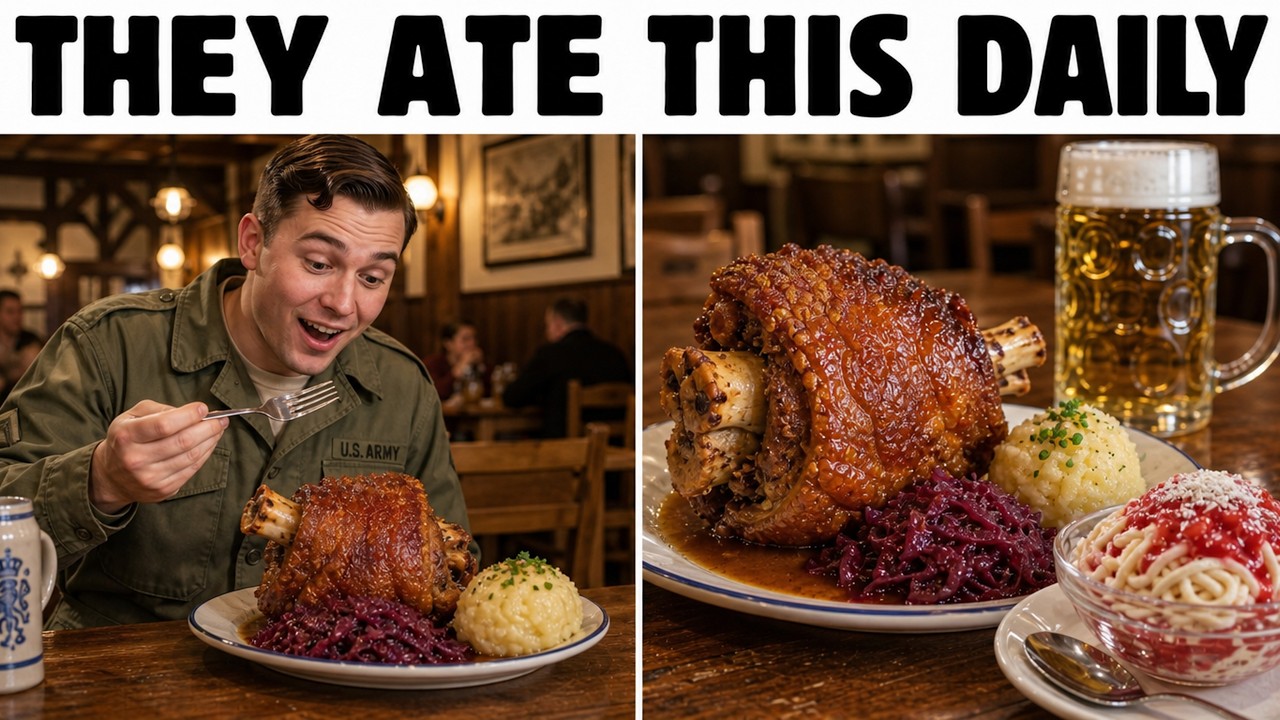
The lower part of the pig’s leg, about the size of a football, standing on the plate with a steak knife jammed straight down into the top of it like a flag planted on a mountain. That was Schweinshaxe, the Bavarian feast of feasts. The knuckle was roasted slowly for hours, basted with dark beer, until the meat underneath turned soft and juicy and the skin on the outside puffed up and crackled into a golden, glass-hard shell. That skin was the prize.
You broke into it with the back of your knife and it shattered like candy. Underneath, the meat fell right off the bone. It came with a heavy potato dumpling, sauerkraut or red cabbage, and a dark gravy made from the drippings. American soldiers ordered it at the Hofbräuhaus in Munich, at beer gardens under chestnut trees, at the Oktoberfest tents where brass bands played American songs just for them.
It cost about ten marks in the late 1970s, which was not cheap, but you did not need to eat again for a full day. Men made bets on who could finish one. Most failed. In northern Germany, they did it differently, boiling the knuckle and calling it Eisbein, served with pea purée and sauerkraut.
Americans stationed in Bremerhaven and Berlin ate that version. But the Bavarian roasted Haxe was the one that got photographed and mailed home. That picture of a young soldier with a giant liter of beer in one hand and a pork knuckle the size of his head in front of him probably sits in a thousand family photo albums across America. One of the foods American GIs loved most in Germany was not German at all.
It was Greek. Starting in 1960, West Germany signed a labor agreement with Greece, and thousands of Greek workers arrived to help rebuild the booming German economy. Many of them stayed. Many of them opened restaurants.
By the 1970s, it seemed like every German town had a Greek taverna with blue-and-white decor, plaster columns, and a name like Acropolis, Olympia, or Delphi. And the Americans found them fast. The Greek restaurant in Germany became a kind of home base for soldiers. The portions were enormous, the prices were fair, and the house specialty was the gyros plate.
Thin slices of seasoned pork shaved off a rotating spit, piled high on a plate next to a mountain of fries, a salad, and a big white scoop of tzatziki, the thick yogurt sauce loaded with cucumber and garlic. Enough garlic that your roommate knew exactly where you had been. And then came the ritual that made Americans fall in love for good. At the end of the meal, the owner came over with a tray of small glasses and gave everyone a free shot of ouzo on the house.
Every single time. Sometimes one at the beginning, too. For a young soldier far from home, that small gesture meant everything. It said, you are welcome here.
GIs went to the same Greek restaurant every Friday for three years. The owner learned their names, asked about their families, remembered their orders. A gyros plate cost around ten marks in the 1980s and could feed you for the day. Veterans who come home and search for that exact taste almost never find it.
American gyros are made differently, usually with lamb and beef. The German-Greek version was its own thing. Born in exile, and it belonged to the people who ate it there. Americans had heard of sauerkraut.
They thought they knew it. The pale, soggy stuff from a can at the ballpark. Then they ate it in Germany and realized they had never actually tasted the real thing. German sauerkraut was cooked slowly with onion, a little bacon fat, juniper berries, a bay leaf, and sometimes grated apple or a splash of white wine, until it turned mellow, tangy, and almost sweet.
And it was nearly always served with Kassler. Kassler is a cured and lightly smoked pork loin or chop, pink throughout, like ham, but juicier and more delicate. Berlin legend credits it to a butcher named Kassel back in the 1880s. Though historians have never been able to prove he existed, it hardly matters.
What matters is that a thick slice of Kassler warmed in the sauerkraut, so the two flavors soaked into each other, served with boiled potatoes and grainy mustard, was one of the most comforting plates in the whole German kitchen. It was the kind of food a German mother made on a cold Tuesday in November. Here is a strange piece of history. During World War I, sauerkraut became so unpopular in America because of its German roots that some people tried to rename it Liberty Cabbage.
Half a century later, the sons and grandsons of those same Americans were stationed in Germany, sitting in cozy village kitchens, eating it by the forkful and asking for seconds. The irony was not lost on the older Germans. And the cabbage did not care what anybody called it. It just kept being delicious.
The first time an American GI saw Stollen, it looked like a loaf of bread that had been buried in snow. A heavy oval loaf dusted thick with powdered sugar, with a ridge down the middle that is said to represent the Christ child wrapped in swaddling cloth. It came from Dresden, where it has been baked for centuries, and the history behind it is remarkable. In the Middle Ages, during Advent, the Catholic Church considered it a fasting period and forbade the use of butter.
So early Stollen was made with only flour, yeast, water, and oil. It was bland and dry. The bakers of Saxony were not happy. They petitioned the pope for permission to use butter.
After decades of back-and-forth, in 1490, Pope Innocent VIII issued what became known as the Butter Letter, allowing butter to be used, and Stollen was never bland again. The modern version is rich and dense, packed with raisins soaked in rum, candied orange and lemon peel, almonds, and often a thick rope of marzipan running right through the center. After baking, the loaf is brushed with melted butter while it is still hot, then coated in sugar. It gets better with age.
Germans bake it in late November and slice it slowly through December, each piece a little more flavorful than the last. GIs received Stollen as gifts from German co-workers, landlords, and families they befriended. They bought them in bakeries wrapped in cellophane and shipped them home at Christmas. And once you have had a real marzipan-filled Stollen, the American fruitcake, the one people joke about regifting, is revealed for what it is.
A pale imitation of a very old masterpiece. Every Sunday afternoon around three, all of Germany seemed to stop. Families sat down together. The good china came out.
A pot of strong coffee was brewed, and the cakes appeared. Kaffee und Kuchen. Coffee and cake. It was not dessert.
It was not a snack. It was a whole mealtime of its own. A tradition as sacred as Sunday dinner. And the star of many of those tables was Bienenstich, bee-sting cake.
A sweet yeast dough baked with a topping of sliced almonds caramelized in butter, sugar, and honey until it turned crunchy and golden like brittle. Then the cake was split in half horizontally and filled with a thick layer of vanilla custard cream. The top was crunchy and sticky. The middle was cool and silky.
The bottom was soft and bready. There is a legend about the name. In the 1400s, bakers from the Rhineland town of Andernach supposedly repelled raiders from a neighboring town by throwing beehives down at them from the walls. They celebrated by baking this cake.
It is almost certainly not true, but Germans love to tell it. American soldiers invited into German homes for Kaffee und Kuchen ate Bienenstich, Streuselkuchen with its buttery crumbs, and plum cake topped with whipped cream, while trying to make polite conversation in broken German. A slice at a Konditorei cost just a few marks. But the real value was in the hours spent at those tables, where two countries that had once been enemies sat down together over coffee and slowly, carefully, became something closer to family.
Schwarzwälder Kirschtorte. Even the name sounded like a fairy tale. And for American soldiers, it looked like one. Layers of dark chocolate sponge cake soaked in Kirschwasser, a clear, fiery cherry brandy distilled in the Black Forest region.
Between the layers, sour cherries and whipped cream. Around the outside, more whipped cream piped into swirls, covered with dark chocolate shavings, and crowned with bright red cherries on top. It was tall, dramatic, and impossibly rich. And that Kirschwasser was not a subtle hint.
In a proper German Black Forest cake, you could taste the alcohol in every bite. The origins are debated, but the most common claim credits a confectioner named Josef Keller, who said he created it in 1915 at a café in Bad Godesberg near Bonn. It became famous across Germany and eventually the world. Americans had seen versions of it back home in grocery-store bakery cases, usually made without any alcohol at all and topped with canned cherry pie filling.
The real thing was a completely different experience. Soldiers stationed in the southwest at posts around Karlsruhe, Heidelberg, and down toward the Black Forest itself drove through those dark pine valleys on weekends, past cuckoo-clock shops and wooden farmhouses, and stopped at cafés where the cake was made that morning. A slice cost about three marks in the 1970s. The men who tried it came home and could never order the American version without sighing.
What they were missing, of course, was the Kirsch. And maybe also the view. Why did everything taste better in Germany? Soldiers asked that question for decades.
And it was not just nostalgia. Part of the answer was law. Since 1516, Bavaria has followed the Reinheitsgebot, the famous beer-purity law, which originally allowed only water, barley, and hops. It later spread across Germany and became a symbol of a whole national attitude toward food.
Germans were fiercely protective of how their food was made. Butchers trained for years in formal apprenticeships. Bakers did the same. Bread was baked fresh daily in tiny neighborhood shops rather than shipped across the country in plastic.
Germans are so proud of their bread culture that in 2014 it was added to Germany’s national inventory of intangible cultural heritage under the UNESCO program. Meanwhile, back in America, the food system of the 1950s, ’60s, and ’70s was racing in the other direction. Preservatives. Shelf-stable, convenience food designed to travel a thousand miles and sit in a warehouse for weeks.
Many of those American soldiers had never eaten bread made the same day. They had never had sausage from a butcher who knew the farmer. They went to Germany and discovered that food could be something else entirely. Then they came home, and the supermarket was exactly the same as when they left.
That is the real reason veterans talk about German food with such longing. It was not only what they ate. It was the realization that there was another way to do it, and that we had chosen not to. Soft, warm, glossy, and deeply brown.
The German Laugenbrezel is not a snack. It is an institution. And the American soldiers who bit into one for the first time understood immediately that the pretzels they grew up with at the mall were a different creature. A Bavarian pretzel is made from a simple wheat dough rolled into a long rope that is thick in the middle and thin at the ends, then twisted into that famous knotted shape with a fat, soft belly.
Before baking, it gets dipped briefly in a food-grade lye solution. That is the secret. The lye reacts with the dough in the oven and creates a deep mahogany crust with a unique flavor. Slightly bitter, slightly tangy, unmistakable.
Then coarse salt goes on top. The legend says a Munich baker named Anton Nepomuk Pfannenbrenner accidentally created the lye pretzel in 1839, brushing a batch with a cleaning solution meant for the baking trays instead of sugar water. Whatever the truth, southern Germans have eaten them ever since. GIs bought them at bakery counters for pocket change, ate them with Obatzda for breakfast, and ordered giant ones at beer gardens that hung from wooden hooks.
In Swabia, locals split them and spread them with thick butter. The Butterbrezel, the perfect morning-commute breakfast. Soldiers on early-morning road marches near Vilseck and Hohenfels stopped at gas stations that sold them warm from the oven. Some Americans developed such an attachment that they spent years after coming home searching for a German bakery that did them right.
And when they found one, they bought a dozen and ate three in the parking lot. The smell of bratwurst grilling over charcoal might be the single most powerful memory in the whole American experience of Germany. Every Volksfest, every Christmas market, every town square on a Saturday, every soccer stadium, and every German-American friendship festival had a grill somewhere with rows of sausages sizzling and spitting over the coals. And every region had its own version.
In Nuremberg, the bratwurst were tiny, about the size of your finger, flavored with marjoram, grilled over beechwood, and served in threes inside a roll, Drei im Weckla. The Thüringer Rostbratwurst was long and thin, seasoned with caraway and garlic, and its history goes back to a document from 1404 in the town of Arnstadt that records the purchase of sausage casings. That makes it one of the oldest documented sausages in the world. In the Franconian towns around Bamberg and Coburg, others were thick and coarse and grilled over pine cones.
GIs learned the ordering system quickly. A bratwurst in a crusty roll, the roll too short for the sausage, so it stuck out both ends, with a line of sharp mustard. In the 1960s, a bratwurst in a roll cost well under a mark. That was pocket change.
And men ate two, three, four in an evening at a fest while the oompah band played and the beer tents roared. Many American communities held their own German-American fests on post, where the local butchers set up grills right next to the American hamburger stands. The Germans lined up for hamburgers. The Americans lined up for bratwurst.
Everybody went home happy. On September 4, 1949, in a war-damaged Berlin that was still divided between the victorious Allies, a woman named Herta Heuwer ran a small food stand in the Charlottenburg district. According to the story Berliners have been telling ever since, she obtained ketchup, Worcestershire sauce, and curry powder from Allied soldiers, most accounts say British, and mixed them together with a few spices of her own. She poured the sauce over a sliced, grilled pork sausage.
And she created Berlin’s most famous dish, Currywurst. A hot sausage sliced into bite-sized pieces, drowned in a sweet, spicy, tomato-based curry sauce, then dusted with even more curry powder on top. Served on a paper plate with that same little wooden fork, usually with fries and mayo, and usually eaten standing up at a high table outside an Imbiss window. It was cheap, it was fast, and it became a symbol of Berlin itself.
Herta Heuwer even registered a trademark for her special sauce in 1959. American soldiers of the Berlin Brigade, stationed in the walled-off western half of the city until 1994, ate Currywurst at every hour of the day and night. After a shift. Before a train at two in the morning.
After a night out in Kreuzberg. It spread across the country, and GIs everywhere adopted it. Here is the wildest fact of all. Volkswagen has been producing its own Currywurst at its Wolfsburg factory for decades, complete with an official company part number, and it has been reported that the automaker sells more sausages than cars in some years.
Germans eat hundreds of millions of Currywurst every year. There is even a Currywurst museum in Berlin. Americans who came home with a craving had to invent their own sauce with ketchup and curry powder in their kitchens, trying to recreate a taste that was, in a way, partly American to begin with. Veterans who served in the 1990s and 2000s often say the same thing.
Forget schnitzel. Forget bratwurst. The food they miss most from Germany is Döner. In 1961, West Germany signed a labor agreement with Turkey, and hundreds of thousands of Turkish workers came to help power the German economy.
They built neighborhoods, families, and eventually one of the most important food cultures in the country. The German Döner kebab was born in Berlin in the early 1970s. Several Turkish immigrants have been credited, and the exact origin is still debated, but the idea was brilliant. Take the meat that Turkish cooks traditionally served on a plate and stuff it into a sandwich that working people could eat on the go.
The result was a toasted wedge of soft, fluffy flatbread packed with thin slices of seasoned veal or chicken shaved off a giant rotating spit. Then loaded with shredded lettuce, tomato, onion, and red cabbage, and finished with a choice of sauces. Garlic yogurt. Herb.
Spicy. The ordering phrase became legendary. Mit alles und scharf. With everything and spicy.
For about three or four marks in the 1990s, you got a sandwich so big you needed two hands and a stack of napkins. The Döner shop became the default late-night stop for every GI in Germany. Kaiserslautern, Ramstein, Baumholder, Vilseck, Grafenwöhr. There was always a Döner shop within walking distance of the gate, open late, with a friendly owner behind the counter who greeted soldiers by name and threw in extra meat for the regulars.
Today, Germany has tens of thousands of Döner shops, and Döner is widely regarded as the country’s most popular fast food. Veterans who come home and try the American version usually shake their heads. It is close. It is just not Kaiserslautern at one in the morning.
Sauerbraten means sour roast, and it begins with a tough, inexpensive cut of beef, usually from the rump. It gets submerged in a marinade of red wine vinegar, red wine, water, onions, carrots, bay leaves, juniper berries, cloves, and peppercorns. Then it sits three days at a minimum. Some families insist on a full week, turning the meat every day.
The vinegar slowly breaks down the tough fibers and seeps the spices deep into the center of the beef. When it finally comes out, the meat is seared in a hot pot and braised in its marinade for hours until it becomes butter-soft. And then comes the secret of the gravy. In the Rhineland version, the cook crumbles ginger-snap cookies or the local spiced Printen right into the sauce and adds a handful of raisins.
The cookies thicken the gravy and give it a deep, sweet-and-sour spiced flavor unlike any gravy in America. It arrives at the table in thick slices, glossy with that dark brown sauce, surrounded by red cabbage and potato dumplings. American soldiers invited to a German home for a holiday dinner often had their first taste of Sauerbraten there. And many of them never forgot it.
It was the dish that the German brides carried home with them. The one they made for Thanksgiving next to the turkey. The one that confused American in-laws at first and then became a family tradition. There are families in Pennsylvania, Texas, and Missouri who serve Sauerbraten every Christmas, marinating it in the refrigerator for a week beforehand, because a German grandmother insisted sometime in 1962 that this was how it was done.
And she was right. Ask almost any American who ever served in Germany what they ate most, and the answer comes fast. Schnitzel. And the version they loved most was Jägerschnitzel, the hunter’s schnitzel.
A pork cutlet pounded thin with a mallet until it was nearly the size of the plate, breaded and fried in a pan until the outside turned golden and crisp, then drowned in a creamy, savory mushroom gravy thick with sliced mushrooms, onions, and sometimes bacon. On the side, a pile of Pommes or fried potatoes and a small salad. That was it. The perfect plate.
It was on the menu at every guesthouse in every village near every American post in the country. It was reliable. It was affordable. In the 1960s, it cost a few marks.
It was the one dish a GI could order in German without fear. Even on his first night off base. Jägerschnitzel mit Pommes, bitte. He would say it, and the waitress would smile, because every American said the same thing.
Its cousins were just as beloved. The Zigeunerschnitzel with its paprika and bell-pepper sauce. The Rahmschnitzel in cream sauce. The plain Schweineschnitzel with a wedge of lemon.
Even the famous Wienerschnitzel, which strictly speaking should be made from veal. Here is a strange twist. In communist East Germany, Jägerschnitzel was something completely different. A slice of breaded, fried bologna-style sausage served with pasta and tomato sauce.
Americans in the West never saw that version. For them, schnitzel meant the golden cutlet and the mushroom gravy. It meant Friday nights with buddies at the corner guesthouse. It meant the old landlady who knew your order before you sat down.
It meant being twenty years old and far from home and discovering that you could find comfort in a place you never expected. Veterans still drive hours back home to find a German restaurant that makes it right. They sit down, open the menu, and order it without even looking.
And for a moment, they are back.
