December 26th, 1862. Mankato, Minnesota. Ten in the morning. Thirty-eight Dakota men step onto a scaffold built to kill them all at once.
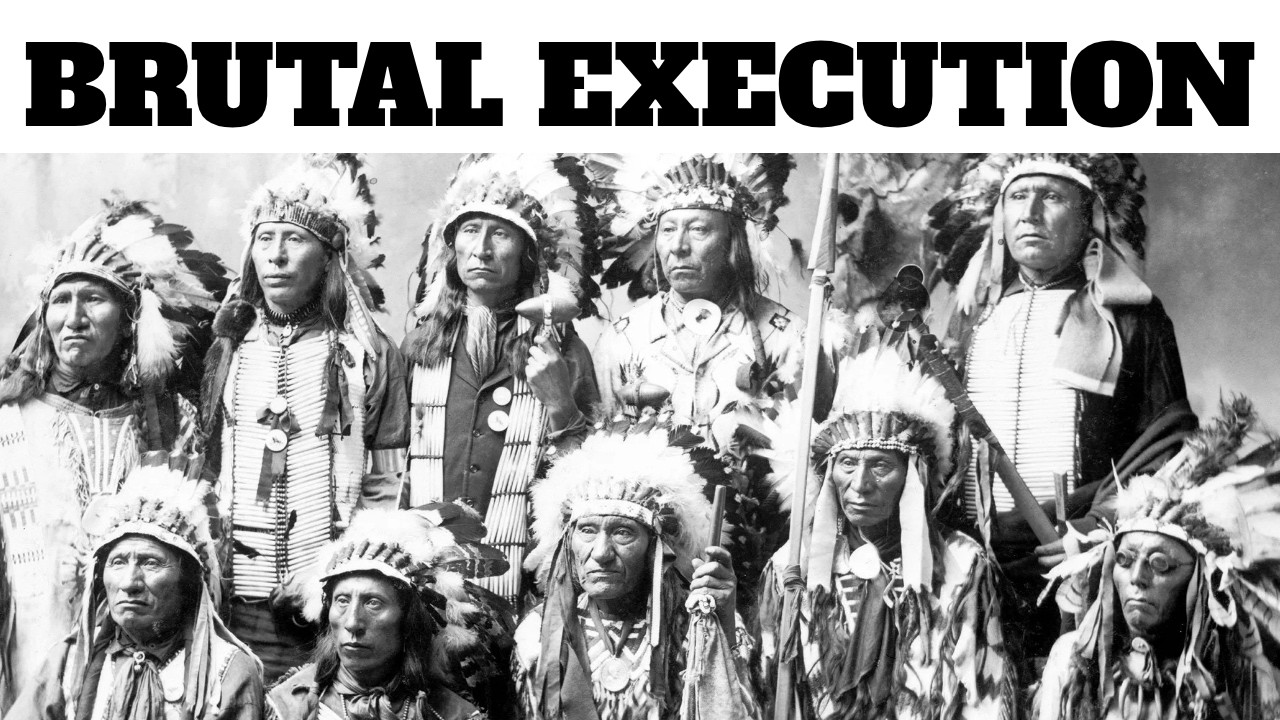
Four thousand onlookers watch. Two thousand soldiers stand under martial law. White muslin hoods cover painted faces. Their hands are tied, but they reach for one another regardless, holding fast.
Together they sing a Dakota death song. Captain William Duley comes forward with an axe in his hands. He had lost three children in the war that brought these men here. He swings.
The platform falls. It is the largest mass execution in United States history, carried out the day after Christmas. To grasp how thirty-eight men came to sing together on that scaffold, you must go back. Not to the war, but to the promises made before it.
The Dakota people, the eastern Sioux, had lived along the Minnesota River and the upper Mississippi for thousands of years. Four bands—the Mdewakanton, the Wahpekute, the Sisseton, and the Wahpeton—were joined by language, kinship, and shared ground. The river bottoms where they planted corn. The deep woods where they hunted deer.
The tall grass prairie where buffalo grazed. These were not abstract territories on a government map. These were the places where grandmothers taught grandchildren to set snares, where medicine men knew which roots grew beneath which trees, where the dead were buried overlooking the water. The Dakota did not own this land in the European sense.
They belonged to it. French and British fur traders had moved through Dakota territory since the 1700s, and the Dakota had traded with them for generations. Those relationships were commercial. The Dakota exchanged pelts for metal tools, cloth, firearms, and ammunition.
Over time, the fur trade created dependencies that had not existed before. By the early 1800s, many Dakota bands depended on trade goods that could only come from white merchants. That dependence would be turned into a weapon. When the United States acquired the region, the dynamic shifted.
The Americans did not come to trade and leave. They came to stay. They brought plows and fences and land offices and a legal system built on the idea that land could be owned by individuals, divided into squares, and sold. They brought families.
They brought the assumption that the land occupied by the Dakota was destined to become farmland. The only question was how quickly. In 1851, two treaties dismantled the Dakota world. The Treaty of Traverse des Sioux, signed July 23rd, and the Treaty of Mendota, signed August 5th.
Together they ceded twenty-one million acres of Dakota land to the United States, nearly the entire southern half of what is now Minnesota. In return, the government promised cash annuities paid annually, supplies, food, education, and support for the transition to farming. The Dakota were confined to a reservation along the Minnesota River, a strip ten miles wide on each side. A people who had known a continent were reduced to a corridor.
The Dakota leaders who signed those treaties were not ignorant. Many understood what they were giving up. But white settlement was coming whether they agreed or not. The military power of the United States was overwhelming.
The treaties at least promised something in return. The Dakota signed because they believed the United States government would keep its word. The promises were rotting before the ink dried. Buried inside the treaty was a separate document called the trader’s paper, drafted by a fur trader named Joseph R.
Brown. Written only in English, never translated, never explained to the Dakota signatories, it authorized the government to pay off alleged debts to fur traders directly out of the annuity money promised to the Dakota. The fur trade was dying by 1851. The traders saw the treaty money coming and wanted their cut before a single Dakota family touched it.
The debts they claimed were in many cases inflated, undocumented, or entirely fabricated. Nearly half a million dollars were rerouted through the trader’s paper before the first annuity payment was ever delivered. The Dakota did not know this document existed when they signed. The treaty of 1858 stripped more.
The northern half of the already shrunken reservation was gone. More promises attached, more money delayed, more money siphoned. By the early 1860s, the Dakota were living on a ribbon of riverbottom that could not feed them. The buffalo were gone from their area.
The deer were depleted by white hunters who ignored reservation boundaries. The farming tools promised in the treaties arrived late, arrived wrong, or never arrived at all. The Dakota who had tried to take up the plow were doing only marginally better than those who refused. Everybody was hungry.
The men who controlled what little the Dakota had left were not neutral administrators. They were participants in the system bleeding the Dakota dry. Thomas J. Galbraith was the Indian agent at the Upper and Lower Sioux agencies, a political appointee placed through the patronage system.
His job was to distribute the annuity payments and provisions. Galbraith refused to release food without the annuity payments in hand. The payments were late, as they always were. But in 1862, they were catastrophically delayed.
The Civil War had consumed Washington’s attention and money. Gold shipments stalled. The bureaucracy did not consider Dakota starvation an emergency worth hurrying for. Galbraith knew his people were hungry.
He could see the warehouses. Everyone could see the warehouses. They were full. Flour, pork, provisions stacked to the ceiling behind locked doors.
The Dakota could see them too. They could walk right up to the buildings and look at the food their land had paid for. They could not have it because the paperwork had not cleared. Andrew Myrick ran the largest trading post at the Lower Sioux Agency.
Born in Westport, New York in 1832, he had a Dakota wife named Wiyanagwin and spoke some of the language. He knew these people by name. He knew their children were hungry. And he was already the most hated man on the reservation before the meeting that made him permanent.
In August of 1862, a formal council was convened. Dakota leaders, the Bureau of Indian Affairs agent, and the local traders sat face to face. The Dakota asked the traders to sell food on credit until the annuities arrived. Their families were starving.
The payment was coming. It always came eventually. Andrew Myrick spoke for the traders. So far as I am concerned, if they are hungry, let them eat grass or their own dung.
The exact wording is disputed by some historians. The meaning is not. Every source agrees. It meant no.
It meant the warehouses stay locked. It meant your children can starve and the man sitting across the table will watch it happen and feel nothing. There is a detail that makes the timing unbearable. The annuity payment actually arrived in St.
Paul on August 16th. It was transported to Fort Ridgely on August 17th. One day too late. By the time the gold reached the fort, the first shots had been fired.
The man who would lead what followed never wanted the role. Taoyateduta, His Red Nation, was known to the whites as Little Crow, a mistranslation of his grandfather’s name. Born around 1810 in the Mdewakanton village of Kaposia near present-day South St. Paul, he was the son of Chief Wakayantanka, Big Thunder.
He became chief after his father accidentally killed himself in 1846. Within days, two half-brothers tried to murder him for the leadership. They shot him in both wrists. He survived, but his hands never healed correctly.
The bones set crooked. He wore long sleeves the rest of his life to cover the scars and the way his fingers could not fully close. He banished the brothers. When they returned, he had them executed.
Little Crow was no simple war chief. He had signed the Treaty of Mendota in 1851. He traveled to Washington in 1858 under pressure to cede more land. He saw the capital, a city holding more people than every Dakota band combined.
He owned a woodframe house on the reservation. He read English. He understood what his people were facing and tried to work within the system. In 1857, when Inkpaduta’s band committed the Spirit Lake massacre, Little Crow volunteered to lead a war party to stop it.
He brought back scalps and freed captives. The Indian Superintendent, William J. Cullen, admitted his intervention prevented a wider war. The government accepted the service.
It did not remember it when the time came. By 1862, he had lost his position as tribal spokesperson. His own people saw his diplomacy as surrender. The young men called him soft, said he had forgotten how to fight.
Then four young men changed everything. August 17th, Acton Township, Minnesota. Four young Dakota men on a hunting trip. An argument at a settler’s homestead.
Five white settlers killed. Three men and two women. The four fled back to the reservation. A war council was called that night.
Little Crow argued against war. The accounts from multiple sources are consistent. He said the whites were like the locusts. Kill one, ten, a hundred, and more would come.
The whites had soldiers and cannons and a nation behind them, already fighting its own civil war. He told them plainly that war meant death for most of them. Not might mean. Would mean.
The young warriors called him a coward. They said his wrists were as crooked as his courage. They said he had spent too many years shaking hands with white men. And he made his choice.
He would not hand the four men over to a system that had stolen twenty-one million acres and starved his people and told them to eat their own dung. When did Taoyateduta run away from his enemies? Taoyateduta will die with you. August 18th, dawn.
The Lower Sioux Agency. Little Crow led warriors against the compound at first light. The traders were the first targets. The Dakota knew every building, every door.
They had walked those paths for years. Andrew Myrick heard the gunfire and scrambled to the second floor. He tried to climb out through an attic window. Two bullets struck him, one in the arm and one in the side.
He dropped and tried to crawl to a ravine behind the building. A warrior named Tawasu ran toward him, screaming he would kill the dog who would not give him credit. Myrick was killed before he reached the trees. He was thirty years old.
When his body was found days later, his mouth was stuffed full of grass. They remembered every word. Other traders died that morning. George Divoll behind his counter.
Francois Laba, a trader of mixed French and Dakota heritage related to Chief Wabasha, killed in his own store despite his kinship ties. Joseph Belland and Antoine Young, clerks at William Forbes’s store, shot at their posts. The agency buildings were set ablaze. The Dakota War of 1862 had begun.
Six weeks of fighting tore the Minnesota River Valley apart. Little Crow attacked Fort Ridgely twice. The garrison held, barely, saved by artillery under Sergeant John Jones that turned the approach routes into killing fields with canister shot. Little Crow himself was wounded during the second assault on August 22nd.
The town of New Ulm was attacked twice. On August 19th, Dakota warriors pushed into the outskirts and set buildings on fire. Judge Charles Flandrau organized civilian defenders, men who had been plowing fields that morning, handed rifles and told to hold the line. On August 23rd, the Dakota came back in greater numbers.
Over 190 buildings burned, 34 defenders killed, over 60 wounded. The town was gutted. The surviving residents, over 2,000 of them, evacuated in a wagon column stretching two miles across the prairie. Across the valley, smaller settlements were overrun.
Lake Chetek, Milford Township, Sacred Heart Creek, Birch Coulee. This was where William Douly’s family was attacked. Three of his children were killed. His pregnant wife, Laura, was taken hostage and repeatedly assaulted in captivity.
She lost the child she was carrying. When she was recovered and told her husband what had been done, he carried that knowledge to the scaffold at Mankato. On September 2nd, a burial detail sent by Sibley was ambushed at Birch Coulee. Roughly 170 soldiers and civilians were pinned down in a shallow ravine for over thirty hours.
Ninety horses killed, twenty soldiers killed, sixty wounded. The survivors dug rifle pits with bayonets until the main force arrived. Between four and six hundred white civilians and soldiers died over six weeks. Dakota dead are estimated between seventy-five and over one hundred.
Hundreds of settlers, overwhelmingly women and children, were taken hostage. Women were assaulted. Families were separated. Children were taken from parents who would never see them again.
This is the part the story demands you hold without softening. The grievance was real. The starvation was real. And people who bore no personal responsibility for any of it died in their kitchens and fields.
The Dakota were never unanimous. Many opposed the war from the first day. Some sheltered white captives in their own lodges at enormous personal risk, feeding them from their own diminished stores. Dakota peace chiefs gathered nearly 270 captives at what became Camp Release and held them specifically for return.
The war fractured the Dakota as deeply as it struck the settlers. Some Dakota who refused to fight were killed by warriors from their own bands. Henry Hastings Sibley was sent to end it. A former fur trader and the former first governor of Minnesota, he spoke Dakota fluently.
He had been adopted into a Dakota band. He had a Dakota daughter. He had hunted with Little Crow personally. Now he was given a colonel’s rank and told to destroy people he had once lived among.
Governor Ramsey appointed him August 19th, one day after the attacks began. Sibley gathered troops at Fort Snelling and marched west. His force was initially raw recruits meant for the Civil War, poorly armed and utterly unprepared for what they found along the Minnesota River. Burned homesteads, dead civilians on the roads, the smell of decomposition in the August heat.
By September, the arrival of reinforcements tipped the scales. The Third Minnesota Infantry—Civil War veterans paroled after their capture at Murfreesboro—could no longer take the field against Confederates, but they could fight Indians. They supplied Sibley with a seasoned professional backbone. On September 23rd, Sibley’s troops defeated the Dakota at the Battle of Wood Lake in Yellow Medicine County.
The clash erupted when soldiers out gathering supplies blundered into a Dakota ambush that had been planned in advance, setting off the fight early. Cannon fire and steady, disciplined volleys pushed the Dakota back. Three days afterward, the Dakota surrendered at Camp Release near Montevideo and handed over 269 captives. The war had lasted six weeks.
The reckoning was only starting. Sibley set up a five-member military commission to try the Dakota prisoners. There were no defense attorneys, and no interpreters able to render the proceedings fully into Dakota. Many defendants sat through their own trials without grasping the charges, the testimony, or the sentences.
Sibley or his adjutant drew up the charges, relying heavily on information from a single source: the Reverend Stephen R. Riggs, a Presbyterian missionary who had spent decades living among the Dakota. One man’s identification molded the whole trial process. Between September 28th and November 3rd, the commission tried 392 men.
On the opening day, 16 cases produced 10 convictions. As the weeks dragged on, the pace only quickened. Three hundred and three men were sentenced to death, sixteen to prison. The standard was taking part in any battle or attack on civilians.
Whether you had personally killed anyone was irrelevant. If you were there, you could die for it. Isaac Heard, the commission’s recorder, was strikingly candid about what this meant. The trials were conducted elaborately until the commission became acquainted with the details of the different outrages and battles, and then five minutes would dispose of a case.
On the last day alone, close to forty cases were settled. The defendants ran from boys of roughly fifteen to old men who could scarcely walk to the stand. Many admitted being present at engagements without realizing that admitting presence was admitting guilt under this commission’s rules. They believed they were explaining themselves.
They were signing their own death warrants. Whether Sibley had the legal authority to convene this commission was no minor technicality. A year later, the Judge Advocate General of the United States Army ruled that he did not. His personal bias as both commander and accuser had violated Article 65 of the Articles of War.
The trials fell short even by military standards. But by then thirty-eight men were in the ground, their bodies parceled out to doctors. The ruling changed nothing for the dead. Here is the broken promise at the heart of this entire story.
Sibley assured the Dakota who surrendered at Camp Release that only those who had attacked settlers would be punished. That was the agreement. The Dakota gave themselves up on that understanding. Peace chiefs who had shielded captives came into custody, trusting that the distinction would count.
Three hundred and three death sentences later, the promise was ash. The system took their surrender and answered it with mass condemnation, delivered in a language the condemned could not speak, under an authority later ruled illegal. Minnesota’s political establishment wanted every one of them dead. Governor Alexander Ramsey demanded it openly.
Senator Morton Wilkinson warned Lincoln that if the president refused, mobs would kill the prisoners themselves. Mobs had already tried to storm the prison at Mankato. The newspapers demanded blood. Abraham Lincoln did something no president had done before or since.
He personally reviewed 303 trial transcripts with two White House lawyers, George Whiting and Francis Ruger, in under a month. He read each case. He separated those convicted of massacring unarmed civilians from those who had only fought in battles. He commuted 264 sentences.
He approved 39. He wrote the final list in his own hand, carefully, knowing a misspelled name could mean the wrong man on the scaffold. One was later reprieved. He did this during the worst month of the worst year of the Civil War, after the disaster at Fredericksburg, while the Emancipation Proclamation awaited its effective date.
He pushed back against his own party, his own state officials, and a public screaming for mass execution. He said he did not want to act with so much clemency as to encourage another outbreak, nor with so much severity as to be real cruelty. Lincoln’s review was the only moment where a figure with genuine institutional power intervened on behalf of the Dakota. It was also not enough.
Two of the thirty-eight were later determined to have been hanged by mistake, their identities confused in a system where Dakota names were written phonetically by English speakers who did not know the language. December 26th. The scaffold. Everything this story has led to is on that platform with those men.
The treaties. The trader’s paper. The locked warehouses. The grass in Myrick’s mouth.
The five-minute trials. Lincoln’s list written in his own hand. Colonel Stephen Miller had declared martial law days earlier. He banned alcohol within ten miles.
He turned back a settler mob that tried to storm the prison. Fifteen hundred soldiers held the perimeter. The Sixth, Eighth, and Ninth Minnesota Infantry regiments ringed the execution site. Miller was not protecting the Dakota.
He was protecting the process. A lynching would embarrass the government. A legal hanging would satisfy it. The thirty-eight were led from the prison at ten in the morning, singing before they reached the platform.
A Dakota death song. Their faces were painted beneath the muslin hoods. They danced in place as the nooses were set. They reached for each other’s hands and held on.
The gallows were specially designed. Every noose connected to a single master rope. One cut would drop all thirty-eight at once. The platform stood twenty feet high.
The scaffold was the size of a two-story house. The drum sounded three times. The singing stopped. The crowd went silent.
William Douly struck the rope. It took two blows. The platform dropped. Thirty-eight men fell together, hands still clasped.
They hung for half an hour. The bodies were cut down and hauled to a shallow mass grave on a sandbar along the Minnesota River. That night, after the crowds dispersed, the grave was opened. Doctors came from across the region and took bodies for dissection and anatomy study.
Bones collected, remains distributed. The dead were not allowed to rest even in the ground. The system did not stop at the scaffold. It turned on every Dakota it could reach.
Approximately 1,600 Dakota, mostly women, children, and the elderly, were force-marched from the Lower Sioux Agency to Fort Snelling beginning November 7th, 1862. Six days, over 150 miles. Many had taken no part in the war. Some had sheltered white captives.
It did not matter. Governor Ramsey had declared that the Dakota must be exterminated or driven from the state. The marching orders made no distinction between the warrior and the grandmother. Along the route, mobs of white settlers attacked the column.
At Henderson, Minnesota, a settler broke through the line of soldiers and tore a Dakota baby from its mother’s arms. The baby was killed. The soldiers guarding the march did nothing to stop it. Elsewhere along the way, marchers were clubbed and pelted with stones.
At Fort Snelling, the Dakota were confined in an internment camp on Pike Island, the low river flats beneath the fort walls. Packed in without shelter, left exposed to a Minnesota winter in makeshift structures and with no real medical care. As many as 300 died during the winter of 1862 and 63. Disease, mainly measles, tore through the crowded camp.
Starvation. Exposure. Outright violence from white civilians and soldiers who came to the camp to assault people simply because they could. Their descendants call it the first concentration camp on American soil.
In April of 1863, a steamboat carrying Dakota men from the Mankato prison to Davenport, Iowa, made a brief stop at Fort Snelling. The men aboard could see their wives and children standing on the riverbank. They called out to them. The soldiers refused to let them reunite.
The boat drew away while children screamed on the shore. Families already torn apart by the war, the trials, and the march were torn apart once more by a steamboat leaving a dock. In May, the survivors were sent to Crow Creek in Dakota Territory, dry, barren ground that would not grow crops. Those who lived through Crow Creek were relocated three years later to the Santee Reservation in Nebraska.
The convicted men whose sentences Lincoln commuted spent years locked up at Davenport. By the time they were freed, one-third had died in custody. The state legislature made the expulsion official. A bounty was set on any Dakota found in Minnesota, $25 per scalp at first, then raised.
Any Dakota discovered inside the state’s borders could be killed, and the killer could collect payment at the state capital. An entire people outlawed by statute. And Little Crow was still alive. He had not surrendered at Camp Release.
After Wood Lake, he fled north and west with a band that kept shrinking. He looked for allies among the Western Sioux. They refused. He crossed into Canada and asked the British for help.
Refused. Other tribes had no wish to take on the consequences of a war they had not begun. His followers dwindled to almost nothing. The man who had once spoken for all the Lower bands was now a fugitive with a handful of relatives, traveling through country where his name was worth money.
By the spring of 1863, his band had scattered. Little Crow made a decision historians still cannot fully explain. He returned to Minnesota. He brought only his teenage son, Wowinape.
Two people crossing a state where his face was worth $500 to anyone with a rifle. Why he came back is genuinely uncertain. Perhaps to steal horses for his family. Perhaps because a man cannot be exiled from the only land that was ever his.
The rivers and the woods and the ground where his father was buried were now a place where being recognized meant being killed. He came back anyway. July 3rd, 1863. Near Hutchinson, Minnesota.
Evening light in the big woods. Little Crow and Wowinape paused in a clearing to pick raspberries. The berries were ripe. The air was warm.
They had been cautious. They had been silent. They were not invisible. Nathan Lamson, a settler out hunting with his son Chauncey, spotted two figures through the brush.
He could not tell who they were. He could tell they were Indians. In 1863, in Minnesota, with a bounty on every Dakota scalp, that was enough. Lamson steadied his rifle against a tree and fired.
The shot hit Little Crow in the hip. Little Crow went down, then came back up firing. He struck Lamson in the shoulder. Chauncey came around a bend and found himself face to face with the wounded chief.
Both fired at the same moment. Chauncey’s shot struck Little Crow through the chest. Little Crow’s bullet flew past the boy’s left ear, close enough to leave his skin warm. Taoyateduta fell.
He told his son to run. Wowinape ran. The man who had signed treaties in Washington, who had read English and worn European clothes and lived in a frame house, who had tried every path the system offered and been failed by all of them, who had warned his own council that war would destroy them and then led it anyway because they called him a coward and he would rather die than bear that name, died on the ground in the woods, picking berries, shot by a stranger who did not know who he was. He was approximately fifty-three years old.
The next day was July 4th, Independence Day. Settlers brought the body into Hutchinson. They scalped him. They dragged his body down the main street behind a wagon during the holiday celebration.
His remains were thrown into the offal pit of the town slaughterhouse. His head was later cut off and tossed into a field to rot in the summer sun. Weeks later, Wowinape was captured near Devil’s Lake. He identified his father.
The identification was confirmed by the twice-broken wrists, the bones that never healed straight from the gunshots his own brothers had put into him seventeen years earlier. The same scars he had hidden under long sleeves his entire adult life. Nathan Lamson received $500 from the state. Chauncey received $75 for the scalp.
Little Crow’s skull, his scalp, and portions of his remains were sent to the Minnesota Historical Society in St. Paul, put on public display behind glass with a placard. They stayed on display for more than a century. Visitors could look at the skull of the man who had led the last Dakota resistance in Minnesota, mounted in a museum case until 1971.
Now consider the fates of the men who built this system. Andrew Myrick, killed the first morning of the war, mouth stuffed with grass, thirty years old. His cruelty did not cause the war alone, but his words were the last thing the Dakota heard before they decided there was nothing left to lose. Thomas Galbraith, the agent who locked the warehouses, stayed in federal service after the war.
No investigation, no charges, no consequence. The system that gave him the power to withhold food from starving treaty holders was never reformed in his lifetime. Henry Sibley, who convened the illegal commission, went on commanding campaigns against the Dakota on the western plains, returned to St. Paul as a respected civic figure.
A state park bears his name today. Governor Ramsey, who called for extermination, served as a United States senator and then secretary of war under President Hayes. His mansion in St. Paul is now a historic house museum, run by the same Minnesota Historical Society that displayed Little Crow’s skull for a century.
Abraham Lincoln saved 264 lives by crossing names off a death list. He was assassinated less than three years later. Two of the thirty-eight he approved were hanged by mistake. Whether his intervention was mercy or a more carefully administered form of killing depends on where you stand when you read the list.
The Judge Advocate General’s decision that the trials had been unlawful arrived only after the hangings. After the camps. After the death march. After the banishment.
After the graves were opened so bodies could be studied for anatomy lessons. For anyone involved, the ruling altered nothing. The government confessed its own mistake in a paper that no one wronged by that mistake would ever lay eyes on. It recorded the finding and carried on.
This was no calamity dropped out of an empty sky. This was a machine with names, titles, offices, and budgets. It signed treaties in return for everything a people possessed: their homeland, their hunting grounds, their capacity to feed themselves without begging permission from a man behind a locked door. And then it held back what it had pledged.
It funneled payments through traders who padded debts and pocketed the difference. It filled the agencies with political hires who kept the food under lock. It stalled the annuities through a bureaucracy that filed starvation under scheduling difficulties. And when the people it had starved fought back, the machine hanged thirty-eight of them on a scaffold, drove 1,600 into a camp where hundreds perished, banished the survivors to land where nothing would grow, put a price on every scalp, and set the leader’s skull in a glass case for 108 years.
The Dakota did not start with bloodshed. They started with signatures on treaties they were assured would keep them safe. They watched those treaties gutted by traders who stole the payments, agents who kept the food behind doors, and a government that treated its own written word as a suggestion to be revoked whenever it grew inconvenient. The violence came only once every other path had been closed, after the meetings, after the appeals, after the formal council where a man looked at starving people and told them to eat dung.
None of this excuses what happened to the settlers who died. The women seized as hostages and assaulted. The children killed at homesteads that had nothing to do with any treaty. The families at Lake Shetek and New Ulm and the scattered farms along the river.
The war left victims who deserved none of what they got. But the machine that made the war had names and authority and the power to keep its word. It chose not to. And not a single one of those names met the fate that thirty-eight men met on that scaffold.
The forced march swept up families who had sheltered white children. The mass trial convicted men whose only act was being there. The exile removed everyone. The bounty covered every scalp.
The machine drew no line between the warrior and the grandmother. It wanted them all gone. Four thousand onlookers cheered when the platform fell. The settler communities of southern Minnesota wanted every Dakota gone.
By the spring of 1863, that is precisely what they had: an empty landscape. Twenty-one million acres of former Dakota land, uncontested. The land promised to the Dakota forever, back in the hands of the people who wrote the treaties that took it. Yet within the Dakota community, scattered across reservations a thousand miles from home, the names of the thirty-eight were preserved.
They were spoken in Dakota, in kitchens and lodges and around winter fires, handed from grandmother to grandchild without a break through every generation. The songs they sang on the scaffold were remembered and taught. The story of the march, the camp, the steamboat pulling away while children screamed, was told and retold until it became the living memory of a people who refused to be erased. The machine tried to remove the Dakota from Minnesota.
It could not remove Minnesota from the Dakota. Today, in downtown Mankato, on the ground where the scaffold stood, there is Reconciliation Park. Not justice. Not apology.
Reconciliation. Dedicated in 1997. A 67-ton buffalo sculpture at its center. A monument listing the Dakota names of the thirty-eight men.
The names the commission never learned to spell. The names the muslin hoods were meant to make anonymous, now carved in stone. You can run your fingers over them. Every December, riders on horseback cross 330 miles of frozen plains from South Dakota and Nebraska to Mankato.
The ride began in 2005 when a Lakota spiritual leader named Jim Miller dreamed of exiled Dakota returning to their homeland on horseback. He led the ride for fourteen years through blizzards and bitter cold. Riders as young as twelve and elders who needed help mounting their horses in the morning. Three hundred and thirty miles.
Jim Miller died in 2023. New groups carry it forward. The Mankato Reconciliation and Healing Horse Ride from Lower Brule, South Dakota. The Dakota Exiles Ride from the Santee Reservation in Nebraska.
Runners relay seventy-one miles from Fort Snelling through the December night. They all arrive at Reconciliation Park on December 26th at ten in the morning, the exact hour the platform dropped. They say the names. In September 2026, the 54th annual Mankato Wacipi was held in the town.
For the first time in 164 years, seventeen Dakota women’s names were read aloud. The caregivers. The women who traveled with the condemned men to the prison camp, who tended them through those final weeks, who stood in the street and watched them die. Their names waited 164 years to be spoken in that place.
They were spoken. Little Crow’s skull was not returned to his descendants until 1971, 108 years after his death. He was reburied at First Presbyterian Cemetery in Flandreau, South Dakota, on a reservation. The only kind of home the machine ever let his people keep.
No pardon has ever been granted for the Dakota 38. No formal apology from Minnesota. No formal apology from the United States. Not for the execution.
Not for the internment. Not for the forced march. Not for the exile. Not for the bounties on the scalps.
Not for the skull in the glass case. The promise stays broken. The skull is buried now.
The riders are still coming.
