In December 2006, skilled craftsmen who had spent their working lives hand-building some of the fastest cars in Britain were sent home with no pay and no redundancy compensation, just three days before Christmas. The factory on Bristol Avenue in Blackpool, which had produced TVR sports cars for nearly sixty years, was silent. The last great independent British sports car maker was gone. The story began in a rented workshop in Blackpool after the Second World War, when a young engineer named Trevor Wilkinson left school at fourteen and apprenticed himself to a local garage.
In 1946, he took on a small workshop and called the business Trevcar Motors, mending ex-army trucks and fairground machinery to pay the bills while he worked on the car he actually wanted to build. The first one arrived around 1949, a tubular steel chassis of his own design with a modest Ford engine and, according to one account, running gear salvaged from a fairground dodgem. Wilkinson knocked the vowels out of his own name, and TVR was born. In 1953 came the decision that would define the company for the next half century.
TVR began building its bodies from glass-reinforced plastic, an exotic new material perfectly suited to a small firm. No giant presses were needed, just a mold, a bucket of resin, and skilled hands. The first true production car, the Grand Tourer, followed in 1958, establishing the template: a light chassis, a borrowed engine, a hand-laid fiberglass shell, and enough power to frighten the driver. Through the 1960s and 1970s, TVR survived fires, oil crises, supplier strikes, and tightening American emissions laws that shut it out of its biggest export market.
In 1981, with the money running out, the owner sold control to one of his own customers, a chemical engineer from Sheffield who had made a fortune supplying equipment to the North Sea oil industry. Peter Wheeler was born on 29 February 1944, a leap-year child who seemed to operate on his own calendar. He stood six foot six, was rarely without a Malboro cigarette, and had no background in the motor industry whatsoever. He designed cars by eye and instinct, working the clay in the styling studio with his own hands.
His dog, a pointer named Ned, wandered the studio freely and once took a bite out of the foam styling model of a new car. Wheeler looked at the recess the dog’s teeth had left in the nose, liked it, and kept it, turning the mark of a dog bite into the housing for the front indicator of a car that would sell in its thousands. Wheeler’s first major move was to drop the aging Ford V6 and install the light, torquey aluminium Rover V8. In the Tasmin 350i of 1983, TVR suddenly had the recipe it would ride for the next decade: a light body, a big engine, an enormous noise, and no electronic intervention of any kind.
Wheeler held his philosophy like scripture. Lightness beats cleverness. A curve beats a computer. A driver who can hear and feel everything the car is doing needs no electronics to save him.
In October 1990, TVR took a concept car to the motor show in Birmingham called the Griffith, a low, impossibly clean shape with no bumpers and no straight lines. The reaction was extraordinary. According to the company’s own legend, orders arrived at a rate of one every eight minutes across the show, more than three hundred cars in total, on the strength of a car that did not yet properly exist. The production Griffith reached buyers in 1992, and the following year the Griffith 500 arrived with a 5-liter V8 producing around 340 brake horsepower in a car weighing barely over a ton.
It had no antilock brakes, no traction control, no electronic intervention of any kind. If the back stepped out, it was the driver’s problem alone. Alongside it came the Chimera, a softer, longer-legged grand tourer that became the best seller TVR ever built, with more than five thousand leaving Blackpool. The workforce swelled toward a thousand people.
By 1998, the factory was producing around forty cars a week, every one assembled by hand. There was no robot anywhere on that floor. The fiberglass bodies were laid up wet and finished by workers whose fingers knew the compound curves the way a potter’s hands know clay on a wheel. The first threat came from Germany.
In 1994, BMW bought Rover, and the Rover V8 that powered TVR’s entire range now belonged to a direct rival that could cut off the supply of engines whenever it suited. Wheeler decided to build his own engine from a completely clean sheet of paper, an act of near insane ambition for a firm of a few hundred people. The result was the Speed 8, a 75-degree V8 built around a flat-plane crankshaft that produced specific outputs to shame companies a hundred times TVR’s size. A cottage industry on a Blackpool trading estate had built one of the most potent naturally aspirated V8s on the planet.
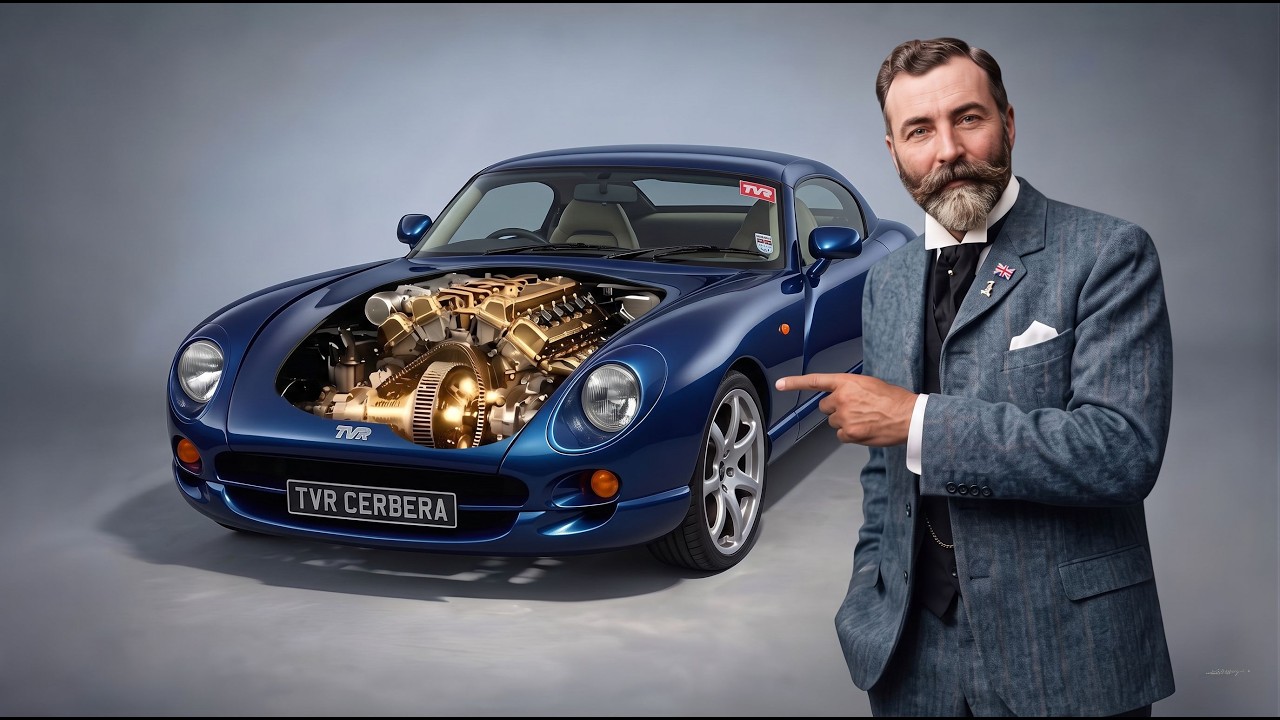
They dropped it first into the Cerbera in 1996, named after the three-headed hound that guards the gates of Hades. For the cars further down the range, John Ravenscroft produced the Speed 6, a straight-six that would power the Tuscan, the Tamora, and the Sagaris. Wheeler never refused to think about safety. He thought about it harder and longer than almost anyone in the business and arrived at conclusions the modern world had decided were heresy.
In 2004, he argued that a driver who knew what he was doing would stop a car without ABS in a shorter distance than one with it. He refused to fit airbags because, in an open-topped car, a deploying airbag fires the driver’s head upward into the danger zone. Asked about the consequences, he said that if someone crashed one of his cars through their own mistake, he could live with himself. But if he fitted an airbag and that airbag killed someone, he could not live with that at all.
His engineering case rested on the fiberglass itself. A curved panel is inherently stronger than a flat one, and TVR had no flat panels anywhere on its body. Beneath the skin sat a tubular steel backbone chassis engineered to hold its shape in a rollover. The Tuscan, Wheeler noted, passed its offset crash test twice.
On television, Jeremy Clarkson lowered himself into TVR after TVR wearing a look of pure delighted terror, and the word he kept reaching for stuck like tar: widowmaker. The reputation was not entirely fair, but it was not entirely wrong either. TVR’s cars had no crumple zones as the modern world understood them, and the firm’s tiny production volumes bought it exemption from full crash testing. A company that size could never have afforded to develop full active safety systems even if Wheeler had wanted them.
His principles and his budget happened to point in exactly the same direction. In 1996, Wheeler built the Speed 12, a 7. 7-liter V12 created by marrying two Speed 6 engines onto a single crankshaft, conceived as a rival to the McLaren F1. When they strapped the engine to a dynamometer, it broke the machine, which was rated to read up to a thousand brake horsepower.
Wheeler took a roadgoing prototype out of the gates, drove it for a few hundred yards, decided it was plainly ridiculous, and cancelled the project. The man the tabloids painted as reckless had found his own outer limit and said no. In 2001, a Hollywood thriller called Swordfish put a chameleon-painted TVR Tuscan up on cinema screens across the planet. The film took well over a hundred million dollars, and audiences from Tokyo to Toronto watched a hand-built Blackpool sports car most of them had never heard of.
But the trouble had already begun. The Speed 6 engine, TVR’s proudest achievement, had been designed and pushed into production at speed without the years of validation testing a Toyota or a Ford would have run. Out in the hands of owners doing exactly what TVR owners had always done, the engine began to fail. Small components in the valve train called finger followers wore out early, along with camshafts and valve guides.
Engines needed rebuilding at thirty-five thousand miles or less. Dozens of failed engines sat stacked at Bristol Avenue at once, waiting to be taken apart and put right by the very craftsmen who should have been building new cars. Every warranty claim came out of TVR’s own pocket, again and again. By the time improvements arrived around 2003, the financial damage was done.
The law was closing in too. Low-volume manufacturers across Europe enjoyed exemptions from full crash testing and type approval, but European law only ever moved one way. Each new tier of emissions and safety requirements demanded more electronics, more of everything a Wheeler car was built to do without. The United States, the largest sports car market on earth, mandated airbags without appeal, and a TVR, by the deepest principle of the man who owned it, would never have one.
In July 2004, Peter Wheeler, tired of the regulation and the fight, sold TVR for around fifteen million pounds to a buyer named Nikolai Smolensky. The new owner was twenty-four years old, the son of a Russian banker whose bank had collapsed in the 1998 Russian financial crisis owing well over a billion dollars. On paper, the deal did not look like madness. Smolensky presented himself as a true enthusiast and promised investment, modernization, and a future for the mark that would keep it British.
The first car of the new era was the Sagaris, unveiled in 2005, by common consent one of the most beautiful and most vicious things TVR ever built, the purest expression of everything Wheeler had ever believed arriving just as he walked out the door. It was also the last new model the company would ever properly bring to market. Beneath the beautiful car, the warning signs were already there. Suppliers had stopped delivering because they had stopped being paid.
Output had fallen far below the level the firm needed to break even. In February 2006, the company spent a hundred and twenty thousand pounds on a stand at the London Motor Show, a grand public statement that all was well. That same spring, the first tranche of workers was laid off. In April, around 260 jobs, which was nearly everyone, were reported to be under threat.
On 18 October 2006, Smolensky announced that body production and final assembly would be moved to Turin in Italy. Engine work would remain in the United Kingdom, and around 250 jobs would go at Blackpool. The union called it a bitter blow for an iconic British sports car. On 10 November, TVR sent 158 of its 250 Blackpool workers home.
The union’s industrial organizer said that the personal undertakings the owner had given to the union had been effectively ripped up. On 26 November, the owners did the only thing they could think to do. They drove their TVRs, Griffiths, Chimeras, Cerberas, and Tuscans in a convoy through the center of London in support of the workers who had made them. They called it London Thunder.
For one afternoon, the streets of the capital shook with the sound of the very engines now standing cold and silent in Blackpool. In the middle of December, the company was broken into pieces. TVR Motors would hold the brand and intellectual property. TVR Power would take the parts and spares business.
Blackpool Automotive would hold the factory, the manufacturing assets, and the workers. Days later, Smolensky and the production director resigned as directors of Blackpool Automotive, replaced by Smolensky’s personal assistant and a twenty-five-year-old with a Vienna address. Around 22 December, a receivership was announced. Blackpool Automotive went under.
Production had effectively stopped in September. Perhaps twenty cars sat unfinished on the silent floor. The workers, between 245 and 250 of them, were left with no pay and no redundancy compensation of any kind, three days before Christmas. In February 2007, Smolensky bought the company back out of administration, the highest bidder for the wreckage of the very thing he had owned all along.
There were fresh promises of production restarting, of two thousand cars a year, of a Sagaris 2. None of it happened. Not one of those cars was ever built. The announcements grew quieter and then stopped altogether.
Bristol Avenue fell silent for good. Peter Wheeler died of cancer on 11 June 2009 at the age of sixty-five. Trevor Wilkinson had died the year before at the age of eighty-five. The founder and the savior gone within a year of one another, the company they had each given their lives to already a ghost.
The buildings on Bristol Avenue came down in stages across the following decade. In the place where the factory had stood rose a development of commercial units, called the Wheeler Hub. There are plans for a life-size bronze statue of Peter Wheeler with Ned the pointer at his side, the dog who left his teeth marks in a car that sold in its thousands. The name did not quite die.
In June 2013, Smolensky sold TVR to a British consortium, and between 2015 and 2017 a genuinely new Griffith was developed using Gordon Murray’s carbon composite architecture, unveiled at the Goodwood Revival in 2017 to genuine excitement. A factory was planned in South Wales. And then it stalled again, tripping over European state aid rules. The car slipped and slipped again, and did not enter series production.
Stand on Bristol Avenue today among the neat commercial units of the Wheeler Hub, and there is nothing left to hear. But somewhere out on a wet road on a Sunday morning, a Griffith fires up. No airbag, no antilock brakes, no electronic net of any kind between its driver and the tarmac. It asks everything of the people who drive it and forgives them nothing.
When it was gone, the silence it left behind was the wrong shape. And it has stayed the wrong shape ever since.
