In the spring of 1913, the water came into downtown Dayton in a wave. For three days the rain had fallen on the watershed of the Great Miami River as it had not fallen in living memory, and the river, swollen past any levees the city had built, crested at twenty-nine feet on Wednesday, March 26th. Gas mains sheared off at the foundations of flooded buildings and exploded into the water, igniting fires that burned for thirty-six hours across two square miles of the city center. By the time the water receded, 360 people were dead, 65,000 were displaced, and 20,000 buildings were damaged or destroyed.
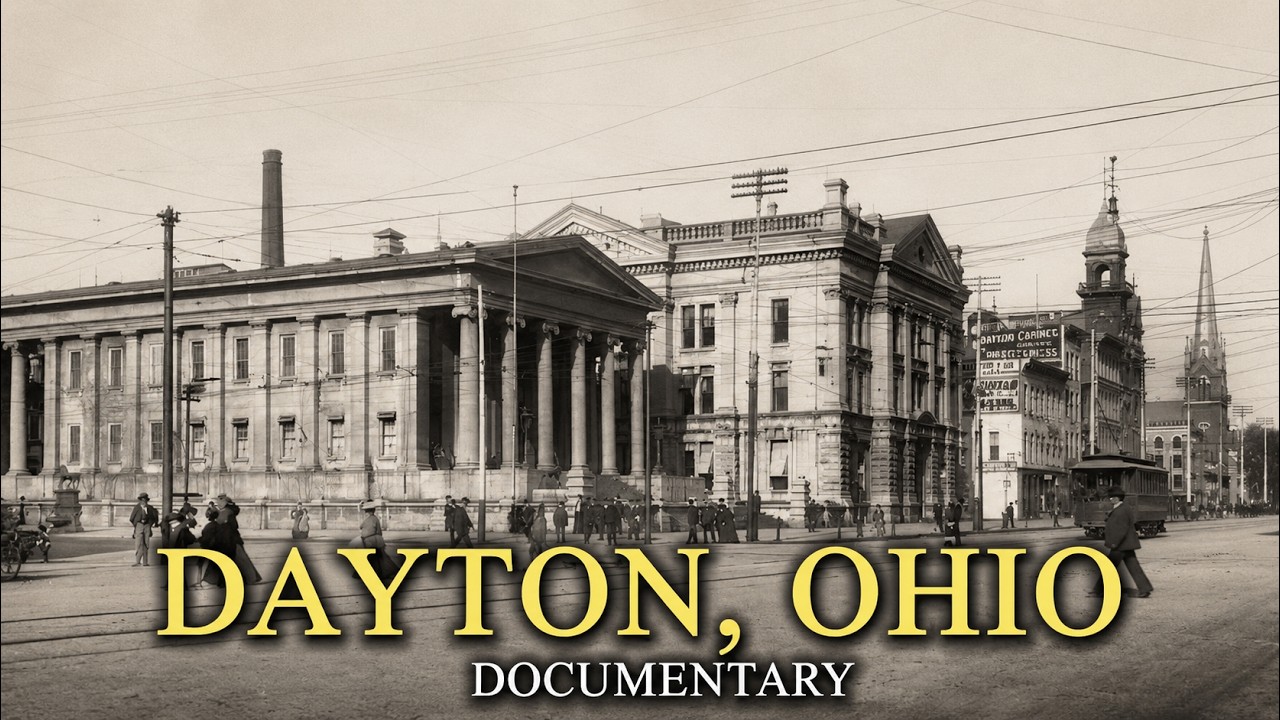
It remains the worst natural disaster in Ohio history. A few miles upriver, the man who would answer this catastrophe sat in a factory that had already made him the most influential industrialist in America. John Henry Patterson, sixty-eight years old, recently convicted in federal court of antitrust violations and sentenced to a year in prison, converted his National Cash Register factory on South Main Street into a relief headquarters within hours. The carpentry shop produced three hundred flat-bottomed rescue boats in two days, and NCR employees pulled more than ten thousand people off the roofs of submerged houses.
The factory cafeteria served 2,750 meals a day to refugees. Patterson lent the company printing press to the Dayton Daily News, whose own presses were underwater. He raised more than two million dollars by personal subscription. The following year, President Wilson commuted his sentence, partly in recognition of what he had done.
The flood that nearly destroyed Dayton also produced the piece of engineering that would define its next century. In 1914, the Ohio legislature created the Miami Conservancy District, the first major regional flood control district in the United States. The district hired an engineer named Arthur Morgan, who designed a system of five massive earthen dams upriver and channel improvements through the city. They were finished in 1922.
Downtown Dayton has not flooded since. Morgan went on to become the first chairman of the Tennessee Valley Authority. It was a strange fate for a city that had, in the span of thirty years, become the most inventive place on Earth. In 1900, Dayton, Ohio issued more patents per capita than any other city in the United States—more than Boston, more than Chicago, more than New York.
A city of 85,000 people on a flat plain in southwestern Ohio was, by the most rigorous measure of American ingenuity, the most inventive place on the planet. The list of things invented or first manufactured there reads like a syllabus of the twentieth century: the airplane, the electric automotive self-starter, the first mechanical cash register, Freon, leaded gasoline, the pop-top can, the Kettering Bug, the first guided missile. The bomb machines that broke the German Enigma cipher in 1943 were built in a factory three blocks from the Miami River. The city’s founding had made this destiny almost inevitable.
Dayton was established in 1796 at a point where five waterways converged in a single low-lying flood plain: the Great Miami River flowing south toward the Ohio, the Mad River, the Stillwater River, and Wolf Creek. The convergence meant water power, drinking water, transportation, and in the spring, catastrophic flooding. For thirty years, the town was a farming village of a few thousand people, slow to grow because the rivers ran the wrong direction for commerce. Goods had to float down the Great Miami to the Ohio, then to the Mississippi, then to New Orleans.
There was no economical way to ship east. That changed in 1829, when the Miami and Erie Canal opened through downtown Dayton. The ditch, forty feet wide and four feet deep, dug by Irish and German immigrant labor for thirty cents a day, connected the Ohio River to Lake Erie. The canal turned Dayton into a shipping town, and more importantly, into a machine shop town.
Boats needed locks, locks needed gears, gears needed precision. By the 1840s, the foundries and machine shops along the canal had earned a regional reputation for fine metal work, the kind that requires tolerances measured in fractions of an inch. In 1845, a writer for the Cincinnati Daily Chronicle described Dayton as “the gem of all our interior towns. ” The nickname stuck.
The city had 6,000 people in 1840, 38,000 by 1870, 61,000 by 1890. The men who walked into those machine shops in the 1880s built the world that followed. James Ritty, a Dayton saloon keeper with no formal engineering training, spent his days selling whiskey at the Pony House on Main Street and his evenings watching his bartenders steal from him. In 1878, during a steamboat trip to Europe, he observed a device that counted the revolutions of the ship’s propeller.
He returned to Dayton and, with his brother John, patented what he called Ritty’s Incorruptible Cashier in November 1879. The first cash register in history was a wooden box with mechanical keys that rang a bell when a sale was made, ensuring every transaction was witnessed by a sound the owner could hear from the back room. Ritty had no interest in manufacturing. He sold the patent in 1881 for a thousand dollars to a man named Jacob Eckert, who formed the National Manufacturing Company with fewer than twenty workers.
Three years later, a coal salesman named John Henry Patterson bought the company for $6,500. His friends told him he had paid too much. Patterson renamed it the National Cash Register Company, moved it in 1888 to a new factory complex on South Main Street, and within five years turned a small foundry into an industrial cathedral. In 1893, NCR built the world’s first daylight factory—floor-to-ceiling glass windows on every elevation, designed so workers never needed artificial light during the day.
This was at a time when American industrial labor was still mostly performed by candle in sweatshops and basements. Patterson also opened the world’s first formal sales training school, wrote a sixteen-page sales script that became the foundation of modern American selling, installed showers, hot lunches, a library, a school for employees’ children, and gardens between the buildings. None of it was philanthropy. Patterson believed, with the cold conviction of a salesman, that a worker who washed before lunch sold more cash registers in the afternoon.
By 1914, NCR was producing 110,000 cash registers a year and exporting them to every continent. By 1930, an estimated one in six of all American corporate executives had at some point trained at NCR or under one of Patterson’s lieutenants. The most famous of those lieutenants was a young Ohio salesman named Thomas Watson, whom Patterson hired in 1899 and fired in 1913. Watson moved to New York, took over a small company that made tabulating machines, and renamed it International Business Machines.
Patterson lost an empire he had built and seeded an empire he had not. Four blocks away from the NCR factory in those same years, two brothers in their twenties opened a small repair shop at 1005 West Third Street in a working-class neighborhood on the west side of the Great Miami. Wilbur and Orville Wright were the sons of a bishop in the United Brethren Church. Neither had finished high school.
Their previous business had been a small newspaper called the West Side News. The bicycle was, in 1892, the new technology of the moment—lightweight steel frames, pneumatic tires, the safety bicycle replacing the high-wheeler. Twelve million Americans owned one by the middle of the decade. The Wrights rented frames, sold them, then in 1896 began manufacturing their own, the Van Cleave, named for an ancestor who had been one of Dayton’s founding settlers.
The bicycle, more than any other invention of the late nineteenth century, taught a generation of men to think about lightness, balance, and the conversion of human energy into forward motion. The bicycle made the airplane possible. Working on bicycles by day, the Wrights began in 1899 to read everything published about powered flight. They wrote to the Smithsonian for a bibliography.
They studied Otto Lilienthal’s glider experiments, the work of Octave Chanute, George Cayley, and Samuel Langley. And they reached a conclusion no one else had: the published aerodynamic data was wrong. In the summer of 1901, in the back of their bicycle shop, they built a wind tunnel six feet long and sixteen inches square, powered by a one-horsepower gas engine driving a fan. Inside it, they tested more than two hundred wing shapes, recording lift and drag for each.
They rebuilt the published equations of aviation from scratch. Their shop mechanic, Charlie Taylor, built them a twelve-horsepower aluminum block gasoline engine weighing 152 pounds. On December 17th, 1903, on a sand spit on the outer banks of North Carolina called Kitty Hawk, Orville Wright lay flat on the lower wing of a contraption built in a Dayton bicycle shop and flew it for twelve seconds, a distance of 120 feet. The first powered, controlled, heavier-than-air flight in human history was an object built in a city of machine shops by two men who repaired bicycles for a living.
They returned to Dayton and for the next two years perfected the machine at Huffman Prairie, a flat cow pasture eight miles east of town owned by Dayton banker Torrence Huffman, who let them use it for free in exchange for an agreement that they would not damage his cows. On October 5th, 1905, Wilbur Wright flew the Wright Flyer III in a continuous loop over Huffman Prairie for thirty-nine minutes and twenty-three miles. It was the first practical airplane. In 1908, Wilbur sailed to France with a crated aircraft and flew demonstrations at Le Mans before crowds that grew over six weeks from a few hundred curious aristocrats to 50,000 spectators on a single Sunday.
The European aviation community, which had been skeptical of the American claims, was forced to admit that two bicycle mechanics from Ohio had solved a problem that Chanute, Langley, and Lilienthal had not. Wilbur was awarded the Legion d’honneur. Orville flew demonstrations for the United States Army at Fort Myer, Virginia that same year. By 1909, the Wright Company was incorporated, and a manufacturing plant was built in Dayton on West Third Street—the first commercial aviation factory in America, five blocks from the bicycle shop.
Wilbur died of typhoid fever in Dayton on May 30th, 1912, at the age of forty-five. He had been the calculator, the theorist, the one who had rebuilt the equations of lift and drag from scratch. Orville sold the Wright Company in 1915 and retired from manufacturing. He never married.
He lived another thirty-three years in Dayton, mostly at Hawthorne Hill, the mansion he built for the family in 1914, where he worked in a small laboratory on inventions he no longer patented. He died in 1948. Picture downtown Dayton on a Tuesday afternoon in 1906. The NCR factory on South Main is producing three hundred cash registers a day, glowing through its glass walls, hot lunches at noon for 9,000 workers.
The Wright brothers are flying a powered aircraft eight miles east of the courthouse. A coal merchant on Fourth Street named Edward Deeds, Patterson’s vice president, is sitting in his office at NCR sketching out a plan he has discussed with a twenty-eight-year-old NCR engineer named Charles Kettering. The plan involves a barn behind Deeds’s house on Central Avenue, an electric ignition system for an automobile, and a small group of NCR men who have agreed to work nights and weekends without pay. Charles Kettering had arrived at NCR in 1904, a year out of Ohio State, where he had studied electrical engineering after a stint as a country school teacher.
He was nearsighted, plainspoken, and obsessed with mechanism. In 1906, he developed the first electric cash register, replacing the hand crank that had been NCR’s signature feature for twenty-seven years. Edward Deeds, in his early forties, was an Indiana farm boy who had risen at NCR by being competent in a way Patterson trusted. The two men began meeting in the evenings in the loft of Deeds’s barn at 319 Central Avenue, joined by other NCR engineers—William Chryst, Harold Talbott, Henry Theobald—who came after their shift and worked under hanging electric bulbs until midnight.
They called themselves the Barn Gang. They borrowed tools from the NCR shop in defiance of company policy. They were trying to invent a way to start an automobile without a hand crank. The hand crank was, in 1909, the great obstacle to mass automobile adoption.
It required physical strength and considerable nerve. A backfire could break a wrist, or kill a man. Henry Leland of Cadillac commissioned the work after his friend Byron Carter cranked a stalled car for a stranded woman in 1908. The engine kicked back, the crank caught him in the jaw, and he died of complications from the infection.
Leland approached the Barn Gang and ordered 8,000 ignition sets. He needed a way to start a Cadillac with a button. Kettering’s solution was elegant and counterintuitive. He used a small electric motor that drew enough current to crank the engine for a few seconds—far more current than any motor of that size was supposed to handle, but only briefly, so the windings would not burn out.
The motor would do the work of a man’s arm for two seconds, and then a battery, recharged by a generator that the same device doubled as, would carry the load. He filed the patent in 1911. In 1912, the Cadillac Model 30 became the first production automobile in the world with an electric starter. Within five years, the hand crank was obsolete.
Women began to drive in large numbers for the first time. The automobile, in the form still recognized today, was completed in a Dayton barn. The Barn Gang had incorporated in 1909 as the Dayton Engineering Laboratories Company—Delco. They sold it in 1916 to United Motors for cash and stock worth nine million dollars.
United Motors was absorbed shortly afterward into General Motors, and Delco became the foundation of the General Motors Research Corporation, with Kettering as its head. He held the position for twenty-seven years, developing Freon refrigerant, leaded gasoline, Duco lacquer paint, the first practical diesel locomotive engine, and 186 separate United States patents. By 1917, with the flood control dams under construction and the country at war, Dayton’s industrialists made a collective bet on a single industry. Deeds, Kettering, Orville Wright, and Harold Talbott incorporated the Dayton-Wright Airplane Company that summer and built a plant at Moraine on the south edge of the city.
The plant manufactured more than 3,000 de Havilland DH. 4 bombers during the eighteen months of American involvement in World War I, the only American-built aircraft to see combat. In the same period, Kettering developed the Liberty Eagle, more commonly known as the Kettering Bug—an unmanned biplane carrying 180 pounds of explosive that flew on a preset gyroscope to a calculated target and dropped its wings on command. It was the first guided aerial missile in history.
The war ended before it saw combat. In October 1917, the United States Army opened McCook Field on the north side of Dayton as its primary aviation engineering center. By 1924, when McCook had outgrown its site, citizens of Dayton raised $425,000 in two days—by some accounts in less than thirty hours—to purchase 4,520 acres of farmland northeast of the city and deeded it to the federal government. The new installation was named Wright Field in honor of the brothers.
It merged in 1948 with adjacent Patterson Field to form Wright-Patterson Air Force Base, today the largest single-site employer in Ohio with 25,000 jobs. By 1929, General Motors had acquired Dayton-Wright and converted the Moraine plant to refrigerator manufacturing. The Frigidaire division moved its main production to Dayton in 1921 and expanded into the converted facility through the late 1920s. By 1937, Frigidaire was the largest household appliance manufacturer in the world, and the word itself entered American English as a generic term for refrigerator.
The company employed 9,000 workers at Moraine alone. By 1940, Dayton had become known among GM executives as Little Detroit—the largest concentration of General Motors workers outside Michigan. Delco Products, Delco Moraine, Frigidaire, Delco Radio, and Inland Manufacturing together employed 25,000 people in a city of 200,000. The neighborhoods that surrounded the plants—Old North Dayton, McCook Field, Edgemont, Walnut Hills—were grids of two-story frame houses built by carpenters who worked at the same factories the houses were built for.
Consider what Dayton was producing in 1943. NCR’s South Main Street factory, under contract so secret that even the workers did not know what they were building, was manufacturing the Bombe machines—six-foot-tall electromechanical computers designed by Alan Turing and refined for production by NCR engineer Joseph Desch. Building 26 on the NCR campus, a windowless concrete structure built in 1942 with a perimeter of armed Marines, produced 121 Bombes by the end of the war. They were shipped under heavy guard to a Navy installation in Washington, D.
C. , where they ran around the clock breaking the German naval Enigma cipher. Historians credit the Bombes with shortening the Battle of the Atlantic by as much as a year—with saving an unknown number of merchant lives that ran into the tens of thousands. The workers who built them were sworn to a secrecy most of them carried to their graves.
Three blocks away on East First Street, Delco was producing 1. 5 million fifty-caliber machine gun rounds a day. At Moraine, Frigidaire had been converted to manufacture propellers for the B-29 Superfortress, including the propellers on the Enola Gay and Bockscar, the two aircraft that dropped the atomic bombs on Hiroshima and Nagasaki. At Dayton-Wright’s old Moraine plant, 12,000 workers were building parts for the Manhattan Project’s K-25 gaseous diffusion facility, though they did not know that either.
The end of the war did not slow Dayton. It accelerated it. The veterans came home to a city whose factories converted in months from ordnance to refrigerators, from propellers to washing machines. Frigidaire alone hired 3,000 workers in 1946; NCR added 5,000.
The GI Bill paid for the suburban subdivisions that began to ring the city: Belmont, Kettering, Centerville, Beavercreek. The Dayton Daily News had a Sunday circulation of 260,000 in a metropolitan area of 450,000—more than half the households in greater Dayton took the newspaper. Picture South Main Street on a Friday evening in 1948. The NCR factory, now ten city blocks long, glows from the inside out along its full elevation, its daylight windows reversing into nightlight windows after the 4:30 whistle.
Twenty thousand men and women are walking out the gates to streetcars, buses, and their own cars. Five blocks north, the Engineers Club on East Monument Avenue, founded by Deeds and Kettering in 1914, is hosting its weekly dinner for the men who have made Dayton what it is. The population of the city is 243,000; the metropolitan area is approaching half a million. In this single year, the Dayton Public Library will record more circulations per capita than any other city library in America.
By 1960, the city recorded its all-time peak population of 262,332. There were six Fortune 500 companies headquartered within the city limits: NCR, Mead Paper, Standard Register, Reynolds and Reynolds, Huffy, and Delco. The Dayton area had between 70,000 and 80,000 manufacturing jobs. Wright-Patterson, which had absorbed the entire Air Force research and development apparatus in 1951, employed another 30,000.
NCR alone, by 1969, had 20,000 workers in Dayton, the highest single-site employee count in the company’s history. The median family income in the metropolitan area in 1969 was higher than that of New York City, higher than Chicago, higher than Los Angeles. A General Motors line worker at Moraine with twenty years of service and overtime was earning the equivalent of $70,000 in present-day money, with a pension, a health plan, and a house in Kettering or Belmont owned outright. And then, very quietly, things began to shift.
The cash register was a mechanical device for ninety years. From Ritty’s wooden box in 1879 through the 1960s, every NCR machine was built around precision gears, springs, levers, and rotating drums. The factory and the city were a single industrial organism, perfectly matched to a particular kind of object. In the early 1970s, that object disappeared.
The electronic cash register—silicon transistors, integrated circuits, no moving parts—was developed by NCR’s competitors in California and Japan, and within five years it had taken almost the entire market. NCR’s mechanical division, the engine that had built Dayton, became a museum exhibit while it was still operating. The company tried to pivot, building a sixty-million-dollar electronics facility on the South Main campus in 1974. It was too late.
NCR posted a sixty-million-dollar loss in 1972 and a sixfold larger loss in 1976. A new CEO brought in from outside Dayton made the decision in 1974 that the company’s future was no longer in Ohio. In 1977, NCR announced it was moving the bulk of its cash register production out of Dayton. The South Main facility, which had employed 20,000 workers in 1969, was reduced to 5,000 by 1980 and to 2,500 by 1985.
Demolition of the historic factory complex began in 1978. The Daylight factory of 1893, the building that had introduced glass windows to American industry, was demolished in sections through the late 1980s. The bricks were sold. By 1990, only a few of the original buildings remained, and most of those came down within the next decade.
Frigidaire collapsed in parallel and on the same timetable. The Moraine plant, which had employed 9,000 workers in 1955, contracted through the 1960s as competition from Whirlpool and General Electric squeezed margins. By 1975, the workforce was down to 4,000. General Motors sold the Frigidaire brand in March 1979 to White Consolidated Industries, which closed the Moraine refrigerator operation within twelve months.
The buildings were emptied, the tooling sold for scrap. 2,900 Frigidaire workers were terminated in a single quarter. The Moraine buildings were retooled in 1981 to build Chevrolet S10 pickup trucks, and for the next twenty-seven years the plant produced six million vehicles. At its peak in the late 1990s, it employed 6,000 workers building S10s, S15s, GMC Jimmys, Chevrolet Blazers, and Trailblazers.
It was the largest single industrial workforce remaining in Dayton, and through the 1990s, widely considered the most efficient assembly plant in the General Motors system. Other things kept closing. Delco Products on East First Street, the spiritual successor to the original 1909 Delco company, closed in 1998 after eighty-nine years. Delco Moraine, which had built brake systems for half a century, closed in 2002.
Inland Manufacturing closed in 2008. Mead Paper, headquartered in Dayton since 1881, merged with Westvaco in 2002 and moved to Connecticut. Standard Register went bankrupt in 2015. Huffy Corporation, which had inherited the city’s bicycle-making tradition from the Wright brothers, moved production to China in the late 1990s and went through bankruptcy reorganization in 2004.
Six Fortune 500 companies in 1960, all headquartered within the city limits; by 2010, none of them were left. Between 1970 and 1990, the manufacturing base of the Dayton metropolitan area lost approximately 30,000 jobs. The city’s population fell from 262,000 in 1960 to 243,000 in 1970, to 203,000 by 1980, to 182,000 by 1990, to 166,000 by 2000. The Arcade on Third Street closed in 1991.
Rike’s department store closed in 1992. The Loews theater had closed in 1975, the Biltmore Hotel in 1981. The streetcars had stopped running in 1947, replaced by buses that themselves ran on shrinking routes through the seventies and eighties as ridership collapsed. On the morning of June 3rd, 2008, with gasoline at four dollars a gallon and the American sport utility vehicle market collapsing, General Motors chief executive Rick Wagoner announced that the Moraine Assembly plant would close.
The plant had won the J. D. Power Gold Award for vehicle quality the year before. By every internal measure, it was one of the better operations in the GM system.
It was closed anyway. The last vehicle off the line was a white GMC Envoy, completed on December 23rd, 2008. Eleven hundred workers, the survivors of an industrial workforce that had once been 6,000, lost their jobs that day. Six months later, on June 2nd, 2009, NCR Corporation announced it was moving its corporate headquarters from Dayton to Duluth, Georgia.
The company had been in Dayton for 125 years. Its local workforce, which had stood at 1,300 the year before, was reduced to fewer than 100 within twelve months. The 2010 census recorded 141,527 people in the city of Dayton—almost exactly the number who had lived there in 1900. A century of growth had been reversed in fifty years.
Walk west from downtown Dayton on Third Street, across the bridge over the Great Miami River, into the neighborhood the Wright brothers lived in for almost their entire working lives. The bicycle shop at 1127 West Third Street is gone, moved in 1937 by Henry Ford to his Greenfield Village Museum in Dearborn, Michigan, where it stands today as a foreign object two hundred miles from its origin. The shop at 22 South Williams Street survives, owned by the National Park Service—the second-to-last of the seven shops the brothers used, and the only one still on its original site. The brick walls are original.
The wooden floor is original. The wind tunnel was not preserved. At Hawthorne Hill in the suburb of Oakwood, the mansion Orville Wright built for himself and his sister Katherine in 1914 still stands on its hill of grass, operated as a museum. The NCR campus on South Main Street is mostly gone.
The University of Dayton acquired most of the former Patterson farm in 2005 and built dormitories, classrooms, and parking lots on the foundations of buildings that once employed 20,000 people. A single early NCR structure remains, repurposed as university offices. A small bronze plaque marks the location of the Daylight factory. The Engineers Club still operates from its original building; membership is by invitation, and the dining room serves lunch on weekdays.
At Carillon Historical Park on the south side of the city, in buildings collected on the grounds of a 151-foot bell tower commissioned by Kettering’s wife in 1942, the surviving physical artifacts of Dayton’s industrial century have been brought together under one roof. The original 1905 Wright Flyer III, the first practical airplane, restored under Orville Wright’s personal supervision before his death, sits at the center of the main hall. A 1906 electrified NCR cash register, one of Kettering’s first inventions, sits in a glass case. The first Chevrolet S10 built at the Moraine Assembly Plant in 1981 is parked next to the last GMC Envoy off the line in 2008.
The two vehicles face each other across a strip of polished concrete, separated by twenty-seven years of work and six million units of production. Wright-Patterson Air Force Base remains the region’s largest employer, home to the Air Force Research Laboratory and the National Museum of the United States Air Force, the largest collection of military aircraft in the world. In 2014, the Fuyao Group, a Chinese automotive glass manufacturer, purchased the former Moraine Assembly Plant. Fuyao Glass America began producing windshields and side glass there in 2015 and employs approximately 2,000 workers—the largest single industrial workforce in Dayton today.
The wages are lower than those paid at GM. The jobs are non-union. The plant operates at high efficiency by the standards of the global automotive supply chain, and it was the subject of an American documentary film in 2019 that won an Academy Award. In May of that same year, on the night of Memorial Day, sixteen tornadoes touched down in the Dayton metropolitan area in a single storm system, damaging 4,000 structures.
Three months later, on the morning of August 4th, 2019, a gunman in body armor opened fire in the Oregon District, five blocks east of the river. Nine people were killed in thirty-two seconds before Dayton police shot the attacker. The dead included the gunman’s sister. The Great Miami River still runs through downtown Dayton, unflooded, regulated by the five earthen dams Arthur Morgan designed after seeing what unregulated water had done to the city.
They were built to handle a flood forty percent larger than the one in 1913, and they have never been tested at capacity. The water moves through downtown quietly between concrete banks, past parking lots that used to be factories. At Huffman Prairie, eight miles east of the city, the field where Wilbur Wright flew the first practical airplane in 1905 is preserved as part of the Dayton Aviation Heritage National Historical Park. The land is owned by the United States Air Force and closed most days of the year because it sits inside the perimeter of Wright-Patterson.
On the days it is open, you can walk to a wooden replica of the launching catapult the brothers used and stand where the airplane lifted into the air for the first time in human history. The grass is mowed. The sky overhead is the same sky. The Wright Flyer is in there.
The first Chevy S10 is in there. The last GMC Envoy is in there. A cash register that was made in 1906 is in there. They are arranged in the order that they were built, which is also almost exactly the order in which the city forgot how to build them.
The rivers still meet. The grass at Huffman Prairie still grows the way it grew in 1905.
