The baby arrived on the evening of February 12th, 1884, in a brownstone on West 57th Street in Manhattan. She was a girl, healthy, with her mother’s golden hair. Theodore Roosevelt received the telegram in Albany, where he was working on reform legislation in the New York State Assembly, and he rushed toward home. But a second telegram reached him before he arrived.
Come quickly. It was not about the baby. When Theodore walked through the door, his brother Elliott met him at the stairs. His mother, Mittie, was dying of typhoid fever on the third floor.
His wife, Alice Hathaway Lee, was dying of undiagnosed kidney failure on the second. He climbed to Alice first. She barely recognized him. He held her.
Then he climbed another flight and sat with his mother. Mittie Roosevelt died at three in the morning. Alice Lee Roosevelt died at two in the afternoon. Same house.
Same day. Valentine’s Day. Theodore was 25 years old, a man whose entire life had been built on motion and relentless forward progress. He took his diary and drew a single large X across the page.
Beneath it he wrote four words: The light has gone out of my life. The baby remained, two days old, carrying her mother’s name. That name became a wound Theodore could not bear to touch for the rest of his life. He gave the infant to his sister Anna, called Bamie, and fled to the Badlands of the Dakota Territory.
He bought a cattle ranch. He hunted. He rode until his body gave out. He stayed away for two years.
Back in New York, Bamie raised the baby. She hired nurses. She held the child. She waited for her brother to return, knowing he might not.
But Theodore did come back. He remarried, choosing Edith Carow, a childhood friend, a woman of iron will and quiet control. He reclaimed his daughter but never her name. In the Roosevelt household, no one spoke the name Alice Lee.
Theodore’s first wife was erased from conversation, from memory, from the family record. He never mentioned her in his autobiography. He never spoke of her to his daughter. The child grew up knowing she was different.
Five half-siblings arrived: Theodore Jr. , Kermit, Ethel, Archibald, Quentin. They belonged to Edith. They were a matched set.
Alice was the leftover, the living evidence of a day her father wanted to forget. He called her Baby Lee, never Alice, never her mother’s name. When she pressed him about her real mother, he changed the subject. When she asked Edith, she received answers designed to cut.
Alice learned the details of her mother’s death from other relatives, in whispers and fragments, assembling her own origin story from the pieces adults dropped when they thought she was not listening. She learned that she was born on the worst day of her father’s life. Her existence was a reminder of loss. Her name was forbidden.
And the man who would become the most powerful person on Earth could not look at her without seeing the woman who had died giving her life. Most children who learn this about themselves collapse inward. They make themselves small so they will not remind anyone of the pain they represent. Alice Roosevelt did the opposite.
She decided that if she could not be loved, she would be impossible to ignore. Edith Roosevelt told her stepdaughter that if Alice’s mother had lived, she would have bored Theodore to death. Alice never forgot a single word. At Sagamore Hill, the Roosevelt estate on Oyster Bay, Long Island, Theodore’s children ran wild—climbed trees, caught frogs, wrestled on the lawn—with Theodore himself leading the charges.
Alice watched from a distance measured not in feet but in feeling. She was part of the family. She ate at the table. She slept under the roof.
But she was not of the family. Edith made that distinction clear with the precision of a woman who understood hierarchy and enforced it without raising her voice. Edith managed Theodore’s career, his finances, and his household with absolute confidence. She bore him five children and raised them with discipline and warmth.
But Alice was not her child. Alice was the evidence that another woman had come first. Edith kept Alice at emotional arm’s length—close enough to supervise, far enough to sting. She dressed Alice plainly while her own children wore finer clothes.
She gave Alice a smaller allowance. She enforced rules for Alice that bent for the others. Alice noticed everything. She cataloged every slight.
She studied the mechanics of Edith’s control and learned that words, carefully chosen, could wound more effectively than any physical blow. She learned that a woman could dominate a household not through volume but through tone. She learned that power often looked like restraint. And she learned that she was on her own.
Theodore adored his children, but his adoration was a broad, undifferentiated force. He did not single Alice out. He did not compensate for Edith’s coldness. He was too busy being Theodore Roosevelt, consumed by politics, hunting, writing, and the relentless performance of masculinity that was his public identity.
So Alice created a way to be seen that could not be ignored. She became difficult. She became loud. She broke the rules not out of carelessness but out of strategy.
When the family discussed sending her to boarding school, the standard solution for inconvenient daughters of wealthy families, Alice made a threat that stopped the conversation dead. She told her father that if he sent her away, she would behave so scandalously that every newspaper in New York would write about it. She was 14 years old. Theodore backed down.
He understood threats. He understood leverage. And perhaps, in that moment, he recognized something in his difficult daughter he had never seen before. She was not rebelling against authority.
She was negotiating with it. Alice stayed at Sagamore Hill. She received no formal education beyond what she could steal from her father’s vast library. She read voraciously—history, politics, philosophy.
She educated herself, which meant she had no credentials and no limitations. By the time she was 17, she had assembled the raw materials of the woman she would become. From her absent father, she had inherited celebrity and name. From her cruel stepmother, she had learned the art of the precise, devastating remark.
From her own abandonment, she had developed a hunger for attention so fierce it would pull the most powerful men in the country into her orbit for the next eight decades. September 1901. William McKinley was assassinated at the Pan-American Exposition in Buffalo. Theodore Roosevelt, the vice president, became the youngest president in American history at 42 years old.
The family moved into the White House, and 17-year-old Alice saw for the first time the full scale of the stage now available to her. She used it immediately. The newspapers had been covering her since her father’s inauguration as vice president, but the presidency transformed her from a curiosity into a sensation. She was young.
She was beautiful. She was the president’s daughter. And she refused, absolutely and spectacularly, to behave like one. She smoked cigarettes on the White House roof, where she calculated that reporters could see her silhouette.
When Theodore banned smoking inside the White House, she climbed out the windows. She placed bets at the racetrack. She drove her own car through Washington without a chaperone, at a time when women of her class did not drive at all. She jumped fully clothed into the swimming pool on a dare.
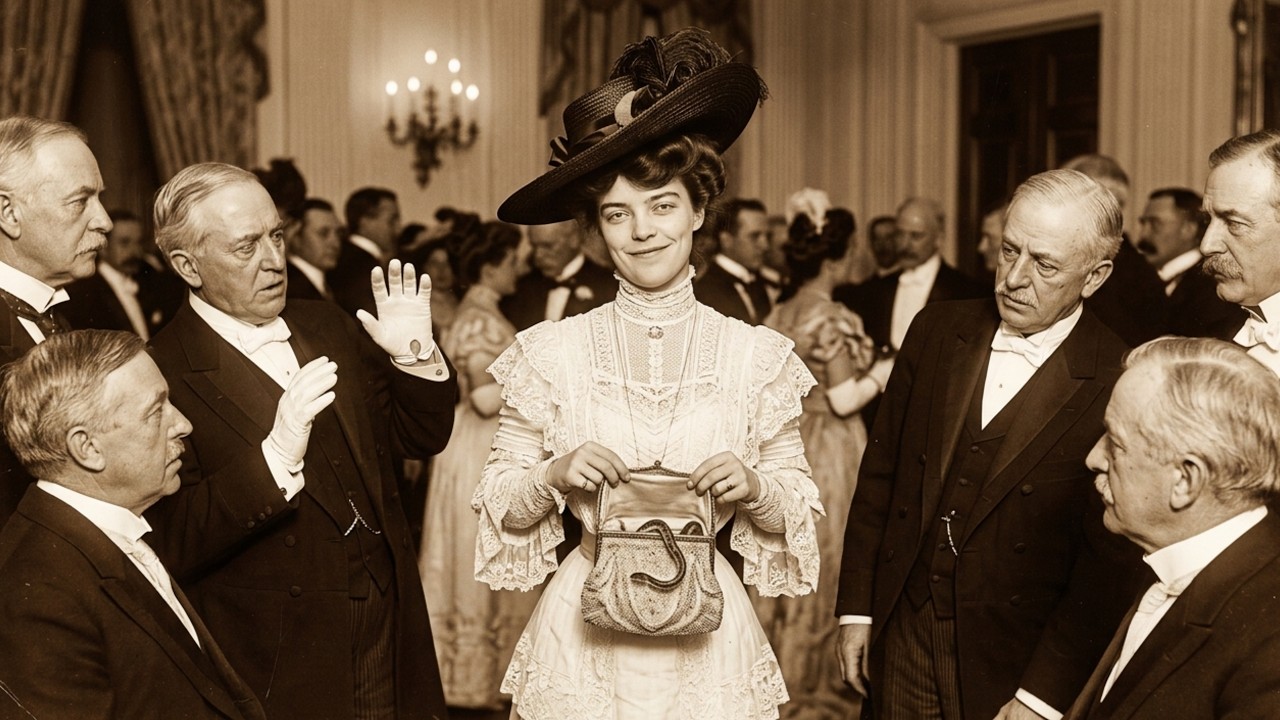
She attended parties that lasted until dawn and slept until noon. And then there was Emily Spinach, a small green garter snake she carried in her purse to social functions. She named it Emily Spinach because, she explained, it was as green as spinach and as thin as her Aunt Emily. She pulled it out at dinner parties.
She draped it across her shoulders at receptions. She used it the way a magician uses a prop, to control the attention of every person in the room. The press could not get enough of her. They covered her outfits, her outings, her opinions.
A popular song was written about her. A shade of grayish blue she favored became nationally known as Alice blue. The Alice Roosevelt Waltz played in dance halls across the country. By 1903, she received more newspaper coverage than any woman in the United States.
The coverage was not incidental. It was engineered. Alice understood that attention was a currency, and that fame, carefully managed, could be converted into access. And access, for a woman in 1902 who could not vote, could not hold office, and could not own property independently in most states, was the only form of political power available.
A visitor once asked Theodore why he did not do more to control his daughter’s behavior. Theodore replied that he could either run the country or he could control Alice, but he could not possibly do both. The line became legendary, quoted in every newspaper in America, confirming what Alice already knew. Her father would not stop her.
He could not stop her. She had found the one arena where Theodore Roosevelt would not compete. But she was doing something more sophisticated than rebellion. She was building a brand.
The term did not exist in 1902, but the concept did. Every time she smoked on the roof, she established herself as ungovernable. Every time she pulled Emily Spinach from her purse, she established herself as entertaining. Every time she stayed out past midnight, she established herself as someone who operated outside the rules that bound other women of her class and era.
This was construction, not recklessness. She was building a public identity that would survive long after her father left office. Other first daughters before her had been decorative. They smiled, attended state dinners, married well, and vanished from public memory.
Alice had no intention of vanishing. She carried a pistol in her purse alongside a copy of the Constitution and occasionally Emily Spinach. By the time she was 21, she was the most famous young woman in the United States, with no title, no money of her own, no formal education, and no political rights. She had celebrity.
And she was about to discover how to transform celebrity into something far more durable. In the summer of 1905, the United States sent a diplomatic delegation to Asia. The party included 23 congressmen, seven senators, and Alice Roosevelt. Officially, she was along as the president’s daughter, adding glamour to a goodwill tour.
Unofficially, she was Theodore’s secret weapon, a celebrity ambassador whose fame opened doors that diplomatic credentials could not. The trip lasted three months. They visited Japan, China, the Philippines, Korea, and Hong Kong. In Tokyo she met the emperor and empress.
In Manila she was received like visiting royalty. At every stop, the crowds came for her, not for the senators. She was 21 years old, famous across two continents, and she loved every minute of it. She also met Nicholas Longworth.
Nick Longworth was a congressman from Ohio, 14 years older than Alice, a product of Cincinnati’s wealthy Republican establishment. He was charming. He was well-connected. He played the violin beautifully.
He was also a dedicated alcoholic and a compulsive womanizer whose affairs would become legendary in Washington. Alice knew all of this before she agreed to marry him. She did not care. Her calculation was precise.
She needed a permanent position in Washington. Her father’s presidency would end. Her celebrity would fade without institutional backing. Nick Longworth offered a seat inside the Republican machine.
His family was wealthy. His district was safe. His ambitions pointed toward the leadership of the House of Representatives. Alice did not marry for love.
She married for position. She would later say, with the bluntness that became her signature, that she did not love Nick when she married him. She liked him. She found him amusing.
She recognized him as a vehicle. The wedding took place on February 17th, 1906. It was the largest social event Washington had seen in a generation. Over a thousand guests filled the East Room of the White House.
The bride wore a gown of white satin that cost, in today’s currency, roughly $45,000. She carried no bouquet. When it came time to cut the cake, she seized a military sword from an aide and slashed through it with a single stroke while the crowd gasped. The gifts arrived from every corner of the world.
King Edward VII of England sent a gold snuffbox. Kaiser Wilhelm of Germany sent a bracelet. The Empress Dowager of China sent bolts of silk. Cuba sent a pearl necklace.
The government of France sent a Gobelin tapestry. In total, Alice received more than 700 gifts from foreign governments, heads of state, and domestic well-wishers, with the value running to the hundreds of thousands of dollars. But the gift that mattered most was the one no one wrapped. Alice Roosevelt was now Alice Roosevelt Longworth, wife of a sitting congressman, daughter of a sitting president, and a permanent resident of Washington, D.
C. The marriage functioned exactly as Alice had designed it, as a professional partnership between two people who understood the rules. Nick drank. Nick had affairs.
Alice knew about the affairs and was indifferent. She had married him for access to the Republican caucus, to the committee rooms, to the men who made legislation. And she got what she paid for. Nick Longworth rose steadily through the House.
He became majority leader. In 1925 he became Speaker of the House, third in line to the presidency, the most powerful legislative position in the country. Alice was now the Speaker’s wife, with a front-row seat in the congressional gallery, and she used it every single day. But the marriage revealed something about the cost of Alice’s strategy.
She had traded intimacy for access. She had chosen power over love. And the emotional vacancy at the center of her marriage would eventually fill with someone else. Nick’s affairs were public and persistent.
Washington society gossiped about them openly. Alice’s response was not jealousy. It was competition. If Nick would not be faithful, neither would she.
The man she chose was one of the most powerful senators in Washington, a man whose political influence rivaled her husband’s. His name was William Borah, and the affair they began would produce a daughter, a scandal, and the most extraordinary double access to power that any woman in Washington had ever held. For 60 years, the most important political conversations in the United States did not happen in the Capitol Building. They happened at 2009 Massachusetts Avenue, and Alice Roosevelt Longworth decided who sat in every chair.
The house was not grand by Washington standards. It sat on a leafy stretch of Dupont Circle, a three-story brick townhouse with faded elegance and animal skins tacked to the walls. Books overflowed every surface. The furniture was old and mismatched.
The curtains needed replacing. Alice did not spend money on decoration. She spent money on food, on wine, and on the one thing that mattered more than either: the guest list. The dinner parties at 2009 Massachusetts Avenue became, over six decades, the most important informal institution in American politics.
It was an engineered system built with the same precision a political boss would use to construct a ward machine. Alice simply used different tools. Instead of patronage jobs, she offered conversation. Instead of campaign contributions, she offered access.
Instead of threats, she offered the one thing every politician in Washington craved and feared: her opinion. The mechanics of her power worked like this. Alice attended the congressional galleries nearly every day for decades. She sat in the visitor’s section of both the House and the Senate, watching debates, tracking votes, studying the body language of legislators as they made deals on the floor.
She listened to committee hearings. She read every major newspaper. She maintained personal relationships with members of both parties across the ideological spectrum. By the time she hosted a dinner party, she knew more about the current state of congressional politics than most members of Congress.
Then she used the seating chart as a weapon. She seated enemies next to each other. She put the chairman of a committee beside the man trying to unseat him. She arranged conversations between senators who had not spoken in months.
She created collisions, then watched what happened. At the table there was no escape. Men revealed their positions. They made promises they did not intend to keep.
They said things after their third glass of wine that they would not have said on the Senate floor. And Alice remembered everything. She never took notes. She never needed to.
Her memory was legendary. She could recall the precise wording of a remark made years earlier and deploy it at the exact moment it would cause the most damage or the most advantage. She was an intelligence operation disguised as a dinner party. Her dual access made the system extraordinary.
Through Nick, the Speaker of the House, she had complete visibility into the legislative agenda, the vote counts, the deals being made in the Republican caucus. Through William Borah, chairman of the Senate Foreign Relations Committee and her lover, she had direct access to the foreign policy machinery of the United States. She knew what the House was planning before the Senate did. She knew what the Senate Foreign Relations Committee was considering before the White House did.
No senator’s wife had access to the Speaker’s strategy. No Speaker’s wife had access to the Foreign Relations Chairman’s pillow talk. Alice occupied both positions simultaneously and used the information flow in both directions. A newspaper editorial in the 1920s identified her as one of the powerful influences affecting national affairs today.
The description was accurate and incomplete. Alice was not merely an influence. She was infrastructure. Senators who wanted to know the Speaker’s position on a bill came to her dinner table.
House members who wanted to understand the Senate’s mood came to her dinner table. Foreign ambassadors who wanted to read the political weather came to her dinner table. She made no secret of her power. She simply disguised it as entertainment.
In an era when women could not hold office and had only recently won the right to vote, Alice operated the most effective political intelligence network in the capital. She called herself a hostess. Washington called her a socialite. The men who sat at her table and watched her eyes move from face to face, cataloging every word, filing every weakness, knew better.
The pillow on her sofa said it plainly, embroidered in careful needlepoint: If you can’t say something good about someone, sit right here by me. Guests laughed at it. They should have read it as a warning. At the peak of her influence in the late 1920s, her dinner table functioned as an unofficial clearinghouse for Republican politics.
Policy was shaped there, alliances were formed there, and careers, when they displeased her, were ended there. Her wit was the enforcement mechanism. Alice’s quips circulated through Washington with the speed and lethality of bullets. She described Thomas Dewey, the 1944 Republican presidential nominee, as looking like the little man on top of a wedding cake.
The line destroyed his candidacy as effectively as any campaign attack. She described Calvin Coolidge as having been weaned on a pickle. She described Warren Harding as someone who looked like a president but acted like a sycophant. These were not casual observations.
They were calculated demolitions. Once Alice delivered a verdict, it stuck. Her wit had the authority of a judge’s ruling, because everyone in Washington knew two things about her. She was always watching.
And she was never wrong about character. But the system she built depended on a foundation that was, by its nature, unstable. It depended on a marriage that was a transaction, an affair that was an open secret, and a daughter whose very existence was a complication Alice had not planned for. On February 14th, 1925, exactly 41 years after death had torn apart Alice’s family, she gave birth to a daughter whose real father was the most powerful senator in Washington, and whose legal father was the Speaker of the House.
The date was not lost on Alice. Valentine’s Day, the day her own mother had died, the day the X had been drawn in Theodore’s diary, the day that had defined the first wound of her life. And now, on that same date, she was creating a new complication that would define the rest of it. The child was named Paulina.
She had dark features that bore no resemblance to the fair-haired, round-faced Nicholas Longworth. She bore a striking resemblance to William Edgar Borah, the Lion of Idaho, chairman of the Senate Foreign Relations Committee, and the man Alice had been sleeping with for years. Washington knew. The nickname that circulated through drawing rooms and cloakrooms was devastating in its precision: Aurora Borah Alice, a play on Aurora Borealis that named the scandal in three words.
Senators told the joke. Diplomats told the joke. The press, bound by the gentlemen’s agreements that governed coverage of political figures’ personal lives in the 1920s, printed nothing. Nick Longworth knew.
His response was characteristic. He said nothing. His own affairs were numerous and well documented. He was in no position to protest his wife’s infidelity.
Nick accepted Paulina as his legal daughter. He treated her with warmth. He played with her. He read to her.
Of the two people who had made her life possible, Nick Longworth was, by every account, the one who actually wanted to be a parent. Alice’s relationship with motherhood was complicated by the same emotional architecture that had defined her entire life. She had been abandoned by her own father. She had been raised by a woman who made clear that she was an obligation, not a joy.
She had never received the kind of unconditional love that teaches a person how to give it. And she had built her entire identity around power, control, and the conversion of personal pain into public performance. Paulina did not fit into that identity. A baby required softness.
A baby required patience. A baby required the one thing Alice had spent 41 years refusing to show: vulnerability. Alice looked at her daughter and saw, perhaps, what Theodore had seen when he looked at the baby named after his dead wife—a complication, a reminder, an obligation that competed with the work she considered more important. The work was politics, and in 1925 the work had never been more consuming.
Nick was Speaker. Borah ran foreign relations. Between them they controlled the domestic and international agendas of the Republican Party. And Alice, through the dinner table, through the bedroom, through the gallery where she sat every day watching both men operate, had more information about the direction of American policy than perhaps anyone outside the White House.
She used it to broker deals between the House and Senate. She used it to identify rising politicians and attach herself to their careers. She used it to maintain her position as the indispensable node in Washington’s social and political network. The cost of this position was paid primarily by Paulina, who grew up in a household where she was not the priority.
She was the daughter of two of the most powerful men in Washington, but neither of them was emotionally available to her. Nick loved her, but was frequently drunk and frequently absent. Borah could not acknowledge her publicly. And Alice, the woman who had turned emotional deprivation into a weapon, was now deploying that weapon in the room where her daughter was trying to grow up.
Paulina Longworth developed a stutter that grew worse every time her mother entered the room. She was shy. She was quiet. She was introverted in a family that celebrated volume, wit, and the capacity to dominate a room.
She had none of Alice’s ferocity. She had none of Theodore’s energy. She had inherited, perhaps from Borah’s more brooding temperament, a seriousness and a sensitivity that Alice found bewildering and eventually contemptible. Alice did not beat her daughter.
She did not starve her. She dismissed her. She ignored her. She made it clear, through a thousand small signals that children read with the precision of instruments, that Paulina was not interesting enough to hold her mother’s attention.
The stutter was the physical manifestation of this rejection. Paulina’s voice broke apart when Alice entered the room. It reassembled when she left. Nick Longworth died on April 9th, 1931, from pneumonia.
He was 61. Paulina was 6 years old. She lost the parent who had loved her without conditions, the parent who had held her, read to her, made her feel safe. She was left with Alice.
Alice grieved Nick in her own way, which is to say publicly and briefly. She lost the speakership and her most direct line to the House of Representatives. But she did not lose her salon. She did not lose her network.
She did not lose her wit. She adjusted. Paulina could not adjust. She grew up in Alice’s house, surrounded by adults who were dazzling, cruel, and always performing.
The dinner parties continued. The senators came and went. The quips flew. And Paulina sat in a corner, or in her room, trying to become small enough not to attract the devastating attention of her mother’s tongue.
Alice’s friends noticed. They later described Paulina’s childhood with the careful euphemisms that Alice’s social circle used for things that could not be said directly. Paulina was sensitive. She was fragile.
She needed special handling. What they meant was that Alice was a terrible mother, and everyone could see it, and no one could stop it. Paulina married Alexander McCormick Sturm in 1944. He was an artist and writer, a Yale graduate from a wealthy family.
The marriage was brief. Sturm drank heavily. He was diagnosed with hepatitis and died in 1951 at 31 years old, leaving Paulina a widow with a young daughter named Joanna. Paulina moved back to Washington.
She was depressed. She drank. She took pills. She sought the psychiatric help that was available in the 1950s, which was uneven at best.
She lived in Alice’s shadow, unable to escape the gravitational pull of a mother who could dominate any room and every person in it. On January 27th, 1957, Paulina Longworth Sturm was found unconscious in her home. The cause was an overdose of sleeping pills. She was 31 years old, the same age her husband had been when he died.
The death was ruled accidental, though the question of intent has never been fully resolved. Ten-year-old Joanna found her mother. The child walked into the room and saw the woman she loved most in the world lying motionless. Joanna would carry that image for the rest of her life.
Richard Nixon served as a pallbearer at the funeral. He was vice president at the time. The political world attended because Paulina was Alice’s daughter, because the Longworth name still commanded the rituals of Washington power. They buried Paulina at Rock Creek Cemetery.
Alice took custody of Joanna. She was 73 years old. She had raised one daughter, and that daughter was dead. Now she would raise another.
The question Alice never answered publicly, and perhaps never answered privately, was whether she understood her own role in Paulina’s destruction. She had been abandoned by her own father. She had been raised by a woman who treated her as an obligation. And she had done exactly the same thing to her own child, with the same result.
The wound she had spent her entire life converting into power had, in the end, been transmitted directly to the person who was least equipped to survive it. Before Paulina’s death and after it, the political warfare continued. When Woodrow Wilson tried to reshape the world after the First World War, Alice followed him across the country. The hatred was old.
Theodore had despised Wilson, who represented opposing parties, opposing temperaments, opposing visions of American power. Theodore was action. Wilson was ideology. When Wilson won the presidency in 1912, partly because Theodore’s third-party run split the Republican vote, Theodore considered it a personal defeat.
When Wilson kept America out of the European war that Theodore believed the country was morally obligated to fight, the hatred became existential. Theodore’s youngest son, Quentin, was killed in aerial combat over France in 1918. Theodore blamed Wilson for the delay that made the war more costly. He died believing Wilson had failed the nation.
Alice inherited that hatred and weaponized it. Wilson’s great project was the League of Nations, attached to the Treaty of Versailles, which ended the war. To take effect, the treaty needed to be ratified by two-thirds of the United States Senate. Wilson believed the Senate would comply.
He was catastrophically wrong, and Alice Roosevelt Longworth was one of the reasons why. The opposition centered in the Senate, led by a group known as the irreconcilables, senators who opposed any American participation in an international body that could commit the country to foreign wars. The most prominent irreconcilable was William Borah, Alice’s lover, the chairman of the Senate Foreign Relations Committee, the man whose pillow she shared and whose political strategy she helped shape. Alice did not sit quietly in the gallery during this fight.
She organized. She lobbied senators directly, inviting wavering Republicans to her dinner table and making the case against the League with a combination of strategic argument and social pressure that few politicians could resist. Declining Alice’s invitation was politically expensive. Accepting it meant sitting across from Borah, from Henry Cabot Lodge, from the most articulate opponents of Wilson’s vision, and being subjected to an evening of persuasion disguised as hospitality.
She also took the fight public. When Wilson embarked on his nationwide speaking tour to build popular support for the League, Alice followed him. She attended his rallies. She sat in the audience and, according to multiple accounts, made her displeasure visible.
One account described her making a voodoo doll of Wilson. Another described her cursing him under her breath as his train passed. These details may be embellished, but the core fact is verified. Alice Roosevelt Longworth physically shadowed the President of the United States across the country as he campaigned for the most important initiative of his presidency.
Wilson collapsed during the tour. He suffered a massive stroke in October of 1919 and was incapacitated. In November, the Senate rejected the Treaty of Versailles and the League of Nations. The vote was not close.
The irreconcilables held firm. The wavering senators wavered the wrong way. The coalition that Alice had helped assemble, fed, and strategized with at her dinner table had won. The United States did not join the League of Nations.
Without American participation, the League lacked the power to prevent the rise of fascism in Europe. Whether the League could have prevented the Second World War is a question historians still debate. What is not debated is that the Senate’s rejection of the League was one of the most consequential foreign policy decisions of the 20th century. And Alice Roosevelt Longworth, a woman who could not vote until the following year, had helped engineer it.
The 19th Amendment was ratified on August 18th, 1920. Alice was 36 years old. She had spent the first 18 years of her adult life wielding political influence in a country where she had no formal political rights. She had helped shape world history before she could cast a ballot.
The irony was not lost on her. It simply did not slow her down. In 1933 the country was in the grip of the Great Depression. Thirteen million Americans were unemployed.
Banks had failed in the thousands. Farm foreclosures had devastated the Midwest. And into the White House walked Franklin Delano Roosevelt, a man Alice had known since childhood and despised with a specificity that bordered on art. The hatred was tribal.
Franklin was a Hyde Park Roosevelt, not an Oyster Bay Roosevelt. He was Eleanor’s husband. He was a Democrat. He represented, to Alice, the theft of the Roosevelt name by the wrong branch of the family.
The Oyster Bay Roosevelts had watched with horror as Franklin appropriated the Roosevelt legacy, the Roosevelt energy, and the Roosevelt name for a political vision Theodore would have rejected. Alice’s response was not retreat. It was performance. When Franklin took the United States off the gold standard in 1933, a move that horrified the Republican establishment, Alice appeared at the White House wearing every piece of gold jewelry she owned.
Necklaces, bracelets, brooches. She wore a dress in Alice blue, the color that had been named for her 30 years earlier, the color that reminded everyone in the room that she had been the most famous Roosevelt in America before Franklin was in a wheelchair. She smiled as she walked through the door. The smile said, I was here before you.
I will be here after you. She kept coming back. She attended Franklin’s social events. She sat in Eleanor’s living room, and she sharpened her wit against the New Deal with a cruelty that became legendary even by Washington standards.
The Eleanor impersonation was her most devastating weapon. Alice could mimic Eleanor’s voice, her mannerisms, her earnest speaking style with lethal accuracy. She performed it at dinner parties, at gatherings, in any room where an audience was available. The audience laughed.
They always laughed. Alice’s mimicry was genuinely funny, and the social dynamics of 1930s Washington meant that laughing at Eleanor Roosevelt, even behind her back, was a way of signaling opposition to the New Deal without making a political speech. Eleanor knew about the impersonation. She endured it with the dignity that defined her public persona.
The two women, both Roosevelts by marriage, both wielding immense influence, represented fundamentally different models of female power. Eleanor worked within the system. She used her position as first lady to advocate for the poor, for civil rights, for women. She published a newspaper column.
She gave speeches. She operated in the open. Alice operated outside the system. She used her salon, her wit, and her network to oppose the same administration Eleanor was supporting.
She wrote a newspaper column for a time, placed directly alongside Eleanor’s in some papers, the two Roosevelt women arguing across the page like dueling editorials. Alice’s column was sharp. Eleanor’s was more compassionate. The contrast told you everything about the two women and the two visions of power they represented.
But Alice’s position in the 1930s was precarious in ways her position in the 1920s had never been. Nick was dead. She had lost the speakership. Borah was aging and his influence was waning.
The Republican Party was out of power and would remain so for two decades. Alice’s salon continued, but the guests were increasingly from the opposition, the party of complaint rather than the party of governance. And she was running out of money. The Longworth fortune had never been enormous, and Alice’s spending had never been restrained.
By the late 1930s she was endorsing commercial products to pay her bills. She appeared in advertisements for Pond’s Cold Cream. She endorsed Lucky Strike cigarettes. Alice Roosevelt Longworth, daughter of a president, wife of a speaker, the woman who had dined with kings and shaped treaties, was selling face cream to support her household.
She also flirted with the wrong crowd. In the late 1930s, as war gathered in Europe, Alice became involved with the America First Committee, the isolationist movement that opposed American entry into the Second World War. Her motives were partly ideological. She was a genuine isolationist who believed, as her father’s generation of Republicans had believed, that America should avoid European entanglements.
But her motives were also personal. The war was Franklin’s cause. Opposing the war was opposing Franklin, and opposing Franklin was Alice’s most consistent political position. The America First involvement damaged her reputation.
The committee included genuine anti-interventionists, but it also attracted anti-Semites and Nazi sympathizers. Alice was neither, but her presence lent respectability to a movement that would be remembered after Pearl Harbor as having been on the wrong side of history. December 7th, 1941 ended the debate. Japan attacked Pearl Harbor.
America entered the war. The America First Committee dissolved. And Alice, stripped of institutional support, her party out of power, her finances strained, her reputation complicated, did what she had always done when the ground shifted beneath her. She stayed.
She stayed in Washington. She stayed at 2009 Massachusetts Avenue. She stayed at the dinner table. She waited for the world to come back to her.
And eventually, because Alice Roosevelt Longworth had understood something fundamental about the power that most politicians never grasp, it did. Power in Washington is not about winning. It is about lasting. And no one in the history of the American capital lasted longer than Alice.
At 86 years old, Alice Roosevelt Longworth survived her second mastectomy, and when asked how she felt, she called herself Washington’s only topless octogenarian and poured another drink. The body had been failing for decades, the accumulated cost of a life lived at maximum intensity. Alice had smoked since she was 17, since the days on the White House roof when the smoke was a signal and the cigarette was a prop. By her 70s, the emphysema was severe.
Breathing became labor. Stairs became an event. The cancer came twice. The first mastectomy was performed in her 80s.
She recovered. The second came shortly after. She recovered again. The joke was the armor.
It had always been the armor. 2009 Massachusetts Avenue was deteriorating alongside its owner. By the 1970s it was a monument to organized decay. The animal skins on the walls were thinning.
The books, thousands of them, had overtaken every flat surface and were stacked on the floors. The furniture was old, mismatched, the upholstery faded. Alice had planted poison ivy on the exterior of the house after a burglary, a detail so perfectly Alice that it reads like fiction. The message was clear.
This house belongs to someone who will make you regret coming uninvited. But the mind remained. That was the miracle and the cruelty of Alice’s old age. The body that had carried her through nine decades of performance was collapsing.
But the intellect that had made her the most dangerous conversationalist in Washington was untouched. She read voraciously. She followed politics with the same obsessive attention she had brought to the congressional galleries 50 years earlier. She still received visitors.
She still delivered verdicts. She still made the powerful men of Washington laugh and then lie awake at night wondering what she had meant. The dark humor was not a performance. It was a philosophy.
Alice had spent her entire life refusing to be pitied. She had been abandoned, betrayed, financially ruined, physically devastated, and bereaved of her only child. She had responded to each blow the same way: with a joke that made the listener flinch. This was not resilience in the inspirational poster sense.
This was resilience as a survival mechanism developed by a woman who learned at two days old that the world would not take care of her. Alice’s humor was not joy. It was control. As long as she was making the joke, she was defining the terms.
As long as the room was laughing, she was still in charge. Joanna Sturm was 10 years old when she found her mother dying. The woman who took her in was the same woman who had helped make that death inevitable. Alice Roosevelt Longworth, the woman who had ignored her own daughter into despair, was now the sole guardian of her daughter’s child.
Something changed. The change was not dramatic. Alice did not suddenly become warm. She did not become soft.
But she did something she had never done with Paulina. She paid attention. Alice and Joanna became, in Alice’s words, free spirits together. They lived in the crumbling house on Massachusetts Avenue.
They read. They talked. They watched the political circus from Alice’s permanent front-row seat. Whether this was love or guilt or simply the recognition that she had been given a second chance at something she had ruined, Alice never said.
She was not a woman who explained her motivations. She acted. And the action, in Joanna’s case, was presence. Alice was there.
She had not been there for Paulina. She was there for Joanna. The late years brought evolution. In her 80s and 90s, the woman who had opposed the New Deal, who had flirted with America First, who had spent decades as the queen of Republican conservatism, began saying things that startled her oldest friends.
She called Gloria Steinem a hero. She expressed admiration for the feminist movement. She told interviewers she had been a feminist before the word existed, that her entire life had been a refusal to accept the limitations men placed on women. On national television she declared herself a hedonist.
She discussed the sexual revolution with the delight of a woman who had been conducting her own sexual revolution since 1905. In 1976, at 92 years old, she attended the Bicentennial dinner at the White House and met Queen Elizabeth II. Two women who had outlasted every man who had ever underestimated them, seated side by side at a table in a house Alice had once ruled. The 60 Minutes interviews from her final years are remarkable.
Alice at 90 was as sharp, as funny, as devastating as Alice at 25. The wit had not dulled. The memory had not faded. The capacity to reduce a powerful man to rubble with a single sentence was, if anything, improved by seven decades of practice.
She had outlasted Theodore. She had outlasted Wilson. She had outlasted both Franklins. She had outlasted Nick, Borah, every senator who had sat at her table, every president who had walked through her door.
She had outlasted the political system that had refused to give her a vote for the first 36 years of her life. And she had, perhaps, outlasted the worst version of herself. The version that had destroyed Paulina. The version that had turned emotional deprivation into a weapon and pointed it at her own child.
With Joanna, she had not repeated the pattern. She had not broken the cycle. She had simply, finally, showed up. It was not redemption.
It was not enough. But it was something. Alice Roosevelt Longworth died on February 20th, 1980. She was 96 years old.
She had been a public figure for 79 of those years, from the moment her father became president in 1901 to the morning she died in the house on Massachusetts Avenue. No one in American political history, man or woman, had maintained a position of influence for that long. No one had done it without holding office, without controlling a fortune, without commanding anything except a dining room, a guest list, and the most lethal wit in the history of the American capital. They cremated her.
They took her ashes to Rock Creek Cemetery and placed them in Paulina’s grave. It was the final act of a life defined by the tension between power and love, and it was perhaps the only time Alice Roosevelt Longworth admitted that she owed her daughter something she had never paid. The Longworth House Office Building still stands on Capitol Hill, named for Nicholas. Alice’s name is not on any building.
Her name is on a color. Alice blue, the shade of grayish blue she made famous at 20 years old, the color that launched a song, a gown, a cultural moment. It is a fitting memorial for a woman whose power was always disguised as something lighter than it was. The embroidered pillow is in the Smithsonian now.
If you can’t say something good about someone, sit right here by me. Tourists photograph it. They laugh. They do not understand that they are looking at the mission statement of the most effective political operation in Washington history.
What Alice Roosevelt Longworth built was not a dynasty. It was not a fortune. It was not an institution with a charter and a board of directors. It was a room.
A room with a table and chairs and a woman who decided who sat where. From that room for 70 years, she shaped legislation, destroyed careers, brokered alliances, and helped determine the foreign policy of the United States. She did this without a vote for the first 36 years. She did this without a title for all 96.
She did this in a country that was not built for women to hold power, in a system that called her a socialite and a hostess and a wit, as if those words were smaller than senator and president and chairman. They were not smaller. They were camouflage. Consider what she accomplished.
She helped defeat the League of Nations, reshaping the international order. She operated a political intelligence network that informed both chambers of Congress. She maintained simultaneous access to the Speaker of the House and the chairman of the Senate Foreign Relations Committee. She entertained 17 sitting presidents across eight decades.
She survived two mastectomies, the death of her daughter, the collapse of her party, the loss of her fortune, and the slow decay of the house she refused to leave. And through all of it, she sat at the head of her table and waited for the next person who thought they understood how Washington worked. She did not ask for permission. She did not wait for invitation.
She did not petition the system to make room for her. She built a room of her own. She set the table. She chose the guests.
And she made the most powerful men in the country come to her. Every woman who has wielded informal political power in Washington since has operated in the space Alice Roosevelt Longworth created. Every woman who has understood that access is power. Every woman who has known that the real decisions happen not on the floor of the Senate, but in the room where the senators go afterward.
Alice did not wait for the world to change. She did not wait for the 19th Amendment. She did not wait for the laws to catch up to her ambition. She walked into the room where the decisions were being made.
And she sat down. The room on Massachusetts Avenue is quiet now. The table is gone. The chairs are empty.
The poison ivy still grows on the walls. But the door she opened has never closed.
