On June 15th, 1952, a man slipped into the Shelborne Hotel in London and drove a double-edged knife into the chest of Christine Granville. She died almost instantly. Hotel staff thought she had fainted, only realizing the truth when they discovered the blade. The killer made no attempt to flee.
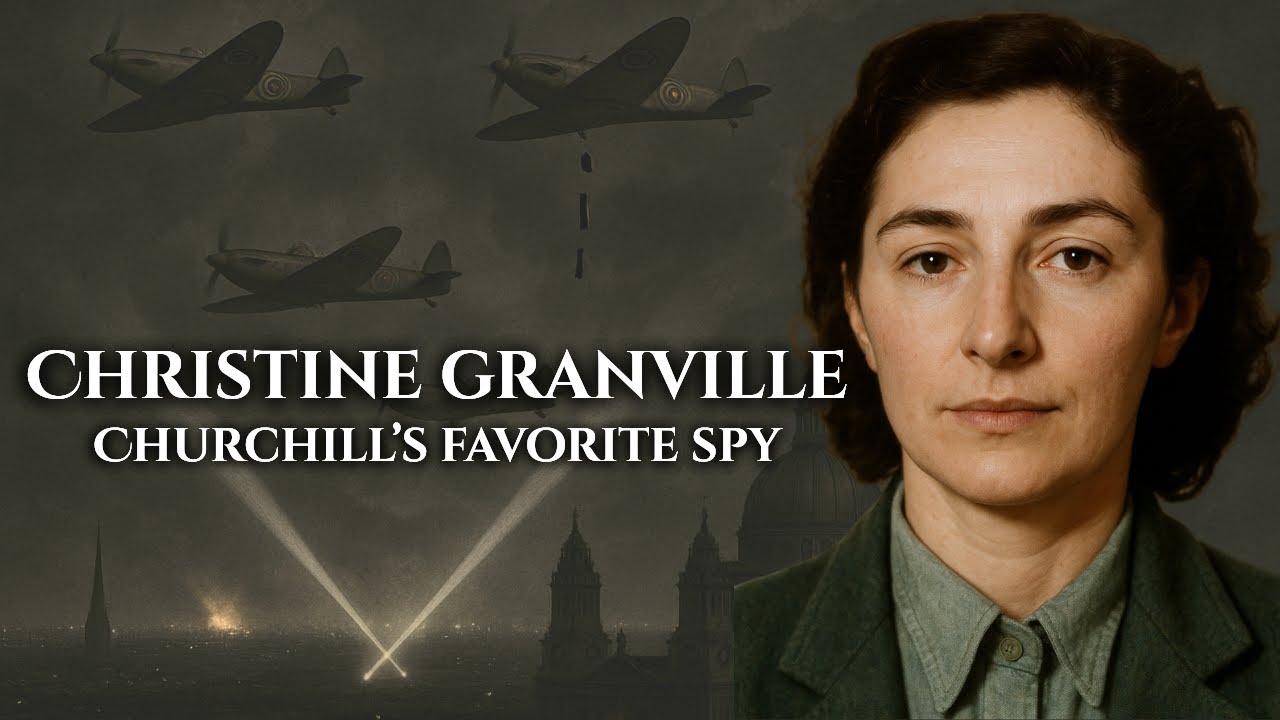
“I did it because I loved her,” he mumbled. He was a socially awkward ship’s steward named Dennis Muldowney, and he had just murdered one of the most decorated women of the Second World War—a woman who had parachuted into occupied France, walked out of Gestapo custody, and faced down death so many times that her survival had become legend. The Gestapo had never caught her. A stalker did.
She had not always been Christine Granville. She was born Maria Christina Janina Skarbek on May 1st, 1908, in Warsaw, then under Russian rule. Her aristocratic family was steeped in Polish patriotism even while Poland itself was absent from the maps of Europe. Her father, Count Jerzy Skarbek, was a charismatic but reckless nobleman whose title carried more social weight than official standing.
A proud patriot, he instilled defiance in Christina, who would one day wear his signet ring instead of a wedding band. The family boasted ties to Chopin’s patron, Count Fryderyk Skarbek. But Jerzy squandered his fortune through gambling, and his financial ruin forced him into a scandalous marriage of necessity with Stefania Goldfeder, a wealthy Jewish heiress whose influential family—connected to the Habsburgs and to Poland’s honorary consul in Japan—secured the Skarbek social standing. As Jerzy’s excesses drained their wealth, tensions rose.
Christina, adored by her father, embodied his fearless spirit, outshining her timid brother, Andrzej. In 1912, Jerzy purchased the estate of Tęczno, where Christina thrived. Preferring adventure over aristocratic refinement, she rode horses, climbed trees, and tamed Satan, a feared stallion. Defying Stefania’s objections, Jerzy taught her to shoot, ride, and wield knives.
At eleven, she met a young aristocrat named Andrzej Kowerski, a fateful connection for her future. Her education was tumultuous: at fourteen, she was expelled from a convent school for setting fire to a priest’s cassock. By eighteen, she abandoned formal education entirely, immersing herself in Warsaw’s culture and sensing adventure ahead. The family’s financial collapse in 1926, worsened by the failure of the Goldfeder bank, forced them into a cramped Warsaw apartment.
Jerzy, now a disgraced alcoholic, abandoned them and died of tuberculosis in 1930. Refusing to be defined by hardship, Christina embraced Warsaw’s nightlife, mingling with artists like Witold Gombrowicz. Seeking independence and a way to support her mother, she took a job at a Fiat dealership, where she met a wealthy businessman named Gustav Getlich. Their courtship revolved around luxury, but Christina’s health suffered from the exhaust fumes.
Sent to recover in Zakopane, she perfected her skiing and smuggled cigarettes with the local highlanders. She married Gustaw in 1930, but soon craved adventure, earning the title Miss Ski in 1931. She divorced in 1932, keeping his name in the settlement. Rejected by an aristocrat named Adam due to her background, she later met Jerzy Giżycki, an adventurer and diplomat.
Their romance, reportedly beginning when he lassoed her like a runaway horse, led to their marriage in 1938. Christina thrived in diplomatic circles, and rumors swirled that she was already working for British intelligence. In late 1938, she traveled to Africa with Jerzy, gaining insight into Jewish politics and anti-Semitism before settling in Kenya. In September 1939, Germany invaded Poland.
Britain and France declared war. Stranded in Africa, Christina and Jerzy sold their car and boarded a ship for Britain, dodging German U-boats. Learning that Poland was occupied but had not surrendered, Christina refused to sit out the war. Polish forces were regrouping in France, but Jerzy was deemed unfit for combat.
Women were barred from fighting. She would not wait. By December 1939, British intelligence had taken note of a flaming Polish patriot, an expert skier, a great adventurer who was absolutely fearless. She proposed a daring mission.
Unlike others awaiting recruitment, she forced her way in. How she entered British intelligence remains unclear—she likely used her political and journalistic connections—but once inside, she impressed senior officers and swiftly gained approval for her mission. On December 20th, 1939, under the alias Madame Marchand, Christina was dispatched to Budapest, a crucial gateway into occupied Poland. Operating as a foreign journalist, she navigated Budapest’s intelligence scene, clashing with her contact, Hubert Harrison, while Polish intelligence monitored her closely.
Thousands of Polish refugees flooded Hungary, including soldiers escaping both Nazi and Soviet rule. Among them was Lieutenant Andrzej Kowerski, an old acquaintance and now a war hero. Having lost a leg in a hunting accident, he had adapted seamlessly, replacing horseback riding with fast cars and leading daring escapes. He ran an underground network from Budapest’s red-light district, smuggling Polish soldiers across borders.
The two reunited at Café Flores, a haven for spies and journalists. Their connection was immediate, their romance fueled by shared patriotism and wartime urgency. They called each other “Kotka” and “Kotek”—she-cat and he-cat. They lived as if every day could be their last.
Christina, growing restless, assisted Andrzej’s operations while waiting for clearance to enter Poland. She helped establish Freedom Station, a clandestine radio transmitting Allied propaganda, impressing British intelligence even as some found her morally ambiguous. An admirer she had rejected, Józef Różański, spiraled into obsession, first shooting himself in the foot in her flat, then surviving a failed suicide attempt. Christina dismissed him with characteristic coldness.
By late February 1940, her mission was finally approved. Andrzej secured legendary Polish skier Janek Marusarz as her guide for the treacherous journey across the Carpathians. Disguised as Zofia Andrefska, Christina set off into minus-thirty-degree conditions. The brutal trek tested her endurance.
Ice formed on her eyelashes, and a blizzard nearly cost them their lives. One morning they discovered the frozen bodies of a young couple locked in an embrace. She covered their faces with pine branches, drew a cross in the snow, and pressed on. Reaching Zakopane, she confirmed her survival to Andrzej via a coded postcard before heading to Warsaw.
The once-grand city was now a Nazi stronghold, its boulevards reduced to ruins. As she neared Warsaw Central Station, Gestapo officers began searching passengers. Thinking fast, she charmed a German officer into carrying a parcel of tea for her sick mother. Inside were hidden documents.
He unwittingly aided her mission, and she retrieved the package upon arrival. Warsaw was unrecognizable. The city was partitioned, the ghetto established, Nazi terror reigned. Governor Hans Frank’s brutal rule saw mass executions, but Polish defiance only grew.
Unlike in other occupied nations, Poland had no major collaborationist movement—only submission or resistance. But Christina had not returned to mourn. She had come to fight. By early 1940, Poland’s underground press flourished despite Nazi suppression, spreading propaganda and even using fake German orders to sow chaos.
The resistance, though fragmented and under-armed, smuggled weapons, bribed German officers, and manufactured arms in Nazi-run factories. By 1944, the Home Army would become the largest underground force in occupied Europe, while the Polish Jewish underground helped over 100,000 people escape the Holocaust. Christina’s inexperience led to missteps—repeating her mountain-crossing story too often drew suspicion. The ZWZ, Poland’s main underground force, distrusted her British ties, so she joined Stefan Witkowski’s Musketeers, a secretive but extensive network.
Tasked with securing British funds under the code name Mucha, she spent three weeks spreading propaganda, printing ten thousand underground newspapers, and proposing radio broadcasts. But her presence drew danger. Volksdeutsche spies sought to discredit her, and British intelligence dismissed her proposal to aid anti-Soviet guerrillas. She was struck by Nazi disorganization and witnessed senseless brutality, from starving child couriers to public executions.
“The terror is indescribable,” she reported, “yet the spirit of the Poles is magnificent. ”
An acquaintance nearly exposed her, forcing her to flee Warsaw. Over two weeks, she gathered intelligence on German supply lines, observing locked train cars filled with Bavarian troops and soldiers kept drunk to maintain morale. Before leaving, she retrieved microfilm from Witkowski and prepared for the journey back to Hungary with Count Władysław Lechowski, a nobleman and ZWZ courier.
They traveled separately but reunited at his safe house before making a dangerous border crossing under gunfire. At her Budapest flat, they found Józef Różański, whose possessiveness sparked Lechowski’s suspicion. Christina dismissed it, but tensions with Andrzej and Lechowski deepened. Her husband, Jerzy, still in France, grew anxious over her silence, unaware of her clandestine work.
British intelligence remained inactive, frustrating Christina. She assisted Andrzej’s escape network and smuggled a Polish anti-tank rifle to the French, hiding it inside her mattress before Hungarian police raided her contact’s room. When France fell, she was stranded in Budapest without pay. Branded a security risk, Polish intelligence warned Lechowski to avoid her.
But Christina was determined to return to Warsaw. She mingled with foreign journalists, including Manchester Guardian correspondent Basil Davidson, whom she scolded for sitting in Budapest instead of fighting. Commissioned to deliver funds and underground press materials to Warsaw, she planned a dangerous crossing with Lechowski. Before departing, he pawned his watch to buy her a flint glass necklace.
“Are you mad? ” she scolded, though she admired it in the mirror. Days later, she returned defeated. Flooding and patrols had made the crossing impossible.
Furious to learn that Andrzej and Lechowski had a pact to flee Hungary if she didn’t return, she vowed to try again. Lechowski was soon assigned to smuggle microfilm confirming General Bór-Komorowski’s promotion. The night before, Christina led him into Budapest’s Acacia Woods, rekindling their romance. With rucksacks filled with propaganda and cash—anything that could seriously compromise her if caught—they set off.
Andrzej, fearing for her safety, secretly removed photos of Sikorski with Churchill. Suspecting him, she repacked them. At dawn they reached the mountains but lost time avoiding patrols. Hungarian police, now under Gestapo control, fired as they sprinted across a road into Slovakia.
In a railway station, they were arrested. Lechowski burned false documents while Christina charmed an officer, but both were sent to the Gestapo. On the Iron Bridge into Poland, she faked a limp while Lechowski discreetly tossed the Sikorski photos into the river. Chaos erupted.
Guards scrambled for the package while others pinned Lechowski against the railing, threatening to shoot. Christina threw herself between them, screaming that it was just money and newspapers. The bundle was lost, and their cover was blown. Under interrogation, Lechowski’s Madonna medallion—a known resistance symbol—was discovered.
Preparing for execution, he offered Christina his cyanide capsule. But at 2:00 a. m. , an opportunity arose.
Christina pretended to grab her necklace, scattering beads across the floor. As guards scrambled, Lechowski knocked out the torch and dragged her up the embankment under gunfire. Christina fell, and he thought she was dead. But she had only injured her leg.
Two days later, exhausted but alive, they reached Budapest, where Andrzej was waiting. Though they had survived, they felt they had failed. The funds were lost, and Christina’s documents were now in German hands. Soon her face was plastered across Polish railway stations—£1,000 dead or alive.
But she was determined to return. Knowing they couldn’t stop her, Andrzej and Lechowski convinced her that her intelligence work was now more valuable elsewhere. Lechowski was sent back to the army and later fought in North Africa. Jerzy, now in London, tried to secure Christina’s passage to Canada.
Receiving no response, he accepted an intelligence post in West Africa, leaving one final letter: “If I do not return, kindly take care of my wife. ”
By summer 1940, Budapest had become a crucial hub for evacuating Polish and British prisoners of war, particularly pilots vital to the Battle of Britain. That year, Polish pilots shot down 201 aircraft, delivering Hitler’s first major defeat. Christina and Andrzej expanded their network, smuggling intelligence, arms, and money while aiding Polish pilots.
Andrzej helped five thousand internees escape, and Christina crossed the Polish border six times, often hiding microfilm in her gloves or behind a panel in Andrzej’s wooden leg. Their exploits became legendary—dodging Luftwaffe gunfire, bluffing border guards, surviving police shootouts. Even humor persisted. During one chase, Christina shielded Andrzej’s head with her handbag, prompting him to joke that her knickers would have been a better choice.
Her reputation grew. British intelligence called her “remarkably courageous and intelligent,” and even the skeptical British ambassador to Hungary, Sir Owen O’Malley, was won over, securing unlimited funding for their operations. By late September 1940, they escalated their sabotage, tracking Romanian oil shipments and mining fuel barges to cripple Nazi supply lines. O’Malley, once hesitant about sabotage, later remarked that Christina could do anything with dynamite except eat it.
But their activities drew Nazi attention. Andrzej was arrested three times. When they identified an informant, he was plied with slivovitz until he passed out in the cold—dead by morning, the scent of cyanide lingering. In October, Christina learned of sixteen British pilots hiding in a Warsaw asylum, fearing Nazi plans to exterminate the disabled.
Denied British support, she acted alone. Crossing the Zarnora Mountains into Ukraine, she reached Warsaw in five days, only to find that most of the airmen had already moved into Soviet-occupied territory. She secured the escape of two and enlisted O’Malley’s help to smuggle others, forging passports and personally escorting them to Belgrade. She returned to Budapest with critical intelligence, including blueprints for U-boat factories and Warsaw-London radio frequencies hidden in an Anglo-Russian dictionary and thirty-five millimeters of film inside her gloves.
While in Warsaw, she checked on her Skarbek cousins and visited her mother, Stefania. Still refusing to register as Jewish or flee to the ghetto, Stefania believed her aristocratic name would protect her. Christina pleaded with her to leave. She refused.
A year later, the Gestapo arrested her. She was taken to Pawiak prison—ironically designed by Christina’s ancestor, Fryderyk Skarbek—where she likely perished. Some claim Christina attempted a rescue, bribing a Gestapo officer who later left her a note saying Stefania had already been sent to Auschwitz. Another version suggests the officer demanded $300 and a night with Christina in exchange for her mother’s life, only to reveal afterward that it was too late.
Whether she truly tried to save Stefania or carried the guilt for the rest of her life remains unknown. By November 25th, Christina returned to Budapest, physically and emotionally drained. She spent Christmas with Andrzej, too ill to return to Warsaw. By early 1941, as Hungary tightened its grip, Andrzej sensed their time was running out.
When police pounded on their door at 4:00 a. m. , Christina smiled as if heading to a cocktail party. While police searched, she discreetly flushed incriminating diary pages, quipping, “Isn’t it usual to flush the loo after use?
” Though they found nothing, both were arrested. Andrzej endured nineteen brutal hours of Gestapo interrogation—beaten, stripped, shown a bloodied prisoner as a warning. Christina, pale but composed, greeted him in Hadik prison. “The doctor says I am not well.
” She had outwitted her captors, exaggerating symptoms and biting her tongue to spit blood, leading doctors to suspect tuberculosis. An X-ray revealed lung shadows from her Fiat factory days, and fearing infection, the Gestapo ordered her release. Freed under surveillance, Christina and Andrzej knew they had to escape. O’Malley and his wife, novelist Anne Bridge, took it upon themselves to help them flee Hungary.
O’Malley issued them British passports, Andrzej becoming Anthony Kennedy and Christina adopting the name Christine Granville—which she would use for the rest of her life. She also shaved seven years off her age, listing her birth year as 1915. Using Andrzej’s hidden Opel Olympia, they slipped past the police and made their way to the British Legation. O’Malley arranged for Christine to be smuggled across the Yugoslav border in a diplomatic car trunk while Andrzej followed separately.
At the border, a Hungarian officer hesitated before offering a salute and waving them through. Once inside Yugoslavia, Christine emerged from the Chrysler’s boot, stretched, laughed, and raised a toast. Free at last. In early 1941, they reunited with allies in Belgrade, celebrating in clubs and belly-dancing bars.
Coincidentally, Christine met two RAF pilots she had once helped escape. Sir Owen later remarked that facilitating Christine’s escape had been “not part of a minister’s duties, nor was entertaining airmen in Serbian nightclubs. ” Yet he became one of her strongest advocates, calling her “extremely obstinate, individualistic, attractive, and moody,” but possessing “unexampled courage. ” His real challenge, he admitted, was finding her a job sufficiently risky and bloodthirsty to satisfy her.
By then, Section D had disbanded. Its agents were absorbed into Churchill’s newly formed Special Operations Executive—SOE—tasked with sabotage and resistance support. Christine’s old contact, George Taylor, now led SOE’s Balkan section and needed a new Budapest agent. To Andrzej’s dismay, Christine suggested her estranged husband, Jerzy.
Fluent in multiple languages, an expert skier, and a skilled organizer, Jerzy had long lobbied for a Balkan post. Suspecting he only wanted to reunite with Christine, the British had stalled his deployment. But by early 1941, he took matters into his own hands, leaving West Africa for Cairo, determined to reach her. In February 1941, Christine and Andrzej set off for Egypt, carrying microfilm hidden in her gloves.
Their battered Opel struggled through rain and mud before they reached Sofia, Bulgaria—a city teeming with spies and Nazi operatives. On the last Sunday of February 1941, they arrived at the British Legation in Sofia, surprising attaché Aiden Cwiley with letters of introduction and crucial rolls of microfilm from Sir Owen. The film revealed Hitler’s preparations for a massive invasion of the Soviet Union—tanks, troops, and supply depots along the eastern border. While Cwiley was cautious due to Christine’s ties to the Musketeers, a group under suspicion, he recognized the intelligence’s significance.
The materials were quickly sent to Churchill, offering the first concrete evidence of Germany’s plans to turn on its Soviet ally. This potential shift in alliances gave new hope to the British, who were relying on exiled resistance forces after the fall of France. In Istanbul, they resumed courier work, strengthening ties with Polish and British contacts while under German surveillance. Christine sent gifts to the O’Malleys, describing a rosary as smelling like an old cathedral.
But the war caught up with them. On March 17th, Christine’s husband, Jerzy, arrived. Sensing her bond with Andrzej, he chose to blame the war rather than betrayal, and focused on his mission—smuggling intelligence and people under a British alias. When Nazis murdered his sister and her children in Ukraine, his fight became deeply personal.
The Balkans fell into chaos. Yugoslavia collapsed in eleven days, and Britain cut ties with Hungary. Jerzy evacuated with the British Legation and lost contact with Christine. Meanwhile, despite mounting dangers, the Budapest network continued its work.
Christine and Andrzej escaped through Vichy-controlled Syria and Lebanon, bribing officials for visas. Andrzej even recovered their Opel. In Haifa, Christine took a brief respite, walking barefoot on the beach before pressing on to Jerusalem. Expecting a hero’s welcome in Cairo, they were met with suspicion.
SOE interrogated them separately, and both the Polish and British communities shunned them. A secret Polish report falsely accused Christine of causing an agent’s death. Her real crime was her past ties to Stefan Witkowski’s Musketeers, a rogue intelligence group distrusted by Polish command. Though the British valued her reports, Poland saw her as a liability.
By mid-1941, as Britain sought to appease its Polish allies, Christine and Andrzej were sidelined, banned from Polish affairs despite years of risking their lives for the cause. Christine wrote to Kate O’Malley about being “left on ice. ” Andrzej, ironically, received Poland’s highest military honor, the Virtuti Militari, the same day he was denounced. Their only hope lay with SOE officer Peter Wilkinson, who instead dismissed them without explanation.
Furious, Andrzej handed over their last microfilm, only to be told it was of no interest. Though still on SOE’s payroll, they were outcasts, wandering Cairo’s markets, sipping tea with shopkeepers, and drinking on the Continental Hotel rooftop. “Without him,” Christine admitted, “I think I would have already gone into a lunatic asylum. ”
Their exile was interrupted when Jerzy arrived in Cairo.
SOE valued his skills, but his volatile temper made him a liability. Learning of the accusations against Christine and Andrzej, he lashed out, writing a scathing report condemning Britain’s betrayal of “well-known Polish patriots. ” His powerful contacts, including General Sikorski and American diplomats, forced London to clear them. However, the damage was done.
They were permanently barred from involvement in Polish affairs. Jerzy stayed in Cairo for five painful months, only to hear Christine finally admit she no longer loved him. Devastated, he lashed out, rejecting all job offers before demanding repatriation. He left for London in October 1941, later moving to Canada and severing ties with Christine and the war.
Meanwhile, the world shifted. On June 22nd, 1941, Hitler launched Operation Barbarossa, beginning a large-scale invasion of Russia and confirming Christine and Andrzej’s warnings. Poland’s strategic importance waned as Britain embraced its new Soviet ally. Sikorski restored diplomatic ties with Moscow, securing an amnesty for Polish POWs.
But the fate of thousands of missing officers remained a haunting mystery. Despite lingering suspicion, Britain no longer saw Christine and Andrzej as threats. SOE offered Christine passage to Britain, but she refused, hoping for a new mission. In August 1942, they traveled to Jerusalem under the guise of medical treatment for Andrzej’s leg.
There, Christine discreetly opened channels with the Jewish independence movement before returning to Cairo, where they were reinstated under probation. In September, they were sent to northern Syria to monitor Turkish neutrality and German threats to Middle Eastern oil. Andrzej trained in explosives while Christine gathered intelligence. Back in Cairo in early 1942, they settled in Zamalek, immersing themselves in the city’s social scene, where diplomats, spies, and resistance fighters mingled.
Though Britain trusted them, Polish intelligence remained wary. Christine found an ally in Polish aristocrat Zofia Tarnowska, while Andrzej underwent surgery for his leg. Frustrated by inaction, Christine criticized officers treating war as a game while Europe suffered. Her intelligence work remained crucial—uncovering assassination plots and political maneuvering—but SOE only offered her secretarial work, which she refused.
As tensions between Poland and the Soviets escalated, Britain tried balancing its support for Polish sovereignty with maintaining Soviet cooperation. Christine and Andrzej’s names were quietly passed to the NKVD, marking them as political pawns. Meanwhile, the Musketeers collapsed. Witkowski, accused of negotiating with the Nazis, was executed by the Polish resistance in September 1942, severing Christine’s last ties to Polish intelligence.
In May 1942, General Anders arrived in Cairo and offered Christine and Andrzej positions in Tehran, but Polish intelligence demanded she renounce her British passport. Sensing a trap, she refused. Desperate for action, she even applied to the ATS but rejected office work. By mid-July, disheartened, she wrote to a friend that she was “on the rocks” and working as a waitress.
Alarmed, SOE intervened, assigning Andrzej a transport officer role while Christine remained in limbo. Her worth soon became clear. Senior SOE officer Richard Truszkowski moved into their boarding house, and Christine exposed a Polish officer’s mistress as a German spy. Meanwhile, as Rommel advanced toward Alexandria, Cairo braced for a Nazi takeover—embassies burned documents and rumors spread that Andrzej might stay behind enemy lines.
But the British victory at El Alamein halted Rommel, shifting the war’s momentum. Despite warnings, new SOE officer Patrick Howarth recognized Christine’s value, calling her “a very remarkable woman. ”
In September 1942, SOE trained her as a wireless operator, a critical role in coordinating supply drops and intelligence gathering. Though she struggled with Morse code, she persevered.
Meanwhile, Soviet spies infiltrated Anders’s army, deepening Polish divisions. As SOE debated deploying Christine and Andrzej, their striking appearances and Christine’s many enemies made placement difficult. By late 1942, SOE considered sending them to France or North Africa, where Polish interference wouldn’t be an issue. In March 1943, Andrzej left for paramilitary training in Haifa, while Christine shared a flat with Romanian journalist Livia Nasta, continuing her intelligence work.
Her involvement deepened when Captain Klimski, an aide to General Anders, sought a secret meeting, fueling Polish suspicions. Around this time, British intelligence uncovered a failed coup to replace Sikorski with General Sosnkowski. Meanwhile, the Katyn Massacre was exposed—thousands of Polish officers executed by the Soviets. Stalin denied responsibility, and when Sikorski demanded an investigation, the Soviets severed ties with the Polish government in exile.
Simultaneously, the Nazis crushed the Warsaw Ghetto, killing over fifty thousand Jews. Any hope that Christine’s mother had survived was gone. From that moment, she never spoke of her mother again, listing both parents as deceased. In May 1943, Sikorski toured Polish units in the Middle East, trying to solidify his leadership amid tensions over Katyn.
British intelligence uncovered an NKVD plot to assassinate him, but he returned to Cairo safely. Christine hoped to secure Andrzej a deployment, but Sikorski focused on purging dissent. On July 4th, he departed for England, only for his plane to crash near Gibraltar, killing him, his daughter, and all but one passenger. Though an RAF inquiry ruled out sabotage, conspiracy theories spread.
Poland’s government fell into chaos, and Christine, disillusioned by betrayals, longed for action. By late 1943, SOE shifted focus to Italy as a base for European missions. Andrzej, still devoted to Christine, sought a transfer, citing pain from his prosthetic leg. His grief deepened after learning the Nazis had murdered his mother and twenty relatives in a raid on a family wedding.
Overwhelmed, he sought a fresh start. In November, his transfer was approved. Despite his prosthetic leg, he trained as SOE’s first one-legged parachutist but was barred from operational drops. Instead, he was sent to Italy as a liaison officer.
Before leaving, he traveled to London, rekindling a romance with Kate O’Malley and leaving Christine heartbroken. Christine remained in Cairo, restless and searching for purpose. She drew admirers, including British officer Michael Dunford, while her friend Zofia Tarnowska found love with SOE agent Bill Stanley Moss, who later helped kidnap a German general in Crete. As wartime rivalry in Cairo reached its peak, Christine sought something greater than parties.
She needed a mission. With Churchill’s backing, SOE began deploying women in combat, and Christine was determined to join. In early 1944, she trained in explosives, firearms, silent killing, and Morse code—excelling in hand-to-hand combat but struggling with wireless skills. She prepared for a mission in Hungary under Operation Chris, but her notoriety led to its cancellation.
Frustrated, she continued training, honing her evasion and disguise tactics in North Africa. In Algiers, she reunited with Andrzej, who tried sharpening her swimming, cycling, and shooting—but she resisted skills she deemed unnecessary, relying instead on persuasion and charm. Briefing officer Major Benjamin Cowburn clashed with her confidence, but she secured approval for deployment. Assigned to Francis Cammaerts’s resistance network in southeastern France, she prepared for one of the war’s most dangerous missions.
On July 7th, 1944, Christine parachuted into Nazi-occupied France as Jacqueline Ardenne, codenamed Pauline. Cammaerts led Jockey, a vast resistance network responsible for major sabotage efforts. Despite constant Gestapo threats, the group thrived, crippling German supply lines. Christine’s arrival bolstered operations.
She coordinated supply drops, salvaged scattered detonators, and persuaded foreign soldiers in German ranks to defect. She quickly bonded with Cammaerts, their resilience and sharp wit forging an instant friendship that blossomed into a brief wartime romance. As the Allies stormed Normandy, Jockey sabotaged railways, cutting German reinforcements. On July 14th, Christine witnessed the largest daylight airdrop of the war—American bombers delivering over a thousand supply canisters to the Maquis on the Vercors plateau.
Spirits soared, but exposed to German retaliation, villages were strafed, and the under-equipped resistance braced for battle. The Maquis, emboldened by de Gaulle’s promise of reinforcements, openly declared defiance. However, the promised weapons never arrived. Cammaerts, refusing to surrender arms, narrowly avoided court-martial.
The Maquis, now three thousand strong but poorly armed, faced German assaults. At Barcelonnette, resistance fighters awaited reinforcements that never came, and an airdrop of anti-tank weapons fell into enemy hands. German attacks followed, killing 150, including British officer Captain Hays. By late July, the Maquis were desperate.
On Bastille Day, the Luftwaffe bombed Vercors, cutting off communications. Christine remained composed, clearing parachutes that marked targets and distributing supplies. She and Cammaerts found solace in each other, convinced they would not survive. On July 21st, the Germans launched their final offensive.
SS airborne commandos massacred over one hundred Maquis fighters at the Vassieux airstrip, using civilians as human shields and burning villages. Christine sent frantic messages for aid, but with RAF opposition to SOE missions, no help came. By July 23rd, six hundred resistance fighters and two hundred civilians were slaughtered. At the Grotte de la Luire, wounded fighters, doctors, and nurses were executed.
One German soldier later wrote, “We completely exterminated a hospital. ”
As the Germans withdrew in mid-August, Christine, Francis, and their team escaped through mountain tunnels, trekking seventy miles to Saint-Jean. Despite exhaustion, they regrouped for Operation Toplink, uniting resistance forces in the Alps. Christine took on the dangerous task of persuading Polish conscripts in the German army to defect while forging alliances with Italian partisans.
Disguised as a peasant, she traveled alone through the Alpine foothills, working with resistance leaders Gilbert Galletti and Paul Héraud. Her quick thinking saved her multiple times—turning an SOE silk map into a headscarf, distracting a patrol dog with chicken fat, and bluffing two Italian conscripts with live grenades. Reporting that German morale was collapsing, she urged SOE to send reinforcements before the war’s end. On August 1st, the first Toplink agents parachuted in.
Christine coordinated arms deliveries and mass defections. At Brosson, four hundred Polish conscripts hesitated, fearing for their homeland. Expanding her reach, she targeted the heavily fortified Col de Larche garrison, scouting it on August 11th. Two days later, she returned with a loudhailer, revealing her identity to sixty-three Polish soldiers and persuading them to sabotage their weapons and defect.
On August 19th, as Maquis forces moved in, the defectors disabled German artillery, forcing the garrison’s surrender. They later formed a machine-gun unit for the FFI. It was one of Christine’s greatest victories. Victory turned to crisis when Francis was arrested by the Gestapo.
Taking charge of resistance operations, Christine cycled twenty-five miles to Digne, confirming his location by humming “Frankie and Johnny” outside the prison, which Francis echoed back. Infiltrating the Gestapo office, she posed as Francis’s wife and the niece of Field Marshal Montgomery, intimidating officer Albert Schenck. Learning that Belgian Gestapo officer Max Waem held real authority, she bluffed him into believing that postwar collaborators would be executed. Waem demanded a two-million-franc bribe, which SOE quickly secured.
On August 17th, believing they were being taken for execution, Francis and his team were instead driven to an isolated farm, where they saw Christine waiting. Realizing they were free, Xan Fielding buried Waem’s Gestapo jacket in the mud, symbolically discarding his past. Back in Digne, they were met with jubilation. That night, the BBC broadcast “Raggle Taggle” and felicitations of “Pauline.
” Christine had pulled off one of SOE’s greatest rescues. Officers marveled at her audacity, one admitting, “She frightens me to death. ” Francis later testified, “She took one chance in a hundred. If it hadn’t worked, she’d have been shot with us.
”
As the Allies advanced after the August 15th landings, the Maquis secured key routes for American forces. On August 17th, Digne was liberated, just after Christine’s daring rescue of Francis. They celebrated amid victory and reprisals, witnessing the humiliation of collaborators. Two days later at Cesteron, they met General Butler, who dismissed them as bandits.
Undeterred, they moved to Gap, where they found the Wehrmacht had already surrendered to a group of boy scouts guarding prisoners in a cinema. Laughing at the absurdity of war, they borrowed a jeep and rolled into town. Christine’s efforts to integrate Polish defectors into the resistance were blocked by Butler, but she and Francis secured Alpine passes, cutting off German retreat routes. By September, Grenoble and Lyon were liberated, and the Maquis fell under Allied command.
Reunited with friends in Lyon, Christine was haunted by the war’s cost—twenty-four thousand resistance fighters dead. While in Poland, the Warsaw Uprising raged. After debriefing in Paris, Christine felt restless. France was free, but Poland remained occupied.
In September, she flew to London, desperate to keep fighting. Arriving to a cold reception, she spent her first night wandering the streets rather than wasting her last SOE gold on lodging. While welcomed at SOE headquarters, her mind was on Warsaw. Francis returned to his wife, confessing their affair but choosing to rebuild his marriage.
Their wartime love had no place in peacetime. As the Warsaw Uprising erupted on August 1st, 1944, the Polish Home Army fought bravely but was overwhelmed. Hitler ordered Warsaw’s destruction, and Himmler ensured mass executions. By October 3rd, after sixty-three days of brutal combat, 180,000 civilians and eighteen thousand fighters were dead.
Stalin’s Red Army, stationed across the Vistula, deliberately stood by, allowing the city’s annihilation. Churchill, unable to challenge Stalin, saw British aid limited. Polish pilots flew deadly missions from Italy, dropping supplies, but the effort was too late. Determined to return to Poland, Christine lobbied for SOE’s Freston mission, aimed at documenting Soviet actions and assisting POW escapes.
Reports of Soviet arrests and executions of Polish resistance fighters made her mission urgent. She was tasked with subtly relaying Britain’s stance on Soviet control. By late October, she reunited with Andrzej in Bari, SOE’s Polish operations hub, both awaiting deployment. Delays stalled the mission, and Christine was recalled to London, where she settled her finances and finalized her legal separation from Jerzy.
On December 28th, 1944, SOE launched Freston without Soviet approval, but the mission collapsed within weeks. Colonel D. T. Hudson’s team was warmly received by the Polish resistance, only to be arrested and imprisoned by the Red Army.
By January 17th, 1945, Soviet forces entered Warsaw, finding only ruins. The Home Army dissolved, its leaders executed or imprisoned, and Poland fell under Soviet control. Britain, unwilling to challenge Stalin, refused to intervene. Stranded in Bari, Christine fought bureaucratic inertia, but the Yalta Conference confirmed Poland’s fate under Soviet rule.
Devastated, she burned her winter gear, symbolizing her loss. Andrzej, hoping to lift her spirits, planned a retreat to Greece and prepared to propose. But Christine, unwilling to settle down, rejected him. Feeling irreparably broken, she left for Cairo to aid displaced persons.
Briefly stranded in Naples, she met SOE officer Peter Lee, who expected a shattered woman but found someone still magnetic and resilient. In Cairo, she was welcomed as a hero but felt restless and unfulfilled. She petitioned SOE for new missions, even volunteering to parachute into Germany to rescue POWs, but was repeatedly denied. When VE Day arrived on May 8th, 1945, she felt little joy.
While Britain and France celebrated, Poland remained under Soviet control. Stateless, blacklisted from Poland, and dismissed from the WAAF with no support, she struggled to find purpose in peacetime. Despite her extraordinary service, Christine received little recognition. She was recommended for the George Cross but dismissed it, wanting a military medal—an honor denied to women.
SOE downplayed her contributions, offering only a lump-sum payout, while her male colleagues secured intelligence roles. Bureaucrats patronized her, urging her to be “a good girl. ” Lacking British citizenship, she faced job rejections and stalled naturalization due to her unresolved marriage to Jerzy. Seeking recognition elsewhere, Christine traveled to France, where she was honored with the Croix de Guerre and the Order of Verors—awards she valued far more than British commendations.
She reunited with Francis Cammaerts and attended resistance memorials. Andrzej, now working in intelligence and business, urged her to settle in Germany, but she refused to live in a country that had destroyed Poland. In August 1946, she traveled to Berlin to dissolve her marriage and secured British citizenship later that year after a long bureaucratic battle. Briefly returning to Cairo, she worked as a switchboard operator, avoiding social events and war discussions.
In 1947, she was awarded an OBE but rejected it, believing she deserved greater recognition. Furious that her George Medal was classified under the WAAF rather than her frontline heroics, she confronted SOE’s Harold Perkins. Her protest fell on deaf ears. Seeking a fresh start, Christine moved to Kenya, reuniting with former lover Michael Dunford and immersing herself in Nairobi’s expatriate and Polish émigré communities.
She dreamed of opening a farm or tea shop but was denied residency. Just as she prepared to leave, an invitation for a formal medal ceremony arrived. Initially refusing, she relented when her residency was mysteriously approved—likely to avoid diplomatic embarrassment. Though receiving multiple honors, she cherished most a small Polish cross—a symbol of the homeland she had fought for but could never return to.
Despite attempts to settle in Kenya, she faced discrimination and rejection while job hunting. Frustrated, she returned to London but found postwar Britain dull and restrictive. Longing for Africa, she went back to Nairobi, traveling with Michael but remaining restless. She urged Andrzej to join her, but he refused, uninterested in settling down.
In late 1948, Andrzej was critically injured in a car accident in Bonn. Without hesitation, Christine rushed to his side, abandoning Kenya and Michael. At his clinic, she teased him about his recklessness while ensuring his recovery. Once stable, they agreed to live separately—she in London, he in Bonn—while seeking ways to reunite.
By early 1949, Christine settled in London’s Polish émigré community, surrounded by relics of her past—medals, a commando knife, an SOE transmitter. Though admired for her heroism, she remained an outsider, mistrusted for her British intelligence ties rather than her Polish underground work. She found camaraderie among former SOE agents and ex-officers at clubs like the White Eagle, earning the title “Queen of the European Underground. ” Yet many comrades had moved on.
Andrzej was in Germany. Others had rebuilt their lives. She drifted between jobs, rejecting secretarial work, and eventually found routine as a waitress at the Minkas, where former agents still rose to kiss her hand. Seeking purpose, she explored new ventures—visiting Andrzej, considering a move to Africa, attempting to open a Porsche dealership in Australia with him.
When that failed, she took a job as a stewardess on the Ruahine in 1951. Among the crew was Dennis Muldowney, a socially awkward steward who quickly became infatuated with her. Christine, feeling isolated and scorned for her foreign background and war medals, accepted his help out of practicality. He became her only ally on a hostile ship.
Although she did not return his romantic interest, she grew dependent on his loyalty and attention. Muldowney, with a troubled past and unstable emotions, began to view their relationship as love. He believed they shared a bond and even claimed they had made a suicide pact—something Christine never took seriously. After the voyage, she gave him a lift back to London, a gesture he misread as affection.
Christine resumed life at the Shelborne Hotel, leaned on her powerful connections in search of better work, and kept Muldowney around out of kindness, even introducing him to her social circle. But he didn’t fit in—awkward and clearly out of place among aristocrats and émigrés. Her friends were skeptical. Andrzej remained gracious but wary.
Christine eventually saw the imbalance for what it was, especially as Andrzej remained faithfully by her side. In November, she took another job aboard the new Australia and enjoyed the experience far more than her time on the Ruahine. She attempted to revive a failed business venture in Australia but ultimately told Andrzej to write off his investment. When she returned to England in early 1952, she was shocked to find Muldowney waiting uninvited.
She told him to leave her alone, but his obsession only deepened. Muldowney began stalking her, waiting outside familiar places, harassing her friends, growing more unstable. Christine became frightened, confiding in those close to her. She tried to handle it gently, even considering spreading false information to throw him off.
Andrzej warned that Muldowney wasn’t just obsessed—he was mentally unwell. Hoping to avoid provoking him, Christine agreed to one last outing with him and Andrzej—a night at the cinema. She later sent a brief, impersonal goodbye note and left again aboard the new Australia. While she traveled, Muldowney stewed.
When he finally received her cold farewell letter, he snapped. He quit his job and began stalking her friends, especially Hanka. Christine, unaware of how far things had gone, returned to London in late April and expressed anxiety about Muldowney’s presence. One night, she encountered him outside her hotel.
She calmly but firmly told him she wanted nothing more to do with him. He left but clearly hadn’t let go. On June 13th, 1952, Christine returned to London from a short voyage, planning one final trip before leaving sea life for good. She hoped to visit Andrzej in Belgium, bringing him a symbolic gift—a portrait painted of her, wearing the same clothes she now donned.
On June 15th, her flight was delayed. She spent the day seeing friends and returned to the Shelborne Hotel that night, unaware Muldowney was lying in wait. Fueled by rage and jealousy after hearing gossip from another steward, Muldowney retrieved a knife from his workplace and followed Christine into the hotel. There he confronted her one last time, demanding his letters.
Calmly, she told him she had burned them and was leaving for two years. Bored with his obsession, she dismissed him coldly. Muldowney snapped. He lunged forward, pinned her against the wall, and stabbed her in the heart.
Christine died almost instantly. At 2:00 a. m. , a police photographer captured the crime scene—Christine, once so full of life, now lifeless.
Among her belongings, officers found her plane ticket and seaman’s papers, listing Andrzej as her next of kin. When he arrived in London, he recognized her Skarbek signet ring but revealed nothing more. Even in death, he protected her. On June 20th, 1952, two hundred mourners gathered for her funeral at Kensal Green’s Roman Catholic Cemetery.
Kate O’Malley placed a Madonna of Częstochowa medal in her hands, and Andrzej, standing at attention, gave one last salute. As mourners sang Dąbrowski’s Mazurka, a fierce wind toppled the metal cross bearing her name, and Andrzej rushed forward to set it right. Among those present were Colin Gubbins, Francis Cammaerts, former agents, Polish émigrés, and members of the French resistance. Gubbins called her “a great woman of spirit and courage,” while Francis declared, “She was certainly one of the finest members of the service, a magnificent person.
”
Her death certificate reduced her to Christine Granville, age 37, former wife of George Giżycki—failing to capture the truth. She was Christina Skarbek: Britain’s first female special agent in the field, SOE’s longest-serving female operative, and a fearless patriot. From warning Britain of Germany’s invasion of the Soviet Union to orchestrating daring rescues and subverting entire garrisons, she had been indispensable to the war effort. The men she saved—Andrzej Kowerski, Władysław Lechowski, Francis Cammaerts, Xan Fielding—were living testaments to her courage.
Some saw her death as a tragic irony—surviving the war only to struggle in peacetime. But Christine had never been bound by rules or convention. It was not war that killed her, but the dangerous devotion she inspired. Muldowney, obsessed with possessing what could never be owned, confessed fully and refused to plead for mercy.
On a rainy September morning in 1952, he was hanged at Pentonville Prison. His final words—“to kill is the final possession”—only confirmed his failure. Christine had never belonged to anyone. After her murder, a group of her closest wartime friends and lovers, led by Andrzej Kowerski, formed a panel to protect the memory of Christine Granville and prevent her legacy from being sensationalized.
They worked to preserve her dignity, quashing early biographies and articles that risked portraying her as a romanticized figure rather than the complex, courageous woman they knew. Attempts by others, including former lovers like Władysław Lechowski and Bill Stanley Moss, to publish accounts of her life were met with resistance. Some projects were written with care, but the panel still rejected them, feeling they did not sufficiently respect Christine’s character.
In the end, loyalty and a shared sense of duty ensured that Christine’s memory remained guarded by those who knew and loved her best.
