William Steinway did not build pianos. Not with his own hands, at least, not in the way his father and brothers did. What he built was a machine far more intricate than any keyboard action, a machine of reputation and desire that would carry the family name past every competitor of his age. He understood something that almost no manufacturer in mid-nineteenth-century America understood: the fastest way to sell a piano was not to advertise its mechanism, but to place it beneath the fingers of the greatest musicians on earth.
And so he did, again and again, until the name Steinway meant not merely an instrument but the instrument. The ambition of that strategy, and the fortune it produced, reached its most visible expression not in a concert hall but in a private house. In 1870, at the height of his family’s commercial power, William Steinway drove through the countryside of Queens, New York, and looked at a stone villa that would soon bear his name. He bought it for $127,500, turned it into a summer residence, and surrounded it with a company town of his own design.
The house stood on a hill above a bay, and for a time it seemed that everything the Steinways touched—the factory, the village, the waterfront resort, the pianos themselves—could not fail. The story begins where so many American fortunes of that century began: with a family crossing the Atlantic. In 1835, William Steinway was born in a small German town, the fourth son of Henry Steinway, an organ builder and piano maker. Music and craftsmanship ran in the family blood, and as a teenager William trained in a piano factory.
In 1850 the family packed up and sailed for New York, and three years later Henry and his sons founded Steinway & Sons in Manhattan. Though it was a family enterprise from the start, it was William who revealed himself as the commercial and promotional genius of the house. While his father and brothers refined the mechanics of the instrument, William studied the mechanics of fame. He saw that a single concert by a celebrated virtuoso could do more for the company’s standing than a year of careful advertising.
The instruments themselves were genuinely revolutionary. The Steinway design featured an overstrung scale and a one-piece cast-iron frame, which together produced a larger, richer, more powerful tone than anything audiences had heard before. That design earned a gold medal at the Paris International Exposition of 1867, and the honor cemented the company’s reputation across Europe. By the 1870s, the factory was turning out pianos at a rate of nearly one per hour, and the musicians of the age praised the pure tone of the Steinway.
But William was already thinking beyond the workshop. In 1866 he built Steinway Hall in New York City, a showroom crowned by one of the largest concert halls in the city, which served as the home of the New York Philharmonic for twenty-five years. Then he did something audacious. In 1872 he brought the great Russian virtuoso Anton Rubinstein to America for a marathon tour of 215 concerts in 239 days, every one of them performed on a Steinway piano.
The tour was a sensation across the country. Rubinstein played, the audiences marveled, and the name Steinway traveled with him into every city he touched. William repeated the trick in 1891, sponsoring the American debut of a young Polish pianist who gave more than one hundred performances that season. The pianist’s name was Ignacy Paderewski, and the frenzy of admiration that followed him was so pronounced that the press called it “Paderewski-mania.
” This was the birth of the celebrity endorsement decades before the term existed, and it worked so well that even today Steinway maintains the practice. The company has stated that in a recent concert season, 777 out of 794 piano performances at 100 major orchestras were played on Steinway pianos. But the story of the house requires us to step back a little. After the death of his father in 1871, William assumed effective control of the company.
Yet by 1870, the firm’s success had already given him the means to look beyond crowded Manhattan. The draft riots of 1863 and the constant labor disputes had convinced him that the city was a risky place to run a factory. So he crossed the East River, heading for Queens. In June of 1870, he drove along the shore road toward Bowery Bay and looked over a property belonging to the late Benjamin Pike Jr.
, a Manhattan maker of scientific and optical instruments. William noted in his diary his admiration for the grand stone house. He purchased the country estate—about eighty acres with more than fourteen acres of waterfront—for $127,500. The greenhouse was part of the deal.
Around the house on the hill, he assembled roughly 440 acres and built Steinway Village, a company town complete with a new piano factory, workers’ housing, a church, a library, a kindergarten, a post office, and its own streetcar line. He thought beyond pianos as well, opening a beach resort at Bowery Bay in the summer of 1886, a place soon renamed North Beach and known as “Coney Island, Queens. ”
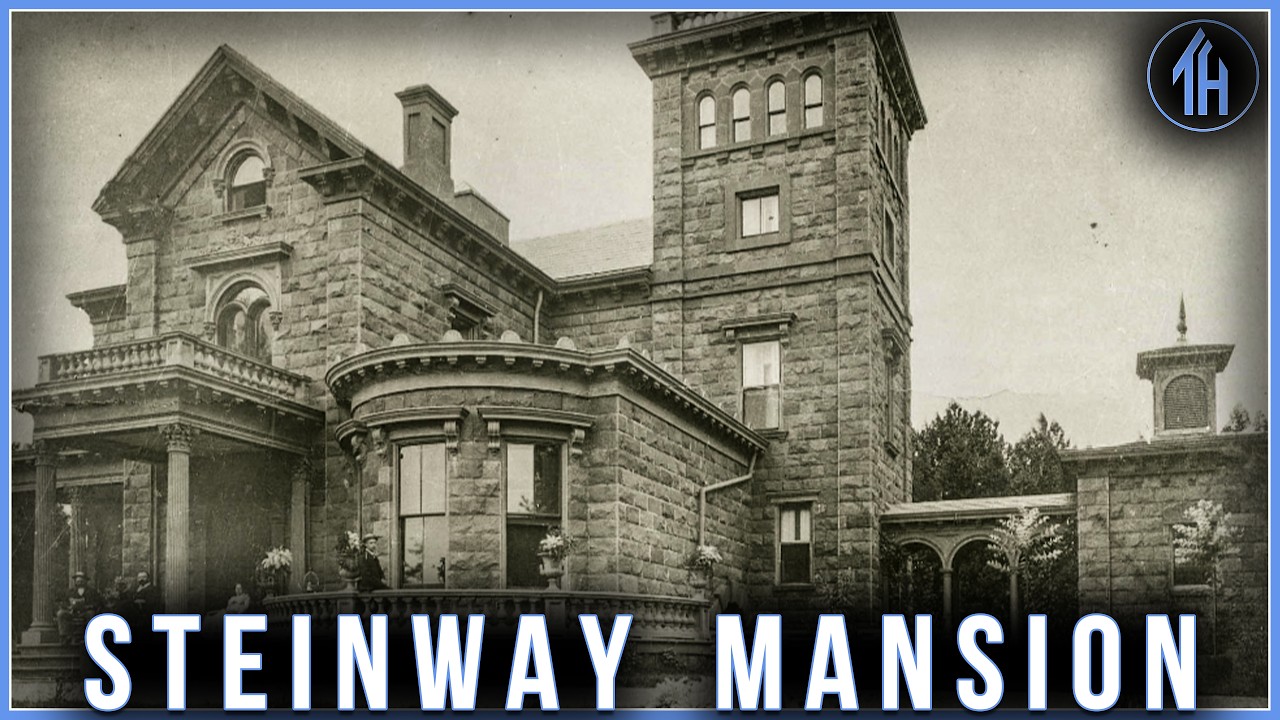
The house itself was a magnificent Italianate villa, built for Benjamin Pike between 1857 and 1858 at a cost of about $85,000. Remarkably, its architect was never documented.
It was constructed of rough granite blocks and blue stone, with an unusual amount of cast-iron ornament—a material common in the commercial buildings of the era but still rare in private homes. The central section rose a full two stories in a T-shape beneath a slate gable roof, while on the western side stood a stunning four-story tower crowned by a balustrade and an octagonal cupola. Three verandas supported by Corinthian cast-iron columns surrounded the house, and terraces wrapped the southern and eastern sides. There was also a carriage house on the property, a large outbuilding that once served the estate’s horses and carriages; in 1947 it became the home of the Modern Art Foundry, which cast sculptures there for decades.
Guests arrived via a circular brick driveway that led to an outside canopy, where carriages could stop under cover. The main entrance porch, one bay deep, rested on four Corinthian cast-iron columns. Inside, there was a stunning two-story central hall. Its upper level was encircled by an oval gallery, onto which the bedrooms opened.
Above that rose a circular dome the full height of the house, topped by a stained-glass skylight that let daylight wash down to the lower floor. A grand staircase ran from the hall up to the second level, its balustrades carved with great skill from walnut. On the western side of the house, in a one-story wing lit by large windows, lay the library. This was Steinway’s study and office, the room where he is believed to have written much of his diary in the evenings.
There was a formal dining room on the first floor of the great hall, beside the reception rooms. All of these rooms were decorated with details that made the house exceptional: Italian marble fireplaces, twelve-foot ceilings, and sliding doors adorned with etched glass depicting the scientific and optical instruments upon which the previous owner had built his fortune. Benjamin Pike Jr. , the man who built this house, died in New York City in 1896 at the age of sixty-one, of typhoid fever.
So what became of the great stone villa on the hill? The Steinway family kept the house as their summer residence until the 1920s. In 1926, the house left the family’s ownership entirely. When the Steinways departed, the house lost the electricity and water it had drawn from the nearby factory, and the new owner nearly went bankrupt trying to connect it to the city’s utilities.
In the end, his family ended up owning the house for far longer than the Steinways ever had. His son, born in the house in 1927, spent decades—and, by his own estimate, millions of dollars—restoring it and filling it with historical treasures. The mansion was designated a New York City landmark in 1967, one of the first private houses in the city to receive that honor. It was added to the National Register of Historic Places in 1983.
In 2010, the house was put on the market and remained without a buyer for years. The price was high and the condition fragile for most prospective purchasers. Then, in 2014, two businessmen from Astoria bought it for $2. 65 million.
The new owners embarked on an ambitious restoration, rebuilding the long-lost roof of the veranda and recladding the cupola. The granite walls, the tower, the two-story hall, the walnut staircase, and the formal dining room all remain to be seen. Even now, the historic villa remains private property, closed to the public.
The house that William Steinway built his empire around, and the empire itself, still stand—one as a monument of stone and iron, the other as a name on the fallboard of the pianos that fill the world’s great concert stages.
