In 1798, Baron Pierre François Percy, chief surgeon to the French Revolutionary Army, stood over a body that made even him hesitate. The corpse belonged to a twenty-six-year-old man. When Percy opened the mouth, he could see directly down into the stomach cavity. The esophagus was a tunnel.
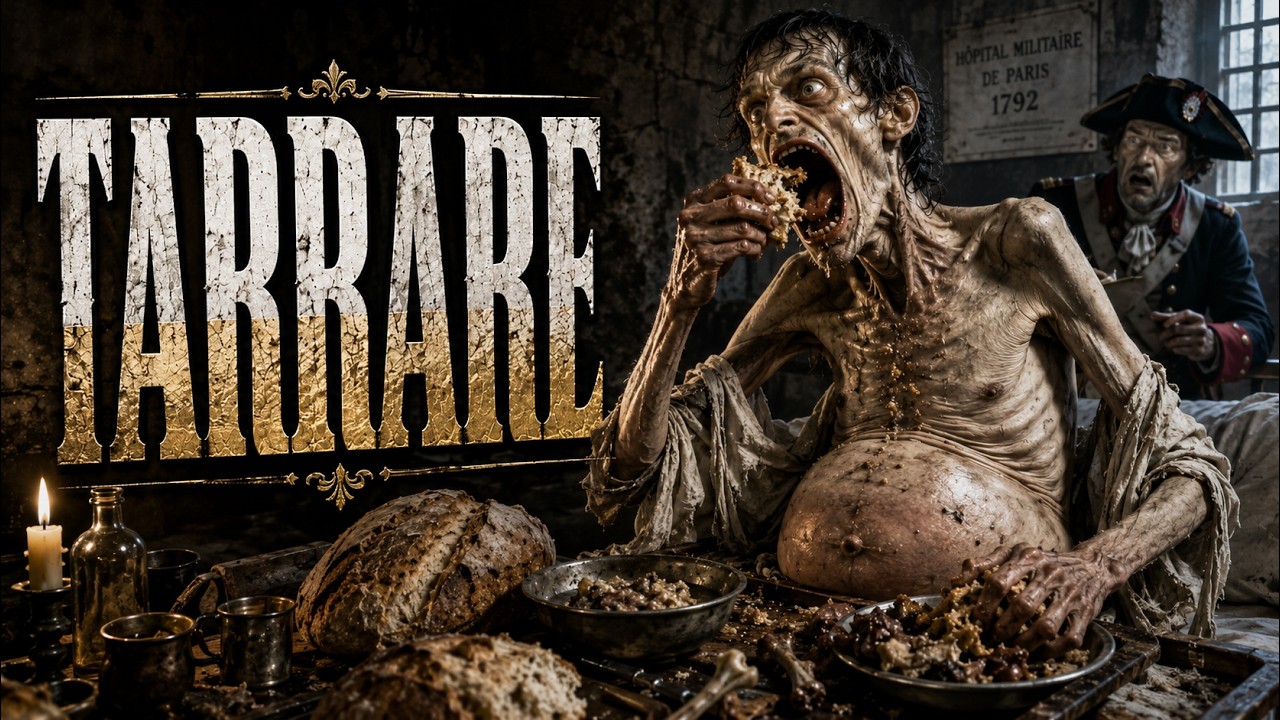
The organs were rotted. The smell forced his assistants back. After years of observing this patient, feeding him meals meant for fifteen soldiers, watching him consume live animals whole, Percy still could not answer the simplest question: what was wrong with him? This was Tarrare, not a legend or a myth, but a documented medical case.
A man who ate constantly and weighed less than one hundred pounds. Born into a world two centuries too early to diagnose what destroyed him, he began as an abandoned child, became a street performer, then a soldier, then a medical experiment, and died suspected of eating a fourteen-month-old infant in a hospital ward. Every detail comes from Percy’s own records, preserved in the Mémoires de l’Académie de Chirurgie, written by a surgeon trying desperately to understand something that should not exist. Tarrare was born near Lyon sometime around 1772 into a family whose name no record preserves.
By adolescence, his appetite had become economically impossible. His family expelled him, not out of cruelty, but because they could not afford to feed him. In pre-industrial France, a teenage boy who ate more than four adults combined was not a medical case. He was a financial catastrophe.
So Tarrare left, perhaps fifteen years old, alone, and hungry. He fell in with a charlatan, one of many men who traveled 18th-century France selling patent medicines and performing minor procedures in the gaps where legitimate medicine didn’t reach. Tarrare became the draw. In town squares, he would eat corks whole and vomit them back intact.
Stones the size of fists passed through his system. Entire baskets of apples, thirty or more, disappeared one after another. He consumed snakes and eels alive, swallowing them without chewing while the crowd watched the animals distend his neck as they slid into his stomach. The cat incident was witnessed by enough people that it appears in multiple independent sources.
Tarrare seized a live cat, bit into its neck, and drank the blood directly. He tore the animal open with his teeth and hands, consuming the internal organs, the muscle, everything except the skeleton. The fur he swallowed as well. About thirty minutes later, he vomited up a compacted ball of hair and bile.
The bones passed through his digestive system over the following day. This was his profession. The charlatan fed him, Tarrare performed, the crowds paid. In an era when public exhibitions of human anatomical anomalies were mainstream entertainment, Tarrare fit comfortably into the commercialized spectacle of the body.
Percy’s later evaluations confirmed he showed no intellectual disability. He understood what he was doing, and he kept doing it because the alternative was starving on the street. The arrangement eventually collapsed. By 1792, France was at war, and mass conscription swept Tarrare into the revolutionary army.
He lasted weeks before his body gave out. Even at quadruple the standard ration, four times what kept an ordinary soldier functioning, he was losing weight. He scavenged from garbage heaps and compost piles. Within weeks, he collapsed, not from combat or disease, but from starvation, despite eating more than any other man in his unit.
He was transferred to the military hospital at Soultz, where he came under the care of Dr. Courville and, more significantly, Baron Pierre François Percy. Percy was not a provincial doctor. He was the French Army’s chief surgeon, a man who had studied in Paris and would eventually become one of Napoleon’s most trusted medical advisers.
He approached Tarrare with Enlightenment rationality, systematic observation, and the assumption that sufficient data would yield an explanation. The first experiments were elementary. Percy ordered full hospital meals intended for multiple patients. Tarrare consumed a meal meant for four men, then one meant for eight, then fifteen.
Percy documented each test. The stomach would distend grotesquely, the skin stretching until the abdomen looked like it contained a foreign mass. Hours later, it would deflate, and Tarrare would report hunger again. No satiation, no sense of fullness, no point at which his body signaled enough.
Percy escalated the experiments, introducing live animals as variables in a medical investigation. Tarrare ate live cats, snakes, lizards, puppies, swallowed whole in front of Percy and his assistants, who documented the process with clinical detachment. Examination of his waste showed partially digested fur, bone fragments, and scales passing through without obstruction or apparent pain. Digestion was functional.
The problem was that digestion solved nothing. The hunger remained, constant and total. Percy tried chemical intervention. Wine vinegar to reduce appetite, tobacco pills to regulate the stomach, laudanum to calm what he hypothesized might be overactive metabolic signals.
Nothing worked. Tarrare’s body responded to no treatment. The hunger did not diminish, his weight did not stabilize, and the heat radiating from his skin, along with the stench that drove other patients from the ward, remained unchanged. Percy’s notes betray frustration masked as clinical observation.
Humans gained weight when they consumed excess calories. Tarrare did not. Appetite decreased when the stomach was full. Tarrare’s did not.
Percy ruled out parasites and madness. What remained was a body that burned energy at a rate that should not be survivable, a metabolism operating so far beyond normal parameters that it consumed everything Tarrare ingested and then began consuming him. Percy could observe it, measure it, document every symptom, but he could not explain it. And he could not stop it.
By late 1793, Percy had tested every intervention available to 18th-century medicine. Tarrare remained in the hospital, eating meals that should have sustained a dozen men, still emaciated, still hungry. Percy kept him there because he had nothing else. Then General de Beauharnais, husband to Josephine, who would later marry Napoleon, arrived with a different idea.
If medicine could not use Tarrare, perhaps warfare could. Prussian forces controlled territory between his position and scattered French units, and communication lines were compromised. Beauharnais needed a way to move intelligence across hostile ground without detection. The plan was an experiment.
A document would be sealed inside a small wooden box. Tarrare would swallow it. Forty-eight hours later, it emerged. The seal was unbroken.
The document inside was legible. Beauharnais had his courier method. The actual mission followed within days. Tarrare would cross Prussian lines disguised as a peasant, mentally deficient enough to explain why he couldn’t answer questions coherently.
The message would be inside him, invisible to standard search procedures. The plan had one flaw nobody addressed. Tarrare spoke no German. Prussian sentries stopped him before he crossed into the operational zone.
They asked questions in German. Tarrare, emaciated and reeking, sweating visibly despite the cold, couldn’t respond. The sentries detained him and beat him, trying to extract information. Terrified and in pain, Tarrare confessed that the message was inside him.
A day passed. Then the wooden box emerged. The Prussians opened it. Inside was a message in French military cipher.
When decoded, it contained nothing. A test communication, trivial content designed to verify the method without risking actual intelligence. After several days of holding him, the Prussians expelled him back across French lines with a beating. Tarrare returned, humiliated and bruised.
Beauharnais attempted no further intelligence operations using Tarrare’s body. He was too sick to be a soldier, too strange to be a spy, and too hungry to be left alone. Back in Percy’s hospital ward, Tarrare’s condition didn’t stabilize. By late 1794, he had stopped being a patient.
He had become something the staff feared. The first incident involved blood. The hospital practiced therapeutic bleeding, and Tarrare was caught sneaking into treatment rooms, drinking directly from the collection vessels. When interrupted, he fought.
Then the morgue. Percy’s records note, without elaboration, that Tarrare was caught multiple times eating from corpses. Staff demanded his removal. Orderlies refused to work night shifts if he remained in the building.
Then the child disappeared. A fourteen-month-old infant, a patient in the hospital ward, vanished. Hospital staff accused Tarrare immediately. Percy’s documentation is careful here, almost evasive.
He does not confirm Tarrare ate the child. He also does not exonerate him. The hospital administrators gave Percy an ultimatum: expel Tarrare or lose the staff’s cooperation entirely. Percy chose the institution.
Tarrare was driven out. No charges were filed, no investigation concluded, the child was never found. Four years passed. Tarrare survived somehow, begging, scavenging, perhaps performing again in smaller towns.
No documentation exists for this period. In 1798, a message reached Percy. Tarrare was dying in a hospital in Versailles. The man Percy found was twenty-six years old and looked fifty.
Advanced tuberculosis, chronic diarrhea. The body finally consuming itself faster than even Tarrare could feed it. Tarrare told Percy he had swallowed a golden fork years prior and believed it was killing him. Percy recognized the desperation of a man inventing a cause for suffering that had no comprehensible source.
Tarrare died weeks later. Percy performed the autopsy. The esophagus was a passage wide enough that Percy could look directly from the open mouth into the stomach cavity. The stomach itself occupied most of the abdominal space, grotesquely enlarged even in death, the lining covered in ulcers.
The liver was swollen, covered in what Percy described as pus. The gallbladder had distended to an obscene size. Every internal organ showed signs of infection. The smell was so overpowering that even men trained to dissect battlefield casualties in summer heat struggled to remain in the room.
Percy found no golden fork. He found no tumor, no parasite, no structural malformation sufficient to explain what had driven Tarrare’s hunger. He documented every abnormality in meticulous detail, knowing he was recording something medicine could not yet interpret. The body was wrong in a hundred ways, but none of them answered the question Percy had been asking for five years.
Why? Modern medicine has proposed theories. Severe hyperthyroidism might explain the heat, the weight loss, the appetite, but not at this scale. Damage to the hypothalamus could disrupt hunger signals, but wouldn’t produce the anatomical changes Percy found.
Every proposed diagnosis fails somewhere. Two hundred twenty years after Percy wrote his final notes, Tarrare remains medically inexplicable. Tarrare was hungry, always. He ate everything.
Nothing ever made him full. And he died at twenty-six in a body so corrupted that even the surgeon who had studied him for years could barely stand to open it. He wasn’t a monster. He was sick in an era that had no framework for what he was, surrounded by people who could not help him.
Percy tried everything his century allowed, but Enlightenment science had no language for metabolic disaster, no treatment for a body destroying itself. Tarrare died unexplained, in flesh so ruined his own doctor recoiled.






