On September 12, 1945, seven Japanese commanders walked down St. Andrew’s Road in Singapore toward a building they had once controlled. At the front was Lieutenant General Seishiro Itagaki, commander of the Seventh Area Army, followed by four other generals and two admirals. Their uniforms were immaculate.
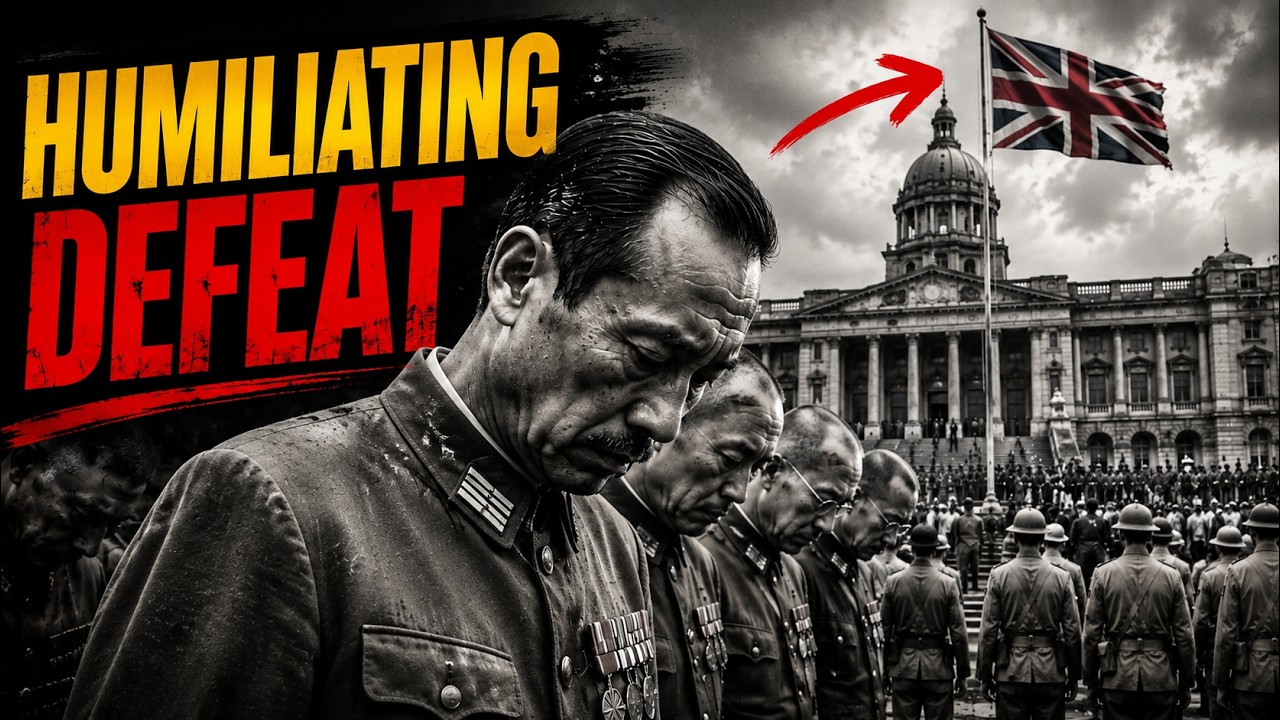
Their faces revealed almost nothing. But the crowd surrounding the Padang and the municipal building revealed everything else. Thousands of people who had lived under Japanese occupation for three and a half years gathered to watch the men who had represented that occupation walk toward surrender. Some in the crowd booed.
The Japanese officers kept walking. The moment was extraordinary for a reason deeper than the scene itself. Less than a month earlier, Emperor Hirohito had ordered the war to end. For men like Itagaki, that created an impossible command.
The Japanese army had spent years teaching its soldiers that surrender was disgraceful. Now the one authority they were required to obey above all others was ordering them to do exactly that. And Itagaki did not immediately accept it. Before he walked into that building, his own superior had to tell him that the emperor’s order would be obeyed.
On August 15, 1945, radios across Japan’s empire carried a voice most listeners had never heard. Emperor Hirohito announced that Japan would accept the Allied terms. The language was formal and indirect. He spoke of the war developing in a way that was not necessarily favorable to Japan.
But the meaning was unmistakable. The fighting was over. For the Imperial Japanese Army, that created a contradiction that had never been resolved because no one at the top had ever expected to face it. Japanese soldiers had been conditioned to believe that surrender brought shame.
Orders from the emperor carried absolute authority. Until August 1945, those two ideas had always pointed in the same direction: fight, do not surrender, obey. Now they pointed against each other. Do not surrender, but obey the emperor who has ordered surrender.
Itagaki was not an obscure officer suddenly trapped by history. He commanded the Seventh Area Army, responsible for Japanese forces across a huge portion of Southeast Asia. He had spent decades inside the system that had created the Japanese military empire. Surrender was not the ending men like him had prepared for.
According to accounts of those chaotic days, Itagaki was reluctant to comply. But above him stood Field Marshal Count Hisaichi Terauchi, commander of the Southern Army. Terauchi was in Saigon and seriously ill, yet his authority still mattered. By August 18, Terauchi had ordered Itagaki to accept the emperor’s decision and cooperate with the surrender.
That changed everything. There was no argument left that could be disguised as military duty. The emperor had ordered surrender. Itagaki’s commander had repeated the order.
The only remaining question was whether the army in Singapore would actually obey. For several days, nobody on the Allied side could be completely certain that it would. Japan had surrendered, but in Singapore no British soldier had yet set foot on a single street. Japanese weapons had not been collected.
Japanese guards still stood at the wire. For the men inside Changi prison camp, the war had ended in Tokyo while continuing hour by hour where they lived. On August 20, a rumor moved through the camps: the emperor’s voice had been heard, broadcast across the empire. Then another: the guards had been seen weeping.
Neither was confirmed. Neither was dismissed. In that uncertainty, an aircraft crossed the sky and dropped leaflets. Japan has surrendered, the message read.
Your treatment will be humane. The prisoners read them in silence. The men who guarded Changi that month faced an order that contradicted everything they had been taught. Surrender was shame.
Surrender was death. Yet the voice that had once commanded them to fight now commanded them to stop. Discipline had to hold. If one battalion chose a final gesture, the war would restart locally after the emperor had ended it nationally.
The most important battle in Singapore was no longer fought between British and Japanese. It was fought between command and collapse. That is the battle Itagaki chose. Not a last charge.
A handover. To understand why that was psychologically extraordinary, one must go back exactly three and a half years. On February 15, 1942, Lieutenant General Arthur Percival led the delegation that surrendered Singapore to the Japanese. The British position had collapsed.
Their water situation was desperate. Their defensive perimeter was shrinking. Percival entered the Ford Motor Factory to face Lieutenant General Tomoyuki Yamashita. Japan had achieved one of the most shocking victories of the entire war.
Singapore had been presented as a fortress. Instead, it became the site of what Winston Churchill described as Britain’s greatest military capitulation. Tens of thousands of Commonwealth troops entered captivity. Across Asia, the image of European military invincibility had been shattered.
And for the Japanese army, Singapore became proof that its methods worked: speed, aggression, psychological pressure, never admitting weakness, never allowing the enemy to believe you might break. That matters because Singapore was not just another occupied city. It was a symbol. In 1942, British officers had walked toward Japanese commanders to surrender.
In 1945, Japanese commanders would be forced to make the opposite journey. Same city, same war, opposite direction. The British understood the symbolism perfectly. The surrender in September would not be handled quietly.
It would be made visible. There would be no giant final battle for the island. Instead came reoccupation. The operation was called Tide Race.
British naval forces approached Singapore while Japanese units were being ordered to comply with surrender instructions. Then came the first unmistakable reversal. On September 4, General Itagaki and senior Japanese officers boarded the British cruiser HMS Sussex in Keppel Harbor. Three and a half years earlier, Britain had lost Singapore.
Now the Japanese commander of Singapore was stepping onto a British warship to receive surrender terms. No artillery duel, no desperate beachhead, no final Japanese counterattack. Just officers, documents, and signatures. September 4 was part of the transition.
September 12 would be the public conclusion. In between, Allied forces began returning. British and Indian troops came ashore. Japanese control disappeared piece by piece.
Military installations were surrendered. Prison camps were opened. People who had spent years wondering whether the British would ever return began seeing Allied uniforms again. The Japanese generals were still standing, but the empire they had represented was disappearing around them.
There are post-war stories of mass suicide and secret last stands. Some are difficult to verify. They are not needed. What the senior commanders verifiably did was harder to tell and harder still to perform.
They did not fight. They accounted. Officers compiled rosters. Units stood down in formation and laid down their weapons in ordered stacks.
Representatives traveled to Allied Headquarters to receive instructions. Facilities were inventoried and handed over. The army that had conquered Singapore in ten days spent its final days performing the quiet, exhaustive labor of disbanding itself. It was administrative.
It was also, for every man who performed it, the complete inversion of four years of doctrine. The same military that had ordered ordinary soldiers to die rather than surrender now required its generals to prove that obedience outranked preference. A command to stop was as binding as a command to fight. Beyond the paperwork waited a reality none of the generals could control.
Surrender meant inspection. Inspection meant prisoners. Prisoners meant evidence. Singapore had been made to suffer under Japanese rule.
Civilians endured shortages, repression, and mass killing. Allied prisoners endured hunger, disease, forced labor, and brutality. Itagaki himself would later be held responsible by the Tokyo Tribunal for the grossly inadequate treatment of prisoners and internees under his authority. The generals were not surrendering territory.
They were surrendering control over what the Allies were about to find. Then came September 12. The area around the municipal building was packed. People climbed to vantage points wherever they could find them.
The Padang became the stage for a victory ceremony. Aircraft passed overhead. Allied troops stood in formation. Then the Japanese delegation appeared.
Seven senior officers. General Seishiro Itagaki led them, with senior army and navy commanders from the Japanese forces of Southeast Asia behind him. They walked along St. Andrew’s Road toward the Council Chamber.
There was almost nothing theatrical about the Japanese side. No visible collapse, no pleading, no rage. That restraint is what gave the scene its power. For years these uniforms had represented authority in Singapore.
People had stepped aside for them. People had bowed. People had learned not to challenge Japanese soldiers in the street. Now the crowd could boo, and the generals could do nothing except continue walking.
One Singaporean eyewitness later remembered that people jeered because for the first time they knew they could get away with it. The balance of fear had reversed. Inside the municipal building, the ceremony became almost brutally simple. On one side sat Admiral Lord Louis Mountbatten, Supreme Allied Commander in Southeast Asia, with senior Allied representatives around him.
Facing them was Itagaki’s delegation. Itagaki was not technically surrendering only Singapore. He was acting on behalf of Field Marshal Terauchi and surrendering the Japanese forces of the Southern regions to Mountbatten’s command. The written terms left little room for interpretation.
Japanese forces were to obey Allied instructions. Any delay or refusal could be punished. The English version of the document controlled if there was disagreement about what the terms meant. There was no negotiation over whether Japan would surrender.
There was only implementation. Itagaki signed. Again and again. Multiple copies of the surrender instrument passed across the table.
Pens moved over paper. Cameras recorded everything. The ceremony took only minutes. Three and a half years of occupation, years of war across Southeast Asia, hundreds of thousands of men under Japanese Southern Army authority, and the formal act that ended it in Singapore was completed in roughly the time it takes to drink a cup of coffee.
The fighting had taken years. The signature took minutes. Mountbatten understood that this was more than paperwork. The ceremony had an audience far beyond the men inside the room.
Outside were the people of Singapore. Beyond them was Asia. In 1942, the fall of Singapore had damaged British prestige across the region. In 1945, the British wanted the return to be unmistakable.
There were guards of honor, aircraft overhead, a victory parade, cameras, journalists, public proclamation. After the surrender was completed, the Union Jack rose again over Singapore while the British national anthem played. In 1942, Britain’s flag came down. In 1945, Japanese generals signed and watched British authority return.
But there is an irony that makes the ending more complicated than a simple story of empire restored. Britain came back. The old world did not. The Japanese victory of 1942 had exposed how vulnerable European colonial power could be.
That lesson could not simply be erased by raising a flag again three and a half years later. The British had recovered Singapore. They had not recovered 1941. History had already moved.
The Japanese officers at Singapore had spent entire careers learning emotional control. What happened to them was not written clearly across their faces. It was written in what they were doing. A Japanese general did not need to cry for surrender to be humiliating.
He only needed to sign. The same military establishment that had treated capitulation as disgraceful now had its senior officers placing their names beneath an unconditional surrender document. The uniforms remained immaculate. The discipline remained.
The hierarchy remained. But the purpose of that hierarchy had completely reversed. Yesterday it existed to continue the war. Now it existed to stop it.
Japan’s senior commanders in Singapore did not prove their devotion by dying. They proved their obedience by living long enough to carry out the order. First, they faced an order they had spent their careers believing should never be necessary. Some resisted the idea, but their chain of command settled the question.
The emperor had spoken. Terauchi ordered compliance. Itagaki complied. Then the commanders did something far more difficult than one last reckless attack.
They controlled an armed military force through defeat. They dealt with Allied representatives. They surrendered installations. They permitted returning forces to land.
They walked publicly through a crowd that no longer feared them. And finally, they signed. That sequence exposes what was really at the center of Imperial Japanese military discipline. The refusal to surrender was powerful, but obedience was stronger.
When those two principles finally collided in August 1945, obedience won. Not every Japanese soldier everywhere immediately accepted defeat. The collapse of the Japanese Empire was chaotic, and surrender unfolded differently across an enormous geographic area. But in Singapore, the senior command ultimately held.
No Battle of Singapore 1945 followed the Battle of Singapore 1942. The city changed hands because the Japanese command implemented surrender. February 1942: Arthur Percival walks toward surrender. September 1945: Seishiro Itagaki walks toward surrender.
Three and a half years separate them. In the first scene, Japanese victory looks permanent. In the second, it has vanished completely. That is why Singapore is one of the most perfect reversals of the Second World War.
The city did not simply change owners twice. It forced two military systems to confront the same humiliation from opposite sides. In 1942, Britain learned that an empire could collapse much faster than anyone imagined. In 1945, Japanese generals learned something equally brutal.
A military culture can tell a man that surrender is worse than death. It can repeat that lesson for years. It can build tactics, rituals, and identity around it. But eventually, every military system reaches the same final question.
Who gives the last order? For Itagaki and the men walking beside him, the answer was the emperor. So seven commanders continued up the steps. The crowd watched.
The documents waited. Inside that building, men who had spent their careers serving an army that said never surrender did exactly that. Not because they had suddenly stopped believing in obedience. Because they still believed in it.
And in the end, the order to surrender came from the one authority they had been taught they could never refuse. The British flag went back up. The generals walked away.
And Singapore’s war was over.
