In May 1775, John McCrea prepared to leave his home in Saratoga, New York, with a newly formed Continental army on its first major mission: the invasion of Canada. He left behind his younger sister, Jane, known as Jenny, who was then about twenty-three years old, and his small family. While John had joined the patriot cause with enthusiasm as revolutionary fervor spread from Boston, the neighboring Jones family, which included six brothers, leaned toward loyalty to the British Crown. One of those brothers, David Jones, had begun courting Jane McCrea.
She found herself torn between her patriot brother and her loyalist suitor. Jane McCrea was born in Lamington, New Jersey, around 1757, the daughter of James McCrea, a Presbyterian minister who had emigrated from Scotland. She lost her mother at an early age and remained devoted to her father until his death when she was about sixteen. Descriptions of her agree that she was a young woman of considerable abilities, personal charm, and notable kindness.
A friend described her as of medium height, with a slender figure, dark hair, and surpassing beauty. General Gates, in a later letter to Burgoyne, called her a young woman of lovely appearance, virtuous character, and kind heart. Because her father loved literature, she found in his library a passion for reading uncommon among her peers, and her religious upbringing gave her thoughts a serious cast. Among her father’s neighbors in New Jersey was the Jones family: a widow and six sons, Jonathan, John, Dunham, Daniel, David, and Solomon.
The two families shared a close and lasting friendship. John McCrea was one of those bold adventurers who moved beyond the edges of civilization to establish homesteads in the wilderness. He settled on the right bank of the Hudson River, a few miles south of Fort Edward, where he cleared land and built a simple home. Soon after, the Jones family followed, settling a few miles north on the same side of the river.
The children grew up together, and a mutual affection developed between Jane and David Jones. Descriptions portray David as handsome, good-natured, sociable, brave, and generous, beloved among his companions. When Jane moved to live with her brother, she and David spent much of their time together, and their childhood attachment matured into a full engagement, known to settlers for miles around. The region around Fort Edward had been a scene of military operations for years, particularly during the French and Indian War.
After the peace treaty of 1763, which made the English masters of Canada, the settlements grew steadily. Discharged soldiers and families from New England and New Jersey, including the McCreas and the Joneses, settled along the Hudson. They lived simply and happily, helping one another with log rollings, barn raisings, and house constructions, gathering in the evenings to discuss crops and livestock. But this peaceful life was not to last.
Clouds began to gather on the horizon as voices of discontent rose from the major cities along the coast. Friends and neighbors who had lived together in harmony began to divide. While many embraced the cause of the colonists, others, including the Jones family, remained attached to the Crown, hoping for reconciliation rather than independence. When the struggle moved from the outskirts of Boston to their own neighborhood, the settlers had to take sides.
The capture of Fort Ticonderoga and Crown Point by Ethan Allen and Seth Warner in May 1775 stirred intense feelings throughout the region. In June of that year, it was decided to invade Canada. Congress appointed General Schuyler to command the expedition, with three thousand men and fifty thousand dollars in cash. As armed men followed Montgomery on the road to Canada, John McCrea was among them.
He had been an early supporter of the patriot cause and became a vocal advocate. None of the Jones brothers joined him. John and Daniel Jones, who lived in Kingsbury, were known loyalists, and the whole family was considered loyal to the king, though Jonathan and David had not declared themselves for either side. David Jones understood the reasons for his brothers’ sentiments, but he also knew that John McCrea, a fervent patriot, would not welcome a loyalist courting his sister.
So David continued his visits as usual, careful not to express his true feelings openly. In front of his prospective brother-in-law, he pretended to agree with his opinions, but in his heart he remained a royalist, secretly resolved to join the king’s cause if circumstances demanded. For more than a year after hostilities began, he maintained a neutral stance, while revealing his true feelings to Jane. In lengthy conversations, he spoke of the folly of resisting England, calling the war a hopeless rebellion doomed to a swift and disastrous end.
He expressed regret at the madness that had driven her brother not only to adopt an unworthy cause but also to turn bitterly against his own family. For the first time, signs of trouble troubled the young couple. The lover could not bear the restraints placed on him, and Jane’s imagination filled with horror when he spoke of leaving her to share the dangers and glory of war. She also trembled for the safety of her brother, now gone with the northern army, haunted by daily rumors of sieges and battles.
She knew well which banner David would follow, and it was terrifying to think that the two men closest to her heart might meet in battle. The dark-haired girl sincerely prayed for peace, not imagining that within a year her name would echo across the country, stirring anger and inciting men to take up arms. John McCrea finally returned from the Canadian campaign, a disappointed and depressed man. He had faced countless dangers and suffered incredible hardships, only to experience the bitterness of defeat.
The people of the northern province, instead of welcoming the Americans, resisted them with stubborn bloodshed that neither Montgomery’s efforts nor Arnold’s reckless courage could overcome. McCrea returned to face the scorn of his loyalist neighbors and to bring devastating news to many families who had lost husbands or fathers beneath the walls of Quebec. The American situation, especially in the north, was grim. The campaign meant to secure Canadian cooperation had ended in disaster.
The patriots had been driven from Canada, and the English had regained control of Crown Point and the northern parts of the lake. In late autumn of 1776, David Jones decided he could no longer remain a passive spectator. He heard of a large, well-equipped British army arriving in Quebec and had no doubt the proposed campaign would succeed and end the foolish, unjustified rebellion. In conversations with Jane, he spoke of his certainty, describing the peaceful times that would follow when the enmity between their families would end and old friends would reunite in loyalty to a rightful king.
Their last meetings took place at the home of Mrs. McNeil, a Scottish woman of considerable bulk and sharp wit, who lived a short distance from the fort and whose daughter was Jane’s close friend. Reluctantly, Jane agreed to David’s plan: he would announce to his neighbors his intention to join the Americans at Ticonderoga, while his real plan was to pass that fort and join the enemy forces in Canada. They arranged to communicate through a man named Alexander Freel, renewed their promises to each other, and parted at Mrs.
McNeil’s house. David, accompanied by his brother Jonathan and about sixty others, headed north, giving the impression they were joining the garrison at Ticonderoga. Instead, they bypassed it and hurried down the lake to Crown Point, offering their services to the British officer commanding there. They then moved to St.
Johns, where they remained until Burgoyne’s arrival in the spring of 1777. Both brothers received commissions in the British service, Jonathan as captain and David as lieutenant in the same company, serving as pilots and guides thanks to their intimate knowledge of the region. While the detachment under St. Leger moved toward the Mohawk Valley, the main British force of more than seven thousand men sailed from St.
Johns on June 1. After a brief stop at Cumberland Head, the troops continued to a point on the western shore of the lake, where Burgoyne ordered the army to camp in a dense forest on the banks of the Bouquet River. There he awaited his fierce allies, the Indians, whose use had been ordered by the misguided and cruel policy of England. Both Burgoyne and Carleton, the governor of Canada, hated employing these savages, knowing from experience that their presence was a burden.
But Burgoyne, ambitious and responsive to ministerial instructions, prepared extensively for their arrival. A war feast was held in their honor. The chiefs and their followers, led by a Roman Catholic priest, appeared decorated with feathers and war paint, numbering more than four hundred, mostly from the Algonquin, Ottawa, and Iroquois nations. Their arrival was greeted with great ceremony.
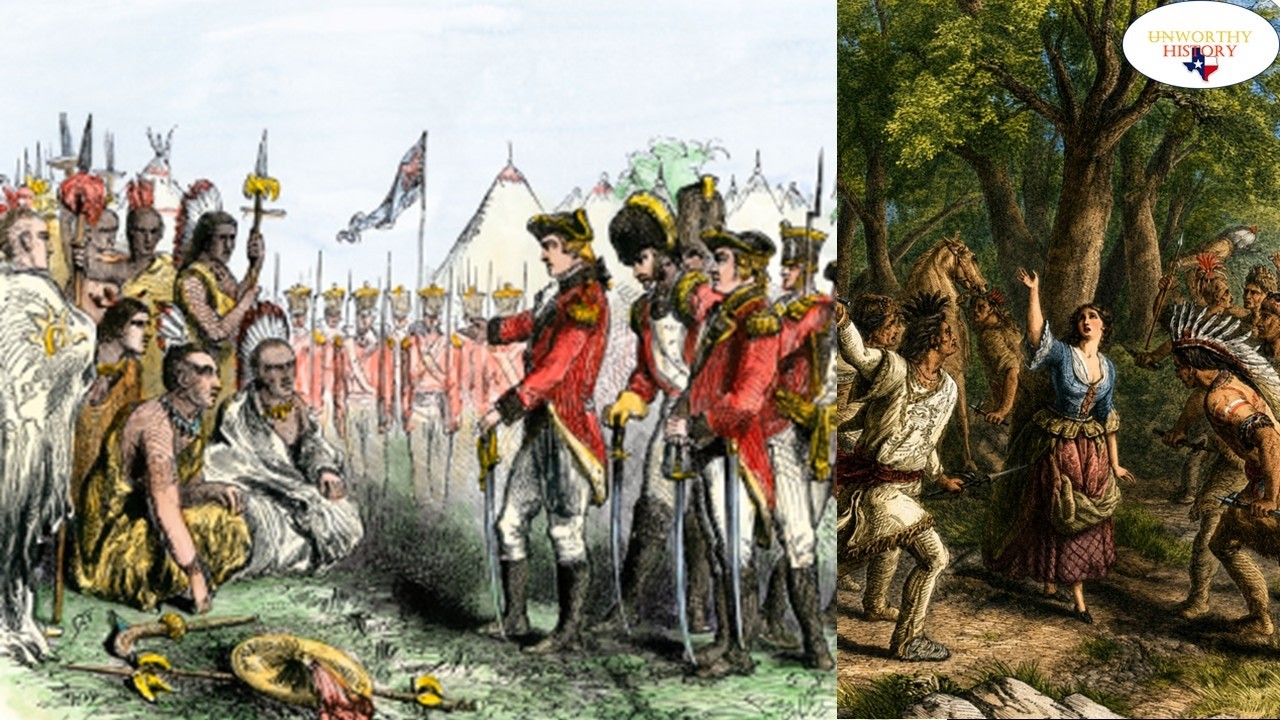
At the feast, they sang their traditional songs and spoke of their ancient glory, then performed a war dance, circling and yelling, brandishing their axes, imitating scalping, ambush, sudden attack, conflict, massacre, and victory. On June 21, 1777, these scenes were enacted before Burgoyne’s army. Never had such wild and enthusiastic sounds echoed through the small valley of the Bouquet. When the ceremonies ended, the Indians gathered to hear the great leader.
Burgoyne, dressed in splendid uniform, addressed them through an interpreter with a speech of considerable power and eloquence. He explained the special nature of the conflict they were about to fight: it was not a normal enemy they would defeat, for a large portion of the country’s population remained loyal to the king, and these people deserved his protection. The old, the women, the children, and prisoners were to be spared. Only those found bearing arms should be killed, and scalps taken only from those killed in battle.
He forbade bloodshed unless there was armed resistance, promising compensation for prisoners taken but holding them accountable for scalps. Yet in the same speech, he told them to strike the common enemies of Great Britain and America. When he finished, an Iroquois chief rose to reply. After a short silence, the Indian extended his hand and said he spoke for all the nations present, confirming they had listened attentively to their father’s speech.
He called the people of Boston the source of their trials, but declared their love for their father, and that their axes were sharpened. Their whole village, he said, was ready to go to war, leaving only the old, the sick, children, and wives at home, and they promised perpetual obedience to all that was commanded. Burgoyne had the naivety to trust these promises, to his shame and sorrow. Their savagery was provoked at the first scent of blood, and all his careful restraints proved as weak as ropes of sand.
In the hour of victory, they disgraced his achievements with their massacres, and in his hour of dire need, they abandoned him like cowards. From this camp, on June 29, Burgoyne issued his famous proclamation to the Americans, exaggerating the number of Indians under his command and their eagerness to attack. He declared he had only to stretch out his hand to extend the Indian forces under his command, which would number in the thousands, to chase down the fanatical enemies of Great Britain and America. He promised safety and protection to those who remained quietly at their occupations, but threatened terrible vengeance on those who persisted in rebellion.
The proclamation, with its bombastic list of titles, was met with ridicule by his enemies and criticism by his friends. One observer noted that Burgoyne seemed to consider his titles more than sufficient to counter all the military force the Americans could muster. The declaration outraged every compassionate heart in Europe and was widely spread in Parliament and throughout Britain. One of those who left the camp to distribute the proclamation in the vicinity of Fort Edward carried a letter to Jane McCrea from Lieutenant Jones, which reached her in time thanks to the assistance of a friar.
The letter was prudently destroyed, but Mrs. McNeil, who learned of its arrival, preserved the essence of its contents. Jones recounted his adventures since their parting, describing the splendid appearance of the army sailing up the lake, the arrival of the Indians on board, the war feast and dance, and the dignified manner in which Burgoyne delivered his speech, as well as the reverent behavior of the Indian who responded.
As Jane pondered the description of the Indian chief, she may have smiled, imagining his strange figure, the grim, decorated savage whom the old followers of Montcalm had called Le Loup, the Wolf.
