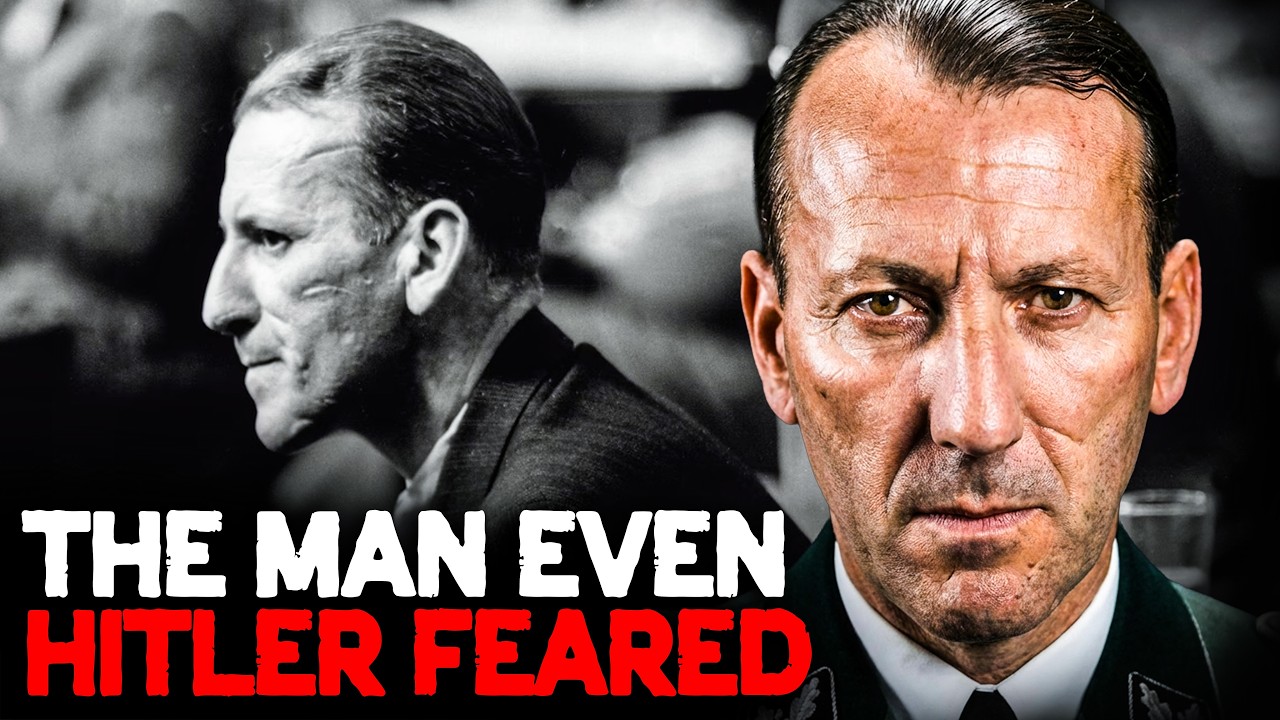
The scarred face appeared at the top of every Allied arrest list in the spring of 1945. Ernst Kaltenbrunner, the chief of the Reich Security Main Office, had controlled the Gestapo, the SD, and the entire apparatus of Nazi surveillance, arrest, torture, and extermination since stepping into the shoes of the assassinated Reinhard Heydrich in 1943. When the war ended and the prosecutors at Nuremberg assembled their cases against the surviving leaders of Nazi Germany, his name stood out among all the rest as the man who had held in his hands the machinery of terror itself. Yet even now, his name is less well known than those of the generals and politicians who sat alongside him in the dock.
He was born on October 4th, 1903, in the small town of Ried im Innkreis in Upper Austria, into a fading Habsburg empire already in decline. His father, Hugo Kaltenbrunner, was a respected provincial lawyer, and his mother, Theresia, was the daughter of an Austrian civil servant. The household was solidly middle-class, Catholic in cultural sensibility, and keenly aware of status and respectability. It gave no outward indication that its eldest son would one day control the terror apparatus of an empire far larger and more murderous than the one that had presided over his birth.
Young Ernst was a physically imposing boy. He grew tall and broad-shouldered with a lean, angular face marked by high cheekbones and deep-set eyes beneath a prominent brow. His most distinctive feature was a set of vivid dueling scars on both cheeks, acquired during his student years when fraternity dueling was still common among Austrian university men. The scars remained with him for the rest of his life, giving him a menacing, almost theatrical appearance remarked upon by virtually everyone who encountered him.
Allied interrogators after the war described him as physically intimidating even in defeat, a large man whose scarred face and cold gaze projected an air of contained violence. His height, reportedly around 6 ft 2 in, made him tower over many of his SS colleagues. After completing early schooling in Linz, where the family moved when Ernst was a boy, he followed his father into law, enrolling at the Graz University of Technology in 1921. Linz was also the city where Adolf Hitler had grown up, walking the same streets, attending schools in the same provincial capital.
German nationalist sentiment pervaded Linz and left its mark. At Graz, Kaltenbrunner was a competent, if not exceptional, student, earning his law degree in 1926. But extracurricular activities defined his university years. He became deeply involved in the German nationalist fraternities that dominated student life, organizations that combined dueling rituals with an increasingly explicit commitment to pan-German nationalism and, by the mid-1920s, the emerging ideology of National Socialism.
In these circles, he absorbed the foundational ideas that guided his career: belief in German racial superiority, virulent anti-Semitism, the conviction that Austria’s destiny lay in union with a greater German Reich, and the readiness to use violence as a political tool. The dueling culture of the fraternities was a ritual test of courage, not combat aimed at killing. Two combatants faced each other at close range wearing protective goggles with cheeks exposed, exchanging blows with sharp sabers until one received a significant wound. The resulting scars, known as Schmiss, were worn as marks of honor.
For Kaltenbrunner, the experience taught him to endure pain without showing weakness and gave him an appearance that, in the culture of the SS, was genuinely impressive. His formal entry into the Nazi movement came in 1930, when he joined the National Socialist German Workers’ Party with membership number 300,179. Austria was in deep crisis, battered by the Great Depression and divided between a conservative Catholic establishment and the Social Democrats centered in Vienna, with the Nazis a third force of growing menace. The Austrian Nazi Party was still a minor organization in 1930, operating largely in the shadow of its German counterpart.
Kaltenbrunner’s early membership speaks to the depth of his ideological commitment. He was a true believer, not an opportunist. The following year, in 1931, he joined the SS, receiving number 13,039, a relatively low number reflecting early entry into an organization that would number in the hundreds of thousands. He was exactly the type of man Himmler wanted: educated, ideologically committed, physically formidable, and willing to do whatever the organization required.
By the end of 1931, he held the rank of SS-Sturmführer. Also in 1931, he married Elisabeth Eder, an Austrian woman of similar social background, with whom he would eventually have three children. She was herself committed to the Nazi cause, and the household functioned as a meeting point for local SS members throughout years of underground activity. After graduating in 1926, Kaltenbrunner worked briefly as an engineer’s assistant in the mining industry, gaining familiarity with industrial processes he would later apply when overseeing concentration camp labor.
He then returned to law, working as a lawyer in Linz from approximately 1927 onward while intensifying his political activities. The Austrian government under Chancellor Engelbert Dollfuss moved to suppress both Social Democrats and Nazis with equal determination. The Austrian SS was officially banned in 1933 but continued underground, and Kaltenbrunner became one of its most important figures in Upper Austria. He organized cells, recruited members, maintained communications with the German SS across the border, and engaged in clandestine political violence.
This was dangerous work. Austrian security services were active, and members of the illegal SS faced arrest, imprisonment, and beatings from the Heimwehr paramilitaries. In May 1934, Kaltenbrunner was arrested for plotting against the state, accused of organizing an effort to acquire explosives and overthrow the government. He was imprisoned for six months.
The experience did not moderate his views. If anything, it hardened him. Upon release, he resumed underground activities. That year also saw the disastrous July 25th Nazi Putsch in Vienna, when SS men stormed the Federal Chancellery and assassinated Chancellor Dollfuss.
The Putsch failed, the plotters were captured or killed, Germany disavowed involvement, and the surviving conspirators were tried and executed. Kaltenbrunner was not directly involved in the Vienna Putsch but was deeply enmeshed in the Upper Austrian component, and the failure forced him to operate with even greater care. The underground cells were small, typically five to ten members, linked through a hierarchical structure designed to limit damage from arrest of any single member. Communications passed through trusted intermediaries.
Money came through membership dues, donations from sympathizers, and funds channeled from the German party apparatus through couriers. Kaltenbrunner managed portions of this financial and organizational infrastructure. By 1937, he had reached the rank of SS-Standartenführer, a senior colonelcy equivalent, and was regarded as one of the most important figures in the illegal Austrian organization. He developed a close relationship with Arthur Seyss-Inquart, the Austrian Nazi politician who would briefly become Austrian Chancellor and later serve as Reichskommissar of the Netherlands.
The Anschluss of March 1938 transformed Kaltenbrunner’s life overnight. Within weeks, he was appointed Higher SS and Police Leader for the Danube region, placing him in command of all SS and police forces in Austria. This was enormous power. The Higher SS and Police Leaders were Himmler’s personal representatives, standing above the regular police hierarchy and answering directly to the Reichsführer SS.
Promotion to SS-Gruppenführer came quickly, along with appointment as State Secretary for Security in the Austrian administration. In these dual capacities, Kaltenbrunner presided over the post-Anschluss terror with thoroughness that impressed even his superiors in Berlin. Political opponents of every stripe were arrested: Social Democrats, Communists, Monarchists, Catholic Conservatives, journalists, intellectuals. The jails of Vienna filled rapidly.
But it was the treatment of Austria’s Jewish population that was perhaps the most brutal immediate consequence. In Vienna, Jewish men and women were seized and forced to scrub pavements with toothbrushes while crowds jeered. Jewish-owned businesses were looted or seized. Synagogues were vandalized.
Kaltenbrunner created the environment in which such violence was permitted and encouraged, and ensured the formal apparatus of terror was in place to handle the systematic persecution that followed. During the Kristallnacht pogrom of November 9th and 10th, 1938, Austria was among the worst-affected regions. Under Kaltenbrunner’s authority, Austrian Jews suffered the same destruction of synagogues, mass arrests, beatings, and killings as the rest of the Reich. His office coordinated with Adolf Eichmann’s apparatus to facilitate emigration through extortion: Jews could leave only if they surrendered virtually all property and assets.
Tens of thousands escaped this way before the borders closed entirely. Those who remained would face a far more terrible fate. Under his authority, the Mauthausen concentration camp was established in August 1938 in Upper Austria. It was conceived for the so-called asocial elements: political prisoners, criminals, homosexuals, and other categories designated as enemies.
What made Mauthausen particularly terrible was its granite quarry, where prisoners were forced to carry enormous blocks of stone up 186 steps, known as the stairs of death, under conditions designed to work them to death in the minimum possible time. The SS guards engaged in practices of sadism so extreme that even within the broader camp system, Mauthausen acquired a reputation for particular horror. Kaltenbrunner was directly involved in its establishment and early operation. He served as Higher SS and Police Leader for the Danube region from March 1938 until January 1943.
By 1941 and 1942, as the Final Solution was implemented across occupied Europe, Kaltenbrunner was deeply embedded in the regional execution of genocidal policy. The deportations of Austrian Jews to the death camps of the East were carried out under his oversight. On January 30th, 1943, Himmler summoned Kaltenbrunner to Berlin and informed him he was to take over the Reich Security Main Office from the assassinated Heydrich. The RSHA had been created by Heydrich in September 1939, merging the Security Police, including the Gestapo and the criminal police or Kripo, with the SS Security Service or SD.
It was the central nervous system of the Nazi state system of surveillance, terror, and mass murder. Amt 1 handled personnel. Amt 2 dealt with administrative and economic issues. Amt 3 was the SD Inland, monitoring public opinion.
Amt 4 was the Gestapo. Amt 5 was the Kripo. Amt 6 was the SD Ausland, foreign intelligence. Amt 7 handled ideological research.
Heydrich had been brilliant, cold, calculating, and possessed of an administrative genius. He had organized the Wannsee Conference of January 20th, 1942, oversaw Einsatzgruppen operations, and earned the nickname The Butcher of Prague. His assassination by Czech paratroopers on May 27th, 1942, followed by his death on June 4th, left a power vacuum that Himmler himself nominally filled for months. The choice of Kaltenbrunner was not the most obvious.
He lacked Heydrich’s administrative brilliance and experience with complex intelligence bureaucracies. Walter Schellenberg was considered more capable from an organizational perspective. But Himmler chose Kaltenbrunner because he was absolutely loyal to Himmler personally. He had none of Heydrich’s independent ambition.
He was also a brutal, committed ideologue with no squeamishness about the full range of RSHA activities. Kaltenbrunner was formally appointed Chief of the Security Police and the SD on January 30th, 1943, exactly ten years after Hitler became Chancellor. He was simultaneously promoted to SS-Obergruppenführer und General der Polizei. He was 39 years old and commanded an organization of approximately 50,000 employees with authority to arrest, imprison, torture, and kill on a scale no individual below Himmler could match.
Kaltenbrunner operated the organization in a fundamentally different mode than Heydrich. Heydrich had been an innovator and builder. Kaltenbrunner was a consolidator and implementer, more direct, more brutal, and more personally involved in the physical details of violence. He was a heavy drinker, consuming prodigious quantities of schnapps, and held briefings with the bluntness of a man who had little patience for bureaucratic niceties.
Several subordinates later testified that he ran the RSHA with a combination of personal brutality and organized ruthlessness that made it an even more effective instrument of terror than under the more intellectually brilliant Heydrich. The Gestapo, Amt IV, was the centerpiece. Under Heinrich Müller, known as Gestapo Müller, it had grown into a vast surveillance organization. Its methods were brutal and systematic.
Suspects were arrested in the middle of the night and subjected to what the organization euphemistically called enhanced interrogation, meaning torture, in soundproof cells across Europe. The Gestapo relied heavily on informants, maintaining a vast network of ordinary citizens who reported on neighbors, colleagues, and family members. Despite its fearsome reputation, the Gestapo was actually relatively small in professional staff, relying far more on voluntary cooperation than on its own investigative capabilities. What gave it power was legal impunity, the willingness to use torture, and public knowledge that denunciation could mean death.
The Düsseldorf office, responsible for a city of approximately half a million people, employed fewer than 50 professional investigators. Under Kaltenbrunner, the network of concentration camps received Gestapo prisoners in their thousands. The special courts handed down death sentences with increasing frequency through 1943 and 1944 as German military fortunes declined. The guillotine at Plötzensee Prison in Berlin worked overtime.
Kaltenbrunner received personal reports on executions carried out under his authority. But it was in the implementation of the Final Solution that his authority was most catastrophically exercised. He inherited the machinery in full operation. At the center was Amt IV B4, the section dedicated to the Jewish question, headed by Adolf Eichmann.
Eichmann had run the Central Office for Jewish immigration in Vienna during Kaltenbrunner’s tenure there. Documents produced at Nuremberg demonstrated beyond reasonable doubt that Kaltenbrunner was fully informed of Eichmann’s activities and personally authorized and approved deportations from 1943 onward. His signature appeared on hundreds of documents. He was not a man who could claim ignorance.
He was the man who was making it happen. The number of people who died as a direct result of operations he personally authorized is impossible to answer with precision, but the deportation programs under his authority between January 1943 and May 1945 run into the millions. He visited concentration camps on multiple occasions, including Mauthausen. Witnesses testified he was present during demonstrations of execution methods, including gassing with carbon monoxide, and watched with the detached interest of a man inspecting an industrial process.
He was not a remote administrator who preferred not to know. As Germany’s military situation deteriorated, the question of what to do with prisoners became increasingly urgent. In some cases, Kaltenbrunner’s orders were to execute prisoners before liberation. In others, prisoners were evacuated in the appalling death marches that became a characteristic horror of the war’s final phase.
The Sonderbehandlung order, meaning special treatment, in practice execution without trial, was applied on Kaltenbrunner’s authority to thousands: Western Allied airmen suspected of being spies, Soviet prisoners of war, foreign workers who had resisted, captured resistance members. The documentation showing his personal signature was extensive enough to be irrefutable. The SD, under Walter Schellenberg, gathered intelligence that fed the terror machine. Its reports on German public opinion, compiled through an extensive informant network, were among the most accurate sources the Nazi leadership possessed.
Perhaps nowhere was the intersection of SD intelligence and Gestapo terror more dramatically illustrated than after the July 20th, 1944, assassination attempt against Hitler. Colonel Claus von Stauffenberg placed a briefcase bomb under a conference table at the Wolf’s Lair. The bomb exploded, but Hitler survived, shielded by the heavy table. Within hours, Kaltenbrunner was directing the RSHA’s response.
Thousands were arrested. The conspirators were tried before the People’s Court under Roland Freisler and executed by hanging from meat hooks with piano wire. Hitler ordered them filmed. Kaltenbrunner personally supervised aspects of the investigation.
Nearly 5,000 people were executed in connection with the conspiracy, and the military’s capacity for organized resistance was destroyed. The year 1944 was the year of Hungary. Hungary had been a German ally since 1941 but had resisted pressure to deport its approximately 700,000 Jews, the largest surviving Jewish community in German-dominated Europe. In March 1944, Germany occupied Hungary directly, deposing the government of Admiral Miklós Horthy and installing a puppet regime under Döme Sztójay.
Eichmann’s deportation teams moved in with breathtaking speed. Deportations began May 15th, 1944. In less than eight weeks, approximately 437,000 Hungarian Jews were deported to Auschwitz-Birkenau. The trains ran four times a day at peak operation, each carrying thousands in cattle cars without adequate food, water, or sanitation on journeys lasting several days.
The majority were selected for immediate death. The crematoria worked around the clock, with bodies sometimes burning in open pits when capacity was exceeded. Kaltenbrunner met personally with Eichmann to discuss progress and received regular reports. When Horthy attempted to halt deportations in July 1944, Kaltenbrunner worked to circumvent his orders.
The deportations finally stopped on July 9th, primarily because of Horthy’s intervention and international pressure, including a personal appeal from Pope Pius XII. But the majority of Hungary’s provincial Jewish community had already been murdered. The Einsatzgruppen continued to operate under Kaltenbrunner’s authority through 1943 and 1944, pursuing remaining Jewish communities, engaging in anti-partisan operations that frequently involved mass murder of civilians. The Einsatzgruppen reports, meticulous tabulations of people killed by category, were compiled and distributed by the RSHA.
Kaltenbrunner received them throughout his tenure. The medical experiments conducted in the camps also fell under the broader SS authority he represented. At Auschwitz, Josef Mengele conducted experiments on prisoners, including the infamous experiments on twins. At Dachau, prisoners were subjected to high-altitude and low-pressure experiments, hypothermia experiments in ice water, and experiments with malaria.
At Ravensbrück, female prisoners underwent surgical experiments. Kaltenbrunner was part of the system that permitted these experiments. His private life coexisted with his professional horror. During the war years, he developed a long-term relationship with a mistress, Gisela von Westarp, an aristocratic woman with whom he fathered twin boys in 1945.
This led to separation from Elisabeth. It was with Gisela that he would spend the final weeks of the war. His relationship with Himmler and Hitler was more complex than a simple loyal subordinate. He cultivated direct reporting to Hitler, giving him independent influence.
In the autumn of 1944, growing evidence emerged that Himmler was engaging in unauthorized contacts with Allied representatives. When these became known to Hitler in late April 1945, Himmler was dismissed. Kaltenbrunner was among those who informed Hitler of his superior’s contacts. The bullet decree, the Kugel Erlass of March 1944, which Kaltenbrunner personally signed, ordered that recaptured escaped prisoners of war who were not British or American, primarily Soviet and Polish officers, be delivered to Mauthausen and executed by shooting.
It was issued in response to the great escape from Stalag Luft III, when 76 RAF officers escaped and 73 were recaptured. On Hitler’s orders, 50 of those 73 were executed. The bullet decree extended this policy, killing hundreds at Mauthausen. The documentation showing Kaltenbrunner’s signature was among the most compelling evidence at his trial.
The RSHA also played a central role in persecution of Roma and Sinti people, with the Roma camp at Auschwitz-Birkenau housing thousands eventually murdered in mass killings. The T4 euthanasia program, formally ended in August 1941, continued in modified form. Homosexual men were arrested, sent to camps, and subjected to forced medical procedures. Jehovah’s Witnesses were arrested for refusing military service.
All were administered through the RSHA. In the final chaos, Kaltenbrunner was in Austria, not Berlin. He had received instructions to establish a final Alpine redoubt, the mythological Alpenfestung. He went through the motions but was primarily concerned with his own survival.
He dissolved his command structure, ordered destruction of documents, and retreated with Gisela von Westarp into the Salzkammergut lake district. On May 7th, 1945, Germany’s unconditional surrender was signed. Hitler was dead. Himmler swallowed a cyanide capsule on May 23rd.
Göring had surrendered. Somewhere in the Austrian Alps, Kaltenbrunner was trying to become someone else. He took the false identity of Dr. Ernst Unterhuber, a physician, and retreated to a remote mountain hut near Altaussee.
He grew a beard and stayed away from populated areas. He hoped a single man could disappear in the chaos. He was wrong. On May 12th, 1945, five days after the surrender, American Counter Intelligence Corps agents tracked down the hut.
They found him with Gisela and several companions. He attempted to maintain his false identity, but his enormous physical presence, scarred face, and documents in the hut made deception impossible. He was under arrest. He had suffered what appeared to be a minor stroke during the final weeks of the war and complained of severe headaches.
Whether genuine or calculated was debated, but the consensus was that his complaints were at least partially real, a consequence of stress and chronic heavy drinking. The trial at Nuremberg began November 20th, 1945. Twenty-four senior leaders were indicted on four counts: conspiracy to wage aggressive war, crimes against peace, war crimes, and crimes against humanity. The tribunal was a joint enterprise of the United States, Great Britain, France, and the Soviet Union, presided over by eight judges.
Chief prosecutors included Robert H. Jackson, Hartley Shawcross, François de Menthon, Auguste Champetier de Ribes, and Roman Rudenko. Among the 21 defendants present, Kaltenbrunner occupied a unique position. He was the highest-ranking SS officer in the dock.
He had run the organization that had done it. His co-defendants included Göring, who dominated proceedings; Hess, sitting in apparent derangement; Ribbentrop; Keitel; Jodl; Speer, cultivating post-war repentance; Rosenberg; and Streicher, regarded with contempt. Kaltenbrunner’s defense was systematic denial. He claimed he had been essentially an intelligence gatherer, not an operational commander.
The Gestapo’s actions, Eichmann’s deportations, Einsatzgruppen operations, camp management, all had been conducted by subordinates with independence. He had signed documents but not understood their implications. The prosecution demolished this defense. Document after document bearing his signature was introduced.
Letters ordering executions, reports on deportations, authorizations for Sonderbehandlung. No one merely gathering intelligence needed to personally sign orders for execution of specific individuals. Perhaps the most dramatic moment came with testimony of Friedrich Winkler, a former Austrian police officer who served under Kaltenbrunner and testified about his direct involvement in atrocities in Austria. Rudolf Höss, former commandant of Auschwitz, provided devastating testimony: selections on the platform, gas chambers capable of killing 2,000 people simultaneously, the Sonderkommando forced to drag bodies and extract gold fillings.
Höss would be tried separately before a Polish court and hanged at Auschwitz in April 1947. The cross-examination by American prosecutor John Harlan Amen was relentless. Amen confronted Kaltenbrunner document by document. Kaltenbrunner argued signatures were forgeries, that subordinates signed in his name, that documents had been altered, that his authority was limited.
When Amen produced a letter signed by Kaltenbrunner ordering execution of recaptured Allied prisoners in violation of the Geneva Convention, and Kaltenbrunner attempted to deny his own signature, the exchange became a defining moment. A health crisis interrupted the trial. In late November 1945, Kaltenbrunner suffered what was described as a cerebral hemorrhage requiring hospitalization. He was absent for several weeks.
Whether genuinely incapacitating or exaggerated as a tactical move is unclear. When he took the witness stand in April 1946, he maintained his denial with consistency many found extraordinary. He acknowledged being head of the RSHA, acknowledged signing some documents, maintained his role was informational. He portrayed himself as a loyal subordinate carrying out duties within legal authority.
The tribunal was not persuaded. On September 30th and October 1st, 1946, verdicts were read. Three were acquitted. Kaltenbrunner was found guilty on counts three and four, war crimes and crimes against humanity.
The judgment was unambiguous: he was directly responsible for an enormous number of murders, tortures, and other crimes. Specific evidence cited included the Hungarian deportations, the bullet decree, oversight of concentration camps, Einsatzgruppen operations, and general operation of the Gestapo and SD. Sentences were pronounced October 1st, 1946. Twelve defendants were sentenced to death, including Kaltenbrunner.
Göring cheated the hangman, swallowing a cyanide capsule on the evening of October 15th. The hangings began in the early hours of October 16th in the gymnasium of the Nuremberg prison, carried out by American Army Master Sergeant John C. Woods. The gallows had been hastily constructed and drop calculations not optimally calibrated.
Several hangings did not result in clean cervical fracture; some condemned men died slowly by strangulation. Kaltenbrunner walked to the gallows with a steadiness observers described as remarkable. When asked for final words, he made a brief, defiant, self-serving statement. He claimed he had served the German people and done his duty as a German officer.
He expressed no remorse, no acknowledgement of suffering, no recognition of the enormity of his crimes. He was hanged at 2:45 in the morning on October 16th, 1946. He was 42 years old. His relative obscurity in popular historical memory reflects several factors.
He was not endowed with Heydrich’s biographical drama. He was not, like Eichmann, the subject of a celebrated trial giving rise to philosophical reflections on evil. He was simply a brutal man who ran a brutal organization with cold efficiency. But his significance cannot be overstated.
The RSHA under his direction was the organizational heart of the Holocaust. He did not shut down the killing machinery when Germany’s position became desperate. He kept it running until the very end, and thousands died in the final weeks under his authority. Mauthausen now functions as a memorial and museum.
The stairs of death still stand. The gas chambers and crematoria are preserved. The trials of his subordinates continued for years after the main proceedings. The Einsatzgruppen Trial, held from September 1947 to April 1948, established the responsibility of the RSHA hierarchy.
His children grew up in post-war Austria carrying a name infamous throughout Europe. His twin sons with Gisela von Westarp grew up knowing their father had been hanged as a war criminal. Austria’s relationship with its Nazi past was complicated by the post-war mythology of Austria as Hitler’s first victim. Kaltenbrunner, an Austrian who had built his career in the Austrian SS, was an inconvenient reminder of complicity.
It was not until the 1980s and the Kurt Waldheim controversy that Austria began a more honest reckoning. He was not a madman. He was an ideologically committed, organizationally capable, personally brutal man who rose through a criminal system to its apex. He had started as a provincial lawyer’s son with political convictions and professional ambitions.
He had ended as one of the worst criminals in recorded history, hanging on a gallows in an occupied German city in the small hours of an autumn morning, having left behind a record of death and terror that will never be forgotten as long as there are people who study the history of the 20th century’s most terrible years.
