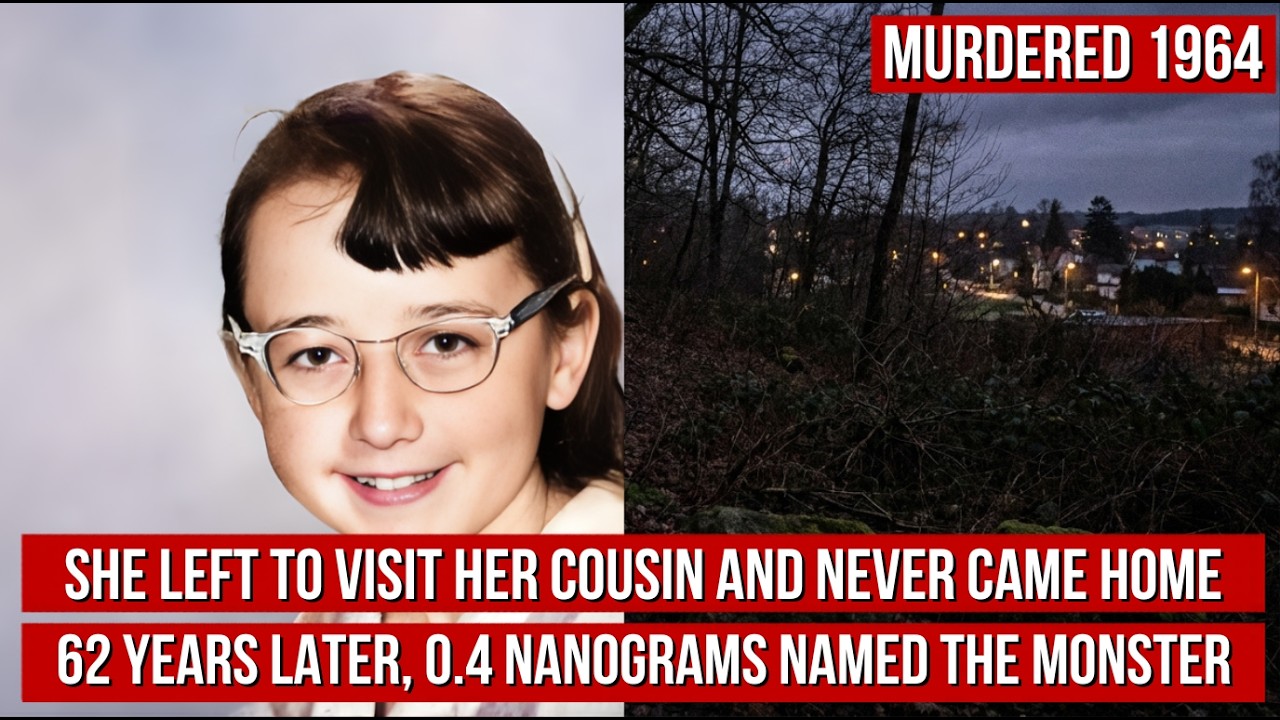
On a Sunday evening in March 1964, twelve-year-old Mary Teresa Simpson left her father’s apartment in Elmira, New York, to visit a cousin. She stopped first at her mother’s house, spent part of the afternoon there, and then set out for home. A witness saw her alone at the corner of East Market and Harriet Streets at approximately 6:30 p. m.
She was fully clothed and heading back. She never arrived. When Mary failed to come home that night, her father called the Elmira Police Department. For four days, officers and volunteers searched the neighborhoods along her likely route, combing parks, alleyways, and the surrounding countryside.
There was no sign of her. On March 19th, a man hiking with his two sons near Combs Hill Road in Chemung County, roughly five miles from where Mary was last seen, stopped at something half-hidden in the underbrush: a small hand and a single sneaker. Investigators removed the debris and found Mary’s fully clothed body concealed beneath four large stones, the heaviest weighing over a hundred pounds. Her mouth had been stuffed with soil and twigs.
The medical examiner determined she had been strangled, and there was evidence of sexual assault. She was twelve years old. The deliberate concealment told investigators from the first hour that this was not panic. This was intentional.
Fifty officers swept the wooded area. They recovered her eyeglasses, several buttons from her blouse scattered in the dirt, and an assortment of trash that was cataloged and stored with the care of an era before DNA existed. The local radio station and newspaper jointly posted a one-thousand-dollar reward. Hundreds of leads poured in.
Officers worked around the clock, formed task forces, and by October 1964, seven months after the body was found, police had formally questioned more than three hundred suspects. Not one of them was the man who killed her. Alfred Raymond Murray, Jr. was living in Elmira at the time.
He was thirty-two years old, married, with children, and a life that looked entirely ordinary from the outside. Local police knew him, but not for murder. His criminal history involving children had surfaced years earlier, when he was a teenager. Yet in the intensive, months-long investigation into Mary’s murder, his name never appeared once in the thousands of pages of records generated by the case.
By the mid-1960s, the investigation had produced no arrest and no named suspect. The reward was raised to five thousand dollars by 1972. Tips trickled in for another decade, but none led anywhere. For the Elmira Police Department, Mary’s case became the city’s defining cold case.
Officers who joined the force years after 1964 inherited the file and took it seriously. Retired detectives thought about it. Mary’s older sister, Linda Galpin, who had been sixteen and out of town when it happened, returned to Elmira after the murder and lived with the image of her sister lying in a casket. She later recalled trying to climb into it, wanting to be in there with her.
Meanwhile, stored in a freezer at Elmira Police Department headquarters, sealed in evidence packaging standard for 1964, sat Mary’s clothing: her skirt, her underwear, her blouse buttons. No one had thrown them out. No one had lost them. They waited for a technology that had not yet been invented.
DNA was introduced as a forensic tool in the mid-1980s, and by the 1990s, law enforcement agencies were beginning to understand what it meant for cases like Mary’s. In 2003, nearly forty years after her murder, investigators pulled her clothing from storage and submitted it to the New York State Police Forensic Investigation Center. On Mary’s skirt, forensic scientists identified semen. They extracted a complete DNA profile belonging to an unknown male and entered it into CODIS, the national DNA database.
The profile was clean. The science had worked. But CODIS returned no match. The killer’s genetic fingerprint existed in the system, crisp and identifiable, and no one in the database matched it.
The profile was logged. The case went back to waiting. In 2014, investigators resubmitted the profile. By then CODIS was larger.
The result was the same. Silence. By 2022, every original investigator in the case was gone. Sergeant William Goodwin of the Elmira Police Department had been carrying the file for years, never quite able to set it down.
That year, he applied for and received grant funding from Season of Justice, a nonprofit that funds DNA testing in cold cases where resources have run out. The grant opened a door that had been closed for decades. What Goodwin and FBI Special Agent Kenneth Jensen faced next was a problem of almost impossible dimensions. The remaining DNA evidence on Mary’s skirt measured approximately 0.
4 nanograms. That is an amount of biological material so small it cannot be seen under normal conditions. There was no margin for error. If the testing consumed the sample without producing a usable result, there would be nothing left.
No second attempt. No other sample. The case would close permanently, not with an answer, but with an absence. Jensen packed the evidence in dry ice and shipped it to Authram, a forensic laboratory in Texas specializing in extracting DNA profiles from degraded trace-level material.
Then came something no one had planned for. An ice storm shut down the FedEx hub in Memphis, the largest in the world, where the package had been routed. The dry ice had a time limit. Jensen and his team could not reach FedEx.
The last viable piece of evidence in a sixty-year-old murder case was sitting somewhere inside a logistics system that had gone dark. The package survived. The dry ice held. When the shipment finally reached Texas, the sample was intact.
Authram’s scientists extracted what they could from those 0. 4 nanograms and developed a forensic SNP profile, a genetic fingerprint built from hundreds of thousands of specific markers across the genome. This type of profile, when uploaded to public genealogical databases, allows forensic genealogists to search for individuals who share enough markers to indicate a family relationship. It does not produce an immediate name.
It produces a family tree. The profile was uploaded. Investigators working alongside specialists from the Criminal Investigation Resource Center at Russell Sage College began building family trees from the matches. The work took months, cross-referencing birth records, death records, census data, marriage certificates, and geographic history.
Through 2022 and into 2023, they worked methodically. Then a match emerged, not to a named suspect, not yet, but to a familial connection. Someone related to the DNA on Mary’s skirt had voluntarily contributed their genetic data to a public database. That person was a son, and the father his DNA pointed toward was a man named Alfred Raymond Murray, Jr.
Alfred Raymond Murray, Jr. was born in Elmira in 1931. He was a U. S.
Army veteran who served during the Korean War. He married, had children, and raised a family in the same city where Mary Teresa Simpson had lived and died. He worked as a truck driver. He died in March 2004 of natural causes at the age of seventy-three and was buried in Elmira.
His name had never appeared in the investigative records. No witness had named him. No tip had pointed in his direction. No detective in sixty years had ever written his name in a case file connected to Mary’s murder.
But local police had known who he was. His history of criminal behavior involving children had been documented. It had simply never been connected to this case. When investigators approached Murray’s son, he cooperated and provided a DNA sample voluntarily.
It confirmed a familial link to the biological evidence on Mary’s skirt. But a familial link is not a direct match. To close the final distance, investigators needed Murray’s own DNA, and he had been dead for over twenty years. In November 2025, Alfred Raymond Murray, Jr.
’s remains were exhumed from his Elmira burial site. Forensic scientists extracted DNA from his remains and compared it directly against the profile built from the 0. 4 nanogram sample preserved on Mary’s skirt since 1964. The probability that the DNA belonged to someone other than Murray was less than 1 in 320 billion.
On February 10th, 2026, sixty-one years, ten months, and twenty-six days after Mary Teresa Simpson was last seen alive at the corner of East Market and Harriet Streets, the Elmira Police Department held a press conference. Police Chief Kristen Thorne stood before a room packed with investigators, prosecutors, family members, and reporters and said the words Mary’s family had waited their entire lives to hear: this was a historic day for the Elmira Police Department, justice after almost sixty-two years. The name Alfred Raymond Murray, Jr. was read into the public record for the first time as a suspect in Mary’s murder.
Investigators made clear that Murray had no known relationship with Mary. She was, in the language of the case file, a crime of opportunity. A twelve-year-old girl walking home on a Sunday evening in the wrong place, encountered by a man with a documented history of preying on children, who then spent the remaining forty years of his life walking free through the same city where she was buried. Linda Galpin was seventy-eight years old when she walked into that press conference.
She had spent more than six decades carrying the grief of a question with no answer. She thanked everyone involved and said she wished her mother had been alive to hear it. Then she said what sixty-two years of waiting produces when it finally ends, not with rage, but with relief: she was very happy it was finally settled. Alfred Raymond Murray, Jr.
died in 2004. He was never arrested, never charged, never spent a single day in a courtroom for what he did to a twelve-year-old girl in 1964. He was buried in the same city as the child he killed, and for twenty-two years after his death, his name remained absent from every file and every public acknowledgement of the crime. But he left something behind, something he could not control and probably never knew existed: 0.
4 nanograms of biological material on a skirt worn by a twelve-year-old girl on a Sunday evening in March 1964. When the science finally caught up to the evidence, when a laboratory in Texas extracted a name from a speck smaller than anything the human eye can perceive, the silence that had surrounded Mary Teresa Simpson for sixty-two years finally broke. That identification stands as the oldest forensic DNA match in American criminal history, and it began with a sample so small it was invisible.
