The child came into the world without a sound, and Rue knew before she touched her that this was no ordinary arrival. The moon was absent from the sky, a true and heavy darkness, and the single tallow candle the midwife had brought refused to hold a flame. Three times she struck flint to steel, and three times a draft that came from nowhere, a breath of cold air in the sweltering cabin, snuffed it out. Resigned to the shadows, Rue worked by touch and instinct, her fingers reading the mother’s contractions like braille.
When the infant finally slipped into her hands, there was no cry, no gasping protest. The child simply opened her eyes, and even in the gloom Rue could see them, unsettlingly bright, irises scattered with flecks of gold that seemed to catch a light that did not exist in the room. The baby stared at the midwife with a calm, terrifying intensity, an ancient awareness that stopped Rue’s breath in her throat. This was not a blank slate.
This was a soul that had arrived with its luggage already packed. The year was 1856, and the place was the Whitmore Plantation on the northern coast of Florida, a desolate stretch of earth where the humid salt air off the Atlantic tangled with the stagnant rot of the marshes. Here the boundary between land and water was porous, shifting with the tides, much like the precarious balance of power that held the region together. The mother, Celia, was only twenty-two, yet her body was a testament to the brutal mathematics of the plantation system.
She had been laboring in the cotton fields since she was six, her skin weathered by the relentless sun, her back mapped with the raised keloids of the overseer’s lash. She had been treated not as a human being but as a biological asset, her existence recorded in ledgers alongside livestock and crop yields. This child was the result of a forced union, a cold calculation by the Whitmore family to increase their stock by breeding Celia with a man from a neighboring property, a man she barely knew and never saw again. But as Celia took the silent infant into her arms, the crushing weight of her reality fractured.
Looking down at the girl whose skin was a deep, radiant obsidian that seemed to absorb the shadows, Celia felt the sudden, violent intrusion of hope. It was a dangerous emotion, perhaps the most dangerous thing a person could possess in a place designed to extinguish it. She named the girl Zora, after a grandmother who had been stolen from the Gold Coast and who had died whispering of a place where her people commanded the iron and the earth, answering to no master but the sky. That grandmother had been a practitioner of what the masters fearfully called witchcraft and what the community knew as root work or hoodoo, a complex spiritual technology of survival, healing, and defense transported across the Middle Passage in the minds of the captive.
Rue remembered Celia’s grandmother well. She had been a woman who could turn the wind with a whisper and cure fevers with weeds that grew by the roadside. Rue saw that same dormant voltage in the newborn Zora, an inheritance of power that had skipped a generation, lying fallow in Celia only to erupt in her daughter. As Zora grew, this difference became impossible to ignore.
She did not learn the lessons of submission that were beaten into the other children. She did not lower her gaze when white people passed. She did not shrink to make herself invisible. Instead she walked with her chin lifted, moving through the quarters with the regal bearing of a displaced queen.
By the time she was a toddler, the enslaved community watched her with a mixture of protective love and deep anxiety, knowing that such a spirit was usually broken quickly and violently by the machinery of the plantation. The first true manifestation of her nature occurred when Zora was just two years old. She had wandered away from the supervision of the older children and found her way into the main plantation house, a forbidden zone where the penalty for trespassing was severe. She was found in the parlor sitting on the bench of the grand piano.
But she was not banging on the keys like a toddler. She was pressing them with deliberate, eerie precision, producing a haunting, dissonant melody that sounded like weeping. The overseer, a sadist named Garrett who prided himself on his ability to break the spirit of the enslaved, found her there. Garrett was a man of leather and grit, his humanity long ago eroded by the brutality of his trade.
He reached for the heavy coiled whip at his belt, intending to teach the child a permanent lesson about boundaries. “Got to cut the rot out early,” he sneered, raising his arm to strike. But the blow never landed. Witnesses, house slaves peering from the hallway, later whispered that as Garrett raised his arm, Zora stopped playing and simply turned to look at him with those amber-flecked eyes.
In that instant the overseer gasped, clutching his chest as if he had been struck by a sledgehammer. His face drained of color, turning a sickly ash gray. He staggered back, dropping the whip, his eyes bulging as he fought for air against an invisible constriction, as though iron bands were being tightened around his ribs by a ghostly hand. He collapsed to one knee, wheezing, overwhelmed by a sensation of pure primal dread that had no physical source.
The moment he crawled backward, breaking eye contact with the toddler, the pain vanished, leaving him trembling and soaked in cold sweat. Garrett never spoke of what he saw in the child’s eyes, but he never raised a hand against Zora again. He avoided her with a superstitious terror, crossing the road if he saw her approaching, a reaction that did not go unnoticed by the rest of the plantation. Years passed, and the legend of the girl grew in the quiet whispers of the quarters.
Zora was five when Celia began to secretly plot their escape, driven by the realization that her daughter’s supernatural tether would eventually be seen not as a curiosity but as a threat that had to be eliminated. The plantation was a place of stagnant misery, but around Zora the laws of nature seemed pliable. Vicious tracking dogs trained to tear human flesh would whimper and roll over on their bellies when she passed. Padlocks on the food stores would click open when she lingered near them, allowing the starving field hands to steal scraps of pork during the lean winter months.
Rue, recognizing that the girl needed guidance to control this volatile gift, began to train her in the old ways. Under the cover of the pre-dawn mist, deep in the woods, Rue taught Zora the language of the earth: which roots could stop a heart and which could mend it, how to read the warnings written in the flight of crows, and how to craft mojo bags for protection. But the most important lesson Rue taught her was psychological: that the chains were forged of iron, but the power of the master was a construct, an illusion that could be dismantled by a stronger will. By the autumn of 1861, the world outside the plantation was burning.
The Civil War had erupted, tearing the nation apart, and the structure of the plantation began to fray. The master’s sons rode off in gray uniforms to fight for the Confederacy, leaving the estate understaffed and chaotic. But the fear of insurrection led to tighter patrols and swifter executions for runaways. The tension was palpable.
The air smelled of impending violence. Zora, now ten years old, was hovering on the precipice of womanhood, a dangerous time for any enslaved girl. Garrett the overseer had begun watching her again, not with the old fear but with a new, predatory glint in his eyes, a calculating look that Celia recognized with sickening clarity. She knew they were running out of time.
But the final push came from Zora herself. For three consecutive nights the girl woke screaming from a vision. She saw men with lanterns, the glint of shackles, and blood soaking the soil of the quarters. On the third morning she looked at her mother, her face grave and ancient.
“We have to go tonight,” Zora said, her voice carrying the weight of a prophecy. “If we stay, we don’t wake up. ”
Celia trusted the girl’s sight more than she trusted her own fears. That day they prepared in silence.
They possessed almost nothing, but they gathered what mattered: a small sack of cornmeal Celia had been hoarding grain by grain, a stolen kitchen knife sharpened to a razor’s edge, and a leather pouch prepared by Rue. The old midwife pressed the bag into Zora’s hands with a fierce, trembling grip. Inside were the tools of their survival: High John the Conqueror root, graveyard dirt, and a slip of paper inscribed with symbols that Rue’s own grandmother had drawn from memory of the old country. “You are not what they say you are,” Rue whispered, her eyes wet.
“The world is wide and you have the power to walk through it. Don’t let them catch you, child. Make them afraid. ”
As the moon vanished behind a bank of heavy clouds, plunging the world into a protective darkness, Celia and Zora slipped out of the cabin.
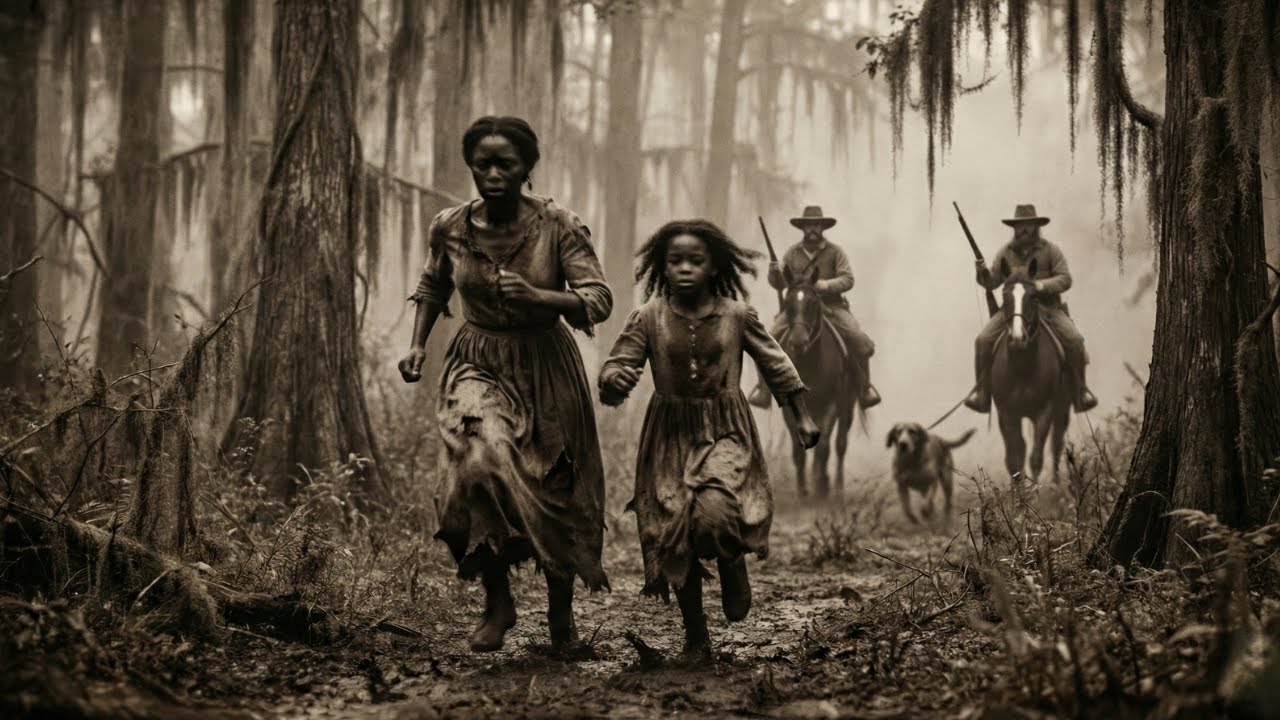
They did not head north, as was the custom for runaways, but east, toward the vast, untamed expanse of the marshes and the sea, stepping off the edge of the known world and into the labyrinth of the unknown. They moved initially toward the St. John’s River, a vast, dark artery of water that cut through the heart of the landscape. It was a counterintuitive choice.
The North Star beckoned them toward the Georgia line and the distant promise of Union territory, but Zora had insisted on the water. “The river has a mouth that doesn’t speak,” she had whispered to her mother, her small hand gripping Celia’s calloused palm with surprising strength. They waded into the current just as the first gray dilution of night began to suggest the coming dawn. The water was cool and murky, thick with silt and the unseen movement of river creatures.
To Celia, every submerged log felt like an alligator, every splash a patrol boat. But Zora moved with an eerie calm, her head above the surface like a swimming otter, navigating the currents as if she had a map etched into her mind. They let the river carry them downstream, drifting with the flow to conserve energy, their feet only occasionally brushing the soft, sucking mud of the riverbed. Back at the plantation, the alarm was raised with the rising sun, though it came later than it should have.
Old Isaiah, the keeper of the bell that summoned the enslaved to the fields, had noticed the empty cabin and the missing women before the first light hit the cotton rows. Isaiah was nearly seventy, a man whose spirit had been ground down by decades of bondage, yet he remembered the way Zora had once looked at him, a look that made him feel like a man rather than a mule. In a quiet act of treason that could have cost him his life, Isaiah delayed ringing the bell. He fumbled with the rope, feigned a coughing fit, and wasted a precious hour of the morning.
That single hour was a gift of distance, a gap between the fugitives and the hounds that would prove crucial. By the time Garrett realized the absence and the plantation erupted into chaos, Celia and Zora had already vanished into the tree line, where the river fed into the coastal marshlands. The Whitmores did not rely on local patrols for this. The escape of a field hand was a nuisance.
The escape of the girl whom they had begun to view with a mixture of covetousness and superstitious dread was a crisis. They sent for Silas Crenshaw. Crenshaw was not a mere slave patroller. He was a specialist, a man whose name was whispered with fear across three states.
He was a professional hunter of human beings, a mercenary who had turned the tracking of runaways into a grim science. He arrived at the plantation just before noon, riding a massive roan gelding and trailing a pack of six Cuban bloodhounds, beasts bred for aggression and stamina, with ears that dragged the ground and noses that could pull a scent out of a rainstorm. Crenshaw was a terrifying figure: tall, gaunt, dressed in drab oilskin that shed water and mud. His face was like a cliffside, craggy and immovable, with pale gray eyes that possessed the dead, flat effect of a shark.
He carried a customized rifle, a coil of heavy rope, and a set of iron shackles that jingled softly against his saddle, a sound that was the music of nightmares for the enslaved population of the region. Crenshaw wasted no time with pleasantries. He listened to Garrett’s blustering report with bored detachment, his eyes scanning the horizon. “How long?
” was all he asked, his voice sounding like gravel grinding together. When told it had been nearly eight hours, he did not blink. He had caught men with a three-day head start. He dismounted and entered the cabin where Celia and Zora had lived, moving with a predator’s economy.
He picked up a rag doll Zora had left behind, brought it to his nose, then offered it to the lead hound, a massive brute named Titus. The dog inhaled the scent deeply, a low growl rumbling in its chest, but then did something Crenshaw had never seen. It sneezed violently and backed away, whining, rubbing its snout against the dirt floor as if trying to scrub the smell out. Crenshaw frowned, a flicker of unease passing through him.
He forced the dog back to the scent, kicking it in the ribs until it complied. “Smart runaways go to water,” he muttered to Garrett, “but water only hides you for so long. Eventually you have to come up for air, and you have to touch ground. ”
The hunt began in earnest.
The party consisted of Crenshaw, his pack of hounds, and two hired guns, hard men named Boggs and Doyle, eager for the bounty money. They picked up the trail at the riverbank where the footprints entered the mud. “They went in here,” Crenshaw noted, pointing to the slide marks. “Woman and a child.
They’ll be slow. The current is pushing south. We ride the bank. ”
He was confident, operating on years of experience and the certainty of his own superiority.
But as they rode, following the river’s winding course, the trail did not behave as it should. Usually, runaways would exit the water within a mile or two, desperate to get out of the cold and the exposure. But miles passed, and there was no sign of them emerging. It was as if the river had simply swallowed them whole.
It was not until late afternoon that the dogs finally struck a scent again, miles downstream, at a place where the river dissolved into the chaotic geography of the salt marshes. Here, the ground became a treacherous mix of saw grass, black water, and hammocks of solid earth, a labyrinth designed to kill the uninitiated. As the sun began to dip, casting long, bruised shadows across the water, the terrain turned hostile. The horses struggled in the muck, sinking to their fetlocks, their breathing labored in the humid air.
The saw grass was tall enough to hide a man on horseback and sliced at their clothes and skin. This was the borderland, a place where civilization ended and the primal, ancient world began. Crenshaw felt a creeping irritation. The trail they had found was clear, footprints leading deep into the swamp.
But it felt too clear, almost inviting. The dogs were agitated, their behavior erratic. They would bay excitedly at a patch of reeds, only to find nothing, or cower from a shadow that held no danger. Titus, the lead dog, kept stopping to look back at the trees they had passed, his hackles raised, growling at the empty air.
“Something’s wrong with these mutts,” Boggs complained, swatting a mosquito the size of a coin. “Heat’s getting to them. ”
Crenshaw said nothing, but his grip on the reins tightened. It was not the heat.
He knew dogs. He knew fear, and his dogs were terrified. Miles ahead, in the deepening gloom of the swamp, Celia was nearing the end of her endurance. Her legs were numb from the cold water, her skirt heavy with mud, her feet cut and bleeding.
But Zora pulled her onward, relentless. The girl seemed to draw energy from the swamp itself, her eyes glowing brighter as the daylight faded. They reached a small, elevated island, a hammock dominated by a massive, twisting live oak tree draped in Spanish moss that looked like the gray beards of wizards. “Here,” Zora said, her voice small but commanding.
“We rest here. ”
Celia collapsed onto the root structure of the tree, shivering uncontrollably. “They’re coming, baby,” she wept, the terror she had suppressed all day finally breaking through. “I can hear the dogs.
That man, Crenshaw, he never stops. ”
Zora knelt beside her mother, taking the pouch Rue had given her from her dress. She began to pull out the items: the roots, the bones, the paper with the symbols. “He’ll stop,” Zora said, her tone devoid of fear, replaced by a cold, glittering purpose.
“He thinks he’s hunting us, Mama. But tonight, the swamp is going to hunt him. ”
As night fell, absolute and suffocating, the hunters made camp on a strip of dry land two miles back. They were frustrated, muddy, and on edge.
The swamp was noisy with the sounds of night, the croaking of bullfrogs, the splash of gars, the screech of owls, but underneath the noise lay a heavy, watchful silence. Crenshaw sat by the fire, cleaning his rifle, trying to ignore the way the darkness seemed to press against the circle of light. He was a man of logic, of bullets and blood, but the atmosphere here felt charged with something he could not name. Suddenly, the fire, which had been burning brightly, hissed and died, plunging them into total blackness.
There was no wind, no rain. It was as if the oxygen had simply been withdrawn from the air. In the sudden dark, Doyle screamed. “Something touched me!
” he yelled, scrabbling for a match. When the flare of the Lucifer finally illuminated the camp again, they were alone. But on the ground, in the center of their camp, lay a perfect circle of white stones that had not been there a moment before. And in the middle of the stones sat a small, crude doll made of marsh grass, its head twisted backward, staring directly at Silas Crenshaw.
The silence that followed the discovery was absolute, a heavy blanket that smothered even the bravado of hired guns. Doyle stared at the small, twisted figure, his eyes wide and rimmed with the white-hot panic of a man whose worldview is collapsing. The doll was not just a crude effigy; it was a message, bound with human hair and smelling faintly of grave dirt and ozone. Crenshaw, shaking off the momentary paralysis that had gripped the camp, kicked the doll into the darkness with a snarl of disgust.
“It’s a trick,” he barked, his voice ragged but loud enough to shatter the quiet. “Just superstition meant to scare weak-minded fools. They’re watching us, trying to spook us because they know they can’t outrun us. ” But even as he spoke, relighting the fire with a furious striking of flint, he felt the lie of his own words.
The air around them had grown inexplicably cold, a wet, seeping chill that ignored their coats and settled deep in the marrow of their bones. Sleep was a fugitive that night. The men took shifts watching the perimeter, backs to the fire, rifles leveled at the wall of black saw grass that surrounded them. But the darkness was not empty.
Throughout the night, the sounds of the marsh shifted from the natural to the impossible. They heard the crying of a baby, distinct, heartbreaking, and human, coming from the center of a deep water channel where no child could be. Then came the sound of chains, the heavy, rhythmic clanking of iron shackles dragging through mud, circling the camp, moving closer, then receding, then returning. The dogs, usually the most reliable sentinels, were useless.
They huddled together in a shivering mass, whining piteously, refusing to look out into the dark. At one point, Titus stood up and stared at an empty patch of ground, his tail tucked, and let out a howl that sounded less like a dog and more like a man screaming in agony. It was a sound that made Boggs cross himself and mutter prayers he had not said since childhood. Miles away, on the hammock beneath the ancient oak, Zora was awake.
She sat cross-legged on the earth, her small hands moving over a collection of objects arranged in precise geometry: a bird skull, a piece of pyrite, dried sage, and a lock of hair she had snagged from a bramble earlier that day. Her eyes were open but unseeing, the amber flecks swirling like nebulae. She was exhausted, sweat beading on her forehead despite the cool air, a trickle of blood leaking from her left nostril. Celia watched her daughter with a terrifying mixture of pride and helplessness.
She wanted to snatch Zora up, to tell her to stop, to run, but she knew that running was no longer enough. They had to fight. “I’m in their heads, Mama,” Zora whispered, her voice sounding raspy and old. “I’m showing them the things they fear most.
I’m making the water look like blood. I’m making the trees look like men with no faces. ” She slumped forward, the connection breaking, gasping for air as if she had been underwater. “The big one, the leader, his mind is hard, like a stone wall.
But I’m finding the cracks. ”
The sun rose on the second day, but it brought no relief. The light was pale and sickly, filtering through a heavy mist that refused to lift. The camp was in disarray.
When Crenshaw went to check the horses, he found them lathered in sweat, eyes rolling as if they had been ridden hard all night despite being tethered. But the real blow came from the dogs. One of the hounds, a vicious tracker named Brutus, was gone. The rope had not been chewed through.
The knot had been untied. It lay on the ground, the intricate loops undone with human dexterity. “They were here,” Doyle whispered, spinning in a circle, his rifle shaking in his hands. “They walked right into the camp while we were sitting here and let the dog loose.
We’re going to die out here, Crenshaw. I’m telling you, this is hate work. ”
Crenshaw struck Doyle across the face, a sharp, violent blow that knocked the man to the mud. “Shut your mouth,” Crenshaw hissed, his face inches from Doyle’s.
“We ride. We finish this. No one walks away from Silas Crenshaw. ”
They pressed on, but the marsh seemed to have rearranged itself overnight.
The trail, clear the day before, was now a confusing tapestry of false leads. Footprints would appear clearly in the mud, leading them into a thicket of thorns, only to vanish abruptly. Marks on trees seemed to shift positions when they were not looking. The compass needle on Crenshaw’s saddle horn spun lazily, unable to find north, drawn by some magnetic anomaly that defied explanation.
The heat rose, suffocating and wet, bringing with it swarms of biting flies that targeted the eyes and mouths of men and beasts alike. And then the visions began. It started with Boggs. He was riding Sweep, trailing the group, when he suddenly reined his horse in with a shout.
“There! By the cypress! ” He pointed a shaking finger at a stand of trees fifty yards away. “I saw her, the girl.
She was standing right there, looking at me. ”
Crenshaw wheeled his horse around, rifle raised, but there was nothing but moss and shadow. “You’re seeing things, Boggs,” he snapped, though his own heart hammered a frantic rhythm against his ribs. “Sunstroke and fear.
”
“I saw her,” Boggs insisted, his face pale and slick with sweat. “She didn’t look right, boss. She was… she was floating, and she was smiling.
Not like a kid smiles, like a wolf smiles. ”
They investigated the spot, splashing through knee-deep black water. There were no footprints, no disturbed vegetation. But carved into the trunk of the cypress tree, fresh and oozing sap, was a symbol: a circle with a cross through it, the ends of the cross hooked like barbs.
It was the same symbol that had been on the paper in Zora’s bag. Crenshaw stared at it, a cold knot forming in his stomach. He recognized it vaguely from stories old slaves used to tell. A mark of the crossroads, a warning that you were entering a space where the laws of the living no longer applied.
As the day wore on, the psychological deterioration of the hunting party accelerated. Doyle began to weep silently as he rode, muttering about his mother and sins he had committed years ago. Boggs kept looking over his shoulder, convinced that the trees were moving closer every time he turned his back. Even Crenshaw, the iron man, began to feel the fraying of his reality.
He saw movement in his peripheral vision, shadows that elongated and reached for him, shapes in the water that looked like drowning faces. He developed a pounding headache, a spike of agony behind his eyes that pulsed in time with the cicadas screaming. He realized with a dawning horror that they were being herded. The trail they were following, the subtle signs of broken twigs and disturbed mud, were not mistakes made by a panicked mother.
They were breadcrumbs. Zora was leading them deeper into the most treacherous part of the marsh, away from solid ground, into a place where the horses would be useless and the heavy men would be slow. By late afternoon, the terrain had become a nightmare. The water was waist-deep in places, black and foul-smelling.
The horses were panicking, fighting the reins, terrified of the things brushing against their legs underwater. They reached a dead end: a vast expanse of open, stagnant water surrounded by a wall of impenetrable cypress knees. There was no way forward, and when they turned to go back, the path they had cut seemed to have closed up, the saw grass knitting itself together to block their retreat. They were trapped.
And then, from everywhere and nowhere, a sound began. It was a low humming, a vibration that rattled their teeth. It grew louder, layering upon itself, a chorus of voices humming an old, sorrowful spiritual. “Wade in the water.
Wade in the water, children. ” The sound did not come from human throats. It came from the wind, the water, the trees. The dogs went berserk, howling and snapping at the air.
Suddenly, the water in the center of the clearing began to churn. Bubbles rose to the surface, bursting with the smell of sulfur and rot. The horses reared, throwing the men into the muck. Crenshaw scrambled to his feet, water sloshing into his boots, his rifle held high.
“Show yourself! ” he screamed, his voice cracking, sounding tiny against the immensity of the swamp. “Come out and face me! ”
And then she did.
Or at least, an image of her appeared. Fifty yards away, standing on the surface of the water as if it were polished glass, was Zora. She was not the ragged runaway child anymore. In the vision, she was ten feet tall, her skin composed of the night sky, her eyes two burning suns of amber fire.
She did not speak, but her voice echoed in their skulls, a telepathic thunderclap. “You are not the hunters here. You are the trespassers, and the swamp is hungry. ”
Boggs broke first.
With a shriek of pure, unadulterated madness, he dropped his weapon and scrambled away, splashing blindly into the thicket, heedless of the thorns tearing his face. Doyle fell to his knees in the water, sobbing, clutching his rosary, paralyzed by the divine terror of the sight. Crenshaw alone remained standing, though his legs trembled violently. He raised his rifle, aiming at the giant spectral child.
“I am Silas Crenshaw! ” he roared, a desperate assertion of identity against the void. “I do not fear haunts. ” He pulled the trigger.
The gun fired, a flash of sparks and smoke, but the bullet passed harmlessly through the image, rippling it like a reflection in a disturbed pond. The giant Zora threw her head back and laughed, a sound of crashing waves and breaking timber. And the water around Crenshaw suddenly erupted, dragging him down into the dark. Silas Crenshaw broke the surface of the black water, gasping for air that tasted of sulfur and ancient decay.
The spectral giantess had vanished, dissolving into mist, but the terror she had heralded was only beginning to take root. The swamp was no longer a passive landscape of water and wood. It had become a hostile, sentient entity. The water around him did not just ripple; it grasped.
Roots beneath the surface felt like skeletal fingers clawing at his boots, trying to drag him back down into the silt. He scrambled toward the nearest hammock of solid ground, his movements frantic and uncoordinated, stripping him of the predatory grace he had cultivated over decades. His rifle was gone, lost to the muck, and with it went his primary illusion of control. He was a man defined by his ability to dominate through force, and he had just been disarmed by a ten-year-old girl’s dream.
As he hauled himself onto the mud, shivering violently, he realized that the silence of the swamp had returned, but it was the silence of a held breath, the pause before the executioner’s blade drops. Doyle was gone. The Irishman had fled into the labyrinthine darkness, his mind shattered by the vision on the water. Boggs was somewhere nearby, whimpering in the saw grass, curled into a fetal ball, broken by a fear that no amount of money could balm.
Crenshaw was effectively alone. He tried to stand, to assert his authority over the empty air, but his legs refused to hold him steady. Then the fog began to coalesce. It did not just roll in; it formed shapes.
From the dark spaces between the cypress trees, from the heavy curtains of Spanish moss, and rising from the water itself, figures began to materialize. They were not solid, yet they blocked the dim light. They were gray and translucent, composed of mist and memory. At first, Crenshaw tried to tell himself it was a trick of the light, a hallucination brought on by swamp gas and exhaustion.
But as they drifted closer, the details became undeniable. He saw the ragged clothes of field hands. He saw the iron collars. He saw the scars that mapped the history of the South’s brutality on their spectral skin.
These were not random spirits. They were the lost, the men and women who had died in these marshes trying to run, the ones Crenshaw and men like him had hunted down, or the ones who had simply vanished into the mud to escape the lash. Zora had not just conjured a scarecrow; she had opened a door. She had turned the marsh into a witness stand.
The figures moved with a terrifying, silent slowness, gliding over the water without disturbing it. There were dozens of them, a silent army of the aggrieved, their eyes hollow voids that seemed to suck the light from the world. They did not scream or attack. They simply watched.
But their gaze was a physical weight, pressing down on Crenshaw’s chest, forcing him to confront the enormity of his own sins. He backed away, his boots slipping in the mud, until his back hit the rough bark of a tree. “Stay back! ” he rasped, his voice a broken ruin.
“I was just doing a job. It’s the law! ” The plea hung in the air, pathetic and absurd, instantly swallowed by the judgment of the dead. Miles away, the source of this apocalypse was collapsing.
Zora let out a sharp cry and slumped forward, the connection to the spirit world severing abruptly. She fell into Celia’s arms, her body limp and burning with fever. The effort of raising the shadows, of pulling the psychic trauma of the land into physical form, had nearly killed her. Blood ran freely from her nose now, staining her ragged dress, and her breathing was shallow and ragged.
“I made them remember,” Zora whispered, her eyes fluttering closed. “I gave the ghosts a shape so he could see them. But they’re heavy, Mama. They’re so heavy.
”
Celia held her daughter tightly, rocking her back and forth, terror and awe warring in her heart. She looked out into the darkness, knowing that somewhere, miles away, a bad man was facing a hell of his own making. “You rest now, baby,” Celia soothed, brushing the damp hair from Zora’s forehead. “You did enough.
You did more than enough. The swamp has him now. ”
Back in the clearing, the psychological dismantling of Silas Crenshaw was complete. One of the figures, a tall man with shackles on his wrists, drifted closer than the others.
He extended a hand, not to strike, but as if to offer an invitation. The sound of rattling chains filled Crenshaw’s head, deafening and rhythmic, drowning out his own heartbeat. The rationality he prized, the belief in a world of master and slave, of order and property, disintegrated. He realized with a shattering clarity that he was the anomaly here.
In the wild, ancient justice of the earth, he was the criminal. The fear that gripped him was not just the fear of death. It was the fear of damnation. He screamed, a raw, primal sound that tore his throat, and scrambled away from the figure, plunging blindly into the swamp.
He did not know where he was going. He did not care. He just ran. He ran until his lungs burned like fire and his muscles failed.
He tore through briar patches that shredded his clothes and skin. He waded through water teeming with snakes, heedless of the danger. He was no longer a hunter; he was prey, chased not by dogs but by the weight of a history he had helped enforce. Every shadow looked like a judge.
Every rustle of leaves sounded like a verdict. He ran through the night, a madman in a ruined kingdom, until he collapsed on a small rise of land, miles from where he had started, utterly broken. He curled up in the mud, covering his head with his arms, shaking uncontrollably. Silas Crenshaw, the man who had never lost a trail, was lost.
He would eventually crawl out of that swamp three days later, half-starved, his hair turned stark white, babbling about judgment and eyes in the dark. He would never hold a weapon again. He would never hunt another human being. The legend of the girl who broke the slave catcher would spread from cabin to cabin, but the truth was simpler.
She had not broken him. She had simply forced him to look in the mirror. With the immediate threat neutralized, the urgency of the moment shifted from combat to survival. The sun rose on the third day, finding Celia and Zora miles to the northwest, moving slowly.
Zora was weak, barely able to walk, her steps faltering. Celia supported her, becoming the strength for both of them. The adrenaline of the chase had faded, replaced by the grinding reality of their situation. They were exhausted, starving, and still deep in Confederate territory.
But the air felt different now. The oppressive weight of pursuit was gone. The birds were singing again. The swamp, which had been a weapon the night before, returned to being just a place, a difficult, dangerous, beautiful place.
“We keep moving,” Celia whispered to her daughter and to herself. “We walk until we see blue uniforms. We walk until we’re free. ”
They left the marshlands behind, transitioning into the pine forests and red clay hills of southern Georgia, moving toward a destiny that was no longer written by their masters but by their own weary feet.
The journey toward the theoretical safety of the Union lines was an ordeal that made the terror of the hunt seem almost merciful by comparison. For eighteen grueling days, Celia and Zora moved northwest, navigating a landscape that was actively hostile to their existence. The terrain shifted from the sodden, forgiving cover of the swamps to the exposed pine barrens and red clay hills. Here, the war was not a rumor but a physical scar on the land.
They passed burned-out homesteads, trampled fields where crops had been seized by foraging armies, and roads churned into mud by the passage of heavy artillery. Hunger became their constant companion, a dull ache that sharpened into agony by the third day. They survived on foraging: bitter wild onions, handfuls of unripe berries, and once, a rabbit that Zora had seemingly coaxed out of its burrow with a quiet melody, allowing Celia to catch it with her bare hands. The girl’s power was changing, evolving from the explosive, defensive force she had wielded against Crenshaw into something subtler, a survival instinct that bordered on precognition.
During the second week, the danger escalated. The deeper they moved into the contested borderlands, the thicker the Confederate patrols became. On the eleventh night, while following the curve of a dry creek bed, they nearly stumbled into a squad of gray-clad soldiers. There was no time to run, no cover to hide behind except a slight depression in the earth beneath an overhang of roots.
Celia pressed Zora into the dirt, shielding the girl’s body with her own, her heart hammering against her ribs like a trapped bird. The soldiers were so close that Celia could smell the stale tobacco smoke on their clothes and hear the leather creak of their boots. One of the men stopped directly above them, peering down into the shadows of the creek bed. By all laws of physics and light, he should have seen them.
But Zora, trembling with exhaustion, was gripping her mother’s hand, murmuring a single, repetitive syllable. The soldier’s gaze passed over them as if they were nothing more than empty air or a pile of dead leaves. He spat into the dust inches from Celia’s head and moved on. When they were gone, Zora collapsed, blood trickling from both nostrils, her skin cold to the touch.
She had bent the light, or perhaps the soldiers’ minds, rendering them invisible in plain sight. Three days later, they encountered others. It happened in a dense thicket of scrub oak, where Celia had decided to risk a daylight rest. They woke to find four faces staring at them: two men, a woman named Sarah, and a teenage boy named Marcus, runaways from a sugar plantation near Valdosta.
The meeting was tense, filled with the instinctive suspicion of the hunted, but it quickly dissolved into a shared, desperate camaraderie. Sarah had heard whispers of them. The grapevine telegraph, the clandestine communication network of the enslaved, traveled faster than horses. “They talk about a girl,” Sarah said, looking at Zora with wide, reverent eyes.
“A girl with amber eyes who broke a slave catcher in the swamp. They say she walks with spirits. ”
Zora shrank from the praise, uncomfortable with being a legend when she felt so much like a tired, hungry child. “We’re just walking,” Zora said softly.
“Same as you. ”
But the group stayed close to her, drawn by the palpable energy that hummed around her, sensing that this child was their best chance of making it across the final threshold. The final barrier was the river. It was wide, swollen with recent rains, and the current moved with a muscular violence.
On the far bank, illuminated by the ghostly light of a full moon, stood a line of fortifications. Earthworks and wooden palisades cut a jagged silhouette against the sky. The dilemma was agonizing. Were those Union fires or Confederate ones?
To cross into the hands of the enemy would mean immediate capture, likely execution, or a return to chains that would be tighter than before. To stay on this side was to starve or be caught by the patrols that were closing in. “Someone has to look,” the older man of the group whispered. “Someone has to get close enough to see the uniforms.
”
Zora stepped forward before Celia could stop her. “I’ll go,” she said. “The water knows me. ”
Despite Celia’s terrified protests, the logic was undeniable.
Zora could move silently. She could hold her breath longer than any adult. She had a rapport with the natural world that made her the perfect scout. Celia stood on the muddy bank, watching her daughter’s small head bob in the dark water until it disappeared into the shadows of the opposite shore.
The wait was an eternity, a suspension of time where every second felt like a physical blow. Sarah held Celia’s hand, humming a low, tuneless melody to keep the panic at bay. An hour passed, then two. Just as the sky began to bleed into the purple bruise of pre-dawn, Zora returned.
She dragged herself out of the water, shivering violently, her lips blue, but her eyes blazing with a frantic, joyful light. “Blue! ” she gasped, her teeth chattering. “They’re wearing blue, Mama, and…
and they’re like us. ”
Celia did not understand at first. “Like us? ”
“Black men,” Zora whispered.
“Black men with rifles. It’s the 54th Massachusetts. They’re soldiers, Mama. Real soldiers.
”
The revelation sent a shockwave through the group. The idea of armed black men, uniformed and sanctioned by the government to fight their former masters, was a dream so radical it was hard to comprehend. They crossed at first light. It was a perilous swim, the current fighting them every inch of the way, but the sight of the blue uniforms on the far bank acted as a beacon.
As they dragged themselves onto the Union-held shore, dripping and exhausted, they were not met with chains or whips. A sergeant, a tall black man with chevrons on his sleeve and a face etched with the gravity of war, stepped forward. He lowered his rifle and extended a hand to Celia. “Welcome to the United States Army lines,” he said, his voice deep and steady.
“You are under federal protection. You are free. ”
The word hung in the air, heavy and strange. Free.
Celia tried to say something, to offer thanks, but her legs gave out, and she fell to her knees in the mud, weeping. Great, heaving sobs that shook her entire body, releasing years of accumulated terror and grief. Around her, the others were crying too, embracing the soldiers, touching the blue wool of their uniforms as if to verify they were real. In the safety of the contraband camp, as they were fed and given dry clothes, the reality of their new life began to settle.
Zora sat wrapped in a wool blanket, sipping tin cup coffee, watching the camp bustle with activity. She was no longer the supernatural force of the swamp. She was just a girl again, safe in the shadow of her mother. The soldiers came by to see her, asking shyly if the stories were true, if she really had conjured ghosts to scare off Silas Crenshaw.
Zora just smiled, a tired, enigmatic smile, and said nothing. She knew that the legend of the girl who walked with spirits would outgrow her. It would travel through the camps, across the battlefields, and down through the generations. It would become a ghost story for the overseers and a prayer for the enslaved.
But for Zora, the magic was not in the root work or the visions. The real magic was simply that they were here, sitting on the earth, answering to no one but themselves. Celia looked at her daughter, seeing the amber flecks in her eyes catch the morning sun. The war was far from over.
The road ahead would be paved with the bitter struggles of Reconstruction, of a nation fighting to define what black freedom actually meant. There would be poverty and hatred and new forms of bondage to resist. But that was a fight for tomorrow. Tonight, they would sleep without listening for the bell.
Tonight, they belonged to themselves. The grandmother’s prophecy had been fulfilled, not by a miracle but by the relentless, terrifying, beautiful will of a mother and child who refused to break. In the ledger of history, where they had once been written as property, they now wrote their own names in ink that would never fade. They were here.
They were alive. And they were free.
