The lye hit Master Davenport’s face like liquid fire, and in that instant, twenty years of careful observation came to an end. I stood before him on his precious veranda, watching his eyes dissolve in the caustic solution I had spent months preparing. For the first time in two decades, I was the one doing the watching while he screamed in agony. “Now you cannot watch anymore,” I said, my voice steady as stone while he clawed at his burning face.
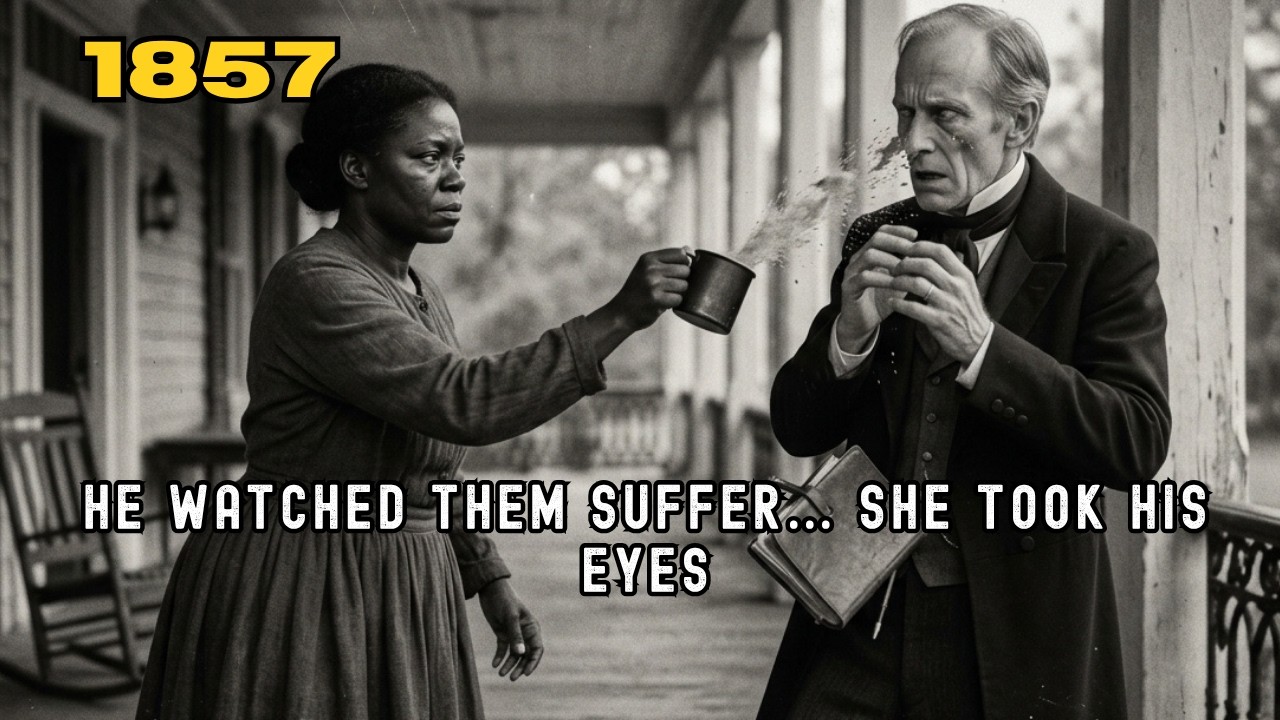
“Now you know what it feels like to be helpless. ”
The morning of October 12th, 1857, had begun like any other on the Davenport plantation in South Carolina. The cotton fields stretched endlessly under the brutal sun, worked by nearly four hundred enslaved souls who knew that their master’s greatest pleasure came not from their labor, but from observing their suffering. But this morning would end differently than any other in the plantation’s history, because today was the day I finally gave Master Davenport something worth watching.
My name is Phoebe, and I am forty years old, though the years have carved themselves deep into my face and body. I have worked these fields since I was a child, have felt the lash across my back more times than I can count, have watched friends and family sold away like cattle. But none of that was what drove me to blind my master with homemade lye. What drove me was something far worse than physical pain.
It was the knowledge that for twenty years he had watched my suffering with the same pleasure other men took in fine wine or beautiful music. Master Davenport was not like other plantation owners. While other masters beat their slaves in anger or frustration, Davenport beat us for entertainment. While others saw us as valuable property to be maintained, he saw us as subjects for his experiments in human misery.
He was a tall, thin man with pale blue eyes that seemed to see everything and feel nothing. Those eyes were his most prized possession, his instruments of torture, his means of extracting pleasure from the pain of others. He would position himself on his veranda each morning with a cup of coffee and a leather-bound journal, and he would watch us work while documenting our suffering with the precision of a scientist studying insects. The journal was his obsession, his masterpiece of cruelty.
In it, he recorded every detail of our pain: the exact expression on a slave’s face when the whip fell, the way a mother’s features contorted when her child was sold away, the precise moment when hope died in someone’s eyes. He wrote about us as if we were specimens in some grotesque experiment, noting our reactions to different forms of torture with clinical detachment. I had seen that journal many times over the years, had glimpsed its pages when I was forced to clean his study. The entries were written in his careful, educated hand, describing acts of cruelty with the same tone he might use to discuss the weather.
“Subject P, Phoebe, showed interesting facial contractions when denied water for 48 hours,” read one entry I would never forget. “The progression from defiance to desperation to resignation was most illuminating. ”
That was how he saw me. Not as a human being, but as subject P, a source of entertainment for his twisted mind.
For twenty years, I had been his favorite subject, the one who provided him with the most interesting data for his journal of horrors. It had started when I was twenty years old, newly arrived on the plantation after being sold away from my family in Virginia. I was strong and defiant then, unwilling to accept my fate without a fight. That defiance caught Davenport’s attention immediately, and he began to devise special torments designed specifically to break my spirit while providing him with maximum viewing pleasure.
He would deny me water on the hottest days, positioning himself where he could watch me work under the blazing sun until I collapsed from dehydration. He would load my cotton sack with rocks, forcing me to carry impossible weight while he observed my struggle from his comfortable chair. He would have me whipped, not for any specific offense, but simply because he wanted to study my facial expressions during the beating. But the worst part was not the physical pain.
It was the knowledge that my suffering was his entertainment. That every tear I shed, every cry of pain I could not suppress, every moment of despair that crossed my face was being cataloged in his journal like entries in a ledger book. Other slaves suffered under his cruelty, too, but none as consistently or as systematically as I did. He had chosen me as his primary subject, his favorite source of data, and for twenty years I had been trapped in his experiment with no hope of escape.
Until today. The plan had been forming in my mind for months, ever since I had volunteered to help with the soap making that supplied the plantation’s cleaning needs. Soap required lye, a caustic substance made from wood ash and water that could burn through skin and bone if used in sufficient concentration. The woman who supervised the soap making, an elderly slave named Aunt Sarah, had taught me the process without realizing she was giving me the knowledge I needed to destroy our tormentor.
“Be careful with that lye,” she had warned me the first day. “Get it in your eyes and you’ll never see again. Get it on your skin and it’ll eat right through to the bone. ”
I had listened carefully, filing away every detail about the substance that could blind a man permanently.
Over the following months, I had carefully stolen small amounts of the concentrated lye, hiding it in a glass jar buried beneath the floorboards of my cabin. I had tested its strength on pieces of wood and cloth, watching them dissolve under its corrosive power, imagining what it would do to human eyes. The timing had to be perfect. I needed to catch Davenport when he was most vulnerable, most focused on his sick hobby of observation.
The annual harvest inspection provided the perfect opportunity: a day when he would position himself on his veranda to watch every slave on the plantation work, documenting our exhaustion and suffering in his precious journal. On the morning of October 12th, I rose before dawn and retrieved the jar of lye from its hiding place. The liquid was clear and odorless, looking as innocent as water, but carrying the power to destroy a man’s sight forever. I transferred it to a smaller container that I could hide beneath my work clothes, and then I made my way to the fields to begin what would be my last day as subject P in Master Davenport’s journal.
The harvest inspection began at eight o’clock with Davenport taking his usual position on the veranda overlooking the cotton fields. He was dressed in his finest clothes, a white linen suit that would show every drop of blood or sweat, a wide-brimmed hat to protect his precious eyes from the sun, and polished boots that had never touched the soil his slaves worked every day. He opened his journal to a fresh page and began to write, documenting the start of another day’s entertainment. I could see him from where I worked in the fields, could see the slight smile that played around his lips as he prepared to record our suffering for his own twisted pleasure.
For four hours I worked under his gaze, feeling his eyes on me like a physical weight. He was waiting for something interesting to happen, some moment of drama or despair that would be worth recording in his journal. He had no idea that the most interesting moment of his life was approaching with every step I took toward his veranda. At noon, when the sun was at its highest and most brutal, I made my move.
I walked slowly toward the house, my head bowed in the posture of submission that he expected from his slaves. The jar of lye was hidden in the folds of my dress, warm against my skin from the heat of my body. Davenport looked up from his journal as I approached, his pale blue eyes focusing on me with the intensity of a predator studying its prey. “What do you want, Phoebe?
” he asked, his voice carrying the casual contempt he reserved for his property. “Master,” I said, keeping my voice humble and respectful, “I need to speak with you about the soap making. There’s been a problem with the supplies. ”
He leaned forward in his chair, interested despite himself.
Any disruption in the plantation’s routine was potential material for his journal, another opportunity to observe and record human misery. “What kind of problem? ” he asked. I stepped closer, close enough to see the pale lashes that framed his cruel eyes, close enough to smell the cologne he wore to mask the stench of his moral corruption.
This was the moment I had been planning for months, the moment when twenty years of suffering would finally be repaid. “This kind of problem,” I said, and threw the lye directly into his face. The scream that erupted from his throat was unlike anything I had ever heard, a sound of pure primal agony that seemed to come from the depths of his soul. The lye hit his eyes and began its work immediately, burning through the delicate tissues, dissolving the organs that had been his instruments of torture for so many years.
He fell backward in his chair, his hands clawing at his face, trying desperately to wipe away the caustic liquid that was destroying his sight, but it was too late. The damage was done, irreversible and complete. Master Davenport, the watcher, the observer of suffering, would never see again. “My eyes!
” he screamed, his voice cracking with pain and terror. “I can’t see! I can’t see! ”
I stood over him, watching his agony with the same clinical detachment he had shown while observing mine for twenty years.
For the first time in my life, I was the one with power, the one doing the watching, the one recording the data. “Now you know,” I said quietly, my voice barely audible over his screams. “Now you know what it feels like to be helpless, to be at someone else’s mercy, to suffer while someone watches. ”
The sound of his screaming brought people running from all directions.
House slaves, field hands, overseers, and finally his wife, Mistress Davenport, who appeared on the veranda with her face pale with shock. “What happened? ” she demanded, looking from her husband’s writhing form to my calm face. “What did you do to him?
”
“I gave him what he deserved,” I replied simply. “Twenty years of watching others suffer, and now he gets to experience it himself. ”
Mistress Davenport knelt beside her husband, trying to comfort him while he thrashed in agony, but I could see something in her eyes that surprised me. Not just shock and horror, but something that looked almost like relief.
As the chaos swirled around me, as people shouted and ran and tried to help the man I had blinded, I felt a deep sense of completion settle into my bones. The watcher could watch no more. The observer of suffering had become its subject. After twenty years, justice had finally been served, and I was ready to pay whatever price that justice demanded.
In the days following Master Davenport’s blinding, as I sat in the plantation jail awaiting my fate, I found myself thinking about the leather-bound journal that had documented twenty years of systematic cruelty. That book was more than just a record of his sadism. It was evidence of a mind so twisted that it found pleasure in cataloging human misery with scientific precision. I had first glimpsed the journal when I was twenty-two years old, two years into my time on the Davenport plantation.
I had been assigned to clean his study, a privilege reserved for slaves who had shown themselves to be trustworthy and discreet. The room was his sanctuary, filled with books on agriculture and philosophy, maps of his holdings, and the tools of a gentleman planter’s trade. But it was the journal that drew my attention, lying open on his desk like a confession of evil. The page I saw that day was dated July 15th, 1839, and it described in meticulous detail the punishment of a field hand named Joshua, who had been caught stealing food for his sick child.
“Subject J was stripped and tied to the whipping post at 10:00 a. m. ,” the entry read in Davenport’s careful handwriting. “I positioned myself at optimal viewing distance to observe facial expressions during punishment.
Initial defiance gave way to pleading at stroke 15, followed by resignation at stroke 25. Most interesting was the progression of emotions: anger, fear, desperation, and finally a hollow acceptance that suggests complete psychological submission. The subject’s wife was forced to watch, providing additional data on secondary trauma responses. ”
The clinical tone of the description made my blood run cold.
This was not the angry scrawl of a man recording punishment in the heat of the moment. This was the careful documentation of a scientist studying the effects of torture on human subjects. Over the years that followed, I caught glimpses of other entries whenever I was allowed into his study. Each one was more disturbing than the last, revealing the depth of his obsession with observing and recording human suffering.
There was the entry about Sarah, a young woman who had been separated from her infant child as punishment for insolence. Davenport had positioned himself where he could watch her face as the baby was loaded onto a wagon and driven away, noting with satisfaction the exact moment when hope died in the subject’s eyes. There was the description of an elderly man named Moses who had been denied medical treatment for a broken leg, with Davenport recording daily observations of how pain and infection affected the man’s ability to work. The entry concluded with a note that the subject had died on day twelve, but not before providing valuable data on the relationship between physical suffering and psychological deterioration.
Most disturbing of all were the entries about me. I discovered that I had been designated subject P in his system, and that he had been documenting my responses to various forms of torture since my arrival on the plantation. He had recorded my reactions to beatings, to starvation, to exhaustion, to the constant threat of being sold away from the few friends I had managed to make. One entry dated September 3rd, 1845 described his experiment in psychological torture.
“Informed subject P that her friend Rebecca had been sold to a brothel in New Orleans. False information, as Rebecca was actually sold to a cotton plantation in Alabama. Subject’s facial expression showed immediate devastation followed by anger, then resignation. The false information produced more intense emotional response than actual sale would have, suggesting that uncertainty amplifies psychological trauma.
Must explore this phenomenon further. ”
Reading that entry, I realized that even my grief had been manufactured for his entertainment. He had lied to me about Rebecca’s fate simply to study my reaction, to add another data point to his collection of human misery. But it was the most recent entries that finally pushed me to action.
In the months leading up to my attack, Davenport had begun to focus his attention on the children of the plantation, documenting their responses to various forms of cruelty with the same clinical detachment he had always shown toward adults. “Young subjects show more intense emotional responses than adults,” read one entry. “Their inability to mask feelings provides clearer data on the progression of psychological trauma. Recommend increasing focus on subjects under age 12 for optimal research results.
”
The idea that he was now targeting children, that he saw them as nothing more than research subjects for his experiments, filled me with a rage that went beyond anything I had felt before. This man was not just cruel. He was evil in its purest form, a monster who found pleasure in the systematic destruction of human souls. It was then that I began to plan his destruction in earnest, spending months preparing the lye that would rob him of his most precious possession, his ability to observe and record suffering.
The attack itself had been swift and decisive, but its aftermath was more complex than I had anticipated. As I sat in my cell, I could hear the chaos that had erupted throughout the plantation. Slaves whispered in the quarters about what I had done, their voices carrying a mixture of fear and admiration. Overseers struggled to maintain order without their master’s watchful presence.
And somewhere in the big house, Master Davenport lay in darkness, experiencing for the first time the helplessness he had inflicted on others for so many years. On the third day after the attack, I received an unexpected visitor. Mistress Davenport appeared at my cell, her face pale but determined, carrying something wrapped in a dark cloth. “I need to speak with you,” she said to the guard, a young white man who seemed nervous about the whole situation.
“Privately. ”
The guard hesitated, clearly uncomfortable with the idea of leaving a white woman alone with a slave who had committed such a violent act. But Mistress Davenport’s authority was absolute, and he reluctantly withdrew to a distance where he could not hear our conversation. “I brought you something,” she said, unwrapping the cloth to reveal her husband’s journal.
“I thought you should see this. ”
I stared at the leather-bound book that had documented so much suffering, so much evil. “Why? ” I asked.
“Because you need to understand what you’ve done,” she replied. “You haven’t just blinded a cruel master. You’ve stopped a monster. ”
She opened the journal to a page near the end, dated just one week before my attack.
The entry described an experiment Davenport had been planning involving the systematic starvation of slave children to study the effects of malnutrition on their development. “He was getting worse,” Mistress Davenport said quietly. “More obsessed, more twisted. I tried to stop him, but he wouldn’t listen.
He said I didn’t understand the importance of his research. ”
I looked at this white woman, this member of the class that had oppressed me for my entire life, and saw something I had never expected to see. Genuine remorse, real horror at what her husband had become. “Why are you showing me this?
” I asked. “Because I want you to know that what you did was necessary,” she replied. “And because I want to make you an offer. ”
The offer was unexpected and disturbing in its implications.
Rather than having me executed immediately, as would normally happen to a slave who had attacked a white man, Mistress Davenport wanted to keep me alive to serve her blind husband. “He needs someone to care for him now,” she explained. “Someone to feed him, dress him, guide him around the plantation. I could assign any of the house slaves to the task, but I think it should be you.
”
“Why? ” I asked, though I was beginning to understand her reasoning. “Because you’re the one who blinded him,” she said with a cold smile. “You’re the one who took away his ability to watch others suffer.
Now you can watch him suffer instead. ”
It was a twisted form of justice, but it appealed to something dark in my soul. The idea of watching Master Davenport struggle with his blindness, of seeing him dependent and helpless, held a certain poetic satisfaction. “And if I refuse?
” I asked. “Then you’ll be executed tomorrow morning,” she replied matter-of-factly. “But if you accept, you’ll live to see him experience every day the helplessness he inflicted on others. ”
I thought about the journal, about the twenty years of documented cruelty, about the children he had been planning to torture for his research, and I made my decision.
“I accept,” I said. Mistress Davenport nodded as if she had expected no other answer. “Good. You’ll start tomorrow.
And Phoebe. ” She paused at the cell door, looking back at me with an expression I couldn’t quite read. “Make sure he understands what he’s lost. Make sure he knows that the watcher has become the watched.
”
As she walked away, taking the journal with her, I realized that my revenge was just beginning. Blinding Master Davenport had been only the first act in a longer drama of justice. Now I would have the opportunity to watch him suffer every day, to see him struggle with the helplessness I had inflicted upon him. The voyeur who had spent twenty years observing the pain of others would now become the subject of observation himself.
And I would be his constant reminder of what he had lost, his daily proof that even the most powerless could find ways to strike back against their oppressors. Justice, I was learning, could take many forms. Sometimes it came swift and violent, like lye thrown in a tormentor’s face, but sometimes it came slow and patient, like the daily humiliation of depending on your victim for survival. I was about to discover which form was more satisfying.
The morning I was released from my cell to begin caring for Master Davenport, I walked through the plantation house with a strange sense of power I had never experienced before. For twenty years, I had moved through these rooms as invisible property, cleaning and serving while trying to avoid the cruel gaze of the man who saw me as nothing more than a subject for his twisted experiments. Now, I walked as his keeper, his guide, his unwilling savior, and his constant reminder of what defiance could accomplish. Master Davenport’s room had been transformed since the attack.
The windows were covered with heavy curtains, not to protect his ruined eyes from light, but because he could no longer bear the reminder of a world he could no longer see. The mirrors had been removed, the paintings taken down, anything that might have reflected light or suggested vision eliminated from his environment. He sat in a chair by the window, his face turned toward the covered glass as if he could will his sight to return through sheer force of desire. The bandages had been removed from his eyes three days earlier, revealing the full extent of the damage I had inflicted.
Where once there had been pale blue eyes that missed nothing, now there were only empty sockets, the tissue scarred and twisted beyond any hope of healing. “Master Davenport,” I said quietly, announcing my presence as I had been instructed. “I’m here to help you with your morning routine. ”
He turned his head toward the sound of my voice, and I saw his face contort with rage and recognition.
Even without sight, he knew who I was. Knew that the woman who had destroyed him was now the one he would have to depend on for survival. “You,” he whispered, his voice thick with hatred. “They’re making you my keeper.
”
“Yes, Master,” I replied, keeping my tone neutral and respectful. “Mrs. Davenport thought it would be appropriate. ”
He laughed then, a bitter sound that held no humor.
“Appropriate? Yes, I suppose it is. The subject becomes the observer. The watched becomes the watcher.
My dear wife always did have a sense of irony. ”
I moved closer to his chair, close enough to see the way his hands trembled with rage and helplessness. For twenty years, those hands had held his precious journal, had written detailed descriptions of the suffering he observed with such pleasure. Now they shook with the palsy of a man who had lost everything that gave his life meaning.
“Shall I help you dress, Master? ” I asked. “Don’t call me that,” he snapped. “Don’t pretend this is normal service.
We both know what this is. ”
“What is it, then? ” I asked, genuinely curious to hear how he would describe our new relationship. “Torture,” he said simply.
“Mutual torture. You’re forced to care for the man you hate, and I’m forced to depend on the woman who destroyed me. My wife has created a perfect hell for both of us. ”
He was right, of course.
There was something deeply disturbing about the intimacy forced upon us by his blindness. I had to help him dress, guide him to the bathroom, cut his food into manageable pieces, describe the world around him when he asked. Every interaction was a reminder of his helplessness and my power over him. But as the days passed, I began to realize that this arrangement was not the torture he believed it to be, at least not for me.
There was a deep satisfaction in watching him struggle with simple tasks, in seeing him fumble for objects that were just out of reach, in observing the frustration that consumed him when he could no longer navigate the world with the confidence he had once possessed. “Where is my journal? ” he asked on the third day, his voice carrying a desperate edge. “I need to write down what’s happening to me.
I need to document this experience. ”
“Mistress Davenport has it,” I replied. “She said you won’t be needing it anymore. ”
The sound he made was somewhere between a sob and a scream.
The journal had been his life’s work, his masterpiece of cruelty, his proof that he was more than just another plantation owner. Without it, he was nothing. Just a blind man dependent on the mercy of others. “Bring it to me,” he demanded.
“I order you to bring me my journal. ”
“You can’t order me to do anything,” I said quietly. “You can’t even see me to know if I’m obeying or not. You have no power here anymore.
”
It was true, and we both knew it. His authority had been based on his ability to observe and punish, to watch for signs of disobedience and respond with swift retribution. Now he was trapped in darkness, unable to see what I was doing, unable to verify whether I was following his instructions or deliberately defying them. I began to test the limits of his helplessness in small ways.
When he asked for water, I would bring it slightly warm instead of cold. When he requested his favorite foods, I would oversalt them or let them grow cold before serving. When he wanted to be guided to the veranda, I would take him by a longer route, letting him stumble slightly on uneven floorboards. None of these acts were dramatic enough to be called abuse, but they were constant reminders that he was no longer in control.
He began to suspect that I was tormenting him deliberately, but he could never be certain. Was the food really oversalted, or had his sense of taste been affected by his trauma? Was I really guiding him into walls, or was he simply disoriented by his blindness? The uncertainty was driving him mad, just as he had once driven his slaves mad with unpredictable punishments and arbitrary cruelties.
“You’re doing this on purpose,” he accused me one morning after I had accidentally guided him into a low-hanging branch during our walk around the plantation grounds. “Doing what, Master? ” I asked innocently. “You know what.
The small torments, the little cruelties. You’re making me suffer the way I made you suffer. ”
“I don’t know what you mean,” I replied. “I’m just trying to help you adjust to your new circumstances.
”
But he was right. Of course I was tormenting him, but in ways so subtle that they could always be explained as accidents or misunderstandings. It was a form of psychological warfare that he had taught me through twenty years of his own cruelty, and I was proving to be an excellent student. The worst part for him was not the physical discomfort, but the knowledge that he was now the subject of observation.
I watched him constantly, studying his reactions to frustration and helplessness with the same clinical interest he had once shown toward my suffering. I began to understand why he had found such pleasure in his journal. There was something deeply satisfying about documenting the breakdown of another human being. “What are you thinking about?
” he would ask when he sensed me watching him. “What are you seeing in my face? ”
“Nothing, Master,” I would reply. “Just making sure you’re comfortable.
”
But we both knew I was lying. I was seeing everything: the way his jaw clenched when he couldn’t find something he was looking for, the tremor in his hands when he realized he had spilled food on himself, the defeated slump of his shoulders when he acknowledged his complete dependence on others. As weeks turned to months, I watched Master Davenport’s mental state deteriorate with the same fascination he had once shown toward my own psychological breakdown. He began to talk to himself, carrying on conversations with people who weren’t there, arguing with voices only he could hear.
“The subjects are escaping,” he would mutter, his hands moving as if he were writing in his journal. “I need to document their behavior, but I can’t see them anymore. How can I study what I cannot observe? ”
Sometimes he would call out for slaves who had died years earlier, demanding that they come forward for punishment.
Other times he would beg invisible overseers to bring him his journal, promising to record important observations if only they would help him write. The plantation around us was falling into chaos without his watchful presence. Slaves worked more slowly, knowing that their tormentor could no longer observe their every movement. Overseers struggled to maintain discipline without the threat of his detailed reports on their performance.
The entire system that had been built on his obsessive observation was crumbling in his absence. Mistress Davenport visited occasionally, checking on her husband’s condition with the detached interest of someone observing an interesting experiment. She would ask me about his behavior, his mental state, his ability to function in his new circumstances. “Is he suffering?
” she asked during one of these visits. “Yes,” I replied honestly. “Every day. ”
“Good,” she said with satisfaction.
“He deserves to know what it feels like to be helpless, to be at someone else’s mercy. You’re doing excellent work, Phoebe. ”
It was strange to receive praise from a white woman for tormenting her husband, but I had learned that the relationships between masters and slaves were more complex than they appeared on the surface. Mistress Davenport had her own reasons for wanting her husband to suffer, her own grievances against the man who had terrorized their plantation for so many years.
As the first anniversary of my attack approached, I realized that Master Davenport was losing his grip on reality completely. He spent most of his time in a world of hallucinations and memories, reliving his years of cruelty while being unable to understand why he could no longer see the results of his actions. “Phoebe,” he said one evening as I helped him prepare for bed. “Do you ever regret what you did to me?
”
I considered the question carefully before answering. “No, Master. I regret that it took me twenty years to do it. ”
He nodded slowly as if my answer confirmed something he had suspected.
“I used to think I understood human nature,” he said. “I thought I could predict how people would respond to suffering, could catalog their reactions like specimens in a collection. But I never predicted you. ”
“Maybe that’s because you never saw me as human,” I replied.
“You saw me as subject P, as a source of data for your journal. You never considered that I might be capable of planning, of patience, of revenge. ”
“No,” he admitted. “I never considered that.
”
As I helped him into bed that night, I realized that our strange relationship had taught us both something about the nature of power and powerlessness. He had learned that the ability to inflict suffering was not the same as the ability to control it. And I had learned that even the most oppressed could find ways to strike back against their oppressors. But I also knew that our twisted dance of mutual dependence and mutual torment could not continue forever.
Master Davenport was breaking down mentally and physically, and I could see that he would not survive much longer in his current state. The question was whether he would die naturally from the stress of his condition, or whether he would find some way to escape the hell that his life had become. Either way, I would be there to watch, to observe, to document his final moments with the same clinical interest he had once shown toward the suffering of others. The watcher had become the watched, and I intended to see the experiment through to its conclusion.
By the spring of 1858, six months after I had blinded Master Davenport with lye, his descent into madness had become impossible to ignore. What had begun as anger and frustration at his condition had evolved into something far more disturbing, a complete break from reality that left him trapped in a world of hallucinations and paranoid delusions. I watched this transformation with the same clinical fascination he had once shown toward my suffering, documenting his mental deterioration with the thoroughness of a scientist studying a specimen. Every day brought new evidence of his psychological collapse, new behaviors that revealed the depth of his torment.
He had begun to believe that his journal was still with him, that he could still see and record the suffering of others. I would find him sitting at his desk, his ruined eyes staring sightlessly at empty air while his hands moved across blank paper, writing invisible entries about imaginary subjects. “Subject P showed remarkable resilience today,” he would mutter as he wrote nothing on nothing. “Despite prolonged exposure to psychological pressure, she maintains her defiant attitude.
Must increase intensity of observation to achieve breakthrough. ”
The irony was not lost on me. Even in his madness, he was still obsessed with me, still trying to understand and catalog my responses to his cruelty. But now I was the one doing the observing, the one taking notes on his behavior, the one studying the effects of psychological torture on the human mind.
His hallucinations became more elaborate as the weeks passed. He would carry on detailed conversations with slaves who had died years earlier, issuing orders to overseers who existed only in his memory, demanding reports on plantation activities that were no longer under his control. “Moses,” he would call out to the empty room, addressing a field hand who had died in 1852. “Bring me the punishment log.
I need to review yesterday’s disciplinary actions. ”
When no one responded, he would become agitated, convinced that his slaves were deliberately ignoring him as part of some coordinated rebellion. He would demand that I summon the overseers, insisting that immediate action was needed to restore order to the plantation. “They’re plotting against me,” he would whisper, his voice filled with paranoid terror.
“I can hear them talking, planning. They think because I can’t see them, I don’t know what they’re doing, but I know. I always know. ”
The truth was that the slaves were indeed behaving differently in his absence, but not in the way he imagined.
Without his constant observation and documentation of their every move, they had begun to work with less fear, to speak more freely among themselves, to reclaim small pieces of their humanity that his presence had suppressed. The plantation’s productivity had actually improved under the more relaxed supervision of the overseers, who no longer felt the pressure of having their every decision scrutinized and recorded in Master Davenport’s journal of cruelty. But he could not accept this reality, could not acknowledge that his reign of terror had been counterproductive as well as evil. “The cotton yield is down,” he would insist, despite evidence to the contrary.
“The slaves are lazy without proper supervision. I need to implement new observation protocols, new methods of documentation. ”
I began to realize that his obsession with watching and recording had been more than just sadism. It had been his entire identity, his reason for existing.
Without the ability to observe and document suffering, he had no sense of purpose, no understanding of who he was or what his role in the world should be. The physical effects of his mental deterioration were becoming apparent as well. He had lost significant weight, his appetite destroyed by the constant anxiety and paranoia that consumed his thoughts. His hands shook uncontrollably, not just from rage, but from some deeper neurological damage caused by the stress of his condition.
Most disturbing of all were the moments when he seemed to recognize the reality of his situation, when the fog of madness would lift just enough for him to understand what he had lost. These moments of clarity were brief but devastating, leaving him sobbing with a despair so profound that even I, who had every reason to hate him, felt a flicker of something that might have been pity. “I can’t see,” he would whisper during these lucid intervals, his voice breaking like a child’s. “I can’t see anything.
How can I know what’s happening if I can’t see it? ”
“You can’t,” I would reply simply. “That’s what blindness means. ”
“But I need to see,” he would insist, his hands reaching out desperately as if he could somehow grasp sight from the air around him.
“I need to watch, to observe, to record. That’s who I am. That’s what I do. ”
“Not anymore,” I would tell him.
“Now you’re the one being watched. ”
These conversations seemed to push him deeper into his delusions, as if the truth of his condition was too terrible to accept. He would retreat into his imaginary world where he still had his journal, where he could still see and document the suffering of others, where he was still the master of his domain rather than a broken man dependent on the mercy of his former victim. It was during one of these episodes that he made his first serious attempt to harm himself.
I found him in his study trying to use a letter opener to cut his wrists, his movements clumsy and ineffective due to his blindness and the tremor in his hands. “Let me die,” he begged when I took the blade away from him. “Please, just let me die. I can’t live like this.
I can’t exist without being able to see. ”
“No,” I said firmly. “You don’t get to escape that easily. You made me suffer for twenty years.
Now it’s your turn. ”
I reported the incident to Mrs. Davenport, who responded by having all sharp objects removed from his room, but I could see that she was beginning to grow tired of the experiment, beginning to question whether keeping her husband alive was worth the trouble and expense. “How much longer can this continue?
” she asked me during one of her visits. “He’s completely mad. He’s no use to anyone in this condition. ”
“As long as it takes,” I replied.
“He watched me suffer for twenty years. I intend to watch him suffer for as long as he lives. ”
But even as I spoke those words, I could see that Master Davenport’s suffering was approaching its natural conclusion. His body was failing along with his mind, worn down by the constant stress and anxiety that had consumed him since losing his sight.
He had developed a persistent cough that grew worse each day, and his appetite had disappeared almost entirely. He spent most of his time in bed now, too weak to maintain the pretense of normal activity, too lost in his delusions to care about his physical condition. The end, when it came, was both sudden and inevitable. I found him one morning hanging from a bed sheet he had somehow managed to tie to the ceiling beam, his body swaying gently in the morning breeze from the open window.
He had finally found a way to escape the hell his life had become, but not before experiencing a full year of the helplessness and despair he had inflicted on others for so many years. The watcher had been watched, the observer had been observed, and the man who had found pleasure in documenting suffering had become its subject. I stood looking at his body for a long time, feeling not triumph, but a strange sense of completion. Justice had been served, not through the courts or the law, but through the ancient principle of an eye for an eye, or in this case, eyes for twenty years of systematic cruelty.
Master Davenport was dead, but his journal remained, hidden somewhere in the house, waiting to tell its story of evil to anyone brave enough to read it. And I was still alive, still capable of bearing witness to what had happened on this plantation, still able to ensure that his crimes would not be forgotten. The experiment was over, but the documentation would continue. The difference was that now I would be the one controlling the narrative, the one deciding what story would be told about the man who had thought he could reduce human beings to subjects in his sick research.
The watcher was dead, but the watched would live to tell the tale. Master Davenport’s funeral was a small, quiet affair, attended only by his wife, a few neighboring planters who felt obligated to pay their respects, and the house slaves who were required to be present. As I stood among the mourners, watching his coffin being lowered into the ground, I felt no satisfaction in his death, only a deep sense that justice had finally run its course. The official cause of death was listed as suicide, brought on by despondency over his blindness, but I knew the truth was more complex.
He had died not just from the physical act of hanging himself, but from the psychological torture of being unable to observe and document the suffering of others. His identity had been so completely bound up in his role as watcher that losing his sight had destroyed not just his vision, but his very sense of self. In the days following the funeral, Mrs. Davenport began the process of settling her husband’s affairs and deciding the future of the plantation.
She called me to her study one afternoon, and I found her sitting behind the same desk where her husband had once written his journal of horrors. “I have something that belongs to you,” she said, producing the leather-bound journal from a drawer, “or rather something that contains twenty years of observations about you. ”
I stared at the book that had documented so much suffering, so much evil. “What do you want me to do with it?
”
“That’s up to you,” she replied. “You could burn it, destroy all evidence of what he did, or you could keep it, use it to tell the world what really happened on this plantation. ”
I took the journal in my hands, feeling its weight, its substance, its terrible significance. Inside were detailed descriptions of every cruelty inflicted on me and countless others, written in the careful hand of a man who had found pleasure in documenting human misery.
“Why are you giving this to me? ” I asked. “Because you’re the only one who truly understands what it represents,” she said. “You lived through what he documented.
You know the truth of what happened here. ”
She paused, looking out the window at the cotton fields where so much suffering had taken place. “I’m selling the plantation,” she continued. “I can’t bear to live here anymore knowing what my husband did, what I allowed to happen by my silence.
”
“What about the slaves? ” I asked. “That’s partly why I wanted to speak with you,” she said. “I’m offering you a choice.
I could sell you along with the others, send you to another plantation where you might face similar cruelty, or I could give you your freedom along with enough money to start a new life somewhere else. ”
The offer was unexpected, but I understood her motivation. She wanted to cleanse herself of the guilt she felt for her husband’s crimes, to make some gesture toward redemption that might ease her conscience. “And in return?
” I asked, knowing there had to be conditions. “In return, you take that journal and you disappear. You never speak of what happened here, never tell anyone about the experiments, the observations, the systematic cruelty. You let the dead bury the dead.
”
I looked down at the journal, thinking about all the suffering it contained, all the evidence of evil that would be lost if I agreed to her terms. But I also thought about the possibility of freedom, of escape from the system that had enslaved me for forty years. “I need time to think,” I said. “Of course,” she replied, “but don’t take too long.
The plantation will be sold within the month. ”
That night I sat in my cabin reading through the journal by candlelight, reliving twenty years of documented cruelty through the eyes of the man who had inflicted it. The entries were even more disturbing than I had imagined, revealing not just his actions, but his thoughts, his motivations, his twisted philosophy about the nature of human suffering. He had seen himself as a scientist studying the effects of various forms of torture on human subjects.
He had believed that his observations were contributing to some greater understanding of human nature, that his cruelty served a higher purpose than mere sadism. But reading his words now, I could see the truth that had been hidden beneath his pseudo-scientific language. He had been nothing more than a monster who had found an intellectual justification for his evil, a man who had dressed up his sadism in the language of research and observation. The journal contained detailed descriptions of experiments he had conducted on dozens of slaves over the years, documenting their responses to starvation, sleep deprivation, physical torture, and psychological manipulation.
He had recorded their breaking points, their moments of despair, their final surrenders to his will. Most disturbing of all were his plans for future experiments, including the systematic torture of children that I had prevented by blinding him. He had been planning to expand his research to create what he called a comprehensive study of human suffering that would establish his reputation as a pioneer in the field of psychological research. Reading these plans, I realized that my attack had done more than just blind a cruel master.
It had prevented untold suffering, had stopped a monster from continuing his evil work. The children of the plantation were safe because I had found the courage to strike back against their tormentor. As dawn broke over the plantation, I made my decision. I would accept Mistress Davenport’s offer of freedom, but I would not destroy the journal.
Instead, I would hide it, preserve it, keep it safe until the time was right to reveal its contents to the world. The next morning, I met with Mistress Davenport and accepted her terms with one modification. I would take the journal and disappear, but I would not promise to keep its contents secret forever. Someday, when the time was right, the world would learn the truth about what had happened on the Davenport plantation.
She agreed reluctantly, understanding that she had no choice but to trust me, to use my judgment about when and how to reveal the truth. Two weeks later, I left the plantation as a free woman, carrying with me a small bag of belongings and the journal that documented twenty years of systematic cruelty. I traveled west to Texas, where I settled in a community of freed slaves and began a new life far from the cotton fields of South Carolina. For thirty years, I kept the journal hidden, waiting for the right moment to reveal its contents.
That moment came in 1890 when I was contacted by a group of abolitionists who were documenting the horrors of slavery for historical purposes. I gave them the journal along with my own testimony about what I had witnessed and experienced on the Davenport plantation. They published excerpts from it in newspapers and magazines throughout the North, using it as evidence of the systematic cruelty that had characterized the institution of slavery. The publication caused a sensation, revealing to the world the existence of masters who had found scientific justification for their sadism, who had treated human beings as subjects for twisted experiments in suffering.
The journal became one of the most powerful pieces of evidence against the romanticized view of slavery that some Southerners were trying to promote in the years after the Civil War. I lived to see the journal’s publication and its impact on public understanding of slavery’s true nature. I died in 1895 at the age of seventy-eight, knowing that the truth about Master Davenport’s crimes had finally been revealed to the world. But my greatest satisfaction came not from the journal’s publication, but from the knowledge that I had survived, that I had outlived the man who had tried to break me, that I had found a way to turn his own weapon, his obsession with documentation, against him.
The watcher had been watched, the observer had been observed, and the truth had finally been told. It was enough. It was more than enough. Phoebe died peacefully in her sleep on March 12th, 1895, in a small house in Austin, Texas, surrounded by the freed slaves who had become her chosen family.
She was buried in the Freedmen’s Cemetery with a simple headstone that read, “Phoebe, she watched back. ”
The Davenport journal became one of the most important historical documents of the slavery era, providing unprecedented insight into the mindset of masters who had justified their cruelty through pseudo-scientific observation. Excerpts from it were included in history textbooks for decades, serving as evidence of slavery’s true nature. The plantation itself was sold and divided among several smaller farmers after Mistress Davenport’s departure.
The main house was demolished in 1889, but the foundation stones were used to build a school for black children, a fitting transformation for a place that had once been dedicated to the systematic study of human suffering. Mistress Davenport moved to Charleston, where she lived quietly until her death in 1902. She never remarried, never spoke publicly about her husband’s crimes, and left no record of her thoughts about the events that had destroyed her family. Her silence was perhaps the most eloquent testimony to the horror of what she had witnessed.
The journal’s publication inspired other former slaves to come forward with their own stories of systematic cruelty, leading to a broader understanding of the psychological as well as physical torture that had characterized the institution of slavery. Phoebe’s courage in preserving and eventually revealing the truth helped ensure that the full horror of slavery would not be forgotten or romanticized by future generations.
