The first scream came at three o’clock in the morning. Marcus Hammond woke violently ill, his body convulsing as it tried to expel something his system could not identify. Within thirty minutes his wife was afflicted the same way. By dawn, all seventeen members of the Hammond family lay stricken, children crying in pain, adults unable to leave their beds.
No one understood what was happening. And somewhere in the December darkness, the young enslaved woman who had prepared their Christmas feast was already gone. Her name was Celia. She was twenty years old.
And she had been planning this night for months. The story had begun more than two years earlier, on a suffocating July day in 1844, in a Savannah auction house where human beings stood on wooden platforms while white men examined their teeth like horses and squeezed their muscles like livestock. Celia was sixteen, dressed in a simple cotton dress, her wrists bound loosely in front of her, her eyes fixed on a point in the middle distance. She had learned not to make eye contact with potential buyers.
Eye contact could be interpreted as defiance, and defiance lowered your price or earned you a beating before the sale even concluded. The auctioneer called out her attributes like he was selling furniture. Sixteen years old. Healthy.
No visible marks or deformities. Mixed heritage, which meant lighter skin, which meant a higher price. Trained in household service. And then the detail that made several men in the crowd lean forward with interest: literate.
She could read and write. This was dangerous knowledge for an enslaved person to possess. In most southern states, teaching a slave to read was illegal, a crime punishable by fine or imprisonment. But some slaveholders, particularly those who fathered children with enslaved women, sometimes arranged for their mixed-race offspring to be educated before selling them away, to erase the evidence of their own violations.
Celia’s literacy suggested exactly this history. Someone had cared enough to teach her, then cared little enough to sell her. Marcus Hammond stood in the crowd of buyers, a tall man with graying hair and the calculating eyes of someone who saw everything as a potential investment. He already owned over two hundred enslaved people who kept his rice and cotton fields productive.
He was looking for something specific: a girl young enough to be molded, educated enough to manage a household, and powerless enough to have no choice in what he planned for her. When the bidding reached nine hundred dollars, an enormous sum, the other potential buyers dropped out. Hammond paid in cash, had the papers drawn up, and added one more human being to his property inventory. Celia was loaded into a wagon with three other newly purchased people and transported north to Charleston County.
She did not cry. She did not speak. She watched the landscape pass, the roads, the rivers, the swamps, memorizing everything. The Hammond plantation rose from the low country like a monument to stolen labor.
The main house gleamed white in the brutal sun, three stories tall with columns that reached toward heaven as if trying to sanctify the hell that funded their construction. Behind the house, the slave quarters stretched in long rows: small wooden cabins where families were crammed together, where privacy was impossible and dignity was a luxury no one could afford. Between the house and the quarters lay the kitchen building, the laundry, the stable, the garden, all maintained by people who owned nothing, not even themselves. An elderly enslaved woman named Ruth met the wagon when it arrived.
She was the head housekeeper, responsible for training new domestic workers in the specific routines the Hammond family demanded. Ruth’s face was lined with sixty years of witnessing things no human should witness. She took Celia to the house, showed her where things were kept, explained the family’s preferences, their schedules, their temperaments. As she spoke, she studied the girl.
Ruth would later write in a diary, hidden in the walls of her cabin and discovered decades after her death, that Celia frightened her from the first day. Not because the girl was violent or angry, but because she was too calm, too watchful, too intelligent. She learned everything the first time. She never needed to be told twice.
She asked questions that seemed innocent but were actually gathering information. What foods does the master prefer? What medicines does the family use? Which plants in the garden are dangerous?
Ruth told her because she had to, but she felt like she was arming the girl for something she could not see. Three months after Celia arrived at the Hammond plantation, Marcus Hammond informed his son Thomas of the arrangement he had made. Thomas was twenty-two, educated, comfortable in his privilege, and completely unprepared for what his father proposed. The girl would be Thomas’s wife in a ceremony that held no legal weight but served the family’s purposes.
Any children born of the union would be enslaved, their mixed heritage ensuring they could be sold if necessary or kept as valuable property if desired. The arrangement would teach Thomas how to manage enslaved people with absolute authority, preparing him for the day he inherited the estate. Thomas wrote to a college friend about his confusion, his discomfort, his eventual acceptance. “Father insists this is for the best,” he wrote.
“He says a planter must understand his complete power over those he owns, and that this arrangement demonstrates that power absolutely. I confess I do not fully understand his reasoning, but I trust his judgment in such matters. ”
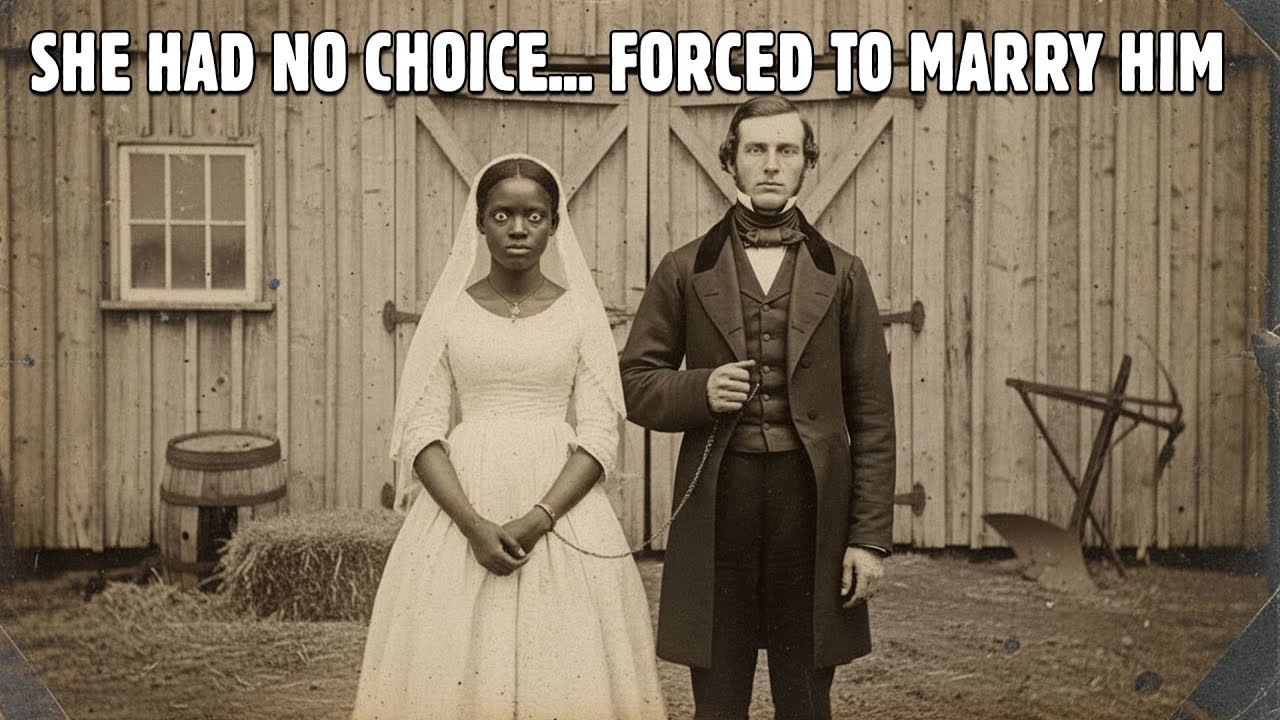
On November 15th, 1844, a mockery of a wedding took place in the plantation’s small chapel. An enslaved preacher named Samuel was ordered to speak Christian vows over a union that was nothing more than legalized rape.
Samuel would later escape to the north and tell abolitionists what he witnessed. “The girl wore white,” he said. “She stood silent and still while they spoke words of love and commitment over a transaction of ownership. When I looked into her eyes, I saw something that terrified me.
Not fear, not sadness. Calculation. Cold, patient calculation. ”
After the ceremony, Celia was moved to a small room next to Thomas’s chambers, the door locked from the outside.
For the next two years, she existed in a state of captivity within captivity, forced to play the role of wife to a man who owned her as completely as he owned his horse or his books or his shoes. What happened during those two years is documented only in fragments. Medical records show two pregnancies. The first ended in miscarriage in the spring of 1845.
The doctor noted it as “spontaneous termination, common in slaves of nervous disposition,” as if reducing her grief and trauma to a medical footnote about the weakness of enslaved bodies. The second pregnancy, in 1846, resulted in a stillborn child. The plantation records list only “female negro deceased at birth. ” No name.
No burial site. Just another piece of property that failed to survive. Ruth’s diary entries from this period grew darker. “Something has broken in the girl,” she wrote in April of 1846.
“Or perhaps something has been born. She moves through this house differently now. She watches the family with eyes that seem to be measuring them for coffins. She has started asking questions about plants, about which ones heal and which ones harm, about doses and symptoms, and how the body responds to different substances.
Old Josiah, who tends the master’s garden, tells me she follows him like a shadow, learning everything he knows about what grows in the soil of this cursed place. ”
What no one understood was that Celia had made a decision. She could not escape: slave catchers and patrollers made running nearly impossible, and even if she succeeded in fleeing, she would be hunted for the rest of her life. She could not fight: physical resistance would result in immediate and brutal punishment, and she possessed no weapons beyond her own hands.
But she could learn. She could watch. She could gather information the way a general gathers intelligence before a battle. And she could wait.
In the garden where Josiah grew vegetables and herbs for the Hammond table, dozens of plants offered more than nutrition. White snakeroot, which grew wild in the shaded areas, contained a toxin that accumulated in the body slowly, causing tremors, weakness, and eventually death. Water hemlock, which grew near the creek, was one of the most poisonous plants in North America, its roots capable of killing within hours if consumed in sufficient quantity. Oleander, with its beautiful pink flowers, contained compounds that disrupted the heart’s rhythm.
Dozens of other plants, some medicinal in small doses, became weapons in larger ones. Celia learned them all. She learned which parts of each plant contained the highest concentrations of toxins. She learned how to dry them without destroying their potency.
She learned how to extract essences by soaking them in alcohol or oil. She learned how to test small amounts on the rats that infested the storage sheds, watching how they died, how long it took, what symptoms appeared. She learned how to combine different substances to create symptoms that would mimic natural diseases, making detection nearly impossible with the primitive medical knowledge of the 1840s. And most importantly, she learned patience.
She did not act impulsively. She did not poison a single meal in a moment of rage. She waited. She planned.
She calculated exactly what she wanted to accomplish and how she would accomplish it. If she was going to cross the line from victim to killer, then she would make certain her actions counted for something. She would make certain they remembered what she did. By the fall of 1846, Celia had been collecting and preparing her materials for months.
Hidden behind loose boards in the pantry, concealed in cloth bags that looked like ordinary kitchen supplies, she kept her arsenal. Dried oleander leaves ground to powder. Water hemlock root carefully preserved. White snakeroot seeds, toxic even when dried.
She had tested them. She knew their effects. She knew their dosages. She knew exactly what would happen when they entered a human body.
All she needed now was the right opportunity: the right moment when the entire Hammond family would gather, when suspicion would be divided among so many potential sources, when she could strike with maximum impact and maximum chance of escape. That opportunity came in December, when Marcus Hammond announced the family would host a Christmas gathering. Seventeen relatives would descend on the plantation for a week of celebration, and Celia would be given expanded responsibilities in the kitchen, preparing special dishes and serving the family during their festivities. Ruth protested this decision.
She begged Marcus Hammond to use more experienced workers, saying she felt something terrible approaching, like a storm on the horizon. But Hammond insisted. He wanted Thomas’s wife visible, wanted the family to see the arrangement he had made, wanted to display his complete control over every aspect of his household. It was pride, arrogance, the absolute certainty of a man who believed enslaved people were incapable of complex thought or long-term planning.
It was the last mistake Marcus Hammond would ever make. The relatives began arriving on December 20th. Carriages rolled up the long drive carrying Marcus Hammond’s brothers, his sister, their spouses, their children. The house filled with noise, with laughter, with the sounds of privilege unexamined and power unquestioned.
Children ran through the halls. Adults gathered in the parlor to discuss politics, cotton prices, the troublesome abolitionists in the north who understood nothing about the southern way of life. Enslaved workers moved silently through the rooms, serving wine, carrying luggage, stoking fires, invisible except when needed. Celia moved among them like a ghost.
She carried trays. She refilled glasses. She smiled when spoken to and kept her eyes down when ignored. And in the kitchen, in the moments between tasks, she worked with the focused intensity of a physician preparing medicine.
Except the medicine she prepared would cure nothing. It would only kill. The head cook, Flora, had served the Hammond family for twenty years. She ran the kitchen with efficiency born of long practice.
Flora trusted Celia with specific tasks: the girl was careful, clean, precise in her work. So when Celia volunteered to prepare the preserves, the pickled vegetables, the special sauces that would accompany the main courses, Flora agreed without hesitation. When Celia offered to handle the wine service and prepare the after-dinner cordials, Flora appreciated having one less responsibility. What Flora did not know was that every task Celia volunteered for was a calculated piece of a larger plan.
The plum preserves that would sit on the breakfast table for the duration of the visit were prepared with care. Celia cooked the plums with sugar and spices exactly as Flora had taught her. But as the mixture cooled, she added a careful measure of white snakeroot extract, stirring it in thoroughly so it would be impossible to detect. The bitter taste was masked by the sweetness of the fruit and the warmth of cinnamon.
She prepared enough to serve the family multiple times over several days. The spiced wine that Marcus Hammond favored, the decanter he kept in his study for evening drinks, received special attention. Celia infused it with water hemlock root that she had soaked in alcohol for weeks to extract the toxins. The resulting liquid was pale yellow and smelled faintly of earth, but mixed with the red wine and heavy spices, clove, nutmeg, cinnamon, it became undetectable.
She made certain the decanter was full and placed prominently where Hammond would see it and pour from it generously. The children’s cake was perhaps the most calculated act of all. Celia knew that children’s smaller bodies would succumb faster to toxins. She knew that their deaths would devastate the adults in ways that might not happen if only adults were affected.
She understood that to truly destroy this family, to make them suffer as she had suffered, she needed to take from them what they valued most: their future, their innocence, their illusion that they were protected by their wealth and status. So she baked a beautiful cake, rich with butter and eggs and vanilla, and laced it with ground oleander leaves mixed into the batter where they would be impossible to identify. The cake looked perfect. It smelled perfect.
And when she presented it to the children on December 22nd, telling them it was a special early Christmas treat, they devoured it with delight. Six children, ranging in age from seven to nineteen, ate slice after slice, their faces smeared with frosting, their laughter filling the house. Celia watched them eat. She felt nothing.
Or perhaps she felt everything and had learned to bury it so deep that it could no longer reach her face. Over the next two days, the family consumed the poisoned foods at multiple meals. The preserves appeared at breakfast. The spiced wine flowed freely in the evening.
Various dishes that Celia had carefully prepared with smaller doses of toxins were served at lunch and dinner. No single serving contained enough poison to cause immediate symptoms. That was the genius of her plan. The toxins accumulated gradually in the family members’ systems, building to lethal levels while still appearing to be nothing more than generous holiday eating and drinking.
Flora complimented Celia on the quality of the preserves. Several family members specifically praised the spiced wine. The children begged for more cake, and Celia, with perfect submissiveness, cut them additional slices. Marcus Hammond himself called Celia into the parlor on the evening of December 22nd to thank her in front of the assembled family for her excellent service.
She stood before them, hands folded, eyes down, the picture of the obedient slave girl they believed her to be. “This girl has become quite an asset to our household,” Marcus said to his relatives, his voice warm with the satisfaction of a man who believes his judgments are always correct. “She serves my son well and learns quickly. A fine example of how proper training can elevate even the lowest to useful service.
”
Celia murmured her thanks. She curtsied. She returned to the kitchen, and in the darkness of the storage room, hidden from view, she allowed herself one small smile. Because she knew what was coming.
She knew that within hours, Marcus Hammond’s self-satisfaction would transform into agony. She knew that his “fine example” would destroy him and everyone he loved. That night, December 22nd, Celia did not sleep. She lay in her small locked room, listening to the sounds of the house settling, waiting for the moment she had planned so carefully.
At midnight, using a thin piece of metal she had fashioned months ago from a broken kitchen utensil, she picked the lock on her door. She had practiced this dozens of times, waiting until the household slept, opening her door, moving silently through the halls to verify she could do it, then returning before dawn. Tonight would be the last time. Tonight she would leave and never return.
But first she had one final task. She moved through the dark house to the kitchen, to the storage room where her cloth bag of remaining poisons was hidden. She gathered it carefully. Then she returned to her room, laid out the white dress she had worn at her forced wedding ceremony, and placed beside it a single sheet of paper with words she had written and rewritten a hundred times in her mind before finally committing them to ink: “I pray that God grants them the mercy they denied me.
”
It was the only explanation she would ever give. The only words that would survive to tell her side of what happened. And then, with the house still dark and silent around her, Celia slipped out through a kitchen window and disappeared into the December night. The first scream came at three in the morning.
Marcus Hammond woke violently ill, his body convulsing as it tried to expel the toxins that were now overwhelming his system. Within thirty minutes, his wife was similarly afflicted. By dawn, all seventeen family members were suffering. The children cried in pain, their small faces pale and drawn.
The adults could not leave their beds. Vomit and worse covered sheets and floors. No one understood what was happening. Dr.
Edmund Thornton was summoned urgently from Charleston. He arrived mid-morning on December 24th, Christmas Eve, to find the Hammond house transformed into a scene of medical horror. Seventeen people in various states of distress, all showing the same symptoms: severe gastrointestinal pain, uncontrollable vomiting, weakness, tremors, blood in their vomit and waste. Thornton had practiced medicine for twenty years and had never seen anything like this.
His first diagnosis was food poisoning, perhaps contaminated oysters, which were notoriously dangerous if not fresh, or spoiled meat, though the cold December weather made that less likely. He prescribed purgatives to clear the system and bed rest. He assured the family that they would recover within a day or two. He was completely wrong.
By the afternoon of December 24th, the children were deteriorating rapidly. Their small bodies could not fight the levels of toxins in their systems. They lay in their beds too weak to cry, their breathing shallow, their skin cold and clammy. The adults were not much better.
Marcus Hammond, despite his suffering, demanded to know what was happening, demanded better treatment, demanded that Thornton save his family. But Thornton had no answers. Without modern toxicology, without any understanding of the specific poisons involved, he could do nothing but watch as his patients slowly died. It was the overseer who discovered Celia’s absence.
On Christmas morning, he went to her room to question her about the food preparation, thinking perhaps she had seen something that would explain the illness. The room was empty. The door, which should have been locked from the outside, stood slightly ajar. The white dress lay on the bed like a ghost, and beside it, the note.
The overseer brought the note to Marcus Hammond’s bedside. Despite his agony, Hammond read it. And in that moment, through the fog of pain and poison, he understood: the girl had done this. The girl he had purchased, the girl he had forced on his son, the girl who had served them so obediently for two years, had systematically poisoned his entire family, and then she had disappeared.
Hammond ordered the enslaved workers gathered and questioned. The overseer, a man named Collins, whose methods were as brutal as his nature, began interrogations immediately. But the enslaved community claimed to know nothing. Celia had kept to herself.
She had been quiet, withdrawn, unremarkable. No one had seen her leave. No one knew where she had gone. Whether this was truth or protective lies, the result was the same: no information emerged.
Dr. Thornton, upon learning of Celia’s flight and reading the note she left, reconsidered his diagnosis. Poisoning. Deliberate, planned, systematic poisoning.
But what poison? What substance could cause these symptoms? He consulted his medical texts, but the toxicology of the 1840s was primitive at best. He could identify the symptoms, but not the cause.
He could describe what was happening to the Hammond family, but not how to stop it. The first death came on Christmas morning. Edward Hammond, seven years old, simply stopped breathing. His small body had fought for nearly two days and could fight no more.
His mother, herself barely conscious with illness, did not even know her son had died until hours later. Two more children died on December 27th, a third on the 28th. The adults began dying on the 29th. By the morning of December 30th, five days after the symptoms first appeared, seven members of the Hammond family were dead.
A magistrate arrived from Charleston to investigate what was now clearly mass murder. Slave catchers were hired, with substantial rewards offered for Celia’s capture. The kitchen was searched, and the cloth bag of remaining poisons was found hidden behind a loose board. A botanist from Charleston identified the contents: white snakeroot, water hemlock, oleander.
All highly toxic. All capable of causing the symptoms the family experienced. And all growing freely on the Hammond plantation itself. The investigation revealed the extent of Celia’s planning.
The preserves tested positive for plant toxins. The spiced wine contained water hemlock extract. Even the residue in the pan used to bake the children’s cake showed traces of oleander. Every food item Celia had prepared was contaminated, and the doses were carefully calibrated.
Adults received amounts that would sicken them severely but might not kill. Children received lethal doses. It was methodical. It was precise.
It demonstrated an intelligence and capacity for planning that the white authorities found deeply disturbing. Because if one enslaved woman could plan and execute something this devastating, what did that say about all the other enslaved people? What did it say about the fundamental premise of slavery itself, the claim that enslaved people were intellectually inferior and incapable of complex thought? The magistrate wrote in his report, though this section was later removed from public records, that the crime demonstrated capacities that challenged their understanding of the negro mind.
If such planning were possible, perhaps their assumptions about the slavery system required re-examination. But re-examination would threaten everything. So instead, the authorities focused on finding Celia and making her an example that would terrify anyone else who might consider similar resistance. The manhunt spread across the low country.
Dogs tracked possible routes. Every road north was watched. Every dock was searched. Rewards increased from five hundred dollars to one thousand dollars, an enormous sum that attracted professional slave catchers from three states.
But Celia had vanished as completely as if the earth had swallowed her. Days turned to weeks. Weeks turned to months. No trace of her was ever found.
Marcus Hammond died on January 2nd, 1847, having lived long enough to see his dynasty crumble, but not long enough to see Celia captured. His wife died two days later. By January 10th, nine members of the Hammond family were dead. The eight survivors would carry the effects of the poisoning for the rest of their lives.
Thomas Hammond, Celia’s forced husband, suffered chronic health problems that would eventually kill him at age forty-one. Others had permanent organ damage, digestive issues that never fully healed, nightmares that plagued them for decades. The Hammond plantation never recovered. Without Marcus’s management, the estate fell into debt.
Thomas proved incapable of running the operation. By 1851, the plantation was sold to satisfy creditors, broken into parcels, and the enslaved community was scattered to different buyers across the South. The house itself burned in 1852 under circumstances that were never fully explained but were widely suspected to be arson. And Celia.
She disappeared into history, into legend, into the whispered stories that enslaved people told each other in the darkness of their quarters. Some said she died in the swamps trying to escape. Others said she made it north to freedom. Still others claimed she was caught and killed by slave catchers who chose not to report it to avoid losing the reward.
But there are hints, fragments, suggestions that maybe, just maybe, she survived. Letters preserved in abolitionist archives tell a story that official records tried to erase. In March of 1847, just three months after the Hammond poisoning, a Quaker named Jeremiah Wright wrote to a fellow abolitionist in Philadelphia about a young fugitive woman he had helped. The letter was deliberately vague, using coded language that Underground Railroad operatives employed to protect their networks, but the details aligned too perfectly to be coincidence.
Wright described meeting a woman in her early twenties, of mixed heritage, bearing scars that suggested harsh treatment. She possessed unusual literacy for a fugitive, and spoke with what Wright called a chilling calm about the violence she had committed against her enslavers. “She killed multiple people, including children, after enduring circumstances I cannot bring myself to detail on paper,” Wright wrote. “She showed no remorse, only a cold certainty that her actions were necessary for her survival.
I arranged passage north for her, though I confess her story troubles me more than most. Is she a murderer or a prisoner of war who struck back at her captors with the only weapons available? ”
Wright helped this woman travel through Pennsylvania into New York and eventually to Canada, where American slave catchers had no legal authority. If this woman was Celia, and the timing and description strongly suggest she was, then she accomplished what seemed impossible: she escaped not only the Hammond plantation, but the entire apparatus of American slavery.
Canadian census records from the 1850s contain a tantalizing possibility. The 1851 Census of Canada West lists a Cecilia Harris, age twenty-three, occupation listed as midwife and herbalist, living in the Buckton settlement near Lake Erie. Buckton was a community established specifically for fugitive slaves, a place where those who had escaped bondage could build new lives beyond the reach of American law. The name change from Celia to Cecilia would have been natural for someone trying to distance herself from her past while maintaining some connection to her identity.
The occupation makes perfect sense for someone with her knowledge of plants and their properties. This Cecilia Harris appears again in the 1861 census, still in Buckton, now thirty-three years old, still working as a midwife. Community records from Buckton mention her several times. A notation from 1863 describes how Cecilia Harris provided crucial assistance during a cholera outbreak, using her knowledge of herbs when doctors were unavailable.
Another note from 1871 calls her a respected elder whose skills in healing have saved many lives in the community. The irony is almost unbearable. If this was Celia, then the hands that had killed nine people spent the rest of their years bringing life into the world. The knowledge she had used to poison, she now used to heal.
The woman who had been forced to serve a master’s family now served her own community by choice. Back in South Carolina, the Hammond case sent shock waves through the planter class that would ripple for years. Within weeks of the deaths, plantation owners across the low country implemented new security measures around food preparation. Kitchen workers faced increased scrutiny and suspicion.
Some planters hired white cooks despite the considerable expense, believing that white workers would be less likely to poison them. Others required that all food be tasted by enslaved workers before it reached the master’s table, essentially using human beings as poison detectors. These measures created additional suffering throughout the enslaved communities of South Carolina. Workers were beaten for minor cooking errors.
Cooks were sold away based on nothing more than a master’s paranoia about a stomach ache after dinner. The fear Celia had created became its own form of poison, spreading through the system, touching lives far beyond the Hammond estate. Private letters between planter families reveal the extent of this anxiety. A woman named Sarah Middleton wrote to her sister in February of 1847, describing the tragedy in carefully coded language.
“They suffered a mysterious illness during Christmas that proved fatal for most of the family,” she wrote. “The circumstances are not spoken of openly, but whispers suggest it was no accident. I confess this news has made me watch our servants differently. We believe they accept their station, but what if behind those placid faces they are planning our destruction?
”
This was exactly what terrified the planter class most. Not the physical danger, though that was real enough, but the psychological revelation. If Celia could plan and execute such a sophisticated crime, if she could maintain an appearance of submission while secretly preparing mass murder, then how could any slaveholder trust the people they enslaved? How could they sleep at night knowing that the cook preparing their food, the maid pouring their wine, the workers moving through their houses might be plotting revenge?
The answer was that they couldn’t. Not really. So they buried the story as much as possible. The Charleston newspapers published only brief notices about a tragic illness that affected a prominent family, with no details about poisoning or the enslaved woman who had fled.
The magistrate’s full report was sealed in courthouse records, accessible only to researchers with special permission. The depositions from survivors were locked away. The goal was to prevent the story from spreading, to keep other enslaved people from learning what Celia had accomplished. But stories like this cannot be contained.
The enslaved community had its own networks of communication, its own ways of passing information from plantation to plantation, county to county, state to state. Within months, variations of Celia’s story were being told in slave quarters across the South. The details changed to protect those who shared them. The location shifted.
The names were altered. But the core remained recognizable: a young woman forced into unbearable circumstances, who refused to accept her powerlessness, who studied her oppressors and found their weakness, who struck back with devastating precision. Ruth’s diary, that remarkable document discovered during renovation work in 1923, contains entries describing how the story spread and what it meant to those who heard it. “They speak of her in whispers,” Ruth wrote in March of 1847.
“They don’t say her name, but everyone knows who they mean. Some condemn her, especially for the children. Others see her as someone who did what had to be done. But everyone understands what her actions proved.
That we are not helpless. That even in chains we have power if we are willing to use it. Master Thomas feels this shift. He’s afraid of us now in a way he never was before.
Not because we threaten him openly, but because he knows he cannot be certain what we’re thinking, what we might be planning. ”
This psychological shift, this crack in the foundation of absolute control, was perhaps Celia’s most lasting impact. She had demonstrated that the system of slavery relied on an illusion: the illusion that enslaved people accepted their condition, that they were incapable of complex resistance, that their submission was natural rather than enforced. By shattering that illusion for those who knew her story, she planted seeds of doubt that would continue growing.
Thomas Hammond’s final years were haunted by more than just physical illness. His letters and the testimonies of those who knew him describe a man psychologically destroyed by what had happened. He never remarried. He never had children.
He spent increasingly long periods alone in his chambers, refusing to eat food prepared by others, growing thin and paranoid. Friends who visited reported that he would sometimes speak to empty rooms as if someone was there, and that he claimed to see Celia standing in corners watching him with those same cold, calculating eyes. Whether these were genuine hallucinations brought on by the lingering effects of poison and trauma, or simply guilt manifesting as haunting, the result was the same. Thomas Hammond died in 1863 at forty-one years old, officially from chronic digestive disease and general health failure.
But those who knew the full story understood he had been dying slowly since Christmas of 1846, killed not by the poison that should have taken him then, but by the knowledge of what he had been part of and what had been done in response. The other survivors carried similar burdens. Katherine Hammond, Marcus’s sister, lived until 1872 but suffered from digestive problems for the rest of her life. Her diary, portions of which were published by a descendant in the 1990s, contains passages reflecting on the Hammond tragedy.
“We called her a murderess,” Katherine wrote in 1868, more than twenty years after the event, “and perhaps she was. But what were we? What name do we give to those who buy and sell human beings, who force them into beds they don’t choose, who steal their children and call it property management? I survived her poison, but I have lived these decades with a different poison.
The knowledge of what we did and what it drove her to do. I cannot ask forgiveness, for we did not deserve to be forgiven. I can only hope that she found some measure of peace after she destroyed us. ”
The financial destruction of the Hammond family extended beyond the immediate deaths.
The plantation that had been worth over one hundred fifty thousand dollars in 1846, representing thousands of acres, buildings, equipment, and two hundred enslaved human beings, sold for less than fifty thousand in 1851. The estate’s creditors fought over the remains like vultures over a corpse. The enslaved community that had existed there for generations was torn apart at auction. Families separated.
Children sold away from parents. Elders who had spent their entire lives on that land sent to die among strangers. Ruth was seventy-three years old when she was sold at that final auction. A farmer bought her to manage his household, and she lived three more years before dying in 1853.
Her diary entries from those final years express a kind of bitter satisfaction about what had happened. “They thought they could control everything,” she wrote. “They thought their wealth and their laws and their violence made them invincible. One girl with access to a garden proved them wrong.
The plantation is gone. The family is scattered or dead. And somewhere out there, perhaps Celia lives free. That knowledge warms me even as I prepare for my own death.
”
The physical plantation itself met a fitting end. After the property was sold and divided, the main house stood empty for a year. Then, on a hot night in August of 1852, fire broke out. The blaze consumed the entire structure: the white columns, the fine furniture, the portraits of Hammond ancestors, all of it reduced to ash.
The official investigation concluded the fire was accidental, perhaps caused by lightning. But workers on neighboring plantations whispered a different story. They said that enslaved people being sold away from the property had sworn they would not leave Hammond’s monument to slavery standing. They said the fire had been deliberately set, a final act of destruction against a place that had caused so much suffering.
No one was ever charged. No evidence was ever found. But the ruins of the Hammond house, the blackened foundation stones overgrown with weeds, became a kind of monument themselves. Not to the family who built the estate, but to the woman who destroyed it.
Meanwhile, if Celia had indeed made it to Canada, she was building a very different kind of life. The Buckton settlement, where Cecilia Harris lived, was a community of around two thousand people by the 1860s, most of them fugitives from American slavery. They had established schools, churches, businesses, an agricultural community. For people who had spent their lives as property, Buckton represented something revolutionary: the chance to own land, to make their own decisions, to raise their children in freedom.
If Celia was the woman living there as Cecilia Harris, then she had finally achieved what had been denied her from birth: autonomy, the right to determine her own life, the ability to use her knowledge and skills for purposes she chose rather than purposes forced upon her. The record suggests she never married, never had children after the two she lost at Hammond. Perhaps the trauma was too deep. Perhaps she chose not to risk bringing new life into a world that had shown her how easily life could be destroyed.
Or perhaps she simply found her purpose in other ways: in helping women through childbirth, in teaching young people about healing herbs, in being a valued member of a community that knew her worth. The question that haunts this story, the question that cannot be answered with certainty, is what Celia felt about what she had done. Did she believe her actions were justified? Did she regret the deaths of the children, innocents who had not chosen to be born into a slaveholding family?
Did she sleep peacefully, or did she see their faces in her dreams? Did she consider herself a murderer or a freedom fighter, a victim who became a perpetrator, or someone who had simply done what was necessary to survive? The single line she left behind offers no answers: “I pray that God grants them the mercy they denied me. ” It is a statement that contains both accusation and appeal to divine judgment.
She acknowledged that mercy existed as a concept even as she noted its absence from her own treatment. She placed the moral evaluation of her actions in the hands of God rather than the hands of men who had created laws that defined her as property. The last confirmed reference to Cecilia Harris appears in the 1881 census. She would have been fifty-three years old, still working as a midwife.
Church records from Buckton’s African Methodist Episcopal congregation include a burial entry from 1889 for a Cecilia Harris, died of pneumonia at approximately sixty-one years of age. The brief eulogy notes her service to the community but mentions nothing about her past before arriving in Canada. If this was Celia, she outlived every member of the Hammond family whose names appear in the plantation records. She lived long enough to see slavery abolished in the United States.
She lived through Reconstruction and its ultimate failure to deliver true justice to formerly enslaved people. She died just five years before the turn of the twentieth century, having witnessed massive changes in the world she had been born into. The Hammond plantation is gone now. The house burned.
The land was divided and sold and developed. Nothing visible remains to mark where these events occurred. No historical plaque explains what happened there. No memorial honors either the Hammond family or Celia herself.
It is as if the earth wanted to forget, to cover over the horror with new growth and new stories. The story of Celia ends with uncertainty. We don’t know for certain if she survived. We don’t know if she found peace.
We don’t know if she regretted her actions or believed them justified until her final breath. What we do know is that she refused to die slowly. She refused to accept that her suffering was simply the natural order of things. She looked at the people who enslaved her, studied them, understood them, and found the one weapon she could wield with deadly effectiveness.
She used that weapon without mercy and without hesitation. And then she disappeared, leaving behind nine bodies, countless questions, and a story that would haunt the low country for generations.
