The circle of packed snow around the camp was roughly two hundred feet across, with the tents at its center. Inside that circle, the snow had not been disturbed by wind or weather. It was packed, beaten down hard as a wagon road or the ground at a cattle gate, flattened by feet moving round and round in the same direction for so long that no single footprint remained visible anywhere in it. Whitman Chadster walked the ring with his regular, measured stride and counted.
He wrote the number in his field book. Then he stood at the edge of it for a while and did the arithmetic. He recorded that too, and later he told it exactly as he had figured it: five men walking side by side at a normal pace without stopping would need more than four days to pack that ring into the condition he found it in. Four days of walking in a circle around their camp, around their fire, their tents, their coffee, their rifles in the rack, their boots beside their beds.
Round and round and round. There was another track at the edge. It left the packed circle on the uphill side and moved away from camp and did not come back. Roscoe Vessell found it and called the others over.
The four of them stood and looked at it. Dr. Osgood Brother took off his spectacles, cleaned them, put them back on, and looked again. It was a single line of footprints in the undisturbed snow, running straight uphill toward the summit of Old Spur.
Chadster wrote a description of it and measured it, because measuring was his trade and the only thing he had left. He noted that the prints were narrow and long. There was no distinct toe or heel he could make out. The snow inside each print was not compressed but frozen, as if it had briefly turned to water and then frozen again.
Then there was the matter of stride length. The first gap measured four feet, a long step for a man but not impossible. The next two steps were fourteen inches apart, shuffling, stumbling. Then eleven feet.
Then eleven feet again. Then two more steps at fourteen inches. Then nine feet. Then a run of six or seven close-set steps, then another long stride.
Brother said aloud that it was the gait of a man being dragged, then apologized for saying it, which Chadster also recorded. They followed the track about three hundred yards up the slope. It ended in the middle of intact snow four inches deep in the open timber. Beyond that point the snow was smooth in every direction as far as they could see.
Vessell said the wind must have filled it in. Chadster wrote: “No wind here for a week, snow undisturbed, track ends. ” He underlined it. They went back to the camp because the light was failing, because there was nowhere else to go, and because they were four men and the town was nine miles away in the dark.
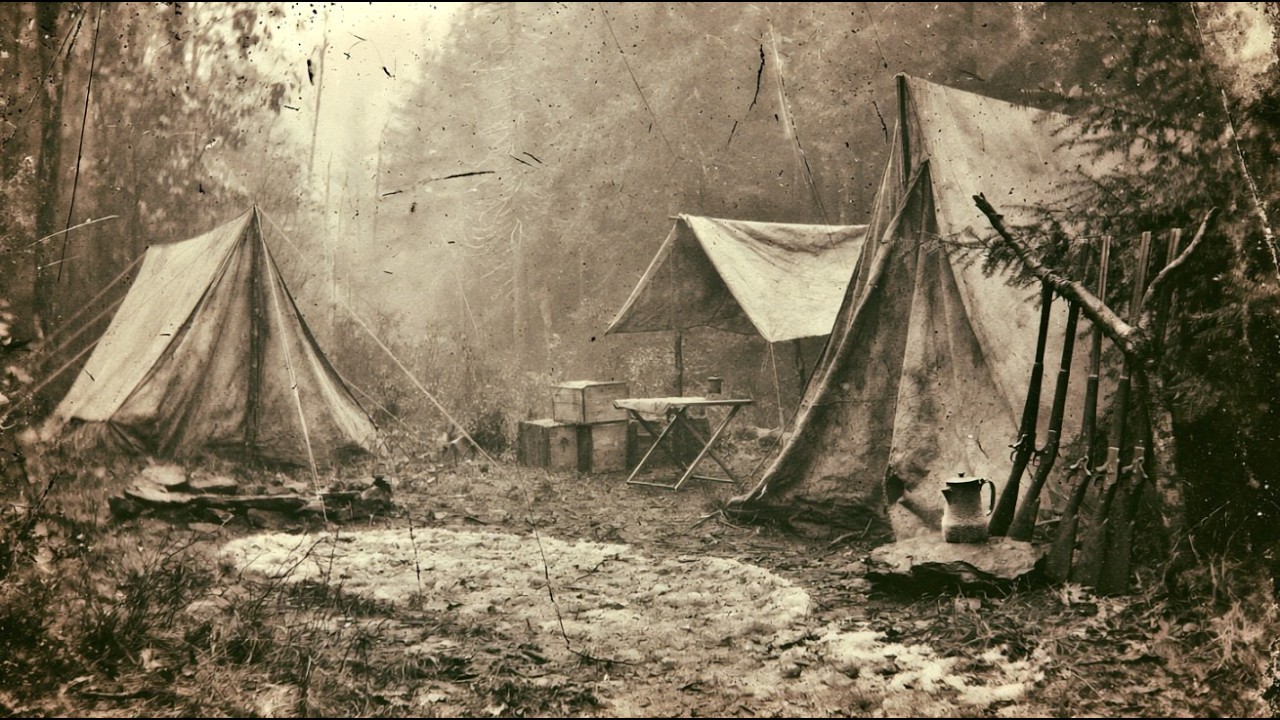
They built a fire. They cooked from the dead men’s boxes, and none of them liked doing it, and none of them said so. Then they went through the camp methodically, and the camp began to speak. The first thing was the watches.
Emmett Lobe had been an engraver of watch cases, and watchmen set their watches by him. He carried his own gold repeating watch, and he had made one for Vandegrift as well. There was a nickel watch in Maribou’s kit, a cheap silver one in Tharp’s, and Slavin’s old brass watch that he had carried for thirty years and that ran about four minutes fast every day. Five watches.
Brother found them all, each where you would expect it, in pockets, in kits, one under a bedroll. All of them were fully wound. All of them had stopped, and all had stopped at the same time: four twenty-two. There was an argument to be made, and Brother made it to himself.
Cold stops a watch. Old oil thickens, the balance stops, it happens. Five watches in the same cold might stop within the same day. But these were five different makes, five different qualities, one of them a gold repeating watch made by a skilled Baltimore watchmaker.
They had stopped in the same minute, not the same day. Brother wound one and it ran perfectly. He set it and it kept accurate time for the rest of the night. The cold had not touched it.
The second thing was the journal. Barnabas Slavin kept a log on every hunting trip he guided, and had done so since he was a young man, because gentlemen hunters argued about what they had shot and when, and a guide who produced a written record got paid without trouble. They found the log in his kit, wrapped in waxed cloth, dry as bone. Vessell could not read well and did not admit it, so Chadster read it aloud by the fire and Brother copied it.
The early entries were exactly what a professional would write: weather, distance covered, what they ate, where they camped. On the fourth of October, Slavin noted that Mr. Vandegrift was displeased at having seen no game on the level, and that he had been told again that none would be seen. On the fifth, he wrote that Mr.
Tharp had taken four photographs of the level and the surrounding trees and asked whether the light was always like this here, and that he, Slavin, had no answer for him. On the sixth, there was a single line: “Mr. Lobe asks why the trees stop. ” That was the entire entry for the sixth.
The seventh of October was written in full. The weather was clear. Vandegrift and Maribou had gone down off the edge into the woods and been gone eight hours without seeing anything at all. Slavin noted it was the third day without a track of any kind.
He wrote that he did not like this place. He noted the party had agreed to break camp on the ninth and move down to the creek where the game was. Then came the eighth of October, written in full. Then the eighth of October again, same date, different entry, different weather.
In the second, it was rainy; in the first, clear. Then the eighth of October a third time. A fourth. A fifth.
Five entries, all dated October 8, 1883. What sickened Chadster was not the repetition but the handwriting itself. The first entry for October 8 was in Slavin’s steady, slanted hand, the hand of a man who had learned to write as an adult and was proud of it. The second was similar but smaller.
The third was smaller still and crowded, and the letters had begun to lean the other way. The fourth was barely legible, a scrawl, the hand of a man holding the pen wrong. The fifth was in a hand Chadster swore before the judge was not Barnabas Slavin’s at all. It was neat, upright, better than Slavin’s own writing, and it had been made by someone who had never seen a pen used before and had worked out the method by studying the other entries.
The fifth entry, in that careful, tidy, incorrect hand, read: “We counted at the fire. The count was right. ” Then, “We counted again to be sure. ” Then the page ended, and the next page was blank, and every page after it was blank to the end of the book.
Vessell, who did not read well, who had been sitting there with his hands folded listening to all of it, said aloud, “What does he mean, the count was right? ”
Chadster said, “He means it wasn’t. ”
The two of them looked at each other across the fire. Then, without a word, the four of them all looked around the circle at each other, one, two, three, four.
Count from the bottom. Count from the top. Don’t count in between. No one said it.
But Chadster wrote in his book at nine o’clock that night, “We have broken the rule. ”
The third thing was the plates. Sylvanus Tharp’s camera was still on its tripod, standing at the eastern edge of camp, covered, aimed across the level toward the trees on the far side. The plate holders were in a wooden box beside it, exposed plates separated from fresh ones the way a careful man would, exposed sides turned inward, pencil marks on the slides.
There were six exposed plates. Chadster carried them down the mountain himself, wrapped in a shirt inside his coat, and did not let them out of his hands the whole way. They were printed in Ivy Lake on November 2, 1883, by a portrait man named Palen Rauch, working over the store, in the presence of Deputy Vessell and Dr. Brother.
The first plate was the level, empty, taken from the eastern edge looking west. A clear view; you could count the trees. The second was of the camp, tents standing, taken from nearly the same place. The third was a group portrait: five men in front of the cook fly, Vandegrift in the center with his thumbs in his vest, beard combed; Maribou to his right, tall, looking off to one side; Lobe with his watch chain showing; Slavin at the end, holding his injured hand, not looking at the camera at all but at something over the photographer’s shoulder.
Tharp himself stood at the far end, because he had used the self-timer and stepped into the frame, and you could see the blur where he had not settled completely. Five men. The fourth plate was the trees on the north side, midday light. The fifth was the trees on the north side again, and this was the one where you began to feel it.
The same view, the same trees, the same light, or nearly. In the fifth plate, the trees on the far side of the level were perhaps four feet closer to the camera than they were in the fourth. Rauch measured it. He was a professional and he was proud and he was disturbed, and he measured three times against the fixed rock in the foreground before he stopped talking for a moment.
The sixth plate was the last photograph Sylvanus Tharp ever took. It was made at night, or in night-like conditions, with a long exposure. It showed the edge of the level. At the tree line on the far edge, facing outward, away from the camera, stood figures.
They stood in a row, their backs to the lens. They were perfectly still, which proved the exposure had been long, because in a long exposure anything that moved became smoke. None of them had become smoke. Not one.
They were as sharp as the trees. Chadster counted them. Brother counted them. Vessell counted them twice and then went out and stood in the street for a while.
Palen Rauch counted them, then sat down and said, in a voice none of them ever forgot, “There were five men in that party. There are six figures in the picture. Six. ”
The camera had been fixed on its tripod at the eastern edge of camp, covered, aimed west.
The six figures stood at the tree line on the western edge, which meant that whoever had stood before the camera to take that picture had been inside the circle, and the five men who could have done that were standing in the frame with their backs turned, or at least five of them were. It was the night of October 23, and four men sat around a fire on the edge of the level. They had read the journal but did not yet know what was on the plates. They set a watch, two hours on, two hours off, and Vessell took the first because he was the deputy and it was his right.
It was Dr. Brother who broke the rule aloud. He was sitting up, unable to sleep, and Chadster was awake too because he did not really sleep, and Brother said quietly, so as not to wake the others, “A doctor’s habit. ” He said, “I counted five of us.
”
Chadster wrote later in his book, exactly: “At two in the morning, the doctor said he had counted five of us. I asked him to count again. He said he had counted three times. I did not count.
He did not count. ”
Think of that. Lying on frozen ground in the dead men’s camp at two in the morning, surrounded by your companions, and refusing to look at them and count them because of a rule an old guide had given you when you were nineteen, and you had never asked him why. Chadster lay there with his eyes open and did not count.
Brother, a man of science who had spent thirty-eight years believing that what could be measured could be understood, counted a fourth time. The doctor’s notes from that night were the ones he burned, every page of that year. But Chadster had copied one line into his own book before the fire. It is the last surviving writing of Osgood Brother in the world.
He wrote: “The fifth sits outside the firelight, back to us, very patient. ”
At dawn they went to look for the fifth man in the snow behind the fire. They found nothing. No tracks, no sign.
The snow on that side was smooth as silk. Brother never mentioned it again, that day or ever, and Chadster never asked. They found Cassius Maribou at half past nine in the morning of October 24. He was sitting at the edge of the rising shelf where the packed snow ring met the timber, looking up the mountain.
By every estimate, he had been there for about three weeks. He was alive. Consider that for a moment. Three weeks.
In October at thirty-four hundred feet, the ground snow-covered, a forty-one-year-old wool merchant from Baltimore sat upright in the open, his coat and boots removed, his bare feet in the snow. And he was alive. One of them ran to him. It was the only time in the whole case anyone saw that small, neat man run.
Brother examined him on the spot, examined him again that night, again in Ivy Lake, again a week later. The core of what he found survives because the deposition was kept even though the notes were not. Maribou had no frostbite. His feet had been bare in the snow for unknown days, and they were pink, warm, and perfectly sound.
He was not hungry, not dehydrated. His pulse was slow and strong. His eyes followed everything. He was not injured anywhere, not even a scratch.
By every measure Osgood Brother knew, he was a healthy man. He simply did not want to stand. They helped him up. It took three of them.
The moment he was on his feet he was docile, no resistance, no fear, and he began to walk up the mountain. Vessell stepped in front of him. Maribou walked into him, chest to chest, and kept walking, his feet pushing the snow, going nowhere, not pushing with his hands, just walking. That was how they brought Cassius Maribou down off Old Spur.
Two men held his arms and turned him around every few steps, because the instant they let him go he faced uphill and began walking again. All nine miles down, he did not speak a word. He never spoke again in Ivy Lake. He never spoke another word for the rest of his life, as far as any record shows, with a single exception.
Before they came down on the afternoon of the 24th, Maribou tied to a tree at the camp because that was the only way to keep him from being lost on the slope, the four of them finished the last part of the task. They went to the middle of the packed ring, to the place where the ground under the ice was hardest, and they dug. Chadster’s reason is in his field book, and it is not dramatic. He wrote: “Ground inside ring sounds hollow underfoot in east third.
Determined to find out why. ” He was a surveyor who measured things, and when he found something that did not make sense he opened his book and looked. They had a hand axe and a shovel from the dead camp. They broke through the ice, then through a layer of frozen earth eight inches thick, and beneath it they found soft ground, which was not to be expected in the last week of October at that altitude.
It was soft and warm enough that steam rose from it. At a depth of about two feet they reached a layer that was not earth but leather. Whitman Chadster told this part to a judge in the Renwick courthouse on December 14, 1883, and I will add nothing to it because he did not. He said, “We found boots.
” They were laid in a ring, soles down, in pairs, tied, each pair set square beside the next, and the buried ring followed the same circle as the ring above it in the snow. They opened it in four places, and it was continuous in all of them. The judge asked the number. Chadster estimated the circumference at 630 feet.
The pairs were set about eleven inches apart, and the arithmetic was not difficult, done on his knees in the dirt with a pencil: more than six hundred pairs. They were of every age. The top layer was recent, good stitching, suitable for town work, and they knew whose they were. Beneath them, older boots, soles nailed with square nails.
Beneath those, older still, nothing left but the shape in the earth, scattered nail holes, and rust stains where the nails had been. And beneath that, a layer with no leather at all, only the dark lines of where the leather had been, and a nail, and then another nail. Six hundred pairs of boots in a carefully laid ring, descending through the earth in layers, older and older, until the leather had rotted away and only its shape remained in the soil. And in every pair, the laces were tied.
Not kicked off, not pulled off in haste. They had sat down, loosened the laces, placed the boots straight, tied them again, and left. There was not a single bone in that earth, not a rib, not a finger, not a tooth. Six hundred men or more had sat on that level ground and taken off their boots and tied them and placed them in the ring, then walked off in their stocking feet.
None of them had lain down anywhere within two feet of the surface of that place. Dr. Osgood Brother knelt at the edge of that pit for about ten minutes and said nothing. Then he stood and walked away.
He vomited behind a tree, came back, and said, “Cover it. ”
They did. They filled all four holes, tamped the earth with the flat of the shovel, broke the ice back over it, and swept the snow across it with their arms until their own tracks could no longer be seen. Then Whitman Chadster walked the ring once more, because he was a walker and could not stop measuring.
He found the gap. On the eastern arc of the ring, in the section they had opened last, in the top layer where the boots were new and the leather still good, the pairs ran evenly at eleven inches, eleven inches, eleven inches. Then there was an empty space. Then they began again.
One gap, about eleven inches wide, bare packed earth, waiting for a good pair of boots on each side of it and room for one more pair. He wrote it in the record. He wrote: “One place open, east side. ” Beneath it he wrote nothing at all.
That blank page is still in the county records to this day. They came down off the mountain on the evening of October 25, 1883. Four men went up, and five came down, counting Maribou, and everyone counted him. No one on that mountain ever counted aloud again for the rest of their lives.
Harlan Vandegrift, Emmett Lobe, Sylvanus Tharp, and Barnabas Slavin were never found. Not that autumn. Not the following spring, when the county sent an eleven-man party that walked that mountain for six days. Not ever.
Vandegrift’s Winchester was found in 1891 in a hollow tree four miles from the level, about six hundred feet lower, wedged in a fork nine feet off the ground, muzzle pointing straight down. No one ever offered an explanation for it. The place where they were actually buried was not on the mountain but in the courthouse. The inquest was held in December.
Chadster testified. Vessell testified. Brother testified, and by then he had burned his notes. He told the judge so directly, refused to say why, paid a cash fine, and went home.
The six plates were entered as evidence. On December 19, 1883, it was recorded in the Renwick County records, and signed, that the four named men had died of exposure. Exposure. Four men in a camp with three weeks of food, four dry rifles, two good tents, a full woodpile, and a carefully built fire ring.
Exposure. That word sat in the county records for seventy years and did what it was written to do, which was end it. The county sold the timber around the level in 1886, and the land was cut, but the flat ground itself was excluded from the sale. A note in the deed: six acres, more or less, reserved.
Reserved for what purpose? Not stated. The six plates were kept in the courthouse until 1922, when a fire broke out in the records wing, and the plates were listed among the losses, which was a convenient sort of fire. But Palen Rauch had printed paper copies of all six plates in November of that year in his shop in Ivy Lake and kept his own set, because he was a professional and professionals keep proof sets.
His set went to his daughter, and from her to a historical society. Four of them I have seen. I have not seen the sixth. The catalog card for the sixth plate is still in the file.
The card exists, with a number, a date, and a brief description in a librarian’s hand. The envelope behind it is empty. Cassius Maribou lived until 1902. His brother brought him back to Baltimore in the spring of 1884 and kept him at home, and when that became too much for the family he was moved to a private hospital outside the city, where he received good care for eighteen years.
He was never violent. He never hurt anyone. The staff there were fond of him, the way people are fond of a quiet man who makes no trouble. He refused to wear shoes; that was the one thing he did.
They tried to reason with him, but he would take his boots off, calmly and without haste, set them side by side at the foot of whatever he was sitting on, tie them, and leave them there without looking at them again. Every day of his life. Eventually they gave up and let him go barefoot, and his feet never suffered any harm at all, which the doctors there noted more than once without finding an explanation. He always faced the same direction.
If you moved his chair, he moved it back. If you turned him, he turned. Toward the northwest. Occasionally, not often, perhaps a few times a year, and always in the evening, he spoke.
He counted under his breath, so faint you had to lean in to hear: one, two, three, four, five, six. Then he stopped. He never counted higher than six. In eighteen years, not once.
The nurse who sat with him longest, a woman who worked there for thirty years and was interviewed about this in 1931 when she was old, said he did not count the way a man counts things. He counted the way a man takes attendance. When he reached six, he gave a small nod, the way you do when everyone is present. Whitman Chadster went back to timber surveying.
What else would he have done? It was his trade and he was good at it, and a man must make a living. But he changed his methods, and the change is documented in his field books, which is how we know. From 1884 until the end of his working life, Whitman Chadster never went into the woods with another man.
He surveyed every piece of land alone, every year. He turned down work that required a partner, turned down work that paid double. When the companies asked why, he said it suited him. He was a surveyor; no one argues with a surveyor about how he works.
He wrote in his field books every day as he always had: bearings, board feet, weather, time. In the margin of every daily entry from 1884 onward, in the same small, square hand, was one word, written alone, every day, for twenty-nine years: “Alone. ” He was not writing it for the company. He was checking.
He died in 1913 at the age of seventy-six, in a cabin he had built himself in the neighboring county. He had been in poor health that last winter, and a nephew came twice a week to check on him. The nephew found him. The stove was cold and had been cold for a day or so.
The door was open, not broken, standing wide, and snow had drifted across the floor. Chadster was sitting in his chair facing the door, facing the mountain. His field book lay open on his knee, the pencil still in the fold. The last entry, dated February 11, 1913, in a hand that shook with age and cold, read: “Clear.
NW wind, light fire. ” Then, in the margin, where the one word had stood alone every day for twenty-nine years, there was a different word. He had written “Also. ”
His boots were beside the chair, side by side, set straight, tied.
I have thought about that ring under the level more than is healthy for a sane man. And the thing I keep coming back to is not the boots, not the plate with the six figures, not even that word in the county record. It is the gap. One empty space on the eastern arc, eleven inches, bare packed earth, with a good pair of boots on each side of it.
Because a gap in a ring like that means the ring was not complete. It means it was still being made. Then they covered it back up and came down off the mountain, and wrote the word “exposure” in a book, and the county sold the timber around it and kept the six acres in the middle, and no one has set foot on that ground since. The level is still there.
It appears on maps as an unnamed area, overgrown in places, they say, but not in the middle. The deer still walk around it. Six hundred pairs of boots were laid, unlaced, straight, tied. Not one of them was running.
Every man who walked up onto that flat ground had eventually sat down and taken his time and carefully tied his laces, the way you do when you are leaving something behind that you want people to find in good condition. Whatever is up there is not chasing. It does not need to. It is simply waiting and counting, and sooner or later the count comes right.
The rule was Barnabas Slavin’s: count from the bottom, count from the top, don’t count in between. For thirty-eight years he never told anyone why. I have come to believe he did not know. I think he inherited it the way everyone inherits it, passed from one man to the next, back to the first one who came down off that mountain, before there was a county or a courthouse or even the word “exposure” to write in a book.
And I think the rule is not to keep you from finding an extra man in your party. It is for what happens in the moment you look up and count, and the count is right, so you keep looking, and then you count again to be sure.
