In September 2022, a sign appeared on the door of the Eastbay store in Wausau, Wisconsin. No farewell sale, no press release. Just three words: “Store permanently closed. ” The company behind that store had once mailed nearly 46 million catalogs in a single year.
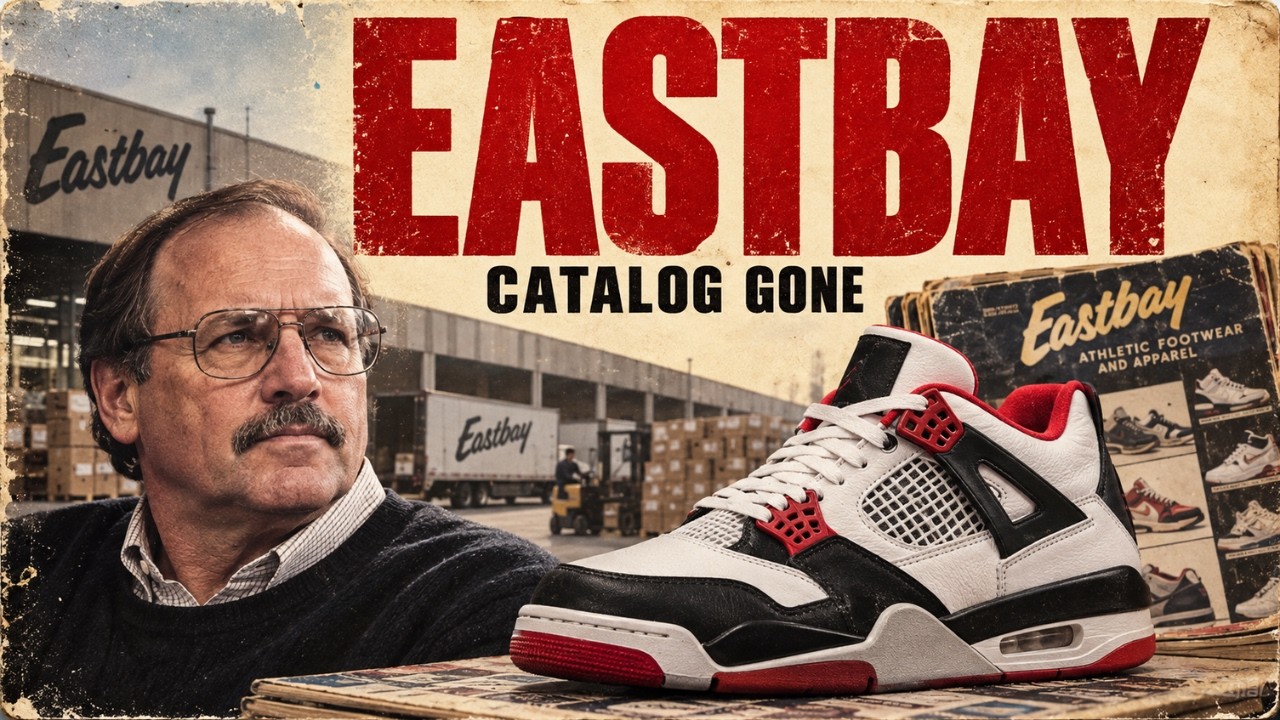
Kids circled sneakers in its pages and handed them to their parents as Christmas lists. Future pro athletes remembered it as the Bible of their childhood. Today, there is no store, no catalog, and no warehouse. Type its name into a browser and you land on someone else’s website.
The story does not begin with a catalog. It begins in a hospital nursery with two baby boys in neighboring bassinets. Art Wedz was one day old when another newborn was placed beside him. He would later remember the boy as noisy.
His name was Rick Gering. They grew up in Wausau, three houses from each other, and their friendship was built on trust long before it was built on business. Wausau gave them something else as well: a town that took sports seriously, with crowded bleachers on Friday nights and young runners training on cold northern roads. Gering would later say that without that sports culture, the two of them might never have started a company at all.
Both men grew up to be coaches. Between them, they had sixteen years of college education and not a single business course. What they had was a problem they could see every season. Their athletes needed real performance shoes, the kind built for a track, a court, or a ball field, and those shoes were hard to find in Central Wisconsin.
The shoe stores of America, in their view, were failing the athletes who needed them most. So they decided to fix it themselves. According to ESPN, the pair partnered with a store called Eastbay, the first running specialty shop in Milwaukee, which allowed them to use the same name for a new company of their own, three hours to the north in their hometown. In 1980, still in their twenties, they scraped together roughly $7,000 worth of running shoes, or perhaps as little as $4,000 in track shoes stuffed inside a car.
The entire company could fit inside a single vehicle. They loaded up a van and took to the road, setting up what they called shoe clinics across Central Wisconsin, small roadside fitting rooms for runners. At each stop, they sold what they had and handed out a price list. That sheet of paper let a customer keep shopping long after the van had pulled away.
Gering would later joke that at the start, the two partners were raking in about five dollars a week. In 1983, the handouts turned into a four-color catalog filled with track and field shoes, basketball shoes, football cleats, and baseball spikes. Two coaches from Wausau had found a way to bring the shoe store to the athlete instead of the other way around. A runner in a town with no specialty shop could now see the same shoes a college athlete wore, read what each one was built for, and order a pair without leaving home.
The business grew page by page. In 1989, Eastbay launched a team sales division to outfit entire high school and college squads. The following year, it produced its first in-house team sales catalog and introduced its own clothing line. By 1990, the call center, shipping department, and creative staff filled nearly an entire city block in Wausau.
The orders did not only come from teenagers. Wedz later recalled a call from the people around Roger Clemens, one of the most feared pitchers in baseball. Clemens needed new spikes for the All-Star game, brown Pumas, size 13, with a special toe for his pitching foot. Eastbay had to get them to Boston in time for him to take the mound.
The real power of Eastbay was in the waiting. Every few weeks a new catalog arrived, thick and glossy, and in households across the country it became an event. Kids carried it to school, folded down corners, circled the shoes they wanted, and memorized the colorways and the technology inside each sole. Before the internet, before message boards and release apps, there were few other places a young athlete could see every new sneaker in one place.
P. J. Tucker, who would become one of the most famous sneaker collectors in the NBA, first saw an Eastbay catalog when a friend brought one to AAU practice. He would later call it his Bible.
Sue Bird, growing up on Long Island, waited each month for the catalog to land in her parents’ mailbox. DeMar DeRozan put it more simply: “Eastbay was my whole childhood. ” Denver Nuggets coach Michael Malone remembered the weeks of anticipation before each new issue, and then the weeks more of waiting once an order had been placed. Nick DePaula, who grew up to become one of the best-known sneaker reporters in America, joked that as a boy he read the sports page and his Eastbay catalog together at breakfast.
The numbers behind that devotion were enormous. In the years leading up to mid-1996, active customer accounts grew from about 1. 3 million to 5. 4 million.
Yearly sales nearly tripled from about $40 million to more than $117 million. By 1997, the company employed roughly 1,400 people at its Wausau headquarters, making it one of the largest employers in Marathon County. At its height, it would employ more than 2,000. On September 29, 1995, Eastbay began trading on the Nasdaq Stock Exchange.
It did not stay independent for long. On December 2, 1996, the Woolworth Corporation, the old American retail giant that also owned Foot Locker, announced it would buy Eastbay for about $146 million. On January 30, 1997, Eastbay stopped belonging to the two men who built it. Woolworth wanted the catalog, but it wanted something else even more.
In its own annual report to federal regulators, the company explained that the deal would let it use Eastbay’s established direct mail channels to expand what it sold and set itself apart from competitors in the shopping malls. Woolworth was not only buying a beloved magazine; it was buying a machine. The company that had once built its name on five-and-dime variety stores was leaving that past behind. In 1997, it shut down the last of its American Woolworth stores and turned its attention to athletic retail, to Foot Locker, Champs Sports, and now Eastbay.
At first, very little seemed to change in Wausau. Eastbay moved into larger offices. In March 1998, it turned its website into a working online store. Then on June 30, 1999, Art Wedz and Rick Gering retired.
There was no scandal and no public falling out. The two friends who had been placed side by side in a hospital nursery simply stepped away together. From that day forward, the company that carried the name of a Milwaukee running store would be run by people who had not been there for the shoe clinics or the five-dollar weeks. In 2001, the old Woolworth Corporation became Foot Locker Incorporated, a company built entirely around athletic shoes and apparel.
Eastbay was now a division of the very kind of mall chain it had once offered an alternative to. Inside that new structure, Wausau took on a role few outside the city noticed. Eastbay’s corporate staff helped run online sales for footlocker. com during the early growth of internet retail, and online orders were filled out of Eastbay’s facilities.
Eastbay also ran a call center in Oshkosh and later another in Green Bay. On paper, it looked like a success. But something subtle had shifted. Eastbay was no longer only a brand that people loved.
It had become infrastructure, a set of warehouses, phone lines, and computer systems that served someone else’s name. A brand can survive in that position as long as it remains useful. The danger comes on the day it no longer is. In the city’s industrial park, out on North 72nd Avenue, stood a distribution center covering 500,000 square feet.
By 2016, it was shipping about 21,000 packages a day. That is not the sound of a dying company. But many of those boxes were simply orders processed in Wisconsin for whichever Foot Locker banner the customer had clicked on. The machinery was humming.
The question was whose name it was really working for. Inside Foot Locker’s headquarters, executives were beginning to ask whether Eastbay still needed a name of its own. Eastbay had a sibling, and the sibling was growing. Champs Sports, created by Woolworth in the late 1980s, leaned toward lifestyle, the sneakers and sportswear people wore on the street rather than on the field.
In 2019, Foot Locker decided the arrangement no longer made sense and began a plan to bring the two banners together. In May 2020, Foot Locker confirmed it was eliminating several departments at its downtown Wausau offices. Select Eastbay operations would be consolidated into the Champs Sports headquarters in West Bradenton, Florida, about 1,400 miles away. By the end of that year, the decisions about what Eastbay sold and what its future would look like were no longer being made in the city where it was born.
In 2021, Foot Locker merged the two brands under a unified name: Champs Sports X Eastbay. In the order of the words, Eastbay came second. The pressure on Eastbay did not begin in Wausau. It began in Beaverton, Oregon.
For decades, Nike had been Foot Locker’s most important partner. But Nike had decided its future lay in selling directly to customers through its own stores, website, and apps, and began limiting how much product it sold to wholesale partners. Foot Locker, the retailer that had built its identity on access to the hottest Nike shoes, suddenly had less of them to sell. It began looking for anything that could be trimmed, sold, or folded into something else.
In February 2022, the distribution center on North 72nd Avenue changed hands, sold to a private investor for about $17. 5 million. The tenant stayed. Then came the announcement that cut deeper.
Foot Locker revealed it was selling Eastbay’s entire team sales business to BSN Sports. This was the part of Eastbay that had outfitted high school and college teams for more than three decades. Foot Locker noted that team sales made up less than 1% of its annual sales. In the story of Eastbay, it was the business that two coaches had started for.
The same announcement carried a second piece of news delivered almost in passing: Foot Locker would fully consolidate the Eastbay website into the Champs Sports banner. In September 2022, the Eastbay retail store in Wausau shut its doors with almost no warning. There was only the sign at the entrance. On Wednesday, October 19, 2022, workers at the distribution center received a notice.
The same day, Foot Locker sent a formal letter to the Wisconsin Department of Workforce Development. Distribution operations in Wausau would be phased out beginning January 31, 2023. The facility would close on or about April 30. Every employee in the building would be affected.
The letter added one more line: “This closure is expected to be permanent. ” Two hundred and ten people would lose their jobs. Jason Christensen had worked in the building for about eight years. He told Wisconsin Public Radio he had seen the signs coming, the smaller staff, the lighter order volume, the constant rumors in the break room.
He was not surprised, but he was disappointed. He made clear that the business was not what hurt most. “It’s all the people I work with here,” he said. At City Hall, the letter landed in front of Mayor Katie Rosenberg, a former Eastbay marketing employee.
She called Eastbay and Foot Locker employment pillars in the community for decades. The rest of the country found out a few days later, not from a press conference but from a short message on Eastbay’s own website saying goodbye and encouraging customers to shop at Champs Sports. The reaction was immediate. Adults who had grown up with the catalog posted photos of old issues.
The sneaker historian Drew Hamilton launched an Instagram page called Eastbay Archive. Sue Bird learned the news from an email. When an ESPN reporter told Los Angeles Lakers coach Darvin Ham that Eastbay was closing, his first response was a single word: “Really? ”
Then came the sale.
In November, Eastbay offered 70% off nearly everything on its website, with a promo code that read like a final message: Thanks70. Every sale was final. The end of Eastbay did not happen on a single day. It happened in pieces over 107 days, and almost none of it was witnessed.
Friday, January 13, 2023, was the last day eastbay. com existed as a store. After that, anyone who typed the address into a browser was sent to the Champs Sports website. There was no countdown and no final message.
One day the page showed Eastbay. The next it showed another company’s logo. Ten days later, Foot Locker sent another letter to the state, announcing the closing of the call center in Oshkosh. The reason was almost hard to believe.
Foot Locker was centralizing its customer care team, and it was moving that work to Wausau. In the same months that the city was losing its warehouse, it was gaining phone lines. The company that was erasing Eastbay’s name still needed the people Eastbay had trained to answer customer calls. On Tuesday, January 31, the phaseout began at the distribution center.
Week by week, the work wound down. On Friday, April 28, the Oshkosh call center closed as scheduled. And on or about Sunday, April 30, 2023, the Wausau distribution center closed for good. More than 160 workers were let go in the first wave in January.
The final 48 followed by the end of April. In Oshkosh, 95 people lost their jobs. As for the two men who started it all, Art Wedz and Rick Gering had stepped away in 1999. They had sold their company decades earlier, at a time when selling looked like the ultimate success.
The company was gone. The friendship that started in a hospital nursery was not. In April 2026, the two men, now in their late sixties, sat down at a bookstore in Wausau to sign copies of a new book, The Book of Eastbay. They described themselves as accidental entrepreneurs, two coaches who had only wanted to help athletes find the right shoes.
Gering said that while working on it, messages arrived from some of the biggest names in sports: LeBron James, Stephen Curry, P. J. Tucker, telling them how much Eastbay had meant. What remains of Eastbay today is mostly paper.
Old catalogs sit in closets and attics across America, their corners folded, their wish lists circled in ballpoint pen. Collectors trade them, archives scan them page by page. The story leaves behind a few lessons. The first is that being loved is not the same as being necessary.
Eastbay was cherished by millions, but inside a large corporation, a brand survives only as long as it fits the plan, and when the plan changes, affection does not appear on the balance sheet. The second is that when founders sell a company, they also sell its ending. Wedz and Gering built Eastbay, but they had no say in how it would close. That decision belonged to people who had never driven the van.
Today, no one waits for weeks at the end of the driveway for a glossy catalog of sneakers. But for a generation, someone did. And it all started with two boys in a hospital nursery in Wisconsin who grew up to bring the shoe store to everyone else.
