The last time you pulled out a dollar bill, you probably gave it no thought at all. You passed it across a counter, collected your coffee, and went about your day. That crumpled green paper in your pocket feels as natural as the sunrise. And yet for the first eighty-six years of the United States as an independent nation, no federally issued paper currency existed.
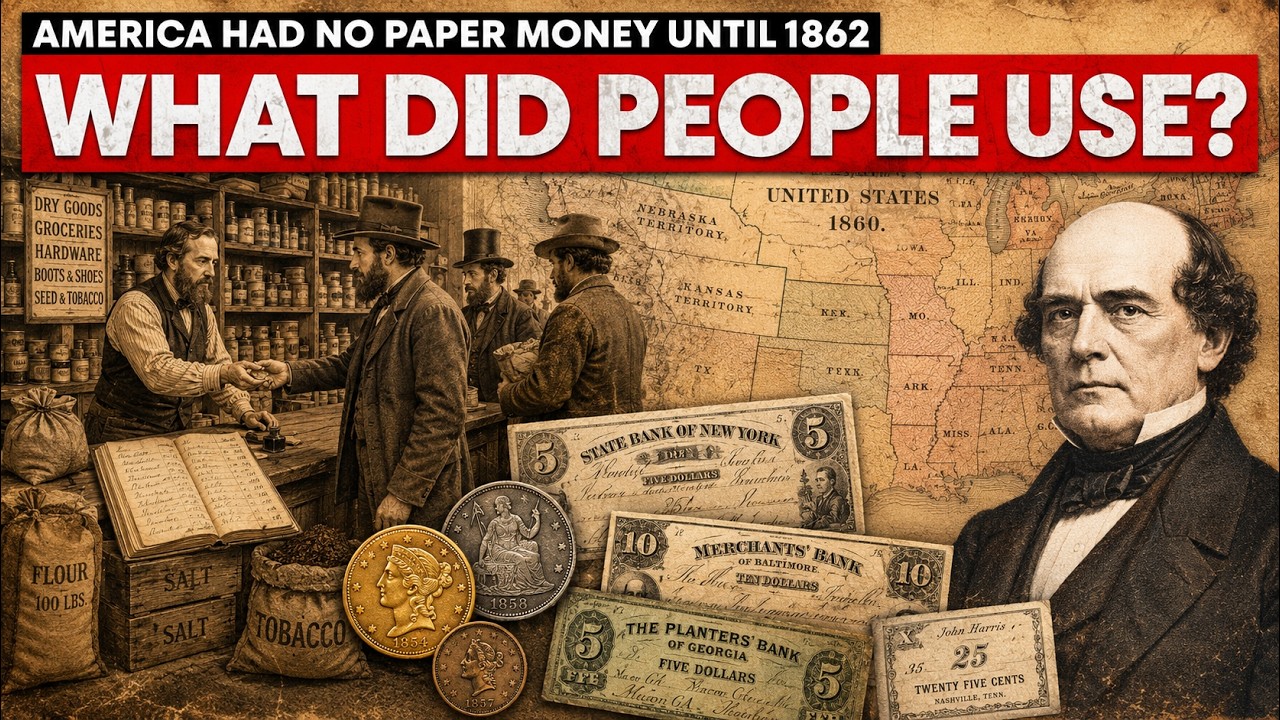
Not a single government-printed dollar bill circulated through the American economy. For the century and a half before independence, the situation was even stranger. The question is how a civilization that would become the most powerful economy in the world managed to function without the most basic tool of modern commerce. The answer runs through tobacco leaves, clam shells, foreign coins, counterfeit nightmares, and one of the most spectacular currency collapses in recorded history.
The scars of that collapse ran so deep that the founders wrote a constitution specifically designed to prevent it from ever happening again. The story begins in the early 1600s, when the first English settlers arrived on the eastern shore of North America. They stepped off their ships into a world with no banks, no mints, and no financial infrastructure of any kind. England ran on silver pennies, shillings, and pounds, but the Crown had no interest in shipping its precious metal across the Atlantic to a handful of struggling colonies clinging to the edge of an unfamiliar continent.
In fact, Britain actively prohibited the colonies from minting their own coins. This was deliberate policy. The right to issue currency was inseparable from sovereignty, and England would grant its colonies nothing that even hinted at independence. The colonists were stranded.
They had goods to sell, land to work, and trades to make, but no medium of exchange to make any of it function smoothly. Whatever coins they managed to bring from Europe drained back across the Atlantic as payment for imported goods. As Benjamin Franklin himself observed, the gold and silver that entered colonial America was almost immediately sucked back to Britain to pay for finished products, leaving local businesses and tradespeople perpetually starved of hard currency. So they improvised.
The first solution was the oldest economic system in human history: barter. If you had a cow and needed grain, you found someone with grain who needed a cow, and you made a deal. Simple in theory, maddening in practice. Imagine being a blacksmith in 1640 Massachusetts.
You need flour, but the miller doesn’t need horseshoes. So now you must find someone who needs horseshoes and has something the miller wants, then arrange a three-way trade. It was clumsy, slow, and a massive drag on economic growth. It was also just the beginning.
The colonists quickly realized that certain commodities, things almost everyone needed that held relatively stable value, could function as informal currency. The most famous of these was tobacco. In Virginia, tobacco wasn’t just a crop; it was money. The colony officially designated tobacco as legal tender as early as 1619, just twelve years after the founding of Jamestown.
You could pay your taxes in tobacco. You could settle debts with it. You could even buy a wife with it, and that’s not an exaggeration. When the Virginia Company shipped young women to the colony to serve as brides for the settlers, the going rate was 120 pounds of tobacco per wife.
Tobacco had real advantages as currency. Everyone grew it, everyone wanted it, and it was divisible. You could pay large amounts or small ones simply by adjusting the weight. But it had enormous problems too.
Tobacco spoiled. It was bulky. Its value fluctuated wildly depending on the harvest. A bumper crop could cause devastating inflation overnight, making your entire savings worth half of what they had been the season before.
Eventually, Virginia began issuing tobacco warehouse receipts: paper slips representing a specific quantity of tobacco stored in a government warehouse. It was a clever workaround to the problem of hauling bales of dried leaves around as payment, and it was one of America’s earliest experiments with paper standing in for tangible value. It would not be the last. Further north, another form of commodity money emerged, one Europeans adopted from the indigenous peoples they encountered: wampum.
For centuries, popular history has described wampum as Indian money, but that framing strips it of its cultural significance. For the Munsee, the Haudenosaunee, and other Eastern Woodland peoples, wampum was far more than currency. These carefully crafted beads, made from the shells of whelks and quahog clams, were used in diplomacy, in spiritual ceremonies, and as records of agreements and treaties. They carried deep meaning that had nothing to do with buying and selling.
But the Dutch traders who arrived in the early 1620s quickly noticed how essential wampum was to indigenous life, and they saw an opportunity. If the native peoples valued wampum and the colonists could manufacture or acquire it in quantity, then wampum could serve as a medium of exchange between the two worlds. And so it did. From 1643 to 1660, wampum was declared legal tender in the Massachusetts colony.
White beads were worth less than the rarer purple ones, and colonial authorities set the exchange rates. It worked for a time, but wampum had fatal flaws as currency. European tools made it far easier to produce than traditional methods, which meant the supply could be inflated almost at will. The British, predictably, disapproved of the whole arrangement and shut it down by 1660.
But wampum continued to circulate informally at trading posts and frontier settlements for decades afterward. While farmers counted tobacco leaves and traders strung shells, another form of money circulated through the colonies, one far more conventional: foreign coins, and in particular the Spanish dollar. The Spanish milled dollar, also known as the piece of eight or the real de ocho, was among the most trusted coins in the world during the seventeenth and eighteenth centuries. Minted from silver extracted from the vast mines of Mexico and South America, it was consistent in weight, reliable in purity, and recognized everywhere from Canton to Cadiz.
Because Spain’s colonial empire touched so many corners of the globe, its silver dollar became the closest thing the world had to a universal currency. In the American colonies, where English coins were scarce and colonial currencies unreliable, the Spanish dollar became the de facto standard. Colonists in every port city from Charleston to Philadelphia to New York used Spanish dollars for their most important transactions. When the colonists needed to make change for a Spanish dollar, they literally cut the coin into pieces.
A dollar was worth eight reales, so you could slice it into halves, quarters, or eighths. Those eighths were called bits, which is where we get the expression two bits for a quarter. The Spanish dollar was so embedded in American commercial life that when the newly independent United States finally created its own monetary system, it modeled the American dollar directly on the Spanish one. The Coinage Act of 1792 explicitly pegged the new US dollar to the value of the Spanish milled dollar.
Remarkably, the Spanish dollar remained legal tender in the United States until 1857, nearly seventy years after the Constitution was ratified. Foreign coins and commodity money could only go so far. As the colonial economy grew, the demand for a reliable, expandable money supply grew too. In 1690, the Massachusetts Bay Colony did something that had never been done before in the Western world.
It printed paper money. Massachusetts had just launched a disastrous military expedition against the French in Canada, what was called King William’s War, and the returning soldiers expected to be paid. The colony’s treasury was empty. There was no gold, no silver, and no way to raise enough through taxes quickly enough to satisfy angry armed men.
So Massachusetts did the only thing it could. It printed paper bills of credit, essentially IOUs backed by the colony’s promise to accept them as payment for future taxes. By 1692, these bills were declared legal tender. And they worked, at least initially.
Other colonies watched and took notice. One by one, nearly every British colony in North America began issuing its own paper currency during the early 1700s. By the time of the Revolution, fourteen different colonies had printed paper money at one time or another. But there was a catch.
Every colony issued its own notes with its own denominations, its own exchange rates, and its own level of trustworthiness. A Massachusetts pound was not the same as a Pennsylvania pound, which was not the same as a Virginia pound. A note happily accepted in one colony might be refused or deeply discounted just across the border. For merchants operating across colonial lines, it was an absolute nightmare.
And some colonies couldn’t resist the temptation to print more money than they could ever hope to redeem. When a colony over-issued its currency, the value of those notes plummeted, wiping out the savings of anyone unfortunate enough to be holding them. The British government watched this monetary chaos with increasing alarm. In 1751, Parliament passed the first Currency Act, restricting the ability of New England colonies to issue new bills of credit.
A stricter version followed in 1764, extending the restrictions to all colonies. The colonists were furious. To them, this was yet another example of the Crown strangling their economic freedom. Though it’s rarely given the same weight as the Stamp Act or the tax on tea, the Currency Acts were a genuine source of colonial grievance that helped push America toward revolution.
Then came the war. When the Continental Congress gathered in 1775 to organize resistance against Britain, they faced an immediate and overwhelming problem. Wars are extraordinarily expensive, and the Continental Congress had no power to levy taxes. That was, after all, kind of the whole point of the revolution.
They couldn’t borrow much either. Lending money to a ragtag colonial rebellion fighting the most powerful empire on Earth wasn’t an attractive investment proposition. France would eventually provide loans and subsidies, but in the early years credit was almost nonexistent. Gold and silver coins had been draining toward Britain for decades and were desperately scarce.
Congress turned to the only tool available. They printed money. In June of 1775, the Continental Congress authorized the issuance of two million dollars in a new paper currency called the Continental dollar. The bills were denominated in Spanish milled dollars, a deliberate signal that they were meant to hold real value.
Each note carried a pledge that the bearer would eventually be redeemed in gold or silver, funded by future tax revenues from the states. It was a reasonable plan on paper. The execution was catastrophic. The states were supposed to collect taxes and use the revenue to gradually retire the Continental dollars from circulation.
They didn’t. Some states dragged their feet. Others printed their own currency simultaneously, flooding the economy with even more paper. And Congress, desperate to keep its armies fed and equipped, kept turning the printing press.
By 1779, roughly 241 million dollars in Continental currency had been pumped into the economy. To put that in perspective, the entire colonial economy before the war probably generated a fraction of that in annual output. The result was exactly what you’d expect. The value of the Continental dollar collapsed.
Prices skyrocketed. A pair of shoes that might have cost a few dollars before the war now cost hundreds. A wagonload of Continental dollars could barely buy a wagonload of supplies for Washington’s army. A barber in Philadelphia reportedly wallpapered his shop with the worthless bills.
Someone in another city tarred a dog, covered it in Continental notes, and paraded it through the streets as a joke. The phrase not worth a Continental entered the American vocabulary as a synonym for total worthlessness, and it stuck for generations. By 1781, a Continental dollar traded at roughly a thousand to one against silver. Congress was forced to officially acknowledge the currency’s collapse, allowing debts to be settled at a rate of forty Continental dollars to one dollar in hard coin.
For all practical purposes, it was a government default. Millions of ordinary Americans, soldiers, farmers, shopkeepers, the people who had actually fought and sacrificed for independence, were left holding stacks of expensive wallpaper. This experience left an incredibly deep scar on the American psyche. When the Constitutional Convention assembled in Philadelphia in 1787, the delegates had the Continental disaster fresh in their minds.
They had watched their own government’s paper currency become a national humiliation. They had seen inflation destroy wealth, erode trust, and nearly undermine the war effort. They were determined to make sure it never happened again. The result was one of the most consequential decisions in the history of American finance.
Article 1, Section 10 of the Constitution explicitly prohibits the states from coining money, emitting bills of credit, or making anything other than gold and silver coin legal tender for the payment of debts. The federal government was given the power to coin money and regulate its value, but conspicuously, the Constitution said nothing about the federal government’s ability to print paper money. The silence was deliberate. The framers wanted an economy built on hard money, on the intrinsic value of gold and silver, not on the fragile promises of politicians.
In 1792, Congress passed the Coinage Act, one of the most important pieces of economic legislation in American history. The act established the United States Mint in Philadelphia and created a decimal-based monetary system, an innovation championed by Thomas Jefferson. The new American dollar was pegged directly to the Spanish milled dollar and backed by a bimetallic standard of gold and silver. The act specified the creation of gold coins: the ten-dollar eagle, the five-dollar half eagle, and the two-and-a-half-dollar quarter eagle, along with silver dollars, half dollars, dimes, and half dimes, plus copper cents and half cents.
Alexander Hamilton’s fingerprints were all over this legislation. He envisioned a monetary system that would give the young republic credibility on the world stage, one where every coin contained a specific verifiable quantity of precious metal so that its value was literally built into the object itself. The penalties for debasing the currency were severe. Any mint officer caught tampering with the gold or silver content of the nation’s coins could be sentenced to death.
That’s how seriously the founders took the integrity of their money. But there was a problem with the hard money system. There wasn’t enough of it. The United States in the late 1700s and early 1800s was a rapidly expanding nation with a growing population and an increasingly complex economy.
Farmers needed credit to buy land and seed. Merchants needed capital to finance trade. Manufacturers needed money to build factories. There simply weren’t enough gold and silver coins to go around.
The Mint struggled for years to produce sufficient quantities of coinage. In its first full year of operation, it managed to produce just over eleven thousand copper cents. Gold and silver coins were even harder to keep in circulation because they kept being exported or hoarded. The ratio of silver to gold set by the Coinage Act was fifteen to one.
But on international markets, the ratio was different, which meant American gold coins were actually worth more as raw metal than as currency. People melted them down or shipped them overseas, where they could get a better price for the gold content. The same thing happened with silver dollars, which were frequently exported to the Caribbean for use in international trade. Congress eventually had to suspend the minting of silver dollars and gold eagles entirely for several years just to stop the bleeding.
Even after the Mint was up and running, the United States remained chronically short of circulating currency. Spanish dollars, French francs, and British guineas continued to flow through American commerce alongside the new national coins, and foreign currency remained legal tender for decades. The shortage created an opening, and private banks rushed to fill it. Starting in the early 1800s, state-chartered banks began issuing their own paper bank notes.
These weren’t government currency. They were private IOUs, promises printed on paper by individual banks stating that the bearer could redeem the note for a specified amount of gold or silver at the issuing bank. In theory, it was a reasonable system. Banks held reserves of gold and silver and issued notes representing a fraction of those reserves, allowing the money supply to expand beyond the physical limitations of hard coin.
In practice, it was chaos. By 1810, the United States had over ninety state-chartered banks issuing their own notes. By 1820, that number had grown to over three hundred. By the 1830s, there were hundreds more.
Every single one of these banks printed notes that looked different, at different denominations, and traded at different values depending on the reputation of the issuing bank and how far you were from its front door. A note from a well-capitalized bank in Philadelphia might trade at face value in the city but at a ten or twenty percent discount in rural Pennsylvania. A note from a small bank in Ohio might be worth fifty cents on the dollar in New York, or nothing at all if the bank had already gone bust. Merchants and tradespeople had to navigate this bewildering landscape every single day.
They couldn’t just look at a bill and know what it was worth. They had to assess the creditworthiness of the institution that printed it, and that required specialized knowledge. This gave rise to one of the most peculiar publications in American economic history: the Bank Note Reporter. These pocket-sized directories, published regularly and updated frequently, listed thousands of different bank notes from banks across the country along with their current discount rates and warnings about known counterfeits.
Merchants kept these little booklets on their counters the way a bartender keeps a cocktail guide, constantly flipping through them to figure out whether the note being offered to them was real and, if so, how much it was actually worth. At one point, there were more than eight thousand different varieties of bank notes circulating in the United States. More than eight thousand. That is more distinct types of paper currency than there are in the entire world today.
And then there were the counterfeits. With so many different notes in circulation, many of them poorly printed and unfamiliar to anyone outside the issuing bank’s immediate region, counterfeiting became practically an American pastime. By some estimates, roughly a third of all paper currency circulating during the free banking era was counterfeit. One out of every three bills you encountered might be fake, and you had no reliable way to know.
Counterfeiters didn’t even have to be particularly skilled. If you could produce something that vaguely resembled a bank note from some obscure bank in rural Indiana, there was a decent chance you could pass it off on an unsuspecting merchant a few states away who had never seen a real note from that institution. This period, roughly from 1837 to 1863, is known as the free banking era, and it was the wild west of American finance. It started when Andrew Jackson killed the Second Bank of the United States.
To understand why Jackson did this, you have to understand the man. Jackson was a frontiersman, a war hero, and a populist with a deep, almost visceral distrust of banks and paper money. Early in his career, he had accepted paper bank notes as payment for some land he’d sold. The buyers went bankrupt and the notes became worthless, nearly ruining Jackson in the process.
He never forgot the experience. He spent the rest of his life convinced that only gold and silver, hard specie you could hold in your hand, qualified as real money. The Second Bank of the United States, chartered in 1816, was supposed to bring order to this monetary mess. It was a hybrid institution, part public, part private, headquartered in Philadelphia and granted a twenty-year charter by Congress.
The federal government owned twenty percent of its stock, and it served as the government’s fiscal agent, collecting taxes, making payments, and storing federal funds. More importantly, the Second Bank acted as a de facto central bank, regulating the money supply by controlling the behavior of state banks. When it wanted to tighten credit, it would present state bank notes for redemption in gold and silver, draining reserves from those banks and forcing them to reduce their lending. When it wanted to loosen credit, it held on to those notes, allowing state banks to expand.
Under the steady leadership of Nicholas Biddle, who became president of the bank in 1823, the system worked reasonably well. The economy stabilized. Inflation was kept in check. The currency achieved a level of uniformity it had never known before.
But Jackson saw the bank as a monster. He believed it concentrated too much power in the hands of a small financial elite, most of them based in the Northeast, while ordinary farmers and workers in the South and West were left at the mercy of distant bankers who cared nothing for their welfare. He was not entirely wrong. The bank did favor certain interests over others, and its enormous influence over the economy was wielded with minimal democratic accountability.
When Jackson vetoed the bank’s recharter in 1832, he delivered one of the most famous presidential messages in American history. He called the bank a threat to individual liberty and states’ rights, and framed his veto as a stand for ordinary Americans against a corrupt aristocracy of wealth. The veto stuck. The bank’s charter expired in 1836, and there would not be another central banking institution in the United States until the Federal Reserve was created in 1913, nearly eighty years later.
What followed Jackson’s Bank War was exactly the kind of chaos the bank’s supporters had predicted. With no central institution to regulate the money supply, states rushed to fill the void. Free banking laws were passed in state after state, and in many of them, virtually anyone who could scrape together a minimal amount of capital and deposit some bonds with the state government could open a bank and start printing money. The result was the era of the Wildcat Bank.
The term supposedly came from the fact that some of these banks were located in places so remote that the only visitors were actual wildcats. The whole point was to make it as difficult as possible for note holders to show up at the bank’s front door and demand their gold. Some were legitimate operations run by honest men. Many were outright scams.
There are stories, some possibly exaggerated but rooted in real events, of bank examiners arriving at frontier banks to inspect the gold reserves only to find kegs filled with nails and scrap iron with a thin layer of coins poured on top to create the illusion of solvency. There are accounts of the same barrel of gold being carted from one bank to the next, always staying one step ahead of the inspector. The banks would issue stacks of impressive-looking notes, circulate them as far and wide as possible, and then vanish, leaving note holders with nothing but worthless paper. Paper money was issued not just by banks, but by states, cities, counties, railroads, stores, churches, and private individuals.
There was no uniformity, no oversight, and no safety net. When a bank failed, and many of them did, especially during the devastating panics of 1837 and 1857, everyone holding that bank’s notes was simply out of luck. Their money evaporated overnight. It’s hard to overstate how dysfunctional this system was for ordinary Americans.
Imagine trying to run a business when every bill you accept might be counterfeit, might be issued by a bank that no longer exists, or might lose twenty percent of its value by the time you try to spend it in the next town over. Imagine being a farmer who sells his harvest for a stack of bank notes from what he’s told is a reputable institution, only to discover a month later that the bank has closed and his entire season’s income has turned to dust. This was not a rare occurrence. It was the normal condition of American finance for nearly three decades.
It was into this environment that the most dramatic monetary transformation in American history was about to arrive. Not because anyone wanted it, but because the survival of the nation demanded it. In 1861, the United States plunged into the bloodiest conflict in its history. The Civil War was not just a military crisis.
It was a fiscal earthquake. The federal government, which had been running on a relatively modest budget, suddenly needed to finance massive armies, purchase mountains of weaponry and supplies, and sustain a war effort that would ultimately cost more than the entire federal budget of the preceding fifty years combined. The old system of gold coins and private bank notes was completely inadequate for the task. In July of 1861, Congress authorized the Treasury to print 250 million dollars in demand notes, paper money that could theoretically be redeemed for gold or silver coins on demand.
The idea was to bridge a temporary funding gap while the government sold bonds to raise real revenue. But the demand notes had a fatal flaw. When people actually tried to redeem them for gold, the Treasury couldn’t keep up. By December of 1861, gold reserves were running dangerously low, and the government was forced to suspend the redemption of its own notes.
The demand notes, which were supposed to be as good as gold, were suddenly worth less than gold. Their value began to slide. Something more drastic was needed. On February 25th, 1862, Congress passed the Legal Tender Act, one of the most consequential pieces of legislation in American economic history.
For the first time, the United States government issued paper money that was declared legal tender for all debts, public and private. These new notes, called United States notes, were not backed by gold or silver. They were backed by nothing more than the full faith and credit of the United States government. The promise printed on each bill was simple: this note is legal tender for all debts, public and private.
That was it. No guarantee of redemption in gold. No pile of silver sitting in a vault somewhere. Just a declaration by the federal government that these pieces of paper were money, and that if someone owed you a debt and offered to pay in these notes, you were legally obligated to accept them.
The notes were printed with green ink on the reverse side, which gave rise to the nickname that would stick for the rest of American history: greenbacks. The initial authorization was for one hundred fifty million dollars, but the war’s appetite was insatiable. Two more Legal Tender Acts followed in July of 1862 and March of 1863, each authorizing an additional one hundred fifty million dollars. By the war’s end, nearly four hundred fifty million dollars in greenbacks had flooded the economy.
Not everyone accepted them willingly. California and Oregon, where gold was plentiful and distrust of paper money ran deep, essentially defied the Legal Tender Act and continued to conduct business primarily in gold coin. Many Americans viewed the greenbacks with the same suspicion their grandparents had viewed the Continental dollar. Was this just another government printing press running wild?
Would these notes collapse the way the Continentals had, leaving everyone holding them ruined? There were genuine reasons for concern. As the greenback supply expanded, its value relative to gold declined. By mid-1864, a greenback dollar was worth only about thirty-five cents in gold.
Inflation surged. Prices climbed. The purchasing power of ordinary workers eroded. Soldiers fighting at the front were being paid in currency that was worth a fraction of what it had been when they enlisted.
But unlike the Continental dollar, the greenbacks survived. The federal government, now equipped with the power to levy income taxes and tariffs in a way the Continental Congress never could, had actual revenue streams to backstop the currency. The National Banking Acts of 1863 and 1864 created a new system of nationally chartered banks that issued uniform bank notes backed by government bonds, gradually pushing the chaotic patchwork of state bank notes out of circulation. A ten percent tax on state bank notes imposed in 1866 finished the job, making it unprofitable for state banks to issue their own currency.
For the first time in American history, the country had something resembling a unified national currency. The greenback era didn’t end the debate over what money should be, not by a long shot. For decades after the war, fierce political battles raged over whether to return to a gold standard, how quickly to retire the greenbacks from circulation, and whether the money supply should be expanded to help debt-burdened farmers or contracted to maintain the purchasing power of creditors. The Greenback Party, which emerged in the 1870s, won seats in Congress on a platform of expanding the paper money supply.
The gold bugs won the larger war. The United States officially adopted the gold standard in 1900. But the fundamental transformation that happened in 1862 was permanent. The idea that the government could issue paper money, that currency didn’t need to be a lump of metal with intrinsic value but could instead be a symbol backed by institutional trust and sovereign authority, took root during the Civil War and never went away.
Looking at the whole arc, from clam shells and tobacco leaves to the green bill in your pocket, what you’re really seeing is a centuries-long experiment in trust. Every form of money the American colonies and the early republic tried was ultimately a bet on trust. Trust that the tobacco would hold its value. Trust that the wampum beads were genuine.
Trust that the Spanish silver dollar contained the weight of metal it promised. Trust that the private bank down the street actually had gold in its vault. Trust that the Continental Congress would make good on its promises. Trust that the federal government’s full faith and credit actually meant something.
The story of American money before 1862 is largely a story of that trust being built, broken, rebuilt, and broken again in an agonizing cycle that cost millions of people their savings, their livelihoods, and in some cases their lives. The Continental dollar collapsed because the trust behind it was never supported by the institutional power to tax and enforce. The wildcat bank notes failed because the trust behind them was nothing more than the word of men who were often liars and thieves. The greenback survived, imperfect as it was, because by 1862 the United States had finally built institutions strong enough to make its promises credible.
And here’s what’s extraordinary. The modern dollar you use every day, the one in your wallet or on your screen, is a direct descendant of those wartime greenbacks. It’s not backed by gold. It hasn’t been since 1971, when Richard Nixon ended the last remaining link between the dollar and precious metal.
Your dollar is backed by the same thing that backed those first greenbacks in 1862: a promise. The full faith and credit of the United States government. Whether that promise is stronger or weaker today than it was during the Civil War is a question economists, politicians, and ordinary people continue to argue about with increasing urgency as government debt climbs, as inflation fluctuates, and as new forms of digital currency challenge the very concept of what money is and who should control it. Whatever the future holds, the history is clear.
America didn’t just stumble into paper money. It resisted it, feared it, tried it, failed at it, tried again, failed again, and only embraced it when the alternative was the collapse of the nation itself. Every dollar bill is a monument to that struggle, even if nobody thinks about it anymore while buying their coffee.
