At the peak of Arthur Treacher’s Fish and Chips in the late 1970s, there were 826 restaurants scattered across America, and the first thing that reached you through the door was the smell—malt vinegar cutting sharp through hot frying oil, salt and batter, and something faintly of the sea. That smell, the unmistakable perfume of a British seaside chip shop improbably housed in an Ohio strip mall, hung over hundreds of parking lots on Friday nights. Millions of Americans grew up inside it. Today, of those 826 restaurants, only three remain on the entire planet, all of them huddled together in northeast Ohio within an hour’s drive of where the whole thing began.
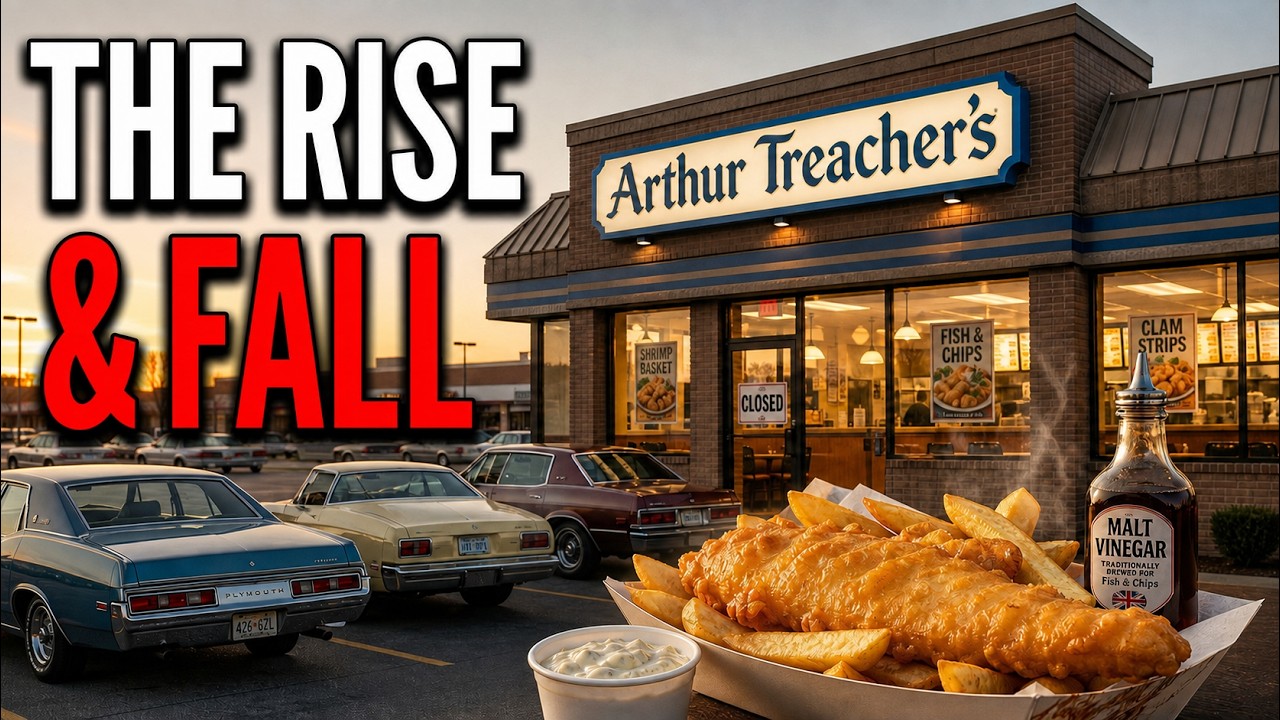
The collapse from eight hundred to three wasn’t the sad, slow fade you might expect, where the food gets worse and the customers quietly stop caring. The customers never stopped caring. People still drive hours across Ohio, past a dozen other places they could easily eat, specifically to sit in one of those three surviving booths and taste a paper tray of the same fish and chips they ate as children. The recipe those three restaurants still use today is the exact recipe the chain was built on in 1969—a recipe already more than a hundred years old when they brought it over.
Arthur Treachers was brought down by something almost nobody would ever guess: a real war fought with actual ships in the freezing waters of the North Atlantic between Iceland and Great Britain over the right to catch fish. A conflict most Americans have never heard of, waged an entire ocean away, reached across the water and quietly strangled a beloved American restaurant chain in its own dining rooms. The story begins in 1969 in Columbus, Ohio. You’d expect a fish and chips empire to be born somewhere with a coastline, but it came from landlocked central Ohio, from a group of entrepreneurs who looked at the American fast food landscape and saw the same thing everywhere they looked: burgers.
Everybody was selling burgers. These men had a simple, brilliant thought: what if we sold something you couldn’t get anywhere else? One of those founders was Dave Thomas, the future founder of Wendy’s. Before the square burgers and folksy TV commercials, he helped start Arthur Treachers.
The founders didn’t cut corners. They wanted authentic British fish and chips, not an Americanized approximation, so they traveled to London to a place called Malin’s, Joseph Malin’s shop, which had opened in the 1860s and is generally recognized as the first recorded fish and chip shop in all of England. The Malin family had been frying fish in that spot for over a hundred years. In 1969, Arthur Treachers bought the exclusive rights to Malin’s recipe—the batter, the method, the whole thing.
They took a century-old authentic London recipe and brought it to Ohio. This wasn’t a recipe cooked up in a test kitchen; this was the actual formula from the actual shop where fish and chips as the world knows it began, passed intact from a London shop to a Columbus strip mall. The fish was cod, good Atlantic cod, hand-dipped in that batter and dropped in the fryer so it came out in a crackling golden shell. The chips were thick cut, proper English chips, soft in the middle.
Around that core, they built a whole menu—hush puppies, clam strips, fried chicken, clam chowder, coleslaw, and always the malt vinegar in shakers on the table. The fish came in a lined paper tray, golden and blistered, so hot you had to wait, but you never waited. You burned your fingers every time. Inside was the cod, snow white and steaming, pulling apart into big soft flakes.
There was a ritual to it: the cool tartar sauce against the hot fish, the vinegar shaken on until the batter went soft at the edges, the chips underneath soaking up the drippings, the hush puppies the kids fought over. For an American family in 1972, this was genuinely exotic. Most Americans had never once eaten real fish and chips and never would unless they made it all the way to Britain. There was no sushi in the strip mall, no pad thai down the street.
The international food we take for granted today simply didn’t exist. So when Arthur Treachers offered a working family in Ohio a taste of actual England for the price of a fast food lunch, with a British butler on the sign and malt vinegar on the table, it was an event. For a kid, it was thrilling—a sense that the wider world was there in that paper tray. They leaned all the way into the Britishness, which brought them to the name.
Arthur Treacher was a real man, a British character actor who had spent a long Hollywood career playing the snooty English butler—Jeeves in the Shirley Temple movies, a role in Mary Poppins. By the late 1960s, his film roles had dried up, and he’d found a second act on The Merv Griffin Show. When a chain of British fish and chips restaurants needed a face, who better than the most famous fake English butler in America? Treacher wasn’t just a name on a sign.
In the early years, he appeared at grand openings, arriving gloriously in a red London double-decker bus. Other celebrities pitched in too—Ed Sullivan, Bob Hope—lending their star power to this odd, delightful idea of British fish in American strip malls. America bit hard. By the early 1970s, there were hundreds of locations across the country.
It rode a wave, surrounded by a boom of fish and chips fast food—Long John Silver’s, Captain D’s, Skipper’s—a brief moment when fried fish looked like it might become a major American fast food category. Arthur Treachers, with the authentic recipe and the dignified butler, was the class of the field. There was one more thing that wove it into the rhythm of American life: Lent. For millions of American Catholics, Fridays meant no meat.
Fish was allowed. So every Friday, and especially through the forty days of Lent, Catholic families needed somewhere to go, and Arthur Treachers was the answer. It became a Friday night institution, a Lenten ritual. The parking lot filled up, the fryers ran nonstop, the line went out the door.
Families piled into booths, ate hush puppies, and stayed together for an hour. That happened millions of times across eight hundred restaurants for years. For the people it happened to, the smell of malt vinegar and hot cod is inseparable from the memory of being a kid on a Friday night with their parents and siblings. That smell doesn’t fade like photographs do; it lies and waits and ambushes you years later.
Then, across the ocean in waters most customers couldn’t have found on a map, the thing that would destroy it was already underway. Through the 1950s, ’60s, and ’70s, Iceland and the United Kingdom fought a series of confrontations over fishing rights in the North Atlantic—the Cod Wars. Iceland, whose economy depended on fishing, kept extending the exclusive zone around its coast, pushing British trawlers out of waters they’d fished for generations. Britain refused to accept it and sent its trawlers in anyway, escorted by naval vessels.
It got genuinely hostile: Icelandic patrol boats cutting the nets of British trawlers, ships ramming each other. By 1976, Iceland had essentially won, establishing a 200-mile exclusive fishing zone and forcing the British fleet out of the richest cod grounds in the world. Here’s how a fishing dispute between two small North Atlantic nations reached into a strip mall in Ohio: it made cod scarce and expensive. The price of cod, the single central ingredient of Arthur Treacher’s entire business, roughly doubled.
A burger place that also sold some fish might have absorbed it. But Arthur Treachers was cod. Cod was the product, the promise, the point. When the price of your one essential ingredient doubles, you have only bad options: raise prices and watch customers balk, eat the cost and watch profits vanish, or change the fish.
The money ran out first. By the end of the 1970s, Arthur Treachers was heading toward bankruptcy. In 1979, the original parent company sold the chain to Mrs. Paul’s, the frozen seafood company.
Facing the brutal cost math, Mrs. Paul’s did the financially logical and spiritually fatal thing: they took out the cod and replaced it with cheaper pollock, a lesser, less expensive white fish. On a spreadsheet, it solved the problem. In the mouth of every longtime customer who had been coming for a decade, it was a betrayal.
The entire reason Arthur Treachers existed and was loved was that it was authentic, that it was genuinely good cod fried in a genuinely old recipe. Customers noticed. Their taste memory was precise and loving. The fish was different, not as good, not the thing they came for.
When you’ve eaten something that many times, it becomes part of the furniture of your life. Then one Friday you take a bite and it’s wrong. A promise you didn’t even know you’d been made has quietly been broken. The decline had a momentum that never really stopped.
The ownership carousel spun for decades, each new owner inheriting a wounded brand and mostly making it worse. In March 1982, Lumara Foods of America bought Arthur Treachers and filed for bankruptcy four months later. Through the 1980s came Chapter 11 proceedings and more ownership changes, the chain shrinking and shrinking. Meanwhile, Long John Silver’s, with a stronger financial footing, expanded aggressively and took over the fast food seafood category Arthur Treachers had helped invent.
The pioneer, wounded and distracted, got lapped by a healthier competitor. Through the 1990s and 2000s, the shrinkage continued, quiet and relentless. Restaurant by restaurant, town by town, the location where you’d had your first communion dinner became a Taco Bell. In Columbus alone, more than a dozen buildings scattered around the city used to be an Arthur Treachers.
By 2006, the brand was bought by Nathan’s Famous, the Coney Island hot dog company, which kept it on life support, folding a few menu items alongside the hot dogs, and later trying to revive the name as a delivery-only ghost kitchen. By 2018, there were seven left. By 2021, at one point there was exactly one standalone Arthur Treachers restaurant remaining on Earth—a single location in Cuyahoga Falls, Ohio, the only place in the entire world still serving the original Malin’s of London recipe from the 1860s. Today, there are three standalone Arthur Treachers, all in northeast Ohio: Cuyahoga Falls, Garfield Heights, and a location that reopened in the Cleveland area in 2025.
They still use the real recipe, run under a longtime franchise license by people who worked for the company for decades and refused to let it die. They still hand-dip the fish in that same batter, still fry the chips thick, still put out the hush puppies and the malt vinegar. One of the men who keeps it alive started working for Arthur Treachers in 1977, right out of college, planning to stay six months to save for grad school. Six months turned into over forty years.
When someone drives ninety minutes across Ohio to eat at the last Arthur Treachers, they’re not hungry for fish. They’re hungry for 1976, for being eight years old in a booth on a Friday night with their whole family. The empire fell, but the recipe didn’t. One hundred and sixty years after Joseph Malin first fried fish in a London shop, and more than fifty years after some Ohio dreamers carried that recipe across the ocean, built an empire on it, and watched a fish war tear it down, you can still sit in a booth and taste exactly what your grandparents tasted.
The fryer is still hot, the batter is still mixed by hand, the vinegar is still on the table. The door opens, someone walks in, and that smell hits them. For just a second, before they’ve even ordered, they’re eight years old again. It’s Friday, and the whole family is still together.
That smell was everywhere once. Now there are three.
