In the spring of 1917, Britain stood closer to starvation than its leaders dared admit. The world’s most powerful empire, which ruled a quarter of the globe and commanded the largest navy in history, had only six weeks of wheat left. Mothers queued for hours outside shops only to be told there was nothing left. Children went to bed hungry in a country surrounded by some of the richest farmland in Europe.
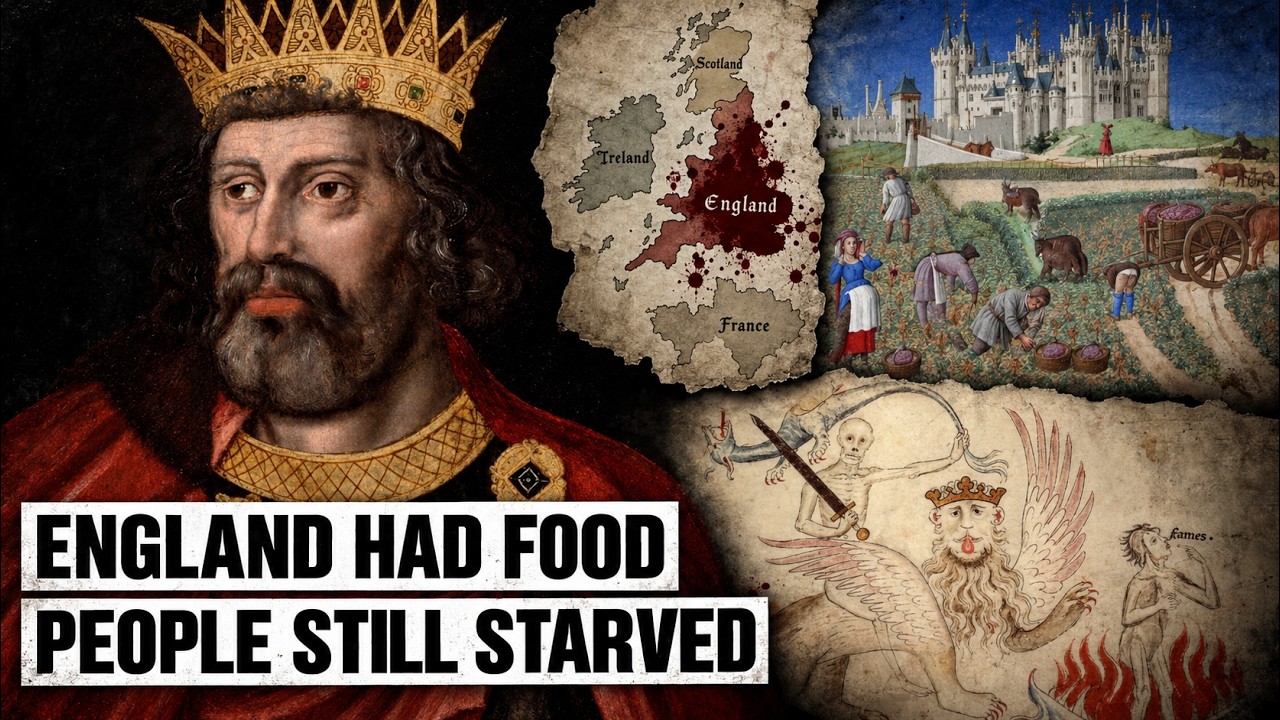
The question no one in authority could answer was painfully simple: how had this happened? The seeds of the crisis were not planted in 1914. They were planted in 1846, by politicians convinced they were doing the right thing. For centuries, English agriculture had been protected by the Corn Laws.
In Britain, the word corn meant grain generally: wheat, barley, oats, the staples that kept people alive. These laws were tariffs on imported grain, designed to keep domestic prices high enough for English farmers to profit. But high grain prices meant high bread prices, and for the rapidly growing urban working class, bread was survival itself. Families in Manchester, Birmingham, and Liverpool spent enormous portions of their wages on a single loaf.
The Anti-Corn Law League, led by Richard Cobden and John Bright, argued that free trade in grain would provide cheaper bread and stimulate economic growth. Their argument gained urgency when a series of bad harvests struck in the mid-1840s, including the devastating Irish potato famine. Under immense pressure, Prime Minister Robert Peel, a Conservative who had once supported the Corn Laws, reversed his position dramatically. In 1846, Parliament repealed them.
Free trade had triumphed. Bread prices fell, urban workers could afford food, and economists declared victory. No one noticed they had planted a time bomb in the English countryside. The repeal did not destroy British agriculture overnight.
For nearly three decades afterward, farming performed reasonably well. This was the so-called golden age of British agriculture, from the late 1840s to the early 1870s, when farmers invested in new machinery, better drainage, and improved livestock. But the golden age had an expiration date, and it arrived in the 1870s with the force of a freight train, or more precisely, a steamship. Across the American prairies, a revolution in farming was underway.
Vast tracts of land were being opened for wheat cultivation, and the invention of the reaper-binder in 1873 allowed a single farmer to harvest twice as much. With railroads expanding and transatlantic shipping costs falling dramatically, American wheat could now be loaded onto steamships and sold in London for less than the cost of growing English wheat. The numbers told a brutal story. In 1830, only two percent of Britain’s grain was imported.
By the 1860s, that figure had risen to 24 percent. By the 1880s, it reached 45 percent. Cheap beef from Argentina, lamb from New Zealand, and butter from Denmark flooded British ports with prices English farmers could not match. The Great Depression of British agriculture followed, lasting from roughly 1873 to 1896.
Grain prices collapsed, farms went bankrupt, and tens of thousands of agricultural workers lost their jobs. In 1831, agriculture, forestry, and fishing contributed more than 23 percent of Britain’s national income. By 1901, that figure had fallen to just 6. 1 percent.
An entire way of life was disintegrating. Other European countries faced the same flood of cheap American grain, and most responded by reimposing tariffs. France did it. Germany did it.
Even Italy imposed duties on imported grain to protect its farmers. But Britain, intoxicated by the ideology of free trade, did nothing. Prime Minister Benjamin Disraeli, who had once enthusiastically supported the Corn Laws, refused to reintroduce protectionism. Free trade had become a religion in British political life, and questioning it was akin to questioning progress itself.
British agriculture was left to die slowly. By 1914, about 60 percent of Britain’s total food supply was imported. For wheat, the dependence was even more extreme: Britain produced only about 19 percent of its own bread grain. All of its sugar came from abroad.
Nearly two-thirds of the calories consumed by the British population came from overseas. The strongest empire the world had ever seen could not produce enough food to keep its own people alive. There had been warnings. In 1903, a royal commission on food supply in wartime concluded that Britain’s food imports were vulnerable to disruption.
In 1915, the Milner Report repeated the warning, recommending that Britain increase domestic wheat production and organize agriculture by county. But these reports gathered dust in Whitehall. Complacency reigned. The Royal Navy was the biggest in the world, the thinking went, and it would protect the shipping lanes.
Food would keep flowing. When war broke out in August 1914, Britain entered the conflict with only 125 days of wheat reserves. For the first two years of the war, the bet seemed to pay off. The harvests of 1914 and 1915 were good, and food imports continued to flow, protected by the navy’s might.
The government, clinging to Victorian laissez-faire principles, was reluctant to intervene in the food market. Voluntary campaigns encouraged people to eat less and waste less, but there was no systematic effort to increase domestic production. The hand of the market would somehow fix things, the government assumed, walking asleep toward catastrophe. Meanwhile, something terrifying was taking shape beneath the surface of the Atlantic.
Germany had been building up its submarine fleet, and its military strategists had identified Britain’s weakness with surgical precision. You did not need to invade a island nation if you could starve it into submission. On February 1917, the German government made a fateful decision: the resumption of unrestricted submarine warfare. Any ship, neutral or enemy, military or civilian, found in the waters around Britain could be sunk without warning.
The effect was immediate and catastrophic. In February 1917, German U-boats sank 230 ships carrying food to Britain. The following month, more than 500,000 tons of shipping went to the bottom of the Atlantic. Then came April 1917, the most destructive month of the entire war for Allied shipping, with 860,000 tons of merchant shipping lost.
On average, 167 merchant ships were being sunk every month. By mid-1917, Britain’s situation was truly desperate. Wheat stocks had dwindled to just six weeks. At one point, the entire country had only four days of sugar left.
That same year, 46,000 tons of meat and 85,000 tons of sugar were lost at sea. By August 1917, more than 40,000 merchant sailors, fishermen, and passengers had been killed, and nearly 5,000 ships lost. Making matters worse, the government had requisitioned enormous numbers of merchant ships for military use. Troops, ammunition, horses, and equipment all competed with food for limited shipping capacity.
And the harvest of 1916 had been poor across Europe and the Americas. Nitrogen and sulfuric acid, two chemicals essential for making fertilizer, were also essential for making shells. The government prioritized ammunition. Every artillery shell fired in France was, in a very real sense, a meal taken from a British family’s table.
By spring 1917, all these factors had converged: decades of agricultural neglect, over-reliance on imports, the submarine campaign, poor harvests, the army’s seizure of ships, and the diversion of fertilizer into munitions. Britain was on the edge of actual mass starvation. Food prices were spiraling. The cost of staples had nearly doubled compared to pre-war levels, devastating working-class families whose diets already depended on cheap bread, potatoes, and tea.
Sugar consumption fell by nearly 20 percent. Butter and cheese became luxuries most families could not afford. Bread became darker, coarser, and less appetizing, earning the name war bread. Food queues became a defining image of the home front.
Women and children stood in lines for hours, often in freezing weather, waiting for whatever scraps of meat or butter might remain. Even after waiting half a day, there was no guarantee they would get anything. The government’s initial response was woefully inadequate. In December 1916, a food controller was appointed and a Ministry of Food created, but the first step was a voluntary rationing scheme.
The public was asked to limit themselves to four pounds of bread, two and a half pounds of meat, and twelve ounces of sugar weekly. The guidelines were based on middle-class consumption patterns, and the working class, whose diet already relied on bread as a primary source of calories, had to cut deeper into already meager rations. The wealthy could still buy what they wanted, when they wanted, while the poor were left to fight over crumbs. The system was unjust, and everyone knew it.
What finally pushed the government out of its complacency was the sheer scale of the crisis. Prime Minister David Lloyd George, who had replaced the more cautious Herbert Asquith in December 1916, realized that half-measures were no longer an option. If Britain did not change course radically, it would lose the war not on the battlefield, but at the dinner table. So the government did something unthinkable just a few years earlier: it took complete control of agriculture.
The centerpiece was the plow-up campaign. Britain had twelve times as much land devoted to cattle grazing as to crops. Pastures produced meat and dairy, but in terms of calories, grain and potatoes were far more efficient at feeding people. An acre of wheat could feed many more people than an acre of pasture.
The government ordered farmers to convert their pastures to arable land. Fields that had grazed sheep for generations were plowed and planted with wheat, oats, and potatoes. Farmers who refused to comply had their land seized and given to someone cooperative under emergency powers. But there was a problem: who would do the plowing?
By 1917, the British army had absorbed hundreds of thousands of young men who would have been working on farms. Conscription had devastated the agricultural workforce. Half the country’s steam plows were unused because no one remained who knew how to operate them. The government mobilized everything it had.
It established a Ministry of Food Production responsible for providing labor, machinery, and fertilizer. Soldiers were temporarily exempted from service to help with spring planting and harvest. German prisoners of war were brought to work in the fields under armed guard. And then there was the Women’s Land Army.
In March 1917, facing the real possibility of mass starvation, the government launched a campaign to recruit women for agricultural work. It was a radical step in a society where farming had always been seen as men’s work. By the end of 1917, more than 260,000 women were working as farm laborers across the country, with about 23,000 of them in the Land Army itself. They milked cows, drove tractors, harvested crops, and kept farms running while men fought and died in France.
The government also launched an urgent mechanization program, buying 400 tractors from the British manufacturer Saunderson in 1917 and investing more than three million dollars in American-made Fordson tractors. By 1918, about 6,000 tractors were in use on British farms, a technological transformation that would otherwise have taken decades. The Corn Production Act of 1917 guaranteed minimum prices for wheat and oats, giving farmers financial security and incentivizing them to grow more grain. It also established an agricultural wages board and set a minimum wage for farm workers.
For the first time in decades, the government was actively supporting its farmers instead of leaving them exposed to unfair competition from cheap imports. By 1918, the plow-up campaign was bearing fruit. About two and a half million acres of pasture had been converted to arable land. Nearly nine million acres were planted with grain and potatoes, producing the largest harvest in living memory.
But the plow-up campaign alone would not save Britain. The German U-boats were still sinking ships, and as long as they did, the country was bleeding food. The solution, when it finally came, was almost embarrassingly simple: the convoy system. Instead of merchant ships sailing alone across the Atlantic, exposed and vulnerable, they would travel together in large groups, escorted by Royal Navy warships.
The Admiralty had resisted the convoy system for years, offering a host of reasons why it would not work. But the catastrophic shipping losses of April 1917, along with strong persuasion from American Admiral William Sims, finally broke the resistance. On May 24, 1917, the government authorized the convoy system for transatlantic merchant shipping. The results were dramatic.
Between May 1917 and the armistice in November 1918, only 154 ships out of 16,539 that crossed the Atlantic in convoys were sunk, and only 16 of those were lost to natural hazards. The convoy system not only reduced losses, it effectively broke the submarine campaign. Even with protected sea lanes, rationing was necessary to distribute food fairly. In January 1918, sugar was officially rationed.
By the end of April, meat, butter, cheese, and margarine were added to the list. Every family received a ration book, and each person was entitled to specific amounts of controlled foods. It was bureaucratic, annoying, and deeply unpopular, but it worked. Rationing ensured that everyone, rich or poor, received a basic minimum of food.
It was one of the most egalitarian measures the British government had ever implemented. National kitchens, government-run restaurants offering cheap, nutritious meals, also helped feed economically during a time of scarce supplies and high prices. By the time the war ended in November 1918, Britain had held on. It had come closer to defeat by hunger than most people realized at the time, and more than many recognize even today.
The crisis had been averted through a combination of desperate measures, radical government intervention, the bravery of merchant sailors, the women who worked the fields, and the belated adoption of the convoy system. Sugar and butter remained rationed until 1920, a reminder that the effects of the crisis lasted long after the guns fell silent. Five thousand merchant ships had been sunk during the war, and more than 14,000 merchant sailors lost their lives. They were not soldiers.
They were civilian seamen doing a dangerous job to keep the nation alive. One might think that a crisis of this magnitude would teach lasting lessons. In some ways, it did. British agriculture emerged from the war in a stronger position than it had been in decades.
Mechanization had accelerated. Women had proven they could do agricultural work as well as men. The government had learned that food security was a matter of national survival. But here is the troubling part.
After the war ended, Britain went straight back to its old ways. The guaranteed grain prices established by the Corn Production Act were abandoned in 1921. Cheap imports flowed in again. Farmers were left to compete in the global market without government support, and British agriculture entered another decline.
By the time the Second World War broke out in 1939, Britain was actually more dependent on food imports than it had been in 1914, with 70 percent of its food coming from abroad. The lessons of the Great War had been learned and then almost immediately forgotten. The entire cycle repeated itself: German U-boats again targeted British shipping, the country again scrambled to increase domestic food production, the Women’s Land Army was reformed, and rationing was imposed once more. The story of England’s food crisis in the First World War is ultimately a story about the hidden costs of complacency.
It is about what happens when a nation allows a vital capability to atrophy because someone else can do it more cheaply. In peacetime, it made perfect sense for Britain to import cheap grain from America rather than grow it at home. It was more efficient. It was better for consumers.
But efficiency is a luxury that only exists in peacetime. When the torpedoes began to strike, all those theoretical advantages evaporated. The British Empire did not fall because its armies were defeated or its navy proved weak. It came within weeks of falling because it could not feed its own people.
The most powerful empire in history was brought low not by enemy soldiers, but by empty grain silos and sinking merchant ships.
