On a Monday morning in 1941, a jewelry store opened for business on the fifth floor of a department store in Manhattan. The cases were full. The designers were at their benches. The salesmen stood behind the glass in dark suits.
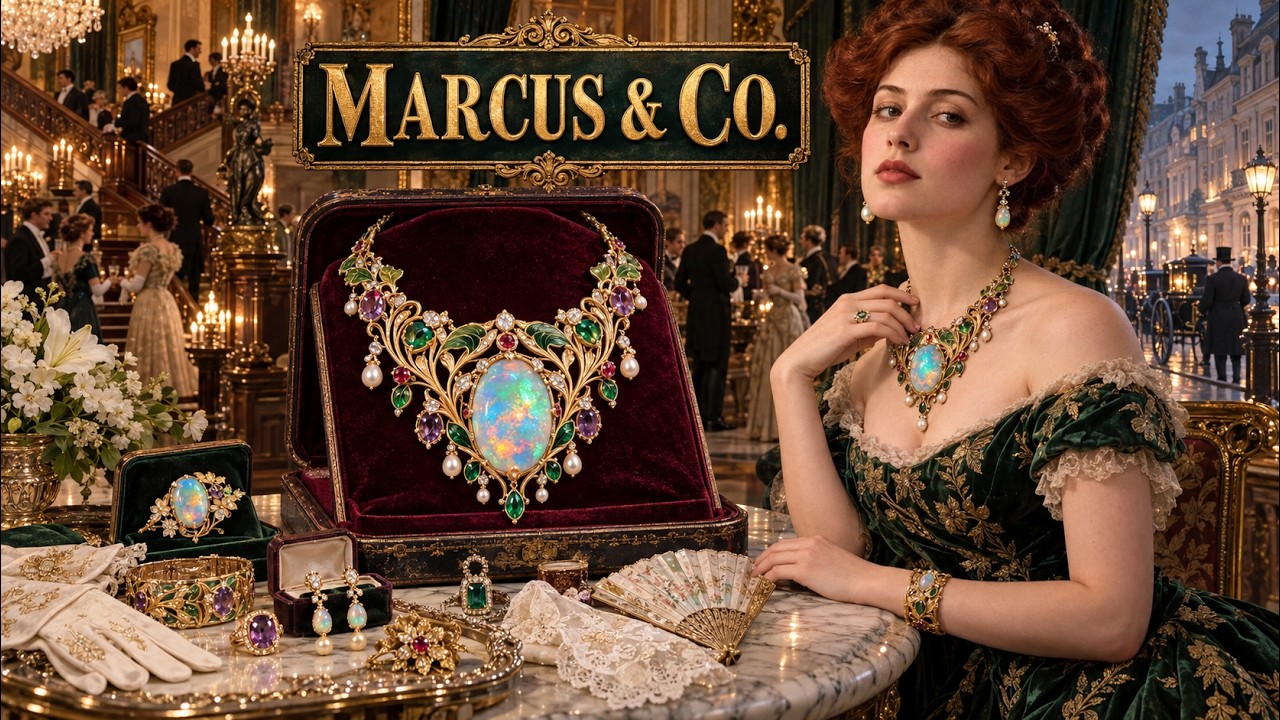
Nothing about the jewelry had changed, only the address had. That same week, a full-page advertisement ran in The New York Times and The New York Herald Tribune. It announced that one of the most celebrated jewelers in America had moved into Gimbels, the department store at Herald Square, the kind of place where a family bought school shoes, bath towels, and a new winter coat on the same trip. The promise in the advertisement was simple: Fifth Avenue jewels at Gimbels prices.
For almost fifty years, that name had belonged to Fifth Avenue. In 1895, the family behind it had sailed to India in search of stones and designs, sixteen years before Jacques Cartier made the journey that would become part of jewelry legend. In 1906, the firm filled its Fifth Avenue windows with flowers made of enamel so thin that daylight passed straight through the petals, and crowds formed on the sidewalk in front of a shop window. Its clients were names from the social register.
When those families left the city each summer for Bar Harbor, Southampton, or the Riviera, the jewelers followed them. The one rival everyone measured against was Tiffany & Company. The firm survived the stock market crash of 1929, the bread lines, the bank failures, and a decade in which fortunes vanished overnight. Through all of it, the workshop kept producing pieces that collectors today describe as flawless.
Then, at the edge of a Second World War, it met a tax. Within a few years, the jeweler that had stopped traffic on Fifth Avenue was selling from a corner of a department store, a few floors above the housewares. Two decades later, the name itself was gone, folded into another company and removed from every storefront in New York. Today, most Americans have never heard of it.
Its brooches sit in museum cases. Its rings cross auction blocks for tens of thousands of dollars. Its necklaces rest in jewelry boxes handed down through three generations. Almost no one who owns one knows the story behind the mark stamped on the back.
But the real story of Marcus and Company is not the move to the fifth floor. It is the story of an immigrant craftsman from Dresden who taught America to love stones it had ignored, and of the sons who turned his workshop into a legend. The story begins in Saxony in the late 1820s. Herman Marcus was born in Germany, most accounts give the year as 1828 and at least one records a Christmas Day birth in 1829.
He came of age in Dresden, the capital of the Kingdom of Saxony, a city of palaces, church spires, and royal workshops along the Elbe River. Dresden held one of the greatest jewel collections in Europe. The Green Vault was a suite of treasure rooms assembled by Saxon kings more than a century earlier, filled with carved gems, gold figurines, and diamonds set in forms so intricate they seemed impossible. For a boy with steady hands, the city was a place where jewelry was treated as an art and a matter of state.
As a young man, Marcus found a place at Ellemeyer, the court jewelers of Dresden. The work was slow and exacting, and it was learned only by repetition. An apprentice spent years at a wooden bench with a curved cutout at its edge called a jeweler’s bench pin. He learned to saw metal with a blade finer than a sewing needle, to file, to solder joints so clean they disappeared, and to set a stone, bending tiny claws of metal over its edge so it holds firm without cracking.
A single mistake could ruin a gem worth more than a year’s wages. Then Europe came apart. In 1848 and 1849, revolution swept across the German states. Dresden itself erupted in an uprising in May of 1849, with barricades in the streets and troops putting it down within days.
There is no record that Marcus took part in the fighting. What is recorded is the year he left. In 1850, Herman Marcus arrived in New York City. Manhattan had roughly half a million residents, and German was spoken on entire blocks.
The Lower East Side was becoming known as Little Germany, a neighborhood of bakeries, beer halls, and workshops run by immigrants who had carried their trades across the Atlantic. Craftsmen trained in Europe were in demand. Marcus went to work for two of the most important firms in the city: Ball, Black and Company, a Broadway jeweler and silversmith that would later become Black, Starr and Frost, and the Broadway shop that would become Tiffany & Company. In 1864, with the Civil War still being fought, Marcus struck out on his own.
He formed a partnership with Theodore B. Starr, and the firm of Starr & Marcus opened at the corner of 17th Street and Broadway, near Union Square. It sold jewelry, but also bronzes, clocks, metals, household ornaments, and silverware. The partnership lasted thirteen years.
In 1877, Starr & Marcus dissolved. At close to fifty years old, Herman Marcus returned to Tiffany, and the following year he represented the firm at the Exposition Universelle in Paris in 1878. At the great world’s fair of its decade, the world’s leading jewelers competed for medals, and Marcus saw what the French were making. He did not forget it.
By then, a second generation was ready. His son, William Elder Marcus, had gone into business with a partner named George B. Jacques. Their firm, Jacques & Marcus, operated at 41 Union Square.
A younger son, George Elder Marcus, had been born in New York and educated partly at a school in Lucerne, Switzerland. He was growing into the family’s most gifted designer. To understand what the Marcus family did next, it helps to see what American fine jewelry looked like at the time. In the 1870s, miners in South Africa began pulling diamonds out of the ground at Kimberley in quantities the world had never seen.
Wealthy Americans in the Gilded Age wore them in heavy clusters, in rows, and in bands. A serious jewel by the standards of the day meant white stones and a lot of metal, measured by the carat. Everything else was an afterthought. Peridot, a clear olive green stone, sat in a jeweler’s drawer, mostly ignored.
So did zircon, which could flash almost as brightly as a diamond, and spinel, a red or pink stone often mistaken for ruby. Tourmaline, chrysoberyl, opal, garnet, and beryl were the same. These stones were beautiful, durable, and far less costly than diamonds of the same size, but the trade treated them as second-class. Jacques and Marcus saw the gap.
In 1882, the firm published information about gemstones the jewelry industry had long overlooked: zircons, chrysoberyls, tourmalines, opals, garnets, beryls, spinels, and peridots. Eight families of stone were named, described, and championed. The firm began building its designs around them. Color would be the point, not a supporting detail beside the diamonds.
Two years later, in 1884, Herman Marcus left Tiffany for the last time and joined his son’s firm. In 1892, George Jacques retired. The firm was reorganized and incorporated under a new name at 857 Broadway. William Elder Marcus became president.
George Elder Marcus became vice president and secretary. Herman Marcus, the court-trained craftsman from Dresden, took the title of treasurer. A father and two sons, one name on the door. Marcus and Company was open for business.
The stones were only half of the idea. The other half was light. Around the turn of the century, the finest jewelers in Paris were experimenting with a technique called plique-à-jour, French for roughly “open to daylight. ” Jewelers had used enamel, powdered glass colored with metal oxides fused to metal in a kiln at high heat, for centuries.
Normally, the glass sits on a solid metal backing like paint on a wall. Plique-à-jour removes the wall. The enamel is suspended inside a thin metal framework with nothing behind it, held in place only by the tension of the metal cells around it. When finished, light passes straight through the color, like a stained glass window small enough to wear on a lapel.
It is also one of the most unforgiving processes in the jeweler’s trade. The glass can crack as it cools. The colors shift in the kiln in ways that cannot always be predicted. A piece can be ruined in the final firing after weeks of work.
In Paris, the master of the technique was René Lalique, whose enameled dragonflies and flowers had made him the most talked about jeweler in Europe. By one account, a member of the Marcus workshop traveled to Paris to study with Lalique himself. The story cannot be fully documented. What can be documented is the result.
Marcus and Company became one of the very few American firms to master plique-à-jour, and arguably the leading one. Its enameled flowers, leaves, and blossoms had petals thin enough to glow when a woman stood near a window. Then the firm combined the enamel with the stones. Its enamels ran to deep blue green, dark leaf green, and a strong saturated pink, colors chosen to sit beside the stones and make them look richer.
A peridot set against green enamel looked greener. A pink spinel beside pink enamel looked warmer. The jewel and the setting were designed together as one composition rather than as a stone with metal wrapped around it. The firm also favored a cut called cabochon, a stone polished into a smooth rounded dome with no flat facets at all.
Faceted stones throw sparkle. Cabochons hold a deep glowing color, almost like a drop of liquid. For jewelry built around color rather than brilliance, it was the natural choice. The same instinct showed up in the firm’s silver department.
Marcus silversmiths adapted mokume, a Japanese metalworking technique that layers different metals to create patterns resembling the grain of wood, developed centuries earlier for sword fittings. In the Marcus shop, gold, copper, and yellow were worked into silver. Niello, a black metallic compound used for inlay, completed surfaces that looked like no other American silver of the period. A Marcus jewel was meant to be looked at closely and to reward the person who did.
A jewel that rewards close attention needs a buyer willing to give it. Marcus and Company found that buyer by making the process personal. George Elder Marcus, the younger son, became known for a habit that set the firm apart: when a client came in to discuss a commission, George would sketch the design in watercolor, often right there in front of her. She could watch it take shape, the curve of a stem, the placement of each stone, the exact shade of enamel.
The painting became a promise of what the finished piece would look like. For a wealthy New York woman in the 1890s, most fine jewelry arrived finished. At Marcus, she took part in making it. The finished work carried the firm’s name, typically marked Marcus and Co.
in block letters, sometimes with New York added. Some of the silver carried a rarer mark, a cursive M inside a rectangular frame. The mark mattered then, and it matters even more now. It is the first thing a collector looks for today, and often the only proof of where a piece came from.
What did it all cost? No complete price list from the firm’s early years is widely available, and any exact figure would be a guess. What is clear is the logic of the materials. A fine peridot, zircon, or tourmaline cost a fraction of what a diamond of the same size commanded.
In the 1890s, an ordinary American factory worker earned roughly $400 a year. A Marcus jewel was never within that worker’s reach. But inside the world of fine jewelry, colored stones changed what money could buy. A client could own a piece of striking size and color, an original design by a recognized artist, without paying diamond prices for every carat of it.
The value was in the design and the workmanship, not the weight of the stones. The firm reached those buyers in three ways. The first was the shop itself. Marcus and Company treated its windows as a stage rather than a shelf, arranging a few pieces with care so a passerby’s eye went to a single jewel.
The second was reputation among artists and critics. In 1897, Marcus and Company exhibited in the first exhibition of the Society of Arts and Crafts in Boston, placing itself among serious makers, not merely merchants. Collaborators came from Europe as well. The French miniature painter Fernand Payet, known for tiny portraits on ivory and enamel, designed a pendant for the firm.
The third was loyalty. The firm’s clients came from the families listed in the social register, a small circle who talked to one another. When those families left New York each summer for Bar Harbor, Southampton, or resorts in Scotland and on the Riviera, Marcus and Company followed them. The strategy did not depend on selling to everyone.
It depended on becoming indispensable to the few who mattered most. By the late 1890s, among the families who set American taste, Marcus and Company no longer simply a place to buy jewelry. It had become the firm people went to when they wanted something no one else had. The founder would not live to see what was built on it.
In 1895, Herman Marcus, then in his late sixties, boarded a ship bound for India with his sons William and George. The journey took weeks by steamship through the Mediterranean, the Suez Canal, and across the Arabian Sea. They went to see firsthand the jewelry of the Mughal tradition, the carved emeralds, the enameled gold, and the elaborate settings that Indian courts had been refining for three hundred years. It would be another sixteen years before Jacques Cartier made his famous journey to India in 1911.
The Marcus family had already been there. They came home with ideas. In the years that followed, the firm produced pieces in what it called the Hindu style, jewels influenced by Mughal design with rich colored stones and dense ornamental gold work, alongside other revival styles including jewels inspired by the Renaissance and by ancient Egypt. In 1898, a boy named Raymond Yard was hired at Marcus and Company as a messenger.
He was a teenager with no training and no family connection to the trade. He would stay with the firm for twenty-four years. On October 18th, 1899, Herman Marcus died. He was seventy-one years old, and he had been working until the end.
Nearly half a century had passed since he stepped off a ship in New York with a trade learned at a Saxon bench. His obituary in the jewelry trade press credited him with developing the artistic side of the American jewelry business. He did not live to see the Fifth Avenue store, the crowds on the sidewalk, or the jewels that would one day sit in museum cases with his family’s name on the label. His sons moved quickly.
After their father’s death, William and George relocated the business uptown to 544 Fifth Avenue. In the 1890s, the center of New York luxury retail was shifting north, away from Union Square and Lower Broadway and toward Fifth Avenue in the forties and fifties, where the mansions of the Vanderbilts and the Astors stood. The brothers placed Marcus and Company where the money was headed, not where it had been. They opened a silver department at the new address.
The firm was no longer just a jeweler. It was becoming a house. In 1901, George Marcus appears on the passenger list of the steamship St. Paul sailing between New York and Europe.
On the same crossing were steel industrialists, scholars, and a celebrated stage illusionist. The jeweler moved in that company now. The trips abroad were constant, to buy stones, to study new work, and to see what Paris was doing before New York knew it. Then came the spring of 1906.
That year, Marcus and Company filled its Fifth Avenue windows with jewelry shaped as flowers. The petals were made of plique-à-jour enamel. In daylight, the sun passed through them the way it passes through a leaf or a stained glass window. The blossoms seemed to glow from the inside.
People stopped on the sidewalk to look. Crowds gathered in front of the glass. On one of the busiest shopping streets in the country, a jeweler’s display had become something New Yorkers went out of their way to see. The most celebrated of the Marcus flower jewels is known today as the Rehan jewel.
It has three morning glory blossoms rendered in tissue-thin plique-à-jour enamel so that light passes through every flower. Its name is associated with Ada Rehan, reportedly its owner, one of the most famous stage actresses in America at the turn of the century, the leading lady of Augustin Daly’s theater company, celebrated as Katherine in The Taming of the Shrew. An actress who performed nightly under the lights owned a jewel designed to catch them. Three flowers, morning glories which bloom for a single day, preserved in glass and gold for more than a century.
In the first decade of the twentieth century, when American collectors and critics wanted to argue that an American firm could match the Art Nouveau masters of Paris, Marcus and Company was one of the names they reached for. The other was Tiffany. The brothers built the business together. In 1917, one of them was gone.
George Elder Marcus, the designer who painted watercolors in front of clients, died that year at around fifty-eight. His boat overturned and he drowned. The man whose sketches had shaped the firm’s most admired work did not die in a workshop or a showroom. He died on the water, suddenly.
That same year, the United States entered the First World War. The war reached the jewelry trade directly. Platinum, the strong bright white metal that fine jewelers had adopted for delicate settings, was also essential to wartime industry, including the chemical processes used to manufacture explosives. The metal came under government pressure, and jewelers across the country had to adjust.
The surviving record of how Marcus and Company managed those years is limited. What is clear is that the firm came through the war intact and entered the 1920s with its reputation undamaged. In 1920, William Elder Marcus retired. His sons, William Elder Marcus Jr.
and Chapin Marcus, took over. Three generations had now run the family business. In 1922, the firm lost a different kind of family member. Raymond Yard, the messenger boy hired in 1898, had risen through every level of the company to become general manager.
That year, he left to open a jewelry firm under his own name, taking with him twenty-four years of training in the Marcus way of doing things. The house adapted to a new decade. The flowing organic lines of Art Nouveau gave way to Art Deco, a style built on geometry, symmetry, and crisp contrasts of color. Marcus jewelry of the 1920s is precise and architectural.
Platinum settings hold diamonds, sapphires, and pearls in clean, disciplined arrangements. Flowers still appeared, but now they were stylized and treated more as patterns than as living things. The record also preserves an account of the house’s reach. By one account, the Indian industrialist Sir Dorab Tata introduced the Marcus firm to a Persian pearl merchant in Bombay.
Through that introduction, Marcus reportedly made what was described as the largest single purchase of pearls ever made by an individual buyer. The claim comes from a company history and cannot be independently verified. What it shows at minimum is how the firm saw itself: a house that dealt with merchants across oceans on terms few American jewelers could match. The same history records the size of the firm’s creative archive.
Its library of original designs filled twenty-five volumes, every page holding drawings of jewels commissioned, made, and delivered to a client somewhere in the world. By the late 1920s, Marcus and Company had been in business under that name for more than thirty years. Counting the family’s earlier firms, its roots in New York went back more than six decades. Then, in October of 1929, the stock market collapsed.
Within three years, roughly a quarter of the American workforce was unemployed. Banks failed by the thousands. Fortunes built over generations disappeared in weeks. For a luxury jeweler whose clients came from the richest families in the country, the danger was obvious.
Marcus and Company did not close. It did not cut the quality of its work. In November of 1933, in one of the worst years of the Depression, the firm announced a new home and advertised it in the newspapers. The advertisement described its windows as miniature stages, each one presenting the drama of precious jewels.
That year, men in worn coats sold apples on New York street corners. On Fifth Avenue, a jeweler was treating its display windows as a theater. The designs of the 1930s are among the firm’s most admired today. Carved moonstones, milky glowing stones that seemed to hold light beneath the surface, were paired with sapphires in bracelets shaped like seashells.
Marine motifs appeared beside floral ones. Retro style arrived at the end of the decade with bolder shapes and warmer gold. Historians now point to Marcus jewelry of these years as evidence against an old assumption that American jewelry of the 1920s and 1930s could not measure up to European work. By 1939, Marcus and Company had been operating under its name for forty-seven years.
It was run by the third generation of the same family. It was still on Fifth Avenue, and its work was still made without shortcuts. It had survived an immigrant’s first failure, a founder’s death, a son’s drowning, a world war, and the worst economic collapse in American history. It had one more test coming.
This one did not come from the market. It came from Washington. The first warning sign did not appear on a balance sheet. It appeared on Fifth Avenue itself.
When William and George Marcus moved their firm uptown after 1899, they were following the great mansions of New York’s richest families. Within a single generation, those mansions began to disappear. In 1926, the enormous Cornelius Vanderbilt II house at Fifth Avenue and 58th Street was demolished, and a department store rose on its site. Other family palaces along the avenue fell in the years that followed, replaced by office buildings and shops.
The reason was structural, not personal. A federal income tax had been in place since 1913, an estate tax followed in 1916, and rates on the largest fortunes climbed sharply through the 1930s. Maintaining a staff of forty servants in a house the size of a museum stopped making sense. Families sold, divided their estates, and moved into apartments.
The fortunes did not vanish entirely, but the way they were spent changed. For a firm like Marcus and Company, that was the quiet danger. Its entire model depended on a small circle of families who commissioned original jewels, returned for more, and passed their loyalty down to their children. The firm did not need thousands of customers.
It needed a few hundred of the right ones. Every year after 1929, there were fewer of them, and those who remained were spending more carefully. The firm survived the Depression by doing what it had always done. It kept its standards, kept its windows, and kept its name on Fifth Avenue.
The balance was fragile. The business was solvent, but it had very little margin for a new shock. In the summer of 1941, Congress began preparing the country for a war it had not yet entered. Defense spending was rising fast, and the government needed revenue.
Lawmakers turned to what were considered non-essential purchases. The Revenue Act of 1941, signed that September, placed a ten percent federal excise tax on retail sales of jewelry, a tax charged on a specific category of goods at the moment of sale, added directly to the price the customer pays. Furs, cosmetics, and luggage were taxed in the same way. On a piece priced at $2,000, the tax added $200 at the counter.
It was a surcharge on exactly the purchases a cautious buyer could most easily delay. A client might postpone a commission or skip the anniversary gift. Across a small clientele, those decisions added up quickly. For Marcus and Company, the new tax arrived on top of twelve years of pressure.
Accounts of the firm’s final independent months are consistent on one point: the luxury tax pushed an already strained business into financial trouble. The firm had survived the crash. This time, it could not absorb the blow. The decision that followed could not be undone.
In 1941, Marcus and Company was sold to Gimbels. Gimbels was one of the largest department store companies in the United States. Its flagship stood at Herald Square on 33rd Street and Broadway, directly competing with Macy’s a block away. Its business ran on volume, selling enormous quantities of goods at prices ordinary families could afford.
That same year, Gimbels had helped sell off part of William Randolph Hearst’s vast art collection to the public, placing the belongings of a newspaper baron within reach of shoppers. It was a bold idea: luxury brought downtown and sold to the many. According to a history of the firm, Gimbels executives came to Marcus with a proposal and sold the idea to the head of the family business. The move was carried out quickly.
On a Monday morning, the Marcus store opened on the fifth floor of Gimbels, complete in every detail. The jewelry, the service, and the design staff all came, and so did everyone who worked there, up to the head of the company. Then came the question of how to tell the public. A full-page advertisement ran in the New York Times and the Herald Tribune.
It announced that Marcus and Company was now at Gimbels with a new policy: Fifth Avenue jewels at Gimbels prices. The sentence was meant as a promise. It also contained a contradiction. For fifty years, the Marcus name had meant one thing above all, exclusivity.
A client did not buy a Marcus jewel because it was a bargain. She bought it because it was designed for her, painted in watercolor before her eyes, and made in a workshop that took no shortcuts. It was sold from a shop on the most prestigious avenue in the country. The rarity was part of the value.
A department store works in the opposite direction. Its strength is reach. It brings goods to as many customers as possible at prices that move them off the floor. Gimbels was very good at that, but it was built around volume and price, and the Marcus name was built on scarcity and craft.
The two were difficult to hold together for long. Surviving records do not include sales figures for Marcus and Company after the move, and any number would be a guess. The structural pressure is clear, though. A department store sets its selling floor by what earns the most per square foot.
The fifth floor at Herald Square was not a Fifth Avenue window. The clientele that had followed the firm to Bar Harbor and the Riviera did not, as a rule, shop for heirlooms between the escalators and the home furnishings. Then the war came. Three months after the tax was signed, Japan attacked Pearl Harbor.
The United States was at war. Metals were redirected to military production. Skilled workers were drafted, or they left for defense plants that paid more. The luxury tax did not go away.
By 1944, the federal excise tax on retail jewelry had doubled to twenty percent. For a year or more, one dollar in every five paid at the jewelry counter went to Washington. For the rest of the jewelry trade, the war was difficult. For a name that had just traded its independence, it was worse.
The firm had lost its address, its autonomy, and much of its original clientele in the same period. What happened next unfolded slowly, and much of it went unrecorded. Gimbels continued to sell jewelry under the Marcus and Company name through the war and into the 1950s. A member of the family remained with the business.
Chapin Marcus, grandson of the founder, is recorded in one account as continuing to work for the new owners; another source gives his dates as 1884 to 1950. The record does not settle the question. Either way, the Marcus family was no longer making the decisions. The name above the counter was now a brand owned by a retailer.
Collectors and historians who have studied the firm’s later work make a consistent observation. The jewelry made in its independent years, from the 1890s through the 1930s, is the work that commands attention today. Some observers describe a decline in craftsmanship after the sale. The house that once filled twenty-five volumes with original designs now operated inside a business whose priorities lay elsewhere.
After the war, American consumers changed. Families moved to the suburbs. Shopping centers began to replace downtown department stores. Fine jewelry became dominated by names that sold diamonds with national advertising and by a handful of great houses that had kept their independence.
In 1955, a retail executive named Walter Hoving took control of Tiffany & Company and remade it as a modern luxury brand. Tiffany still had its own building, its own name, and its own decisions. Marcus & Company had none of those. The brand drifted through the 1950s, visible to fewer people each year.
The families who remembered its Fifth Avenue windows were growing older. The younger generation knew the name, if at all, as a department of Gimbels. In 1962, the name was merged into another old New York jeweler, Black, Starr & Frost, the same house that had grown from Ball, Black & Company, the firm where a young immigrant named Herman Marcus had found work after arriving in New York in 1850. One hundred and twelve years later, the company that had given him his first American job absorbed what remained of his name.
After the merger, Marcus & Company ceased to exist. There was no final sale, no last window display, no farewell advertisement. The watercolors were closed away, the workbenches were cleared, the name came down from the counter. Three generations, seventy years, gone.
No one bought the Marcus name to bring it back. Many of the American jewelry houses that fell in the twentieth century were revived in some form: a trademark was sold, a logo reappeared on imported goods, an old name was stamped onto new products made somewhere far from the original workshop. Marcus and Company was never revived. After 1962, no company relaunched it, no licensing deal put it back on the market, and no new line of Marcus jewelry appeared in a department store case.
The name went quiet and stayed quiet. For almost sixty years, the firm existed mainly in auction catalogs, in the notes of antique dealers, and in the memories of a shrinking number of people who had once stood in front of its windows. Then in 2025, the story was finally told in full. That year, two historians published Marcus and Company, Three Generations of New York Jewelers.
Sheila Barron Smithy is a jewelry historian. Beth Carver Wees is a long-time curator of American decorative arts at the Metropolitan Museum of Art. The book traced the firm from Herman Marcus’s bench in Dresden to its final years, drawing on archives, trade journals, and the surviving jewels themselves. It placed Marcus beside Tiffany, Cartier, and the other great makers of its era.
The same year, the Macklowe Gallery in New York mounted an exhibition of Marcus jewels, bringing the firm’s enameled flowers from the early 1900s together with its sculpted moonstone and sapphire designs of the 1930s and 1940s. For the first time in decades, Marcus and Company was on display in Manhattan again, as history rather than merchandise. This was not a commercial resurrection. No new Marcus jewel has been made.
What returned was the record, and with it the recognition that one of the most accomplished jewelers in American history had nearly been lost entirely. In the meantime, the jewels themselves had never stopped moving. For collectors, a Marcus piece begins with a single gesture. A dealer, an auction specialist, or a woman sorting through her mother’s jewelry box turns the piece over and looks at the back.
She is searching for the mark: Marcus and Co. , sometimes with New York below it, in small block letters on gold or platinum. Finding it changes everything about the object in her hand. An attractive old brooch becomes a documented work by a house that once rivaled Tiffany.
Prices reflect that. Smaller Marcus pieces, such as stick pins, modest rings, and simple brooches, can change hands for a few thousand dollars. Important enamel jewels and major gem pieces reach far higher. In December 2024, Rago Auctions offered an Art Nouveau ring set with a large amethyst, green enamel, and diamonds, a textbook example of the firm’s early style.
At the top of the market, a Marcus necklace built around a 51. 5 carat Burmese star sapphire has been offered at around $100,000. Many Marcus jewels are also held permanently in American museum collections, where they are shown not as antiques, but as evidence that an American firm could stand beside the best in Europe. The value is not only in the stones.
It is in something no modern jeweler can easily reproduce. A plique-à-jour flower is fragile in a way almost nothing else in fine jewelry is. The enamel has no backing. A hard knock can crack it, and a crack cannot simply be polished away.
Restoring it means refiring glass inside a century-old frame at the risk of destroying the piece. The skills to make it this way were rare in 1906. They are rarer now. That fragility is exactly what makes the original matter.
Hold a Marcus enamel flower up to a window, and daylight comes through the petals in green, blue, and pink, the way it comes through a leaf in June. A photograph cannot show that. A reproduction cast in solid metal cannot do it. Only the original, made by hand in a Fifth Avenue workshop more than a century ago, still behaves the way it was designed to.
The places where the story happened have mostly vanished. The Fifth Avenue that Marcus and Company moved to after 1899, lined with mansions and carriage traffic, is gone. The blocks around 45th Street are now office towers and storefronts, with crowds heading toward Grand Central. Nothing on the sidewalk tells a passerby that crowds once gathered there to look at flowers made of glass.
The department store that bought the firm is gone as well. In 1986, Gimbels closed its New York stores. The flagship at Herald Square, where Marcus jewels had once been sold on the fifth floor, was converted into a shopping mall. The company that had absorbed a legend did not outlive it by much.
Only one part of the Marcus story is still in business. It began with a boy. Raymond Yard was the son of a New Jersey railroad conductor. His father had become friendly with William Marcus.
According to the account preserved by the Yard firm, the elder Yard was suffering from tuberculosis and confided that he was worried about his son’s future. William Marcus responded by offering the boy a job. In 1898, at thirteen years old, Raymond Yard began opening doors and running errands for Marcus and Company. He worked all day and studied the business at night.
Over more than two decades, he learned how jewels were designed, how they were made, and how they were sold to the most demanding clients in the country. He rose to become one of the firm’s top salesmen and eventually its general manager. In 1922, encouraged by one of his loyal clients, John D. Rockefeller Jr.
, Yard opened his own firm on Fifth Avenue. Rockefeller recommended him to family and friends. Soon Yard was making jewelry for the Woolworth, Flagler, DuPont, Harriman, and Vanderbilt families, and for Hollywood stars such as Joan Crawford and Douglas Fairbanks. Decades later, an 18.
4 carat emerald from the Rockefeller family, set by Raymond Yard in a platinum and diamond ring, sold at Christie’s for five and a half million dollars. Yard retired in 1958. His firm did not close. It passed to Robert Gibson, a protégé who had once caddied for him on the golf course.
In 1989, it passed to Gibson’s son, Bob, who still runs it today. The Marcus name disappeared in 1962. The house founded by its messenger boy is still making jewelry more than a century after he walked through the door. A family firm can be sold, merged, and removed from every storefront in a city.
What it taught cannot be removed so easily. Herman Marcus brought a Saxon craftsman’s discipline to New York and passed it to his sons. They passed it to their clients, to their workmen, and to a thirteen-year-old boy whose father was afraid for his future. The Marcus family was undone by structural forces, a changing avenue, a shrinking clientele, a war, and a tax.
None of those forces could reach back and unmake the jewels. The company is gone. The standard it set is still being measured against. The meaning of the jewels has changed, too.
A Marcus brooch was made for one woman in one season, painted in watercolor before she ever saw it in gold. Today, it belongs to people its makers never imagined: a collector in another country, a museum visitor, a granddaughter who does not yet know what the mark on the back means. The name was forgotten. The objects never were.
On a winter afternoon, somewhere in America, a woman lifts a small enameled brooch from her grandmother’s jewelry box, turns it over, finds the words Marcus & Co. stamped into the gold, and holds it up to the window as the light pours through three tiny morning glories.
