Three men from the same crew. Three men who took part in the same criminal enterprise, the same hijackings, the same world of violence. One was executed by the mob. One died in prison after a murder conviction.
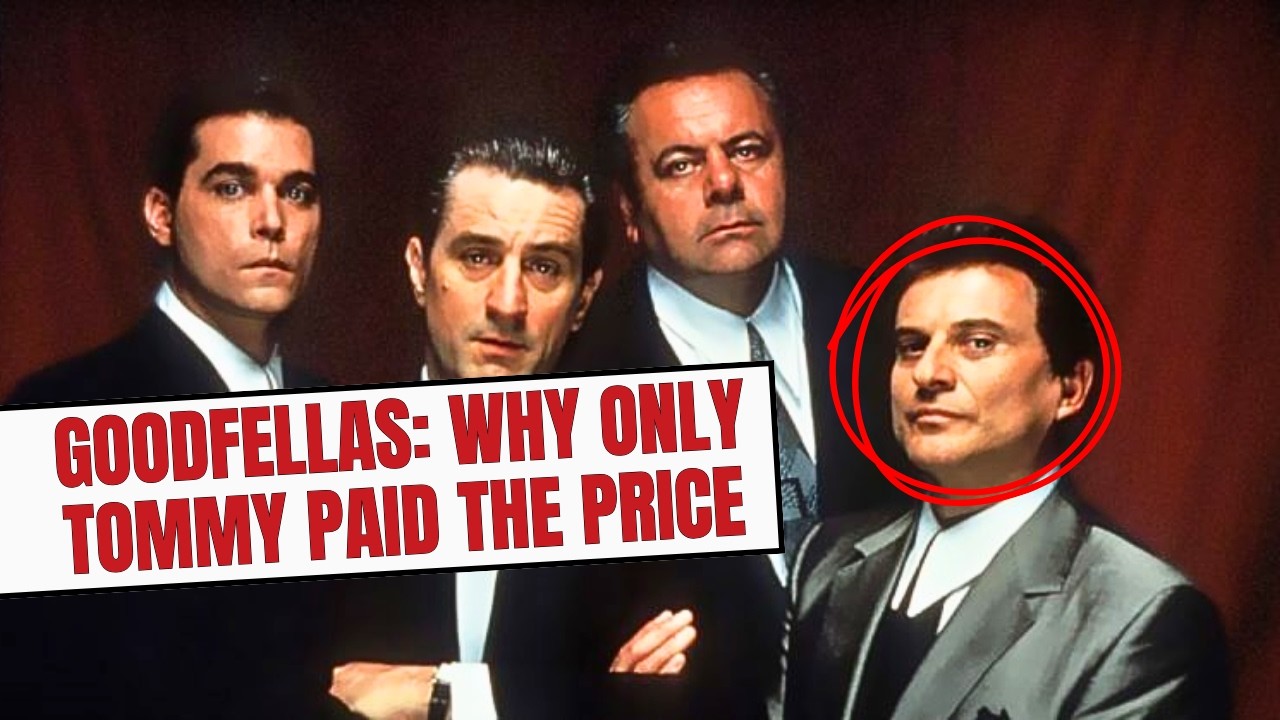
The third died at sixty-nine of heart disease in Los Angeles, having lived freely for three decades after becoming the most important mafia informant of his generation. Tommy DeSimone, the basis for Tommy DeVito in Goodfellas, disappeared on January 14, 1979, at the age of thirty-two. He was lured to what he believed was his official induction ceremony into the Lucchese crime family, driven to a location by men he trusted, and killed there. His body was never found.
Jimmy Burke, the basis for Jimmy Conway, was never convicted of any of the murders he almost certainly ordered and possibly committed himself over four decades of crime. He was convicted in 1982 of fixing college basketball games, and of one murder, that of drug dealer Richard Eaton in 1985. He died of lung cancer in a New York correctional facility on April 13, 1996. He was sixty-four.
Henry Hill became an FBI informant in May 1980, joined the Witness Protection Program, was kicked out of it in 1987 for continuing to commit crimes, and spent the next twenty-five years living openly, giving interviews, appearing on the Howard Stern show, and writing cookbooks. He died on June 12, 2012, of complications from heart disease. He was sixty-nine. Three killers.
Three entirely different endings. One film tells you what happened, but barely explains why. The answer, when made clear, is one of the most illuminating explanations of how organized crime actually works to be found in any historical record. The answer has nothing to do with body count.
It has nothing to do with who was crueler or more violent or more morally bankrupt. Jimmy Burke almost certainly killed more people than Tommy DeSimone. Henry Hill participated in violence, witnessed murders, helped dispose of bodies, and later admitted to killing at least three people on direct orders from Paul Vario. None of that mattered.
The variable that determined who died was this: what rules did you break? Not how many people you killed, but who those people were, and what institutional category they occupied. Tommy broke the one rule that could not be tolerated. Jimmy broke rules that, according to the mob’s internal logic, were either forgivable or outside its jurisdiction to punish.
Henry broke the most despised rule of all: he talked to law enforcement, but he did it in a way that created practical obstacles to his own execution. This is not a story about morality. These men had no conventional morality to speak of. This is a story about institutional logic, and about how a specific criminal organization generated entirely predictable outcomes for three men who were, on the surface, doing almost the same things.
Start with the body count. Henry Hill described Tommy DeSimone as pure psychopath. This was not a casual characterization from a man trying to make his friend sound interesting. Henry Hill had lived among violent men his entire adult life.
He knew what violence looked like in the context of organized crime, where it was professional, purposeful, and calculated. And he would tell anyone who listened that Tommy DeSimone was something different, something that exceeded what the mob context had conditioned him to expect. The evidence supports the characterization. The first documented murder established the pattern.
Around 1968, when DeSimone was seventeen or eighteen, he was walking down the street with Henry Hill when he spotted Howard Goldstein, a passerby. A stranger. A random man going about his day in the neighborhood. DeSimone turned to Hill and said, “Hey Henry, watch this.
” He shouted something at Goldstein, pulled a . 38 from wherever he was hiding it, and shot the man dead in the street. From the very beginning, he was not someone who killed strategically. He was someone who killed reflexively, as a first option, as an expression of whatever was happening inside him at any given moment.
The second murder on the documented record came on June 11, 1970. William “Billy Batts” Bentvena, a made member of the Gambino crime family, was killed. The essential fact is that Bentvena was a made man. Under Cosa Nostra rules, he held the highest level of institutional protection the organization granted.
He could not be touched without explicit approval from Gambino leadership, and if the stakes were high enough, from the Commission. Yet he was touched. The third killing was Michael “Spider” Gianco, a young man serving drinks at a card game. DeSimone, annoyed by a minor service mistake, shot Spider in the foot, not fatally, apparently as a warning or assertion of dominance.
A week later, when Gianco returned to work wearing a full leg cast and DeSimone began needling him, Spider told him to go perform an anatomically impossible act on himself. DeSimone shot him three times in the chest in front of witnesses. The fourth victim was William Rehal, a warehouse supervisor who witnessed a robbery and was asked to hold stolen goods for Burke’s crew. He refused.
DeSimone solved the problem by killing him. The fifth was Dominic “Remo” Cassani, DeSimone’s close friend. Burke received information that Cassani was talking to the NYPD and that there was a plan to arrest Burke. The order came down to take care of Cassani.
DeSimone strangled his closest friend with a piano wire because Burke told him to. The sixth victim was Ronald “Foxy” Jerothe, December 18, 1974. Jerothe was an associate of the Gambino family, a protégé of a rising Gambino captain named John Gotti. DeSimone had been in a relationship with Jerothe’s sister.
He beat her, and Jerothe, in an act of understandable personal loyalty, threatened to kill DeSimone. DeSimone went to Jerothe’s apartment, knocked on the door, and when Jerothe opened it, put a . 38 in his face and fired three times at point-blank range. The seventh victim was Parnell “Stacks” Edwards, December 1978.
After the Lufthansa heist, Edwards had been assigned the task of disposing of the getaway truck. He failed. He got high and fell asleep, and the truck remained in place long enough for police to find it. Burke needed the problem handled, and DeSimone was one of the men assigned to it.
Hill indicated in multiple accounts that the actual number of DeSimone’s kills was much higher, at least eleven. Some were victims of passing opportunity, people killed for reasons ranging from practical necessity to personal grudges, or simply for being in the wrong place at the wrong time. The real DeSimone was over six feet tall with a massive build, a huge, muscular man who combined physical intimidation with psychological unpredictability. This is the man the mob sanctioned, organized, and executed in January 1979.
But the essential analytical point stands: the number of murders was not why Tommy was killed. It came down to two specific killings that violated the one rule the organization considered absolutely non-negotiable. Billy Batts and Foxy Jerothe. These two men, and what they represented institutionally, are why Tommy DeSimone died.
To understand why Tommy died and Jimmy survived, you must understand the specific structure of Cosa Nostra’s rules of conduct. Not as a romanticized set of principles invented for mafia movies, but as a practical framework designed to make a multi-family criminal organization function across decades and jurisdictions without tearing itself apart. The most important rule in this structure, the rule all others existed to support, was the prohibition on killing made members without Commission authorization. This rule was not moral.
It was not humane. It was strategic. A made member represented a significant institutional investment. He had been vetted over time, tested through increasingly serious criminal activity, approved by family leadership, and officially recorded.
The most important protection was this: he could only be killed with explicit approval from the leadership of his own family. Any other killing, any murder of a made member without this authorization, was illegitimate. It was a violation of the founding contract on which the stability of the entire organization rested. Without this rule, there was no safety in membership.
If any associate or soldier could kill any made member for any personal reason, then the entire incentive structure that made the organization work collapsed. The mob operated on the understanding that there were people you could not touch. Remove that understanding, and you remove the organization’s ability to function. The Commission enforced this rule with one instrument that could reliably be deployed: the threat of authorized violence against violators.
If you killed a made member without permission, the Commission would kill you in return. This is the rule Tommy DeSimone broke when he killed Billy Batts in June 1970. Bentvena was a formally installed member of the Gambino crime family. No kill order had been issued for him.
He was absolutely protected under the rules of the organization itself. Tommy killed him anyway. Then, in December 1974, he killed Ronald Jerothe, who was not a made member, but who was so closely tied to John Gotti that the killing functioned as a second insult to the Gambino family. Jerothe was Gotti’s personal protégé.
Thomas Agro, a Gambino enforcer, was present or directly involved in the execution of DeSimone. The execution was carried out by men who had both personal grudges and institutional mandates. This convergence of personal and institutional motives is what made Tommy’s execution so complete and final. It was not just an institutional correction.
It was also personal justice for a specific man who had lost a specific friend, and who by 1979 had the power to ensure the debt was paid in blood. Tommy’s other five or six documented murders did not create an institutional crisis requiring his execution because none of those victims occupied the institutional category that mattered: a made member of a Cosa Nostra family. Goldstein was a civilian with no mob connection. His death was a crime, a murder, but it was not a violation of mob rules.
Spider was a civilian bartender. Rehal was a civilian supervisor. Remo was an associate of the Lucchese family, below full membership, and therefore not protected by the rule. Stacks Edwards was also just an associate.
Women were civilians. None of them mattered institutionally. What mattered was Bentvena. What made the murder of Billy Batts an unforgivable violation was not the violence itself.
The violence was the nature of the business. It was the target category. Billy Batts was a made man. He was protected.
Tommy killed him without permission. In Cosa Nostra doctrine, that was a debt that had to be paid in blood. Now understand this: Tommy’s other five or six documented murders did not create an institutional crisis requiring his execution, because none of those victims occupied the institutional category that mattered. A made member of a Cosa Nostra family.
Goldstein was a civilian with no mob connection? His death was a crime, a murder, but it was not a violation of mob rules. Spider was a civilian bartender. Rehal was a civilian supervisor.
Remo was an associate of the Lucchese family, below full membership, and therefore not protected by the rule. Stacks Edwards was also just an associate. None of them were important institutionally. What was important was Bentvena.
There is a second dimension to Tommy’s vulnerability that is equally important. Tommy DeSimone himself was never a made member. He was an associate of the Lucchese family, influential, respected within his crew, but he never underwent the formal induction ceremony that would have granted him the institutional protection he violated when he killed Bentvena. In the Cosa Nostra hierarchy, the distinction between made member and associate is not merely ceremonial.
It is existential. A made member has rights. An associate has no formal protection at all. He can be killed by anyone for any reason without any formal authorization.
Tommy was just an associate. His survival depended entirely on the informal protection of those he worked for. The irony of Tommy’s execution is that it was staged as an induction ceremony. He was told he would finally get his button.
He put on his best clothes, said goodbye to his mother, borrowed sixty dollars from his estranged wife Angela, and allowed Peter Vario and Bruno Facciolo to drive him to what he believed was his induction. Instead, he was killed. The same institutional ambition he had nurtured since 1965 was used as the mechanism for his own execution. The mob was sending a specific message: you are not worthy of this.
You would never have gotten this. You violated the most sacred rule of membership, and you were not a member, and you never would have become one while that debt remained unpaid. Tommy’s lack of membership status also explains why the execution happened when it did. Even up to that moment, pressure from the Gambino family could have been handled through Paul Vario’s diplomacy and the continuing value of Burke’s operations, which generated income that benefited both the Lucchese family and, indirectly, Gambino interests.
But the Lufthansa heist changed the calculation. The pressure from the $5. 875 million robbery was intense and continuous. The FBI was everywhere.
According to Henry Hill’s account, Paul Vario gave his permission for DeSimone’s killing. The man who was supposed to protect his own crew agreed to have him killed. Why did Jimmy Burke survive? Because none of Jimmy Burke’s victims were made members of a Cosa Nostra family killed without authorization.
The Lufthansa cleanup victims were organizationally invisible. Stacks Edwards, an associate. Martin Krugman, a civilian bookmaker. Richard Eaton, a civilian drug dealer and con man.
Thomas Monteleone, a civilian bar owner. Louis and Joanna Cafora. Louis was an associate of the Colombo family. Joanna was a civilian.
Joe Manri and Robert McMahon were associates. Theresa Ferrara was a civilian. Paolo LiCastri was an associate of the Gambino family, and his death caused some tension, but the Gambinos did not declare war over it. By the mob’s accounting system, Burke was running a notably clean operation institutionally.
He was killing people who were not protected from the organization’s point of view. There is a second reason the mob did not move against Jimmy Burke. He made too much money. Burke was one of the most productive earners in the Lucchese family orbit.
He generated money through truck hijackings and loan sharking, expanded through systematic exploitation of JFK Airport, making Vario’s crew one of the most profitable in New York. The Lufthansa heist alone netted $5. 875 million. His value to the Lucchese family as an earner created a strong institutional incentive to keep him alive and working.
Burke also had something that made him difficult to dispose of from a purely logistical standpoint. He was not a made member of the Lucchese family. He was Irish. He could never have become a made member under the organization’s rules, which formally restricted membership to men of full Italian descent.
But because he was not a made member, his killing would not require the same level of Commission authorization as the killing of a made member. Theoretically, any family could order his death without the formal diplomatic mechanism. But any family doing so would have to deal with the reaction of the Lucchese family, because Paul Vario considered Burke his man. There is another dimension to Burke’s relative safety.
By the time the Lufthansa heist placed enormous FBI pressure on the mob, Burke had already fortified himself. He was killing the people who could testify against him. The Lufthansa participants who knew the details of his involvement. By the time Henry Hill flipped in 1980, the list of people who could directly link Burke to the heist had been dramatically reduced by death.
The FBI was ultimately unable to prove the Lufthansa case against him. They caught him on the basketball fixing case and one murder. Everything else, the eight or nine murders in the aftermath of the Lufthansa heist, decades of hijackings, extortion, and loan sharking, went unpunished by law enforcement. Burke went to prison.
He died in prison, but he was not killed by the mob. The distinction between strategic and reflexive killing matters to the mob, not primarily for moral reasons, but for practical ones. A strategic killer is predictable. He kills in response to specific problems, which means you can anticipate his behavior, manage his actions, and avoid situations that might trigger him.
A reflexive killer is unpredictable. He kills in response to emotional states that outside parties cannot reliably anticipate or manage. He is not an asset. He is a liability.
Every time he is in a room with someone who might make him feel disrespected, that person is in potential danger. Paul Vario spent the decade between Batts’ murder in 1970 and Tommy’s execution in January 1979 managing the burden that Tommy represented. Henry Hill’s relationship with murder is the most complex of the three. For most of his public career, he insisted he had never personally killed anyone.
This was not entirely accurate. Hill admitted on the Howard Stern show that he had killed three people on direct orders from Paul Vario. He did not name them, did not clarify the circumstances, and was never pressed in a way that produced a documented record, but the admission was made. Hill’s role was clearly substantial involvement in the operational context of murder.
He helped transport Billy Batts’ body, still alive, to the site of his final murder. He helped dig up the decomposing corpse when the burial site became threatened by development. But he was not the one who killed Billy Batts. He did not pull the trigger on Stacks Edwards or strangle Remo Cassani.
When the question of what to do about Henry Hill came up in mob deliberations, and it did, the FBI produced a recording of Burke telling Vario that Hill had to be taken care of. The calculations were different from what they would have been for someone who committed the specific violations Tommy committed. Hill never killed a made man. Hill never violated the rules between families.
Hill was a useful, productive, likable participant in a criminal enterprise, but he had become a liability, not because of institutional violations, but because of his arrest on drug charges. His liability, from the mob’s point of view, was the FBI, and the FBI reached him before Burke had a chance to eliminate him. When Hill flipped in May 1980, the mob’s options regarding him changed dramatically. He was in federal custody.
He was under FBI protection. Killing him was practically impossible, not because the mob lacked the will, but because the physical and logistical obstacles were insurmountable. There is a persistent myth about the mob’s treatment of informants: if you snitch on the mob, the mob will kill you, point blank, no exceptions. This is not entirely wrong.
The mob’s official posture toward cooperation with law enforcement was absolute. But the mob’s actual practice was far more complex and far more pragmatic. The decision of whether to kill an informant depended on a cost-benefit calculation. The cost of killing a witness in the Witness Protection Program was significant.
If a protected witness were killed, the FBI and the Justice Department would devote massive resources to finding and prosecuting those responsible. The benefit of killing Hill, from the mob’s point of view, was primarily psychological: revenge, internal law enforcement, proof that betrayal has consequences. But by 1980, when Hill flipped, most of the operational damage had already been done. He had given his testimony.
His knowledge was in the hands of the government. Killing him would not turn back the clock. There was also the question of what the mob believed about Hill’s actual knowledge. He was a mid-level associate, below the rank of the leadership, not a full member.
He knew a lot about the specific operations of Vario’s crew and about specific events in which he participated. But his knowledge of the high-level strategy and operations of the Lucchese family was limited. And there is a factor no one in the mob liked to acknowledge publicly, but the historical record makes clear: as the years passed and the people Hill testified against died or were imprisoned, the practical necessity of killing him faded. Burke died in 1996.
Vario died in 1988. The direct targets of Hill’s cooperation were either dead or serving sentences that amounted to life in prison. The financial and operational damage had already been done. The men most eager to kill Hill, Burke and Vario, were gone.
By the time Hill was kicked out of the Witness Protection Program in 1987, the men he had directly betrayed were in prison or dead, and the organizational capacity and motivation to pursue him had significantly diminished. He lived in fear. He moved frequently, wore disguises, and told the Telegraph in 2010 that every day seemed surreal and that he never expected to reach old age. But he was right that no one came for him.
Not because the mob forgave him, but because the calculations had changed in ways that made his continued survival more acceptable than the cost of eliminating him. To understand the three different outcomes, it is useful to sketch what could be called the mob’s hierarchy of sins. At the bottom, the least consequential category, is violence against civilians. Killing someone with no connection to the mob, no family membership, no protected status.
One step up is killing mob associates without permission. An associate is someone who works with a family without formal membership. Henry Hill’s category. Tommy’s category.
Jimmy Burke’s category. Associates are not protected by the made-man rule. Another step up is killing members of another family’s crew, including made members, with authorization from the Commission or the leadership of the family in question. These killings are legitimate.
Tommy’s execution falls into this category. At the top of the hierarchy, the most serious crime, the unforgivable violation, is killing a made member of another family without permission. This is what Tommy did when he killed Billy Batts. Now apply these three men to this classification.
Tommy killed at least two victims in the top category of protected murders. Jimmy killed victims almost entirely in the bottom two categories: civilians and associates. No top-category killings. The organization had no institutional obligation to respond to Burke’s body count.
Henry participated in the organization’s violence at various levels. He personally killed, by his ultimate admission, three people on direct orders from Vario, and witnessed and assisted in additional murders, but none of his victims fell into the protected category. His violations of mob rules were real and serious, but they fell into categories the mob could absorb. The clarification explains everything.
The number of bodies is almost irrelevant. What matters is where each man’s most serious crime falls in the hierarchy. Tommy was at the top. Jimmy and Henry were at the bottom.
This is how the mob decided who lived and who died, not how many, but who. Jimmy Burke’s Irish heritage created a specific institutional situation. He was never a made member. But his position as Paul Vario’s most valuable earner gave him informal protection that surpassed what formal status would have granted him.
He understood he could never become a made member, and he never behaved as if he were one. This strategic awareness kept him alive. John Gotti’s role in Tommy’s death cannot be overstated. Gotti and Bentvena were close.
The relationship was not a casual mob friendship. They drank together. They worked together. Gotti’s wife and children treated Jerothe as a member of their household.
The men Tommy DeSimone killed were not, from Gotti’s perspective, institutional abstractions. They were his friends. Gotti carried the Bentvena debt for nine years with the patience of a man who knew it would eventually be paid. And according to Henry Hill’s account, Gotti was present at the execution of Tommy DiSimone.
Hill said on the Howard Stern show in 2007 that Gotti made sure DeSimone’s death took a long time. Agro, the Gambino enforcer, was known for killing for personal reasons, not merely institutional ones. The execution was not just an institutional correction. It was personal justice for a specific man who had lost a specific friend.
Tommy DiSimone never received a funeral. There was no body, or at least none that was ever formally identified or claimed. His wife Angela reported him missing on January 14, 1979. She had last seen him a few weeks earlier when he borrowed sixty dollars from her.
The mob’s disposal of Tommy’s body was itself a message. They did not leave him to be found, identified, mourned, and buried. They erased him. Jimmy Burke died in a hospital bed inside a New York correctional facility from lung cancer.
He was given a Catholic funeral and buried in St. Charles Cemetery in East Farmingdale, New York. His grave can be found. Henry Hill died of heart disease at sixty-nine.
He died with his name in the headlines, eulogized around the world as the man whose testimony led to fifty convictions, as the inspiration for Goodfellas, as one of the most important mafia informants in American history. Three killers. Three fates. One lesson.
The mob was not a moral institution. It was a strategic institution. Its decisions were made on strategic grounds. And when you understand its strategy, the three fates are not surprising at all.
They are predictable. They follow the logic of the institution as precisely as any other institutional outcome follows the rules that produced it. Three men, one crew, one organization, and three completely different systems of accounting. The mob’s logic was not fair, and it was not moral, but it was consistent within its own framework and by its own standards.
That consistency, more than anything else, explains why Cosa Nostra endured as an institution for as long as it did. The rules were real. The enforcement was real. The outcomes were predictable if you knew the rules.
Tommy did not follow them. Jimmy mastered them. Henry exploited their limits. The mob killed Tommy not because he was the most evil, but because the specific form his violence took created an obligation the organization was forced to honor.
Jimmy survived because his violence never touched the categories the mob protected. Henry survived because the mob calculated that killing him was no longer worth the cost. The mob was not an ethical institution. It was not a humane institution.
It was simply an institution, and it behaved exactly as its rules dictated, until the end.
