In the spring of 1884, a young woman sat in England, heavy with child, while her husband traveled south to France in search of warmer weather for his aching joints. Prince Leopold, Duke of Albany, the youngest son of Queen Victoria, had always been fragile. His mother had wrapped him in cotton wool since childhood, knowing that the slightest injury could prove fatal. His bride, Princess Helena of Waldeck-Pyrmont, had married him anyway, understanding the risk.
Now she waited for news from the Riviera. When it came, it shattered her world: Leopold had slipped and fallen. For an ordinary man, the mishap would have been nothing. For a hemophiliac, the internal bleeding could not be stopped.
He died on March 28, 1884, at just thirty years old. Helena was twenty-three, a widow after barely two years of marriage, and four months away from giving birth to a child who would never know his father. Her marriage had been a quiet, intellectual love story, one that few had expected. She was a princess from a tiny German principality, Waldeck-Pyrmont, a state so small it barely registered on the maps of Europe.
Her father, Prince George Victor, ruled his little domain with progressive ideas, and he had given his daughter an education unusual for a royal woman. As a teenager, Helena had been put in charge of the principality’s kindergartens, helping to design the curricula herself. She loved mathematics and philosophy, a passion that earned her the reputation of a bluestocking. When the idea of a match with Prince Leopold was first raised, Queen Victoria’s own daughter, Crown Princess Victoria of Prussia, warned her mother that Helena was an intellectual.
The queen was alarmed. She imagined a cold, pedantic young woman who would never fit into the family. A clever girl, she feared, would be distant and lack warmth. But Victoria’s daughter Vicky, a tireless matchmaker, believed Helena’s strong mind and warm heart would be the perfect complement to her beloved brother Leopold, who was himself studious and gentle.
When the two met, there was an immediate connection. Leopold, who had long struggled to find a bride willing to accept the risk of his illness, was charmed by Helena’s empathy and intelligence. Before long, the queen had revised her opinion entirely. Helena was not cold at all.
She threw herself into charitable work, mingled easily with ordinary people, and proved, in the queen’s own approving words, that she was keen to get among people. Victoria wrote happily to Vicky that she was pleased with the match. The young princess was everything the queen could have hoped for: developed in mind, kind in nature, and gentle in manner. They were married on April 27, 1882, in St.
George’s Chapel at Windsor Castle. Helena, just twenty-one, walked down the aisle in white satin and tulle on her father’s arm. Leopold, twenty-nine, waited in full military uniform, leaning on his walking stick; his condition caused him constant joint pain. The queen, always in mourning, allowed herself the rare pleasure of seeing her youngest son wed, and she noted that the couple looked very much in love.
Their new life together began at Claremont House in Surrey, a stately home lent to them by the queen. For the first time, Leopold was free of his mother’s constant supervision. Helena proved the perfect companion. They shared an interest in literature and music, entertained learned friends from Oxford, where Leopold had studied, and spent quiet evenings reading side by side.
Leopold took pride in introducing Helena to his circle of scholars, pleased that his wife could hold her own in conversation with theologians and philosophers. The professors were impressed by the erudition and genuine curiosity of the young duchess. Helena would maintain those intellectual friendships long after Leopold was gone. Their happiness was real, but so was the fragility of their time together.
Every small injury, every bruise, threatened disaster. Helena took on the role of loving nurse and guardian, encouraging Leopold to be careful without undermining his independence. In 1883 she gave birth to their first child, a daughter named Alice, after Leopold’s deceased sister. The queen rejoiced at the arrival of a granddaughter and noted how well Helena fulfilled her roles as mother and wife.
In the winter of 1884, on medical advice, Leopold traveled to the south of France, seeking warmer weather for his joints. Helena, far along in her second pregnancy, remained in England. The news of his fall and sudden death reached her in March. Queen Victoria was devastated; she had doted on Leopold, and now she cast an even more protective eye on his widow.
Helena, true to her character, did not crumble. In July 1884, four months after her husband’s death, she gave birth to a healthy son. She named him Charles Edward. The queen comforted Helena through her confinement, and the two women, bound by shared grief, grew very close.
Victoria wrote of Helena’s strength and gentle bearing in sorrow, calling her “my dear Helen,” and admired how bravely she carried her misfortune. Helena did not retreat from the world. She threw herself into the charitable work that the queen had first admired in her. In 1894 she became a founder of the Deptford Fund, an organization dedicated to improving the lives of the poorest Londoners through housing and employment programs.
She actively supported hospitals, especially those for maternity and children, likely reflecting the empathy of a young mother herself. She became a fixture of the extended royal family, a faithful presence at gatherings and a beloved Aunt Helen to Victoria’s many grandchildren. She never remarried. Her brief married happiness with Leopold remained a cherished memory she would not replace.
Instead, she poured her love into her children and her work. Her daughter Alice grew into a well-balanced, socially conscious woman. She married Prince Alexander of Teck and later became Countess of Athlone, building a long career in public service that stretched well into the twentieth century. Her son Charles Edward’s fate was stranger.
In 1899, by a twist of inheritance, the teenage boy was chosen to succeed to the German duchy of Saxe-Coburg and Gotha, the same title that had belonged to the husband and son of Grand Duchess Maria Alexandrovna of Russia. Queen Victoria selected her own grandson as the heir after the earlier line died out. And so, in 1900, at just sixteen years old, Charles Edward was sent to Germany to take up his ducal responsibilities. It was painful for Helena to see her only son leave England to be raised and shaped as a German duke.
Nevertheless, she supported his destiny, accompanying him to Coburg at first and making sure he was placed with suitable guardians. As a sad final act, Charles Edward later fought against Britain in the First World War and lost his titles — but that came long after both Queen Victoria and Helena had passed away. When the war broke out in 1914, Helena had close family on both sides. Her son and sister were in Germany, while her adopted homeland, Britain, was at war with them.
She stayed in the background, drawing no attention to her German connections, and focused on nursing and relief work instead. Her cosmopolitan family background gave her a nuanced view of the tragedies of war, and she mourned in silence the divide it caused among her relatives. After the war, with Germany defeated and in revolution, Helena spent her last years partly in Germany and Austria, close to her son and grandchildren. In 1922, while staying at her son’s home in Austria, she died at the age of sixty-one.
She was buried in a quiet churchyard in Tyrol, far from the pomp of Windsor. A reflection of how much the world of princes and dukes she had known had changed. Her story was quieter than the others. She had taken a gamble on love and duty, knowing her time with Leopold might be short.
She gave him happiness and two children in the brief years they had. And when he was gone, she turned her grief into service for nearly forty years. The people who benefited from her schools, funds, and hospitals likely never knew the full royal lineage of their benefactor. To them, she was simply the kind lady who cared about the fate of others.
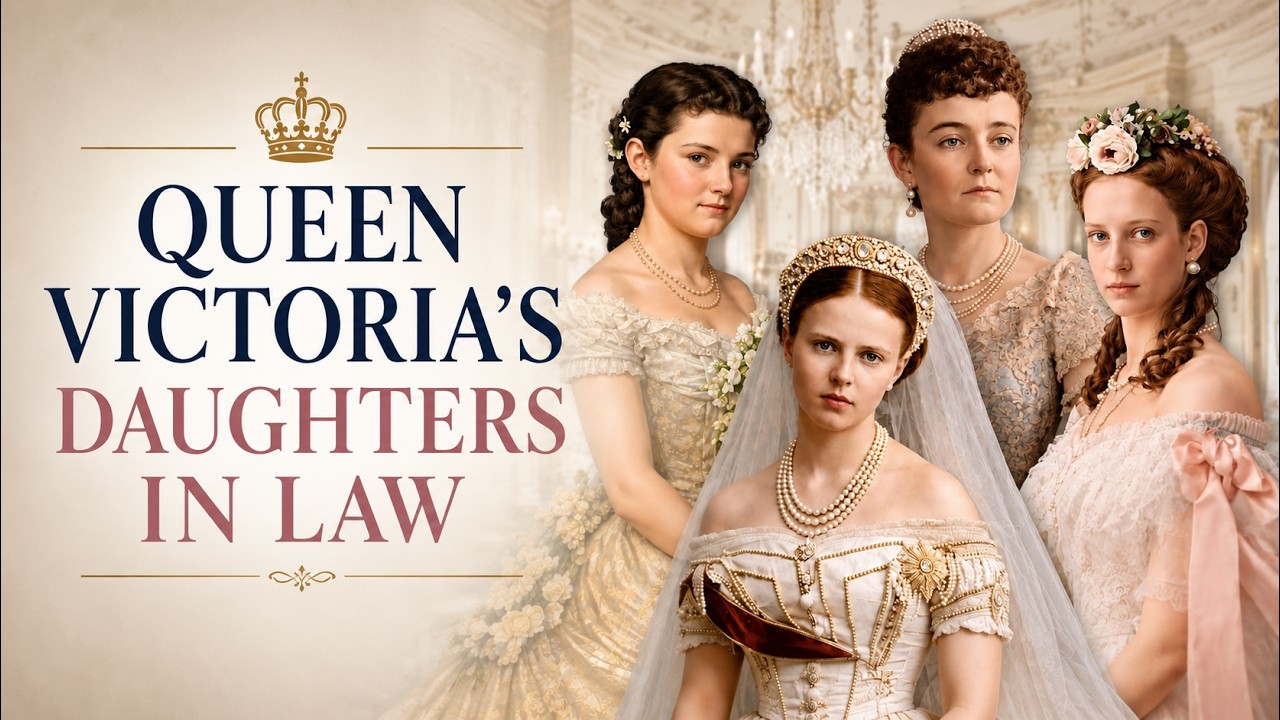
One of Queen Victoria’s granddaughters wrote that Aunt Helen showed compassion to others in sorrow, drawing on her own experience of loss. Sense, heart, and resilience: Helen possessed all three. The story of Queen Victoria’s four daughters-in-law spans nearly four decades, from 1863 to 1882, as a succession of young women from across Europe married into the British royal family. Each brought her own heritage, strengths, and struggles.
There was Alexandra of Denmark, the patient Princess of Wales. Born in modest circumstances, the daughter of a prince who unexpectedly became King Christian IX of Denmark, she grew up frugally, even doing her own mending. This unpretentious upbringing gave her a grace and sincerity that would endear her to the British public. At sixteen, her life changed forever when Queen Victoria’s eldest son, Albert Edward — “Bertie” — went looking for a bride.
The handsome but wayward Prince of Wales fell in love with the Danish princess almost at first sight during an arranged meeting in 1861. Politically, the match raised doubts. Denmark was locked in a bitter dispute with Prussia over Schleswig-Holstein, and Victoria, sympathetic to her German relatives, worried that Alexandra’s Danish loyalties would cause problems. But Bertie was smitten, and after dutifully ending a youthful affair with an Irish actress, he proposed in September 1862.
The eighteen-year-old princess accepted, and they married in March 1863 in St. George’s Chapel at Windsor, in a ceremony deliberately subdued in splendor because the queen still mourned deeply for Prince Albert. Victoria insisted the wedding guests wear mourning colors such as lilac and gray instead of bright hues. So began Alexandra’s thirty-eight-year tenure as Princess of Wales, the longest anyone ever held the title.
With the queen withdrawn from public duties after Albert’s death, it fell to Bertie and Alexandra to represent the youthful, glamorous face of the monarchy. Alexandra’s beauty, elegance, and kindness soon captivated the nation. She set fashion trends across Europe. After a bout of rheumatic fever in 1867 left her with a permanent limp, ladies of high society reportedly imitated her walk, creating a craze known as the “Alexandra limp.
” She also popularized high necklines and choker necklaces to hide a small scar on her neck, unintentionally starting an enduring fashion for pearl collars. In an era when royals were expected to be distant, Alexandra’s charm made her deeply loved. Crowds cheered her warmly, sometimes louder than her husband, a popularity that sometimes irritated the queen. Behind the public adoration, her life at court was not without hardship.
She faced a dominant mother-in-law who gave unsolicited advice on everything from childrearing to household matters. The queen could be highly critical, disapproving when Alexandra kept an active social life after childbirth and finding her too frivolous and insufficiently deferential to the Prussian relatives Victoria favored. Their relationship, though genuinely warm, was strained by such differences. The queen even tried to interfere in choosing the names of Alexandra’s children, causing friction.
Alexandra remained outwardly respectful but quietly asserted herself in areas she cared about, such as her children’s upbringing and loyalty to her own family abroad. A deeper sorrow was Bertie’s notorious infidelity. The pleasure-loving Prince of Wales kept a series of mistresses, including society beauties such as Lily Langtry, Daisy Brooke (Countess of Warwick), and Alice Keppel. These affairs were an open secret, which Alexandra chose to bear with dignity and patience.
She once remarked, “He loved me the most,” when asked how she endured her husband’s escapades. She maintained that whatever other relationships Bertie had, his deepest affection remained with her. In a remarkable gesture of grace, she even allowed Alice Keppel, his last mistress, to visit the dying king at his bedside in 1910, granting her husband comfort in his final moments. Her forbearance won her public sympathy and strengthened the image of her as the wounded but dignified wife.
Still, she found fulfillment in many aspects of her role. She devoted herself to charity, serving as patron of hospitals, raising money for the poor, and promoting causes such as healthcare for the deaf, herself afflicted with significant hearing loss from hereditary otosclerosis. She bore six children with Bertie. Two of her sons would not live to old age.
Her infant son, Alexander John, died in 1871 just one day after his birth. And in 1892, she suffered the devastating loss of her eldest son, Prince Albert Victor — “Eddie” — who died of pneumonia during an influenza epidemic. Alexandra was grief-stricken. Just as Queen Victoria had after the death of Prince Albert, she preserved Eddie’s room and personal belongings exactly as they had been during his lifetime, a shrine to her lost child.
Her other children thrived. Her second son became King George V, and her daughters Louise, Victoria, and Maud made illustrious marriages. Maud even became Queen of Norway. When Queen Victoria died in 1901, Bertie ascended the throne as King Edward VII, and Alexandra, after nearly four decades of waiting, became queen consort.
She performed her public duties impeccably, from state visits to opening hospitals, always radiating kindness and royal glamour. Although Edward VII’s reign was short, from 1901 to 1910, the royal couple set a tone of elegance that defined the Edwardian era. Alexandra’s composure proved valuable during the coronation of 1902, when Edward fell seriously ill days before the planned event. Alexandra calmly took over his public engagements to avoid alarming the nation.
After surgery saved the king’s life, the coronation was postponed by only a few months, a crisis managed skillfully thanks in part to her calm. Edward’s death in 1910 left Alexandra a widow at sixty-five. As queen mother during the early reign of her son George V, she remained a revered figure. Though she withdrew somewhat from public life in her later years, preferring a quieter existence at Sandringham and Marlborough House, she still found fulfillment in charity.
During the First World War, she visited hospitals and organized relief efforts, offering motherly comfort to wounded soldiers. The war years were personally painful. Her nephew, the Kaiser, brought war to her beloved England, and her own brother, King George of Greece, was deposed. Yet Alexandra maintained a stoic public demeanor.
She lived long enough to see the end of the war and the beginning of the 1920s. When she died in 1925 at the age of eighty, enormous crowds lined the streets of London for her funeral, a testament to how deeply she had remained loved since the moment she first set foot in England as a Danish princess in 1863. Grand Duchess Maria Alexandrovna of Russia traveled a very different road. In January 1874, the Winter Palace in Saint Petersburg hosted one of the most lavish royal weddings of the nineteenth century.
Maria, the only surviving daughter of Tsar Alexander II, married Prince Alfred of Great Britain, the second son of Queen Victoria. It was unprecedented: never before had a daughter of the Romanov tsars married into the British royal family. The union sprang from youthful attraction but was forged amid great political calculation and cultural tension. Maria had grown up amid the splendor of the Russian imperial family, the beloved only daughter of the tsar, spoiled and indulged.
She spoke four languages fluently and was known as willful, stubborn, and uncompromising when she wanted her way. At fifteen, she met Prince Alfred, the sailors son of Queen Victoria, during a visit to her mother’s Hessian family in 1868. Alfred was twenty-four, reserved and gentle, with a passion for music. They bonded over their shared love of it — he played the violin, she the piano — and took long walks together during a second meeting in 1871.
When Alfred asked for her hand, both sets of parents recoiled. The tsar, deeply attached to his daughter, could not bear the thought of losing her to a life abroad. He cited Maria’s youth as a reason for delay and nursed resentment toward Britain over Russian hostility after the Crimean War. On the British side, Queen Victoria was initially shocked.
No British prince had ever married a Romanov, and she foresaw problems with Maria’s Orthodox faith, her enormous dowry, and the political rivalry between the empires. The queen called Russia unfriendly toward Britain and worried about Russian ambitions in Asia, writing that the prospect of this marriage gave her mixed feelings. Yet Alfred and Maria would not be deterred. By 1873, their determination, and perhaps the diplomatic hope that a British-Russian union might ease tensions on the world stage, led both courts to give in.
Alfred formally proposed in July 1873 at the family’s summer villa. She accepted, and he sent an exultant telegram to Queen Victoria: “Cannot say how happy I am. ” The queen gave her blessing despite lingering doubts, noting privately that she did not yet know Maria and foresaw many difficulties. Those difficulties began with arduous negotiations over the marriage settlement.
Tsar Alexander demanded that his daughter retain her imperial title and take precedence over all other women at the British court except the queen. He also provided an astronomical dowry: more than a million rubles in trust, plus a substantial annual allowance, a fortune that far exceeded the usual provisions for British princesses. This immense wealth, rooted in the vast riches of the Romanovs, would later feed a certain snobbery in Maria, who was accustomed to a level of luxury unknown even in British royal circles. The wedding itself was a magnificent two-part spectacle.
On January 23, 1874, Alfred and Maria married in the Winter Palace, first in a brilliant Russian Orthodox ceremony under the gilded domes, then according to the Anglican rite. The grand duchess wore a mantle of crimson velvet and ermine and a Romanov tiara heavily set with diamonds. The tsar kept the newlyweds in Russia for a time and preserved their wedding suite in the Alexander Palace for two decades, hoping his beloved daughter would visit often. In March 1874, Alfred brought his bride to England.
After meeting her, Victoria wrote that she had formed a high opinion of Maria, praising her intelligence, good nature, and lack of pretension. “Everyone must like her,” the queen noted approvingly of the twenty-year-old Duchess of Edinburgh. It seemed a promising beginning. But integrating a Russian grand duchess into the British royal family proved challenging.
Accustomed to the splendor of the Russian court, Maria was not impressed by relatively sober British manners. She brought Russian extravagance to her new residences, decorating Clarence House with heavy continental furniture and gold icon lamps, raising eyebrows. Worse, she showed open disdain for certain British customs. She scandalized London society by smoking cigarettes in public, something proper English ladies simply did not do.
When criticized for her coarse habit, she shrugged off British opinion and went her own way. Her direct manner, described as almost masculine by the standards of the day, and her tendency to speak her mind freely, did not endear her to everyone at court. The most problematic issue was Maria’s insistence on her royal status. In Russia, as the tsar’s only daughter, she outranked all women except her mother.
In London, she was suddenly expected to yield precedence to the Princess of Wales, Alexandra of Denmark. Maria could not accept standing behind Alexandra at state occasions. In her eyes, she was the daughter of an emperor, while Alexandra, though the future queen, was born merely a princess of a smaller kingdom. This dispute over precedence became a bitter point of contention.
Backed by her father, the tsar, Maria sometimes demanded to be treated in Britain according to her Russian rank, even insisting on being addressed as Imperial Highness, which infuriated Alexandra and strained the family. Queen Victoria refused to yield on British protocol. In England, Maria was a royal duchess, her royal highness, and she would accept her place behind the Princess of Wales. Nursing her resentment, Maria complied, but the episode clouded her relationship with her sister-in-law for good.
The two women developed a lasting mutual dislike. Family life for the Duke and Duchess of Edinburgh was pleasant enough at first. They settled at Clarence House in London and Eastwell Park in Kent, and in the first decade of their marriage, Maria bore Alfred five children in rapid succession. She was a devoted, if strict, mother.
Remarkably, she defied Victorian convention by breastfeeding her babies herself, a practice Queen Victoria, who believed noble mothers should employ wet nurses, viewed with horror. But Maria was willful in doing things her own way. Motherhood did not bring the couple closer. Maria soon discovered that Alfred, like many men of his station, including her own father, was not a model of fidelity.
He frequented gentlemen’s clubs and reportedly had affairs elsewhere. Disillusioned, Maria withdrew into her own circle. The marriage, one historian wrote, was shaky almost from the start. By the 1880s, Alfred had taken to heavy drinking, becoming moody and hot-tempered, and the couple lived largely separate lives.
Maria was deeply hurt by her husband’s neglect and infidelity, but she kept up appearances. Only much later did she confide that during her marriage she had never felt more than his lawful mistress. Maria found more happiness outside England. In 1876, Alfred’s naval career brought them to the Mediterranean when he was stationed in Malta as a fleet commander.
The warm climate and relatively informal atmosphere brightened her spirits. She gave birth on the island to her daughter Victoria Melita and wrote that life there was a refreshing pause from England, where she often felt constrained and criticized. She also traveled frequently to visit her many royal relatives across Europe, trips that conveniently took her away from her husband. She visited Russia almost every year and remained very close to her father.
Tragically, Alexander II was assassinated by revolutionaries in 1881, and Maria rushed to Saint Petersburg to mourn him. She had been her father’s darling, and his violent death cut her deeply. In 1887, Alfred retired from the navy, and the family moved to Coburg in Germany, awaiting a major change: Alfred was the heir presumptive to his childless uncle, Duke Ernst II of Saxe-Coburg and Gotha, the duchy of Prince Albert’s family. When Ernst died in August 1893, Alfred inherited the ducal throne, and Maria finally became a sovereign duchess, a position she enjoyed.
She called the change a gift from heaven, delighted to finally run her own court in Coburg, free from the shadow of Queen Victoria and British expectations. She enthusiastically renovated castles, supported the arts — particularly theater and opera — and engaged in charity, such as founding a home for the intellectually disabled. Her happiness in Coburg was overshadowed by personal grief. In February 1899, her only son, young Prince Alfred, died at twenty-four under mysterious circumstances.
The official cause of death was given, but rumors circulated that he had shot himself during a bout of depression, possibly related to a scandal. Maria was shattered by the loss of her son and heir. Queen Victoria wrote that poor Marie must be going through a terrible ordeal burying her child. Barely a year later, in July 1900, Maria’s husband died after an illness aggravated by his alcoholism, leaving her a widow at forty-six with three surviving daughters.
She remained a formidable matriarch for them. Her daughters went on to notable fates: Marie “Missy” became the famous Queen of Romania; Victoria Melita “Ducky” shocked Europe by divorcing her first husband, a grandson of Queen Victoria, and then marrying Maria’s own nephew, the Grand Duke of Russia; Alexandra married into the princely family of Hohenlohe-Langenburg; and Beatrice “Baby-Bee” married a Spanish infante. Family quarrels continued to flare, including a row with Queen Victoria over Ducky’s divorce and remarriage. The First World War destroyed Maria’s world.
Her sympathies lay firmly with Germany, which she had adopted, and she had little love for Britain or for her nephew, Tsar Nicholas II, with whom she had an icy relationship. In 1917, she learned that Nicholas and the entire Russian imperial family, including several of her own relatives, had been murdered by the Bolsheviks. The Romanov dynasty into which she had been born was wiped out. The German Empire fell, and with it the ducal throne of Coburg.
In November 1918, her grandson Charles Edward was forced to abdicate. Maria lost most of her enormous fortune when the new Soviet regime seized Romanov assets, much of her wealth having remained in Russian trusts, now inaccessible. Anti-Russian sentiment in Germany during the war had even driven her from Coburg. At one point, she was confronted by an angry mob in the Bavarian town of Tegernsee and fled for her safety to neutral Switzerland.
By 1919, she lived in exile in Zurich in greatly reduced circumstances. The hardships of war and exile had visibly marked her. Once robust and imposing, she became frail and trembling, suffering from the ailments of old age and chronic stomach problems. On October 25, 1920, Grand Duchess Maria Alexandrovna died in her sleep in Switzerland at sixty-seven.
In accordance with her wishes, her body was returned to Coburg and laid to rest beside her husband and son in the ducal mausoleum. Reflecting on her mother’s life, Princess Marie of Romania wrote, “She was deeply religious. I hope God will not disappoint her, as most things and people in this life did. ” It was a bittersweet tribute for a woman who began life with every advantage — a loving father, enormous wealth, royal status — yet whose journey was full of disappointments.
The third daughter-in-law, Princess Louise Margaret of Prussia, married into the family in March 1879 at Windsor Castle, a royal wedding that drew far less attention than those of the Prince of Wales or the Duke of Edinburgh but bound the British and Prussian royal houses together. Prince Arthur, Duke of Connaught, Queen Victoria’s third son, wed Princess Louise Margaret, known in England simply as Louise. Although not a familiar name today, her life offers a fascinating look at the duties of a royal wife who quietly supported the British crown worldwide. Her story is one of steadfast duty, extensive travel, and unheralded contributions in the long shadow of her dominant mother-in-law.
She was born in Potsdam in 1860 into the Prussian Hohenzollern dynasty, a great-niece of Emperor Wilhelm I, though her immediate family branch was of secondary importance. Her parents had a notoriously unhappy marriage. Her father, Prince Friedrich Carl, a celebrated Prussian general, desperately wanted a son. When Louise was born as his fourth daughter, Friedrich Carl struck his wife in a fit of rage for not producing a male heir.
The abuse was so severe that the Prussian king, the baby’s great-uncle, had to intervene to prevent an official separation. Louise was thus born amid domestic violence. Eventually a son was born in 1865, but her parents lived largely apart afterward, and affection was scarce in that household. Nevertheless, Louise received a princess’s education, with the added strictness typical of Prussian court culture.
She was schooled in multiple languages, art, and the rigorous social etiquette of the Hohenzollerns. By the late 1870s, she was of marriageable age, and Queen Victoria, always seeking suitable matches for her children, took notice. Prince Arthur met Princess Louise Margaret for the first time in 1878. Arthur, an easygoing professional officer, had remained a bachelor into his late twenties, unusual for a Victorian prince.
The queen initially had reservations about Louise as a daughter-in-law. The young princess was not considered a great beauty; Victoria noted that she looked rather plain and had some broken teeth, hardly a flattering description. More concerning was the potential scandal attached to Louise’s family. The estrangement between her parents and her father’s brutal behavior were hardly ideal references.
The queen was not keen to connect the royal family to what she called unpleasant family matters in Prussia. Yet Arthur was fond of Louise, and importantly, the union was dynastically attractive, linking Victoria’s descendants to the Prussian royals at a time when Britain and Germany were on good terms. Eventually, Victoria consented. When Arthur and Louise married on March 13, 1879, the queen did her best to welcome her new daughter-in-law warmly, presenting her with a magnificent diamond tiara and pearl pendant so the Prussian princess would shine with proper splendor on her wedding day.
The first years of Louise’s marriage were spent far from the public eye in London. Arthur was a professional soldier, and Louise spent the first twenty years of her marriage accompanying her husband on his various military postings across the British Empire. In essence, she became a nomadic military wife, albeit of royal status. The couple established temporary households at far-flung posts such as India, Egypt, and Canada as Arthur’s career demanded.
They kept a base in England, Bagshot Park in Surrey as their country residence and Clarence House in London, but they were mostly abroad. Louise proved adaptable and dutiful during these travels. The itinerant life could be challenging — packing up households, coping with tropical climates, navigating colonial social circles — but she rarely complained publicly. Instead, she devoted herself to supporting Arthur and connecting with local communities as a representative of the crown.
Louise and Arthur had three children in the 1880s: Margaret, Arthur Jr. , and Patricia. Family life had to accommodate military life. Their first child, Margaret, was born in London in 1882, but their son was born in 1883 while Arthur was stationed in India.
Some historians note that Louise, though loving, struggled to bond with her children in their early years, possibly due to the frequent moves and the habit of leaving the little ones in England while she accompanied her husband abroad. When circumstances allowed, however, she took an active role in raising them. She was a conscientious mother who insisted on a solid education. Her daughter Margaret would recall that her mother was loving but instilled in them a sense of discipline and service.
All three children grew up with a strong sense of duty. Margaret married the Crown Prince of Sweden and became Crown Princess Margaretha, an ancestor of the current Swedish and Danish monarchs. Arthur Jr. became a British military officer and governor-general.
Patricia, after years of royal service, made an unconventional but happy marriage to a commoner. Through Margaret, Louise is a great-grandmother of the Swedish King Carl XVI Gustaf and the Danish Queen Margrethe II. The most important chapter of the Duchess of Connaught’s life came in 1911, when Prince Arthur was appointed Governor General of Canada. For the first time, a member of the British royal family would serve as the crown’s viceroy in Ottawa, and Louise became the viceregal consort of Canada.
She and Arthur moved to Rideau Hall in Ottawa with their youngest daughter, Patricia, embracing their new roles with enthusiasm. Louise approached her Canadian duties with energy. She organized numerous official events, traveled extensively across the vast country from the Maritimes to the prairies, and endeared herself to Canadians through her down-to-earth manner. She threw herself into charitable work, especially during the First World War, which broke out in 1914 during their tenure.
She sponsored Red Cross hospitals for the Canadian Expeditionary Force and acted as patron or fundraiser for organizations supporting soldiers and their families. She was known for knitting socks and rolling bandages alongside other Canadian women, setting an example of practical war effort. A Canadian encyclopedia notes that she personally sponsored medical units that cared for the wounded, underscoring her compassionate engagement in times of crisis. Her time in Canada ended prematurely due to poor health.
In late 1916, after five years in Ottawa, the Connaughts returned to England, with Louise suffering from attacks of bronchitis and exhaustion. The harsh Canadian winter of 1916-1917 worsened her condition. Tragically, Princess Louise Margaret died on March 14, 1917, in London of bronchial pneumonia, a complication likely stemming from the emerging Spanish flu pandemic. She was only fifty-six.
In a quietly groundbreaking move, the duchess left instructions for cremation and thus became the first British royal to be cremated rather than buried whole. This choice was highly unusual at the time and caused some astonishment in royal circles, but it reflected the practical, modern outlook of the Connaughts. Her ashes were placed in an urn and interred with full honors at Windsor, alongside the coffins of her royal in-laws. Prince Arthur lived until 1942, long enough to see a new war, and he always remembered Louise fondly as a devoted partner in all his endeavors.
The fourth daughter-in-law was Princess Helena of Waldeck-Pyrmont, whose story began with that tragic spring day in 1884. The queen, who had once feared getting an intellectual into the family, came to count Helen among her dearest daughters-in-law. Helen’s silent legacy lived on through her children and the causes she supported, reminding future generations that royal influence could indeed be a force for good among the people.
