The shovel hit wood on the morning of May 11th, 1950, and the construction crew at Fifth and Cedar Street in Rollins, Wyoming stopped what they were doing. They had been digging a foundation for a new building next to the Rollins National Bank, an ordinary job in ordinary dirt, when the blade struck something solid a few feet down. It was a whiskey barrel, standing upright, buried in the middle of a city block. When they pried the top off, they found a human skeleton packed inside, preserved.
The skull was there, but the top of it was gone. Not shattered, not broken. It had been sawn off with a clean horizontal cut all the way around, the way you would open a boiled egg. In with the bones sat a glass bottle of vegetable compound and a pair of shoes—small ones, dress shoes, the kind a man wears to something formal.
The leather was pale and finely grained, and it did not look like cowhide, because it was not cowhide. The crew stopped working. Someone called the county coroner, and within a day word moved through Rollins that the barrel had been found. Almost nobody in that town was confused about whose bones those were.
In Rollins, Wyoming, in 1950, there were still people alive who remembered watching the man die. And there was one person in particular they needed to call: a retired woman in her eighties, still living in Rollins, who had something in her house that had been sitting on a shelf for sixty-nine years. It was the top of a skull. She had used it as an ashtray.
She had used it as a doorstop. For a while, she had kept a plant in it. They brought her skull cap down to the barrel and lowered it onto the sawn-off skull inside. It fit perfectly.
Every edge, every saw mark, lined up after sixty-nine years apart. That is how the town of Rollins confirmed the identity of the man in the barrel. His name was George Parrot. They called him Big-Nose George.
And what had been done to his body is the strangest thing that ever happened to a human being in the history of the American West, because the men who did it to him were not criminals hiding in a canyon. One of them became a United States congressman. One of them became the third governor of the state of Wyoming. And he wore those shoes to his inaugural ball.
The woman with the skull cap on her shelf became Wyoming’s first licensed female physician. The question that runs through all of it is not how a man ended up as a pair of shoes. The question is what the respectable people of Rollins, Wyoming thought they were doing. Because they did not hide any of it.
They displayed it in a bank lobby in a glass case for decades. They showed it to children. And one of the pieces they cut off him is still missing today. Start with the man, because almost nobody knows who he actually was, including him.
George Parrot was probably born on March 20th, 1834, in Montbéliard, France. The most grotesquely mutilated outlaw in American history was most likely a Frenchman. The name Parrot appears to be an anglicization of the French name Parrot, though there is also the simpler explanation everybody preferred: the man had an enormous beak-like nose, and the frontier was not a subtle place about nicknames. But here is where it gets slippery.
Nobody actually knows who he was. He used at least three other names: George Manuse, Big Beak Parrot, and, when he was finally arraigned for murder and his own lawyer asked him his name, he said it was George Francis Warden, born in April of 1843 in Dayton, Ohio. A different name, a different year, a different continent from the record that exists. Wyoming’s own state archaeologist, Mark Miller, who spent years on the case, has said he suspects the man was not lying to his lawyer.
Which means the man in that barrel may not be Big-Nose George Parrot at all. He may be some other man entirely who went into the ground under a name that was never his. What he did for a living was more ordinary than the legend suggests. He stole horses.
He robbed people on stagecoaches. He was arrested for horse theft at least once, tried in front of a justice of the peace, and acquitted. He drifted into the outlaw country west of present-day Casper, Wyoming—the Hole in the Wall—and ran with a loose crew. His second was a man called Dutch Charlie Burris.
And Parrot did one thing that turned out to be the worst decision of his life, and it had nothing to do with violence. He talked. He was a braggart. Historians have noted that he personally fanned the rumor that he rode with Frank and Jesse James.
During a pretrial interview in 1880, he claimed one of his gang, a man named Frank McKinney, had said he was Frank James, and that another man, Sim Jan, was the real leader. He was inflating himself, building a reputation he had not earned. That habit would kill him directly. In August of 1878, George Parrot decided to stop robbing stagecoaches and rob a train instead.
The target was a Union Pacific pay car near Como, Wyoming, east of Medicine Bow. Once a month, the railroad ran its own payroll cash out along that line—real money moving on a schedule through empty country. The plan was crude but workable. The gang went out to an isolated stretch of track and loosened a spike in the rail.
Then they wrapped telegraph wire around it and ran the wire off into the sagebrush, where they hid. When the train came, they would pull the wire. The spike would come out, the rail would shift, the train would derail, and they would take the payroll out of the wreck. Then a section crew came down the line before the train did, and one of them noticed a spike that looked wrong.
That was the whole robbery. A railroad worker doing routine track inspection spotted a loose spike, and the gang watched from the brush as the men repaired the rail, found the wire, and understood exactly what it meant. They did not get a dollar. What they got was a telegraph line and a manhunt.
The gang ran about twenty-five miles southwest to Rattlesnake Canyon at the base of Elk Mountain and made camp. Two men came after them. Robert Widdowfield was a Carbon County deputy sheriff. Henry Vincent, everyone called him Tip, was a Union Pacific detective.
Two men tracking an armed gang into a canyon, because that was the job. They found the camp, and a lookout found them first. The gang stamped out their campfire and got down into the brush. Widdowfield walked into the empty camp.
He knelt down and put his hand near the ashes and realized they were still hot. That was the last thought he had. They shot him in the face. Tip Vincent ran.
They shot him before he got out of the canyon. Then the gang took the dead men’s weapons, took one of their horses, dragged the bodies out of sight, covered them, and rode. That was a double murder of a sworn deputy and a railroad detective. In 1878 Wyoming, that was the single most dangerous thing a man could do, because the Union Pacific Railroad is not a person.
It is an institution with money. The reward for the killers was set at ten thousand dollars. Then it was doubled to twenty thousand dollars. Every man along that rail line now had a financial reason to find George Parrot.
And what did George Parrot do with that price on his head? He went to Montana and kept working. In February of 1879, in Milestown, now Miles City, Montana, the gang pulled the single most impressive job of Parrot’s career, the one nobody talks about. A local merchant named Morris Kahn was traveling east with a large amount of cash.
He knew it was risky, so he arranged to travel with a military convoy out of Fort Keogh: fifteen soldiers, two officers, an ambulance, and a wagon going to collect the army payroll. Fifteen armed soldiers. Parrot’s gang robbed them anyway. About ten miles past the Powder River crossing near present-day Terry, Montana, the trail drops into a steep coulee with a sharp turn at the bottom.
To get there, the convoy had to cross five miles of open plateau first. And over five miles, a column of soldiers, an ambulance, and a wagon does not stay together. It stretches out. Gaps open.
The gang put on masks and positioned themselves at the bottom of the turn, where you cannot see what is waiting until you are in it. The lead element came down first, captured. Then the ambulance with Kahn and the officers, captured. Then they waited with the men they had already taken until the rear soldiers in the wagon came down and took them too.
They dismantled a fifteen-man military escort, one piece at a time, using the terrain. Kahn lost somewhere between thirty-six hundred and fourteen thousand dollars, depending on the account. That coulee is still called Kahn’s Coulee today. Understand what George Parrot was at this moment.
He had killed two lawmen. He had robbed a military convoy. There was twenty thousand dollars on him. He had genuinely gotten away with it.
And then he walked into a bar in Miles City with Dutch Charlie, and they got drunk, and they started telling people about it. Not about the Montana robbery. About Wyoming. About the lawmen.
Two men in a saloon bragging about the exact crime with a twenty-thousand-dollar price attached. Somebody listened. Somebody sent a wire. That was the arrest.
There was no chase and no shootout. Two deputies, Lem Wilson and Fred Schmalsle, took them, because George Parrot could not stop talking about himself. Now Dutch Charlie goes first, and this part of the story tells you Rollins was not improvising later. They had already done it once.
In January of 1879, Dutch Charlie Burris was being transported by train to Rollins to stand trial. The locomotive stopped at the town of Carbon for coal and water. A mob boarded the train, found him, dragged him off, and hanged him from a telegraph pole in the middle of town. No trial, no jury, no verdict.
And then they made one more decision. Dutch Charlie was not buried in the Carbon Cemetery. Deputy Widdowfield was buried there, the man he had helped kill. Dutch Charlie was considered unfit for the same ground.
He is out in the sagebrush somewhere beyond the fence line, unmarked. Nobody today knows where. So before George Parrot ever saw a courtroom, the pattern was set. Carbon County had already decided that the legal system was optional for these two men, and that even the ground was segregated.
Which makes what happened next genuinely surprising. They gave George Parrot a trial. A real one. Sheriff James Rankin went up to Montana in July of 1880 and brought him back.
On September 13th, 1880, Parrot was arraigned in Rollins. Then the court record does something strange, and you can feel a man’s nerve breaking through it. He pleads guilty. Then he changes it to not guilty.
On November 16th, a jury is sworn in. Two days later, with twelve men seated and looking at him, he changes his plea back to guilty. His lawyer files a motion for arrest of judgment. The court takes it under advisement for a month and denies it on December 15th.
That is a functioning legal process: arraignment, plea, jury, motion, ruling. Whatever else Carbon County was, it was not incapable of doing this properly. George Parrot was sentenced to hang on April 2nd, 1881. He had three and a half months to wait for a lawful execution.
A gallows, a warrant, a sheriff, a signed death certificate, the whole apparatus. He had eleven days left when he threw the trial away himself, on purpose, on March 22nd. For weeks in his cell, Parrot had been working on the heavy iron shackles riveted around his ankles. He had a pocketknife and a piece of sandstone, and he used them to wedge and file at the rivets until the irons would come off.
A man with a folding knife and a rock defeating a blacksmith’s iron work by hand. On the 22nd, he got the shackles off. Then he hid in the washroom and waited for the jailer. The jailer was Robert Rankin.
When he came into the area, Parrot swung the loose iron shackles at his head and hit him hard enough to fracture his skull. And Robert Rankin, with a fractured skull, did not go down. He fought back. While he was fighting, he shouted for his wife.
Rosa Rankin came. She got the outside door shut, cutting off the escape route. She grabbed her husband’s revolver, and she stood there and made George Parrot, a double murderer with iron bars in his hands, back up and go into his cell. Then she went outside and fired the pistol into the air so people would come.
They did. Rosa Rankin was later given a gold watch by the citizens of Rollins in appreciation. That watch is still in the Carbon County Museum today. Here is the thing about her courage that nobody says out loud.
She saved him from escaping. And by saving him from escaping, she put him in front of the mob. Word went through Rollins fast. The murderer had nearly killed the jailer and nearly gotten out.
Groups of people started walking toward the jail. They kept coming. At about 10:55 that night, roughly thirty masked men with pistols burst into the jail. Robert Rankin, still recovering from a fractured skull, was held at gunpoint.
They took his keys. They dragged Parrot out of his cell. Outside, a crowd was waiting, estimates as high as two hundred people. Two hundred in a frontier town at eleven at night is not a gang.
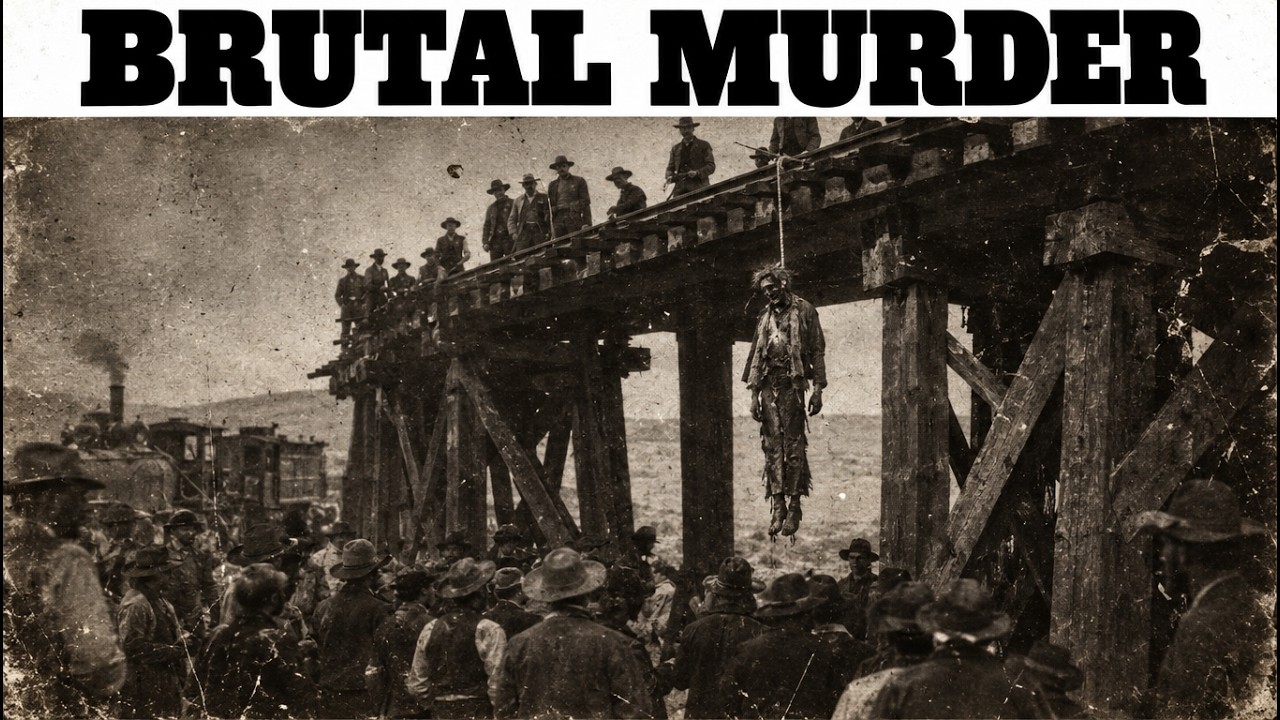
It is a significant fraction of everybody in Rollins. They tied his hands behind his back and put a noose around his neck and threw the rope over the crossbar of a telegraph pole—the same kind of pole they had used on Dutch Charlie. Then they stood him up on an empty kerosene barrel and kicked it out from under him. The rope broke.
He hit the ground alive. This is the detail that reframes the entire night. It is the moment where two hundred people had a choice, and you find out exactly what they were. George Parrot, on the ground with a broken rope around his neck, begged them to shoot him.
He was asking for the fast one. He knew what the slow one was. They said no. They put the noose back on him, and instead of the barrel they brought out a twelve-foot ladder and made him climb it himself.
The shackles he had filed off had been put back on his legs, repaired. So he had to climb twelve feet of ladder, hands bound, wearing iron, in front of two hundred people, to the place where they were going to kill him. He could not manage it properly. The accounts say the climbing was difficult.
When it was done, there was no drop and no broken neck. The Wyoming state record puts it plainly. He choked to death. The local paper ran the story under a headline that was, in its way, a joke: Gone Up Higher.
His body hung from a telegraph pole in Rollins, Wyoming, on the night of March 22nd, 1881. And nobody claimed it. No family, no friend, no church. Twenty thousand dollars of reward money had been attached to this man’s existence, and now that he was dead, not one person in North America stepped forward to say they wanted him buried.
That is the moment the story turns from a hanging into something with no real parallel in American history, because two doctors asked for the body, and they got it. The first was Dr. Thomas Maghee, a Union Pacific Railroad physician and surgeon. The second was Dr.
John Eugene Osborne. He was twenty-two years old. He had graduated from the University of Vermont’s medical school the year before and come out to Rollins to practice. Osborne had actually been at the lynching.
He had been asked to be present to confirm that the man was dead. The reason they gave for wanting the body was scientific. This was the era of criminal anthropology, the belief that criminality was a physical trait you could locate in the body—in the shape of a skull, the structure of a brain. If you could open up a murderer and look, you might find the thing that made him one.
That is the justification. Watch how much of what follows it actually explains. They made a plaster death mask of his face, a real medical and forensic practice of the period. They sawed the top of his skull off horizontally to get at the brain.
Maghee studied it. Also defensible under the stated theory. Then Maghee took that skull cap and gave it as a gift to his teenage medical assistant. Her name was Lillian Heath.
She was sixteen years old. She kept it. For the next sixty-nine years, the top of George Parrot’s head lived in Lillian Heath’s house, where she used it as an ashtray, a pen holder, and a doorstop. Now the science runs out entirely.
Osborne had the body skinned. Skin was taken from the chest. Skin was taken from the thighs. There is no theory of criminal anthropology that requires a man’s thighs.
The skin was shipped to a tannery in Denver. It went through the mail, and somebody on the receiving end in Denver processed it and sent it back. Nobody along that chain stopped it. From the skin of George Parrot’s body, that tannery made two things: a medical bag and a pair of shoes.
The accounts note that the piece used included the dead man’s nipples. Osborne is said to have asked the tannery to leave them on. They came back without them. The rest of the corpse—the bones, the lower half of the skull—went into a whiskey barrel filled with salt solution and sat there for about a year while the two doctors continued working on it.
Then the barrel was buried in the yard behind Maghee’s office. That yard is the lot at Fifth and Cedar. That is the barrel the construction crew found in 1950. Now follow the shoes, because this is where the story stops being about an outlaw and starts being about the town.
John Eugene Osborne kept them, and his life did not suffer for it. It accelerated. He became mayor of Rollins. He went into the sheep business and became wealthy.
He went into politics. And in 1893, John Eugene Osborne was sworn in as the third governor of the state of Wyoming, the first Democrat ever elected to that office. He went to his inaugural ball. And he wore the shoes.
He danced in the state capital in front of Wyoming society in footwear made out of a human being. The story that comes down to us is not that anyone objected. It is that people wanted to see them. Osborne’s career kept going.
He served a term in the United States House of Representatives from 1897 to 1899. And in 1913, President Woodrow Wilson appointed him first assistant secretary of state of the United States, a senior position in the federal government that he held until the middle of the First World War. A man who had a human being skinned and made into shoes went on to represent the United States of America in its foreign affairs. And he was not hiding.
Osborne became chairman of the board of the Rollins National Bank, and he put the shoes in a glass case in the front lobby of that bank, along with the death mask. For decades, if you walked into a bank in Rollins, Wyoming to cash a check, they were right there. One man whose recollection made it into the historical record remembered going into that bank as a child with his father, and Dr. Osborne himself coming over to them, showing the boy the shoes, explaining that the skin came from Big-Nose George’s back, and telling him the whole story.
A governor of Wyoming personally telling a child about the shoes. That is not shame. That is not a secret. That is a town that had decided this was a civic attraction.
In 1928, Osborne signed a formal statement authenticating the shackles from the hanging so they could be donated to the Union Pacific Railroad. He was still curating the collection forty-seven years later. Meanwhile, Lillian Heath’s life went in a direction nobody in 1881 would have predicted. The sixteen-year-old girl handed a piece of a man’s head went to medical school in 1893, the same year Osborne wore the shoes to his ball.
She earned her medical degree. She became the first licensed female physician in the state of Wyoming and one of the first in the American West. She practiced for decades in a town and an era that did not want a woman doing it. In the early years, she sometimes dressed in men’s clothing on night calls, and she carried a gun.
She was by any measure a pioneer. And she kept the skull cap on her shelf the entire time. Both of those things are true about the same person. The decades passed, and the strangest thing about this entire case happened.
Rollins forgot. Osborne died in 1943. The people who had stood in that crowd got old and died. The shoes were still in the bank, but the man in the ground behind the old doctor’s office stopped being anything anyone thought about until May 11th, 1950.
Fifth and Cedar. A shovel hits a whiskey barrel. Bones, a skull with the top sawn off, a bottle of vegetable compound, and a pair of shoes in the barrel with him. And somebody in Rollins remembered that there was an old woman across town who had the rest of the skull.
Lillian Heath was in her eighties. They contacted her, and her skull cap was brought to the scene. They set it onto the skull from the barrel. It fit exactly—sixty-nine years.
Two halves of one man’s head, separated when she was sixteen, matched back together while she was in her eighties, by the woman who had been given the piece as a gift. There is a photograph from 1950 of the two halves reunited. Standing with the skull are Ben Sturgis, the Carbon County coroner, and Lou Nelson, Lillian Heath’s husband. The story went national.
Time magazine ran it that May. And then they split the skull up again. That is not a metaphor. They put the halves back in separate places, and they are still in separate places today.
The top of George Parrot’s skull, Lillian Heath’s ashtray, is at the Union Pacific Railroad Museum in Council Bluffs, Iowa, with the shackles he filed through with a pocketknife. The bottom half of the skull is at the Carbon County Museum in Rollins, along with the death mask, which is missing its ears. The museum also has the shoes George Parrot himself was wearing on the night he was hanged, and the jail register, and the gold watch the town gave Rosa Rankin for stopping his escape. And in a case in that same museum are the other shoes.
Osborne’s. Still there. Still on permanent display, as they have been in one building or another in that town for more than a century. In 1995, the case finally got real science applied to it.
A forensic anthropologist named George Gill, with Wyoming state archaeologist Mark Miller and a graduate student named Christy McManus, examined the remains as part of a study on frontier violence. They confirmed the leather on the shoes was human skin. But Gill wanted to do the thing that would actually close the case: chemically match the skin on the shoes to the skin still clinging to the skull cap, and prove beyond argument that the shoes and the bones are the same man. They did not do it, because the test would destroy the sample, and there is very little sample left.
And there is the deeper problem. To find living relatives and match DNA, you have to know who you are looking for. And nobody knows whether this man was George Parrot of Montbéliard, France, or George Francis Warden of Dayton, Ohio, or somebody else who never gave a real name to anybody. Over the years, people from across the United States and Canada have contacted the museum and the archaeologists believing they might be related to him.
There has been no match. There may never be one. Which leaves the last loose end. They made two things out of him in that Denver tannery: a pair of shoes and a medical bag.
The shoes are in a museum. The medical bag has never been found. It was made. It existed.
It was presumably carried by a doctor on house calls in Wyoming, into the homes of sick people, for years. And then it left the record entirely. As far as anyone knows, it is still out there—in an attic, in an antique shop, in an estate sale, in a box in somebody’s basement. A leather bag that nobody would look at twice.
Go back to the beginning, because now you can see the whole shape of it. On May 11th, 1950, a construction crew found a whiskey barrel at Fifth and Cedar in Rollins, Wyoming. Inside were the bones of a man whose name nobody can verify, with the top of his head sawn off, buried in the backyard of a doctor’s office in the middle of town, with a pair of shoes made from his own thighs sitting in the barrel beside him. And the town’s response was not horror.
It was recognition. They knew exactly who to call. George Parrot murdered two men in a canyon. He was caught, and Carbon County gave him a real trial with a real jury, and a judge sentenced him to a lawful hanging eleven days in the future.
Then two hundred of the town’s citizens decided eleven days was too long to wait and took him off the legal system’s hands. When the rope broke and the man on the ground begged them for a bullet, they told him no, and made him climb a ladder in leg irons instead. The doctor who stood there confirming the death took the body home, had it skinned, wore the result to a governor’s ball, put it in a bank lobby, and showed it to children for forty years, and went to Washington to help run the foreign policy of the United States. Not one of them was ever charged with anything.
The sawn skull is in two states. The death mask has no ears. The bag is missing. The name on the grave may not be his name.
And the two lawmen who started all of this—Robert Widdowfield, who knelt down and felt warm ashes, and Tip Vincent, who almost made it out of the canyon—Widdowfield has a marble obelisk over him in the Carbon Cemetery. They are the only people in this entire story who got a normal ending. Everybody else is in pieces, in different buildings, in different states, more than 140 years later.
And somewhere, in a box nobody has opened, there is still a medical bag made of human skin, waiting to be recognized.
