On the morning of September 8, 1900, Isaac Cline, the man in charge of the weather office in Galveston, Texas, saddled his horse and rode down to the beach to watch the water. Within a single day, the sea he was watching would kill at least six thousand of his neighbors, and by some counts as many as twelve thousand. It would leave the wealthiest city in Texas lying broken on a sandbar that stood barely eight feet above the waves. The storm had been no secret.
In the final days of August, a dangerous system was already crossing the Caribbean, and some of the finest hurricane forecasters in the world were tracking it at the Belén Observatory in Havana, run by Jesuit priests. The Cuban meteorologists read the sky correctly. They believed a great storm was building and turning toward the Gulf of Mexico. But their warnings were never allowed to reach the people who needed them.
Willis Moore, chief of the United States Weather Bureau in Washington, did not trust the Cuban forecasters in the bitter aftermath of the war with Spain, and he did not want the American public listening to them. He ordered their reports blocked from the telegraph lines and cut the direct line between the Havana office and New Orleans, forcing all reporting to go through Washington alone. The Cubans were even discouraged from using the word hurricane, for fear of causing panic. The most accurate warning on Earth was smothered by pride, and the storm came on toward Texas in near silence.
To understand the scale of the loss, one must understand what Galveston was in 1900. It was not a sleepy town. It was the largest city in Texas and one of the busiest ports in the country, the place through which the cotton of the American South poured out to the world. Men called it the Wall Street of the South.
It had electric streetcars, an opera house, telephones, and gas-lit mansions, and more millionaires per capita than almost anywhere in the nation. And all of it, every wharf and every ballroom, was built on a low barrier island of sand. The highest natural ground in the entire city stood less than nine feet above sea level, and most streets lay lower still. There was no seawall, and there never had been, because no one believed one was needed.
Isaac Cline had said as much in print, arguing that the long, shallow slope of the seafloor off the Texas coast would drag the power out of any great storm and break it apart before it reached the beach. On the most important question of his life, he was completely wrong. That Saturday, heavy swells rolled in under an odd brassy sky, and the water began climbing into the streets while the wind was still merely strong. Cline rode his horse along the beachfront, telling families to move back from the water, though on that flat island there was nowhere truly high to send them.
Then the storm arrived, and the wind rose past anything the instruments could record. Gusts are believed to have passed 120 miles per hour before the gauges were torn from the roof of the weather office. The barometer fell to among the lowest readings ever seen in the country, and the wind drove the sea across the island in a single rising wall of water. The Gulf on one side and the bay on the other met in the middle of the city, and Galveston simply disappeared beneath the sea.
The storm surge rose more than fifteen feet over an island whose highest point stood under nine. Whole rows of houses were lifted off their foundations and shoved inland, collapsing into a churning mass of broken lumber that rolled across the city like a grindstone. Almost everyone caught in the open water was crushed inside it. Isaac Cline’s own home was large and strongly built, and dozens of neighbors had crowded in, believing it would hold.
In the dark of night, it broke apart. His wife, Cora, who was carrying their fourth child, drowned in the wreck. His brother Joseph dragged Isaac and his three daughters out of the ruin, and the five of them clung to a floating section of wall and rode it through the storm, turning their backs to the wind to shield the children from flying timber. A different group did not survive.
At the far western edge of town stood St. Mary’s Orphan Asylum, run by the Sisters of Charity. Inside that night were ten sisters and about ninety children. As the water rose into the dormitories, the sisters tied lengths of clothesline around their own waists and bound six, seven, eight children to each of themselves, so that whatever came, the little ones would not be swept away alone.
When the buildings finally gave way, the ropes that were meant to save them held them together in death. Ten sisters and every child but three were lost. Only three boys came through the night alive, found the next day clinging to a floating tree. When the sun rose on Sunday, the survivors walked out into a city that no longer existed.
Where streets had been, there were now long ridges of shattered wood packed solid with the dead. No one has ever counted them exactly. The most careful estimates place the dead between six and twelve thousand people, with the figure most often repeated around eight thousand. Whatever the true count, it remains the deadliest natural disaster in the history of the United States.
The bodies were so many that ordinary burial was impossible. They were first carried out to sea and dropped, and when the tide brought them back to the beaches, the living were forced to burn them on great funeral pyres that smoked over the ruined city for weeks. For a full day, the rest of the country did not even know. The storm had torn down every telegraph wire and every bridge to the mainland.
A small party of survivors finally crossed the bay by boat, found a working telegraph on the mainland, and sent out a message almost too large to be believed. Help began to move toward Galveston. Looting spread through the wreckage, and by the middle of that week martial law was declared and the Texas militia patrolled the ruins with rifles. Into that chaos came Clara Barton, the founder of the American Red Cross, nearly eighty years old, traveling to Galveston in person with supplies, money, and workers, directing the relief herself.
It would prove to be the last field mission of her long life. Then came the argument that most towns would have accepted. Serious, respectable voices urged the only sane course: abandon Galveston altogether, move the port and the remaining people to the safe mainland, and leave the sandbar to the sea. The logic was hard to answer.
The place had shown exactly what it was, and everyone knew it would flood again. The people of Galveston chose to stay and fight the Gulf instead. Before a single wall was raised, they did something quietly radical. A group of leading businessmen, calling themselves the Deep Water Committee, concluded that the old mayor and council could never organize a recovery on the required scale.
They pushed through an entirely new form of city government: a small board of appointed commissioners, each responsible for a single department of the rebuilding. It was called the Galveston Plan, and it worked so plainly that hundreds of cities across the United States would copy it in the years to come. Out of the worst disaster in American history, the survivors invented a new way to run an American city. But that was only the organizing.
The real work was physical. The county brought in three engineers: retired Brigadier General Henry Martyn Robert, the author of Robert’s Rules of Order, who had spent his life bringing order to unruly rooms and was now asked to bring order to the Gulf of Mexico itself; Alfred Noble, one of the most respected civil engineers in America; and H. C. Ripley, a local engineer who knew every foot of the island.
In January 1902, they delivered their report, calling for two enormous works that had to be done together. The first was a seawall. A flat wall takes the full punch of a wave head-on and loses over time. The wall the engineers drew was curved, a concave face of solid concrete that leaned back toward the land, catching a charging wave, turning it upward, and throwing it back on itself out toward the sea.
It stood seventeen feet above low tide, sixteen feet thick at its base, tapering as it rose. In front of it lay a wide apron of heavy granite boulders called riprap to break the sea before it touched the concrete and to keep the water from scooping out the foundation. The build drove deep rows of timber piling far down into the island so the sea could never undermine the base. Work began in the autumn of 1902, and the first stretch, more than three miles along the Gulf, was finished in the summer of 1904.
The county pledged its own credit to pay for it, borrowing against the future of a city that outsiders had already written off for dead. The three engineers understood that a wall on the beach is useless if the land behind it still lies only a few feet above the sea. Water would flow around the ends of the wall or seep up through the low ground behind it, and the city would drown from the back while its fine new wall stood uselessly out front. The land itself had to be lifted.
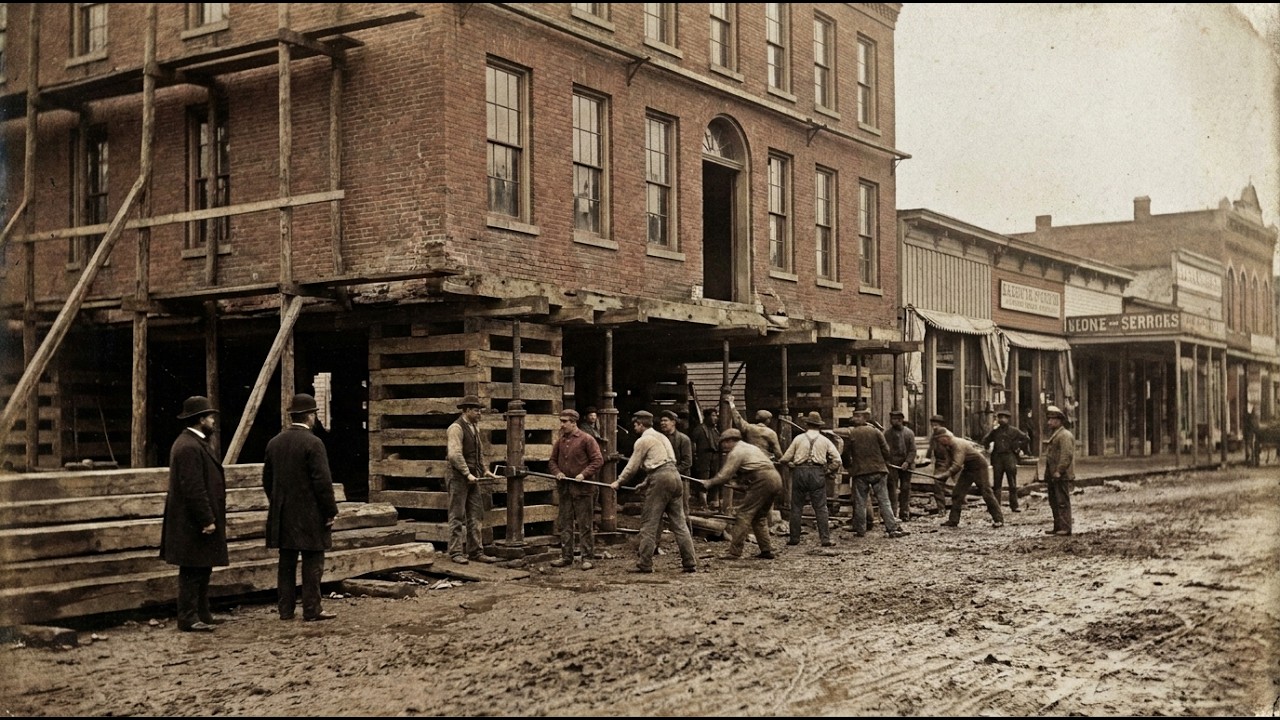
The entire city had to be raised, not flat, but tilted, standing highest against the new seawall at the full seventeen feet and sloping gently down toward the bay, so that water would always run away from the people instead of gathering around them. It would also give the city real drainage and sanitation for the first time. They were going to raise the ground beneath an entire living city. Not a building, not a block, but some five hundred city blocks, every street, house, church, shop, water main, gas pipe, and streetcar rail across the developed half of the island, lifted and packed underneath with new earth while the people went on living and working there the whole time.
Nothing on that scale had ever been attempted. The tool that did the actual lifting was a jack screw, a threaded iron post that raises a heavy load a small fraction of an inch with each turn of its handle, driven by nothing but a human arm. The engineers divided the city into sections about a quarter mile square, raised an earthen dike around each, and then jacked every structure off its foundation. About 2,146 buildings were lifted in exactly this way, turned by patient, by hand.
People did not move out. They lived in their houses while they climbed slowly into the sky on a forest of iron screws, climbing ladders to reach front doors that hung several feet above the yard. Shops stayed open. Wooden catwalks were laid across the raw wet fill so customers could reach the stores.
For months at a stretch, entire neighborhoods went about their ordinary lives, suspended in the air above their own rising ground. The most famous lift was St. Patrick’s Church, a massive brick building weighing some three thousand tons, raised a full five feet on seven hundred jack screws. They did not close the church while they lifted it.
Mass was celebrated every Sunday on schedule while the sanctuary rose slowly beneath the feet of the kneeling congregation. The fill came from the bottom of the sea. The project swallowed more than sixteen million cubic yards of sand, spread across those five hundred blocks anywhere from a few inches thick at the bayside to as much as eleven feet deep against the seawall. Dredges tore the sand from the floor of the ship channel, and a canal was cut straight through the living city, twenty feet deep and two hundred feet wide, running two and a half miles inland.
Four great hopper dredges pumped the slurry through pipes into the diked sections, where it settled, drained, and left new, higher ground behind. The crews lifted the streetcar tracks, the water mains, the gas lines, the sewers, the fire hydrants. Where families cared enough, the very trees and gardens were dug up, held aside, and replanted on the new grade. It went on for eight years, from 1903 to 1911, section by dike section, quarter mile by quarter mile, while knowing they were racing the next hurricane, which might arrive any season and find the work only half finished.
The men who turned those screws are almost entirely nameless today. The names of the three engineers are remembered, and they should be. But the true labor, the endless turning of handles under the dead weight of a house, the digging of the dikes, the running of the dredges, the hauling of the fill, was done by thousands of workers whose names appear in no book at all. They did not stop at the wall and the raised grade.
Between 1909 and 1912, they built the Galveston Causeway, a long, solid, all-weather crossing carrying both railroads and automobiles over the bay, so the island could no longer be completely cut off when the water rose. Its rolling lift drawbridge was, when finished, the largest of its kind in the world. Then the sea came back to test it. In August 1915, a hurricane struck Galveston that was by many honest measures as powerful as the storm that had destroyed the city fifteen years before.
The same island, the same Gulf, the same kind of monster. But the island was not the same. The surge came in and struck the seawall and was turned back and thrown down exactly as the engineers had drawn it. The wall held.
The raised grade shed the water away toward the bay. The storm of 1915, of nearly equal fury, killed only a small fraction of that number. The distance between those two death tolls was the exact measure of what all that hand labor had bought. And yet the fight did not restore everything.
Galveston had been the great port of Texas, but after 1900 no one wanted to stake the future of a shipping empire on a sandbar lying in the path of the Gulf. Investors turned their eyes inland to a bayou town some fifty miles up the coast and poured their money into digging a deep channel that would let ocean ships reach it in safety. That town was Houston. Its ship channel opened in 1914, and within a few years Houston had passed Galveston to become the leading port in Texas and in time one of the busiest in the world.
The storm did not only kill thousands of people; it quietly shifted the center of gravity of an entire state, and Galveston never ruled the coast again. There was another lesson, written in the silenced warnings from Cuba. The decision in Washington to suppress the forecasts from the Belén Observatory had helped fill the funeral pyres. In the years that followed, the way America watched the tropics and warned its own coasts slowly began to change, because eight thousand graves had shown what happens when a warning is buried for the sake of pride.
Isaac Cline, the forecaster who once called the danger absurd, was not destroyed by the storm, though it took his wife and his certainty both. In 1901 he moved with the weather office to New Orleans and spent thirty-four years as the leading forecaster of the Gulf Coast, becoming one of the foremost authorities on tropical storms in the country. The man who got it so terribly wrong spent the rest of his life trying to make certain the next city would get its warning in time. The Galveston Seawall still runs along the Gulf, extended over the years to about ten miles in length, one of the longest continuous sidewalks in the country.
The city behind it still rests on the ground those crews raised, still sloping quietly down toward the bay, exactly as three engineers drew it in 1902. The form of government they invented in their grief spread to hundreds of American cities. The wall has stood against storm after storm in the century since, and it is standing yet. The seawall and the grade raising together were named a national landmark of American civil engineering, honored among the greatest works this country has ever built.
Nearly all of them were accomplished with machines. This one, at the level that truly mattered, was accomplished by hand.
