The wind did not let up for three days. In February 1864, somewhere in the high desert west of what is now Albuquerque, New Mexico, a column of people walked east through snow that reached their knees in hollows and their waists in drifts. They called themselves Diné—”the People. ” The outside world borrowed a word from the Tiwa language and called them Navajo.
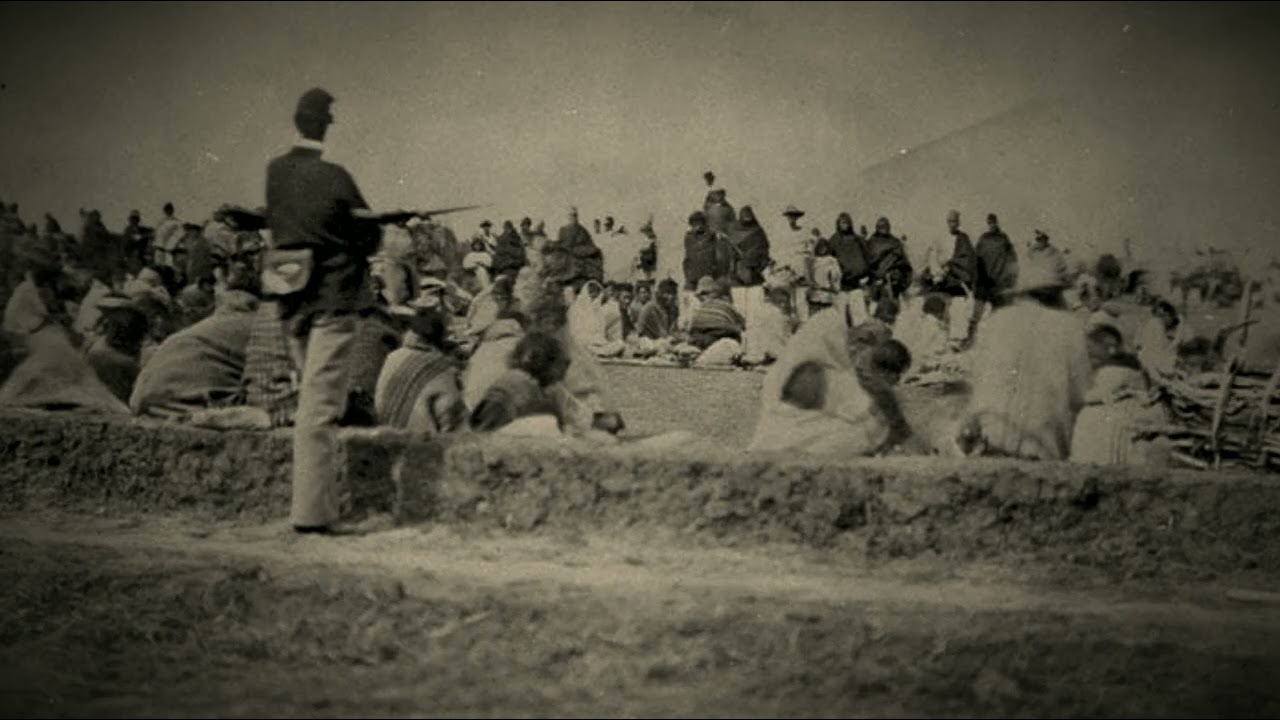
That morning, more than two thousand people walked east, with United States Army soldiers riding behind, beside, and ahead of them. None of them knew where they were being taken, how long the journey would last, or whether the soldiers themselves even knew. An old man walked at the rear of the column, his name never recorded. He is known to have existed only because a captain in the First New Mexico Volunteer Infantry wrote a report weeks later mentioning him briefly: an elderly man with gray hair, a strip of red cloth tied around his head.
He walked beside his wife, who collapsed that morning. The captain used five words to describe what happened next. Those five words matter, but not yet. Most of what people believe about the Long Walk of 1864 comes from textbooks, which give the size of the army and the date of the treaty and little else.
They do not describe the snow on bare feet, nor what a man wrote by candlelight in a stone fort in New Mexico Territory when he was certain no one in the East would ever read it. People did read it eventually, and the letters tell a different story from the one in the books. The letters are scattered across six archives—the National Archives in Washington, the William A. Keleher Papers at the University of New Mexico, the Samuel Tappan Papers at Yale.
In 1970, historian Lawrence Kelly gathered the most important ones into a single book titled Navajo Roundup. The men who carried out the campaign and the men who ordered it wrote down what they were doing, sometimes in plain English, sometimes in a cold tone that reads like a shopping list. They wrote about burning fields, slaughtering livestock, and cutting down trees. One of those officers, James Henry Carleton, a New Englander, wrote a sentence in 1863 that historians have debated for 150 years.
He wrote that severity—that was his word—would be the most humane course. That was the policy: severity disguised as kindness. The men in the field who read his orders by lamplight understood exactly what he meant. To understand how things reached that point, you have to go back before 1864, back centuries.
The Diné had lived on the land between the four sacred mountains so long that their creation stories began there: Blanca Peak to the east, Mount Taylor to the south, the San Francisco Peaks to the west, and to the north a mountain they called Dibé Nitsaa in what is now southwestern Colorado. Inside those mountains was their world. There, according to stories passed down by Diné grandmothers for generations, the people were given everything they needed: corn, and sheep that had come from the Spanish but that the Diné made entirely their own. There was wool and looms and peach trees that grew in the bottom of a canyon in northeastern Arizona, a canyon so deep the sun only touched its floor at noon.
They called it simply “the canyon. ” We know it by a Spanish corruption of that name, Canyon de Chelly. They were not always at peace with their neighbors. They raided the Pueblo villages along the Rio Grande, the Pueblos raided them, the Spanish raided everyone, the Comanche and Ute raided everyone, and there was a slave trade throughout that country for 250 years.
The Diné were on both sides of it. None of it was simple. Then a different kind of government arrived. The United States took the Southwest from Mexico in 1848, drew lines on maps that did not exist on the ground, and built forts—Fort Defiance in what is now eastern Arizona, Fort Wingate in what is now northwestern New Mexico—placed deliberately like chess pieces in the heart of Diné territory.
In 1849, a Diné leader named Narbona signed a treaty. Narbona was eighty years old. He was killed by an American soldier during the treaty negotiations, shot in the back while his back was turned. The soldiers cut a piece of his scalp and kept it as a souvenir.
The surgeon who attended the treaty meeting recorded it in his journal. The Diné who watched did not forget. Violence between the Diné and the Americans escalated and subsided for fourteen years. Raids happened, reprisals followed, treaties were broken.
Then in the fall of 1862, in the middle of the Civil War, Brigadier General James Henry Carleton arrived in Santa Fe to take command of the Department of New Mexico. Carleton was an odd figure. He had been a man of influence—he wrote a book about a meteor shower and served in the Mexican War—and he saw himself as a thinker, a planner, a visionary. He arrived convinced that the so-called Indian problem in the Southwest could be solved with one bold move, and that he was the man to make it.
He chose a place: a flat, treeless stretch along the Pecos River in eastern New Mexico, where the water tasted alkaline, the soil would not hold a plow, and the wind blew constantly from west Texas. He called it Bosque Redondo, “round grove,” after a small stand of cottonwoods on the riverbank. He had visited it once in 1854 with a survey party, and something about the place stuck with him. He decided to make it a reservation, a model reservation.
He would gather the Mescalero Apache and the Diné there, force them to farm, force them to live in adobe houses, force them to speak English, force them to give up, as he put it in one letter, everything they cherished of their former life. He truly believed this was kindness itself. That is the hardest part of reading his correspondence. He did not consider himself cruel; he considered himself practical.
His instrument was a 53-year-old colonel named Christopher Houston Carson, known to most of the country as Kit Carson. After the campaign, the Diné called him Pe-a-whitche, “Red Shirt. ” Carson was a mountain man, a guide for John C. Frémont.
He had married three times, twice to Native women, and he hosted Apache, Cheyenne, and Arapaho in his home. He spoke at least four languages. He could not read or write, so he dictated his letters to a clerk. By the standards of his time, he was not a man of simple feelings toward Native people.
Yet when Carleton ordered him in the spring of 1863 to round up an entire people and march them three hundred miles to a place none of them had ever heard of, Carson did not refuse. He delayed, grumbled privately, raised concerns about supplies and season, and then carried out the order. The strategy, codified on June 15, 1863, in a document filed at department headquarters as General Orders No. 15, was simple, brutal, and effective.
Carson did not intend to chase the Diné and fight them in battle. He attacked their food sources instead. He burned their cornfields, scattered or killed their sheep—the foundation of their entire economy—cut down their peach trees, and set fire to their hogans. He did this in fall and winter, the seasons when the Diné had the least time to plant or rebuild.
Ute men, who had a long history of conflict with the Diné and a longer history of raiding their families, were brought in as scouts and promised the right to keep any livestock they captured. In September 1863, Carson asked Carleton whether the scouts could keep Diné captives as slaves. Carleton refused, to his credit, saying such practice was against government policy. It was one of only two direct orders he gave Carson during the entire campaign.
Read that sentence again. During an eighteen-month military operation affecting the lives of more than ten thousand people, Carleton sent his field commander two specific instructions. The rest Carson improvised as he went. By the end of 1863, Carson had moved his troops into Diné country.
He marched through villages whose inhabitants had already fled. He found cornfields full of dried stores and set them on fire. By his own count, reported in a letter to Carleton dated October of that year, he destroyed more than two million pounds of grain. Two million pounds.
That was the food an entire nation had counted on for winter. He slaughtered sheep he had no need of for meat. His Ute scouts captured women whose families had been killed before their eyes. In one of the most striking letters of the entire collection, Carson wrote that the Diné he was seeing were “perfectly destitute, almost naked,” and that had it not been for the unusual growth of piñon nuts that year, they would have had no food at all.
In the same letter he noted that the Diné were not lighting fires for warmth, afraid their smoke would be seen by his scouts. Imagine that: January cold in northern Arizona, at elevations above six thousand feet, temperatures below freezing, and a people who preferred to freeze rather than risk being found. Then came Canyon de Chelly. This is the part of the story the textbooks usually leave out, and the part the letters describe in the most detail.
The canyon was the spiritual heart of Diné country, where rock walls rise a thousand feet straight up, where ancestral dwellings carved into the cliffs still stand in their recesses, where peach trees brought from Spanish orchards 150 years earlier grew along the canyon floor, trees that sons had tended for six generations. Carson was ordered to enter the canyon but resisted, writing that taking an army into Canyon de Chelly in winter would be reckless, that his men would be exposed, that the Diné might rain rocks and arrows down on them from above. He was right. Carleton would not budge.
On January 6, 1864, Carson left with 375 soldiers and entered the canyon. The journey took about a week. They found no great battle. They found something worse: starving people, people coming out of the cliffs with their hands raised, people saying through interpreters that they had run out of food and had no strength left to fight.
And they found the peach trees. On January 14, 1864, Carson’s clerk recorded a passage that survives in the official records. Three Diné men approached the camp under a flag of truce. Through an interpreter, they said they wanted to surrender, that they wanted to bring in their people.
Carson told them they had until ten o’clock the next morning. After that, the destruction would resume. The next morning, before the hour had passed, sixty more Diné men came into camp. By March, about five thousand people had surrendered.
Most surrendered because their last food was gone and the cold nights were killing the old people. The peach trees were cut down, thousands of trees in the Canyon de Chelly floor, mostly by Carson’s men in January and February. The rest, more than three thousand mature trees, were cut by Captain John Thompson of the First New Mexico Cavalry in August 1864, after Carson had returned home to Taos. We know the number because Thompson recorded it in his report.
He enumerated them like items in an inventory. Three thousand mature peach trees destroyed. The soldiers, when they talk among themselves about that time, have a phrase: “when everything turned against them. ” It is hard to translate precisely.
Plants, animals, weather, soldiers, machines—everything turned against them, even the seasons. By early spring 1864, more than six thousand Diné had gathered at Fort Canby and Fort Wingate, waiting for the march east. Carleton had planned for half that number. He had not stockpiled enough food.
He had not prepared enough wagons. According to quartermaster reports, he allocated eight days of rations for the journey. In fact, the march would take, depending on the route and the group, between eighteen and forty days. The math was wrong, and the army knew it—and they sent the people anyway.
There were at least four separate routes. Between August 1863 and the end of 1866, 53 separate forced marches occurred, some involving small groups of a few dozen people. The largest single march, in March 1864, involved about 2,400 people covering 350 miles in the worst weather of the year. The first leader to bring his group in under force was a man named Delgadito, who brought 187 people to Fort Wingate in late 1863.
Carson had promised him in writing that if he surrendered, he would be allowed to return home in peace. Carson was not lying; he believed it. But what Carson believed and what Carleton planned were two different things. Delgadito returned to Diné country carrying Carson’s promise, clinging to it.
He came back in late January 1864 with 680 more of his people, only then learning that they would not go home. They would go to a place they had never heard of: Hwéeldi. Although Hwéeldi is the Diné word for Bosque Redondo, it is not exactly a translation. It carries the weight of a place where people suffer, a place that takes everything.
Even today, 150 years later, the word is rarely spoken aloud without preparation. The army records, in neat columns and military ledgers, recorded the deaths of about 336 Diné during the various marches. That is the official number, written by Carleton in a letter to General Lorenzo Thomas in Washington as proof that the campaign was run humanely. Historians today, reviewing the records and comparing the number of people who surrendered at Fort Canby with the number who arrived at Bosque Redondo, estimate that about two thousand Diné who began the march did not finish it.
The army’s own records are off by a factor of six. The Diné oral histories, passed down through generations and collected in 1973 in a book called Navajo Stories of the Long Walk Period, contain accounts the army records never captured: soldiers who would not let the column stop when an elder collapsed, people left where they fell, and what sometimes happened to the wives of men who tried to defend them. A Diné man named John Dah testified in 1951 before the Indian Claims Commission that the soldiers did not respect the women, and that when a Diné man tried to protect his wife, the soldiers shot him. He said this not as an accusation but as testimony, because someone had finally asked.
Then there are those five words from the captain’s letter, about the man at the rear of the column whose wife had collapsed in the snow. The letter survives in a private collection in Albuquerque. The five words are: “he would not leave her. ” Four short clauses.
Then the captain continued in the next sentence to say the column kept moving. He did not record what happened. I read that letter three times trying to understand what the captain meant. I am still not certain, but I think the silence is the point.
By late spring 1864, the first large groups of Diné arrived at Bosque Redondo. They climbed over low buildings on the west bank of the Pecos and looked at where they would live. It was a plain. No mountains.
No trees except a thin row of cottonwoods along the riverbank, which gave the place its Spanish name. The river itself carried alkaline water that made anyone who drank too much of it sick. The wind blew constantly. The summer heat was unlike anything in their homeland desert.
The winter, when it came, was cold as the eastern plains, dry and harsh, softened by no terrain. The army built a square fort nearby and named it Fort Sumner after a war hero of an earlier generation. When the Diné saw the place, they did something that survives in three separate accounts. They sat down.
They sat on the dirt and cried. Then they got up, because they had no other choice. For four years, between 1864 and 1868, the Diné lived at Bosque Redondo as captives. At its peak, in November 1864, about 8,500 Diné were held there along with about 400 Mescalero Apache.
The Mescalero and the Diné had been enemies for generations. Carleton put both groups in one camp without consulting either. They avoided one another when they could and fought when they could not. In a daring move the Diné did not make, the Mescalero escaped en masse on the night of November 3, 1865.
All 400 slipped away into the darkness and vanished into the mountains to the west. The army never recaptured them. The Diné, for reasons of geography, numbers, and exhaustion, could not do the same. Life in the camp was grim.
The river water caused what army surgeons called “bloody flux”—dysentery—which killed hundreds in the first eighteen months. Crops failed. A cutworm the soldiers had never seen consumed the corn. The wheat crop of the second year did slightly better, but the soil was thin and the rain did not come.
The Comanche, who lived to the east, raided the Diné sheep herds regularly. There was not enough firewood. The Diné, promised fuel, ended up pulling up yucca roots and sometimes carrying them for miles on their backs. They built irrigation canals with their bare hands, more than one hundred miles of them; the traces are still visible.
Still the crops failed. By 1866, most of the food at Bosque Redondo was government rations: salt pork, hardtack, coffee the Diné did not know how to prepare, and flour that was sometimes wormy and sometimes moldy. The army surgeon at the fort, a man named George, kept a diary now held at the National Library of Medicine. He wrote that the Diné he treated were “sinking into despair.
” Even the strongest men were losing weight; the women held up, but he saw what he called an emptiness in their eyes. The year 1865 was the most disastrous. By the end of that year, feeding and maintaining the camp cost about $1. 25 million—more than the entire Bureau of Indian Affairs budget for the rest of the United States.
General William Tecumseh Sherman, who would later become a central figure in this story, wrote a famous scathing letter to Carleton complaining that the United States government could not and would not sustain such extravagance. In another letter, to a general named John Rawlins, Sherman joked that it would be better to send his soldiers to a Fifth Avenue hotel in New York and lodge them there at government expense. A cruel joke from a man who had not yet seen the place. We will return to Sherman, because he eventually did see it, and what he saw broke something in him.
Meanwhile, in the country to the west, in the valleys and high mountains the army had not penetrated, between five hundred and a thousand Diné refused to surrender. They hid in places like Navajo Mountain, the lower reaches of the Grand Canyon, and the badlands along the San Juan River. The leader of the largest of these groups was a man named Manuelito, a war leader before the campaign began. By most accounts he was a serious man who disliked speeches, a man who fought out of tactical necessity rather than love of combat.
Carleton wanted him captured. The army sent Ute, Hopi, and Pueblo scouts after him. Some found him; most did not. Manuelito kept moving.
By 1866 he was sick. His group had shrunk through starvation and constant desertion. On September 1, 1866, Manuelito walked into Fort Wingate with the last 23 of his followers. He surrendered not because the army had defeated him but because he had run out of food.
He was sent to Bosque Redondo. His arrival marked the beginning of the end, not as a final defeat but because it gathered all the Diné leadership in one place. Manuelito and Barboncito, the medicine man and headman who had been in the camp since 1864, began to coordinate. There were others—Ganado Mucho, Herrera Grande, Largo—and that winter they began talking to one another about how to get home.
They sent letters, dictated to Spanish-speaking interpreters, up the chain of command. They demanded an investigation. They asked for someone from Washington to come and see for themselves. Again and again they asked for the right to return to the homeland between the four sacred mountains.
In Washington, the political climate was shifting. The Civil War was over. Senator James Doolittle, chairman of the Committee on Indian Affairs, was receiving reports from civilians, missionaries, and even some army officers that the Bosque Redondo experiment was going badly. He launched a congressional investigation.
The Doolittle Committee, as it became known, traveled the West and held hearings. Its findings, published in 1867, were damning. It concluded that Native populations throughout the West were declining in part due to wars and forced removals, and that the Bosque Redondo reservation in particular was a humanitarian disaster. The committee did not directly call for the camp to be closed—it lacked that authority—but it created the political conditions that made closure possible.
Carleton was relieved of command in April 1867 and sent back East. He never apologized. He died in 1873, believing he had done something difficult for a good reason. The Diné did not celebrate when they heard the news.
They had learned not to celebrate too soon. In the spring of 1868, two men arrived at Fort Sumner with a tent, a stenographer, and a mandate from Congress. One was General William Tecumseh Sherman. The other was Colonel Samuel Forster Tappan, a former journalist who had co-founded Colorado Territory and who was so disgusted by the Sand Creek Massacre four years earlier that he devoted the rest of his career to trying to repair the damage.
Sherman was the famous one; Tappan was the one for the job. They arrived on May 28, 1868, authorized by an act of Congress earlier that year to negotiate a new treaty with the Diné and decide the fate of Bosque Redondo once and for all. Sherman walked through the camp and saw what it had become. He saw men and women who had been there four years, who had buried, by the most conservative estimate, about two thousand of their people in unmarked graves along the river.
He saw fields that produced almost nothing. He saw rations being handed out at the storehouse as if to a defeated army. He later said the Diné were in the most abject poverty and utter despair. Sherman is one of the most controversial figures in American history, capable of terrible things and terrible words.
But what he saw at Bosque Redondo affected him deeply. For three days, May 28, 29, and 30, he sat in a tent outside the fort, with notebooks and recorders capturing everything, and tried to decide what to do. The minutes of those three days survive, and they are among the most remarkable documents in Native American history. On the first day, Sherman opened.
He spoke first because he was Sherman and because protocol demanded it. Through interpreters, he said the commissioners had come to find out everything about the Diné situation, that they wanted to hear the whole truth, that the Diné had been at war with the United States, that Carleton had brought them there to turn them into farmers, that the government had given them money and built the fort to protect them—and that now they found the Diné with no farms, no herds, living in as much poverty as they had four years earlier. He wanted to know what they had done in the past and what they thought of the reservation. Then he sat down, and Barboncito stood.
Barboncito was about 48 years old, a medicine man of the Coyote Pass clan, a short man of considerable presence. The interpreter that day was a young man named Jesús Arviso, 28 years old, a Mexican who had been captured by the Diné as a boy and raised among them. Arviso translated Diné into Spanish; another interpreter, James Sutherland, translated Spanish into English; the stenographer, a man named Ashton White, recorded everything in an old ledger the army no longer used for anything else. The pages of that ledger are now in the National Archives, written in ink faded almost to brown, but still legible.
Barboncito began with restraint. He did not raise his voice, did not make accusations. He simply started to tell what had happened. He said a sentence quoted by historians for 150 years: “The bringing us here has caused a great decrease of our numbers.
Many of us have died, and also our animals. ” He spoke of ruined crops, the salt water, the Comanche raids, the hard work without result. Then he said something Sherman was not prepared for. Barboncito said: “Our grandfathers had no idea of living in any other country but our own, and I do not think it right to do what we have been told to do.
When the Navajo were first created, the first woman pointed to four mountains and four rivers which would be our land. ” He named the mountains. He named the rivers. Then he said: “I hope to God you will not ask me to go to any other country but my own.
”
Sherman was taken aback. He later admitted he had come with a different plan—to offer the Diné a choice between staying at Bosque Redondo and moving to Indian Territory, the land that would become Oklahoma. It had not occurred to him that the Diné would refuse both options, that they would simply and clearly ask to go home. The negotiations lasted three days.
Barboncito did not back down. Manuelito, standing beside him, did not back down. The other headmen—Ganado Mucho, Largo, Herrero, Delgadito, Armiyo, Torivio—did not back down. At one point Sherman proposed, perhaps out of frustration, sending a delegation to see Indian Territory for themselves.
Barboncito refused. Sherman tried again in a different way. Barboncito refused again. Tappan, sitting beside Sherman, spoke little, but there is a small marginal note in the minutes indicating that at some point during the second day, Tappan leaned over and whispered something to Sherman.
We do not know what he said. We know what happened next: Sherman changed his mind. On June 1, 1868, in a tent on the plains of Bosque Redondo, 29 Diné headmen signed a treaty with the United States. Unable to write their names, they made their marks.
Sherman and Tappan signed on behalf of the United States. The treaty was written on a sheet torn from an army ledger because nothing else was available. Most of its provisions were modeled on the Treaty of Fort Laramie signed with the Lakota a few months earlier—routine articles about assimilation, reservations, rations, and railroads. But the crucial provision, the one the Diné had fought for since arriving at Hwéeldi four years earlier, was embedded in the treaty’s geography.
It allowed them to return home, though not completely. The reservation it created, about three and a half million acres on the border of what would become Arizona and New Mexico, was smaller than their original territory. It excluded some of their best land and did not include all four sacred mountains. But it touched their homeland, included Canyon de Chelly and the places where their ancestors were buried.
This was an acknowledgment, in a way the United States government had never done before and would never do again with such finality, that a previous policy had failed. The Diné had won. They remain the only Native nation in the era of removal allowed by treaty to return to their ancestral land after being forcibly removed from it. On June 18, 1868, the Diné began the Long Walk home.
About 7,200 people were at Bosque Redondo then. The return journey took about a month and was, by all accounts, a different journey. They walked slowly. They were given a few wagons and promised goats and sheep to rebuild their herds.
They stopped to bury their dead, whom they carried with them in memory. And they sang. There is a song from that time, composed during the return march, that the Diné still sing today. Its English title is “I Am Going.
” It is a song of return. Its melody is gentle. Its words essentially say the singer is leaving, the singer is happy, and the singer is heading toward the place that had always been theirs. When the survivors crossed the Rio Grande and began to see the silhouette of Mount Taylor on the horizon to the west—one of the sacred mountains—many Diné accounts describe people falling to their knees.
They had not been certain, even on the way back, that they would see it again. They had been told lies for four years: they would go home in the first year, then the second, then the third—and they had stopped believing. Then, in the heat of a July afternoon in New Mexico, the mountain rose from the horizon, and they knew home was still there. Home had been waiting.
The letters, in the end, reveal something. This is a country built on documents; we write things down and keep them even when we wish we had not. The same hand that signed General Orders No. 15, ordering the destruction of Diné property, also signed the reports that later admitted the cost of that destruction.
The same general who wrote that severity was the most humane course also wrote budget requests that proved the policy financially impossible. The same army that carried out the campaign kept a copy of the minutes in which Barboncito refused to be moved. The evidence was left behind—evidence of the worst behavior. And because it was left behind, the Diné, their descendants, and anyone who wants to know what actually happened can read it, sit with it, hold the faded paper in their hands in the reading rooms of the National Archives, the University of New Mexico, the University of Yale, and the Bosque Redondo Memorial.
There is a memorial at the Bosque Redondo site today, built in the 1970s after a young Diné student visited the site and said quietly that there was nothing of the Diné there. It is small: a circular arrangement of stones where visitors leave offerings—sometimes a stone from home, sometimes a feather. Once, a park superintendent told a journalist, a visitor left a Purple Heart, and no one knew whose it was. The Navajo Nation today numbers more than 390,000 people, and the Navajo Nation territory, established by the 1868 treaty and expanded since through a series of executive orders, covers more than 17 million acres across three states—the largest Native reservation in the United States.
The Navajo language, which Carleton wanted to ban and was certain would disappear within a generation under his policy, is now spoken by more than 170,000 people. And the peach trees cut down in Canyon de Chelly in August 1864 have grown back, slowly replanted over the following half-century. The orchard in the canyon floor today is not the same orchard the Diné had in 1863, but it is a peach orchard—and the trees are now old enough that the families who tend them say their grandmothers planted them. The chain is unbroken.
When you read all the letters in order, what stands out is not the cruelty of the policy, though the cruelty is there, and not the heroism of the resistance, though the resistance is there too. What stands out is the feeling that this story did not have to end the way it did; that at any moment between 1862 and 1868, another officer, another general, another president, another congressman could have stopped what was happening. They did not. And finally, after four years, approximately two thousand graves, and seventeen thousand pages of correspondence, a man in a tent on a hot day in late May listened to another man, listened to him fully, and changed his mind.
That is no small thing. In the end, that is what makes the Long Walk different from so many other stories of forced removal in nineteenth-century America—not because the policy was less cruel. The policy was cruel like the others.
But in the end, someone listened.
