The phone call came from a man named John Erskine, and Heather Tonkin had made the decision to record it. She had not expected a negotiation to turn into a threat, but as she listened to the voice on the other end of the line, she understood exactly where she stood. Erskine was Mark Phillips’s agent, the man who handled the business affairs of the Queen’s son-in-law, and he was not calling to offer sympathy. He was calling to warn her.
If she pressed for legal recognition of her daughter, he said, he would make life a bloody misery for her. When the story hit the fan, the machine would turn against her, and her daughter’s life would be ruined. Heather Tonkin was a sheep farmer’s daughter from New Zealand, a woman with no title, no money, and no army of lawyers. Mark Phillips was an Olympic gold medalist, a captain in the British army, and the husband of Princess Anne.
On paper, the power imbalance was absolute, and Erskine knew it. But he had made a miscalculation. He thought he was dealing with a woman who could be frightened into silence. He did not realize he was dealing with a mother who had decided she was done being afraid.
The threat ended the conspiracy of silence that had lasted five years. In early 1991, Heather Tonkin picked up the phone and called the Daily Express, and the story that had been buried in a hotel cupboard in Auckland exploded into the British public’s consciousness. The roots of that explosion reached back to the mid-1980s, to a royal marriage that was dying a slow, suffocating death. Princess Anne had married Captain Mark Phillips in 1973, and on paper, the match had seemed perfect.
They were the golden couple of the equestrian world, both Olympians, both fearless riders, both seemingly allergic to the fuss and frippery of court life. The public expected them to ride off into the sunset and live happily ever after at Gatcombe Park, the Gloucestershire estate the Queen had bought for them. But behind those closed doors, the silence was deafening. The marriage had been built on a shared hobby, not a shared soul.
Once the riding boots came off, they had little to say to each other. Mark was a commoner, an army officer with a solid pedigree but no title, and no intellectual spark that interested the royals. In the sharp-tongued ecosystem of the royal family, he was an outsider, reportedly nicknamed “Foggy” by insiders who found him dull. Prince Charles, a man who prided himself on his philosophical musings, reportedly treated his brother-in-law with barely concealed disdain.
By 1983, the marriage was effectively over in all but name, and Mark Phillips found himself in a gilded cage, a man stripped of purpose. He had left the army to support Anne, and in doing so, he had become merely Mr. Anne, a prop in her life, walking two steps behind her, holding her flowers, enduring the silent judgment of her family. It is a dangerous thing to make a man feel small, especially a man used to commanding a cavalry regiment and winning Olympic gold.
In 1984, seeking an escape from the icy atmosphere of Gatcombe Park, Captain Phillips accepted an invitation to conduct a series of equestrian clinics in New Zealand. For him, it was a sanctuary, as far away from Buckingham Palace as one could physically get on Earth. There he was not Foggy. He was Captain Phillips, the gold medalist, the expert, the man in charge.
He boarded the plane to Auckland as a royal husband escaping a wife who no longer looked at him with affection. He would return as a man carrying a secret that would eventually detonate under the monarchy. Heather Tonkin was not the stereotypical other woman. She was thirty-two years old, a mature, independent art teacher who came from a respectable hardworking family that owned a sheep farm.
She was grounded, pragmatic, and capable, traits she ironically shared with Princess Anne. She had signed up for the clinic for professional reasons, a serious rider eager to learn from a man of Mark Phillips’s caliber. She arrived in her riding gear, smelling of leather and horses, focused on the jumps, not the man. But the chemistry of loneliness is a powerful thing, and during the clinic, Mark Phillips noticed her.
Perhaps he saw the admiration he was missing at home, perhaps he liked her no-nonsense attitude, or perhaps he simply saw a woman who did not know he was Foggy, who saw him only as a strong, capable man. The attraction was mutual, and on one occasion, it crossed a line. According to later reporting repeated over the years, Felicity Tonkin was conceived during a brief encounter at an Auckland hotel. It was not a love affair of rose petals and champagne.
It was, by all accounts, a fumble in a cupboard, a detail that added a layer of gritty, humiliating realism to the story. There was no seduction, no promise of a future, just two people in a cramped dark space stealing a moment of intimacy that was never meant to be remembered. Mark Phillips zipped up his breeches, smoothed his hair, and flew back to Britain, assuming the incident would stay locked in that hotel room forever. But biology does not care about royal protocols.
A few weeks later, thousands of miles away, Heather Tonkin missed a period. It was 1985. She was single, she lived in a conservative rural community, and she was carrying the child of the Queen’s son-in-law. Her first instinct was not to run to the tabloids.
It was to tell the father. When she managed to get a message to Mark Phillips, his response was not panic, nor anger, nor denial. It was a chillingly pragmatic suggestion. She should have an abortion.
He reportedly told her, in a voice devoid of emotion, that he could not and would not be involved. He laid out the facts of his life: he lived in England, he had a reputation to uphold, he had a wife who was the daughter of the sovereign. A baby in New Zealand was a variable that did not fit into the equation of his existence. He offered to pay for the procedure.
He wanted the problem erased. For Heather, this was a moment of profound clarity. She realized the man she had admired was a coward. But she refused his offer.
She decided to proceed with the pregnancy alone, fully aware that she was embarking on a path of immense difficulty. On August 8, 1985, Felicity Tonkin was born in a hospital in Auckland. At that same moment, Zara Phillips was four years old, the darling of the British press, photographed on ponies at Windsor Great Park, her golden hair shining in the sun, surrounded by doting grandparents and an army of nannies. Felicity entered the world in silence.
There were no royal salutes, no christening gifts from the palace. Mark Phillips did not call. He did not send flowers. He pretended, with a terrifying capacity for compartmentalization, that August 8th was just another day.
Heather took her daughter back to the family sheep farm and made a vow to protect this child and love her enough for two parents. But the secret had a life of its own. For five years, the story was held together not by love or fear, but by routine payments and the hope that distance would do the rest. To the outside world, Captain Mark Phillips was the respectable, if somewhat dull, husband of the Princess Royal.
But inside the accounts department of his business empire, a fiction was being written every month. Heather Tonkin, a woman who lived eleven thousand miles away and had likely not seen Mark Phillips since that fateful morning, was officially listed on his books as an equestrian consultant. The payments that trickled down to New Zealand, roughly six thousand pounds a year, were labeled as fees for advice on horses. It was a bureaucratic lie designed to sanitize a biological reality.
Every time Heather cashed one of those checks to buy school shoes or groceries for Felicity, she was accepting the premise that her daughter was not a person, but a business expense. As the 1990s approached, the payments became erratic. Some months they arrived, some months they did not. Heather watched the news from England and saw the headlines about the disintegration of Mark and Anne’s marriage.
She realized with a sickening clarity that once Mark Phillips was divorced, once he was no longer tethered to the royal purse, he could cut the line completely. She picked up the phone and called his agent, John Erskine, to ask for security. She was not asking for millions. She simply wanted Mark’s name on Felicity’s birth certificate, a simple act of legal recognition that would grant her daughter the rights of inheritance and identity.
What she got was the threat to make her life a bloody misery, and the warning that her daughter’s life would be ruined. Heather hung up the phone, looked at her five-year-old daughter, and decided she was done with being afraid. In early 1991, she contacted the Daily Express. The headline that morning did not whisper.
It screamed: exclusive: Mark Phillips secret love child. The story laid it all bare: the night in the cupboard, the abortion demand, the consultancy fees, the threats. For the British public, it was a shock. They had always viewed Mark Phillips as a bit dim, a bit boring, but fundamentally harmless.
Now he was revealed as a cad leading a double life, abandoning his own flesh and blood. For the royal family, it was a catastrophe. The war of the Waleses was already chipping away at the monarchy’s dignity, and now the Princess Royal’s husband was being dragged through the mud of a paternity scandal. Mark Phillips’s initial reaction was the oldest defense in the book: deny everything.
He gambled that New Zealand was too far away, that the public would see Heather as a fantasist, that his royal proximity would shield him. But Heather Tonkin had already filed a paternity suit in the High Court of New Zealand. This was no longer tabloid gossip. It was a legal cage fight.
And in 1991, the courts had a new weapon that no royal scandal had ever faced before: DNA profiling. The judge ordered a test. Mark Phillips was backed into a corner. If he refused, the court would rule against him by default.
If he took it and failed, he was exposed. He submitted the sample. When the results came back from the laboratory, there was no room for interpretation. The DNA test confirmed paternity.
The consultant was his lover. The business expense was his daughter. Captain Mark Phillips, the Olympic hero, was officially the father of three children: Peter, Zara, and Felicity. In a storybook, this is the moment of redemption.
The father flies to New Zealand, sees the little girl who looks just like him, falls to his knees, and makes amends. In the real world of the British aristocracy, he called his lawyers. Mark Phillips accepted the legal reality because he had no choice, but he entirely rejected the emotional one. He did not ask for a photograph.
He did not ask for a phone number. A settlement was negotiated, a cold hard transaction. Mark Phillips agreed to pay a lump sum to Heather Tonkin, reported to be around three hundred fifty thousand pounds in 1991. It was enough to pay for Felicity’s education at one of Auckland’s finest private schools.
But it was go-away money. In exchange for the cash, Heather agreed to stop pursuing him. The payments were not an opening of a door. They were the bricking up of a wall.
While the lawyers were finalizing the wire transfers, a quiet, heartbreaking scene was playing out in the Tonkin living room. For years, Heather had protected Felicity with a lie, telling her daughter that her father was dead. It was easier for a child to mourn a dead hero than to understand a living father who simply did not want them. But with the scandal splashing across newspapers worldwide, Heather knew the clock had run out.
Felicity was around eight years old, old enough to read, old enough to understand secrets. She had been assigned a school project about her family history. Heather sat her daughter down, walked over to the bookshelf, and pulled down a glossy biography titled Captain Mark Phillips: The Man and His Horses, written by the British journalist Angela Ripon. The cover featured the handsome, dashing Olympic rider looking every inch the royal hero.
Heather opened the book and pointed to the man in the picture. This is your father, she told her daughter. He is not dead. He lives in England.
He is a famous rider, and you look just like him. Imagine the confusion in the mind of an eight-year-old girl. The dead father was alive. He was a hero.
He was right there inside a book. But he was also a ghost, a two-dimensional figure who had paid three hundred fifty thousand pounds to ensure he never had to step off the page and hold her hand. In that moment, Felicity Tonkin’s identity fractured. She learned she was a Phillips by blood, but a Tonkin by decree.
She learned she had a sister named Zara and a brother named Peter living on the other side of the world. And she learned, with the crushing certainty of childhood, that she was not invited to the party. The scandal had one final seismic consequence. In 1992, shortly after the settlement was finalized, Princess Anne and Mark Phillips formally divorced.
The Queen’s son-in-law packed his bags and left Gatcombe Park, moving to a nearby farm called Aston Farm, astonishingly close to the family he had just been ejected from. He would go on to marry his second wife, Sandy Pflueger, an American equestrian. In 1997, they would have a daughter, Stephanie. He proved quite publicly that he was capable of being a father.
He raised Stephanie with love. He remained close to Peter and Zara. He was seen at horse trials laughing, coaching, being dad. This selective fatherhood was the cruelest cut of all.
It proved to Felicity that his rejection of her was not because he was incapable of love. It was because he chose not to love her. She was the mistake. The others were the family.
As the 1990s bled into the new millennium, the two daughters of Mark Phillips began to grow up in parallel worlds, unknowingly marching toward identical futures. In Gloucestershire, Zara Phillips was becoming the royal rebel. She had a tongue stud, she dated rugby players, she was photographed drinking straight from the bottle at festivals. The British public adored her because she seemed normal.
But her path was paved with gold. She had access to Gatcombe Park’s world-class facilities, the pick of the finest bloodstock in Europe, and sponsors like Land Rover, Rolex, and Must lined up to write the checks. Central to her success was her father. Mark Phillips was not just her dad; he was her coach, her mentor, and the chef d’équipe of the US eventing team.
The images of Mark and Zara together became staples of the British sporting press: the proud father walking the course with his daughter, the hug at the finish line, the shared laughter in the VIP tent. The lens shifts to New Zealand. Felicity Tonkin was mucking out stables in the mud of the North Island. The settlement money had paid for her education, but it did not buy her entry into the elite world of equestrianism.
There were no Land Rover sponsorships for the illegitimate daughter. Felicity chose a path adjacent to her father’s world but distinct from it. She became an equine vet nurse, a job that commands immense respect among horse people but no glory. It requires physical stamina, a total lack of vanity, and dealing with blood, colic, terrified animals, and long freezing nights in the barn.
While Zara rode groomed eventers worth half a million pounds, Felicity tended to sick foals, stitched up wounds, and comforted owners who had to put their beloved animals down. Yet the Phillips DNA was undeniable. Felicity was a talented rider who competed on the local New Zealand circuit, riding horses she often trained herself. She had the same deep, secure seat as Zara, the same fearlessness.
People in the tight-knit New Zealand horse community knew who she was, but there was a protective ring around her. To them, she was just Flick, the hardworking girl who was good with horses. But Felicity lived with a window into a parallel universe. Every time she walked past a newsstand, every time she turned on the television for a sporting update, there was her sister.
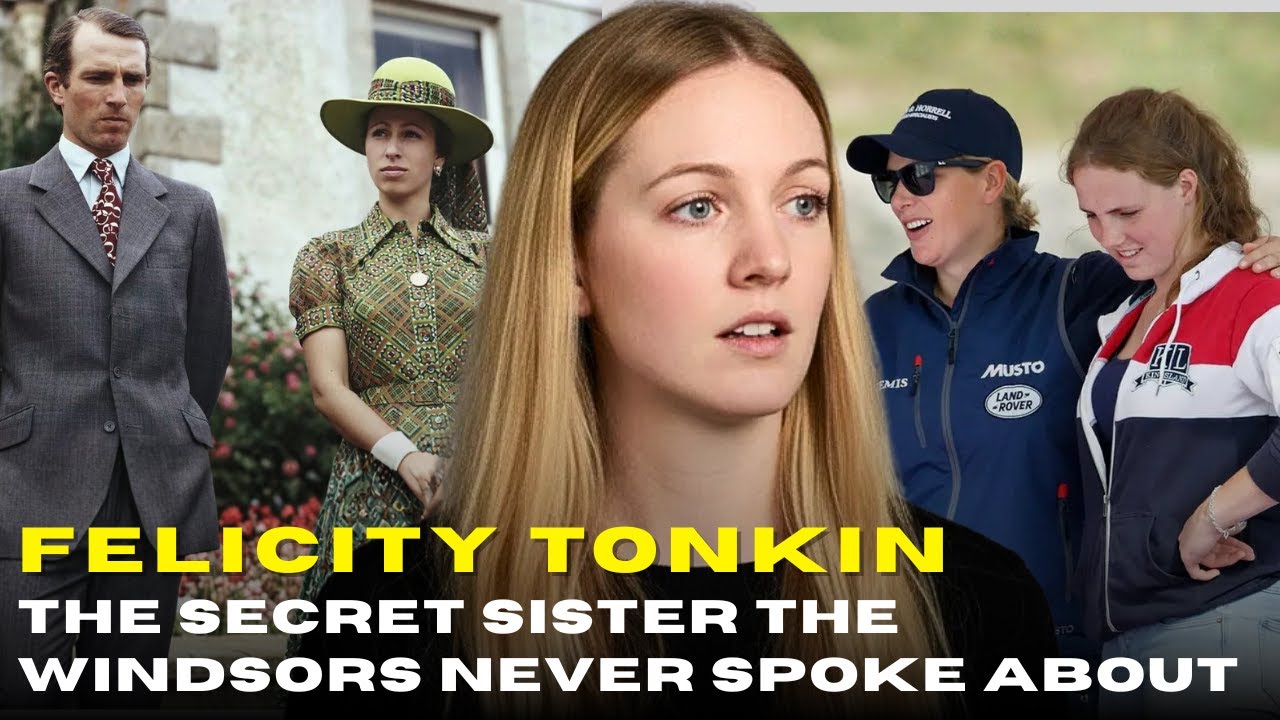
As both women entered their twenties, the physical resemblance shifted from similar to uncanny. They shared the same square jaw, the same nose, the same bright piercing blue eyes. Even their mannerisms, the way they tucked their hair behind their ears, the way they stood with their hands on their hips while assessing a jump, were identical. It was a genetic rebuke to Mark Phillips’s rejection.
He could pay for her silence, but he could not pay for her face. There is no record of Felicity ever speaking publicly about this pain. She maintained the dignity her father lacked. But her mother occasionally broke the silence.
In interviews, Heather described Felicity’s sadness not at the loss of money or titles, but at the loss of connection. “She is a lovely girl,” Heather said in a rare interview. “She just wants to know her father. She just wants to know where she comes from.
”
The most devastating aspect of the ghost-sister dynamic was not the absence of the siblings, but the presence of the father. If Mark Phillips had been a distant, cold father to everyone, Felicity might have been able to rationalize his abandonment. But Mark Phillips was a great father to everyone else. Stephanie, born in 1997, was just a few years younger than Felicity.
Unlike Felicity, Stephanie was embraced. She grew up riding with Zara, part of the Gatcombe clan. Mark was a hands-on dad, photographed teaching her to ride, laughing with her, being present. Felicity had to watch this from afar, to see the photos of Mark, Peter, Zara, and Stephanie, the legitimate quartet, smiling at Christmas or gathering at horse trials.
She was the one child out of four deemed unlovable. This brings the story to the most uncomfortable question of the modern royal era: What about Zara and Peter? By the mid-2000s, they were adults, worldly and intelligent. They certainly knew about Felicity.
The scandal was public record. The resemblance was obvious. Zara, in particular, built her brand on being down-to-earth, the royal who did not use a title, the one you could have a beer with. And yet, regarding her sister, the silence was absolute.
There is a concept in royal circles known as the cordon sanitaire, an invisible line drawn around the firm to protect it from infection. Zara and Peter, for all their modernity, are products of the firm, raised by Princess Anne, a woman who values duty and discretion above all else. To acknowledge Felicity would be to acknowledge their father’s shame. So they ignored her.
It is a passive form of cruelty, the polite smiling exclusion of the British upper class. Did Zara ever look at Felicity’s photo online? Did she ever feel a pang of curiosity? It is likely we will never know.
But the fact that she never reached out, never sent a private letter, never arranged a quiet meeting, speaks volumes about the power of royal conditioning. Blood may be thicker than water, but royal protocol is thicker than both. As the decade turned, Felicity solidified her own identity. She was a respected professional saving animals’ lives.
While Zara rode for glory, Felicity worked for healing. In a strange way, she became the keeper of the true equestrian spirit, loving the horses for themselves, not for the medals they could win. She was the one up at three in the morning with a sick foal while the trophies gathered dust in cabinets in England. By 2010, Zara was aiming for the London 2012 Olympics.
Felicity, meanwhile, was falling in love, building a home, and preparing to start a family of her own. The summer of 2012 was the apotheosis of the House of Windsor. The London Olympics served as a glittering stage for a nation desperate to project confidence, and the royal family was the centerpiece. On July 31st, Greenwich Park was transformed into a cauldron of patriotic fervor.
Prince William, Kate Middleton, Prince Harry, and Princess Eugenie were all there wearing Team GB kit, hugging each other and cheering themselves hoarse. In the center of the arena, Zara Phillips rode for her life aboard her horse High Kingdom. She was under immense pressure. She was not just a competitor; she was the Queen’s granddaughter.
When she secured the team silver medal, the relief was palpable. But the true theater happened on the podium. In a moment no scriptwriter would dare invent, the person handing out the medals was Princess Anne. The Princess Royal, usually so stoic, pinned the silver medal onto her daughter’s chest and then, breaking protocol, kissed her on both cheeks.
It was the ultimate closed loop: the mother presenting the medal to the daughter, watched by the cousins who would one day be kings. There was no room on that podium for a mistake made in a cupboard in 1985. Eleven thousand miles away in the quiet winter of New Zealand, Felicity Tonkin watched the broadcast. She saw the same jawline she saw in the mirror every morning beaming from a podium.
She saw the father who had rejected her standing in the VIP box, his face flushed with pride. Those close to Felicity suggest that by 2012, her reaction was no longer one of childhood confusion or teenage longing, but of adult acceptance. She had stopped waiting for the phone to ring. She had realized that the glittering world on the screen was not a paradise she was exiled from, but a high-stakes cage she had luckily escaped.
As Zara faced the flashbulbs and the drug testing and the relentless scrutiny, Felicity turned off the TV. She had horses to feed. If the Olympics highlighted the professional divide between the sisters, their weddings highlighted the personal one. In July 2011, Zara Phillips married rugby superstar Mike Tindall.
The wedding was held in Edinburgh, a state occasion in all but name. The Queen attended. The streets were lined with thousands of well-wishers. The press analyzed every inch of the dress, every guest, every smile.
Felicity was not invited. There was no discreet envelope sent to Auckland. The cordon sanitaire remained in place. But four years later, in March 2015, Felicity walked down her own aisle, and the contrast could not have been more stark.
She married Tristan Wade, a polo player. The irony of her choice of husband was almost literary: polo is the sport of kings, the sport of Prince Charles, the sport her father played. But Tristan was not a royal dilettante playing for social status. He was a working horseman.
The wedding took place on their property in Karaka, South Auckland. There were no security snipers on the roof, no crowds, just family and friends. The photos, which remained private and were never sold to Hello magazine, show a woman who looks exactly like a royal bride, minus the tiara. Felicity wore white.
She looked radiant, and most importantly, she looked free. By taking the name Wade, she shed the label of Tonkin, the name associated with the scandal, the court case, and the love-child headlines. She stepped fully into a new identity, no longer defined by who her father was, but by who she loved. In 2017, the story entered its next generational cycle.
Felicity and Tristan welcomed a son, James. The birth of James Wade made Captain Mark Phillips a grandfather again. In England, Mark was frequently photographed with his official grandchildren, Zara’s daughters Mia and Lena, and Peter’s daughters Savannah and Isla. He was the doting grandpa, seen giving them piggyback rides at the Festival of British Eventing at Gatcombe Park.
But in New Zealand, there was a little boy with the Phillips blood running through his veins who would likely never meet his grandfather. Did Mark Phillips send a card? Did he send a silver rattle? The silence suggests not.
James Wade and Mia Tindall are first cousins. They share a grandfather. They share the genetic legacy of Olympic athletes. In a normal family, they would be playing together at Christmas.
In the House of Windsor, they are strangers who will likely live and die without ever speaking a word to one another. The wall of silence had been extended to a third generation. However, as the years passed, a shift in perspective began to occur among those who followed the story. For decades, Felicity had been viewed as the victim, the poor abandoned girl.
But as the toxic reality of modern royal life became clearer, her position began to look less like an exile and more like an escape. Consider the life of Zara Tindall. Every time she steps out of her house, she is photographed. If she gains weight, it is a headline.
She has to curate her life for public consumption, bound by the invisible chains of protocol and expectation, forced to monetize her royal connection to maintain her lifestyle. Now consider Felicity Wade. She wakes up on a beautiful farm in New Zealand. She works with the animals she loves.
She goes to the supermarket in sweatpants without fear of landing on the front page of the Daily Mail. She raises her son James without security guards. She has a husband who married her for herself, not for her proximity to the throne. Mark Phillips, in his cowardice, had inadvertently given Felicity the greatest gift of all: the gift of irrelevance.
By refusing to acknowledge her, he had liberated her. He had spared her the gilded cage. He had allowed her to become a person rather than a persona. There is a profound dignity in her labor.
While her father spent his life chasing gold medals and royal favor, Felicity spent hers healing pain. She proved that nobility is not a title you are born with. It is a quality you demonstrate. The tragedy of this trans-hemispheric drama is not that the two sisters are different, but that they are so heartbreakingly similar.
They are two halves of the same coin, but one side has been polished to a shine while the other was tossed into the mud. The most damning indictment of Captain Mark Phillips is not that he had an affair. Infidelity is a human failing as old as time, and a moment of madness in a hotel cupboard does not make a man a monster. His true crime is that he maintained the rejection for thirty years.
It is easy to panic in 1985. It is easy to be a coward when you are married to the Queen’s daughter and terrified of losing your position. But Mark Phillips had decades to fix it. He had thirty years to pick up the phone, thirty years to get on a plane to Auckland, knock on a farmhouse door, and say, “I’m sorry.
I want to know you. ” He never did. Even after he was divorced from Princess Anne, even after he was a private citizen living on his own farm, even after he had fathered another daughter whom he raised with love and pride, he continued to treat Felicity as a contractual liability rather than a human being. This exposes the hollowness of the family man image he projects.
You cannot be a good father to three children while pretending the fourth does not exist. By rejecting Felicity, Mark Phillips compromised his integrity as a parent to all his children. He taught Peter and Zara a terrible lesson: that family is conditional. So who is the true winner in this drama?
It is not Mark Phillips. He is an old man who must live with the secret knowledge that he failed his first test of character. He must look at his grandchildren playing on the lawn and know there is a cousin in New Zealand who is a stranger to them because of his cowardice. He bought silence, but he sold his soul.
Is it Zara Tindall? She has played the hand she was dealt with grace and grit, but she is lesser for the loss of her sister. She missed out on a relationship that could have been profound. She missed out on knowing the one person in the world who truly understands what it means to be Mark Phillips’s daughter.
The winner is Felicity. She won because she survived. She won because she refused to be destroyed by the rejection. She won because she took the hush money and used it to build a loud, vibrant, authentic life.
She became a healer of animals, a mother, a wife, and a woman of substance. She proved that you do not need a title to be noble, you do not need a castle to have a home, and you do not need a father to be a whole person. The House of Windsor tried to erase her. They tried to make her a footnote in a biography, a sordid detail to be glossed over.
But in her quiet, dignified refusal to disappear, Felicity Tonkin became the most formidable character in the drama. She is the ghost who refused to haunt them, simply because she was too busy living a better life than they could ever offer.
