In the summer of 1883, Morgan County, Tennessee, lay under an unusually severe drought. Hollow Creek had shrunk to a thread of water, and the heat pressed down on the scattered farms of the Appalachian foothills. But on the Warwick estate at the edge of the valley, the unnatural quiet came from something more than the weather. The property belonged to Ambrose Warwick, a 72-year-old widower descended from one of the region’s first settler families.
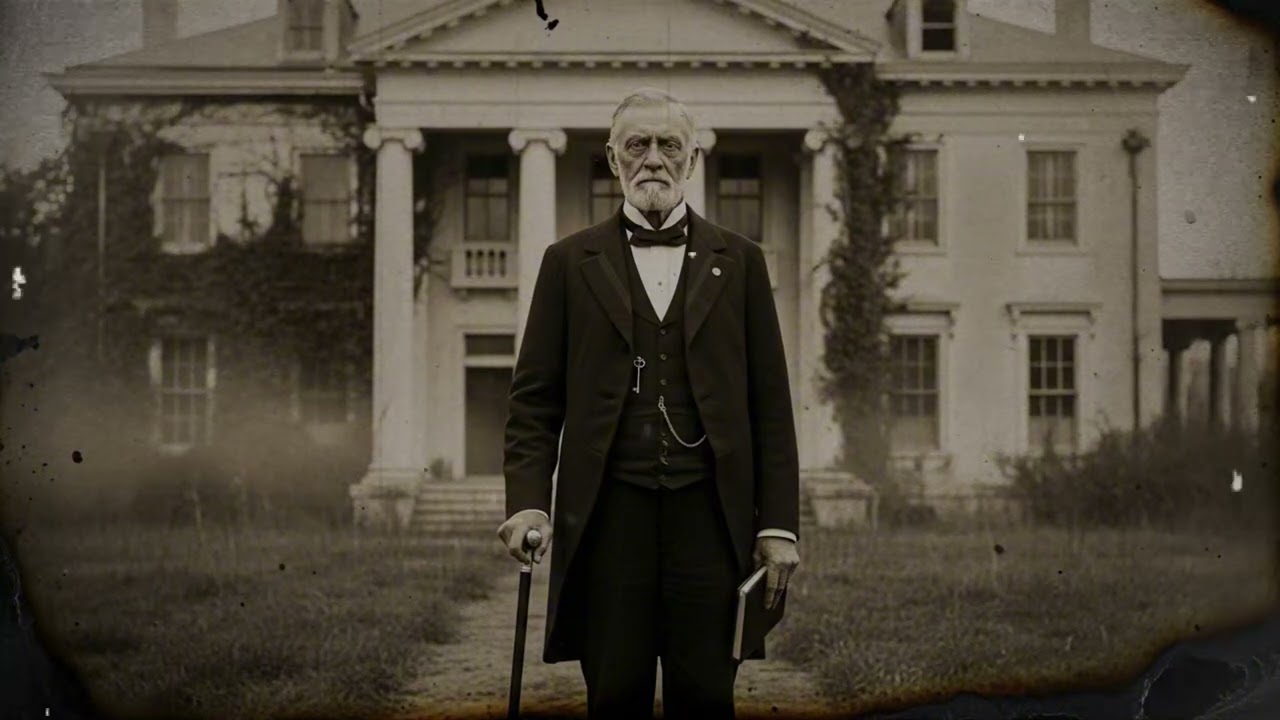
His home, built in 1842 by his father, Judge Hammond Warwick, was a grand two-story structure with four white columns supporting a broad porch. By 1883, the land had fallen into visible neglect. Weeds choked the gravel drive, and unpruned vines climbed the north face of the house. Local people often hurried past the property after dark, unable to explain why beyond a vague sense of unease.
Ambrose had lived alone since his wife died of tuberculosis in 1874. He had no heirs, rarely appeared in the nearby town of Coalfield, and kept to himself except for Sunday services at the Presbyterian church, where he always sat in the same pew wearing the same black suit. The official death of his father in 1871 had been recorded as a heart attack brought on by old age and frailty. But a more detailed medical report found decades later in the old Knoxville hospital archives described symptoms that did not fit natural causes: episodes of violent agitation alternating with deep lethargy, disturbing visions, claims that something inside the walls was watching him, permanently dilated pupils even under bright light, a corpse-like pallor, and, during periods of delirium, speech in a language unknown to the attending physician.
On June 12, 1883, Ambrose Warwick failed to appear at Sunday service. When his absence stretched across three consecutive Sundays, the pastor, Josiah Cunningham, sent his housekeeper, Prudence Holloway, to check on the old man. She knocked for several minutes without an answer. Finding the door unlatched, she entered.
The interior was clean and orderly, as if prepared for visitors. A half-empty glass of brandy sat on a side table, its contents long evaporated. There was no sign of struggle. And no sign of Ambrose Warwick.
She noticed that every clock in the house had stopped at exactly 2:47. Her search brought her to the cellar, an unusual space built with cut stone floors and walls lined with mortar that later experts found to be exceptionally moisture-resistant. The accessible cellar covered only about half of what the house’s footprint suggested it should, and the dividing wall did not align with any wall above. In that wall was a small, nearly invisible door of dark wood.
In the cellar, Prudence found an open mahogany chest containing a black-bound diary written in Ambrose’s neat hand. The final pages, however, showed increasingly frantic handwriting, almost illegible, as if written under great stress or fear. She took the diary directly to Sheriff Isaiah Montgomery and reported the disappearance. The sheriff was not known for diligence in his investigations.
A former Confederate officer appointed in 1878 through political connections, he conducted a brief and superficial inquiry. After three days of searching the property and surroundings without finding a trace, he concluded that Ambrose had likely traveled to Nashville to visit relatives without telling anyone. The case was archived and the house closed, awaiting its owner’s return. Notably, the investigation found all of Ambrose’s clothes, jewelry, gold pocket watch, silver cufflinks, and a wallet containing a substantial sum of money untouched.
If he had left willingly, he had gone without taking any possessions or resources. The diary Prudence had found never entered the official record. For decades, its whereabouts remained unknown. In 1964, a carpenter named Silas Tucker discovered a wooden box hidden inside a false wall while renovating an old parsonage in Coalfield.
Inside, wrapped in black silk, was Ambrose Warwick’s diary. It eventually passed to Father Lawrence Blackwell, who delivered it to the history department of the University of Tennessee. The diary was placed in restricted documents and remained inaccessible to the public for five years. In 1969, Professor Augustus Wellington, a meticulous historian with a background in psychology, obtained permission to examine the document.
He was researching the social history of post-Civil War East Tennessee. What he found in the yellowed pages so disturbed him that he abandoned his original research and devoted himself entirely to the case. The early entries, dated January 1874 shortly after his wife’s death, were ordinary: lists of tasks, records of expenses, occasional reflections on loneliness and loss. The handwriting was steady and organized.
By November 1882, the tone shifted. Ambrose began recording strange sensations, nocturnal noises he could not identify, a persistent feeling of being watched, and objects that seemed to move when he was not looking. He wrote of scratching sounds coming from inside the walls, which his groundskeeper Jeremiah Caldwell could find no explanation for. In December 1882, Jerome left his employment, claiming he had found a better job.
Decades later, his relative Martha Caldwell told the professor a different story. Jeremiah had never spoken of that house. He said only that there were things money could not compensate for. The night before he left, she heard him tell his wife that the walls of that house had eyes and ears.
Jeremiah, a previously strong and healthy man, began to wither after leaving the property. He lost weight, lost his appetite, suffered such severe nightmares that he screamed in his sleep, and died only six months later, raving about something living between the walls and repeating: I should never have looked. I should never have opened that door. Ambrose’s diary entries became increasingly disturbing.
He reported seeing a dark figure at the foot of his bed. He wrote of whispering voices emerging from the walls, speaking words he could not understand but felt were directed at him. On January 2, 1883, he recorded finding a photograph in the bottom of a dresser drawer, despite being sure he had burned it three days earlier. The eyes in the photograph seemed to follow him.
On January 5, he resolved to examine the cellar, the small door at the back that had remained locked for years. His father had made him promise never to open it. The next day, he went down. The key was already in the lock, the door ajar.
He described a smell he could not precisely name, a mixture of damp earth, mold, and something metallic, like old blood or rusted iron. He lacked the courage to open the door fully and closed it again. The entry for January 15 records a recurring dream. He stands before the cellar door.
His hands move against his will. When the door opens, he sees only darkness and feels a terrible cold. A voice speaks from the depths: I am keeping my promise. He always wakes at 2:47 in the morning, with the sense that someone is sitting on the edge of his bed.
The diary gives no prior mention of any such promise or who might have made it. On January 27, he wrote that he could no longer sleep. The walls were damp, although it had not rained. The moisture formed patterns like faces watching.
The same smell was everywhere. He wrote that his father had known, had tried to warn him. On January 29, he described hearing footsteps in the attic that had been locked for years. He went to check.
The door was locked as always, but pressing his ear to the wood, he heard heavy, irregular breathing. When he stepped away, the breathing stopped suddenly, as if whatever was inside knew he was listening. Later that night, he woke to deliberate scratching on his door in a pattern, three slow scratches followed by three faster ones, repeated for nearly an hour. In the morning, there were no marks on the wood.
The entry for January 31 reveals more of the past. Ambrose recalled the last night his father seemed fully conscious, when Judge Warwick called him to his study and handed him the key to the cellar door, making him swear never to open it. The old judge said: What we did was wrong, Ambrose. I should never have brought that into our home.
I should never have made that agreement. Ambrose remembered that in 1869, after his father returned from a journey to Virginia, the judge changed. He became more withdrawn, spent hours alone in the cellar, and was sometimes heard speaking down there, though no one was seen entering or leaving. After that trip, the room at the back of the cellar was built, officially for storing important documents.
The last regular entry is dated February 9, 1883. Ambrose wrote of finding marks on the cellar floor, as if something heavy had been dragged toward the door. The voices were louder now, nearly clear enough to understand. He planned to speak with Pastor Cunningham.
There is no record that he ever did. But a note found among the pastor’s personal papers after his death in 1924, dated February 10, asked for forgiveness for missing a scheduled meeting, stating that the matter Ambrose had intended to consult about had become more urgent than he imagined, and that he feared he was facing something beyond his understanding, perhaps beyond the doctrine of the church itself. After February 9, the diary is silent for nearly a month. The final entry is dated June 8, 1883, four days before his absence was first noticed.
The handwriting is nearly unreadable, frantic and rushed. It states that something is in the house with him, that it is not his father, and never was. The cellar door is open, and he did not open it. The sounds it makes as it moves inside the walls.
He can no longer stay. The photographs, all of them, even those he burned, have returned. The faces in them have changed, and now they all have its eyes. The last clearly legible sentence reads: There is only one way.
The final page contains one line written in a clear, steady hand so different from the previous entries that it raised questions about whether it was written by the same person: I finally understood what it wanted from the beginning. Professor Wellington spent years trying to reconstruct the case. He considered multiple possibilities: intruders, a distant relative interested in the inheritance, or gradual mental deterioration ending in flight or suicide. He found the recurring time of 2:47 particularly striking, given that all the clocks in the house had stopped at the same time.
He also discovered that the judge, in his final illness, had spoken of an agreement made during his 1869 trip to Virginia, saying he had obtained an artifact from a merchant in Richmond, which he kept in a hidden place in his home, and insisted that this object had changed after being brought into the house and was communicating with him through the walls. An interview with Cordelia Visser, who had been twenty years old and lived three houses away in 1883, added another disturbing element. She recalled that on the morning after the disappearance was discovered, she saw a man leaving the house very early, before sunrise. He wore a hat that covered his face and carried something wrapped in dark cloth in his arms.
She never told the authorities. The description matched accounts of a mysterious stranger who had visited Judge Warwick during the months before his death, always arriving after dark, always meeting the judge alone in the study or the cellar, a thin, very pale, tall man in dark clothing. The Hollow Creek house remained closed for years. In 1928, tobacco merchant Vernon Caldwell purchased it and undertook extensive renovations.
He insisted, after an incident involving workers, that the cellar be entirely sealed in cement. The workers had discovered the small door in the back wall, broken the lock, and found a narrow chamber the size of a closet. They left the same day and refused to return, even at double wages. The Caldwell family occupied the house for only five months.
They left abruptly, selling well below market value. Caldwell later told Professor Wellington that his wife woke screaming one night, claiming a dark figure stood at the foot of the bed. On the dresser, they found a small carved wooden box containing a single photograph of an old man with entirely black eyes. On the back was written: It lives in the walls and wants company.
He identified the man as Ambrose Warwick. In 1952, the abandoned house was demolished. Workers removing the cement cellar floor discovered a small wooden door sealed with what appeared to be black wax. Inside a tiny chamber, they found three items: an old matchbox, a broken pocket watch, and a faded photograph.
The site supervisor, Nathaniel Boggs, described it decades later to Professor Wellington: a photograph of an old man sitting in a chair, a vague shadowy form behind him, and eyes that were completely black, as if covered with ink. On the back were faded words: The promise inside the walls. He also revealed that he found a small carved box of bone, empty except for a thin layer of dark powder. Feeling disturbed, he burned it that same night.
Only the photograph was handed over to authorities, and no record of it exists. Professor Augustus Wellington died in September 1976 before completing his research. His notes and collected materials were donated to the university library, but a large portion of the collection inexplicably disappeared during an archive reorganization in 1978. His assistant Henrietta Vaughn expressed doubt that such a loss could be due to ordinary bureaucratic error.
In one surviving notebook, Wellington recorded a personal experience from August 1969. After months of investigating, he began suffering from insomnia and hearing strange sounds in his own home: scratching in the walls, footsteps in the hallway when he was alone, the creak of a rocking chair he did not own. His final known note on the case described a dream in which Ambrose Warwick stood in the Hollow Creek cellar before that door, looked directly at him and said: You also made a promise, Professor. When he woke, he found an antique matchbox on his desk, identical to the one described in the demolition report.
He abandoned the investigation shortly afterward, burned his remaining notebooks, avoided working after dark, installed extra lighting, and developed an aversion to enclosed spaces. No trace of Ambrose Warwick has ever been found. No evidence of a crime was ever proven. The official records still classify his case as a disappearance.
A journalist who attempted to reopen the investigation in 1962 discovered that Prudence Holloway, the housekeeper who first found the empty house, had withheld one detail from her original report. In the cellar, the small door at the back had been ajar. The room behind it was small, like a closet set into the wall, but seemed deeper than the structure of the house should allow. The interior walls were of packed earth, not stone.
In the center sat a small box carved from a material that was neither wood nor metal, and beside it a photograph lying face down. She did not touch anything. Something about the place filled her with an instinctive terror. The journalist, Russell Norton, died of a sudden heart attack three months after his article was published.
A colleague later told the professor that Norton had become increasingly uneasy in his final weeks, hearing strange sounds in his apartment and feeling constantly watched, and having found an antique matchbox on his desk with no explanation. Today, a small shop stands where the Warwick estate once was. Employees occasionally report strange occurrences: goods shifting positions, footsteps upstairs when the building is empty, and a persistent smell of old cologne with a subtle undertone of damp earth, especially in June, the month of Ambrose Warwick’s disappearance. Workers renovating the floor in 1965 found a small silver medallion embedded in the concrete, engraved with the initials A.
W. and the date 1883. It was donated to the county historical museum, where it remains on display. On the first night after it was placed in its case, the museum’s security cameras recorded a malfunction at exactly 2:47 in the morning, lasting exactly seven minutes.
When the system came back online, the medallion had turned 180 degrees inside its display case. The truth of what happened to Ambrose Warwick in June 1883 remains unknown. His body was never found. No tangible evidence of a crime was ever established.
The official records still list his case as a disappearance. The patterns in the surviving evidence, the black eyes in the photographs, the recurring smell of damp earth and metal, the sounds in the walls, the time 2:47, the gradual mental decline of those who pursued the mystery, and the unidentified figure repeatedly described by witnesses across decades, resist easy explanation. Perhaps the answer lies in the last legible words of his diary about understanding what it wanted from the beginning, or perhaps it is simply one of those unsolved cases that history leaves behind, a whisper from the past that still makes people look uneasily at old walls and dark cellars, wondering what might be hidden behind the surface of things.
