You clock in at 6:00. The floor shakes under your boots. The man next to you has been here 23 years and he will be here 23 more. You make the same seven welds in the same order 412 times a day.
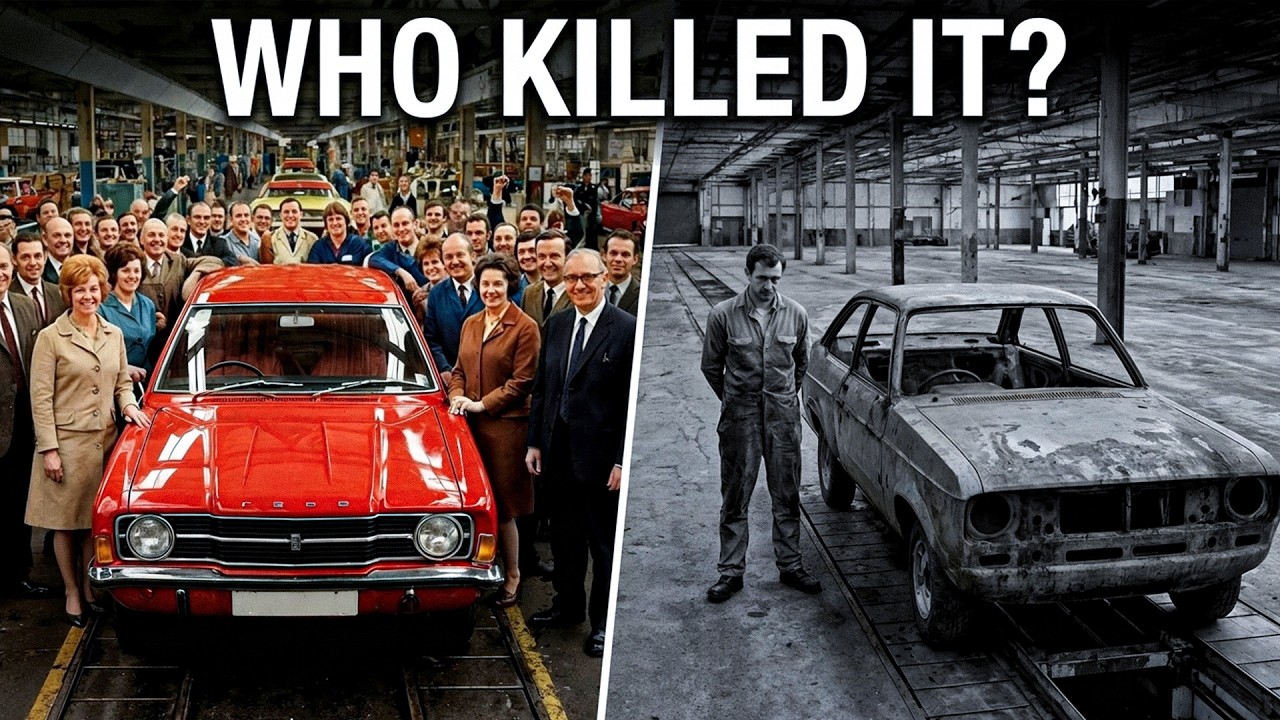
Your back is wrecked by 40, but by 35 you own your house outright. That factory does not exist anymore. Neither does the life it paid for. This is not just a Detroit story.
It is the story of what happens when an entire city bets everything on one industry, and then the men running that industry decide to walk away. There is one number buried in a bankruptcy filing 50 years later that tells you exactly where it all went wrong. But first you need to understand what Detroit actually was, because what they built there for a little while had not existed anywhere on Earth. On January 5th, 1914, Henry Ford did something nobody in American business had ever done.
He doubled his workers’ wages. Five dollars a day. More than double what any factory in the country was paying. In today’s money, that is about $156.
The news hit Detroit like a bomb. Thousands of men flooded in from across the Midwest and lined up in the freezing cold outside Ford’s Highland Park plant. When the crowd got too big, they were turned away with fire hoses in the middle of cold January. That is how badly people wanted in.
Here is the thing most people do not know. Before the $5 day, Ford’s turnover rate was 370 percent. Men quit faster than Ford could replace them, because the assembly line had turned skilled work into mind-numbing repetition. The $5 day was not generosity.
It was survival, the only way to keep people on the line. But it worked. And it changed everything. A factory worker could suddenly buy a house, buy a car.
The same car he was building with his own hands. And he could send his kids to school instead of sending them to work. That is when the American middle class started to take shape. Not in a bank.
Not at a university. On a factory floor in Highland Park, Michigan. Every dollar that came out of those gates touched a dozen other lives: the barber who cut the workers’ hair, the grocer who sold them Saturday dinner, the car dealer, the diner on Michigan Avenue. These factories did not just pay wages.
They paid for barber shops, school clothes, mortgages, Little League gloves. Then the war came. And Detroit did something that should not have been possible. The entire city stopped making cars and started making weapons.
Ford built a plant called Willow Run. A mile long, 3. 5 million square feet. Aviation experts said mass producing a four-engine bomber on an assembly line could not be done.
Ford did it anyway. By 1944, Willow Run was finishing one B-24 Liberator every single hour. Chrysler’s Detroit Arsenal built half the tanks America used in the war. 91 percent of all army helmets were stamped in Detroit.
The city produced a quarter of everything the Allies used to win. Roosevelt called it the arsenal of democracy. And it was. By 1950, Detroit had almost 2 million people, the fourth largest city in America, with 296,000 manufacturing jobs.
The Big Three—Ford, GM, Chrysler—controlled 90 percent of every car sold in the country. You did not need a college degree. Did not need to know anybody. You needed two hands and a strong back.
And the city gave you a life: a house with a yard, a car in the driveway, a week at the lake in August, and a pension when your body finally gave out. That was not a poster on a wall. That was just a normal Tuesday in Detroit. But here is what almost nobody tells you about that golden age.
The cracks were already showing. And the men in the boardrooms already had one foot out the door. The factories did not die in Detroit. They moved.
Between 1947 and 1963, 150,000 manufacturing jobs left the city. Not the country—the city. They went to the suburbs. The old downtown plants were cramped, multi-story buildings from before the assembly line even existed.
The new plants needed wide, flat, single-story floors with room to spread. And the suburbs had cheaper land, lower taxes, and no union leverage. Ford’s River Rouge plant, the one that once employed 90,000 people, deliberately built duplicate plants in other states so that a strike at Rouge could not shut down the whole company. This was not about floor space.
It was about control. By 1960, Rouge was down to 30,000. By 1990, 6,000. Same gates, same parking lots, a tenth of the people walking through them.
And here is what made it so much worse. When the factories moved, the white workers followed them out. They could get mortgages in the suburbs. But black workers—the same people who had come up from the South for exactly these jobs—were blocked.
Redlining. Restrictive covenants. Banks would not lend to them. Neighborhoods would not sell to them.
So the people who stayed in the city were poorer. And the tax money that paid for schools and roads and police drove off with the people who left. That golden age everybody remembers was already cracking underneath. In the late 1950s, Detroit’s unemployment was hovering near 10 percent.
During the 1958 recession, a quarter of a million people in Detroit were out of work. The state employment commissioner went on the radio and told auto workers to start looking for jobs in other industries. In the middle of the golden age. That is what it actually looked like from the inside.
Then came the summer of 1967, and everything that had been cracking finally broke wide open. On July 23rd, 1967, police raided an unlicensed bar on 12th Street, on the west side of Detroit. What followed lasted five days. 43 people dead.
More than 7,000 arrested. Over 2,000 buildings destroyed. The National Guard in the streets. The army sent troops with bayonets into an American city.
But the riots did not start the decline. The decline had been building for a decade. What they did was rip the bandage off. 80,000 white residents left Detroit in 1968 alone.
And they did not just take their families. They took the tax money, the small businesses, the customers, the school funding. Block by block, the city got quieter. And the cars coming off the line were getting worse.
Not because the workers forgot how to build them. The welders and machinists were as skilled as they had ever been. But management kept cutting corners: cheaper steel, faster line speeds, less time for a man to check his own work. The guys on the floor could feel it in the parts they were handed.
Bolts that did not thread right. Panels that did not sit flush. They said something, but nobody upstairs listened. Then came the oil crisis.
1973. Gas prices spiked overnight. And suddenly the big, heavy, fuel-hungry cars Detroit had staked everything on were exactly what nobody wanted. Japan had smaller, cheaper, better-built alternatives ready to go.
And Detroit was years behind. Years. While Toyota and Honda were engineering fuel efficiency, the Big Three were still betting on V8s and chrome. What followed was a cascade.
Packard, gone. Hudson, gone. Studebaker, gone. Hundreds of parts suppliers and tool and die shops, gone.
Neighborhoods emptied out. Tax revenue collapsed. City services crumbled. One dark block after another.
And it was not just Detroit. In Gary, Indiana, US Steel went from 30,000 workers to a skeleton crew. In Youngstown, Ohio, they still call September 19th, 1977 Black Monday—the day the mill cut 5,000 jobs in one announcement. In Flint, the city that gave birth to General Motors, they could not afford clean water.
That is not a metaphor. That actually happened. Somewhere in Detroit, a man walked out of a factory for the last time. He had been on the line since he was 19.
His father had worked on the same floor before him. He carried his lunch pail home the way he always did. Grease still on his cuffs. Except this time there was no shift to come back to.
The plant was closing. And within five years, half his street would be empty. You would think that was the bottom. It was not even close.
2008. The financial crisis hit, and everything that was barely holding together came apart. Auto sales dropped 40 percent. General Motors and Chrysler both filed for bankruptcy.
The federal government pumped $80 billion in bailout money into the industry. GM killed Pontiac, killed Saturn, killed Hummer, killed Saab, closed 13 plants, cut 22,000 jobs. Chrysler got bought by Fiat. Ford survived without a bailout, but only because they had mortgaged everything they owned—including the logo on the building—two years before the crash.
On July 18th, 2013, Detroit filed for bankruptcy. 18 to 20 billion dollars in debt. The largest municipal bankruptcy in American history. And here is the number mentioned at the beginning.
The city once had 20,000 workers and 10,000 retirees drawing pensions. By 2013, those numbers had completely flipped. 10,000 workers, 20,000 retirees. More people collecting checks than earning them.
That one ratio tells you everything you need to know about what happened to Detroit. Police response times stretched to nearly an hour. The national average was 11 minutes. 40 percent of the street lights were dark.
Walk down a residential block at night and count the porch lights that are off. That is not a power outage. That is a neighborhood where nobody lives anymore. They nearly sold the city’s art collection—the Detroit Institute of Arts, one of the great museums in the country—just to cover debts.
A coalition of foundations stepped in with what they called the Grand Bargain. Detroit exited bankruptcy in December 2014. $7 billion in debt wiped out. Retiree pensions cut 4.
5 percent. And the city’s former mayor was sitting in federal prison on 24 felony counts. The city was broke, and its own leadership had been robbing it. The question that never goes away is what we actually lost.
We lost more than factories. People do not say that enough. We lost the idea that a man with a high school diploma and two strong hands could build a life worth living. Own a home.
Raise a family. Coach his kids’ baseball team on Saturdays. Retire with a pension and a porch to sit on. The $5 day did not just create workers.
It created citizens. People who voted, joined the PTA, put a flag on the lawn, sent their kids to college on a factory wage. When the factories left, the neighborhoods followed. The barber closed up.
The diner went dark. The lot where the corner store used to be grew weeds for 10 years, and then somebody dumped a mattress on it. And the thing that replaced manufacturing—the temp jobs, the gig work, the service economy—does not build that kind of life. Never has.
Here is the part that should stay with you. When Toyota opened a plant in Kentucky and Honda opened one in Ohio, American workers matched Japanese productivity standards almost immediately. The problem was never the people on the line. It was always the decisions made above them.
The saddest building in Detroit is Michigan Central Station. The old train station. 18 stories of stone and glass, built in 1913 to be the front door of the city. Train service stopped in 1988.
For 30 years it sat there empty. Broken windows, pigeons in the lobby, weeds growing through the marble. It became the most photographed building in Detroit. The picture people showed when they wanted to say, “Look what happened here.
”
Ford bought it in 2018. They are turning it into a tech campus with Google. They are calling it the front door of a new Detroit. Maybe it is.
Or maybe it is a renovation on top of something that never healed. None of this was inevitable. Not one piece of it. This was a series of choices.
Choices made in boardrooms and statehouses and union halls and city councils. The choice to stake everything on one industry. The choice to move the jobs instead of fixing the plants. The choice to let a city decay because saving it would have cost money somebody did not want to spend.
Detroit did not collapse because the workers failed. It collapsed because the system around them was slowly dismantled, piece by piece, by people who never had to live with the consequences. But Detroit’s population grew last year and the year before that. First time since 1957.
The city is still here. Smaller, scarred, but still standing. And the people who stayed through all of it—the closings, the riots, the bankruptcy, the street lights going dark—deserve to be remembered for that. Detroit was built for 2 million people, and for a while they were all there.
The factories are gone now. Most of the workers are gone, too. But drive down any boulevard in this city and you will feel it. The roads are still too wide.
The parking lots are still too big. And the whole place still feels like it was built for a future that never showed up.
