In March 1968, a wrecking ball swung through the icy Manhattan air and struck the most beautiful tower in Lower Manhattan. The sound echoed across Broadway like a funeral bell. Clouds of dust rose and mixed with the pale winter light, and beneath that dust, a precious piece of memory disappeared forever. The Singer Building—once the tallest skyscraper on earth—was being erased from the New York skyline, blow by brutal blow.
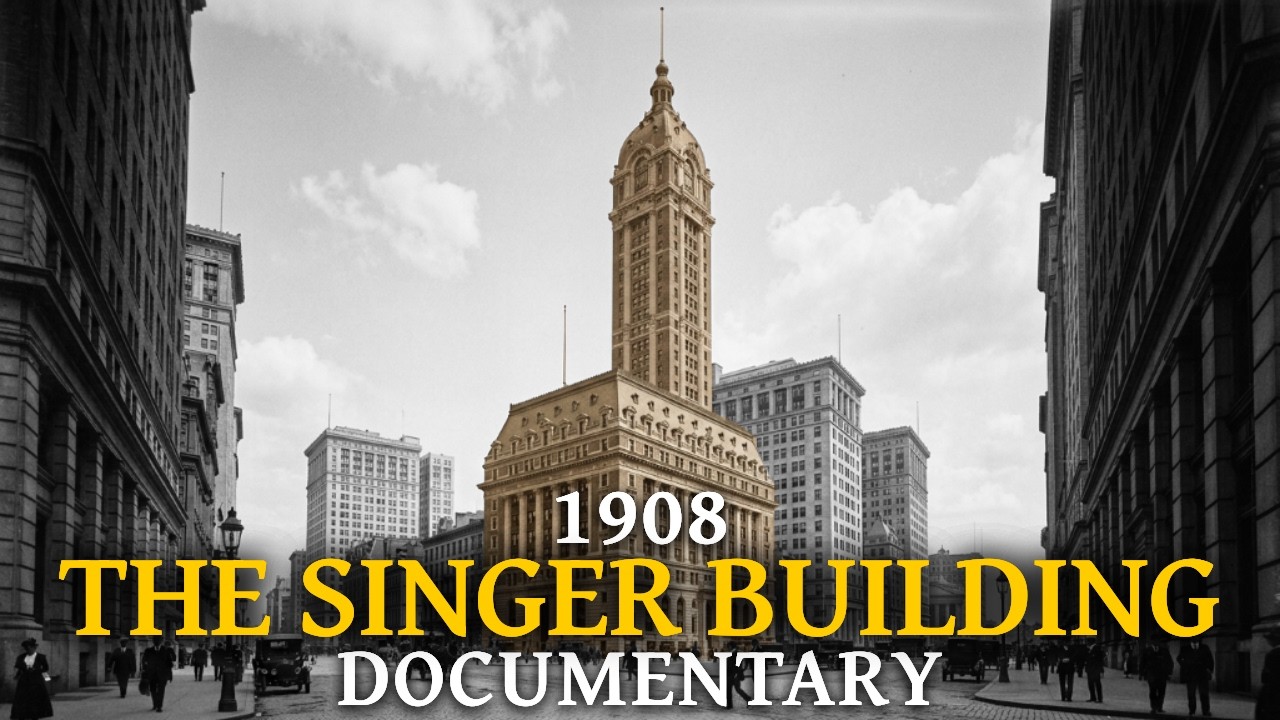
Workers on the surrounding streets stopped. Some covered their faces. Some wept. For sixty years, the tower had carried the identity of Lower Manhattan, its red brick façade rising 612 feet like a French palace that had learned to fly.
Now it was falling apart, piece by piece, taking with it a chapter of American history that would never be written again. The story begins not in New York, but in a small Boston workshop in 1850, with a question that would change the lives of millions of women. Isaac Merritt Singer was thirty-eight years old and had failed at nearly everything he had tried. Born in 1811 to poor German immigrants in Pittstown, New York, he had dreamed of becoming an actor.
Standing six feet four inches tall, with thick reddish-gold hair and a commanding personality, he had formed his own traveling theater troupe, the Merritt Players, and spent nine years staging Shakespeare across the country to dwindling audiences. But Singer had a fatal weakness: he loved women—many women. He had fathered children with one after another during his travels, and his debts had grown beyond anything his theater could pay. By 1850, his artistic ambitions were in ruins, his theater company bankrupt, and he had at least eight children by multiple women.
Desperate for money, he returned to his backup profession: mechanics. Singer had always possessed an uncanny ability to understand machines. At nineteen, he had worked as an apprentice machinist and held several patents, including one for a rock-drilling machine. Now, penniless and humiliated, he took a job repairing sewing machines in the workshop of Orson Phelps in Boston.
The machines there were primitive and unreliable. They jammed constantly. The thread tangled. Women had to stop every few stitches to fix the machine.
When Phelps asked Singer to examine the machines, Singer initially refused, calling the work beneath him. But then something caught his eye. He looked at the useless machines not as a tailor, but as an engineer. He studied their mechanics, found the flaws, and in eleven days—working eighteen to twenty hours a day on a single meal—he created something entirely new.
Singer’s sewing machine was revolutionary. Unlike the old models, it could sew continuously without stopping. It could sew curves. Its needle moved straight instead of circular, and it featured a “pressure foot” that delivered an unprecedented speed of 900 stitches per minute.
Most importantly, it actually worked. Singer, indifferent to the invention itself, told his partners he was chasing money, not innovation. He soon had more of it than he could count. On August 12, 1851, he received patent number 8,294 for his improved machine.
He partnered with a lawyer named Edward Clark, and together they formed a company that became one of the first great multinational corporations in history. Success was not immediate. The machines cost $125 each, far beyond the reach of ordinary families. Then Clark had an idea that transformed American commerce forever: instead of selling machines outright, they offered them on installment plans.
Families could make small monthly payments and eventually own the machine. It was likely the first consumer credit program in American history. By 1860, the Singer Manufacturing Company was the largest sewing machine producer in the world. By 1863, Singer’s machines had reached homes across America and Europe.
Isaac Singer retired to England, built a palace, and maintained his complicated personal life. When he died in 1875, he left an estate of $13 million—roughly $400 million today—and at least twenty-four children by five different women. His will sparked bitter disputes, with his children unequally provided for; one son received only $500 for supporting his mother in a divorce suit against his father. But Singer’s true legacy was not his money.
It was the revolution he had started. A shirt that once took fourteen hours to sew by hand could now be completed in one hour and sixteen minutes. The company that Isaac Singer left behind grew under new leadership. By the 1890s, it was so powerful, profitable, and global that its leaders dreamed of something unprecedented: a building that would announce to the world who they were.
Enter Frederick Gilbert Bourne. Where Isaac Singer was chaos and passion, Bourne was precision and planning. Born in 1851 to a Boston clergyman, he rose through the ranks of American business with remarkable discipline. His opportunity came through music.
Bourne was a member of New York’s Mendelssohn Glee Club, where he met Alfred Corning Clark, the son of Isaac Singer’s original partner Edward Clark. They became close friends, and Clark recommended Bourne for a position in his father’s real estate company. Soon Bourne was managing construction of the legendary Dakota apartment building on Central Park West. When Edward Clark died in 1882, Bourne became the manager of his estate.
Three years later, he became secretary of the Singer Company. In 1889, at just thirty-eight years old, Frederick Gilbert Bourne became the fifth president of the Singer Manufacturing Company. Under Bourne, Singer became something the world had never seen—historians would later call it possibly the first modern multinational industrial enterprise of any nation. Bourne expanded global production and international sales, building factories on three continents.
By the turn of the twentieth century, Singer was earning millions annually, and its red and gold logo was recognizable from New York to Shanghai. Bourne knew exactly what he wanted to do with that success: he wanted to build the tallest building in the world. In 1902, the Singer Manufacturing Company began purchasing property around its existing headquarters at the northwest corner of Broadway and Liberty Street in Lower Manhattan. Frederick Bourne wanted something more—something that would make Singer’s dominance visible for miles.
For such an ambitious project, Ernest Flagg was an unlikely choice. Born in Brooklyn in 1857, the son of an Episcopal clergyman who was also a prominent painter, Flagg had left school at fifteen to work as an office boy on Wall Street. But he had a secret patron. Through his sister’s marriage to publishing magnate Charles Scribner, Flagg gained access to one of America’s wealthiest families.
Cornelius Vanderbilt II was so impressed by Flagg’s early architectural sketches that he personally financed the young man’s education at the École des Beaux-Arts in Paris, the most prestigious architecture school in the world. Flagg studied there from 1889 to 1891, mastering classical design, structural logic, and the French principles of Beaux-Arts architecture. He returned to America with firm opinions about how cities should be built. Flagg believed that extremely tall buildings were inherently problematic—they cast long shadows, blocked light from the streets below, and created dark canyons where pedestrians felt small and insignificant.
He argued that buildings taller than ten or fifteen stories should be set back from the street, with towers occupying only a small portion of the building’s footprint. It was a bold position in an era intoxicated by height. But when Frederick Bourne asked Flagg to design Singer’s new headquarters, the architect had the chance to prove his theories in the most dramatic way possible. Flagg’s original design called for a 35-story tower, but Bourne, caught up in the competitive frenzy of the era, demanded more.
He wanted the tallest building in the world. The final design reached 47 stories and 612 feet, nearly double Flagg’s initial proposal. Construction began in September 1906, and what rose over the next twenty months became one of the most extraordinary buildings America had ever seen. The Singer Building was not just tall; it was theatrical.
Flagg designed a massive 14-story base that filled the entire city block, providing the commercial space Singer needed. But rising from the center was something entirely different—a slender tower that shot straight toward the sky like a French bell tower transplanted to Manhattan. The tower floors were only 65 feet square, occupying just one-sixth of the building’s total area. It was a compromise with Flagg’s own principles: the building would be impossibly tall, but the tower would be so narrow that light could still reach the streets below.
The exterior was clad in red brick and bluestone, giving the building a warm, almost residential feel despite its commercial purpose. The façade featured delicate iron balconies, carved stone, and decorative ornamentation echoing the French Renaissance. At the summit, an inflated mansard roof and enormous lantern crowned the structure like a cathedral dome. When the Singer Building opened to the public on May 1, 1908, it surpassed Philadelphia City Hall’s 548 feet, which had held the record for years.
Newspapers called it an architectural giraffe. Critics debated whether such a tall building could be safe, but the public was captivated. One month later, on June 23, the observation deck opened at the top of the tower. For fifty cents, visitors could ascend to the highest open-air point in New York City, 564 feet above the street.
From that astonishing height, they could see thirty miles in every direction—from the hills of New Jersey to the coast of Long Island, from the Statue of Liberty to the distant hills of Westchester. Thousands of visitors crowded to the top, passing through lavishly decorated executive offices and finally emerging onto the wind-swept balcony at what felt like the top of the world. But the Singer Building’s reign as the world’s tallest was brief. Just one year later, in 1909, the Metropolitan Life Insurance Company Tower at 24th Street and Madison Avenue reached 700 feet, breaking Singer’s short-lived record.
The age of the skyscraper was accelerating rapidly, and records that once lasted decades now fell within months. Yet even as taller buildings rose around it, the Singer Building remained unique. Its slender profile, beautiful proportions, and warm red brick against the gray sky set it apart from the newer towers. It was no longer the tallest, but to many observers, it was the most beautiful.
Then something happened that would stain the building’s reputation forever. Within the first few months of the observation deck’s opening, people began jumping. The first was Albert Goldman, an agent for the Mutual Life Insurance Company. He climbed to the top of the tower, crossed the railing, and plunged into the void.
The building’s superintendent was so shaken that he closed the observation deck for several days. But it reopened, and soon there was another—a 59-year-old wagon maker named Austin Adams jumped from an office window. Then another, and another. Newspapers began calling it “Suicide Row.
” The psychology was cruel and simple. For those contemplating ending their lives, tall buildings offered something other methods could not: finality, drama, and perhaps for some, a strange beauty—one last flight through the air before darkness fell. The Singer Building, with its open observation deck and romantic silhouette against the sky, became a magnet for the desperate. Some jumped from the deck.
Others rented office space under false pretenses and jumped from windows. A few climbed the exterior and leapt from the decorative balconies. By the 1930s, the observation deck was permanently closed. The building designed to lift people’s spirits toward the sky had become associated with tragic falls.
Still, New Yorkers’ love for the Singer Building never diminished. It remained a beloved landmark, its elegant profile appearing on countless postcards and photographs. At night, powerful floodlights illuminated its façade, making it one of the first buildings in New York to glow dramatically after dark. Architect Ernest Flagg continued his practice until his death in 1947, designing everything from tenements to country estates, and tirelessly advocating for zoning laws that would limit building heights and require setbacks.
Frederick Bourne retired from Singer in 1905, before the building was even completed. He spent his remaining years yachting, pursuing philanthropy, and commissioning his own architectural projects. When he died in 1919, he left behind a company that was still the world’s largest sewing machine manufacturer and a building that continued to define New York’s skyline. The Singer Company remained in the building for over fifty years.
But by the mid-1950s, the world was changing. Japanese manufacturers were producing cheaper sewing machines. The garment industry was moving overseas. The building that had once symbolized progress now seemed outdated.
In 1961, the Singer Corporation made a decision that sealed the building’s fate: it announced it was moving its headquarters to Rockefeller Center uptown. The building was put up for sale. What followed became one of the greatest tragedies in American architecture. Real estate developer William Zeckendorf bought the building and the entire block, hoping to convince the New York Stock Exchange to relocate there.
The Exchange refused. In 1964, the United States Steel Corporation acquired the Singer Building and its neighbor, the City Investing Building, announcing plans to demolish both and build a massive new corporate tower. Preservationists were horrified. The memory of Penn Station’s demolition in 1963 was still fresh.
The new Landmarks Preservation Commission might have saved the Singer Building, but it did not. The commission’s executive director revealed a terrifying truth: if the building were declared a landmark, the city would have to either find a buyer willing to preserve it or take responsibility for the building itself. The city had neither the resources nor the staff to become the real estate broker of a skyscraper. So the Singer Building never even received consideration as a landmark.
Demolition began in September 1967. There were no ceremonies, no moments of silence, no acknowledgment of what was being lost. Workers simply showed up one morning with their equipment and instructions, and the slow, methodical destruction began. It took nearly two years.
Demolishing a skyscraper is nothing like demolishing a house. A 612-foot structure of steel and thousands of tons of brick and stone must be dismantled floor by floor, from the top down. It is essentially construction in reverse. Workers climbed to the top, where the ornamental lantern and mansard roof once crowned the Manhattan skyline.
They removed the decorative ironwork. They loosened the bluestone and red brick. They cut through the steel beams that had held everything together for sixty years. Day by day, the building grew smaller.
Architecture critic Ada Louise Huxtable visited the site repeatedly during the demolition. She had been writing about buildings for the New York Times since 1963 and had witnessed many destructions. Penn Station’s demolition had turned her from an observer into an advocate. Now, she stood before the Singer Building’s remains, searching for words to describe what she saw.
She later wrote that artists never created ruins as impressive as those visible during the Singer Building’s destruction. It was a strange and terrible beauty. As the exterior walls were stripped away, the building’s steel skeleton became visible. The bones that had been hidden behind brick and stone for sixty years now stood naked against the sky.
For a few weeks, the Singer Building existed in a state between life and death. It was no longer a functioning building—its offices empty, its elevators still, its marble lobby stripped of bronze fixtures—but it was not yet rubble. It stood there, exposed and helpless, like a ghost of itself. By March 1968, the tower was completely gone.
Only the 14-story base remained, and that too was being demolished. Almost nothing was saved. The 38 tons of bronze that were the building’s trademark, the specially designed fixtures and fittings, the intricate ironwork that decorated the façade—nearly all of it went to scrap dealers. Only one item survived: the lobby chandeliers, the magnificent light fixtures that had illuminated the marble halls for sixty years, were rescued and donated to the Pratt Institute in Brooklyn, where they still hang today in the East Building.
When the demolition was completed in 1969, the Singer Building had achieved one final record: it was the tallest building in the world ever intentionally demolished by its owners. It was not a record anyone wanted to hold. In its place rose One Liberty Plaza, designed in the International Style that dominated corporate architecture of the 1960s and 1970s. The Singer Building had been slender and elegant; One Liberty Plaza was massive and bulky.
The Singer Building had been full of ornamental craftsmanship; One Liberty Plaza was stark and utilitarian. The developer proudly announced that the new building contained several times more office space than the two structures it replaced. In real estate terms, that was progress. But the Singer Building’s story did not end with its destruction.
In many ways, that destruction was only the beginning of a larger story—one about what Americans value and what they are willing to fight to preserve. Penn Station’s demolition in 1963 had stunned the city. The Singer Building’s demolition in 1967 confirmed that the shock had not been enough. Despite the Landmarks Preservation Commission’s creation and the public outrage over Penn Station, another invaluable structure was lost.
Architectural historian Robert A. M. Stern later wrote that the loss of the Singer Tower was not just the loss of an important part of the city’s architectural past, but the loss of a great lesson in humane urban planning for the tower-based skyscraper. The Singer Building represented a different way of building cities, one that valued beauty and harmony alongside efficiency and profit.
Its destruction was not just the loss of a building; it was the defeat of an entire philosophy. The preservation movement, which had existed in various forms since the nineteenth century, now began to reach a broader public. It was no longer just the concern of wealthy collectors and architecture professors. Ordinary New Yorkers were joining the fight, attending meetings, signing petitions, and making their voices heard.
The Landmarks Preservation Commission, which had failed to protect the Singer Building, came under intense criticism. In the years following the demolition, the commission grew stronger. New laws gave it more authority. New funding allowed it to expand its staff.
New public pressure forced developers to take preservation seriously. None of it could bring back the Singer Building, but it helped protect other buildings that would otherwise have suffered the same fate. Today, more than fifty years after the Singer Building’s destruction, its memory survives in unexpected ways. Architectural historians still study it as an example of early skyscraper design.
Preservationists cite it as a cautionary tale. Urban planners point to its tower-and-base configuration as a model that modern buildings should follow. In the archives of libraries and museums, the story of the Singer Building lives on. The chandeliers at the Pratt Institute still cast their light over students who have no memory of the building they once adorned.
Old photographs and postcards still circulate, showing the tower in its golden days, its red brick glowing in the Manhattan sun. If you walk today to the corner of Broadway and Liberty Street, you will find no trace of the Singer Building. One Liberty Plaza stands there, plain and functional, surrounded by the towers of the financial district. Thousands of people pass it daily without a second glance, unaware that something magnificent once stood there.
But the Singer Building’s legacy is not in the building itself, which survives only in photographs and memories. Its legacy is the awareness its disappearance created. Every preserved landmark, every designated historic district, every old building adapted for new use owes something to the Singer Tower and the outrage that followed its fall. The buildings we choose to save, and the ones we allow to be destroyed, shape the cities we live in.
Singer’s story is a reminder that once something is lost, it can never truly be recovered—and that the lessons we learn from such losses are the only things we carry forward.
