She came through the connecting door as she always did, because the house had been built so that she never had to knock. The door stood between her drawing room and theirs, one of several cut into the walls on different floors, installed at her request by the architect she had hired. There was no lock on it. There had never been a lock on any of them.
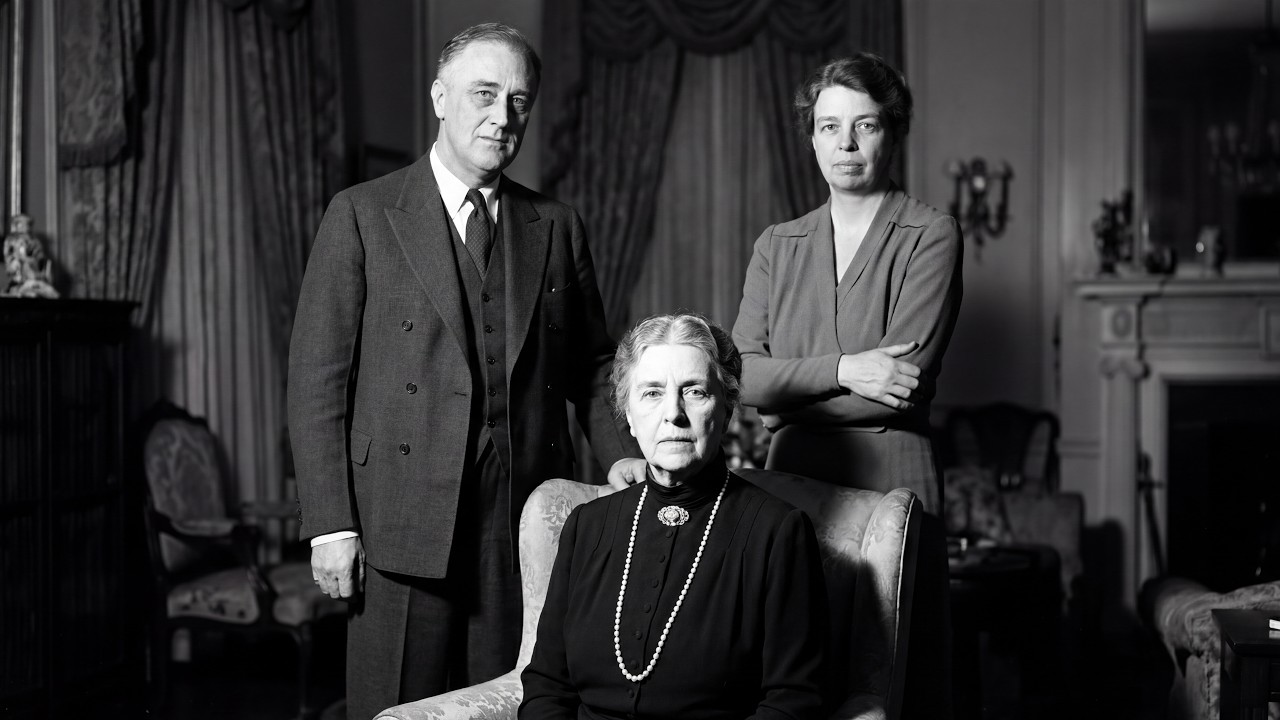
And so Sara Delano Roosevelt passed from her house into her son’s house, and into her daughter-in-law’s marriage, whenever she chose, for twenty-five years. The two town houses on East 65th Street in Manhattan shared a single front and a single grand entrance, so that a visitor climbing the steps could not tell where one home ended and the other began. On the upper floors they opened into one another so completely that a single large room could be made simply by opening the doors between them. It was not a duplex with a polite shared wall.
It was one household wearing the costume of two. Sara had commissioned them as a wedding gift for Franklin and Eleanor, a matched pair designed by the fashionable architect Charles Platt and finished in 1908. One house was for the young couple. The other was for Sara.
That was the condition of the gift. She would build them a beautiful home, and she would live in the identical house pressed against it, wall to wall, for the rest of her life. Inside, Eleanor could not have a conversation with her husband that his mother could not interrupt. She could not discipline a child, host a friend, or weep in private without the possibility that Sara would drift in through the connecting door.
The house was a machine for surveillance, though no one would have used so ugly a word about so elegant a building. It was built of good brick and fine plaster, and the unspoken understanding that the older woman was always entitled to be present. Franklin found the arrangement perfectly agreeable. He had lived his entire life inside his mother’s orbit, and her nearness was not a burden to him but a comfort, the familiar warmth of the only home he had ever known.
What was suffocating to his wife was simply air to him. The very closeness that imprisoned Eleanor was the closeness Franklin had been raised to need, and so he could never quite see the bars, because to him they had always just been the shape of love. Eleanor remembered the early days in that house as a time when she never felt the home was truly her own. She had not chosen it.
She had not planned it. She had not furnished it. It had been given to her complete by a woman who intended to remain inside it. A gift can be a cage if the person who gives it never truly lets it go.
Sara never let go of anything she gave. To understand how she had come to hold that power, you have to go back to where the money came from, because the money is where her power began. Her father was Warren Delano II, a senior partner in Russell and Company, the largest American firm in the China trade. He built his wealth on two commodities.
One was tea. The other was opium, which in those years was still a legal article of commerce, and which made men like Warren Delano very rich. By the early 1840s he had prospered enormously. He brought his money home and spread it across waterfront property in New York, shares in railroads, copper mines, coal mines.
He built an estate near Newburgh on the Hudson. Then the panic of 1857 swept much of it away. Warren Delano did not retreat into what was left. In his fifties he went back to China, back to the opium trade, and rebuilt the whole fortune a second time.
When he died in 1898, he left an estate of roughly two million dollars, an immense sum in a century when a working family might live on a few hundred a year. Sara was born into that certainty. She was one of eleven children, though several died young, two as small children and three more in their twenties, so death was familiar to her before she was grown. She spent three years of her childhood in Hong Kong, then returned to Newburgh.
She was educated the way daughters of such families were educated, mostly at home, with a brief interval at a girl’s school in Dresden in 1876. She grew to be tall, nearly five feet ten inches, striking and self-possessed. The money answered to her and to no husband. She was not a woman who would ever be impressed by anyone, and she was not a woman who would ever be intimidated by anyone either.
She was in no hurry to marry, and she had many suitors. When she found what she wanted, it did not look like most marriages of her time. The man she chose was old enough to be her father. His name was James Roosevelt, a widower and a courtly Hudson Valley squire with a fine estate at Hyde Park called Springwood, a man of horses and railroads and country dignity.
When Sara married him in 1880, she was twenty-five and he was in his early fifties. She had chosen a kind, established man who adored her and who would never seriously contest her will. In a marriage like that, the younger partner holds the future. Two years later, on the thirtieth of January 1882, at Springwood, she gave birth to her son.
They named him Franklin Delano Roosevelt. The birth was difficult, and afterward the doctors told Sara what they told many women of her era in careful final language. She should not have another child. And so the shape of the rest of her life was set.
She would have one heir, one boy, one vessel for everything she was and everything she intended to become through him. Most wealthy mothers of the Gilded Age handed their children to an army of servants. Sara refused that arrangement completely. She kept Franklin close, almost startlingly close.
She taught him to read herself. She taught him geography. She supervised his lessons, chose his tutors, and kept him out of conventional school far longer than was usual. She kept a diary of his childhood.
She saved his hair, his first shoes, the small relics of a boyhood she was documenting like a curator. She loved her son with a fierce and genuine devotion that never wavered for the rest of her life. But love and control are not opposites, and in Sara they grew from the same root. She did not simply adore Franklin.
She organized him. She decided what he wore, whom he saw, where he traveled, and how he understood his own place in the world, which was that he was exceptional, and that his mother was the source and guardian of that exceptional destiny. James Roosevelt was often ill in Franklin’s later boyhood, his heart weakening through the 1890s, and this only drew mother and son closer. When James died in 1900, Sara was forty-five and Franklin was eighteen, about to enter Harvard.
She did not grieve into stillness. She packed up and moved to Boston to be near her son at college, taking a house so that she could remain within reach of him during his student years. Wherever Franklin went, Sara would follow, and she would be close enough to reach him. The boy had never in his life made a major decision without her.
Now the man was about to try, and the first thing he would try to decide for himself was the one thing his mother was least willing to surrender. He was going to choose a wife. The young woman was Eleanor Roosevelt, Franklin’s own distant cousin, a tall, shy, serious girl who had lost her mother at eight and her father not long after, and who had grown up starved for exactly the warmth and belonging that the Roosevelt family seemed to offer. Franklin fell for her while he was still at Harvard, and in the autumn of 1903 he asked her to marry him, and she said yes.
Sara was appalled, though she was far too well bred to show it crudely. Franklin was twenty-one, far too young in her mind to bind himself, and beneath the reasonable objection lay the unspeakable one. She did not want to share him with anyone. So she maneuvered first.
She demanded secrecy, insisting the engagement be kept hidden for a full year, telling the young couple that time would prove whether their feelings were real. It was a delaying tactic dressed as prudence, and it bought her twelve months to work on her son. Then she deployed distance. In the winter of 1904 she took Franklin away on a cruise through the Caribbean, a long sunlit separation designed to let the ordinary heat of a young romance cool in the absence of its object.
She surrounded him with other company. She reminded him in a thousand small ways of the life of comfort and closeness that waited for him, if only he remained a little longer, entirely hers. It did not work. Sara Delano Roosevelt, who won almost every contest she ever entered, lost this one.
Franklin was charming, evasive, and outwardly obliging, but underneath the pleasant surface he was as stubborn as she was, and he did not let go of Eleanor. When the year of secrecy ended, the engagement stood. On the seventeenth of March 1905, Franklin and Eleanor were married in New York. The bride was given away by her uncle, the president of the United States, Theodore Roosevelt.
And for a moment, the wedding belonged to everyone but the groom’s mother. But Sara did not sulk and she did not withdraw. She simply changed her objective. If she could not stop Franklin from having a wife, she would make certain the marriage happened on her terms, inside her world, under her roof, and within her reach.
She would lose the engagement and win the household. The wedding was barely over before she began arranging the young couple’s life: their home, their servants, their furniture, their holidays, their money. On one side stood a bride of twenty, an orphan with no mother to guide her, no fortune of her own, and no home to call hers. On the other side stood a mother-in-law of fifty, in command of a fortune approaching a million dollars in her own name, mistress of Springwood, and possessed of forty years of unbroken habit in getting exactly what she wanted.
Eleanor had love and youth. Sara had money, property, and will. In the world of 1905, money, property, and will were the things that decided who ruled a family. Sara hired the servants, and the servants understood whose authority truly ran the house.
She chose the furniture, the curtains, the carpets, the placement of every table and chair. When the wife gives one instruction and the mother-in-law gives another, the staff obey the woman who pays them and who will still be there in command long after the young wife’s tears have dried. In the earliest years, Eleanor leaned on her mother-in-law as a kind of substitute mother, turning to her for guidance, grateful for the direction. The two women were, for a time, genuinely close.
But dependence and resentment are often the same feeling seen from two different years. What comforted Eleanor at twenty began to strangle her at twenty-five. She was bearing children now, one after another, and she discovered that even her babies were not entirely her own. She would give an instruction and find it quietly reversed.
She would set a rule and watch her mother-in-law dissolve it with a grandmother’s indulgence. She recalled sitting down and weeping, overwhelmed, telling her husband that she did not feel this life was really hers, that she was living someone else’s idea of a home. She could not name the enemy, because the enemy was kindness, generosity, and love, all deployed as instruments of control. How do you fight a woman who is only ever trying to help you, who gives you everything, who asks nothing except the right to decide?
You cannot fight her directly. You can only slowly begin to build a self she cannot reach. And there was one more fact that made Eleanor powerless, the quiet engine of all of it. The future president of the United States did not control his own money.
When James Roosevelt died in 1900, he did not leave his fortune outright to his young son. He left the family resources largely in the control of his widow, and Sara now sat at the center of all the wealth that mattered in Franklin’s life. She did not hand him his independence in one clean gift. Instead, she gave him money the way a sovereign grants favors, in a long series of large gifts spread across the decades.
A sum here for a house, a sum there for a debt, a venture, a comfort. Each gift was generous. Each gift was also a renewal of the same lesson. The money came from her, and what comes from her can be given again or, if she chooses, stop coming.
A man who inherits a fortune is free. A man who is given his fortune in installments by his mother is not free. He is dependent, permanently, structurally. Franklin could rise through the New York legislature, serve in Washington as assistant secretary of the Navy, run for national office, and still at the end of the day the roof over his family and the money in his accounts traced back to a decision his mother had made and could unmake.
She had built a leash of pure gold, and she let it out a long way, and she never once let go of the other end. The grandmother, meanwhile, claimed the children. She told one of her grandsons, James, a sentence no mother should ever have to hear about her own child. Your mother only bore you, she said to him, in effect.
I am more your mother than your mother is. It was not shouted in anger. It was offered as a kind of loving truth. She spoiled the children in the way only a wealthy and determined grandmother can.
She gave gifts their parents had not approved. She softened rules their mother had set. To a child, the choice was simple. Down one hallway lay correction and worry.
Down the other lay treats and adoration. Every rule Sara relaxed made Eleanor look like the villain. Every gift Sara gave made Eleanor look poor by comparison, though the family was rich, because the wealth was Sara’s to give. And in the middle stood Franklin, who loved his mother, loved his children, was fond of his wife, and had spent his entire life avoiding open conflict with the woman who had raised him.
He would not take Eleanor’s side against his mother. He rarely took anyone’s side against anyone. He smiled and charmed and let the tension flow around him like water around a stone. His refusal to take a side was itself a decision, and the person it failed was his wife, who learned that in any contest with his mother, she would be standing alone.
In the autumn of 1918, Eleanor opened her husband’s luggage and found the evidence that would nearly end the marriage. Franklin had been serving in Washington as assistant secretary of the Navy and had just returned from a trip to Europe, ill with pneumonia and influenza in the terrible pandemic year. As she unpacked his belongings in the ordinary domestic act of caring for a sick husband, she found a bundle of letters. They were love letters, written to Franklin by a young woman named Lucy Mercer.
And Lucy Mercer was Eleanor’s own social secretary, a beautiful, gracious woman who had moved through the Roosevelts’ Washington life as a trusted friend. Eleanor understood in an instant what the letters meant. Years later she would say that the bottom dropped out of her world in that moment. What Eleanor did next was extraordinary for a woman of her time and class.
She did not swallow it in silence. She offered Franklin his freedom. She told him that if he wanted Lucy Mercer, she would give him a divorce. Divorce in 1918 among people of the Roosevelts’ standing was a scandal that could end everything.
But Eleanor would not hold a husband who loved someone else. She laid the choice at his feet and waited. And now the crisis reached the one person who was never willing to let anything in this family happen by chance. Sara learned of the affair and the offer of divorce, and she reacted not with a mother’s tears but with a strategist’s clarity.
A divorce would disgrace the Roosevelt and Delano names. It would humiliate the family before all of society. And with a cold and accurate political sense, Sara understood something else. A divorce would destroy Franklin’s career.
In that era, a divorced man who had abandoned his wife and children for his mistress could not hope to rise in public life. The presidency that no one yet knew was coming would have been over before it began. Sara did not plead with her son to stay married. She reached for the one weapon he could not ignore.
She told Franklin that if he left Eleanor for Lucy Mercer, she would cut him off. Not scold him, not weep over him. Cut him off from the family fortune, from the money that had housed him and funded him and cushioned every day of his adult life. The mother who had spent twenty years handing her son his living in careful gifts now made the meaning of those gifts perfectly clear.
They could stop. Franklin was forty-six years old, the father of five, a rising national figure, and he still could not afford, in the most literal financial sense, to defy his mother on the question of his own marriage. The leash of gold pulled tight, and it held. Sara reinforced the financial threat with the political one.
Divorce, she reminded him, would end everything he had worked for. And Franklin, whatever he felt for Lucy Mercer, was a deeply ambitious man raised from the cradle to believe he was destined for greatness. Faced with the loss of his mother’s money and the ruin of his career, weighed against a love affair he could not openly keep, he made the calculation that a certain kind of ambitious man always makes. He chose the future over the feeling.
He agreed to end the affair. He promised never to see Lucy Mercer again, and he stayed married to Eleanor. It may be the most important thing Sara Roosevelt ever did, and almost no one remembers she did it. Because Franklin stayed married, his career survived, and he went on to become governor of New York and then president of the United States four times, leading the country through its worst economic collapse and through a world war.
Every one of those world-shaping years rests, at least in part, on a decision made in a private family crisis in 1918, and on a mother willing to threaten her own son with poverty to force his hand. Sara did not save the marriage for Eleanor’s sake, and she did not save it for love’s sake. She saved it for the sake of the family name and her son’s destiny. Eleanor stayed married, but the marriage that survived was never again a true romance.
It became a partnership, a working alliance between two people who respected each other and built extraordinary things together. Eleanor had been spared the scandal of divorce and handed in its place a lifetime beside a husband she now knew had loved someone else. Franklin did not in the end fully keep his promise. Lucy Mercer remained a presence at the far edge of his life for decades.
She would be with him on the day he died in 1945 at Warm Springs, long after Sara herself was gone. Three years later, a swim in cold water at Campobello left the strongest man in the family unable to stand. It was August of 1921. Franklin had spent a long day of vigorous activity, sailing, fighting a small brush fire, swimming in the chilly bay.
That night he felt a chill and an ache he could not shake. Within days a fever took hold, and then something far worse. His legs weakened, and then failed, and then went still. The paralysis climbed.
The illness was diagnosed as polio, the disease that terrorized families across the early twentieth century, striking without warning and leaving its victims crippled or dead. Some later researchers have questioned the exact diagnosis, suggesting another paralytic illness may have been the true cause. But for Franklin and everyone around him in that terrifying summer, the reality was simple and merciless. He was thirty-nine years old, paralyzed from the waist down, and no one knew if he would ever walk or stand or return to public life again.
Sara looked at her paralyzed boy and reached a conclusion that was from her point of view entirely loving. Franklin should stop. He should give up the brutal, punishing world of politics. He should come home to Hyde Park, to Springwood, to the estate she controlled, and live out his life quietly as a country gentleman, cared for and protected, safe from the strain public life would place on a broken body.
She wanted her son home. She wanted him hers again. A paralyzed man could not campaign. He could not stride onto stages or shake ten thousand hands.
Surely, Sara reasoned, the sensible, safe, loving course was retirement. But there were two other people in that house, and they saw the paralyzed man on the bed and reached the exact opposite conclusion. One was Eleanor. The other was a small, rumpled, chain-smoking political operative named Louis Howe, Franklin’s fiercely devoted adviser, who had staked his own life on the belief that Franklin Roosevelt would one day be president.
They understood something Sara either could not see or could not accept. For a man like Franklin, retirement would not be safety. It would be a slow death of the spirit. To take away his ambition would be to take away the thing that made him want to live at all.
The battle did not happen in a single dramatic scene. It happened over years, in the long, grinding struggle of Franklin’s rehabilitation, and Sara lost it inch by inch. Eleanor and Louis Howe kept Franklin connected to the political world when his mother wanted him withdrawn from it. Howe handled correspondence, kept Franklin’s name alive in party circles, and fed his hunger to matter.
Eleanor forced herself out into public and political work, in part to keep the Roosevelt name active while her husband could not, becoming a stand-in for a paralyzed man and in the process becoming a formidable public figure in her own right. And Franklin himself, whatever his mother wished, chose the fight. He threw the whole of his considerable will into the attempt to recover, spending years and a fortune in pursuit of the ability to stand. He found his way to the warm mineral waters of a run-down resort in Georgia called Warm Springs, where he believed the buoyant water helped his wasted legs, and he poured himself into the effort of rebuilding his body and through it his career.
He learned to appear to walk, gripping a strong arm and swinging his locked and braced legs forward in a punishing performance of normalcy that hid the full extent of his paralysis from the public for the rest of his life. The verdict came in 1928. Franklin Roosevelt ran for governor of New York, and he won. The paralyzed man his mother had wanted to tuck away at Hyde Park was now the chief executive of the most populous state in the union.
Four years later, in 1932, in the depths of the Great Depression, he was elected president of the United States. Sara had wanted something for Franklin with the whole of her heart and been refused. In the cruelest irony of her life, the very sense of destiny she had built into Franklin from birth was the thing that now carried him away from her and into history. She had made him too large for the small, safe life she wanted to give him.
In 1933, Franklin and Eleanor finally moved into a house his mother did not own. It was the White House, the first home of Franklin Roosevelt’s entire adult life that had not been built, bought, furnished, or controlled by Sara. For the first time in twenty-five years, there were no connecting doors. But do not imagine that Sara faded quietly into the background.
She remained the absolute mistress of Springwood, the Hyde Park estate, which she kept in her own name and ran exactly as she pleased until her dying day. When Franklin came home to Hyde Park, he came home to his mother’s house, run by his mother, furnished by his mother, on land that belonged to her. In 1932 she achieved a small distinction that captured her whole life in miniature. She became, it is said, the first mother in American history to cast a vote for her own son for the presidency.
Women had only won the vote nationally a little more than a decade before, in 1920, when Sara was already an old woman of sixty-six. For the whole of her adult life she had exercised more real influence over the course of events than almost any voting man in America, entirely from inside the private world of the family. Now, at the very end, the law finally offered her the small formal power of a ballot, and she spent it on her son. Sara died on the seventh of September 1941 at Springwood, at the age of eighty-six.
Franklin, the president of the United States, was at her bedside. The family would tell ever after a strange and haunting story about the hour of her death. They said that minutes after Sara died, the largest oak tree on the Hyde Park estate crashed to the ground on a clear and windless day, as though the land itself had felt her go. It is almost certainly a legend, not a fact, but it endured in the family’s memory because it felt true to who she had been.
Franklin was devastated. He wore a black mourning band on his arm for weeks. He was still wearing it that December when he sat down to sign the declaration of war against Japan after the attack on Pearl Harbor. The most famous photographs of that world-changing moment show the president with a band of mourning on his sleeve, grieving his mother even as he led the nation into the greatest war in its history.
But the most revealing response to Sara’s death came from Eleanor. In public, in her newspaper column, she wrote a generous and gracious tribute. She praised Sara’s strongest trait, her deep loyalty to her family. She wrote honestly that Sara had not been only sweetness and light, that there had been in her a streak of jealousy and possessiveness where her own were concerned.
But the public verdict was on the whole kind and dignified. And then, in private, in a letter to a friend, Eleanor told the truth she could not print. She wrote that it was dreadful to have lived so close to someone for thirty-six years and to feel no deep affection and no real sense of loss. Thirty-six years, from 1905 when a frightened orphan of a bride married into Sara’s world, to 1941 when the old woman finally died.
Thirty-six years of living wall to wall through connecting doors, sharing a husband and a son, raising children in the shadow of a grandmother who claimed them. And at the end of all those years, standing at the graveside, Eleanor searched her own heart and found no grief there. Only the strange hollow relief of a woman released from a presence that had pressed against her for the whole of her adult life. Sara had won almost everything.
She had won the house, the money, the children’s affection, the great marriage crisis, the pride of a president’s son. But she had not won the genuine love of the other woman in her family. She left a fortune of between twelve and thirteen million dollars before taxes. She left a son who was president of the United States.
She left grandchildren she had spoiled and a daughter-in-law she had shadowed. And she left Springwood, the estate she commanded until her last breath, preserved as a national historic site, where visitors walk through the rooms she furnished, and which her son tellingly refused to change even after she was gone. He could run the free world, but he would not move his mother’s furniture. The twin town houses on East 65th Street still stand restored, and they now belong to Hunter College, where the very rooms in which Sara ruled her son’s household serve as a public policy institute, a place where people study how power works.
On the Lower East Side of Manhattan there is a park that carries her name, Sarah Delano Roosevelt Park, dedicated while she still lived. And here is the final turn. The daughter-in-law Sara spent thirty-six years trying to contain did not stay contained. Eleanor Roosevelt walked out of that fortress of connecting doors and became the most influential first lady in the history of the United States, a champion of the poor and the powerless, a force in her own right on the world stage.
And she became that person in part because of Sara, in reaction against the airless, controlled world the older woman had built around her. The matriarch who ruled from inside the home helped create the very woman who would break the mold of the woman in the home. Sara never held an office. She never ran a company.
She never cast a vote until she was nearly eighty. In a country that gave women like her no throne, she took the one that was left. She ruled the house. She ruled the money.
She ruled the man the whole world believed was in charge. She built her life on being unavoidable, and she made possible, in ways she would never have understood or approved, the freer and larger lives of the women who came after her, starting with the very daughter-in-law who could not wait to be free of her.
