In 1928, in a brick building in Stockton, California, a doctor sat down with a patient and asked whether he had ever been sterilized. The man said no. The doctor suggested they operate while he was there. The man wanted to know whether it would bring better composure to the nervous system.
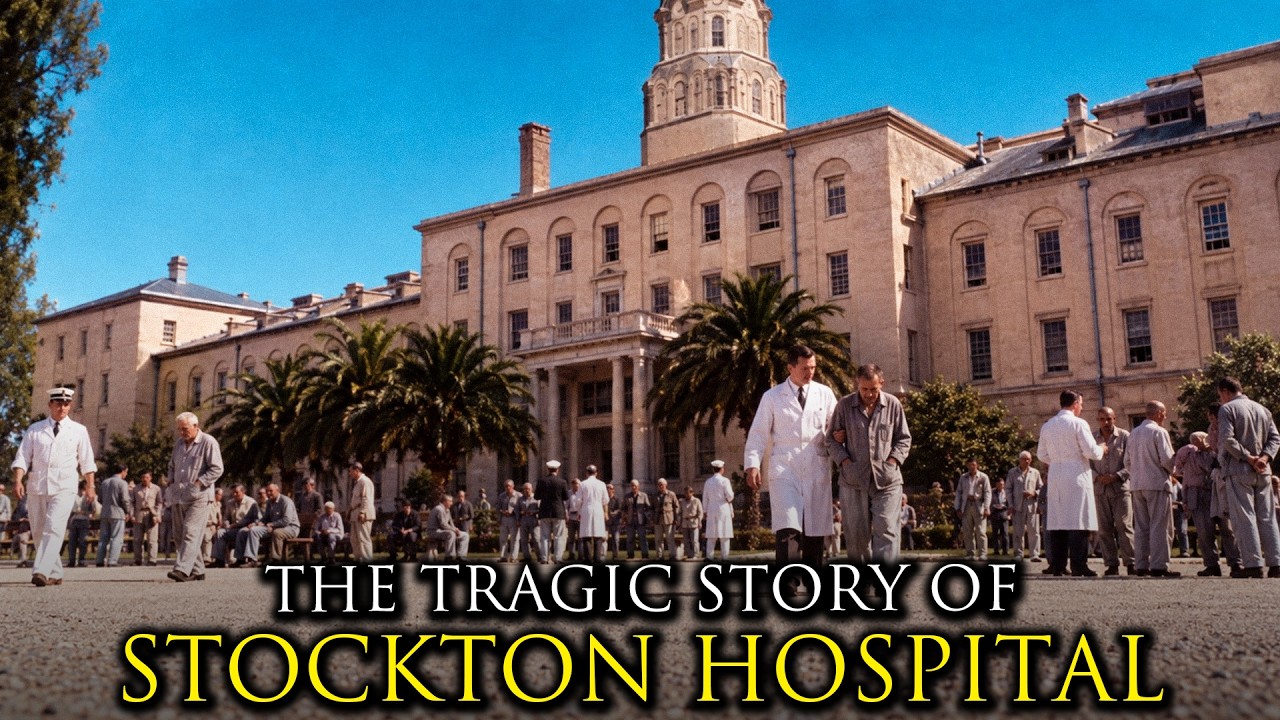
The doctor said it was supposed to. Then the patient said, “I will be very much obliged to you, sir. ” That was the consent. By then, this one hospital had sterilized nearly 1,500 people, and every chart called it good medicine.
The building was Stockton State Hospital, 77 years old in 1928, the first hospital of its kind in California and the first publicly funded asylum west of the Missouri River. The women’s building carried a tower rising more than 200 feet, and river pilots working the Stockton Channel steered by it. The tallest thing in the city was the place the state put the people it could not fix. The law that allowed it was passed on April 26, 1909, and signed by Governor James Gillett.
It let the medical superintendent of a state institution sterilize a patient if the operation would improve, in the statute’s own words, his or her physical, mental, or moral condition. No court, no hearing, no judge, no appeal, no lawyer for the patient. One doctor’s opinion recorded in a chart was the entire process. California was the third state to pass such a law; within twelve years, it was performing eight out of every ten sterilizations in the United States, and Stockton was where they got good at it.
To understand how California’s first asylum became the place that perfected this operation, you have to go back to a boat: a rotting British brig tied up in San Francisco Bay with men chained inside it. Gold was found at Sutter’s Mill in January 1848, and in four years California’s population went from about 14,000 to more than 380,000. A great many arrived with nothing and had no way home. San Francisco had no jail, so on October 8, 1849, the town council bought the abandoned hulk of a brig called the Euphemia for $3,000 and anchored her off what is now Jackson and Battery Streets.
A legislative report from 1850 counted the insane of California: 22 people, all in San Francisco, fourteen locked in the station house, five secured on the brig. That was the entire mental health system of the state. The legislature’s answer was a general hospital at Stockton, created on April 30, 1851. It was not built; it was rented.
The state took a shabby wooden building of ten or twelve rooms that had been in turn a saloon, a lodging house, and a ten-pin bowling alley, and opened it in August 1851 with thirteen patients brought off a ship anchored in the slough. It filled immediately. The Presbyterian minister in town recalled that every building on Market Street between Center and El Dorado had to be pressed into service. He also recalled what he saw in the backyards of those buildings more than once: patients chained to the oak trees, because there was nowhere else to put people.
The man in charge was Robert King Reed, 31, son of a Protestant minister from Erie, Pennsylvania. Gold pulled him west like everyone else; when the state needed a resident physician, he was the doctor who was there. In 1852, a physician from a Sacramento hospital talked the legislature into building a separate institution. The location was decided by a gift.
Captain Charles Maria Weber, the German-born founder of Stockton, offered the state roughly 100 acres north of Park Street. In May 1852, the legislature ordered every mental patient in California moved to Stockton. Fifty-four people came in wagons and on steamers, delivered to the former bowling alley. On May 17, 1853, the Stockton General Hospital changed its name to the Insane Asylum of the State of California.
In October, the patients were walked out of downtown onto the Weber land, into a two-story brick wing and a wooden building with a ten-foot fence around a two-acre yard. It was built for 80 patients; within a short time it held 102. Reed ran it on a principle called moral treatment, the most advanced idea in the field. He instructed his attendants to abstain from violence and to cultivate the patients’ self-respect.
He put people outdoors to work when he could. In his annual report for 1855, he wrote a sentence a man would only write if he knew exactly what the alternative looked like: “There is not a single cell in or about the establishment. ” His case notes survive in the state archives. One entry reads like a different world: in December 1852, an 18-year-old from New York, a professor of drawing and painting who had been working on a map for sixteen days and nights, and who was in love with a ventriloquist named Kate Hayes, had been bled, blistered, and purged before arriving.
Reed prescribed tincture of iron wine, a nutritious diet, and an opiate at bedtime. The patient was discharged four weeks later, sent home to his father. That is how fast it could work when the place was small. It was never going to stay small.
In 1856, the Know Nothing Party took the governorship, and the new governor wanted Reed’s job for one of his own men. The legislature refused to remove him; the governor simply declared the office vacant. It went to the California Supreme Court, and the court ruled for the governor. In April 1856, the man who had written that there was not a single cell in the establishment walked out of it.
Reed went to Paris, studied in the clinics there, returned to Stockton in 1860, served in the Union Army as a colonel, and practiced in the town until he died in 1891, having outlived his own reforms by about thirty years. His successor lasted fifteen months and fought a duel with his own assistant physician. Two doctors employed at the same asylum met with pistols to settle a point of honor; the assistant put a bullet through the superintendent’s knee. Nobody was fired for the duel.
That is the detail to hold on to. A superintendent shot in the leg by his own deputy was a political embarrassment, not a medical scandal. And the patients in the wards were not mentioned in any of it. Next came Dr.
W. P. Tilden, who wrote the single best description of the problem anybody ever managed. Eastern asylums, he said, can be filled, and when they are full, further applications can be rejected.
Stockton, he wrote, was like a Montgomery Street omnibus: “It is never so full that room must be made for another. We have 249 patients more than its utmost capacity can properly accommodate. Yet they come and must be crowded in. We have no right to reject any.
”
Hold that sentence, because everything that follows comes out of it. An institution that cannot turn anybody away and cannot cure people fast enough to make room has only one variable left it can move, and it will eventually find it. Across the country after the Civil War, moral treatment went out of fashion, replaced by apathy and detention. Stockton followed.
The women’s building went up in pieces between 1865 and 1874, costing $249,500, more than seven times the price of the entire original asylum. It was designed to hold 325 women, and out of the center rose the tower, more than 200 feet from the ground. From the top you could see the delta; from the delta you could see it, and the men piloting steamers up the Stockton Channel used it to fix their position. For 75 years, the landmark of the city of Stockton was an asylum tower.
Underneath it, in the hallways, they put chairs. The wings were narrow and the wards were full, so beds and chairs went into the corridors, and patients were strapped into those chairs and sat there. The entire four-story building holding hundreds of women had exactly two chimneys. That is the shape of the thing: a magnificent public monument with people tied to furniture inside it.
The men got their own monument in 1885: a three-story brick building on Grant Street that everyone called the Bricks. It cost $224,000 and held 530 men. The superintendent’s report called it “beautiful and attractive” and noted with pride that the cost worked out at $425 a man. What he did not put in the report: in the basement there were dungeons, and the men the staff called maniacs were locked in them.
There was no heat in the dining room until 1950. For 65 years, the men of Stockton State Hospital ate their meals shivering. In April 1888, a 22-year-old man was pulled out of the Stockton Channel, floating face upward, fully dressed, making no attempt to save himself. He kept repeating one thing: “Let go.
I want to go to my sister who lives in the beautiful water. ” His name was Frank A. Peltret, a reporter for the San Francisco Examiner, and he had come up the San Joaquin River with a plan to have the state of California commit him to its own asylum. He was taken before a judge, examined by two court-appointed physicians who had known him for a quarter of an hour, and pronounced insane.
The whole thing from the river to the ward took a few hours. Inside, they gave him a warm bath. Supper was tea without milk and two pieces of bread. He slept on a straw mattress and did not sleep; the lunatics, he wrote, “whistled, chirped, sang, bellowed, roared, and shrieked until the air vibrated.
” He started counting things because that was the job. Twenty-six patients in his ward. Breakfast of mush and milk and “some very questionable looking black coffee. ” The south yard held about 250 men behind a brick wall twelve feet high.
Above the wall, across the grounds, the tower of the women’s building stood over everything. Dinner was soup, beans, potatoes, and bread. Supper was bread, butter, and tea. Up at five, down at six.
That was the day. Every day. He found an institution that was well-run and humane. He heard of exactly two acts of cruelty, both in violation of a written rule.
What he complained about was that there was nothing to do. There were no workshops, nothing to make, nothing to repair. The superintendent had been begging for workshops since 1886; a bill to build them had passed both houses of the legislature and been vetoed by the governor. Peltret wrote that it was “almost criminal negligence” to delay any longer.
He complained hardest about the arithmetic: three physicians looking after nearly 1,600 patients. More than 500 patients to a physician. Five days after Peltret walked out, the superintendent, Dr. William Henry Mays, stood up at the annual meeting of the Medical Society of the State of California and said out loud that many believed patients sent to Stockton and Napa were in a worse condition when released than when committed.
In his own biennial report that year, he described the moment of discharge with precision: a certificate of recovery restored the patient to citizenship; anything short of that did not. From being “civilly dead,” he wrote, a discharged patient becomes “again a living integer in the Commonwealth. ” That was the legal status of a person inside these walls. A civilly dead person cannot sign a contract, cannot be trusted with property, cannot fully be said to own anything, including, as it turned out, their own body.
Four years later, the most famous woman in California walked through the gate. Sarah Althea Hill had sued William Sharon, the Nevada silver baron and former U. S. senator, claiming she had secretly married him.
Her lawyer was David S. Terry, a former chief justice of the California Supreme Court who had killed a U. S. senator in a duel in 1859, and who married his client in the middle of the case.
It ended in violence. In 1889, at a railroad lunch counter in Lathrop, ten miles from Stockton, Terry struck Justice Stephen J. Field of the U. S.
Supreme Court, and Field’s bodyguard shot Terry dead. Sarah was in the room. She was never the same afterwards. On March 11, 1892, she was committed to Stockton State Hospital at age 41.
She died there on February 14, 1937 of pneumonia, after 45 years inside, in a ward where almost nobody knew who she had been. The hospital started burying its dead almost immediately. The first burial ground was on the grounds themselves, used from about 1854 until January 1875, with 4,467 known burials. When it was full, the state bought 14 acres beside the Stockton Rural Cemetery and moved some of the bodies.
Of the 4,467, the number carried to the new ground was 1,619. Roughly 2,800 people were left where they were, under the grounds of a working hospital, and the hospital went on operating on top of them for another 120 years. There was no law requiring a cemetery to keep a plot map. Markers were wooden or numbered or absent.
Ledgers were misplaced or thrown out. The state itself has since admitted the scale of it: a legislative resolution from 2010 records that from the mid-1880s to the 1960s, more than 45,000 individuals died while residents of a state institution, and that information about these patients is incomplete for the most part. And in 1909, into a system that was already burying more people than it discharged, California introduced the operation. The Asexualization Act passed both houses unanimously.
It gave the medical superintendent the power to sterilize a patient when in his judgment the operation would improve that patient’s physical, mental, or moral condition. The law was rewritten in 1913 and amended again in 1917, and by 1921 California was performing eight out of every ten eugenic sterilizations in the United States. Why Stockton? Part of it is that Stockton was first and Stockton was full.
A hospital that cannot reject anybody has the strongest possible motive to believe in a procedure that promises there will be fewer people next time. But part of it is one person. Margaret H. Smyth was born in Santa Rosa in 1873, took her medical degree in San Francisco, and came to Stockton State Hospital in 1900 as surgeon and physician.
She stayed 46 years. In 1929 she was made superintendent, the only woman in the United States running a state hospital for the mentally ill. By every contemporary account, she was the best thing that happened to the place in a century. When the hospital’s own historian sat down in 1976 to write her memorial, he listed her achievements in order: national recognition as a psychiatrist, national recognition as a surgeon, and then one more sentence offered with no shadow on it at all.
“The technique for sterilization surgery was perfected by Dr. Smyth. ” That is a tribute printed in a county historical journal by a man who worked at the hospital and admired her. In 1976, it was still possible to write that sentence as a compliment.
What did the operation look like from inside the ward? We know because the hospital wrote it down. Stockton held clinical conferences, and one transcript from 1928 survives almost word for word. A patient describes his symptoms: “I get a little melancholy and then things don’t break quite right and I get quite nervous.
” The doctor’s next question has nothing to do with any of that. “Have you ever been sterilized? ” No. The doctor suggests they operate while he is there.
The patient says it will certainly be all right with him and with his wife also. The doctor explains it will not interfere with his sexual life in any way. The patient says, “It has always been all right with me, and my wife did not want to take the responsibility of signing it. ” Nobody in that room is a villain.
That is the whole horror of it. The doctor believes he is offering a treatment for nerves. The patient believes he is being offered one and is grateful. And his only regret is that his wife hesitated over the form.
The men who promoted California’s program explained in a 1929 book why consent was sought: “This is not required by law and was done mainly to make friends for the law and avoid complaint or possible litigation. ” Consent was public relations. They said so themselves in a book on sale for two dollars. That book had a reader they did not expect.
In 1933, the officials drafting Germany’s law for the prevention of hereditarily diseased offspring referred to it. An American public health official returning from Berlin reported that the leaders of the German sterilization movement stated repeatedly that their legislation was formulated only after careful study of the California experiment. California did not learn this from Germany. It went the other way.
The Stockton program did not stop in 1929 or in 1933 or in 1945. California’s last eugenic sterilization was performed in 1963. By 1950, 26,000 psychiatric patients had been sterilized in the United States, 11,000 of them Californians. The final tally for the state from 1909 to the repeal of the law in 1979 is around 20,000 people, roughly one in three of every such operation performed in the entire country.
Governor Gray Davis apologized for it in March 2003. A compensation program for survivors opened in 2022, and by then there were very few survivors left to apply. While all this was going on, the hospital kept treating people, and the treatments changed roughly once a decade. Before the shock therapies, there was hydrotherapy: the wet pack, in which attendants wrapped a patient in wet sheets then a blanket, and tied the whole thing to the bed; and the continuous bath, in which a patient was fastened into a hammock inside a tub of running water under a canvas sheet with a hole for the head, left for hours.
The first electroconvulsive therapy machine arrived at Stockton in 1943. Then came the lobotomy, and again the hospital stenographers wrote down what happened afterwards, in a conversation between a doctor and a woman who had recently been operated on. “Joan, did you have an operation? ” “Not that I know of.
”
Two of the people inside during these years are remembered now for reasons the hospital had nothing to do with. In 1931, a Mexican migrant laborer was picked up homeless and disoriented and brought to Stockton State Hospital. His name was Martín Ramírez, diagnosed with catatonic schizophrenia, and he stayed in California state hospitals for the last 32 years of his life. At Stockton in the 1930s he started to draw.
He glued sheets of thin operating-table paper together with mashed potato and saliva. He drew with pencil, crayon, and charcoal made from burnt matchsticks; for color, he chewed colored newsprint and spat the pulp into bowls hardened out of oatmeal. Attendants threw the drawings away. He kept making them.
Martín Ramírez produced more than 300 works before he died in 1963, and they now hang in the Guggenheim and sell for sums that would have rebuilt a ward. He made them out of rubbish on a locked corridor in the same institution that in the same years was recording sterilizations as a therapeutic success. The other man had been world lightweight champion. Ad Wolgast, the Michigan Wildcat, held the title from 1910 to 1912.
By the 1920s, the damage in his head had caught up with him, and he was committed to Stockton in 1927. He lived there for decades, still shadow boxing, still training for a title fight that had been over for a generation. In 1949, two employees of the hospital beat him. The assault put him in a hospital bed, and he never really got out of one again.
He died in 1955, 43 years after he lost the title. 1949 was also the year the tower came down. Demolition of the women’s building began on July 1. The reasons given were all practical and all true: it had become a fire hazard, repairs cost more than the building was worth, and the whole structure had a depressing effect on everyone in it.
The mark the river pilots had steered by for three-quarters of a century was knocked into a pile. The Bricks lasted longer, shut down ward by ward through 1958 and demolished in 1964; contractors pulled three and a quarter million bricks out of it. The population had peaked in 1956 at 4,878 people in a place built for 80. Then it fell, for reasons that had almost nothing to do with psychiatry: Social Security gave the elderly somewhere else to be; the new antipsychotic drugs emptied the back wards; the state started paying 90 percent of the cost of county programs.
By October 1973, there were too few mentally ill patients left at Stockton to justify running the programs at all. The state changed what the hospital was for, moved in people with developmental disabilities, and renamed the place. First the Stockton Residential Facility, later the Stockton Developmental Center. Nobody was going to call it an asylum.
The ending came from a lawsuit. In February 1990, an advocacy organization filed suit on behalf of 950 people living in California’s developmental centers. The settlement, approved in January 1994, required the state to move 2,000 people out of its institutions within five years and to stop admitting new ones; two institutions had to close. Stockton was one of them.
In February 1996, 145 years after thirteen men were carried off a boat into a rented bowling alley, the oldest hospital in California shut its doors, and the patient records that had sat in that filing room since 1852 were carted off to the state archives in Sacramento. California State University, Stanislaus moved onto the 102 acres in 1998 and teaches in the hospital’s own buildings. Bones keep coming up. Remains were unearthed in 1990 and again in the mid-2000s during construction.
The legislature’s own record notes that 42 sets of remains dug up at the university were reinterred at the Stockton Rural Cemetery with a monument, because there was no way on earth to work out who any of them had been. The same resolution made the third Monday of every September a day of remembrance for them. There is a marker now on the campus a few hundred feet from where the tower stood.
And in the ground beneath the lake and the fountain lie somewhere in the region of 2,800 people whose only surviving record is a subtraction.
