The train was already moving when she leaned out of the window, one hand gripping the frame, the other raised in a wave toward the platform. Below her stood a man and a five-year-old girl, the husband and the daughter she was leaving behind in Berlin. The night before, Marlene Dietrich had been given the ovation of her life in that city, and she was leaving anyway. The man she was leaving with was not the man on the platform.
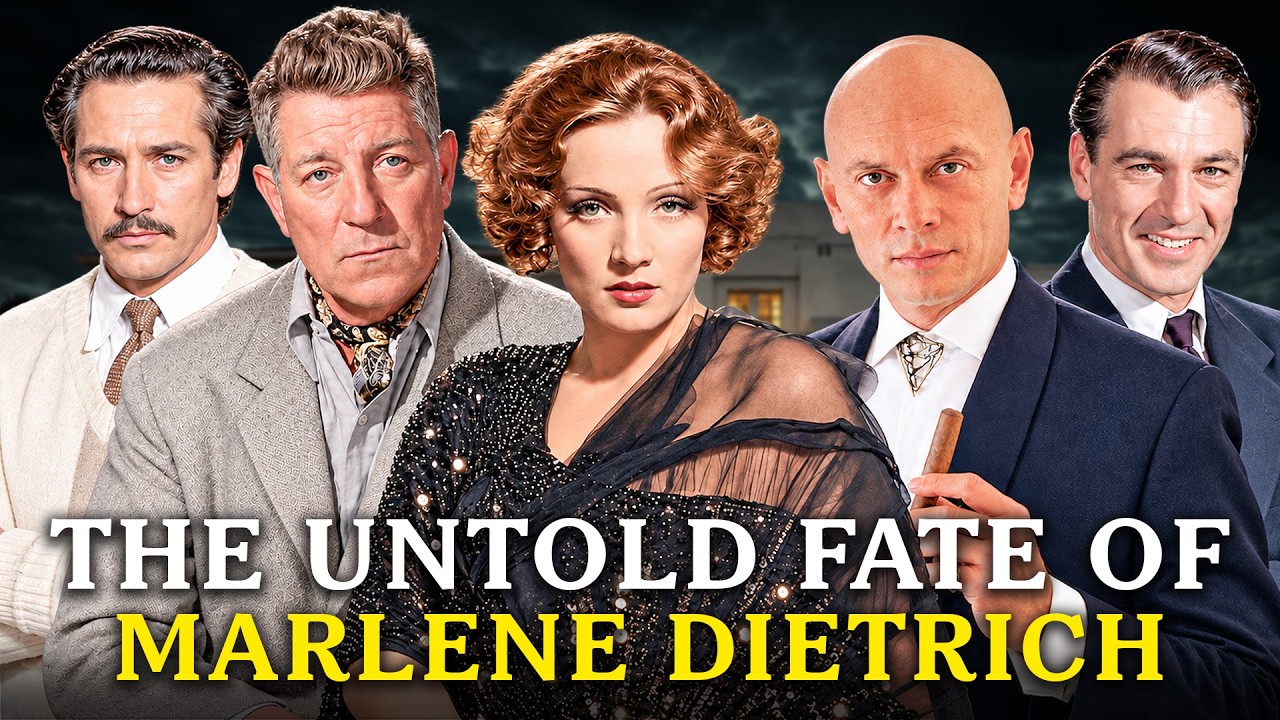
By the time that train reached the coast, a wife in New York had already hired a lawyer. That lawyer would be waiting at the dock. To understand any of the rest of it, you have to start with Josef von Sternberg, because he was the one who built the face the whole world fell for. In 1929, he was an Austrian-born director working in Berlin on a picture called *The Blue Angel*.
He needed a woman to play a cabaret singer who ruins a respectable schoolmaster. The studio wanted somebody else. Almost everybody wanted somebody else. Sternberg went to a Berlin theater one night, watched a young actress lean against the scenery, looking thoroughly bored by everything happening around her, and decided that was the one.
In his memoirs years later, he described that first sight of her with the language of a man describing a conversion. She was twenty-eight. She had been kicking around the Berlin film and stage world for the better part of a decade in small parts, and nothing much had come of it. She had a husband, an assistant director named Rudolf Sieber, whom she had married in 1923, and a little daughter, Maria, born in 1924.
Sternberg had a wife, too, named Riza Royce. What happened on that film set was less a romance than a kind of construction project. He lit her from above until her cheekbones appeared out of nowhere. He made her lose weight.
He made her hold poses until she was in pain. He taught her exactly how far to tilt her chin so the camera would find the line of her jaw. People on that set said he watched her through the lens the way other men watch a fire. The leading man, Emil Jannings, a huge star at the time and the first actor ever to win an Academy Award, grew so resentful of all this attention going to an unknown that he threw tantrums and reportedly threatened her outright during filming.
*The Blue Angel* opened in Berlin at the end of March 1930. It was a triumph. That same night, the director and his discovery got on a train and left the country together, bound for Paramount and a Hollywood contract. Riza Royce found out.
She got to America ahead of them. When the ship docked in New York, she was waiting with her attorney, not to make a scene but to serve papers. She sued over remarks attributed to the actress in a European magazine, and she sued over the collapse of her marriage. She filed for divorce from her husband a month later.
The suits made headlines on two continents. They were eventually settled, and Royce did not win, but the message had landed, and it landed permanently. This was a woman who would be followed by other people’s wives for the rest of her life. The strange part is what the affair became afterwards.
Over five years they made seven films together: *Morocco*, *Dishonored*, *Shanghai Express*, *Blonde Venus*, *The Scarlet Empress*, *The Devil Is a Woman*. And in that time, he watched her take other lovers openly, one after another, and kept lighting her anyway. Colleagues at Paramount noticed the dynamic tilting. On the set, he was in absolute command.
Off it, he was the one waiting. There was a period in the early 1930s when she went back to Germany for a while to see her husband and daughter and to get away from a set of reviews she had not enjoyed. He stayed in California and directed something else entirely, and people around the studio noticed that he was not really there while he did it. When she came back, the arrangement resumed exactly as before.
Critics had begun to complain that the films they made together were becoming too styleless, too much about the lighting and not enough about anything else, and that she ought to work with somebody new. She refused. For a while, she would not be directed by anybody but him. By 1935, he had had enough and ended the working partnership himself.
Her career wobbled badly without him. His never really recovered at all. He went on directing for decades, wrote a famously prickly autobiography, and died in 1969. And no matter what else he did, the first line of every article about him was about her.
Now, the odd thing is that the man she left standing on that Berlin platform, the actual husband, did not disappear. He didn’t divorce her. He didn’t fade out of the story. He stayed married to her for fifty-three years.
And what he agreed to live with is stranger than anything Hollywood put on a screen. Rudolf Sieber was a Czech-born assistant director. They met in 1923 on a film set in Berlin, married that same year, and had their daughter the year after. And then, in every conventional sense, the marriage stopped.
But it never ended. For the next five decades, she was legally, publicly, permanently Mrs. Rudolf Sieber. He lived apart from her, first in Europe, later in California, where she bought him a ranch in the San Fernando Valley, and he raised chickens on it.
She supported him financially for most of his adult life. They wrote and telephoned constantly. She called him by an affectionate nickname to the end of his days. And when she needed advice on a contract or a co-star or a haircut, he was the one she asked.
She also sent him her love letters. This is the detail that even people who know the outline of her life tend to disbelieve when they first hear it. As the affairs came and went, she would forward the correspondence from her lovers to her husband, sometimes with her own commentary in the margins, occasionally unkind commentary about the man who had written it. He read them.
He replied. In a collection of 300,000 pages of her papers, now held in Berlin, that private traffic between husband and wife is one of the most consistent threads in the whole archive. Sieber, for his part, had a long-term companion of his own, a Russian emigrant who lived alongside the family for decades in a position that had no name and no security. She was there at holidays.
She was there on the ranch. She was never the wife, because the wife was never going anywhere, and she could not become the wife because there would be no divorce. Her physical health, and increasingly her mental health, declined badly over the years, and she spent the last part of her life in care, dying in 1965. It is the quietest tragedy in the whole story, and the one that almost never gets told.
Their daughter, Maria, grew up inside all of this. She was on film sets as a child, traveling with her mother, watching the traffic of lovers come and go through hotel suites and dressing rooms with a clear-eyed attention that would eventually produce the most unsparing celebrity biography ever written by a child about a parent. Maria Riva published it in 1992, the year her mother died. She lived to be a hundred, dying in October 2025.
And until the end, she described herself with a kind of tired accuracy as having been her mother’s handmaiden more than her mother’s child. Riva’s account is where most of what follows comes from: the diaries, the letters, the names. And one of the first names in it belongs to a man that half the women in America were in love with in 1930, who found himself acting opposite a newcomer who had been in Hollywood for about ten minutes and who treated him on their first meeting as though he were part of the furniture. Her first American film was *Morocco*, released in 1930.
Her co-star was Gary Cooper. Cooper at that moment was twenty-nine, extremely famous, and involved with the actress Lupe Vélez, a relationship conducted at a volume you could hear from the street. He was used to a certain effect on women. The new German arrival produced instead what everyone around her always described first: indifference.
Cool, total, slightly amused indifference. It was the same thing Sternberg had seen in that Berlin theater, and it worked on Cooper exactly as well as it had worked on the director. The affair ran through the production on the set. It caused a particular kind of friction, because Sternberg was directing and Sternberg spoke to her in German constantly, and Cooper, who did not speak German and did not enjoy being discussed in a language he couldn’t follow, objected loudly.
There are accounts of him telling the director in plain American English what he thought of the whole arrangement. *Morocco* made her a star in America and got her an Academy Award nomination, her only one. It also produced the scene everyone still knows: the singer in white tie and tails who kisses a woman in the audience and then moves on without breaking stride. It was 1930.
Nobody had seen anything quite like it. The tailoring became a signature, the suits, the trousers, the hats, and it changed what a beautiful woman was allowed to look like for the rest of the century. The Cooper affair burned out quickly and left no damage, which was rare. They worked together again in *Desire* in 1936 and got on perfectly well.
Around the same period, there was Maurice Chevalier, the French singer, and later the English actor Brian Aherne, and Douglas Fairbanks Jr. , who pursued her in London and wrote her letters that survive in the archive. But of that whole early Hollywood run, one affair ended in a way that stayed with her for the rest of her life. A man who had been the biggest star in the world, who had lost almost everything by the time she met him, and who had months to live.
John Gilbert had been the great romantic lead of silent film. By the mid-1930s, that was over. His career had collapsed in the transition to sound in circumstances that were part technology, part studio politics, part bad luck, and he had been drinking heavily for years. He was, by every account, a man in free fall.
They met in 1935, and she moved in with him. What she did next is the part that doesn’t fit the ice queen image at all. She tried to rebuild him. She cooked for him.
She was genuinely a serious cook, and people who knew her well said that feeding somebody was her most reliable form of affection. She managed his drinking. She got him swimming and exercising. She used her own leverage at Paramount to get him cast opposite her in *Desire*, the film she was about to make, which would have been the comeback.
He didn’t make it, and it happened fast. He suffered a heart attack during pre-production and had to be replaced. In January 1936, at the age of thirty-eight, he died of another one. She had been with him in the weeks before it happened, and the people around them said she had genuinely believed the plan was working, that the swimming and the schedule and the enormous meals were going to hold.
When it didn’t hold, she took it personally, the way you do when you have decided that somebody is your project as well as your lover. She was devastated in a way her friends had not seen before and would rarely see again. For years afterwards, she kept his memory close, stayed in touch with his family, and spoke about him with none of the lightness she used on almost every other name in her past. Of all the people in this story, he is the one she couldn’t turn into an anecdote.
For a woman with a romantic history this size, the people closest to her were consistent about one thing. Her daughter wrote it plainly: what she actually wanted was not the physical side of any of it. What she wanted was to be adored, to be needed, to be written to, to be the one arriving with soup and clean sheets and total devotion. The conquests were almost a byproduct.
Which is exactly why the next set of relationships in her life have been argued about for ninety years, the ones conducted with women in a Berlin that has now completely vanished and in a Hollywood that had rules about absolutely everything. She came out of the Berlin of the 1920s, and that matters enormously. That city in that decade had a nightlife culture of extraordinary openness: cabarets, clubs, magazines, a whole visible world that would be shut down and erased within a few years of her leaving. She belonged to it.
She wore the tails and the top hat on Berlin stages before she ever wore them in front of a camera. She knew the cabaret performers and the songwriters. The celebrated Berlin singer Claire Waldoff was part of that circle, and so was the performer Margot Lion, with whom she appeared on stage in a duet that audiences understood perfectly well at the time. When she got to Los Angeles, she found a much more careful version of the same thing, a network of women in the film business, writers, actresses, and designers who moved in each other’s houses and kept each other’s secrets.
Hollywood gossip of the period had a nickname for it. The studios knew. The studios also had morality clauses, and a press corps that could be managed. And so it stayed where it was.
The best documented of these relationships was with Mercedes de Acosta, a Cuban-American writer and poet who lived at the center of that circle for decades. De Acosta had a long, complicated on-and-off involvement with Greta Garbo, and in the early 1930s she and Marlene were involved too. The flowers she sent de Acosta were almost comically excessive. The story of entire rooms being filled with them is one of the enduring Hollywood legends of the era, and the letters between them survive.
Garbo herself is a whole separate mystery. The two of them had crossed paths in Germany in the mid-1920s as young unknowns, and for the rest of their lives, Garbo behaved as though the other woman simply did not exist, would not speak of her, would not acknowledge her, even though they moved in overlapping circles and at times shared the same lovers. Biographers have argued for decades about what happened between them. Nobody has ever settled it.
There were other names attached over the years, some solid, some pure rumor. The wealthy British speedboat racer Marion “Joe” Carstairs is one of the better attested. And much later, in the 1950s, there was Édith Piaf, a bond that was unquestionably one of the deepest of her life, whatever else it was. She served as a witness at Piaf’s wedding in New York in 1952, and she looked after her in the way she always looked after people she loved, which is to say obsessively and with food.
So by the late 1930s, she had a husband she wouldn’t divorce, a director who built her and couldn’t leave her alone, a circle of women the studios pretended not to see, and a run of Hollywood men behind her. What she didn’t have anymore was a career. And the man who walked into her life at that exact moment, the lowest professional point she would ever reach, was one of the most famous novelists alive. And their relationship was about to be interrupted by the invasion of Europe.
She was in Venice on the Lido when she met Erich Maria Remarque. He had written *All Quiet on the Western Front*, the novel about the trenches of the First World War that had become one of the most widely read books on earth and which the Nazi government had banned and burned. He was living in exile in Switzerland. His German citizenship would be stripped from him.
His sister would later be executed in Berlin. They were two Germans abroad, both of them extremely famous, both of them unable to go home. The relationship that started that summer was the most literary of her life. The letters between them are astonishing documents: long, obsessive, jealous, funny, self-lacerating.
He called her by a private name he made up. He wrote her into his fiction; one of his later novels is built around a woman that everyone who knew them recognized immediately. He also wrote in his diaries about the agony of loving a woman who was at any given moment also somewhere else with somebody else. Their timing was terrible in a way that had nothing to do with either of them.
Hollywood had just declared her finished. In May 1938, a trade advertisement placed by a group of independent theater owners listed the stars they said were no longer worth booking, and her name was on it. Paramount bought out the rest of her contract. She was thirty-six, and professionally she was over.
At the same time, the German government came calling. Officials approached her with an offer: come home, make films for the Reich on her own terms, with enormous money attached. She said no. She went in the opposite direction and became an American citizen in 1939.
Her films were banned in her own country, and a very large number of Germans never forgave her for the choice, for decades. The comeback came from an unexpected direction. Universal offered her a western, a saloon singer in *Destry Rides Again*, released in 1939 opposite James Stewart. It worked.
She was funny in it and rowdy, and she got into a full-blown brawl on camera, and audiences who were tired of the smoke and shadows loved it. She also inevitably started an affair with Stewart during filming, which ended when filming ended. He was famously reticent about his private life and said almost nothing about it ever. And then the war arrived properly, and everything about her, the accent, the citizenship, the ambiguity, the glamour, got pointed in one direction.
What she did between 1940 and 1945 is the part of her life she was proudest of. It’s also where she met the Frenchman she would still be calling the love of her life forty years later. Jean Gabin was the biggest male star in France, and in 1941 he was a refugee. He had refused to work under the German occupation and had come to Hollywood, where he joined the other exiled French: Charles Boyer, Jean Renoir, Julien Duvivier.
And there he was thoroughly miserable. He didn’t speak much English. He didn’t like California. He was a solid, granite-faced man from the Paris suburbs who had been dropped into a town of palm trees and publicity photographs.
She had met him before, briefly, in France. This time it took. They set up house together, which she had never really done with anybody. She helped him learn English.
And here the story takes a genuinely absurd turn, because the FBI, watching foreign nationals as a matter of routine, became suspicious of the two of them sitting together with language books, and wondered whether the lessons were cover for something else entirely. They were not. They were language lessons. She cooked for him.
This comes up in every account. She cooked enormous French meals for a homesick Frenchman. And for two or three years, she was as close to domestic as she ever got. His American films flopped, and he hated being a matinee idol in a country that didn’t want him.
In 1943, he did something that changed the shape of the relationship permanently. He enlisted with the Free French forces. He went to North Africa. He became a tank crewman.
He fought his way up through the campaign and ended the war with a Médaille militaire and a Croix de Guerre, riding into Paris with the armored division that liberated it. She followed the war too, in her own way. At one point, hunting for news of him, she went looking for him in Algiers. Then it came apart, and it came apart over things neither of them could negotiate.
He wanted to go home to France and stay there. He wanted a family. He wanted a wife, and she already had a husband she would not divorce, and by then she had also been involved with an American general, which he knew about. They made one film together after the war, *Martin Roumagnac*, released in France at the end of 1946, and it was a failure.
The only time the two of them ever appeared on screen together, and it didn’t work. In November 1946, he wrote to her and ended it, not gently. The letter said he did not want to see her again, and that he didn’t even want to watch the films they had made. By February 1947, it was finally, formally over.
He married somebody else, had the children he wanted, and became a French national institution all over again. She never really accepted it. There are accounts of her years later living nearby in Paris and sitting in a café near his house, watching him and his wife come and go. When Robert Kennedy asked her in 1963 to name the most attractive man she had ever known, she gave his name without hesitating.
And in 1976, in the space of a few months, she lost both of them: her husband of fifty-three years in June, and Gabin in November. She said afterwards that she had now been widowed twice. But to understand what broke that relationship, you have to go back into the middle of the war itself, to the years she spent closer to the front line than almost any other entertainer of her generation, and to the commanding officer who wrecked his own marriage over her. From 1944, she was overseas with the USO, and she stayed out there.
This was not a photo opportunity. She toured North Africa, Italy, and then France and into Germany, performing on the backs of trucks and in field hospitals and in mud, often within range of artillery. She slept rough. She caught illnesses.
She toured with a musical saw in her luggage, an actual saw played with a bow, a trick she’d picked up in Berlin years before. And she would sit on the edge of a stage with her legs crossed and play it for men who had been in combat for months. She did more than sing. She sat with the wounded.
She wrote letters home for men who couldn’t. She recorded German-language broadcasts aimed at enemy soldiers, which, given that her country of birth had banned her, was a remarkable thing to agree to do. She was awarded the Medal of Freedom by the United States, one of the highest honors available to a civilian, and later the Légion d’honneur by France. In the archive of her possessions, those decorations sit alongside the gowns.
The men who saw her out there remembered it for the rest of their lives, and not because she was glamorous. She arrived in the same weather they were standing in, wearing a uniform that had been tailored for her, because of course it had, and she stayed long after the point where anybody would have blamed her for going home. There were nights she performed by the light of vehicle headlamps. There were stretches where the tour moved close enough to the fighting that the schedule had to be rearranged around it.
She was also, all the way through it, conducting relationships. The best known is with James Gavin, at the time the youngest American general commanding a division, the man who led the 82nd Airborne. Photographs survive of her with his paratroopers. The relationship ran through 1944 and 1945 and into the immediate postwar period in Berlin, and it ended his marriage.
His wife filed for divorce. He would later marry again and go on to be an ambassador. She was also close to General George Patton, who at one point handed her a small pistol and told her to use it on herself rather than be captured by German troops, given what she had been broadcasting. She kept it.
And there was Ernest Hemingway, who is often put on the list of lovers and probably does not belong there. They wrote to each other for decades, some of the warmest and funniest letters in the whole collection. By both of their accounts, the affection was total, and the timing was never right. He had a nickname for her.
She adored him. It stayed that way. The war years were, by her own reckoning, the best years of her life. She was forty-three when they ended.
She had no film career to go back to. A Frenchman had just written to say he never wanted to see her again, and Hollywood had very little use for a leading lady in her mid-forties. What she did next is the reason she is still famous, and it produced a second wave of affairs with men young enough to be her sons. She reinvented herself as a live performer, not immediately and not easily.
There were films through the late 1940s and early 1950s: Billy Wilder’s *A Foreign Affair*, Hitchcock’s *Stage Fright*, Fritz Lang’s *Rancho Notorious*. Then, in 1953, she was offered an enormous fee to appear at the Sahara in Las Vegas. She took it, and it worked. The act became London, then Broadway, then the world.
She wore a gown so precisely engineered that audiences gasped when she walked out in it, and she performed a concert show for the better part of twenty years, into her seventies. The private life kept pace. Around 1951, she began an affair with Yul Brynner that lasted roughly four years and is described by everyone close to it as the most consuming of that whole period. He was about twenty years younger.
He was married. He was in the middle of becoming a huge star with *The King and I*. Her daughter’s account of this relationship is the account of a woman helplessly, uncharacteristically in love, and of a man who was not going to leave his marriage. They were careful in public and not careful at all in private.
And the arrangements around it, the hotel rooms booked under other names, the go-betweens, the phone calls at impossible hours, were handled largely by her daughter, who by then was a grown woman with children of her own and had long since stopped being surprised by any of it. When it finished, she went straight back to work, which is what she always did. There was Frank Sinatra on and off across the 1940s and 1950s. There was the English actor Michael Wilding around 1950, before he married Elizabeth Taylor.
There was the broadcaster Edward R. Murrow. There was Orson Welles, who adored her, cast her in *Touch of Evil* in 1958 in a small part that people still talk about, and who once had her on stage in a magic act in wartime. There was the French actor Gérard Philipe.
The list from these years runs long, and the overlap is constant. And then there is John F. Kennedy, which is the one people always ask about. The source for it is her daughter, who describes her mother returning from a visit to the White House in the early 1960s and telling the story to the family afterwards in her usual flat, unembarrassed style, including a gesture toward Riva’s husband that no biographer has been able to unprint since.
There is no other documentation. It is her account of her mother’s account. She also said her mother had been involved with the president’s father many years earlier. By the end of the 1950s, she was in her late fifties, the biggest live act in the world, and technically a grandmother.
The press had christened her “the world’s most glamorous grandmother” the moment her first grandson was born in 1947. And it is at exactly this point, with the great love supposedly behind her, that she met a twenty-nine-year-old piano player who would end up mattering more than nearly anyone else in this entire story. Burt Bacharach was hired as her musical director. He was born in 1928, which made him twenty-seven years younger than her, and at that point he was an unknown arranger looking for work.
He stayed with her on and off for about seven years, arranging her show, conducting her orchestra, rebuilding her act from the ground up. He taught her things about phrasing and pacing that she had never learned, and she knew it. The show that toured the world in the early 1960s was, to a very large degree, his construction. It also became a relationship, and by every account it was the one that did the most damage to her when it ended.
She was very open about what he meant to her in public, in ways she had never been about anybody else. She talked about him from the stage. She said flatly that he was the man who gave her a new professional life. In 1959, she went back to perform in Germany for the first time since before the war, a return that was genuinely dangerous, with protests and hostility from people who still considered her a traitor for having chosen the other side.
And he was standing in front of the orchestra for it. On that German tour, there were nights when things were thrown at the stage and nights when the hall would not stop applauding, sometimes in the same city, and she went out and sang anyway, in German, to people who had spent fifteen years arguing about whether she had betrayed them. He was the one keeping the orchestra steady behind her while it happened, and she never stopped crediting him for it. Around 1964, he left.
He had his own career arriving at speed. The songs he was writing with Hal David were becoming enormous, and he was not going to spend his life conducting somebody else’s act. He married and had a family. She did not recover from it in the way she had recovered from the others.
The people who worked with her afterwards described a change. She became harder to handle, more dependent on the ritual of the show, and over the following years the drinking got worse and the falls began. She kept asking for him. He remained fond of her and spoke about her warmly for the rest of his own long life.
But he was gone, and she was in her sixties, and the audiences were not. She kept going anyway, which is the most characteristic thing about her. She toured into the mid-1970s through injuries that would have retired anyone else. In 1975, she fell from a stage in Sydney and broke her leg badly.
A few years later, another fall broke her thigh. That was the end of the performing. And so the last act of one of the most pursued lives of the twentieth century was spent almost entirely alone in one apartment, behind a locked door. And she arranged it that way deliberately.
From roughly 1979, she lived in an apartment in Paris on the Avenue Montaigne, and she essentially stopped letting the world see her. She was in bed for most of the last decade. She had a telephone, and she used it constantly, calling friends, journalists, family, old colleagues all over the world at all hours, running up bills that were legendary. Voice only, never in person, never photographed.
When a documentary was made about her in 1984, she agreed to be interviewed on the condition that the camera never entered the room. The film is her voice over other people’s footage, and it won her an award she didn’t attend. The reason she gave was simple and entirely in character. The face that Josef von Sternberg had built in 1930 was not going to be seen at eighty.
If the image was the achievement, then the image was the thing you protected, even if protecting it cost you the last ten years of ordinary human company. Old friends who rang that apartment described the same strange experience: a voice that had not aged at all, coming out of a room nobody was allowed into, talking for two hours about cooking or politics or somebody’s grandchildren, and then simply hanging up. The letters stayed with her, every one of them, from the director, the novelist, the Frenchman, the general, the piano player, the women whose names the studios had spent decades keeping out of print. She never threw anything away.
Not a costume, not a receipt, not a note. After her death, her daughter sold the whole collection to the city of Berlin, and it turned out to run to something like a hundred thousand items: three thousand pieces of clothing, fifteen thousand photographs, three hundred thousand pages of paper. The correspondence files read like a roll call of the century. She died in Paris on the 6th of May 1992, at ninety years old.
She was taken back to Berlin, the city she had left on that train in 1930, and buried beside her mother. The photograph from the railway platform is still there in that archive, with everything else: a woman leaning out of a window, waving at a husband and a daughter she was not leaving exactly, and not staying with either. Behind her in the carriage, a director who had just built her a face. Ahead of her, five decades of it.
She kept every letter any of them ever wrote to her. That, more than any of the names, is the part that stays with you.






