Nelson Mandela spent twenty-seven years in prison and emerged as the symbol of a new South Africa, a man whose name became synonymous with forgiveness and reconciliation. But the children who carried that name lived a very different story, one shaped by absence, secrecy, and loss rather than triumph. Mandela married three times and fathered six children, two with his first wife Evelyn and two with his second wife Winnie, while two others were lost in infancy. Those children grew up in township houses under police surveillance, in the shadow of bannings and whispered meetings, and then under the long cold absence created by their father’s imprisonment on Robben Island.
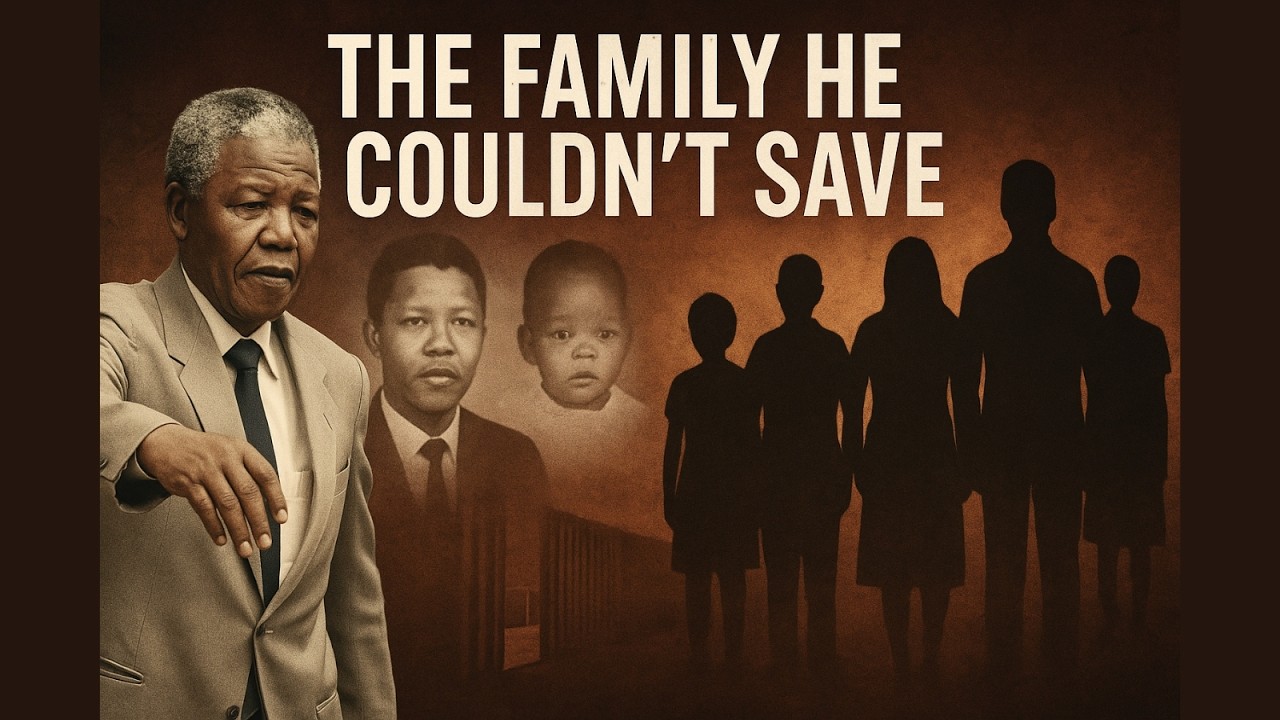
The eldest of Mandela’s children was his first son, Thembekile, known as Thembi, born in 1945. He came into the world just as the architecture of apartheid was beginning to rise, and he grew up in a home caught between domestic rhythms and political urgency. Thembi inherited his father’s warmth and his mother Evelyn’s quiet steadiness, and for a brief period he experienced something close to an ordinary childhood. That ended when Mandela went underground in 1961 and was later sentenced to life imprisonment in 1964.
Thembi was still a teenager when his father became a symbol he could no longer touch, see, or confide in. Visits were nearly impossible under apartheid regulations, and letters were rare and heavily censored. The tragedy that defined Thembi’s place in the Mandela story came on July 13, 1969, when he died in a car accident outside Cape Town at the age of twenty-four, leaving a wife and two young daughters. The apartheid authorities informed Mandela of his son’s death in a cold administrative note delivered on Robben Island.
He was not allowed to attend the funeral, not allowed to comfort his grandchildren’s mother, not allowed even a final look at the child he had once carried on his shoulders. Years later, Mandela described Thembi’s death as a wound that never closed, a private grief buried beneath the rigid discipline expected of political prisoners. Thembi became the symbol of everything Mandela lost in the struggle, the milestones missed, the embraces denied, the devastating personal cost of liberation. Mandela’s second child with Evelyn was a daughter named Makaziwe, born in 1947 and named after Mandela’s sister.
She lived for only nine months before dying, and although she left no public legacy, her passing shaped the emotional landscape of the Mandela household. Evelyn often recalled how deeply the loss affected them, carving a quiet space of grief into a marriage already strained by political duty and long absences. The death came just as Mandela’s activism intensified, and it added pressure to a relationship that would soon fracture under the demands of the struggle. Mandela rarely spoke about his first daughter publicly, but in later reflections he acknowledged that his political path had forced him into impossible choices, beginning with a child he could not protect.
Mandela’s third child with Evelyn was Makaziwe, known as Maki, born in 1954. She grew up in Orlando West, Soweto, where the sound of police vans and political meetings became the background music of her childhood. Unlike many of her siblings, Maki’s childhood was marked by stability in education. She showed early academic promise, completed school at Waterford Kamhlaba in Swaziland, earned a degree from the University of Fort Hare, and later left South Africa to pursue postgraduate studies in the United States, culminating in a PhD in anthropology from the University of Massachusetts.
The distance from home offered perspective on the struggle and on the personal sacrifices embedded in her father’s choices. After returning to South Africa in the final years of apartheid, Maki chose a different direction from the one many expected. Rather than stepping into a visible political role, she built a career in business, higher education, and development work, serving on corporate boards and participating in initiatives aimed at economic transformation. She spoke candidly about the emotional costs of growing up with a father imprisoned for the freedom of a nation, and she rejected romanticized depictions of the Mandela family, insisting that the world acknowledge both the triumphs and the wounds that came from decades of separation.
She carried the Mandela name with dignity, using education and leadership rather than political inheritance as her tools for influence. Mandela’s fourth child with Evelyn was Thembi’s younger brother, Makgatho, born in 1950. He entered the world during a moment of tightening repression, and he grew up in Soweto during years of political surveillance and police raids. When Mandela went underground and was later arrested, Makgatho was left to navigate adolescence in a household fractured by politics, separation, and grief, learning manhood without the guidance of the man South Africa would later revere.
Like his mother, who lived a largely private life after separating from Mandela, Makgatho followed a similar pattern. He worked in business, kept close ties with extended family, and remained a relatively unpublicized figure even during the dramatic years of South Africa’s transition to democracy. The turning point in his story came in his final years. In 2005, Makgatho died at the age of fifty-four from an AIDS-related illness, leaving behind children of his own.
His death confronted Mandela with a personal tragedy, but it also pressed him into another public role. Breaking the stigma surrounding HIV and AIDS in South Africa, Mandela stood before the world and declared the cause of his son’s death, insisting that silence was far deadlier than the disease itself. It was a moment that fused private grief with public responsibility, adding a new layer to Mandela’s moral authority. Makgatho was buried in Johannesburg, remembered by those who knew him as measured, thoughtful, and devoted to privacy, yet his death reshaped national discourse and allowed his father to lead South Africa into a conversation the country had long avoided.
Mandela’s fifth child, and his first with Winnie Madikizela-Mandela, was Zenani, born in 1959, just months before the Rivonia Trial years began to take shape. Her childhood unfolded in long stretches of separation, uncertainty, and fear, a life suspended between the absence of an imprisoned father and a mother relentlessly persecuted for refusing to abandon the cause. When Mandela was sentenced to life imprisonment in 1964, Zenani was barely five years old. She and her younger sister were thrust into a childhood shaped by bannings, police harassment, and the constant threat of exile.
Their mother was repeatedly detained, leaving the girls to move between relatives and safe houses. Zenani’s turning point arrived in adolescence when she was sent abroad for schooling, a decision made to protect her from the chaos surrounding her mother. She attended Waterford Kamhlaba in Swaziland and later studied in the United States. Distance gave her a perspective few others possessed, deeply connected to the struggle yet painfully aware of the cost it exacted on families like her own.
She became measured where others were fiery, observant where others were outspoken. After Mandela’s release and the dawn of democracy, Zenani stepped into public life with a steadiness shaped by years of displacement. She served as South Africa’s ambassador to Argentina, then to Mauritius and South Korea, becoming one of the country’s most respected diplomats. Her career reflected a shift from the politics of protest to the politics of statecraft.
Mandela’s sixth child, and his second with Winnie, was Zindzi, born in 1960 at the very moment South Africa entered its darkest decades. She did not grow up in a home defined by warmth or routine, but in the middle of a political battlefield. Her memories were shaped by boots at the door, whispered warnings, and the sudden disappearances of both parents. When Mandela was arrested and sentenced in 1964, she was only four.
She and her sister were raised largely by Winnie, whose own activism meant imprisonment, banishment, surveillance, and long periods in solitary confinement. Zindzi became a witness to the cost of resistance at an age when most children were learning their alphabets. Her turning point arrived in 1985 when she stood before a roaring crowd in Soweto and read her father’s historic letter rejecting the apartheid government’s conditional offer of release. Mandela could not speak for himself, so his twenty-five-year-old daughter became his voice.
Her delivery was steady, uncompromising, and unforgettable, marking her public arrival and signaling a new generation of Mandela resistance. In the years after Mandela’s release and the transition to democracy, Zindzi pursued a life shaped by diplomacy, literature, and public service. She wrote poetry, acted as a cultural ambassador, and eventually became South Africa’s ambassador to Denmark. Beneath those achievements lay the trauma of a childhood spent absorbing the blows aimed at her parents, a weight she carried with candor in later interviews.
Zindzi died in 2020 at the age of fifty-nine, a reminder that the struggle never truly leaves the families who lived through it. Taken together, the children of Nelson Mandela form a portrait of persistence. They survived exile, surveillance, fractured homes, and global expectations, and each carried a different fragment of the struggle. Some grew into leaders in their own right, stepping into diplomacy, business, or public service.
Others lived and died quietly, shaped not by politics but by the ordinary, often painful realities of family life under oppression. And some were lost before they ever had the chance to grow. Their stories reveal the emotional truth behind the public myth, that even the most heroic victories cast long, complicated shadows at home. Mandela spent twenty-seven years in prison fighting for a nation’s freedom, but those years left empty chairs at school concerts, silent places at dinner tables, and questions his children learned not to ask.
In the end, the Mandela children did not all become symbols, but they all became witnesses to a father transformed into an idea, to a nation transformed by sacrifice, and to the enduring complexity of a legacy carried not only in the spotlight but in the shadows it leaves behind.
