The phone call came in 1993, years after the case had gone cold. Chris Jacobs had an ex-girlfriend named Stacy Weisz, and according to what she eventually told the Marathon County Sheriff’s Department, she and Jacobs had been driving home from a bowling league sometime around 1991 when he turned to her and asked a question that had nothing casual about it. “If I told you I killed the Koons family, what would you think? ” And then, she said, he told her.
Not just told her—he drove her there, to the house, to the garden where the tire tracks had been found, and finally to the marsh 19 miles away, where Helen Koons’s body had been pulled from the water three years earlier. He showed her the exact spot, she said, claiming that was where Helen’s life was taken, and that he had done it to prove to himself and to her that he was a man. There was a problem, though, and it was a serious one. Jacobs had already been acquitted of murdering the Koons family.
Under the Fifth Amendment, a person cannot be tried twice for the same crime. But prosecutors found a narrow legal path forward, and on July 7, 1993—one single day before the statute of limitations on that charge would have expired forever—they filed new charges against Chris Jacobs for kidnapping and false imprisonment while armed with a dangerous weapon. To understand how a case that had already produced one not-guilty verdict ended with a man in prison, you have to go back to where it all began: a small Wisconsin town on the 4th of July, 1987. Fireworks over Athens, Wisconsin, population just over 1,100.
Across the country, people stood in parking lots and backyards, necks craned upward, watching color fall out of the sky. In Athens, the fair-weather crowd gathered downtown the same way it had for as long as anyone could remember. A 70-year-old woman named Helen Koons stood among them. Her 30-year-old son, Randy, stood beside her.
He always stood beside her. He drove her everywhere she went, and tonight was no different. Around 10:30, as the last embers drifted down over Main Street, the two of them got back in the car and headed home—six miles west of town, down a gravel road, to a farmhouse that had not changed in any real way since the 1930s. Behind them, the fair was still going.
Kids running between lawn chairs, a radio playing from someone’s truck, the smell of gunpowder drifting low over Main Street. It was the kind of small-town Independence Day that could have come from any decade. Nothing about it marked 1987 as different from 1977 or 1967. That was the thing about Athens—time didn’t move there the way it moved everywhere else.
And nowhere was that more true than inside the Koons family’s own front door. The Koons family had arrived in Marathon County in 1906, migrants from the lakeshore town of Manitowoc. They settled on 108 acres in an unincorporated area called Bearn, and there they stayed, generation after generation, largely undisturbed by the passage of time. But the family had known tragedy before 1987.
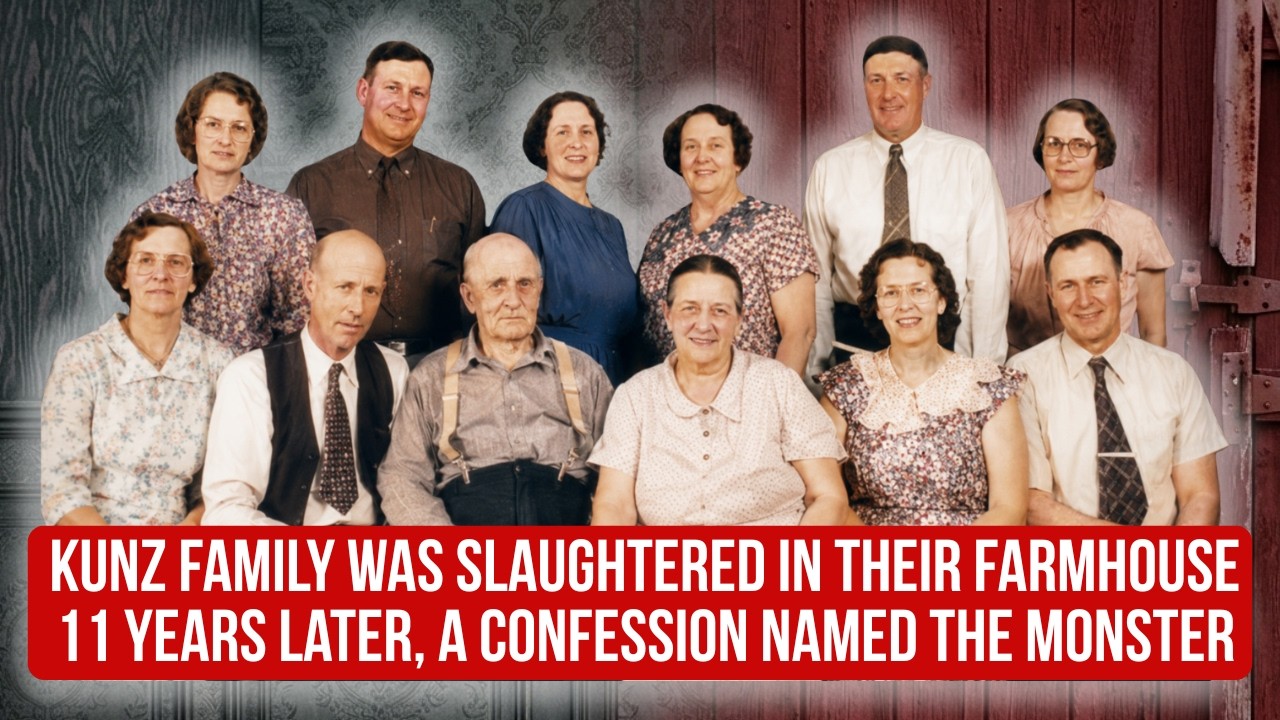
In 1905, a Koons family matriarch lost her life at home at the hands of her son, a man later described as imbalanced, who was committed to a mental institution afterward. He wasn’t the only relative institutionalized for mental illness in that generation. It was the kind of detail that decades later true crime writers would seize on—a family with a documented history of violence and instability, long before anyone had ever heard the name Chris Jacobs. By the summer of 1987, five of them lived together in the family farmhouse: 76-year-old Clarence, 81-year-old Irene, 72-year-old Marie, and their younger sister, 70-year-old Helen.
Helen had two sons—30-year-old Randy and 55-year-old Kenneth, who everyone called Kenny. Kenny was the only one of the six who didn’t sleep in the main house. He lived a short walk away in a small trailer parked on the same property. There was no running water in the house, no furnace.
Heat came from wood-burning stoves scattered through the rooms, and light in the evenings came from a single television and a VCR, one of the only modern conveniences the family owned. The house itself was, by every account, a hoarder’s home—every room stuffed with old farm implements, vehicles bought and sold and never quite disposed of, decades of accumulated belongings piled into corners. Neighbors described the Koonses as private almost to the point of invisibility. They paid for everything in cash and never let outsiders pass the front door.
They rarely spoke unless spoken to first. Of the six of them, only Kenny held a job—35 years spent pasteurizing milk at a local cheese factory. Everyone else lived off social security checks that arrived and mostly just sat in a house that time seemed to have skipped over entirely. Kenny himself was known around town as painfully shy, a quiet man who by most descriptions had a low IQ and struggled in social situations most people take for granted.
Helen had a routine, and it was one of the only windows the town had into her life. Every Sunday she went into Athens for breakfast. Randy drove her. He always waited in the car while she ate, the same way he waited in the car for every other errand she ever ran.
He was, in every practical sense, her chauffeur. She dressed, neighbors said, like it was still 1930—long out-of-fashion clothes decades behind whatever the rest of the country was wearing. She was polite, quiet, an enigma even to people who’d lived near her for years. On this particular 4th of July, the family did what most families in Athens did.
They held a picnic in the yard that afternoon. Helen’s sister Germaine, who lived elsewhere and rarely visited, came out to join them for the occasion. It was, by every account available, an ordinary holiday. Sandwiches, lawn chairs, the six of them together in one place, the way they almost always were.
Nothing about that afternoon suggested it would be the last one this family would ever spend together. Kenny spent his evening differently than the rest of them. Around 8:00, after the picnic wound down, he headed out on his own. He drove to the cheese factory where he worked—not to work, but to wash his truck, something he apparently did often on his nights off.
He had some drinks. At some point that night, he bought fireworks, the same as almost everyone else in town that evening. Later, he drove to a nearby bar, and still later, rather than drive the three miles home in the dark, he decided to sleep in his car in the factory parking lot, the way he’d apparently done plenty of times before. Back at the farmhouse, the rest of the family was settling in for the night.
Clarence had gone to bed around 8:00. Irene was in the living room watching television, likely dozing in her chair. And sometime between 10:30 and 11:00 that night—right around the time Helen and Randy were pulling back onto the gravel road after the fireworks—someone else arrived at the Koons farm. By morning, four of them would be dead.
The fifth would be gone without a trace. Kenny got back to the farm around 5:00 in the morning. He was quiet about it—he’d been out all night, slept in his car, and didn’t want to wake anyone. But something felt wrong before he even reached the door.
Randy’s car wasn’t parked where it usually was. It was sitting instead in the middle of the garden Kenny had freshly tilled the day before, something neighbors said they’d never once seen happen. And the radio inside the house was on, loud, at 5:00 in the morning, which nobody in that family ever did. He walked toward the house, and the first thing he saw was his Aunt Marie near the back porch door, not moving.
He went inside. In the kitchen, he found his brother Randy on the floor. He tried to help him. It was already too late.
He kept moving through the house, terrified of what or who he might still find inside. In the living room, in a cushioned chair, sat his Aunt Irene, her head slumped forward. In the bedroom, his Uncle Clarence lay on his side in the bed where he’d gone to sleep the night before. Four members of his family, all dead, their lives taken in an instant.
And his mother, Helen, was nowhere in the house at all. Kenny ran to a neighbor’s home and asked them to call the sheriff. When deputies arrived, he told them there were three people dead inside and two missing. He was wrong.
There were four dead. Only one was missing. It was a small, telling mistake—the kind a person makes when they are in shock, moving through a scene faster than their mind can process it. And it would matter more than almost anything else said that morning.
If Kenny had committed this crime, investigators reasoned, he would have known exactly how many bodies were in that house. He didn’t. Case closed on Kenny, at least for now. Marathon County Coroner John Larson arrived that morning at a scene unlike anything the area had seen in years.
Just inside the back porch door was Marie Koons, who had succumbed to fatal injuries. In the kitchen, Randy’s death would turn out to be more complicated than it first appeared. Initial signs pointed to a severe physical altercation, indicating a struggle had taken place. Forensic analysis later confirmed he had suffered injuries consistent with a struggle, alongside severe physical trauma.
Clarence and Irene had met the same tragic fate, targeted right where they rested without a chance to escape. A firearms expert with the crime lab suspected the weapon used was a semi-automatic long gun. Eight spent shell casings were eventually recovered from inside the house—more than enough to account for every victim, and then some. The condition of the house itself became its own obstacle.
Investigators later described how difficult it was to process a crime scene inside a home that cluttered. Every room stacked with belongings, decades of accumulated clutter, making it nearly impossible to tell what had been disturbed by a killer and what had simply always been there. Identifying evidence, one investigator explained afterward, becomes exponentially harder when you can’t tell what’s normal for the house and what isn’t. In a home like most people’s, an overturned chair or a moved object stands out immediately.
In the Koons house, almost nothing stood out because almost everything already looked disturbed. Investigators noticed something else almost immediately, something that did stand out even in all that clutter. The phone lines running into the house had been cut. And a light fixture above the back porch door had been removed from its socket and thrown out into the yard.
Whoever had done this hadn’t stumbled into an accident. They had planned, at minimum, to control what happened in that house and to make sure no one inside could call for help before it was over. Then came the detail that turned a quadruple homicide into something far stranger. Investigators searched the house and found envelopes of cash tucked into drawers, corners, and hiding spots throughout the home—roughly $20,000 in total, some reports say closer to $22,000, worth well over $50,000 today.
None of it had been touched. If this was a robbery, it was a robbery that walked straight past the money. And alongside the cash, investigators found something else: a house that, underneath its threadbare exterior, contained a substantial collection of mature, adult-oriented media kept out in the open in the family’s living room. A detail that would follow this case for the next three decades and, more than once, threatened to overshadow the four people who had actually died there.
Sheriff LeRoy Schilling stood in front of reporters that week and laid out the scene as plainly as he could. Detective Harold Bean told the press that investigators had five, six, seven working theories, and that some of them accounted for the possibility that Helen Koons was still alive. Was she a victim taken from the house against her will? Or was she somehow involved in what had happened to her own family?
In a case like this, investigators explained later, you have to look first at whoever’s missing. You don’t like saying it publicly, but you have to rule them in or out fast before you can move on to anyone else. The town of Athens did what small towns do. They organized.
Search parties combed the 108 acres of Koons land and the woods beyond it—corn fields, timber land, outbuildings, all of it. Volunteers walked shoulder to shoulder through brush for entire weekends and came back with nothing. People wore buttons that read simply, “Where’s Helen? ” For weeks, then months, the question hung over the entire county unanswered, and the fear that came with it didn’t fade.
This was a community that had never seen a homicide like this. A place where the biggest local news most years was a highway expansion or a bad harvest. And now, nobody could say for certain whether the person responsible was still walking among them. Doors that had never been locked started getting locked.
Parents who’d always let their kids ride bikes down empty gravel roads started calling them home before dark. It wasn’t just grief moving through Marathon County that summer. It was something closer to dread—the particular, corrosive kind that comes from not knowing whether the danger has already passed or whether it’s still out there waiting to happen again. As investigators dug into the family’s private life, the rumors started, and once they started, they didn’t stop.
Neighbors began sharing stories about the highly unconventional living arrangements inside the home, suggesting dynamics that defied normal social standards. That when Helen became pregnant with Kenny in 1933 at only 15 years old, she said a neighboring farmer named Frank Gums had raped her—a claim serious enough that Gums was convicted and served roughly 18 months in prison, and afterward lost his farm entirely. But persistent rumors in town suggested someone else—her own brother Clarence—may have actually fathered the child. Kenny himself, when sheriff’s deputies asked him to identify the victims, referred to Clarence not just as his uncle, but as his father.
Investigators initially assumed he was confused, disoriented by grief. He wasn’t. He meant it. And he said as much again in later interviews.
Rumors extended even to Randy. Some in town believed he too may have shared the same father. None of this had ever been proven. None of it, as investigators would eventually have to admit, had anything directly to do with who pulled the trigger.
But in a case with almost no hard evidence in its first days, rumor filled the space where facts should have been. And it would keep doing that for years, shaping how the public saw this family long before anyone knew who had killed them. Then, on July 8th—four days after the murders—a new piece of information reached investigators. A reporter with the Associated Press had been interviewing a clerk at the local hardware store, and the clerk mentioned something odd.
A few weeks earlier, Helen Koons had come into the store to order a toaster. And while she was there, she’d also bought a box of . 22 caliber shells. It was an ordinary transaction at first—a toaster, a box of ammunition, the kind of small errand Helen ran into town for all the time.
When the clerk asked what the shells were for, Helen said they were for her son to deal with blackbirds that had been bothering the property. It was a plausible enough answer for a farm that had lived off the same land for 80 years. But there was something else. Helen, usually so quiet, so composed, had seemed furious that day.
She told the clerk she was highly frustrated with her family’s lifestyle and choice of entertainment, claiming it made her angry enough to snap. She said it more than once, grinding her teeth as she spoke. The murder weapon was a . 22 caliber firearm.
Investigators searched the Koons house and did find a rifle of the same caliber, but cobwebs had formed inside the barrel—evidence that it hadn’t been fired in a long time. Still, the timing of Helen’s purchase, paired with what she’d said in that store, was enough to keep her name on the suspect list for months. Was this a woman who had finally, after a lifetime of the same four walls, snapped? Had she grabbed what cash she could carry and fled before her son came home?
There was a second theory taking shape as well, one that would resurface later in a courtroom. Randy Koons, some in the area suggested, might have been involved in illicit transactions. This was a period when rural Wisconsin was seeing a rise in drug activity spreading out from larger cities. And investigators had heard whispers that Randy—reclusive and low-profile—fit the exact profile of a small-time dealer who wouldn’t draw attention.
If that was true, maybe this wasn’t a robbery or a family implosion at all. Maybe it was a debt that came due on the worst possible night. For nine months, none of it went anywhere. No arrest, no answers, and no Helen.
Then, in March of 1988, two boys out fishing near Medford caught a smell they wouldn’t forget. It led them to a body in the water—decomposed, difficult to identify, roughly 19 miles from the Koons farmhouse. Investigators would later explain that the elements and the passage of time made recovery and identification extremely difficult. Dental records and what remained of the body confirmed what the county had feared for nine months.
It was Helen. She had lost her life in the same tragic manner as the rest of her family. Nine months—that’s how long it took just to know for certain that all five members of this family were dead. Her death didn’t just close the loop on a missing person’s case.
It eliminated her once and for all as a suspect. Whatever had happened at that farmhouse on July 4th, Helen Koons had not walked away from it. She had been taken from it and killed somewhere else entirely, in a place chosen specifically because no one would ever think to look there. Even before Helen’s body was found, investigators already had a name they kept coming back to: Chris Jacobs III, a 21-year-old farmer from across the county line in Taylor County.
Jacobs had purchased a used car from the Koons family sometime before the murders—one of the only outsiders on record who’d had any real interaction with the household at all. Kenny himself had mentioned Jacobs to deputies, along with a few other young men who’d bought old vehicles off the family over the years. Investigators knew Jacobs for a different reason, too. Not long after the murders, he was arrested for stealing a car, stripping it down, and dumping the parts in a marsh near his own property—the same general area where Helen’s remains would later surface.
In January of 1988, police brought Jacobs in for questioning about the Koons murders directly and held him over a weekend. They didn’t have enough to charge him yet, and he walked free. But detectives kept working. They took plaster casts of tire tracks found near the Koons garden, about a quarter mile from the house—tracks that didn’t belong to any vehicle that should have been there—and compared them to the tires on Jacobs’s car.
Detectives noted the specific front-and-back tire configuration, the kind farmers rotate seasonally. And it matched what they’d found in the dirt. They searched his property and found dozens of bullets and shell casings consistent with what had been recovered from the Koons home—a match, investigators explained, that comes down to firing pin marks and breach marks stamped onto every casing a weapon ever fires, as distinct as a fingerprint. And a local woman named Alice, who’d driven past the Koons farm the night of the murders, had described being blinded by a handheld spotlight from a car waiting near the property’s entrance—a car that followed her briefly before turning back toward the farmhouse.
Investigators later found a spotlight matching that description in Jacobs’s own car. There was more. A man named Wayne Wyler came forward and told investigators that Jacobs had spoken to him before the murders about a plan to rob the Koons family—that Jacobs had seen the money in that house and wanted it. By the time charges were filed, the case had already saturated local media for a full year.
Reporters from Milwaukee and beyond had made the trip to Marathon County more than once, and the details—the isolation, the cash, the rumors—had traveled well past the county line. The trial itself was ultimately held in Brown County, more than 70 miles away, an acknowledgment that finding an impartial jury any closer to Athens might not have been possible. In August of 1988, prosecutors charged Chris Jacobs with five counts of first-degree murder as a party to the crime—a legal theory suggesting he may not have acted entirely alone. Their case, presented at trial in October of 1989, went like this: Jacobs had been to the Koons house before to buy that car and collect its bill of sale.
While there, he’d seen the cash the family kept lying around in plain view. He came back a month later intending to rob them. And something went wrong. Randy, prosecutors argued, tried to fight back.
A struggle broke out. And once it started, whoever was in that house made sure there would be no witnesses left behind. Which meant Helen, too, had to be taken and silenced. It was, by every measure, a circumstantial case.
There was no confession, no murder weapon ever recovered, no eyewitness placing Jacobs inside that house at the moment of the killings. What prosecutors had was tire tracks, shell casings, a spotlight, and a second-hand account of a robbery plan—physical evidence and testimony that put him near the crime and gave him a motive, but nothing that directly put the gun in his hand. The defense pushed back hard on all of it. The tire tracks, they argued, proved nothing.
Jacobs had legitimately been to the house to buy a car; of course his tracks would be somewhere on the property. The shell casing match, a defense witness testified, was only a possible match, not a certain one. And if Jacobs had gone there to rob the family, why was $20,000 still sitting in the house when the police arrived? The defense offered its own theory instead—the drug deal theory—and brought a witness named Tracy Bartlett to the stand who testified he had bought $1,800 worth of illegal substances from Randy and Kenny just days before the murders.
The implication was clear: maybe Randy owed money to dangerous people, and maybe those people came looking for it on the 4th of July. But the theory collapsed almost as fast as it appeared. Investigators found no evidence of any illicit activity in the house—no packaging or equipment of that nature. And it later came out that Bartlett had been in jail during the exact period he claimed to have bought drugs from the brothers, which gutted his credibility on the stand.
The trial lasted about a month. Jacobs never took the stand in his own defense. His mother did, however, testify that he had been with her that night helping deliver a calf around 11:00—an alibi that placed him nowhere near the farmhouse at the time investigators believed the murders occurred. After roughly 10 hours of deliberation, the jury sent a note back to the judge.
They wanted the legal definition of “intent to kill” clarified. It’s a small detail, but it matters. It suggests the jury wasn’t necessarily convinced Jacobs was innocent of being there that night. They may simply have struggled to agree beyond a reasonable doubt on what he’d intended to do once he was.
Not guilty—all five counts. The reaction in the courtroom and across the county was disbelief. A local journalist who covered the verdict later said her hands were physically shaking as she typed the story that day. She’d expected a conviction.
Almost everyone had. Instead, a man many in Athens believed had murdered an entire family walked out of the courthouse a free man. And under the law, he could never be tried for those five murders again. Some jurors, years later, signed affidavits claiming their verdict meant they believed Jacobs hadn’t even been at the Koons residence that night—a claim his defense would try to use in the years ahead, though courts would ultimately reject it as a basis for blocking any future charges.
Sheriff’s investigators, standing in front of reporters after the verdict, didn’t hide their frustration. “Technically, this case remains open,” they said, “but we believe we had the right man. ”
The case went cold. Officially, it stayed open.
Unofficially, most people in Marathon County had stopped expecting an answer. For four years, that’s exactly what happened. Nothing. Then, in 1993, an investigator’s phone rang.
Weisz had her own legal troubles—an outstanding robbery charge in another state—and in exchange for her cooperation and testimony, she received a plea deal. The defense would spend years arguing that this fact alone made her account worthless, a story built to save herself rather than tell the truth. But prosecutors believed her, enough to act on it in a way that hadn’t been tried before. Jacobs fought the new charges immediately, arguing this was double jeopardy in everything but name.
Even journalists covering the story at the time weren’t sure it was legal. A circuit court judge disagreed with Jacobs and rejected his motion to dismiss in January of 1994. Jacobs appealed. The Wisconsin Court of Appeals sided with the state as well, ruling that his murder acquittal had never actually resolved, one way or the other, whether he’d kidnapped Helen Koons.
He took it all the way to the United States Supreme Court, which, in June of 1996, declined to even hear the case. It’s worth understanding why that argument mattered so much and why it took three separate courts to resolve. The whole point of the double jeopardy clause is to stop the government from getting a second, third, or fourth chance to convict someone of the same wrongdoing just because the first attempt failed. If prosecutors could simply relabel a rejected murder case as something else and try again, the protection would mean almost nothing.
Jacobs’s attorneys argued that’s exactly what was happening here—that Helen’s abduction had already been presented to the first jury as part of the murder case, and that jury had rejected it along with everything else. Some of those original jurors, in fact, signed statements years later saying that’s precisely what they believed they’d decided. But the appellate courts drew a narrower line. Under the legal test they applied, two charges only count as the same crime if proving one automatically proves the other with no separate facts required.
Murder and kidnapping, under Wisconsin law, are not built from identical elements. A person can be found not guilty of causing someone’s death without a jury ever having formally decided whether that same person committed a kidnapping along the way. It’s a technical distinction, and to a lot of people watching from Athens, it may have felt like a loophole. But it was a loophole the courts, all the way up through the federal system, agreed was real.
The path was clear. It had just taken three years of legal argument to get there. While free on bail awaiting this new trial, Jacobs found himself in fresh trouble, charged separately with bail jumping and disorderly conduct after threatening a former co-worker—a violation of the conditions that had kept him out of custody. It did nothing to help the image jurors would eventually form of him.
The second trial began in June of 1998, nearly 11 years after the murders. This time, prosecutors could bring in evidence the first jury never heard. Because Jacobs hadn’t testified in 1989, his prior conviction for stealing and stripping a car, then dumping the parts in a marsh close to where Helen’s body was later found, had stayed out of that courtroom entirely. This time, a judge ruled it admissible as what’s legally called “other acts evidence”—past conduct that can help establish a pattern, even if it isn’t the crime being tried.
It came in, and jurors heard it. And this time, there was Stacy Weisz on the stand describing a confession no jury had ever heard. Eight days of testimony. The tire tracks, the shell casings, the spotlight, the prior conviction, and Weisz’s account of a drive to a bowling league that ended with a confession, a tour of a murder scene, and, according to her testimony, Jacobs telling her he had done it to prove to himself that he was a man.
The defense worked to dismantle her credibility the same way they had in the first trial’s aftermath, reminding jurors that Weisz was, by her own admission, someone with an outstanding robbery charge hanging over her head—someone who had a documented incentive to tell prosecutors exactly what they wanted to hear. It wasn’t a new strategy. It was, in fact, one of the only strategies available, because so much of the physical evidence in this case had already survived one trial intact. The tire tracks were the same tire tracks.
The shell casings were the same shell casings. What had changed was the law that once kept certain facts out of the courtroom, and a jury willing to hear all of it together for the first time. The jury took four hours to reach a verdict. Four hours after eight days of testimony spanning 11 years of investigation.
A number that, on its own, suggests a jury that didn’t spend much time in genuine doubt. Guilty. Kidnapping and false imprisonment of Helen Koons, committed while armed with a dangerous weapon. Eleven years after four members of a family were shot to death in their farmhouse, and after Chris Jacobs had already been acquitted of killing all five of them, a Wisconsin jury finally held him responsible.
Not for murder, but for what happened to the one person taken alive from that house. On August 21st, 1998, Circuit Judge Donald Fox handed down the maximum possible sentence: 31 years in prison. Even the prosecutor, who had spent over a decade pursuing this case, didn’t sound satisfied standing outside the courthouse that day. Asked if he was happy with the outcome, he said simply that no one should be happy.
Five people were dead. And now, a young man was going to prison for one crime tied to their deaths, not for the deaths themselves. Chris Jacobs III grew up not far from the Koons family—close enough to know them, close enough to buy a car from them, close enough that his own tire tracks were expected to be somewhere on that property. By the time his name first reached investigators, he already had a local reputation—not as a violent man, but as a troublemaker, someone known around Taylor County for petty theft and for tinkering with cars he didn’t always own legally.
He liked to fix up old vehicles, which is part of why buying a used car from a family like the Koonses wouldn’t have struck anyone as unusual at the time. He was 21 years old when the murders happened. Young, local, the kind of person nobody in Athens would have looked at twice on any ordinary day. That proximity—a man who wasn’t a stranger, who had stood inside that house, who had likely seen the same cash Helen kept lying in plain sight—is part of what makes this case as unsettling as it is.
This wasn’t a random act carried out by someone who appeared out of nowhere. This was, by every piece of evidence prosecutors ever assembled, someone who had already been let inside. Jacobs never confessed publicly, and never has to this day. He has always maintained his innocence, insisting the girlfriend who put him at that murder scene and inside that marsh was lying to save herself from her own legal troubles in another state.
His appeals continued for years after his conviction, each one rejected. A reporter for the Milwaukee Sentinel who had covered the case from the beginning eventually wrote an entire book about it, laying out the family’s history, the crime scene, and the trial in detail—a book that even decades later remains one of the only comprehensive accounts of what happened to the Koons family. Though even that account leaves the central question unanswered. Not everyone in Marathon County was or is convinced.
In the years since his conviction, a small number of advocates have taken up Jacobs’s case publicly, arguing the physical evidence against him was thinner than it looked—that tire tracks and shell casings placed him near a house he’d already admitted visiting to buy a car, and that Stacy Weisz, the woman whose testimony sealed his conviction, had every reason to tell investigators whatever would keep her out of a prison cell of her own. It’s a theory that leans hard on the drug debt narrative the first jury heard and didn’t believe. Whether you find it persuasive likely depends on how much weight you give to a single witness’s word—weighed against tire tracks, matching shell casings, and a spotlight that matched a stranger’s description of a car in the dark. Kenneth Koons—the man who found his family’s bodies at 5:00 in the morning, who spent the rest of his life as the last surviving member of that household—never saw the case fully resolved.
He died in 2001, roughly 14 years after the murders, having watched the only person ever charged walk free once, get convicted of a lesser crime the second time, and never once face a jury on the actual killings of his brother, his aunts, and his uncle. Chris Jacobs completed his sentence and was released on February 4th, 2020. He was taken back into custody the same day, placed under extended supervision. He refused to cooperate with the terms of his release—refused to sign the paperwork, refused to report to a parole officer—reportedly because he believed accepting those conditions would look like an admission of guilt.
In June of that year, at his own request, he returned to prison, choosing further confinement over supervised freedom. Where the Department of Corrections says he’ll remain under extended supervision until 2029. Think again about who these people actually were, underneath everything the rumors and the headlines turned them into. A 70-year-old woman who went to breakfast in town every single Sunday, and whose son waited outside in the car every single time, without fail, for years.
A 30-year-old man who spent his final evening exactly where he’d spent every other 4th of July—at the fireworks, driving his mother home afterward, the same way he always did. A man who pasteurized milk at the same cheese factory for 35 years, who came home that morning not expecting anything at all, and found the worst morning of his life waiting for him instead. Two elderly sisters who went to sleep in their own living room, the way they had for years, and never woke up. Athens, Wisconsin’s town motto at the time was “a friendly town that bands together.
” And for a while, that’s exactly what it did. Search parties, buttons, a community that refused to let a missing 70-year-old woman become just another cold statistic. That same closeness, though, is part of what made this case so hard to solve. A family that kept to itself, that completely, in a town where everyone else knew everyone else’s business, left investigators working almost entirely from rumor and circumstance, instead of the kind of first-hand knowledge that usually cracks a case like this open early.
Four members of the Koons family died in that farmhouse on the night of July 4th, 1987. Their sister and mother, Helen, was killed somewhere else entirely—her body left in a marsh 19 miles away, not found for nine months. From the night of those murders to the day a jury finally convicted anyone connected to this case: 11 years, 1 month, and 17 days. Eleven years for one conviction.
For kidnapping, not murder. Not for any of the four people shot inside that house. Chris Jacobs is still the only person the state of Wisconsin has ever formally connected to what happened at that farmhouse. And he is, at the same time, a man the state of Wisconsin has never actually convicted of killing anyone.
Both of those things are true at once, and they’ve been true for over a quarter of a century now. That contradiction is really the whole story here—not just what happened in that house on the 4th of July, but what happens afterward when the legal system runs out of tools to close a case cleanly and has to settle for the closest thing it can prove instead. To Clarence, Irene, Marie, Randy, and Helen Koons—they were more than the rumors that followed them.
They deserved better than what happened in that house, and better than what happened to their case in the years after.
