Fans kept the photograph. October 1982, the cover of Creatures of the Night. Four men in full makeup stared out from record store shelves across America. One of them was Ace Frehley, the original Spaceman, with his silver face and everything that went with it.
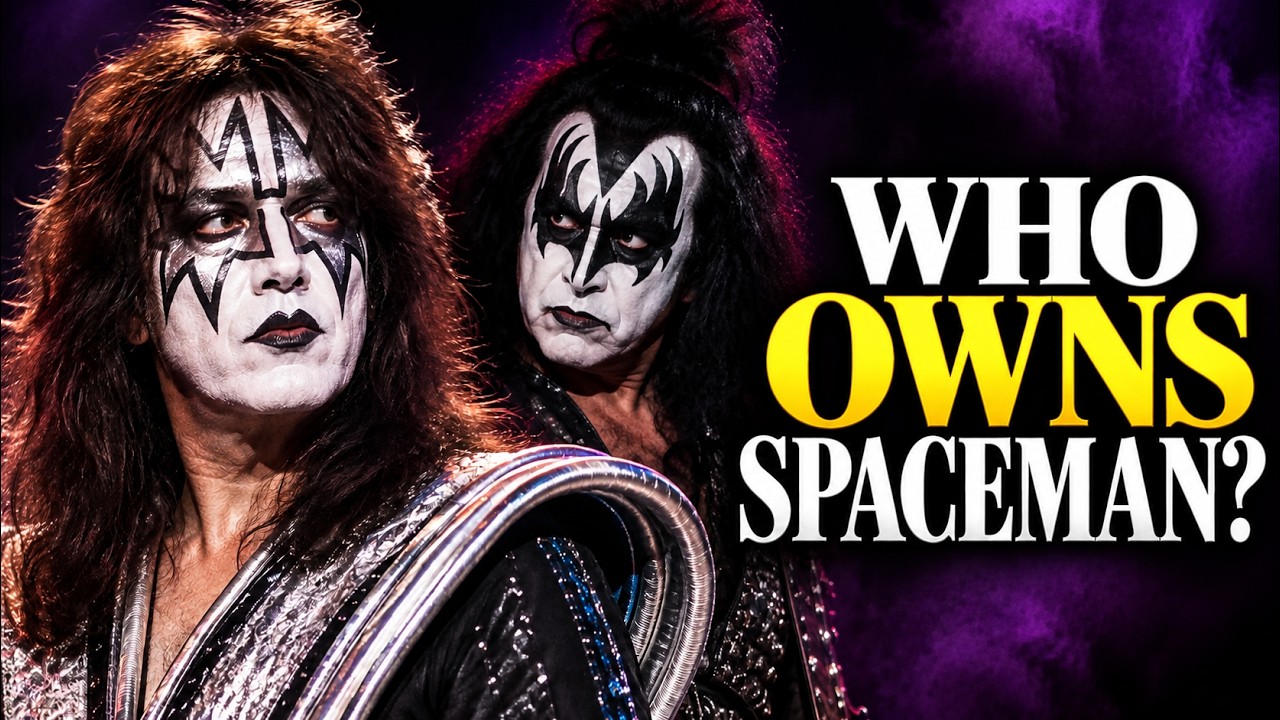
What the cover did not show was that Ace had not played a single note on the album. Five other guitarists reportedly did, and none of them received credit. What no one knew at the time was that he had already resigned. His departure had become official by June 1982, months before the album reached a single shelf.
He stayed on the cover, in the album notes, and in the I Love It Loud video because of a contract. Kiss’s new deal with Phonogram included a two-million-dollar advance per album, on the condition that the three remaining original members took part. If any one of them left, the deal could fall apart. Their manager, C.
K. Lendt, later wrote that the goal was to maintain the illusion that Ace was still in the band. The public was not told the full truth until December 29, 1982, when Kiss opened its tenth-anniversary tour with a new guitarist and new makeup, and even then the announcement was not candid. Ace Frehley’s exit from Kiss was not simply the story of a guitarist who left.
It was the story of a band that needed the world to believe he had never gone anywhere, and of who has been telling that version of events ever since. The beginning was in the Bronx. Paul Daniel Frehley was born on April 27, 1951, the youngest of three children. His father was an electrical engineer.
His parents played piano, and his brother and sister played guitar and piano as well. The street outside offered a different kind of education. By his own account in his memoir No Regrets, the options in the Bronx in the mid-1960s were nearly binary: join a gang or get beaten up by one. He was a skinny kid, so he joined.
The gang was called the Ducks, or in his case the Junior Ducks, and he was around twelve or thirteen years old. Then came the guitar. He received his first guitar as a birthday gift at age thirteen. He never took a lesson.
He taught himself from records, with Jimi Hendrix, Jeff Beck, and Led Zeppelin as instructors, and he proudly claimed he knew nothing about music theory. His interest in the gang faded as his interest in music grew. No one had to convince him to leave the streets. The instrument simply took up more of his time.
Working alone was not a personality trait. It was a method. It had its place, its time, and it produced results. That would matter again in 1981, from a home studio in Connecticut.
From 1970 to 1972, Ace played in a string of local bands. None of them advanced beyond club gigs and opening slots for touring acts. He drove a cab during the day. At twenty-one, he still lived with his parents, and when it came time for an audition, his mother drove him there.
That was December 1972. A friend had seen an advertisement in the Village Voice. Wanted: guitarist with flash and talent. The ad had been placed by three musicians: Paul Stanley, Gene Simmons, and Peter Criss.
They were a band without a fixed name, the remnants of a group called Wicked Lester. The audition took place at 10 East 23rd Street, above a bar called the Live Bite. Ace walked in wearing one red sneaker and one orange sneaker. Everyone knows the version in which a strange kid in mismatched shoes charmed his way into the greatest band of the decade.
Nearly all of it is true. The sneakers appear in almost every account. The part the legend leaves out is that the shoes did not get him the job. His playing did.
In Paul Stanley’s memoir, Ace interrupted the other auditions and then improvised a solo that Stanley described as killer. That recollection was written decades after the fact, not as a transcript, so it should be treated accordingly. Even small details remain unresolved. One account says the friend who showed him the ad was Bob McAdams.
Another says it was Chris Casson. The shoes stayed in the story because the story works better with them. About three weeks after the audition, the band hired him as lead guitarist. They settled on the name Kiss in January 1973.
Ace, a lifelong science fiction fan, was nicknamed Space Ace, and later the Spaceman. He also designed the band’s logo, the double-S lightning bolt, which Stanley later refined. The two of them were building the thing together from the start. They drew inspiration from bands like the New York Dolls and Alice Cooper and began painting their faces.
Financial rewards lagged behind ambition for a while. Then a television producer named Bill Aucoin became their manager and secured a deal with a fledgling label called Casablanca. He also provided something more effective: a weekly salary. For the first time, Ace could quit his taxi job.
Their first album came out in February 1974. Cold Gin was the only song Ace wrote alone, and Gene Simmons sang it. By Ace’s own account, he lacked confidence in his singing voice. What is known is that he gave up the opportunity.
The band was not an immediate success. But with Alive! in 1975, their live show finally reached records, and Ace’s playing on it became a reference point. By his own account in Kiss Behind the Mask, many guitarists told him that album was why they learned to play.
Within the band, the balance was unequal but functional. In No Regrets, Ace writes that the group often split into two camps: he and Peter Criss on one side, Paul and Gene on the other. He says that when conflicts flared, he always tried to be the peacemaker. That is a self-portrait, and self-portraits often flatter.
But nothing in the early record contradicts it. He was the one who stayed calm, kept the peace, and let the other three argue over business. Then he began writing songs for the group. There was Parasite, Rocket Ride, and Shock Me, which he wrote after a near-fatal electric shock.
The son of an electrical engineer wrote a song about nearly dying from electricity. Ace sang that one himself. The singer who had passed on Cold Gin now had a lead vocal on a Kiss album. He was also, by that time, famous in a way that suited him offstage more than on it.
In 1977, he said the most important thing about the makeup was that it allowed him to disappear. He said, onstage he was Ace Frehley, and offstage he was just a kid from the Bronx. That kid who taught himself guitar alone was still there under the silver paint. He had found three other people he could build something with.
For a few years, that was enough. It stopped being enough sometime in 1978. According to reports from Ultimate Classic Rock, both Ace and Peter Criss had already expressed a desire to leave. The band’s response was to take a break.
Then four solo albums were released together on September 18, 1978. Ace’s sold best and reviewed best. From then on, he occupied more space in Kiss’s recordings. He was no longer just a peacemaker.
He was a songwriter with influence. On October 31, 1979, the band appeared on NBC’s Tomorrow with Tom Snyder in full makeup on Halloween night. Early in the interview, Snyder mispronounced the word bass, and Ace seized the moment. He told the host he was not the bass player, he was the trout player, and he kept going.
Ace later admitted he was drunk and nervous. In his memoir, he wrote that he felt no pain. Peter Criss, in his own memoir, remembered it as the first time he and Ace hijacked an interview from Gene and Paul. Footage shows the band sitting in two separate camps the entire time.
Stanley told an interviewer years later that the drinking seemed funny, but he saw something else beneath it: a lack of respect for the fans. The crisis exploded during the tour in December. According to Criss’s own account, he deliberately sabotaged several of his final shows with the original lineup. In one performance, Paul Stanley gestured for him to slow the tempo mid-song, and Criss took it as an insult.
The last show with all four members was December 16, 1979, in Toledo. Gene Simmons stated that Criss had been fired. One account in Ultimate Classic Rock suggests that Simmons, Stanley, and Ace made that decision together. Criss’s departure was announced officially on May 18, 1980.
That complicates the picture of Ace as an innocent victim. By that account, he was part of the vote. What happened to the record afterward is the part fans often skip. Drummer Anton Fig had already played on nearly all of Dynasty in 1979 and every track on Unmasked in 1980.
His name was not listed on the albums for years. Wikipedia attributes this to an attempt by management to cover up personnel problems and notes that Criss still appeared in the video for Shandi. Ace says in No Regrets that after Peter left, he realized things would never be the same. He had lost his only ally in the band against Paul and Gene.
This was not just a band replacing a drummer. It was a band learning that a face could remain on the record long after its owner left. Whether anyone intended it as a rehearsal or not, it worked as one. That brings the story to 1980 and to the one place where the band was still thriving.
Shandi unexpectedly climbed into the top five in Australia, sparking a wave of Beatlemania-style popularity there. Kiss toured the country for six weeks and played only eight or ten shows. Ace remembers it as one of the most enjoyable tours they ever did. On December 3, 1980, at Western Springs Stadium in Auckland, New Zealand, he played what turned out to be his final show with the band for nearly fifteen years.
No one knew at the time. Ace did not announce it. There was no farewell. But he had decided, despite what he describes as strong objections from his lawyer, his advisers, and his bandmates.
In No Regrets, he recalls sitting in his lawyer’s office while the lawyer tried to convince him that leaving Kiss was the stupidest thing he could do. Ace’s own account is the only version of what was in his head. Stanley, to his credit, tried. According to Ace’s account, Paul drove to his house and the two of them went to a mall in Stamford, Connecticut, walked around shopping, and tried to recover their old friendship.
Ace now sees it as a generous gesture. Paul argued strongly that day, but nothing could change Ace’s mind. Even that afternoon has been told two ways. According to a fan-compiled timeline, Ace once said in an interview that Paul never asked him to stay.
He later corrected himself. Paul did come to his house one afternoon and took him to lunch. Even the accounts of the men involved change. Then came Music from the Elder.
Stanley and Simmons moved away from the straightforward album Ace wanted and toward a medieval concept album produced by Bob Ezrin. Everyone knows the version in which Ace hated the project, refused to participate, and mailed in his guitar parts from Connecticut. Nearly all of that is true. Ultimate Classic Rock reports exactly that, and Ace later told them he would have bet a million dollars the album would fail.
The part the legend leaves out is that the sessions began in his home. According to Wikipedia, recording started in March 1981 in Ace’s home studio in Wilton, Connecticut, and only moved to Ezrin’s farm near Toronto on May 11. Ace sang only one song on the album, Dark Light, and many of his solos were cut from the final version. The album was released on November 10, 1981, and the band did not tour for it.
The Wikipedia report on those sessions adds a structural detail. After Criss left, Ace was often outvoted two to one in band decisions because the new drummer, Eric Carr, was an employee rather than a partner like the other three. Ace resented what he saw as domination by Simmons and Stanley over the sessions. The honest answer is that we do not know whether a guitarist who had stopped caring performed his work indifferently, or whether a man who always worked alone was simply doing the only thing he knew how to do in the only room he trusted while the band moved on without him.
The first public sign came in January 1982. On January 15, Ace performed with the band on ABC’s Fridays in Los Angeles, playing songs from The Elder. Thirteen days later, on January 28, Kiss was scheduled to accept an award from the Sanremo Festival in Italy via a live feed from Studio 54 in New York. Gene, Paul, and Eric Carr stepped out of a limousine, ran inside, and performed I lip-synching as a trio.
Ace did not appear. A fan-compiled timeline lists the reason as stomach problems and adds that his unhappiness had reached the point where he no longer wanted to appear with the band at all. Author Dale Sherman wrote that Gene and Paul had felt for some time that Ace was about to leave, and that night proved to Ace that it did not matter much to them whether he was there or not. In June 1982, he told Paul Stanley and Gene Simmons he was leaving.
That could have been the end, except for the contract. The exit took a full year. Wikipedia, citing the band’s tour history, notes that it took twelve months of lawyers negotiating his full departure. The Phonogram deal required Stanley, Simmons, and Frehley all to be in the band.
So for those twelve months, Ace was both gone and not gone. He did what the situation required. He appeared on the cover of Creatures of the Night. He agreed to appear in the I Love It Loud video.
He took part in a press conference in late October 1982 and traveled to Europe in late November for promotional appearances. By his own account, he had already decided he felt no connection to the band and was unhappy with its direction. He did the work anyway because someone needed him to do it. The work that mattered most was happening without him.
In July 1982, the band entered Record Plant studios in Los Angeles to begin the new album. Session players filled the guitar parts. Among them was a young guitarist named Vinnie Cusano. Cusano co-wrote I Love It Loud with Gene Simmons, and the guitar on the recording is his.
Wikipedia says the video featuring Ace was made that way for contractual reasons, though that statement lacks a strong citation. Meanwhile, Paul Stanley was designing a new face for Cusano. It was an Egyptian ankh makeup design with the stage name Vinnie Vincent. The tour’s press release described him as even weirder than the rest of the band.
The same release did not say Ace had quit. It said he had been seriously injured in a recent car accident that prevented him from touring, but he might appear onstage when able. The photographs told the same story. At the start of the tour, press kits and band advertisements used group photos that included Ace Frehley.
Promoters printed them, and many fans did not realize he had been replaced until they arrived at the venue. Before Vincent was announced, new photos were taken, and later advertisements showed the band with him. The tour opened on December 29, 1982, at the Civic Center in Bismarck, North Dakota. According to Billboard box office results, 3,335 tickets were sold for an arena that seated 8,200.
Gross revenue was $30,011. No one in that hall was told the full truth. Ace Frehley left Kiss in 1982 and did what he had always done. He returned to the room.
He formed his own band, Frehley’s Comet, which played from 1984 to 1988, and spent the next decade building a solo career on his own terms. Kiss removed the makeup in 1983, and according to Billboard, found mixed success without him. In 1996, the four original members reunited for a hugely successful tour. It lasted until 2002, when Ace chose not to stay, predicting it would be the band’s last.
His final show was February 24, 2002, at the closing ceremony of the Winter Olympics. Tommy Thayer took his place that month, wearing the Spaceman makeup. Ace told the Village Voice in 2014 that the band should have created different makeup, as it had done with Eric Carr and Vinnie Vincent. The four original members were inducted into the Rock and Roll Hall of Fame in April 2014, and both Ace and Gene spoke onstage that night.
Paul Stanley said in 2023 that he refused to perform with Ace and Peter Criss at that ceremony because of how it would look. Yet Stanley sang on Ace’s version of Fire and Water in 2016, and Gene Simmons co-wrote two songs on Ace’s solo album Spaceman in 2018. These are not the actions of enemies. They are not the actions of friends either.
The honest answer is that both were true at once. At least four versions of the story have been told since. C. K.
Lendt, the band’s former manager, wrote Kiss and Sell. Ace wrote No Regrets in 2011. Stanley wrote Face the Music in 2014. Simmons has told his version in interviews for decades.
The version everyone knows, as told by Simmons, is that by the time of Creatures of the Night, Ace was already gone. His appearance in the I Love It Loud video was a favor, but it backfired because he did not know the song and had to fake performing it. Nearly all of that is true. Ace did not play on the recording.
The part that account leaves out is that the favor was written into a contract. Lendt’s own book says the goal was to keep the deal alive. A favor required by a recording contract is not quite a favor. The mechanism of control was not the memoirs but the makeup.
Stanley said Ace and Peter Criss sold the rights to their characters for a pittance because they did not think the designs had value. Ace described it differently. In 2018, he said he believed he still owned the Spaceman design and had licensed its use to the band. In 2023, he told Ultimate Guitar that he was paid whenever the design was used on merchandise.
The record shows that when Kiss played its final shows in December 2023, the Spaceman onstage was not Ace Frehley, and the band planned to continue as digital avatars. Ace called that plan a business gimmick. The story was never really about a guitarist leaving. In 1982, they needed a fiction to protect a contract.
In 2002, they kept the character and replaced the man. By 2023, they planned to keep all four faces without any of the men. The question of who decided what Ace’s departure meant came down to who owned the face. Ace died on October 16, 2025, at age seventy-four, after a fall in his home studio in Morristown, New Jersey.
Stanley and Simmons issued a joint statement describing him as an essential rock soldier who could not be replaced, and both attended his memorial. Simmons also wrote that no one could touch Ace’s legacy. Peter Criss wrote that he was shocked. Rolling Stone’s Joseph Hudak summarized the two sides of the band this way: Simmons’s demon was the scowl, and Frehley’s spaceman was the laugh.
Simmons later wrote that Ace had not lived long enough to be honored at the Kennedy Center Honors that December. Then the story was revised again. Simmons hinted that bad decisions contributed to Ace’s death. Billboard reported that this seemed to refer to the guitarist’s long struggle with alcohol, although reports indicate Ace had been sober for more than twenty years.
Simmons later apologized. He wrote that he now realized how much hurt that caused everyone. Even that says something. Forty-three years later, the story of Ace Frehley’s life as the public remembers it was still being written, edited, and retracted by other people.
Look at the photograph again. October 1982, the cover of Creatures of the Night. Four men in full makeup. One of them is Ace Frehley, the original Spaceman, silver-faced and unmistakable.
Now you know what the picture shows: a man who had already told Paul Stanley and Gene Simmons he was leaving, a guitarist whose playing was not on the album, a face that stayed on the cover and in the video and in the ads while the contract was settled and his replacement was handed a face of his own. And now you know what the picture left out: a deal that paid its two-million-dollar advance only if the three original members remained, a press release about a car accident, a cover that was closer to a signature than a band portrait. Other men have worn the Spaceman since. The question of who owned that face fueled interviews, memoirs, and merchandise for forty years.
The album does not settle that argument. What it settles is that no one asked the guitarist what the picture should mean. The world thinks it remembers Ace Frehley leaving Kiss.
What it actually remembers is six months of the band pretending he had never left.






