On the morning of November 20, 1947, Westminster Abbey was packed with 2,500 guests. Crowds lined the route from Buckingham Palace despite the cold, despite rationing books still folded in coat pockets, despite a country that had spent six years learning what it meant to lose things. Inside, a 26-year-old naval lieutenant named Philip Mountbatten waited at the altar. In a few minutes, the woman who would become Queen Elizabeth II walked toward him, and Britain allowed itself, for one day, to feel like the worst was over.
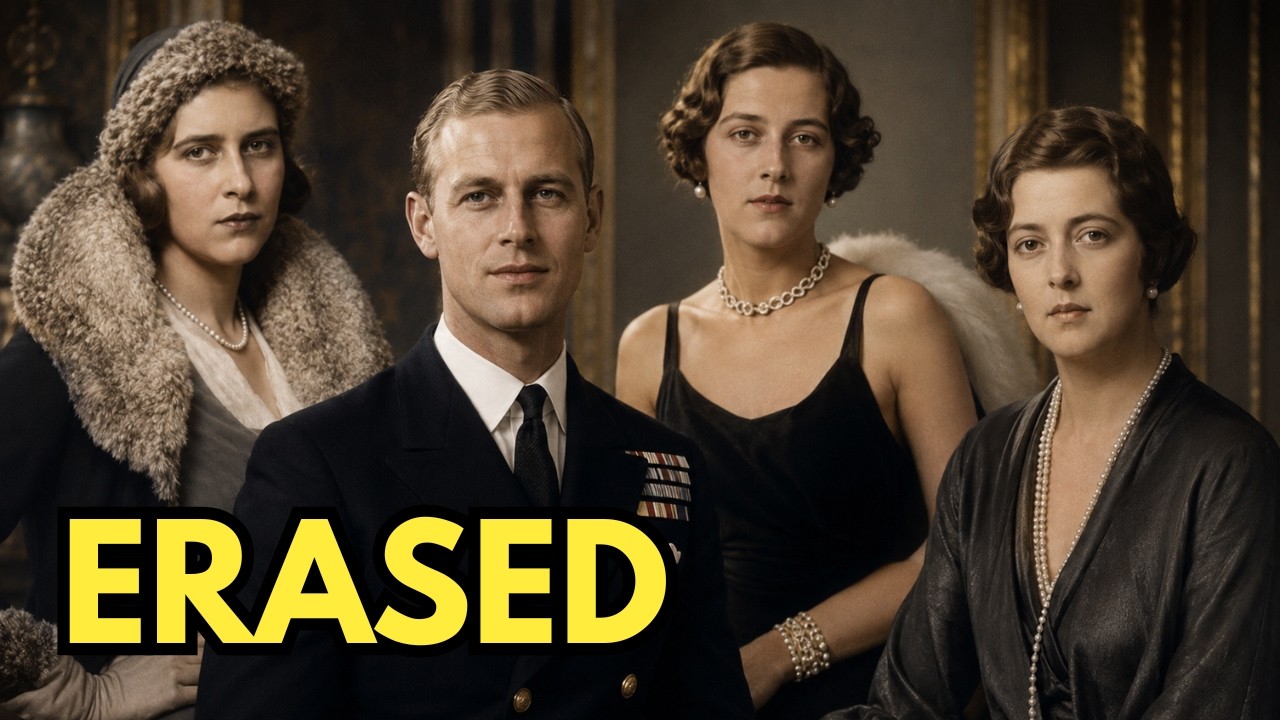
But a staggering absence marked the guest list. Philip’s four sisters were not there. Not seated in the back. Completely left off the list.
Three of them were somewhere on the European continent that morning, reading about their brother’s wedding in the newspapers like everyone else. The fourth, Cecilia, had died a decade earlier in a plane crash that took most of her family with her. The explanation that survived into popular history fits into one sentence. Philip’s sisters had married into German aristocratic families, and some of those families carried documented ties to the Nazi party.
Two years after British newsreels first showed audiences the liberated concentration camps, a wedding broadcast to the world was not going to make room for that history in the official photographs. That is the line most retrospectives settle for. A sentence, a footnote, and then on to the wedding dress, the nine-foot cake, the diamond ring cut from his mother’s old tiara. But the reality of what that morning meant for Philip runs deeper than political optics.
By the time he reached Westminster Abbey, he had already erased virtually every foreign marker from his own biography. He gave up his Greek and Danish titles. He swapped his continental royal house name for Mountbatten, his mother’s heavily English surname. He converted from Greek Orthodoxy to Anglicanism.
By the time he walked into that Abbey, everything about where he actually came from had been sanded down until he looked, sounded, and acted like a textbook British naval officer. The wedding was the final step in that transformation. His sisters’ absence was the day his reinvention became complete, watched by the entire world, with none of the people who had known him before any of it in the room to see what he had become. Accounts differ on who actually made the call.
Some reporting describes King George VI as having effectively barred the sisters himself. Other retrospectives describe it more vaguely as something the family decided, without naming whose voice carried the final word. A paper trail, if one ever existed, has not surfaced. What survives more clearly is how the sisters felt about it.
Philip’s cousin Lady Pamela Hicks later recalled them asking, in effect, why they had not been allowed to attend their own brother’s wedding. That is not the language of people calmly accepting a wartime technicality. That is a wound that never properly closed. The sisters did not all arrive at fascism by the same road.
Princess Sophie, the youngest, married Prince Christoph of Hesse in 1930, three years before Hitler became Chancellor. He later served as an SS officer. Margarita’s husband held an actual command in the German army. Cecilia and her husband had joined the Nazi party before they died together in 1937.
That much of the post-war explanation holds up. It is documented, and the family never tried to deny it. But the war itself fractured this family even further. Philip received fragments of all this from a distance, in letters crossing an increasingly hostile border, while he trained at Dartmouth and then went to fight at sea against the very country his sisters now called home.
This was not, for him, the clean choice a textbook describes. Britain versus Germany. Ally versus enemy. It was a young man getting letters from people he loved, watching them drift into a world he was actively at war with, while he sailed in the opposite direction.
He was not choosing between abstractions. He was choosing every day what to do with people he could not stop loving and could not follow. To understand any of this, the story must go back further. Philip was born in 1921 on the Greek island of Corfu into the royal house of Greece and Denmark.
On paper, it looked like privilege itself. The following year, a military coup forced his father, Prince Andrew, into exile. The infant Philip was evacuated from Greece aboard a British naval vessel, reportedly carried off in a makeshift cot fashioned from a fruit crate. There had not been time to prepare anything more dignified.
He was not even two years old when he lost an entire country. What followed mattered just as much. His parents’ marriage did not survive the strain of exile and financial collapse. His mother suffered a severe mental health crisis and spent years in a Swiss sanatorium, largely separated from her children during some of the most formative years of his life.
His father drifted to the south of France, living out much of the rest of his life with little involvement in raising his son. Philip later described it in one flat sentence, recorded in his biography. “The family broke up. His mother was ill.
His sisters were married. His father was away. And he simply had to get on with it. You do.
”
Notice what Philip does not say. He does not say his sisters abandoned him. He says simply that they were married, placed on the same flat register as his mother’s illness and his father’s absence. A fact to be listed, not mourned out loud.
That is not the language of someone who never felt it. That is the language of someone who learned early and thoroughly that feeling it any other way in public was not really an option. Before they became Philip’s sisters with ties to the Nazi regime, a phrase that would follow them through seventy years of retrospectives, they were the people who filled the space where his parents should have stood. That is the boy who grew into the man at the altar in 1947.
Not a calculating adult weighing political optics, but a man who had already practiced for two decades the exhausting skill of getting on with it whenever the people he loved disappeared. Place his sisters’ marriages back in their actual sequence instead of judging them by what came after. Margarita married Prince Gottfried of Hohenlohe-Langenburg in 1931. Theodora married Berthold, Margrave of Baden, that same year.
Cecilia married Georg Donatus, hereditary Grand Duke of Hesse, also in 1931. Sophie had married Christoph the year before, in 1930. Every one of these marriages predates Hitler’s appointment as Chancellor by one to three years. They did not marry into the Nazi regime.
They married into centuries-old German princely houses connected by blood to Queen Victoria, to the old Russian Imperial Court, to the entire intermarried aristocracy of pre-war Europe. At the time, such unions were simply the ordinary business of royal families managing alliances, the way they had for generations. What those houses became afterward was not a choice the sisters made standing at their own altars. It was a transformation of the ground beneath the countries they had already moved into.
One detail refuses to fit the clean explanation, and it comes from inside the family itself, decades after the war, with nothing left to gain by admitting it. Sophie wrote a memoir. In it, she acknowledged that she and Christoph had been genuinely taken in by Hitler at first, by what she called his apparent charm, his promises to rebuild a broken Germany. And then, in her own words, their views changed fundamentally.
She never gives a date for that shift, which is frustratingly vague. But the fact that she admitted it on paper at all is massive. Yet history is rarely tidy. In that same memoir, one of her sons still carried the middle name Adolf.
A jarring contradiction, and Sophie just leaves it there, completely unresolved. The wider Hesse family Philip’s sister married into pulls the picture further still. Christoph’s older brother Philip of Hesse joined the Nazi party in 1930 and grew personally close to Hitler, close enough to act as a go-between with Mussolini’s Italy. Then in 1943 he fell out of favor and was arrested by the same regime, held first at Flossenbürg concentration camp, then Dachau.
His wife, Princess Mafalda, was arrested too and sent to Buchenwald, where she died after an Allied bombing raid struck the camp. The very family British wartime opinion would later flatten into a single phrase, Nazi sympathizers, contained people who were themselves imprisoned by the regime. Christoph himself, Sophie’s husband, died in a 1943 plane crash while serving in the Luftwaffe, never living to see how any of it would be judged. Philip’s mother, Princess Alice, complicates the picture one more layer.
She was at the wedding, the one parent who attended. During the German occupation of Greece, she had hidden a Jewish family in her Athens home for more than a year, reportedly using her own profound deafness as cover, pretending she could not understand the Gestapo officers who came to question her. Today she is honored at Yad Vashem, recognized as righteous among the nations. So picture what Philip actually carried into that Abbey.
A mother who had defied the Gestapo to shelter a family from the gas chambers. Sisters who had married into the regime she defied. A sister who later admitted in her own hand that her sympathies had shifted without ever quite explaining how far or when. None of it canceled the rest out.
He did not get to choose the simpler version. He just had to walk forward that morning into the only family history he actually had. Now jump forward 74 years. April 2021.
St. George’s Chapel inside Windsor Castle. Prince Philip’s funeral, held under strict pandemic restrictions that limited the guest list to a small fraction of what a royal funeral would normally allow. Among that small number were Prince Donatus, head of the House of Hesse and grandson of Philip’s sister Sophie, and Bernhard, hereditary Prince of Baden, descended from Theodora.
Reporting from The Times says plainly they were there at Philip’s own wish. The bloodline judged too politically sensitive for a wedding in 1947 stood inside the chapel when he was finally laid to rest. What was Philip actually doing in the seventy years between that wedding and that funeral? Not the version of his life the public got.
The private version, lived quietly. By November 1947, Britain had almost no appetite left for nuance about Germany. Rationing was still in force. Bomb damage was still visible across entire London neighborhoods.
Newsreels had only recently shown the public the first detailed footage from the liberated camps. Against that backdrop, German aristocrats with documented Nazi affiliations appearing in the future Queen’s wedding photographs was close to unthinkable. The wedding, attended by the king himself and broadcast to the world, needed to project unity and recovery, not a visual reminder of the regime the country had just spent six years defeating. Reporting describes the decision as having effectively come from George VI.
The precise chain, who proposed it, who agreed, how much Philip himself was consulted rather than simply told, has not survived in any source that has come to light. That silence in the record is itself worth sitting with. Decisions made for unimpeachable reasons rarely need anyone to hide who made them. What happened to the sisters afterward in public was mostly silence.
Philip rarely spoke about them. Biographies and documentaries devoted enormous attention to his naval service, his marriage, his decades supporting Elizabeth. His sisters showed up, when they showed up at all, as a brief aside before the story moved to safer ground. None of this requires a coordinated cover-up managed from inside the palace.
No evidence of one has ever surfaced. It looks far more like the ordinary mechanics of how public narratives settle into shape. Journalists and broadcasters followed the version audiences already wanted, the fairy tale, the long stable marriage, rather than the uncomfortable history of in-laws connected to a defeated enemy. The silence did not require censorship.
It only required that nobody for seventy years had a strong enough reason to keep asking. But look closely at what Philip was doing underneath that public silence, because it tells a different story than the silence implies. He never relitigated the decision publicly, never asked for sympathy. He also never let his sisters go.
Privately, gradually, as the post-war decades wore on and the political temperature cooled, he stayed in contact with his German family. The relationship grew close enough that by 2021, it was specifically at his own wish that their descendants were included among the small handful of mourners permitted at his funeral. The family kept outside Westminster Abbey in 1947 stood inside St. George’s Chapel the day he was buried.
Philip clearly never viewed his sisters as a footnote. He carried that family history quietly for seventy-four years. And by making sure their grandchildren were there at his final send-off, he made sure the world finally noticed them, too.
