Workmen arrived at one of Kraków’s city gates in the spring of 1551 carrying tools and royal orders to tear it down. They pulled the gate apart stone by stone while townspeople stood around watching, wondering what had gotten into their king. The reason was a wagon. Sigismund Augustus had commissioned a special carriage, built wide and low so that a passenger could travel lying completely flat, because the passenger he had in mind could no longer sit upright.
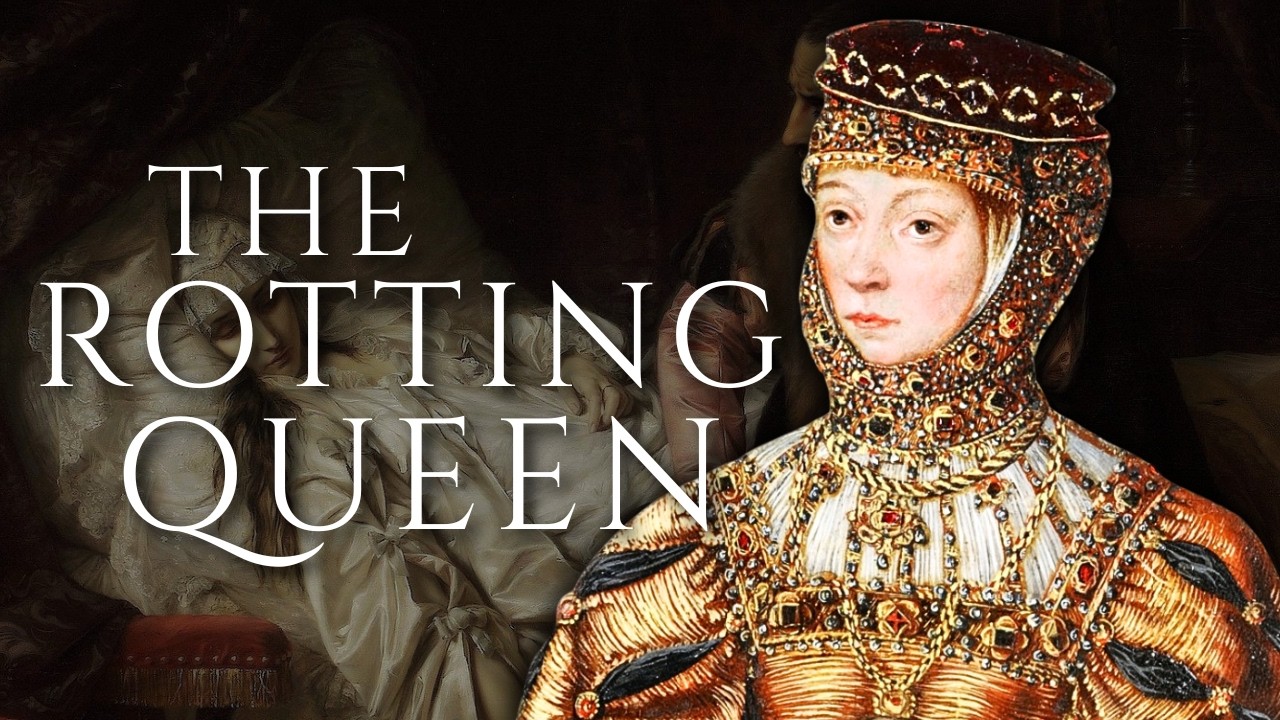
His wife was dying in a room at Wawel Castle, eaten from the inside by something the doctors would not even try to treat, and he had convinced himself that if he could just get her out of the city, out to the hunting lodge at Niepołomice, where the air was cleaner and the spring was coming in, she might hold on. Then somebody measured the wagon against the gate and found it would not fit through. So the king had the gate demolished. A grown man, ruler of one of the largest states in Europe, tearing down his own fortifications because a doorway stood between his wife and a breath of country air.
She never made the trip. Within weeks she was dead, and the smell coming off her body in those final days was reportedly so foul that courtiers could not stay in the room with her. Her husband stayed anyway. He held her hand while the abscesses in her abdomen broke open one after another, and when it was over, he put on black clothing and essentially never took it off for the remaining twenty-one years of his life.
Her name was Barbara Radziwiłł, and for a stretch of the sixteenth century she was probably the most hated woman in Poland. Pamphlets called her a whore. Senators called her a witch. Crowds of armed noblemen threatened civil war over her existence.
Her own mother-in-law was accused, loudly and publicly, of poisoning her. Beneath all that noise sat a fairly simple story: two people who married for love in a century when kings absolutely did not do that, and a disease that took its time killing a young woman in one of the most agonizing ways the human body has on offer. It gets dark. It gets genuinely grotesque toward the end, and it left a hole in European history big enough that you can argue the map of the continent looks different because of it.
Lithuania, early sixteenth century, a family on the rise. Barbara was born on the 6th of December, and the year depends on which piece of evidence you trust. A silver plaque sealed inside her coffin says she died not having completed her twenty-eighth year, which puts her birth in 1523. The Radziwiłł family genealogy kept at their castle in Nieśwież says 1520.
Either way, she came into the world as the youngest child of a man whose nickname tells you most of what you need to know about him. Jerzy Radziwiłł was called Hercules. He was the great hetman of Lithuania, meaning he commanded its armies, and he held the governorships of Trakai and Vilnius, two of the most powerful posts in the Grand Duchy. He fought in something like thirty battles and had a reputation for winning most of them.
Her mother, Barbara Kolanka, was the daughter of a governor of Podolia, down in what is now Ukraine. By the time little Barbara was learning to walk, the Radziwiłłs were the wealthiest and most powerful noble house in the entire Grand Duchy of Lithuania, stacking government offices the way other families stacked firewood. Two men in that family kept turning up to the very end. Barbara had an older brother, Mikołaj, whom everyone called Mikołaj the Red, and a cousin, also Mikołaj, whom everyone called Mikołaj the Black.
Two Mikołaj Radziwiłłs, distinguished by color-coded nicknames, and historians have been quietly grateful for those nicknames ever since. The Red eventually became governor of Vilnius, Grand Chancellor, and Grand Hetman of Lithuania, his father’s old job. The Black collected the offices of governor of Vilnius, Grand Chancellor, and Grand Marshal. Between the two of them, these cousins spent decades effectively running Lithuania, and both understood from very early on that their beautiful young kinswoman was an asset.
That sounds cold, and it was. Sixteenth-century noble families treated their daughters as diplomatic currency, and the Radziwiłłs were better at spending that currency than almost anyone alive. Through her descent from a woman named Elizabeth of Pilica, who had married King Władysław Jagiełło over a century earlier, Barbara also carried a thin trace of connection to the royal house of Poland. Distant, faded, mostly ceremonial, but when she eventually married into that dynasty, she was circling back toward her own family tree.
Her upbringing was comfortable rather than scholarly. She spoke and wrote Polish and Ruthenian, the administrative language of much of the Grand Duchy, and could understand a bit of Latin, though she never wrote in it. Later romantic legend inflated her into a polyglot who chatted away in Lithuanian and Italian, and the evidence for that is essentially zero. What the sources agree on instead is her appearance and her tastes.
She was, by broad contemporary consensus, strikingly beautiful. She loved fashion. She used perfumes and face powder and took real care with cosmetics at a time when that could get a woman whispered about. Above everything else, she loved pearls.
Pearls became her signature. She wore ropes of them, wove them into headdresses, collected them, and the fame of Barbara Radziwiłł’s pearls eventually traveled across Europe. At around thirteen or fourteen years old, she was married off. A magnate named Stanisław Łowicz Gasztołd, governor of Nowogródek and heir to one of the other great Lithuanian fortunes, had been betrothed to Barbara’s older sister, Anna Elżbieta.
In 1536 he broke that engagement off rather than let the alliance between the two families collapse. Jerzy Radziwiłł simply offered up his younger daughter instead. Custom be damned, and custom very much said a younger sister should not marry before an elder one. The wedding treaty was signed on the 20th of October 1536 in a place called Raduń, and the marriage itself happened on the 18th of May the following year, 1537, at the Gasztołd residence at Hieraniony.
Her dowry was the sort that got written down in detail precisely because it was meant to impress: silver and gilded tableware, twenty-four fine horses, gowns of satin and damask worked through with gold thread and precious stones. In exchange, her new husband transferred property worth 8,000 kopecks of Lithuanian groszy into her name, a serious fortune that would quietly shape the rest of her life. No children came. Barbara was in her mid-to-late teens, mistress of great estates, married to a man she had been handed to as a replacement bride.
Then on the 18th of December 1542, Stanisław Łowicz Gasztołd died suddenly after a short illness. He was the last male of his line, which mattered enormously under Lithuanian law, because when a noble family ran out of men, the bulk of its estates reverted to the Grand Duke. The Grand Duke at that moment was the old king of Poland, Sigismund I, known as Sigismund the Old. A river of Gasztołd land and castles flowed away from the young widow and into royal hands, leaving her the properties settled on her personally.
Barbara was roughly twenty years old, childless, extremely wealthy in her own right, famously lovely, and suddenly unattached. She had no way of knowing it, but the paperwork transferring her dead husband’s lands had just set a fuse burning toward the rest of her life. On the 15th of June 1543, old King Sigismund transferred the confiscated Gasztołd property to his son and heir, a young man in his early twenties named Sigismund Augustus. In October of that year, the young prince traveled to Hieraniony in person to take formal possession of his new lands.
Hieraniony, you’ll remember, was where Barbara had been married and where she still had every reason to be. Most historians place the beginning of their relationship right around this visit in the autumn of 1543, though nobody wrote it down at the time, for the excellent reason that the prince was a newlywed. Just months earlier he had married Elizabeth of Austria, a sixteen-year-old Habsburg princess, daughter of Ferdinand I, in a match arranged for all the usual dynastic reasons. Whatever started between Sigismund Augustus and the widow Gasztołd started as an affair conducted while his teenage wife sat neglected in another set of rooms.
Elizabeth’s story is miserable in its own right. The girl suffered from epilepsy. Her seizures were frequent and severe, and her young husband, instead of showing her patience, recoiled from her. He avoided her company.
The marriage curdled almost immediately, and hovering over the whole household was the prince’s mother, Queen Bona Sforza, an Italian duchess who had come north decades earlier to marry Sigismund the Old and had spent the years since accumulating land, money, and enemies at a rate that alarmed the Polish nobility. Bona had opposed the Habsburg match and made no secret of despising her daughter-in-law. When Elizabeth of Austria died on the 15th of June 1545, at eighteen years old, officially of her epilepsy, the whisper went around almost before the body was cold: the Italian queen had poisoned her. No proof then or now.
Epilepsy in the sixteenth century, untreated and poorly understood, killed young people all the time. But the accusation attached itself to Bona Sforza like a burr, and it would come back with tremendous force a few years down the line. With Elizabeth dead, the affair between Sigismund Augustus and Barbara stopped hiding. He was Grand Duke of Lithuania in his own right by then, ruling from Vilnius while his elderly father held court in Kraków, and the geography of Vilnius did the lovers a favor.
The royal palace and the Radziwiłł family palace stood practically next door to each other. The story that has clung to this romance for nearly five centuries says that the king had a private passage built connecting the two, a covered corridor or tunnel through which he could slip from his own residence into hers without a single guard, servant, or ambassador being any the wiser. Guides in Vilnius will still show you what is said to be remnants of it at the Castellan’s house. Whether every stone of that story is sound, the underlying picture certainly is: a young ruler in love arranging his capital city around his access to one particular woman.
He made little effort to hide the rest of it either. The account books from those years survive, and they sketch a man thoroughly distracted from the business of governing. In 1546 he spent 223 days of the year hunting. Meanwhile the money flowed toward the Radziwiłłs in a warm, steady current.
He financed the construction of Mikołaj the Red’s palace in Vilnius. In 1544 he handed 200 gold coins to Barbara’s cousin Janusz, in 1545 and 400 to Mikołaj the Black. If you were a Radziwiłł in the mid-1540s, life was extremely good, and the source of all that sunshine was your kinswoman’s bedroom. His parents, meanwhile, were busy shopping for his next wife.
The old king and Queen Bona worked through a list of candidates that tells you exactly what league this young man was supposed to be playing in: Anna Sophia of Prussia, Anna d’Este from the court of Ferrara, Anna of Lorraine, Margaret of France, and remarkably, Mary Tudor, the future Mary I of England. Any of those matches would have brought territory, alliance, or treasure. All of that machinery was grinding along in Kraków while the heir to the throne up in Vilnius was quietly deciding to torch the entire thing. Sometime in the summer of 1547, Sigismund Augustus married Barbara Radziwiłł in secret.
No official record survives of the date, the priest, or the guests. The historian Władysław Pociecha, who spent years combing through the correspondence, narrowed the window to somewhere between the 26th of July and the 6th of August. Beyond that, the wedding of a reigning Grand Duke of Lithuania is simply a blank space in the record, and that blankness was the whole point. He told no one.
Not his father the king, not his mother, not the Senate of Poland, not the council of Lithuania. A handful of Radziwiłłs knew, and that was it. How exactly that wedding came about is one of the genuinely contested corners of this story, and two very different versions have come down to us. The lurid version comes from the Lithuanian Chronicles, and it goes like this.
Barbara’s brother Mikołaj the Red and her cousin Mikołaj the Black grew tired of watching the king treat their kinswoman as a mistress, a status that shamed the family name even as it enriched the family accounts. So one night they staged an ambush. They burst in on the couple together, caught the king in Barbara’s chambers in circumstances that allowed for exactly one honorable interpretation, and demanded, with swords more or less figuratively drawn, that he restore her honor by marrying her on the spot. A priest, conveniently available at that hour, performed the ceremony then and there.
The trapped king, the scheming brothers, the beautiful bait. It is a tremendous scene, and it circulated for centuries. The problem with it is the man at the center. The historian Anna Sucheni-Grabowska, who studied Sigismund Augustus about as closely as anyone ever has, pointed out that this particular king hated above almost all things being forced into anything.
He was stubborn to the point of self-destruction, as the next few years demonstrated at length, and the idea of him being bounced into the single most consequential decision of his life by two ambushing noblemen sits very oddly against everything else we know about his character. On her account, the secret wedding was planned and controlled by the king himself, with the Radziwiłł men as accomplices rather than puppet masters. A more recent writer, Kamil Janicki, pushed back on that too, noting that no source actually confirms the king was the calm architect either, and that when it came to Barbara specifically, this famously calculating man behaved like anything but a calculator. What we have from the king’s own hand is a letter to his cousin, Duke Albert of Prussia, in which he explains the marriage with one word essentially: love.
He married her because he loved her. Every complication that follows flows out of that one sentence. What he did immediately afterward is documented, and it shows you how well he understood the storm he had just invited. He did not present his bride to the world.
He sent her away. Barbara was packed off to the Radziwiłł estate at Dubingiai, a lakeside castle north of Vilnius, to sit in seclusion while her new husband figured out how to break the news. Step one was dispatching Mikołaj the Black south to Kraków to inform the old king and Queen Bona, armed with a carefully constructed lie. The Black was instructed to claim the couple had actually been married since the 25th of November 1545, shortly after Elizabeth of Austria’s death.
Backdating the wedding by two years would have laundered the affair into a longstanding marriage and made the whole thing feel settled and historic, beyond argument. Nobody in Kraków bought it. The mission failed completely, and Sigismund Augustus realized he would have to face his parents in person. He left Vilnius on the 15th of November 1547, heading south toward the most uncomfortable family conversation in the history of the Polish crown.
Five days into that journey, a letter went back north that historians still argue about. Stanisław Dwejno, the royal courtier keeping watch over Barbara at Dubingiai, wrote to the king on the 20th of November with hard news. The difficult journey to the estate, he reported, had caused her grace to miscarry. A pregnancy lost on the road.
If true, it means the couple came within months of an heir whose existence would have rewritten everything that follows. But the report sits alone, uncorroborated, and it has been endlessly picked over. Some historians take it at face value. Some suspect the Radziwiłłs invented or exaggerated a pregnancy to bind the king tighter to his secret wife at the exact moment he was walking into pressure to abandon her.
And some medical historians have raised a third possibility, a genuinely grim one, that what Dwejno described as a miscarriage may have been an early rupture of something already growing inside Barbara’s abdomen, the first visible sign of the disease that would kill her four years later. A bleed misinterpreted. If that interpretation is right, then her death was already in motion before her marriage was even public knowledge, and every battle everyone fought over the next four years was fought over a woman who was already running out of time. While the king rode south, Barbara sat at Dubingiai through the winter of 1547 into ’48.
That lonely stretch of months gave us the only surviving letters of the entire romance, eight of them, all in her hand, all written between November and the following March. If you come to them expecting passion, they will stop you cold. They are formal to the point of pain. She addresses her own husband as “your royal grace, my gracious lord” over and over, sentence after sentence.
She signs herself “his smallest servant. ” In one letter she calls herself his eternal handmaid, and in another she reaches for a word that translates as bondwoman, his slave, more or less. One of the eight accompanied a gift. “I humbly thank you for this writing,” she wrote, “by which your royal grace, my gracious Lord, deigned to inform me of your good health.
I send your royal grace a little ring as a sign of my most submissive service, which I commend to the gracious favor of your royal grace, my gracious lord. Your royal grace’s smallest servant,” and then just her initials, B. R. Another went out with a clock, and this one, once you sit with it, is quietly devastating.
“I humbly beg,” she wrote, “that your royal grace, looking upon these twelve hours, might deign to choose at least one during which I, the smallest servant of your royal grace, might be kept in your royal grace’s memory. ” One hour out of twelve. That was the size of her request to her own husband. An earlier detail suggests that formality was partly trained into her.
The king had corrected her writing early on, scolding her for signing letters with the singular “I” instead of the royal “we. ” He wanted his secret wife to sound like a queen on paper before anyone was allowed to know she existed. Letter writing in the 1540s was a formal art with manuals and models, and a noblewoman addressing a monarch, husband or not, was expected to deploy the full apparatus of self-abasement. “The smallest servant of your royal grace” was practically boilerplate, humility as protocol rather than confession.
But what the manuals cannot explain away are the choices inside the formulas. She wrote often, more often than protocol demanded of a wife in seclusion. The gifts, a ring, a clock sent from a lakeside castle in midwinter, were her ideas, small physical objects dispatched to keep herself present in his hands when she could not be present in his rooms. And the requests she smuggled into the ceremonial language, one hour out of twelve, keep me in your memory, are not the requests of a schemer confident in her hold on a king.
They are the requests of a woman who was not sure. The formality of the letters hides what was actually happening to her, but Dwejno’s reports from the same castle do not. The courtier wrote to the king with the bluntness of a man covering himself, and his dispatches describe a woman coming apart. “Unspeakably great was her grace’s weeping,” he reported, “and the result of such great weeping were frequent and cruel faintings.
” In another dispatch: “Several times, gracious king, both by day and by night, they came running for me, saying that her grace was very ill. And when I myself ran to her grace, I found her grace deeply swooned. ”
Down in Kraków, the king finally said the words out loud. On the 2nd of February 1548, at Piotrków Trybunalski, Sigismund Augustus informed his parents that he was married to a subject, to his own former mistress, without asking the Senate, without asking them, without asking anyone.
The explosion was everything you’d expect. His father was old and failing and did not have long to be furious. His mother, Bona Sforza, had years of fury left in her, and she deployed it immediately, becoming one of the loudest voices demanding the marriage be undone. She had spent a decade lining up princesses of Prussia and Lorraine and Ferrara and England for this boy, and he had thrown the whole board over for the widow next door.
Bona had arrived in Poland back in 1518 as a twenty-four-year-old Italian bride for the widowed Sigismund the Old, bringing with her a duchy at Bari, a Sforza pedigree, a formidable education, and an entourage of Italians who proceeded to colonize the Polish court’s kitchens, gardens, and back channels. Poles credit her to this day with introducing half the vegetables in their national cuisine. What she introduced alongside the vegetables was a style of politics the local nobility found alarming: inquisitive and relentless. Over three decades she bought and maneuvered her way into one of the largest private land holdings in the realm, built a treasury independent of her husband’s, sold offices, cultivated her own faction of bishops and senators, and increasingly governed through the aging king rather than beside him.
The szlachta hated her for all of it, and their hatred came preloaded with every Italian stereotype the age had in stock: the schemer, and inevitably the poisoner. Some of that was pure prejudice. Some of it was earned. She was by any fair measure one of the most capable political operators in sixteenth-century Europe, and she had spent twenty-five years building her son’s future as the centerpiece of everything she had constructed.
His marriage was the single most valuable card in her hand. Finding out he had already played it secretly on the widow of a Lithuanian magnate was for Bona both a personal wound and the demolition of her life’s work. Contemporaries had no doubt about whose energy sat behind the loudest of the campaign against Barbara, and about whose network kept the accusations circulating. Then on the 1st of April 1548, Sigismund the Old died, and everything accelerated.
The son was now king of Poland in fact as well as in title, and he had to travel south to bury his father and take hold of his throne. Before leaving Lithuania, he did something that closed off every diplomatic exit behind him. On the 17th of April in Vilnius, he publicly announced his marriage and proclaimed Barbara Radziwiłł Queen of Poland, an act that simultaneously made her Grand Duchess of Lithuania. He skipped the trial balloons and the quiet Senate soundings entirely.
A proclamation. From that day forward, any demand that he abandon Barbara was a demand that a crowned king unsay his own royal word, and this particular king would rather have chewed glass. Poland’s answer arrived in ink first. Anonymous pamphlets started circulating, and they went after Barbara with a viciousness that still startles when you look at the surviving material.
She was called a whore in more or less those terms. She was accused of witchcraft, of having snared the king with love spells and potions, the standard sixteenth-century explanation whenever a powerful man did something inexplicable over a woman. She was declared barren, unfit to produce the heir the dynasty desperately needed. The accusations of promiscuity got Barbara a loose lifestyle supposedly inherited from her mother.
Insinuations of incest and inventories of invented lovers drawn from every rung of society, senators at the top, servants at the bottom. Some of this filth came from anonymous hands, but not all of it. The humanist Stanisław Orzechowski, one of the most celebrated writers in the country, published against her. So did Mikołaj Rej, a founding figure of Polish literature, the man schoolchildren in Poland still study.
The literary establishment of an entire kingdom turned its talents to destroying the reputation of one woman. The mud stuck so thoroughly that respected historians were still repeating the promiscuity claims in the twentieth century. Modern scholars who went looking for the evidence underneath those claims, the Lithuanian historian Raimonda Ragauskienė foremost among them, found essentially nothing back there. Slander printed becomes citation.
Citation aged four hundred years becomes fact. Her reputation was manufactured by her enemies, and it outlived them all. One group notably was not attacking her: the Lithuanians. The nobility of the Grand Duchy never mounted open opposition to the marriage.
Their queen was one of their own, after all. What they watched with narrowed eyes instead was the Radziwiłł family itself, suddenly cousins to the crown, suddenly first among equals, and plenty of Lithuanian magnates quietly loathed the two Mikołajs for it. All of it came to a head in the autumn of 1548, when the general sejm, the great parliament of the realm, gathered at Piotrków from the end of October into December. The king needed this assembly to accept his marriage.
The assembly arrived intending to break it. The sessions were loud, angry, and packed, and out of them came one of the most theatrical scenes in the history of Polish politics. A deputy named Piotr Boratyński stood to address the king, and as he spoke he went down on his knees, and behind him the entire chamber of deputies knelt too. A parliament on the floor begging its monarch.
Boratyński’s speech, preserved and celebrated as a masterpiece of oratory ever since, hit the king with words like these: “We beg you, sir, abandon what you have undertaken. Do not give the name of marriage to what is no marriage. Let this worthy and virtuous lady whom your royal majesty wishes to have as wife be adorned with something other than infamy, disgrace, harm, dishonor, and in the end the ruin of your royal majesty and of the whole house of Jagiellon. ” Notice the shape of it.
Even in the act of demanding her disposal, he calls her worthy and virtuous. The performance required courtesy toward the lady while the machine ground her up. Barbara herself was hundreds of kilometers away while all of this was said about her, and no record survives of anyone asking what she thought. Behind the eloquence sat something with real teeth.
Powerful senators, Piotr Kmita, the governor of Kraków, and Jan Tęczyński among them, spoke against the marriage in harder terms. Out in the chamber and beyond it, nobles talked openly of taking up arms. Armed rebellion over a wedding. The kneeling deputies were the soft option.
The alternative on the table was civil war. The king let them kneel, and then he refused. He told the sejm, in substance, that he would not forsake his wife so long as God kept him in this world. What God had joined, no parliament would separate.
When the pressure kept coming, word went around that he was prepared to abdicate, to walk away from the crown of Poland itself rather than repudiate Barbara. Whether he ever would have signed such a thing, nobody had the nerve to test. A twenty-eight-year-old king months into his reign, staring down his entire political nation over a woman they had spent a year calling a witch and a whore, and not giving an inch. The sejm broke up in December having achieved precisely nothing.
No annulment came out of it, and no coronation either. Stalemate. Deputies rode home through the winter mud to tell their local assemblies that the king would not budge, and the pamphlet presses picked up where the orators had left off. With the parliament defied, the king went and got his wife.
On the 13th of February 1549, Sigismund Augustus brought Barbara into Kraków and installed her at Wawel Castle, the seat of Polish royalty, in the teeth of a capital that despised her. Once she was there, he wrapped her in luxury as if sheer expenditure could substitute for acceptance: gowns, jewels, gifts, an establishment worthy of a queen who had not actually been crowned. In May of that year he went further and signed over to her a swath of territory in the Trakai region of Lithuania that amounts to a small principality: Kowno Castle, Rumšiškės, Alytus, Merkinė, Brastonys, and more besides. Whatever else you want to say about this man, he did not hedge.
He had bet his reign on this marriage, and he kept doubling the stake. Barbara herself, in the middle of all this, is strangely quiet in the sources, and the quiet seems to reflect the woman. She showed almost no interest in politics. Unlike her brother and cousin, who worked hand in glove with the king through every stage of the fight for her crown, she made no recorded effort to charm the senators, catch the szlachta, or win over the crowds of Kraków.
She undertook no progresses and mounted no charm offensive. Some historians see passivity in that, or depression, and given what Dwejno witnessed at Dubingiai, depression is not a stretch. Others see a simpler explanation. She had watched an entire kingdom’s literary class call her a whore in print for a year.
The appetite for winning those people over may simply not have survived the experience. Either way, the campaign for Barbara’s crown was fought entirely by men over her head while she waited inside Wawel with her gowns and her pearls and her worsening health. The king’s campaign was relentless, and it operated on every level at once. Threats where threats worked, bribes where bribes worked, offices and lands redistributed to soften opponents, and on the international stage, a move of genuine cold blood.
In the summer of 1549 he concluded an alliance with Ferdinand of Habsburg, the same dynasty of his miserable first marriage, specifically to guarantee that if his own nobility rose against him over Barbara, he would have Habsburg backing. The price of that insurance policy was paid by his own sister. Isabella Jagiellon, Queen of Hungary, was at that moment fighting for her son’s inheritance against Habsburg power, and her brother’s new alliance effectively abandoned her to lose. He traded his sister’s cause for his wife’s crown, and he does not appear to have hesitated.
Meanwhile his mother saw which way the wind was blowing. Bona Sforza, outmaneuvered at court and unwilling to watch her daughter-in-law triumph, withdrew from the capital entirely and removed herself to her lands in Mazovia. The queen mother leaving court was a political earthquake in its own right, and everyone understood what it meant. She had lost this round.
Piece by piece, the wall of opposition came down. By the time the next sejm met, from May to July of 1550, the deputies who had knelt on the floor at Piotrków eighteen months earlier had essentially stopped contesting the validity of the marriage. Money, exhaustion, and the plain fact of the king’s immovability had done their work. The last gatekeeper was the church.
A coronation needed the primate of Poland, Archbishop Mikołaj Dzierzgowski, a man who had been aligned with Bona and dragged his feet on recognizing the new queen. The king worked on him too and won him over. Rome came through late in 1550 when Pope Julius III instructed the Polish bishops to crown Barbara, though by the time the papal envoy actually arrived, the king had already secured the primate himself. Three years of political warfare, and Sigismund Augustus had beaten the pamphlets, the parliament, the primate, and his own mother.
So on the 7th of December 1550, in Wawel Cathedral, Archbishop Dzierzgowski placed the crown of Poland on Barbara Radziwiłł’s head. The coronation portrait shows her almost buried in the occasion, layered in gauzy robes and heavy jewels, her pearls worked into an ornate headdress. Every inch the queen her enemies had sworn she would never be. December, cold outside, incense and choir within, the primate who had resisted her now performing the anointing, and senators in attendance who two years earlier had knelt on a parliament floor to demand she disappear.
Three years and some months after a hidden wedding ceremony in Vilnius that no one recorded, she stood in the holiest royal space in Poland with holy oil on her skin and a crown on her hair. It was a total victory, and it was hollow at the center, because the woman being crowned that day was already dying, and most of the people in that cathedral could probably see it. Her health had never been good, or at least not for as long as she had been the king’s wife. Complaints run through the correspondence going back almost to the secret wedding itself, and they cluster around her abdomen.
Pain, recurring and severe, low in the belly. The people around her had a ready explanation, since kidney and bladder stones were among the everyday torments of the sixteenth century, and the court settled on calling her trouble “the usual stone,” as if it were a familiar house guest. In late February 1549, the court steward Stanisław Mężyk-Jofski wrote from the royal lodge at Niepołomice that her grace had “deigned to fall somewhat ill of her usual stone. ” Even her agony got wrapped in court etiquette.
Earlier than that, from November 1548, survives a stranger little document: the king writing to Mikołaj the Red, asking him to forbid Barbara from spending so long in the bathhouse, for it harms her health. You can take that a couple of ways. A husband fussing, or a woman in chronic pain discovering that hot water was one of the only things that gave her relief and soaking for hours because of it. Whatever was growing inside her, it moved at its own pace, allowing stretches of apparently normal life in between the bad spells.
The most striking example lands after the coronation. In the middle of February 1551, at the carnival festivities at Niepołomice, the newly crowned queen of Poland danced through an entire night, music, feasting, a young woman in her twenties dancing until morning. She had less than three months to live. Guests at Niepołomice that evening watched a queen in full glitter, laughing, spinning through the figures until the candles burned low, and some of them surely went home reassured that the talk of her failing health had been overblown.
Courts run on appearances, and for one final night she gave them a flawless one. The collapse, when it came, came fast. In the weeks after the coronation, the picture in the sources darkens by month. A high fever set in and would not fully break.
The abdominal pain sharpened past anything the usual stone had ever done. Her appetite failed, and she began wasting. And low on her abdomen, a swelling appeared that you could see and feel from the outside. A lump, hard at first, then growing, then filling.
The court physicians examined her and understood, in the way sixteenth-century physicians understood anything, that this was no stone. What they were looking at in their vocabulary was an ulcer, an apostema, a gathering of corrupt matter inside the queen’s body. The nineteenth-century historians who worked through the court correspondence, Julian Bartoszewicz and Michał Baliński, assembled the progression from the letters. Barbara had long had a certain hardness on her side, one account records, which began to grow and swell so rapidly that it soon turned into a great abscess.
From that point forward, the record of the last months of Poland’s most hated queen becomes essentially a wound diary. The swelling on her abdomen matured into what the accounts call a great abscess, a cavity packed with pus straining against her skin. Ulcerations opened across the area. Corrupt matter, in the language of the day, began discharging from her body, and with it came the detail that every account of Barbara’s death fastens onto, the one that turns this from a sad story into a horrifying one.
The smell. The discharge produced what the sources describe as a repellent stench. This was dead tissue and pus in a closed, candle-heated room day after day, soaking into bedding faster than it could be changed. Necrotic flesh has an odor unlike anything else, sweetish and rotten at once, and people who work around it in modern hospitals with ventilation and disinfectant will tell you it clings to the inside of the nose for hours.
Barbara’s attendants had no ventilation and no disinfectant. They had perfumes, herbs to burn, cloths to press over their faces. Court servants whose entire function in life was standing in rooms with royalty found they could not physically remain in hers. They gagged.
They made excuses. They rotated out. The queen was rotting while still alive, and everyone in the castle could smell it. Servants burned juniper and herbs in the braziers against it, and scented water came in by the jugful, and none of it did more than blur the edge of what filled that room.
Her body distorted as the disease advanced. The hardness spread until, in the words drawn from the correspondence, her whole lower abdomen had gone rigid, one solid mass under the skin. Her legs swelled with fluid until they lost their shape. Above the ruin of her midsection, the rest of her wasted, since she could barely eat.
A young woman turning skeletal in her face and arms while her belly and legs bloated. The fever rode her constantly, spiking and easing and spiking. And the pain, months of it, in an age with nothing better than wine, poppy syrups, and prayer to set against it. Modern oncology considers the pain of advanced abdominal cancer one of the most severe in medicine and attacks it with opioids.
Barbara got warm plasters. Then the abscess burst. The largest of the masses on her abdomen broke open, and an extraordinary thing happened. She got better briefly, with the pressure released and the cavity draining.
The fever eased, the agony ebbed, and hope shot through the court. The physicians allowed themselves optimism. Perhaps the corrupt matter was leaving her. Perhaps this was the crisis in the old medical sense, the turning point after which recovery begins.
The disease had merely emptied one chamber, and it had others. Further growths rose and softened and broke open in their turn, and the accounts record what came out of them: reddish pus, blood-tinged, pouring from a queen of Poland while her attendants held basins. With each new rupture, the fever surged back, and now vomiting joined it, and nausea that made even the sight of food unbearable. The cycle repeated: swelling, rupture, false hope, collapse, and each turn of it left her weaker than the last.
The medical historian Witold Zembicki, going over the sources centuries later, made the clinical correction that what the era called an ulcer was properly an abscess. Behind an abscess like that, forming and reforming in the lower abdomen of a woman in her twenties, sat something the physicians of 1551 could name but not touch. They did name it, actually, or at least one contemporary did in plain Latin. Stanisław Orzechowski, the same celebrated writer who had published against Barbara during the marriage fight, recorded in his annals that the queen died of a grave disease that is called cancer.
Cancer. The crab in the old imagery, clawed into the flesh and impossible to pull free. Modern scholarship, working from her symptoms, from her physicians’ surviving prescriptions, and eventually from her remains, has converged on the same word with more precision: advanced cancer of the reproductive organs, most likely cancer of the cervix spread beyond any hope, with everything the sources describe mapping onto the known course of that disease when nothing whatsoever stands in its way. A medical review published in 2022 went back through the written record and arrived at the same conclusion.
Cervical cancer with metastasis. Untreated, it kills exactly the way Barbara died. The treatment she received tells its own story about what her doctors believed. Sigismund Augustus, desperate, cast the net as wide as a king could cast it.
Physicians summoned from across the country. Folk healers brought to Wawel alongside the university men, women among them. And one detail that stands out in the record: a Jewish woman healer fetched all the way from Lithuania, presumably because someone swore by her. When your court physicians train at Padua and you are still sending riders hundreds of kilometers for a village healer, you have run out of medicine.
What the medicine of the day actually offered is preserved in the surviving prescriptions, and it is almost unbearably modest. Plasters and patches, dressings laid over the abscesses. The pharmacopoeia of the era held ointments, pastes, powders, aromatic waters, medicated wines, herbal solutions, a whole inheritance running back to the Roman herbals, and nearly all of it in Barbara’s case was applied to the outside of a disease living on the inside. That restraint was doctrine.
Sixteenth-century medicine taught that cutting into cancer was worse than useless, that aggressive treatment tormented the patient and hastened the end. The recognized protocol for a case like hers was to dress the wounds, ease what could be eased, and wait for death. The very passivity of her doctors is one of the strongest clues historians point to about the diagnosis. These men knew a hopeless case when they smelled one, and they treated the Queen of Poland as a hopeless case.
Behind everything those physicians did and did not do at that bedside sat a complete theory of the body. Medicine in 1551 still ran on the ancient system of the four humors, and cancer had a specific place in that scheme. It was understood as a local overflow of black bile, the coldest and most malignant of the body’s fluids, pooling and hardening in the flesh. The name itself came down from the Greeks: karkinos, the crab.
Supposedly because a tumor with its swollen veins spreading outward resembled a crab’s body and legs, and because like a crab’s grip, it could not be pried loose. The crab image carried a warning that every university-trained doctor of Barbara’s era had absorbed: provoke the crab and it bites harder. Cutting into a cancer, the authorities taught, enraged the black bile, spread the corruption, and killed the patient faster and in greater agony. So surgery on a growth like Barbara’s counted in the eyes of the profession as malpractice.
What remained inside orthodox practice was exactly what her prescriptions show: soften, soothe, draw. Plasters to draw the corrupt matter outward. Warm applications to ease the hardness. Medicated wines and herbal waters to fortify the failing body and adjust the humors from within.
Cleaning and dressing the open sores as they ruptured, hour after hour, day after day. An endless, foul, losing labor of basins and linen, carried on by whichever attendants could endure the room. Prayer wound through all of it, masses said for the queen’s recovery, because in the medical theory of the day the line between physic and providence was thin, and when the plasters failed, the failure said as much about God’s intentions as about the doctors’ skill. Judge those men gently, working inside the knowledge available to them.
They mostly got the diagnosis right, correctly refused treatments that would have added torture to torture, and settled for what a modern hospice would recognize as palliative care, minus every effective painkiller invented since. The cure for what she had lay four hundred years beyond anyone’s reach, for a disease that medicine today screens for and frequently cures. The disease worked on her mind as well as her body, and the sources are humane enough to have noticed. Irritability crept in, and stretches of black depression, the psychological weather familiar to anyone who has sat with the terminally ill.
She had months to lie in that bed and understand what was happening to her. Twenty-seven years old, perhaps, crowned for less than half a year, and able to smell her own body failing. The court around her, with a handful of exceptions, kept its distance, and the record preserves a phrase for that circle that needs no decoration: a heartless court. The exceptions matter though, and the great one was the king.
Through every stage of this, the ruptures, the basins, the stench that drove trained courtiers from the room, Sigismund Augustus stayed. He nursed her personally. The sources put it with brutal simplicity: he tended his dying wife even though she stank of pus. A reigning monarch, a man raised on Renaissance ideas of majesty and ceremony, sitting in that reeking chamber, holding a dying woman’s hand, adjusting her pillows, keeping the vigil his servants could not stomach.
He had fought half the kingdom for four years to keep her. He was not going to be driven off now by the smell of her dying. Of course, a court being a court, the sick room bred theories, and some of them were poisonous in their own right. The secretary of the papal legate, Giovani Francesco Commendone, put one about that had a nasty plausibility to it.
The queen’s illness, he claimed, was caused by medications she had taken in her frantic efforts to conceive. Fertility drugs, in effect, blamed for the tumor, with the neat implied moral that her barrenness and her death were one package. Uglier still was the whisper that came from inside her own family. The Radziwiłłs, in private letters to one another, worried over whether Barbara might have a sexually transmitted disease and followed the thought to its natural end, whether she had given it to the king.
Her own brother and cousin, the men who had ridden her marriage to the summit of Lithuanian power, quietly wondering in correspondence whether the family asset had a shameful disease. The venereal theory escaped the family circle too, and versions of it, gonorrhea, syphilis, the pox, floated around for centuries afterward, fitting so conveniently into the pamphlet portrait of the promiscuous queen. Set against it stand two stubborn observations. Her physicians, who saw syphilis constantly and knew its treatments intimately, mercury above all, prescribed none of them for Barbara.
Not one item from the standard anti-pox arsenal. And her skeleton, examined in the twentieth century, shows none of the bone damage that advanced syphilis reliably carves into its victims. The rumor served everyone who had ever called her a whore. The evidence never served the rumor.
And looming over every theory, bigger than all of them put together, stood the one accusation that half of Poland treated as obvious fact. Bona Sforza had poisoned her. The queen mother, the Italian, the woman who had fought this marriage with everything she had and then stormed off to Mazovia in defeat. Ask a Kraków burgher in the summer of 1551 what killed the young queen, and there is a decent chance you’d have gotten a knowing look and one word: poison.
You can see why the story wrote itself. Bona was Italian at a moment when northern European eyes meant intrigue and the poisoner’s art. She was a Sforza, tangled by blood and marriage into the dynastic snake pit that produced the Borgias, and the name Lucrezia Borgia hovered close to hers in hostile mouths. She had motive stacked on motive: hatred of Barbara, humiliation at her son’s defiance, the wreck of a decade of marriage diplomacy.
And crucially, she had a prior charge on the docket. Elizabeth of Austria, the epileptic first wife, dead at eighteen back in 1545 with whispers of Bona’s poison already attached. One dead daughter-in-law might be misfortune. Two started to look like a pattern.
What lends the rumor its lasting sting is a detail from inside the royal family. Sigismund Augustus never defended his mother. The accusation was everywhere attached to the queen mother of Poland, mother of the reigning king, and the reigning king said nothing. He issued no proclamation of her innocence and punished none of the gossips.
Make of that silence whatever you like. His contemporaries certainly did, and the estrangement between mother and son, already deep, went permanently cold. Some historians think he half believed it himself. Others think he simply hated her enough by then to let her twist.
Either way, the one man whose word could have quashed the story declined to say it, and the story fed on his silence for four hundred years. Set against all of that atmosphere, the actual course of the illness makes an awkward fit for poison. Poison in the era’s playbook struck at a banquet and killed within days or hours. Barbara declined visibly in stages over at least six months from the coronation, and arguably over years if you follow the abdominal pain back through the usual stone to the very beginning of the marriage.
No poison in the sixteenth-century cabinet worked like that, mimicking over half a year the precise progression of a documented tumor. The Radziwiłłs, who scrutinized every other theory, including the venereal one, who had every political incentive to cry murder against their family’s great enemy, never once accused Bona. Neither did the grieving king, whatever he privately withheld from his mother. The people who watched Barbara die from the closest possible range smelled cancer at that bedside, and nothing else.
History, however, was not finished with Bona Sforza. Six years after Barbara’s death, Bona had returned to Italy, to her duchy of Bari, taking with her an immense fortune. A large chunk of it loaned out to Philip II of Spain, the most powerful monarch on Earth, and a man with no intention of repaying anything. On the 8th of November 1557, Bona fell suddenly ill.
According to the testimony of an eyewitness named Chzurefina, she was poisoned twice, the second dose administered when the first seemed insufficient, on the orders of her own trusted secretary, Jan Lorenzo Pappacoda, working as Philip’s agent to erase the debt along with the creditor. She died at four in the morning on the 19th of November 1557, while Pappacoda extracted a forged will. Her biographer Maria Bogucka put the point plainly: the woman whom Poland accused of removing her enemies with poison ended her own life poisoned by a servant for money. Back in the spring of 1551, with Barbara visibly failing, something unexpected arrived at Wawel from Mazovia.
A letter. In March, during one of the brief rallies when Barbara was strong enough to receive anyone, a messenger came bearing a note from Bona Sforza herself, and its contents, after four years of open war, must have taken the sick room’s breath away. The queen mother recognized the marriage. She wished Barbara a swift recovery, and she addressed her in writing as “daughter” and “beloved daughter-in-law.
” People around Barbara called it her last victory, and the phrase fits. Every institution that had set itself against her, the sejm, the primate, the Pope’s hesitation, and now finally the implacable mother-in-law, had submitted one by one while she was still alive to see it. Early in April, a formal embassy followed the letter. Envoys from Bona and from the king’s sisters, received at the bedside with full ceremony, solemnly welcoming Barbara Radziwiłł into the royal family.
She had to be propped up in bed for it, and the room they gathered in was the room that courtiers fled from. The dynasty came to pay homage to a dying woman it had spent four years trying to erase. Recognition came when it could no longer cost anyone anything. Through April she sank.
The rallies grew shorter, the ruptures and fevers closer together. And it was in these weeks that the king conceived his last scheme, the one we opened with: Niepołomice. The royal hunting lodge outside Kraków. The place where she had danced through the night at carnival only weeks earlier, the place her spells of illness had sometimes eased before.
Spring air, open country, distance from the city she had every reason to loathe. He ordered the special wagon built, wide enough for a bed so she could make the journey lying flat. And when the finished wagon proved too broad for the city gate, he ordered the gate torn down. Masonry that had stood for generations pulled apart so a dying woman’s bed could roll through the gap.
The demolition went ahead. The journey never did. By the time the way was clear, Barbara was past moving. She knew it, too.
In her final days she made her wishes unmistakably plain. She received the last rites of the church, and it helps to see what that meant in 1551, since dying was a ceremony then, choreographed as carefully as a coronation. A priest came to the bedchamber with the viaticum, the final communion, food for the road in the literal translation, and anointed her with holy oil, sealing the senses through which sin had entered the body. Candles burned around the bed while the prayers for the dying were spoken over her, the priest working through the ritual with the smell of her dissolution in his throat.
By the standards of her world, all of this made hers a good death, the phrase the era genuinely used for an end met conscious and reconciled with God. And she asked insistently for one thing concerning what came after. Do not bury me in Kraków. Her coronation had been sung in Wawel Cathedral five months earlier, and she wanted no grave there, nor anywhere else in a city that had printed filth about her and knelt en masse to demand her disposal.
“Take me home,” she asked. “Bury me in Lithuania among my own people. ” Even dying, she understood exactly what Kraków was to her, and she refused to spend eternity in it. Her enemies had told her for four years that she did not belong there.
In the end, she agreed with them. Barbara Radziwiłł died on the 8th of May 1551, at two in the afternoon, in Kraków. The plaque her husband sealed into her coffin records the hour with a precision that aches a little across the centuries: precisely at the hour of 2 in the afternoon, as if the exact minute of the loss were a fact too important to let go of. She had not completed her twenty-eighth year, by that plaque’s count.
She had been a crowned queen of Poland for five months and one day. The disease had taken roughly half a year to kill her from the coronation, longer if you count from the first usual stone, and it had done so by inches, in full view of a court that held its nose, a husband who would not leave, and a kingdom that had hated her with an energy it rarely mustered for actual enemies. The hating stopped that afternoon. What replaced it over the next weeks was one of the strangest displays of royal grief in European history.
The preparation of her body became a statement in itself. She was dressed in a gown of black satin and laid in a coffin lined with golden brocade. The outside covered in black velvet bearing a great golden cross embroidered by Sebastian Link, the master craftsman who had decorated her garments in life. The same hands that had sewn her queenship sewed her shroud.
Into the coffin with her went the full regalia of her rank: a gilded crown on her head, a scepter, an orb topped with a cross, a long chain about her neck, and three rings on her fingers. Two of those rings deserve naming. One was a plain woven band, her wedding ring, the physical trace of that undocumented ceremony in Vilnius. The other was gold inlaid with black enamel and set with a diamond, an emerald, and a ruby.
She was buried, in other words, as a full queen of Poland, crowned and sceptered in death, whatever anyone in the kingdom still thought about the matter. And fixed inside the coffin went that silver plaque, its inscription composed with obvious care: “The most serene Princess Barbara, by the grace of God, Queen of Poland, of Lithuania, Ruthenia, Prussia, at not yet 28 years of age, in Kraków on the 8th day of the month of May, precisely at the hour of 2:00 in the afternoon, taken by a premature death and received into heaven. Here lies buried. ”
Her burial wish, though, set off one final argument, and the loudest objections came from inside her own family.
The Radziwiłł brothers, the Red and the Black, came to the king and begged him to bury Barbara at Wawel after all, among the kings. Their reasoning was pure dynastic calculation delivered through gritted teeth. One of them pleaded that her body be laid among the bodies of other kings “so that people do not say she was cast out of the crown, unworthy to rest among those anointed queens. ” You can hear the fear inside the request.
A queen shipped out of the royal necropolis, whatever the stated reason, would look for all time like a queen expelled. The king refused, and his recorded answer has a controlled fury that four centuries have not cooled. “Since there were those here in Kraków,” he said, “who could not show her majesty gratitude in life, let them never see her in death, and may they never claim her as their own. ” He was honoring his wife’s request, and in the same breath he was punishing his capital.
Kraków had knelt and threatened and pamphleteered against her for four years, and now Kraków would lose her permanently, and every future generation praying in Wawel Cathedral would notice the absence and know why. Grief and spite fused into a single decision. He was capable of both at once, this king. So began one of the most extraordinary funeral journeys of the century.
On the 25th of May 1551, seventeen days after her death, the procession left Kraków bearing the coffin north and east toward Vilnius, more than 700 kilometers away. Nearly three hundred courtiers rode in the cortège, plus a small army of servants, wagons, and clergy. A moving city inching across Poland and Lithuania in the early summer heat. The journey took close to a month, and at the head of it, mile after mile, went the king.
The accounts say that for great stretches of the road and through every town they entered, Sigismund Augustus dismounted and followed his wife’s coffin on foot. A king of Poland walking behind a wagon, town after town, in mourning black, while the townspeople who came out to watch understood they were seeing something with no precedent in living memory. Kings buried their wives with ceremony and moved on to the next alliance. This one walked her home across two countries.
As a physical event, the procession must have been unlike anything the people along that road ever saw before or after. A month of it, early summer, the roads dust or mud depending on the week, and coming over the horizon toward your town: outriders first, then clergy, then the wagon with the velvet-draped coffin and its golden cross, then the king of Poland on foot in black, then three hundred courtiers obliged to match the pace their monarch set, then the servants, the baggage, the spare horses, a column stretching back farther than a village boy could run. Church bells went ahead of them. In every town the coffin entered, the local clergy came out, and services were held over a queen most of these people had only ever heard described in the language of the pamphlets.
The witch of the broadsheets rolling past at walking pace with the most powerful man in the realm trudging behind her like a penitent. Political theater has rarely been performed on a stage the length of two kingdoms. And make no mistake, alongside the raw grief, theater is part of what this was. Every day of that walk rebuked the nation watching it.
You would not accept her, the spectacle said. So look at what your king thinks of you, and look how far he is willing to carry her to get her away from you. A practical horror rode along underneath all that devotion. May and June, a month on the road, a body dead of suppurating abdominal disease.
The embalming arts of the era were not going to hold that line by themselves. So before the procession left Kraków, Barbara’s body was packed in a dense mixture of ash and burnt lime, the same caustic material used in mortar, poured around her in the coffin. The lime did what lime does. It bound the corruption, suppressed the odor, and as the weeks passed, it hardened around her into a solid mineral casing, sealing the queen inside a shell of her own funeral chemistry.
The people who packed that coffin were solving an immediate ugly logistical problem: how to move a decomposing body 700 kilometers in summer. And they solved it well. What they could not have known was that they were also, entirely by accident, building the vault that would carry Barbara Radziwiłł, more or less intact, into the twentieth century. The cortège reached Vilnius in the last days of June.
On the 23rd of June 1551, after a solemn funeral mass, Barbara was carried into the crypt of Vilnius Cathedral and laid to rest. The placement chosen for her stops you for a moment. She was set down beside Elizabeth of Austria. The two wives of Sigismund Augustus, the discarded Habsburg teenager and the scandalous Lithuanian widow who had supplanted her, side by side in the dark under the cathedral floor, sharing her husband’s grief and eventually a rumor, since the same queen mother stood accused over both coffins.
Barbara had gotten what she asked for: out of Kraków, home to Lithuania, buried among her own. Whether she would have chosen the neighbor, nobody thought to wonder. The king came back from Vilnius a changed man, and the change never reversed. The transformation was visible before anything else.
He dressed in black, and he kept dressing in black for the rest of his life, twenty-one more years of it. The court noticed him withdrawing from the pleasures that had defined his youth. The man who once spent 223 days a year hunting grew serious, avoided feasts and festivities, turned inward. Seventeen years after Barbara’s death, the papal nuncio Giulio Ruggieri, writing a report on the Polish court for Rome, included an observation about his host that had clearly struck him: the king had loved Barbara sincerely, and after her death mourned her deeply and honored her beyond measure.
Seventeen years on, and a foreign diplomat could still see it on him. Grief as a permanent feature of the royal person, noted in dispatches alongside the state of the treasury. Grief that deep goes looking for doors, and in the sixteenth century doors were on offer. Sigismund Augustus had always carried an interest in astrology, respectable enough for a Renaissance prince.
But in the years after Barbara’s death, that interest deepened into something needier. Astrologers, fortune-tellers, practitioners of arts that the church filed under forbidden, began finding a welcome at his court. He wanted knowledge of things no council of state could brief him on. Out of that hunger grew the single most famous legend attached to this entire story, the one that Polish schoolchildren still know: the tale of the sorcerer and the mirror.
The legend runs like this. A magician named Pan Twardowski, a Polish nobleman who had signed his soul over to the devil in exchange for power, was brought before the mourning king. Twardowski possessed a magic mirror, and in it, he claimed, he could show the king his dead wife one more time. The conditions were strict.
His majesty must remain seated, and whatever he saw, whatever he felt, he must not rise from his chair or reach toward the glass. The candles were arranged, the mirror uncovered, and out of drifting smoke a figure took shape in the glass: Barbara as she had been before the abscesses and the wasting, walking toward him. And the king who had faced down his entire parliament without flinching shattered on the spot. He cried out and lunged from his chair toward the image of his wife.
Twardowski had to physically seize the king of Poland and wrestle him back, because touching the apparition, the legend says, would have cost him his soul or his life, or both. The mirror clouded. Barbara vanished. The king had bought himself one glimpse and paid for it with a fresh bereavement.
That’s the folktale, and painters loved it. Both Jan Matejko and Wojciech Gerson put the scene on canvas in the nineteenth century: the desperate king straining toward the glass. What sits underneath the folktale, though, is better documented than you might guess. Sigismund Augustus really did attempt to summon Barbara’s spirit.
A séance, in substance, held at the royal court in the 1550s, arranged with the help of a man versed in the hidden arts. Even the name Twardowski appears to trace back to a real person. Court records show a German astrologer and diviner in the king’s orbit called Laurentius Dür, whose surname was Latinized as Duratus, meaning “hard,” and “hard” in Polish is “twardy. ” Laurentius the hard, polished by generations of retelling into Pan Twardowski, devil’s bargain and all.
So the wildest story in this whole saga, the necromancer conjuring a dead queen for a broken king, sits on a foundation of sober archival fact. A real king, really grieving, really hired a man to show him his dead wife. What exactly the king saw that night has a second version, and it is crueler than any devil. According to this account, no spirit was summoned at all, because none was needed.
The court around the aging king included a young woman named Barbara Gizanka, who bore a striking resemblance to the dead queen, close enough in face and figure to stop conversation. In the cynical telling, the royal chamberlain and confidant Mikołaj Mniszech arranged the whole séance as theater, dressing Gizanka as the dead Barbara and presenting her in dim light and smoke to a man aching to believe. On this version, the king wept before a costume. Whichever way the séance itself went, Gizanka’s resemblance was no minor footnote.
She later became the king’s mistress, one of several in his last years, kept close, plainly, at least in part because of whose face she wore. A man spending his final decade with a living echo of his dead wife, while a courtier who had built his influence on that grief stood by collecting the benefits. His remarriage, meanwhile, had already come and gone as a purely political transaction, and a wretched one. In 1553, two years after Barbara’s death, the diplomatic machine finally got its way and married him to Catherine of Austria, a Habsburg princess pushed forward by Emperor Ferdinand I.
Two details tell you everything about that match. Catherine was the sister of Elizabeth of Austria, his miserable first wife, so the king was now married to the sibling of the teenager he had neglected while courting Barbara. And by the accounts, neither bride nor groom wanted the marriage. They were both marched into it by dynastic necessity.
What followed was two decades of cold. In 1554 Catherine went through either a miscarriage or a false pregnancy; the sources genuinely cannot decide which. After that, nothing. No children came.
The king withdrew from her almost entirely, and in time he lobbied Rome for an annulment and failed to get it. Catherine finally gave up and went home to Austria in 1565, and she died at Linz in 1572, still legally queen of a country she had abandoned. Three marriages for Sigismund Augustus: one arranged and neglected, one loved and destroyed by disease, one arranged and mutually detested. The middle one poisoned the other two in every sense but the literal.
The stakes of all this unhappiness reached far beyond one marriage, and here the story of Barbara’s death widens into the story of a continent. Sigismund Augustus was the last male of the Jagiellonian dynasty, the house that had ruled Poland and Lithuania for nearly two hundred years and at its height had worn the crowns of Bohemia and Hungary too. Everything depended on him producing a son, and everyone knew it. So much so that in his last years, as he cycled through mistresses, Gizanka among them and another named Anna Zajączkowska, the sejm signaled it would legitimize any son he fathered by anyone.
Parliament was prepared to crown a bastard rather than face the alternative. No son ever came. Whether the failure lay with him, a question his three childless unions certainly invite, or with brutal luck, the outcome was the same. On the 7th of July 1572, Sigismund II Augustus died at Knyszyn, and the male line of the Jagiellons died in the bed with him.
His sister Anna carried the name another generation, and with her death in 1596 the dynasty was extinct altogether. What Poland and Lithuania did next reshaped Eastern Europe. Three years before his death, Sigismund Augustus had pushed through the Union of Lublin in 1569, welding his two realms into a single Commonwealth, partly because he knew no heir was coming and the union had to outlive the dynasty. And with no dynasty to inherit, the Commonwealth turned to electing its kings.
Foreign candidates paraded before the assembled nobility, crowns handed out by vote, a system that made Polish royal elections the plaything of French, Swedish, and Habsburg intrigue for the next two centuries. Trace the chain backward, though, and it keeps arriving at the same bedroom in Wawel in the spring of 1551. A queen dead at twenty-seven of a disease that in a later century might have been caught and cut out. A king who never emotionally survived her, who put a body double in his bed and black on his back and produced no heir in twenty-one remaining years.
A dynasty ending. A great power switching to elected kings. You do not have to squint very hard to see Barbara Radziwiłł’s tumor as one of the quiet hinges of European history. The story could have ended there in 1572 with the last Jagiellon in his grave and Barbara in hers.
Instead, her grave went on to have one of the strangest afterlives of any royal burial in Europe, and the next chapter opens almost a century after her death. Midway through the 1600s, war rolled toward Vilnius. Muscovite armies were coming, and everyone understood what invading armies did to royal crypts: pried them open, stripped the regalia, scattered the bones. So the cathedral clergy did something both prudent and, in the long run, catastrophic for memory.
They took the royal remains out of their resting places and hid them, walling them up somewhere within the building’s Gothic underworld of chambers and passages. The invasion came and went. The city burned and was rebuilt, and at some point in the shuffle of decades, the knowledge of exactly where the royals had been hidden simply fell out of living memory. Vilnius Cathedral stood over its dead for close to three hundred years without anyone knowing precisely where they were.
Barbara Radziwiłł, one of the most famous women in the history of two nations, was lost inside her own church. Water found her again. In the spring of 1931, the river Neris flooded, and the water got into the foundations of Vilnius Cathedral, undermining them badly enough that the building cracked and engineers had to go down into the cellars to assess the damage. On the 21st of September 1931, workers probing the damaged substructure broke through into a walled-up Gothic chamber that appeared on no plan.
Inside it, undisturbed since the seventeenth century, lay three royal burials: Alexander Jagiellon, King of Poland, dead in 1506; Elizabeth of Austria, the epileptic first wife; and Barbara, still with their regalia, the crowns and orbs and chains that had gone into the coffins with them, untouched by four centuries of war, fire, and occupation. Because thieves cannot rob a room nobody knows exists. Newspaper accounts of the find ran across Poland. A national romance, dead four hundred years, had physically resurfaced.
Her condition startled the specialists, and the credit goes to that grim decision made in Kraków in May of 1551. The wooden coffin had long since rotted to fragments. The ash and burnt lime packed around her body had not. It had set over the centuries into a hard mineral shell, a sarcophagus formed around the queen by her own funeral chemistry.
Inside that casing, her skeleton had survived in remarkable order. Anatomists from Stefan Batory University in Vilnius, Michał Reicher and Witold Sylwanowicz, took charge of the remains, examined them, and conserved them, and their notes give us the only physical description of Barbara Radziwiłł not filtered through a court painter or a paid poet. A round skull of medium massiveness, they recorded, with a flattish face and a narrow nose. Normal occlusion, meaning her bite was even.
A slender build, rather tall. Their first calculation in 1931 put her height at just over 160 centimeters, later revised upward to about 162, roughly 5’4″, genuinely tall for a sixteenth-century woman. Broadish shoulders, a narrow waist and hips. Her teeth, and the examiners made a point of this, were white and straight.
A small vanity confirmed across four hundred years. And a couple of quiet anatomical oddities went into the file too: an extra rib in her neck, a cervical rib, and an unusually flat sacrum at the base of her spine. The body that had been argued over by parliaments turned out to be, on the anatomist’s table, just a body: tallish and slender, with good teeth and one rib too many. Then history repeated itself with almost insulting precision.
The rediscovered regalia went on display. The crypt became a site of pilgrimage. And it all lasted eight years, because in 1939 another war came for Vilnius. Once again the treasures were hidden to keep them from an invader’s hands, walled up somewhere in the cathedral by people working fast.
And once again, the hiders did not survive to pass on the location, or the location passed out of reach in the chaos. After the war, with Lithuania absorbed into the Soviet Union and the cathedral itself converted at one point into a picture gallery, the royal regalia was simply gone. For the better part of a century, the crowns and chains that had been buried with Barbara and her companions were a rumor inside a wall. Searches were made.
Nothing turned up. The consensus hardened that they had been looted after all, melted down somewhere, lost for good. One more casualty of the twentieth century. They were in the wall the whole time.
In December of 2024, investigators using modern survey equipment located a hidden niche in Vilnius Cathedral, opened it, and found the burial regalia of Alexander, Elizabeth, and Barbara, wrapped and stacked where frightened hands had placed them in 1939. Barbara’s funeral crown, out of the dark for the second time in a century. The find made news around the world, and in 2025 the pieces went on public display in Vilnius, where you can now stand in front of a gilded crown made for a dead woman in 1551. Hidden from the Muscovites in the 1600s.
Lost. Found in 1931. Hidden from the next war in 1939. Lost and found once more within the last couple of years.
Objects are not supposed to have biographies like that. Hers do. Modern science had one more appointment with her. In 2001, seventy years after the flood, her sarcophagus was opened once more for study, and this time the examiners brought techniques the 1930s could not have dreamed of.
Two findings stand out. First, the bones themselves showed no disease of any sort, no trace in the skeleton of what had killed her. Far from muddying the picture, that fits the cancer diagnosis neatly, since a soft-tissue cancer of the reproductive organs can destroy a body completely while never marking the bone. And it fits just as neatly with what her skeleton lacks: any of the damage syphilis leaves.
The absence in her bones is itself evidence, and it points the same direction as her doctors’ plasters and Orzechowski’s blunt Latin. Second, a Lithuanian specialist named Viktoras Urbanavičius took her skull and rebuilt her face using the Gerasimov method, layering reconstructed muscle and tissue over the bone according to anatomical rules rather than artistic taste. The face that emerged bears little resemblance to the portraits. The painters gave posterity a soft, idealized beauty, all smooth oval and downcast serenity.
The skull gave back something with more character: a distinct aquiline nose with a small hump in it, strong features, a face the reconstructors themselves described as belonging to an energetic and resolute woman. Four hundred and fifty years of painting Barbara as a fragile ornament, and her own bones came back with a correction. The woman who held on to a king through four years of national fury apparently looked the part. While her bones waited in the dark all those centuries, the people who had orbited her went on to their own endings.
Her brother and cousin, the Red and the Black, did not fall with her death. If anything, the connection she had given them kept paying out for decades. Mikołaj the Black ran Lithuania as the king’s right hand until his death in 1565, and Mikołaj the Red commanded its armies into old age, winning one of the great victories of the era against Muscovy. The family she was born into rode the wave she had created, whether she had ever wanted to create it or not.
The Radziwiłłs remained one of the mightiest houses in Eastern Europe for centuries, princes of the Holy Roman Empire, magnates on a scale that made kings nervous. Every branch of that vast tree owes something to a widow in Hieraniony catching the eye of a grand duke in 1543. Her marriage was the springboard. Her death changed the family’s trajectory not at all.
The men had already converted her into altitude, and altitude, once gained, they knew how to keep. Her reputation, though, had no protectors, and what happened to it after her death is a study in how thoroughly slander can outlive the slandered. The pamphlet portrait, the witch, the seductress, the woman of countless lovers, did not die with the pamphleteers. It calcified.
Chroniclers repeated it. Then historians repeated the chroniclers, and each repetition wore the claims a little smoother until they stopped looking like accusations and started looking like background fact. Well into the twentieth century, you could find serious scholars stating matter-of-factly that Barbara Radziwiłł had been notoriously promiscuous before her royal marriage, with footnotes that, if you chase them all the way down, land on nothing sturdier than the anonymous filth of 1548 and the paid pens of her enemies. Raimonda Ragauskienė, who has done more than anyone to audit this material, went looking for the primary evidence underneath the tradition, actual documented lovers, actual contemporary testimony independent of the political campaign, and came back close to empty-handed.
What the record shows is an affair with one man, the man she then married. Everything beyond that traces to people with an announced interest in destroying her. Four hundred years of received wisdom resting on a smear campaign whose authors never hid what they were doing. Curiously enough, the opposite legend was growing right alongside it, and the two have shared the stage ever since, wrestling over the same dead woman.
Call them the Dark Barbara and the White Barbara. The dark one we’ve covered: the sorceress with the poisoned reputation. The white one began taking shape in the 1700s. Once the elective monarchy that followed the Jagiellons had decayed into paralysis and Poland itself was being carved up and swallowed by its neighbors, a partitioned nation started looking back at its last homegrown dynasty with an ache of nostalgia.
Inside that nostalgia, Barbara transformed. The scandal became a romance. The stubborn king became a man who chose love over politics, practically the only monarch in memory who had. And the hated queen became a martyr, a beautiful innocent hounded by a cruel court and cut down by fate, or by her mother-in-law’s poison, depending on how Gothic the teller was feeling.
Writers began calling her, with a completely straight face, a mother of the homeland. The woman Kraków had knelt to expel was repackaged as a national saint of doomed love. The Polish stage got hold of her early: Alojzy Feliński built a celebrated tragedy around her in 1817, Antoni Edward Odyńec another drama in 1858. By the middle of that century, Barbara and Sigismund had settled into the position they still hold in Polish memory: the great doomed royal romance, with the hard twist that this couple won their fight and lost anyway to a tumor.
Painters fed the same appetite, and one canvas in particular fixed the death scene in the national mind. In 1860, Józef Simmler exhibited a painting called “The Death of Barbara Radziwiłł,” and it became one of the most beloved images in nineteenth-century Polish art, reproduced endlessly, hung in schoolbooks, the whole apparatus of a cultural icon. In it, Barbara lies pale and composed on her deathbed, lovely to the last, while the king collapses beside her in his grief. Crowds wept in front of it.
And knowing what you now know, notice what the painting leaves out: no stench that emptied the room, no basins, no hardened abdomen or ruptured abscesses, no wasted face on a bloated body. Simmler painted the White Barbara, death as a swoon into marble. And honestly, who could blame him? Nobody was going to hang the real 1551 sick room in a salon.
But it does mean that for a century and a half, the most famous image of Barbara’s death has been a beautiful lie of omission. Part of why her actual dying can still shock people today is that the national memory chose early on to look away from it. The Lithuanians, meanwhile, built their own Barbara, and theirs might be the most exalted version of all. In Lithuania she is Barbora Radvilaitė, one of the most cherished figures in the national story, the local girl who became the greatest beauty of her age and won a crown.
Lithuanian culture has returned to her over and over. Balys Sruoga wrote her into drama, Juozas Grušas after him, and in 2012 the director Anželika Cholina staged a lavish musical spectacle of her life in Vilnius that played to packed houses. A statue of her stands in the city. In the Lithuanian telling, the emphasis falls less on tragic romance and more on something like vindication: a daughter of Vilnius whom the Polish establishment tried to destroy and could not, at least not while she lived.
Two nations, one corpse, and each built the monument it needed. She has been portrayed, all told, more often than nearly any other woman in the shared history of Poland and Lithuania, and the portrayals agree on almost nothing except her face. And as we saw, even the face turns out to have been softened. The movies came for her too.
In 1936, five years after her body resurfaced in the flooded crypt, and you have to assume the timing was no accident since the discovery had put her back on every front page, Polish cinema produced “Barbara Radziwiłłówna,” a lush historical romance starring Jadwiga Smosarska, the biggest female star of the Polish screen. The film premiered on the 7th of December 1936, 386 years to the day after her coronation, and went on to earn a distinction from the jury at the Venice Film Festival the following year. It gave audiences the White Barbara at full wattage, all doomed elegance, and cinemas filled for it. A country two decades into regained independence wanted its great royal romance on the screen, and Smosarska in pearls delivered exactly the queen the nineteenth-century painters had promised.
Then in 1983, Janusz Majewski made “Epitafium dla Barbary Radziwiłłówny,” a film with a very different temperature, franker about the politics, the bodies, and the dying, made for viewers who could handle a version of the story with the smell left in. Between those two films, you can measure the whole arc of how the twentieth century learned to look at her: first through gauze, then through the sick-room door. A few loose threads deserve pulling. The first is made of pearls.
Barbara’s pearl collection, the ropes and headdresses that had made her famous across Europe, did not follow her into the crypt. The pieces buried with her were regalia: crown, orb, and rings. The great collection stayed above ground, in the world of the living, where valuable things get inherited, gifted, sold, and moved. And then the trail does something strange.
According to a tradition preserved on the Lithuanian side, her pearls eventually surfaced, of all places, in the treasure of the English royal house, having migrated west through channels nobody can fully reconstruct. Centuries later, the same tradition holds, they were being kept in the twentieth century on a manor estate near Hanover in Germany. After that, nothing. No sale was ever documented, and no museum has ever claimed them.
Somewhere out there, possibly, strands of pearl that sat against the throat of a dying queen of Poland are lying in a drawer or a vault, their provenance forgotten by whoever holds them. Of all the ways her possessions scattered, the pearls matter most precisely because they were the thing everyone associated with her while she breathed. Her words survived better than her jewelry, if only just. Those eight letters from Dubingiai, the “smallest servant” letters, made it through four and a half centuries of wars that erased whole archives, and you can consult them today.
The actual ink of a frightened newly married woman begging her king for one hour out of twelve. Set them beside the anatomist’s report and the facial reconstruction, and you have the three most direct encounters with Barbara that survive: her handwriting, her skeleton, and her rebuilt face. Everything else, every portrait, every play, every film, every historian’s paragraph, is interpretation layered on top of those three things, and on the hostile paperwork of her enemies. For one of the most depicted women in two national histories, the amount of her that is actually physically her fits in a small room.
The places are still there too, and they hold the story with varying degrees of honesty. In Vilnius, guides walk visitors through the Castellan’s house and point out what tradition says are the remnants of the covered passage, the lovers’ corridor between the royal palace and the Radziwiłł palace. Whether or not every brick of that identification would survive an archaeologist’s cross-examination, standing in the space does something the documents cannot. The distance is so short.
Whatever ran between those two buildings, tunnel or garden walk or simple adjacency, the king’s route to Barbara was a matter of a few dozen steps, and empires shifted because of the foot traffic. Dubingiai, the lakeside castle where she wept and fainted through the winter of 1547, is a grassy castle hill now, the buildings long gone, though archaeologists working the site in recent decades uncovered the remains of the Radziwiłł church and the burials of her family’s later generations. Niepołomice, the lodge where she danced through her last carnival, still stands outside Kraków. And at Nieborów, a Radziwiłł palace turned museum in central Poland, an exhibition devoted to her death lays the story out for modern visitors: plasters, prescriptions, cancer diagnosis, and all, proof that at least one institution has decided visitors can handle the real sick room.
Bona Sforza’s memory ran the mirror-image course of Barbara’s, and the symmetry is hard to miss. While the White legend was scrubbing Barbara into a saint, Polish tradition was blackening Bona into a stage villainess: the poisoner queen, the scheming Italian, a caricature every bit as unfair in its direction as the pamphlets had been in theirs. Modern historians will tell you Bona was one of the most capable rulers Poland ever had adjacent to its throne, a brilliant administrator and economic reformer whose reputation was fed into the same slander machinery that processed her daughter-in-law, some of it cranked by the very same noble families. Two women locked in genuine mutual hostility while alive, then flattened after death into a matched set of dolls, the angel and the witch, neither of whom would have recognized herself.
And what about Barbara’s own five months as a crowned queen, the prize the whole war had been fought for? Strip away the legend and look at what those months physically contained, and the victory turns to ash in your hands. December, crowned while feverish, a ceremony she could barely stand through. January, declining.
February, one night of dancing at Niepołomice, the last good night of her life. March, bedridden, receiving her mother-in-law’s letter of surrender between spells of agony. April, the formal embassy at her bedside, the abscesses rupturing in sequence, the court holding cloths over its face, the gate coming down for a journey she would never take. May the 8th, two in the afternoon.
That is the entire reign of Queen Barbara. She never presided over a sejm or made a royal progress, none of the things queens exist to do. The crown arrived at almost the same moment the disease entered its final phase. Four years of political warfare purchased her a title she held from a sickbed.
Her husband got his way in everything: the marriage recognized, the coronation performed, his mother’s submission extracted, and every single one of those victories was delivered to a woman who was actively dying faster than the victories could arrive. If you want to know why this story has haunted two nations for close to five centuries, that timing is most of the answer. Everything came true, and it came true just barely too late. One last irony sits at the center of the geography.
Think back to the king’s furious decree over her coffin, that Kraków would never see her in death and never claim her as its own. He kept that promise absolutely. Barbara lies in Vilnius to this day, the conspicuous absence in Wawel’s royal crypt where nearly every other queen of her era rests. And then consider where Sigismund Augustus himself ended up.
When he died at Knyszyn in 1572, his body was carried back to Kraków, to Wawel Cathedral, into the great Renaissance chapel his father had built, where he lies among the Jagiellons to this day. The machinery of state buried him where kings of Poland get buried, and nobody recorded any instruction from him demanding otherwise. So the man who spent twenty-one years in mourning black engineered, through his own grand gesture of grief, an eternal separation. He punished Kraków by sending her away, and Kraków in the end kept him.
Seven hundred kilometers of Polish and Lithuanian countryside lie between the husband and the wife. The same road the funeral procession walked, now walked forever in only one direction. If some poet had invented that arrangement, you’d accuse them of laying it on thick. His sister Anna, the last Jagiellon of all, went into Wawel too when she died in 1596, and with her the dynasty’s story closed inside that Kraków crypt.
All of them gathered, except one. The family that had ruled for two centuries assembled its dead in one place, and the woman who had convulsed the entire kingdom, the only queen a Jagiellon ever chose for himself, lies apart, exactly as she asked and exactly as he ordered, in a cathedral basement seven hundred kilometers to the northeast, next to the teenage first wife she had once helped to make miserable. Elizabeth and Barbara, rivals in life for about two years, neighbors in death for closing in on five hundred. A pairing nobody planned, and one that lands harder than anything planned could.
Two young women, both dead in their twenties, both rumored victims of the same mother-in-law, both married to a man who lies in another country. The crypt under Vilnius Cathedral holds more of this story’s meaning per square meter than any archive in either nation. You can go down there, by the way. The cathedral’s underground chambers are open to visitors, and the descent collapses the whole 470-odd years into a single staircase.
You buy a ticket, you go down some steps, and the centuries peel away around you as you go. Above, the bright neoclassical cathedral, the white columns, the tourists, the city noise of modern Vilnius. Below, the older Gothic bones of the building, cool air, low vaulting, and the royal remains resting where the 1930s investigators reinterred them after their studies were done. The mausoleum chapel holds Alexander the King, Elizabeth the First, and Barbara together in the same small company the flood revealed in 1931.
Nearby, since 2025, the recovered regalia sit in their exhibition, her gilded funeral crown under glass and museum lighting, close enough to the bones it once rested on that a visitor can see both within a few minutes. Urbanavičius’s facial reconstruction has been displayed as well, so the energetic, aquiline face rebuilt from her skull now looks out at the descendants of the crowds that once called her a witch, and at busloads of people from countries that did not exist when she died, most of whom learn her story for the first time, standing more or less on top of her. The room is quiet in the way underground rooms are quiet, and people tend to lower their voices in it without being asked. Somewhere in that hush, a small justice has finally arrived for a woman whose name spent her whole lifetime being shouted in pamphlets, in Parliament, in the streets of a capital that could not wait to be rid of her.
Nobody shouts about Barbara Radziwiłł anymore. They file past her in silence, and they lean in to see her better. Set the two endpoints of her story side by side. A girl weighed down in pearls at a Lithuanian wedding feast in 1537, and a mineral shell of ash and lime cracked open by floodwater in 1931.
The same person inside both. Between those two points run the secret corridor, the ambush that may or may not have happened, the smallest-servant letters, a parliament on its knees, the pamphlets, the crown, the abscesses, the stench, the demolished gate, the long walk to Vilnius, the mirror and the smoke, the extinction of a dynasty. Every era that has touched this material took what it needed: the moralists their warning, the Romantics their martyr, the nationalists their icon, the doctors their case study. And the material has outlasted every single use it was put to.
The silver plaque is still with her, the one sealed into the coffin in Kraków in May of 1551. Its wording makes as good a final stop as this story offers. “Taken by a premature death,” it says. “Praematura morte.
” Her husband commissioned those words in the first raw days of his loss. The sentiment that has always been attached to his mourning is that the phrase was not really about her age at all. She died before her time, yes, at twenty-seven or twenty-eight, robbed of decades. But the way he grieved for the next twenty-one years, the black clothes, the mirror, the girl with the borrowed face, says that no allotment of years would ever have been enough.
That if Barbara Radziwiłł had died white-haired at eighty with her king beside her, the old man would have looked at the coffin and reached for the same words: taken before her time. Some losses do not scale with the calendar. His never did, and the plaque saying so has been lying in the dark under Vilnius, telling anyone who finds it, for 475 years.






