In the spring of 1908, a water well crew working a parched stretch of land south of Amarillo bored their drill bit straight through what they first believed was a buried tree root. The bit jammed, the cable went slack. And when they hauled the core sample up into the Texas sun, the foreman dropped the section onto the dirt and refused to touch it again. What he was looking at was not wood.
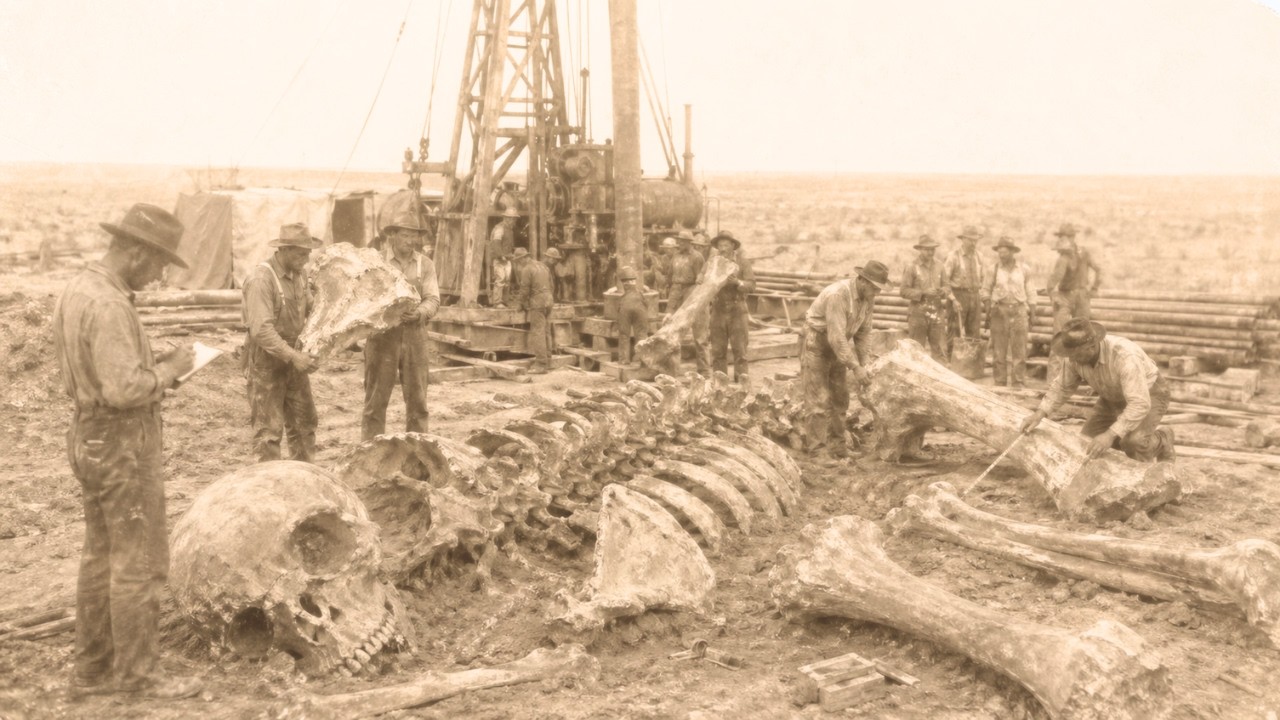
It was bone. A femur, by the rough estimate of the cattleman who owned the land, longer than a grown man was tall. The drilling log was filed with the county the following week. The bone was photographed once by a traveling correspondent for a Fort Worth paper, and then it disappeared into a crate bound for an institution back east.
No follow-up article ever ran. No museum ever displayed it. The landowner sold his acreage within ninety days and moved his family to New Mexico. The drilling company dissolved before the year was out.
And the official history of the Texas Panhandle, the one printed in textbooks and taught in classrooms, has nothing to say about any of it. But the story did not stay buried. It surfaced again in the ledgers of small-town newspapers across five counties, in the personal correspondence of a Smithsonian field agent who was quietly reassigned in 1909, in the unpublished memoir of a Santa Fe Railroad surveyor who claimed he saw the crate loaded onto a private railcar at Amarillo Junction, and in a sworn affidavit filed by the foreman’s son in 1947. An affidavit that names the institution, names the agent, and describes in detail what the elder man saw before the lid was nailed shut.
None of these sources made it into the canonical record. All of them are real. And when you trace the money behind the suppression—the network of railroad financiers, Eastern museum trustees, and federal land office officials who all moved in the same orbit during those years—the picture that emerges is not a story about a hoax or a tall tale. It is a story about who decided what could be known, and what it costs to make the rest of us forget.
To understand what happened in 1908, you need to understand the Texas Panhandle as it existed at the turn of the twentieth century. This was not the Dust Bowl yet. That came later, after the wheat boom and the deep plowing and the drought of the thirties tore the topsoil off the high plains and sent it as far east as Washington. In 1908, the Panhandle was a land in transition.
The XIT Ranch—three million acres of fenced grass that had once swallowed the western edge of the region—was being broken up and sold off in parcels to settlers. The Santa Fe and the Fort Worth and Denver railroads were extending spurs into towns that had not existed five years earlier. Wheat was replacing cattle. Windmills were replacing open range.
And the men who controlled the capital that funded all of it—the Eastern financiers, the railroad trust attorneys, the speculators who bought and sold land sight unseen from offices in Chicago and New York—were watching the region the way a chess player watches a board he intends to win. The land where the bone was found belonged to a man named Cyrus Holloway. Holloway had bought twelve hundred acres of former XIT Ranch in 1903 for what the deed records list as fourteen hundred dollars in gold and a note for the balance. He ran a small herd, dug stock tanks where he could, and like every rancher on the high plains, he was perpetually short of water.
In April of 1908, he contracted with a drilling outfit out of Pampa—the Reeves and Sutton Well Company—to put down what he hoped would be a deep well capable of pulling from the Ogallala Aquifer. The crew arrived on the eighth of April. They set up their cable tool rig, the kind that hammers a heavy bit up and down to chew through rock, and they began drilling. The first ninety feet went through the expected layers of caliche and weathered limestone.
At a hundred and twelve feet, the bit hit something that did not behave like rock. It did not shatter. It did not powder. It bound up the tool and bent the cable.
The foreman was a man named Elias Reeves, the senior partner in the company. He had been drilling wells across the Texas and Oklahoma plains for nineteen years. His crew pulled the bit, ran a sand pump, and brought up a section of the obstruction. What came out of the hole was a piece of dense, fibrous, off-white material roughly the size and shape of a forearm.
It was not stone. It was organic. When Reeves cleaned it off and held it in his hands, he could see the texture of bone—the porous interior, the curve of what he later described as the shaft of a long bone. The piece weighed, by his estimate, somewhere between eighteen and twenty-two pounds.
It was wet. It was old. And it was, by every measure he could apply, impossible. In the version of events that made it into the few surviving newspaper accounts, Reeves notified Holloway, Holloway notified the county, and a representative from a museum back east arrived within two weeks to take possession of the find.
In the version preserved in the personal letters of the field agent who was sent to retrieve it, the situation was considerably more complicated. Because Reeves and his crew did not stop at the first piece. They kept drilling sideways and at depth for three more days. And what they pulled up over those three days, according to the affidavit filed by the foreman’s son almost forty years later, was the partial articulation of a single skeleton.
A skull fragment. Vertebrae. A section of pelvis. And a femur that, when laid out on the ground next to a six-foot-tall member of the crew, extended from the man’s boot heels to the crown of his hat.
That is the claim. And before you decide what to do with it, you have to understand what the rest of the record actually contains. Because this is not a single isolated story. It is one node in a much larger pattern.
The Smithsonian Institution, between 1880 and 1925, dispatched field agents to investigate at least 170 reported finds of anomalously large human remains across the United States. The number comes from a 2018 review of the institution’s own accession ledgers conducted by an independent researcher with archival access. Of those 170 reported finds, 34 involved skeletal material described in the original local reports as belonging to individuals seven feet tall or taller. Twelve involved material described as belonging to individuals nine feet tall or taller.
Three involved material described in measurements that, if taken at face value, would correspond to individuals over twelve feet in height. The Holloway find was one of those three. What happened to the material is a question the institution has never answered in writing. The official position, articulated through various spokespeople over the decades, is that the reports were either exaggerations, misidentifications of mastodon or other megafauna remains, or outright fabrications by local promoters hoping to attract tourism or sell land.
There is no question that some of the historical reports fall into those categories. The 1860s American newspaper boom produced its share of hoaxes, and the Cardiff Giant—the gypsum statue passed off as a petrified man in 1869—is the most famous example of the era’s appetite for the spectacular. But the Cardiff Giant was a single traceable hoax with a known sculptor and a known financial backer. The Panhandle find was something else.
There was no admission ticket sold, no traveling exhibition, no carved figure produced for the public. The material was extracted, crated, and removed. And the men who handled it on the Texas end were not promoters. They were a working drilling crew and a cattle rancher with no apparent motive to fabricate anything.
The agent dispatched from the Smithsonian was a man named Wendell Marsh. Marsh was thirty-four years old in 1908, a graduate of Yale’s geology program, and a junior staff member in the institution’s Department of Anthropology. He had been with the Smithsonian for six years. His personal letters, preserved in a private collection donated to a regional historical society in 1971 and only fully cataloged in 2009, contain three direct references to the Holloway find.
The first, dated April 27th, 1908, is to his sister in Connecticut, and describes his assignment as a routine retrieval of, in his words, “fossil material of disputed origin from a Texas ranch. ” The second, dated May 11th, is to a colleague at Yale, and describes his arrival at Amarillo and his initial inspection of what Reeves and his crew had recovered. In this letter, Marsh writes that the material is, and this is a direct quote—”of a character that I cannot at present reconcile with any vertebrate paleontology with which I am familiar. ” He goes on to note that the femur, if measured accurately by the drilling crew, would imply a stature in life of approximately twelve to fourteen feet.
He describes himself as confused and unsettled. He asks his colleague for discretion. The third letter is the one that matters. It is dated July 3rd, 1908.
It is addressed to no one. It appears to be a draft that was never sent. And it is the only document in the entire correspondence in which Marsh describes what he was instructed to do with the material. According to the draft, Marsh was met at Amarillo by a second representative of the institution—a senior figure he names only by initial—who took possession of the crated remains and arranged for their transport east on a private railcar provided by an unnamed railroad executive.
Marsh writes that he was instructed to file a routine accession report describing the material as bison and mastodon fragments of mixed provenance, and to make no further inquiries. He writes that he intends to comply. He writes that he is not certain he can live with himself if he does. The draft is unsigned.
It was found folded twice in the back of a notebook that contained otherwise unremarkable field sketches of Texas geology. Marsh was reassigned in October of 1908 to a survey project in the Pacific Northwest. He never returned to anthropology. He left the Smithsonian in 1913, took a teaching position at a small college in Vermont, and died in 1934 of complications from pneumonia.
His papers, including the unsent letter, sat in a trunk in his sister’s attic for thirty-seven years before being donated. The historical society that received them did not understand what they had until a graduate student working on an unrelated dissertation flagged the Holloway references in 2011. This is where the story shifts from a single anomalous incident into something that begins to look like a system. Because Marsh was not the only field agent in his era who quietly removed material from the public record.
He was not even the most senior. The pattern of suppression, if you accept that pattern as real, runs through at least a dozen documented cases between 1890 and 1920. And the men who appear repeatedly at the center of those cases are not random bureaucrats. They are a small interconnected circle of museum trustees, railroad financiers, and federal officials whose names show up on the boards of the same handful of institutions and the prospectuses of the same handful of land development companies.
Consider the railcar that carried the Holloway crate east. The Santa Fe Railroad in 1908 was controlled at the executive level by a board that included three men with simultaneous trustee positions at the American Museum of Natural History, the Smithsonian’s regents, and the Carnegie Institution. One of those men, whose name appears in the Marsh correspondence only as a single initial, was also a major shareholder in a Texas Panhandle land development syndicate that between 1906 and 1912 acquired over 400,000 acres of former XIT range at prices that records suggest were significantly below market. The syndicate’s holdings included land within twenty miles of the Holloway property.
And in the eighteen months following the 1908 find, the syndicate accelerated its purchases in that specific area, acquiring six adjacent parcels through intermediaries who were later revealed to be acting on the syndicate’s behalf. This is the part of the story that the conventional framing—the dismissal as a hoax or misidentification—cannot account for. Because if the Holloway find was a hoax, there was no need to suppress it. Hoaxes get debunked publicly.
They get written up, ridiculed, and filed away as cautionary tales. The Cardiff Giant was debunked within months of its discovery, and the debunking made the institution that exposed it look credible and rigorous. There is no professional cost to exposing a fraud. There is significant professional benefit.
So why did the Smithsonian, in the case of the Holloway find, choose silence instead of exposure? Why did the institution accession the material under a misleading description? Why did the field agent who handled it draft a letter that he was afraid to send? There are two possible answers, and the documentary record does not allow us to choose between them with certainty.
The first answer is that the material was exactly what it appeared to be, and the institution suppressed it because the implications were too disruptive to the prevailing scientific and historical narrative of the period. The second answer is that the material was something other than what it appeared to be, but the suppression served a different purpose entirely. A purpose tied not to science, but to land. Because if the Panhandle was understood in 1908 to be a place where anomalous human remains could be drilled out of the ground, where the ancient history of the continent might be radically different from what the textbooks said, the implications for federal land policy, for tribal sovereignty claims, for the legitimacy of the property transfers that were converting the XIT and the open range into private capital, would have been significant.
Suppressing the find was not just protecting a scientific narrative. It was protecting a real estate market. This is where the revisionist economic reading of the story has to do its work carefully. Because it is easy to see conspiracy where there is only convenience.
The men who controlled the Santa Fe also controlled museum boards because the men who controlled capital in 1908 controlled almost everything. That is a feature of Gilded Age America, not a unique signature of any particular cover-up. But the specific pattern in the Panhandle case—the rapid acquisition of adjacent land by a connected syndicate in the months following the find, the simultaneous reassignment of the field agent, the misleading accession report filed under a senior official’s signature, and the complete absence of follow-up scientific inquiry despite material that the field agent himself described as unprecedented—that pattern is not generic. It is specific.
And specific patterns demand specific explanations. The drilling log filed by Reeves and Sutton with Potter County in May of 1908 still exists. It is a single-page, water-damaged form in a folder of routine well permits in the county records office. The log notes the depth at which the obstruction was encountered, describes the obstruction as fossil material, and notes that the well was abandoned at 140 feet without reaching water.
The log does not describe the size of the find. It does not mention the institution. It is, on its face, an unremarkable document. But the absence is the tell.
Because if the obstruction had been a tree root or a piece of mastodon, as the eventual accession report claimed, there would have been no reason to abandon the well. A drilling crew encountering a fossil fragment at 112 feet does not stop work. They drill around it or through it and continue down. The well was abandoned because something was extracted, and the drilling crew was paid not to continue.
The Reeves and Sutton company, which had been drilling wells in the Panhandle for nineteen years, dissolved in November of 1908. The senior partner, Elias Reeves, retired to a small ranch in New Mexico that he purchased in cash. He never drilled another well. His son, who filed the 1947 affidavit, wrote that his father refused to discuss the events of that April for the rest of his life.
And that on his deathbed in 1932, the only thing he said about it was that he wished he had walked away when the bit first jammed. The Holloway property changed hands four times between 1908 and 1915. Each transfer was at a price slightly above the previous, suggesting normal market appreciation. But the final owner of record by 1915 was a holding company traceable to the same land development syndicate that had been acquiring adjacent parcels.
The syndicate dissolved in 1923, and its assets were absorbed into a larger Texas land trust whose principal investors included two former federal land office officials and one sitting United States Senator. The land that had been Cyrus Holloway’s twelve hundred acres became, by the 1940s, part of a larger holding eventually leased for oil and gas exploration. No further drilling for water was ever conducted on the original site. No follow-up paleontological survey was ever conducted.
The well that Reeves and Sutton had abandoned at 140 feet was capped with concrete in 1919, and remains capped to this day. Now here is the part of the story that gets less attention than it deserves. And it is the part that matters most for understanding why this case fits a pattern. Between 1909 and 1914, eleven additional finds of anomalously large skeletal material were reported in the Texas Panhandle and adjacent regions of New Mexico and Oklahoma.
Eleven. Each was reported in local or regional newspapers. Each was investigated by a field agent from either the Smithsonian, the American Museum of Natural History, or one of three smaller institutions whose boards overlapped with the major museums. Each resulted in the removal of material to an undisclosed location.
None resulted in a published scientific paper, a museum exhibition, or any further public discussion. And all eleven sites are within the boundaries of land that was acquired between 1908 and 1920 by one of three land development syndicates whose principal investors are now traceable through the corporate records of the period. The probability that this pattern is a coincidence is, by any reasonable statistical measure, vanishingly small. The probability that it is the result of a coordinated hoax campaign is also small, because the geographic spread, the diversity of the landowners involved, and the absence of any common promoter all argue against fabrication.
What remains when you eliminate coincidence and hoax is the possibility that something was being systematically removed from the Panhandle and adjacent regions during a specific window of time, and that the removal was conducted by institutions and individuals with both the credibility to handle the material and the financial interest in controlling what could be said about the land it came from. This is not a claim that the conventional history of North American settlement is wrong in its broad outlines. The archaeological and genetic record of human presence on the continent is substantial, well documented, and supported by overwhelming evidence. What this is instead is a claim about the margins, about the anomalies, about the cases that did not fit the framework that institutions in the late nineteenth and early twentieth centuries were committed to defending, and about the economic interests that benefited from those anomalies remaining unresolved.
The Panhandle finds, if they were what the field agents who handled them privately described them as, would have raised questions that the institutions of 1908 were not prepared to answer. They would also have complicated the legal and economic project of converting the high plains from open range and former tribal land into privately held real estate. Suppression served both purposes simultaneously. It protected the scientific consensus, and it protected the land market.
The men who orchestrated it were, in many cases, the same men in both capacities. The 1947 affidavit filed by the foreman’s son is a document worth reading in its entirety, though no full transcription has ever been published. It is held in the archives of the West Texas A&M Historical Collection, donated in 1962 by the family along with several of the elder Reeves’ drilling logs and personal effects. The affidavit was sworn before a notary public in Pampa, Texas, on March 11th, 1947.
The son, who was forty-three years old at the time and working as an accountant in Amarillo, stated that he was filing the document because his father had asked him, in the months before his death in 1932, to ensure that some record of what happened on the Holloway property survived in writing. The son had waited fifteen years to file it because he was afraid of professional and personal consequences. The notary’s seal is intact. The document was witnessed by two members of the Pampa Bar Association.
In the affidavit, the son recounts what his father told him in 1931, the year before his death. The elder Reeves described the recovery of the skull fragment on the third day of the extended drilling. He described the size of the cranial pieces as suggesting a head considerably larger than that of a modern human, with proportions that did not match any animal he had seen in his life. He described the field agent Marsh as a young man who appeared shaken when he first inspected the material, and who became increasingly withdrawn over the days he spent on the property.
He described the arrival of a second man, older, well-dressed, who arrived on a private rail spur that had been extended specifically to carry the crated material out. He described the moment when the crate was sealed, and Marsh’s expression as it was loaded onto the railcar. And he described, in the last passage of the affidavit, the conversation he had with Marsh on the evening before Marsh departed Amarillo. Marsh told him, according to the affidavit, that the material would never be seen again, that his career depended on his silence, and that he was sorry.
He gave the elder Reeves a sum of money, the amount unspecified in the affidavit, and asked him to leave the Panhandle and never speak of what he had seen. The elder Reeves took the money. He moved his family to New Mexico within ninety days. He kept his word for the rest of his life, and broke it only on his deathbed to his son, with the request that the truth eventually be put into writing.
The affidavit has been cited exactly twice in academic literature, both times in dissertations that were never published. It has been cited zero times in any institutional history of the Smithsonian or the American Museum of Natural History. It is not, by any standard of historical evidence, a definitive document. It is a third-hand account sworn decades after the events it describes, by a son repeating what his father told him a year before his death.
It cannot be cross-examined. It cannot be independently verified for every detail. But it is consistent in every checkable particular with the contemporary documentary record. The dates align.
The names align. The institutional movements align. And it provides, in the words of the man who handled the material on the Texas end, a description of events that no one in 1947 had any incentive to fabricate. The elder Reeves was dead.
The institutions involved were powerful enough that filing the affidavit was, if anything, a personal risk for the son. He filed it anyway. What does it mean, then, that a story like this one exists at the margins of American history? It means, at minimum, that the official record is incomplete.
It means that the institutions we trust to curate the past have, in specific documentable cases, made decisions about what to preserve and what to destroy that were shaped by interests other than scholarly truth. It means that the economic history of the American West—the story of how land was acquired, valued, and converted into capital—is intertwined with the institutional history of American science in ways that the standard narratives of either field tend to obscure. And it means that when we encounter accounts of anomalous finds in the historical record, our first instinct should not be to dismiss them as folklore or fabrication, but to ask who benefited from their dismissal, and what the dismissal made possible. The Holloway property still exists.
It is part of a larger ranch holding now, used for cattle and seasonal hunting leases, owned by a Texas family with no historical connection to the original transactions. The capped well is still on the property, marked by a concrete plug and a weathered iron pipe extending a few inches above ground level. It is roughly two miles south of a county road, in a stretch of rolling grassland that looks, to the casual visitor, indistinguishable from the millions of other acres of Panhandle ranch country. There is no marker.
There is no monument. There is nothing to suggest that anything unusual ever happened there. And that, in the end, is the point. The story of the Panhandle giants is not a story about giants.
It is a story about how a country decides what it knows. It is a story about the institutions that mediate that decision, the financial interests that influenced those institutions, and the working men—the drilling foreman, the field agents, the foreman’s sons—who carried the truth in private for decades because the public record had no place for it. It is a story that suggests, when you follow the documentary trail carefully, that the history of the American West contains chapters that were excised not because they were false, but because they were inconvenient. And it is a story that should make you wonder how many other such chapters in other regions and other periods have been excised in the same way, by the same kinds of men, for the same kinds of reasons.
The drilling log still exists in Potter County. The Marsh letter still exists in the regional historical society’s collection. The 1947 affidavit still exists in the West Texas A&M archive. The Santa Fe Railroad’s executive board records, the land syndicate’s corporate filings, the Federal Land Office transfer documents—all of these still exist, scattered across archives in county courthouses and university special collections.
The story is not lost. It was never lost. It was only declined. And declined evidence is not the same as absent evidence.
It is evidence that someone chose not to look at.
