The auction room at the St. Louis Hotel in New Orleans was packed with the city’s wealthiest men on that autumn evening in 1837, and the air held something more than the usual hunger of the trade. The city was already the largest slave market in the United States, and auctions drew crowds as a matter of course. But this sale was different.
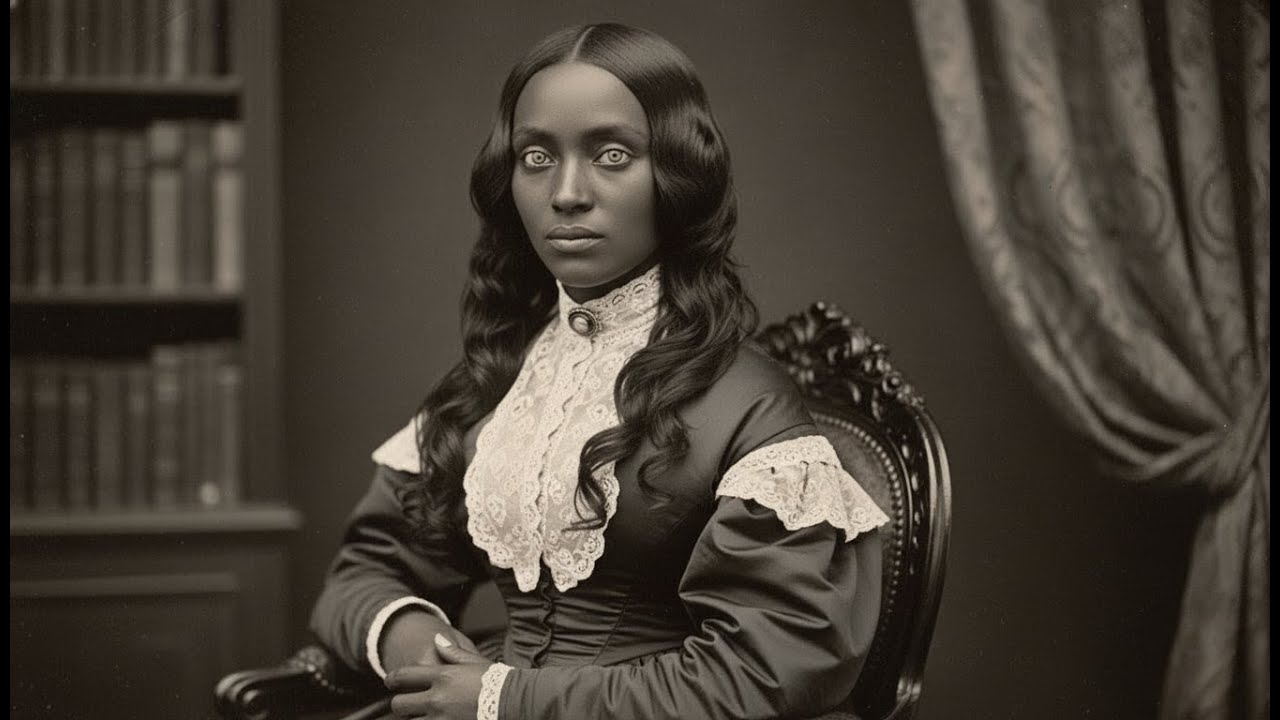
The number of human beings on the block was unremarkable. What drew the crowd was a single woman. She stood five feet four inches tall, with skin the auction papers described as the color of fresh cream with the slightest hint of coffee. Her eyes were a deep amber that seemed to change hue with the light, and her hair fell in long, glossy black waves down her back.
The auctioneer, Thomas Williams, introduced her simply as lot number 17. But whispers moved through the crowd like ripples on the Mississippi. They already had a name for her: the Pearl. The bidding opened at a staggering sum, five times the price of an ordinary house servant.
James Thornton, a northern businessman in New Orleans to establish cotton trade connections, recorded the scene in his personal diary, recovered from his Boston estate in 1952. “I have never witnessed such frenzy among gentlemen of standing as occurred tonight at the hotel exchange,” he wrote. “The woman on sale was indeed remarkable in appearance. Yet the behavior of those present seemed driven by something beyond mere desire for human property.
One could detect an almost religious fervor in their bidding, as though acquiring this particular slave had significance beyond the material realm. ”
What Thornton could not have known was the web of history surrounding the woman on the block. Eleanor Reynolds had not been born into slavery, nor had she come through the traditional channels of the domestic slave trade. Ship records from the port of New Orleans showed she had arrived just three weeks earlier on a vessel called the Augusta, listed not as cargo but as a passenger accompanying a merchant named Marcus Bennett.
By the time the Augusta docked, Bennett was dead, supposedly of a fever contracted in Havana during the voyage. No free papers were found among his possessions. Eleanor was seized by port authorities and eventually placed for auction. That much was public record.
What was not known until much later was why a woman of such obvious refinement and education had found herself in such circumstances, and why certain families in New Orleans had taken such extraordinary interest in ensuring she would never leave the city. New Orleans in 1837 was a complex mosaic of cultures, economies, and racial classifications, more elaborate than anywhere else in America. After the Louisiana Purchase in 1803, the city had transformed from a French and Spanish colonial outpost into a booming American port where fortunes were made in cotton, sugar, and human beings. It had developed a three-tiered racial system unlike the strict black-white division found elsewhere in the South.
Between these categories existed the gens de couleur libres, free people of color, many of them wealthy property owners who sometimes owned slaves themselves. It was a city of contradictions. Brutal slave markets operated within walking distance of opera houses. Codes noirs regulated the treatment of slaves, while sophisticated social events called quadroon balls facilitated arrangements between white men and free women of color.
Above all, it was a city where appearance and bloodlines carried immense social and legal importance. The difference between freedom and bondage could hinge on a single ancestor. That fact would prove central to Eleanor Reynolds’s story. The winning bid came from Charles Delaqua, a wealthy sugar planter whose family had been in Louisiana since the early French colonial period.
Delaqua paid the unprecedented sum of seven thousand dollars, enough to purchase an entire plantation of field workers, for a woman who, by all accounts, had no experience with domestic service or field labor. Notary William Patterson, who recorded the transaction, noted something unusual in his ledger. Delaqua insisted the bill of sale describe Eleanor not as a slave, but as a ward to be housed in his Royal Street residence. What happened after Eleanor was taken to the Delaqua home remains clouded in conflicting accounts.
Household staff interviewed decades later by a journalist from the Daily Picayune recalled that she was treated not as a servant but as a guest, given a private room in the family quarters and provided with clothing befitting a society woman. Yet she was never seen leaving the property. Visitors to the house reported that Delaqua introduced her as his distant cousin from France who spoke little English. According to household records, Delaqua’s wife, Isabelle, left for her family home in Natchez just two weeks after Eleanor’s arrival, taking their three children with her.
She would not return for nearly six months. During this period, Charles Delaqua closed his Royal Street house to all visitors and conducted his business affairs entirely through written correspondence delivered by his private secretary. In January of 1838, Dr. Samuel Lawrence was summoned to the Delaqua home to attend to Eleanor, who was reportedly suffering from a persistent cough.
His medical journal, preserved in the archives of Tulane University, contained an unsettling entry. “Called to attend to young woman at the Delaqua residence,” he wrote. “Patient exhibits symptoms consistent with consumption, though her overall constitution appears sound. What troubles me more is the evident distress in her manner.
When alone, she asked if I knew of her true circumstances before her arrival in New Orleans. Before I could respond, Delaqua returned to the room, and she spoke no further on the matter. ”
Lawrence prescribed bed rest and tonics, but also recorded his impression that the lady’s ailment seemed as much of the spirit as of the body. He was never called back to the house.
By spring, rumors had begun to circulate through New Orleans society about the mysterious beauty of the Delaqua mansion. Some claimed she was Charles Delaqua’s illegitimate daughter. Others said she was his mistress, brought from abroad. The most persistent rumor was that she was somehow connected to the Villars family, one of the oldest and most secretive lineages in Louisiana, whose patriarch, Henri Villars, had been among the most aggressive bidders at the auction before Delaqua’s winning offer.
The Villars family had built their fortune in the early days of the colony, controlling vast sugar plantations and, according to local legend, engaging in privateering during the War of 1812. By 1837 they had largely withdrawn from public life, maintaining their estate on the outskirts of the city and rarely participating in society events. What connected them to a young woman newly arrived from Havana would remain unanswered for more than a century. The Delaqua Journal, discovered during renovations in 1962, provided the first real insight into Eleanor’s life in the mansion.
Written in a precise, educated hand, it began in February 1838. The early entries were mundane, recording weather conditions and brief notes about books read or meals taken. But as winter gave way to spring, the entries became more revealing. On March 11, 1838, she wrote: “C has agreed to allow me access to the family library, though I am still forbidden from venturing beyond the inner courtyard.
When I asked why I must remain hidden away, he said only that it was for my protection. From what, he will not say. I begin to fear that the story he told me about my papers being processed is merely a fiction to keep me compliant. ”
On April 23, 1838: “Today C brought a visitor, an elderly man named Villars, who stared at me with such intensity that I felt as though he was searching for something in my features.
They spoke in French, believing I could not understand, about the resemblance and the bloodline. When I later asked C about this conversation, he became agitated and reminded me of my precarious position. Without free papers, I remained legally his property regardless of my true history. ”
The journal entries became increasingly distressed as Eleanor began to realize that Delaqua had no intention of securing her freedom as he had initially promised.
By summer, she was planning an escape. July 17, 1838: “I have managed to make contact with a housemaid who has agreed to deliver a message to the offices of the American consul. If my mother’s story was true, my birth in Philadelphia should be sufficient to establish my free status. Regardless of my appearance, I must act quickly before C makes good on his threat to send me to his plantation if I continue to cause difficulties.
”
The next entry, dated August 2nd, contained a single line: “It was a trap. The maid informed C of my plan. I am to be moved tomorrow. ”
The journal then fell silent for nearly a month.
When entries resumed in September, Eleanor was writing from Beau Refuge, the Delaqua sugar plantation fifty miles downriver from New Orleans. Her situation had clearly deteriorated. September 5, 1838: “I am kept in the former overseer’s house, separate from both the main residence and the slave quarters. A woman named Martha has been assigned to attend to my needs, though I suspect her primary role is to report my activities to the plantation manager.
I have seen C only once since my arrival, when he came to inform me that any further attempts to contact outside authorities would result in my being reclassified as a field worker. The meaning was clear enough. ”
It was at Beau Refuge that Eleanor’s story intersected with another mysterious figure. Joseph Miller, a northern abolitionist who had infiltrated Louisiana society posing as a doctor interested in treating slave ailments, made coded reference to her in correspondence with anti-slavery activists in Boston.
That correspondence, decoded and published in 1949, mentioned “a woman of unusual circumstance held at the Delaqua plantation who claims to have been born free in Philadelphia to a mother who was herself a free woman. ”
Miller managed to speak with Eleanor briefly during a visit to Beau Refuge in October 1838. He wrote: “The subject has reason to believe her imprisonment is connected not to ordinary human trafficking, but to some matter of inheritance and identity that threatens powerful interests in this region. She begs assistance in contacting authorities in Philadelphia who might have record of her birth and parentage.
”
Miller promised to investigate her claims, but his work in Louisiana came to an abrupt end in November 1838 when his true purpose was discovered. He narrowly escaped the state with his life. There is no record that he ever managed to pursue Eleanor’s case further. Eleanor’s journal entries from Beau Refuge grew increasingly infrequent through the winter of 1838 into 1839.
She recorded her observations of plantation life, her failed attempts to convince household servants to aid her, and her growing suspicion that her confinement had some purpose beyond mere ownership. December 12, 1838: “I overheard the plantation manager speaking with a visitor about the Villars inheritance and the problem of verification. When they realized I was within earshot, they fell silent and separated. Later, I asked Martha if she knew anything about the Villars family.
She grew pale and refused to speak on the subject, saying only that they were not people to be trifled with. What connection could I possibly have to them? ”
The mystery deepened in February 1839 when, according to the journal, Eleanor received an unexpected visitor. Henri Villars himself, now quite elderly, came to Beau Refuge without Delaqua’s knowledge or permission.
February 26, 1839: “The old man came alone, dismissing Martha from the house. He asked about my mother, specifically whether she had possessed a gold locket with an engraving of a ship. When I confirmed that she had worn such a piece until her death, he nodded as though something had been confirmed. He then asked if I knew the circumstances of my father’s death.
I told him what Mother had always said, that he was a French merchant who died at sea before my birth. At this the old man made a sound that might have been a laugh or a sob. ‘Your mother was a prudent woman,’ he said, ‘but perhaps too prudent for your own good. ’ He left without explaining further, promising to return, though I am not certain whether to hope for or dread such a visit.
”
Henri Villars never did return. Three days after his visit to Eleanor, he was found dead in his study, apparently from natural causes related to his advanced age. His death set in motion a complex legal battle over the substantial Villars estate, for Henri had died without a male heir. His nearest relative was a nephew named Louis Villars, who immediately filed to claim the inheritance.
During the inheritance dispute, the connection between Eleanor and the Villars family began to emerge in the pages of her increasingly fragmented journal. April 9, 1839: “C arrived in a state of great agitation, demanding to know exactly what the old man had said to me. When I related our brief conversation, he became even more disturbed. ‘Did he mention any documents?
’ he asked repeatedly, ‘any papers he might have given your mother? ’ I told him truthfully that the old man had mentioned nothing of the sort. C then searched my room thoroughly before leaving, taking with him my mother’s Bible, the only possession I had managed to keep with me from Philadelphia. Within its pages were my mother’s few letters and papers, including my certificate of birth.
I fear I have now lost the only proof of who I truly am. ”
By June of 1839, Eleanor had begun to piece together the truth of her situation. June 17, 1839: “I now understand why I was brought here. It was never about my value as property, but about preventing me from claiming what might rightfully be mine.
My mother once told me that my father’s family had rejected her, but she never explained why. If what I now suspect is true, then my father was not simply a French merchant, but a Villars, perhaps even Henri’s son. And if documentation of such a connection exists, it would explain C’s desperate efforts to keep me hidden away and classified as a slave rather than a potential claimant to one of the largest fortunes in Louisiana. ”
This theory aligned with rumors that had long circulated in New Orleans about Henri Villars’s estranged son, Jean-Baptiste, who had allegedly formed a relationship with a free woman of color in Philadelphia in the early 1800s.
According to these rumors, Jean-Baptiste had been disowned by his father, but may have secretly married the woman before his death at sea in 1817, the year of Eleanor’s birth. If Eleanor was indeed Jean-Baptiste’s legitimate daughter, and if proof of the marriage existed, she would have had a claim to the Villars inheritance under the French inheritance laws that still influenced Louisiana’s unique legal code. Such a claim would have been unprecedented and scandalous, recognizing a woman with African ancestry, however minimal, as the rightful heir to one of Louisiana’s most prestigious white family fortunes. The final dated entry in Eleanor’s journal was from September 3rd, 1839.
She wrote: “I have found a way. The riverboat stops here tomorrow to take on sugar. Martha has agreed to help me in exchange for the pearl earrings Mother left me. If all goes well, I will be in New Orleans by nightfall, and from there I can seek passage north.
I must find those papers before it is too late. ”
The journal ends there, leaving historians to piece together what happened next through other sources. According to Beau Refuge plantation records, a female slave matching Eleanor’s description was reported missing on September 4th, 1839. A substantial reward was offered for her return, with the primary search focused on riverboats heading north toward free territories.
Instead, evidence suggests Eleanor made her way back to New Orleans, perhaps intending to search the Delaqua townhouse for her mother’s papers before leaving the South. A receipt from a French Quarter apothecary dated September 7th, 1839 shows the purchase of women’s toiletries charged to the account of Marie Laveau, the famous voodoo priestess known to sometimes shelter fugitives within her extensive network. For almost three years, Eleanor Reynolds seemingly vanished from all records. The Villars inheritance case proceeded, with Louis Villars ultimately confirmed as the rightful heir in 1841 after no other claimants came forward with sufficient proof of relation.
Charles Delaqua, after an initial aggressive search for his missing property, appeared to abandon the pursuit, focusing instead on resolving mounting financial difficulties that had begun to plague his once prosperous sugar operations. Then, in January 1842, Eleanor Reynolds reappeared in New Orleans society in a manner that shocked even that scandal-accustomed city. She attended the annual Mardi Gras ball at the St. Louis Hotel, the very building where she had been sold five years earlier, not as a slave or servant, but as the elegantly attired companion of Louis Villars, the new head of the Villars family.
The society columnist for the Daily Picayune wrote: “The mysterious beauty on the arm of Monsieur Villars caused all conversation to cease momentarily as they entered the ballroom. She was adorned in a gown of midnight blue silk that emphasized her extraordinary complexion and bearing. Those who had attended certain transactions at the same venue some years prior exchanged significant glances, though none dared make explicit reference to the lady’s previous appearance there. ”
What arrangement existed between Eleanor and Louis Villars remains uncertain.
Some historians suggest he may have purchased her freedom secretly. Others propose a more complex scenario in which Eleanor had obtained leverage over the Villars heir through discovery of documents related to her parentage. What is clear is that their public appearance together represented an unprecedented breach of New Orleans social boundaries, regardless of Eleanor’s ambiguous racial classification. Charles Delaqua was also in attendance at the ball that night.
According to multiple accounts, he grew visibly distressed upon seeing Eleanor with Louis Villars, attempting to approach them before being physically restrained by friends. He left the event shortly thereafter. Three days later, he filed a legal complaint claiming that Louis Villars had unlawfully taken possession of human property rightfully belonging to the Delaqua estate. The complaint was quietly withdrawn within twenty-four hours.
On February 12, 1842, Eleanor and Louis Villars were seen boarding a steamship bound for France. According to passenger manifests, they traveled as Monsieur Louis Villars and ward. They left behind a New Orleans already ablaze with rumor and speculation. They would never return to American soil.
And here the documented history might have ended, were it not for the events that unfolded at the Delaqua mansion two weeks after their departure. On February 27th, 1842, neighbors reported unusual activity at the normally quiet Delaqua residence on Royal Street. Lights burned through the night and servants were seen carrying large trunks to waiting carriages. By morning, the house stood empty.
There was no formal announcement of the family’s departure. When creditors arrived days later to inquire about mounting unpaid debts, they found the house abandoned, though apparently not in haste. Clothes remained in wardrobes, books on shelves, food in the pantry, as though the occupants expected to return shortly. Charles Delaqua, his wife Isabelle, and their three children had vanished.
Initial assumptions that they had fled creditors gave way to more sinister theories when, in March 1842, the bodies of two men were discovered in the swamp land outside the city. They were identified as Delaqua’s private secretary and his plantation manager from Beau Refuge. Both had been killed by a single gunshot to the head, execution style. A police investigation was launched but yielded few results.
The detective in charge, James Morrison, noted in his report that “individuals connected to this case seem remarkably reluctant to provide information, suggesting that forces beyond ordinary criminal matters may be involved. ” The investigation was officially suspended in June 1842. For more than a century, the disappearance of the Delaqua family remained one of New Orleans’s most enduring mysteries, occasionally revived in newspaper articles or local histories, but never resolved. Then, in 1962, the renovation of the long-vacant Delaqua mansion uncovered a hidden room containing Eleanor’s journal, three human fingerbones, and a portrait of a woman whose beauty, even captured in aging paint, seemed almost otherworldly.
The journal provided crucial insights into Eleanor’s captivity, but ended before her reappearance in 1842. The fingerbones, when examined by forensic anthropologists in 1964, were determined to belong to a male who had died approximately 120 years earlier, roughly the time of the Delaqua disappearance. DNA testing, when it became available decades later, was inconclusive due to the condition of the remains. It was the portrait that perhaps offered the most tantalizing clue.
Executed in the style of prominent New Orleans portrait artists of the period, it showed Eleanor Reynolds in an elegant blue gown, possibly the same one described at the Mardi Gras ball. But X-ray examination of the canvas in 1975 revealed another image underneath: a family portrait showing a man, woman, and young girl. Art historians identified the hidden subjects as Jean-Baptiste Villars, his wife, and their infant daughter, based on comparison with other Villars family portraits from the period. The existence of this painting strongly supported the theory that Eleanor was indeed the legitimate daughter of Jean-Baptiste Villars, and thus potentially entitled to the Villars fortune.
But why was this crucial evidence hidden in the Delaqua house rather than in Eleanor’s possession when she fled with Louis Villars? A partial answer emerged in 1982, when a collection of letters was discovered during the cataloging of the Villars family papers donated to the Historic New Orleans Collection. The letters, exchanged between Louis Villars and an unnamed correspondent in Paris between 1841 and 1842, suggested a far more complex scenario than had previously been imagined. In one letter dated December 1841, Louis wrote: “The arrangement is proceeding as planned.
I have made contact with the subject and explained our mutual interest in resolving this matter quietly. She is understandably suspicious, but sees the logic in cooperation rather than continued conflict. D remains the primary obstacle, as his financial entanglements with my late uncle make him particularly resistant to any settlement that might expose their previous dealings. ”
A subsequent letter from January 1842 stated: “The documents have been verified by my attorney.
There can be no doubt as to their authenticity or their legal implications. Had these papers come to light during the inheritance proceedings, the outcome would have been quite different. However, our present arrangement satisfies all parties. She gains her freedom and a suitable settlement, while the family avoids both scandal and financial restructuring.
D alone remains unpacified, but I believe his economic circumstances will eventually compel his cooperation. ”
These cryptic communications suggested that Louis Villars had discovered proof of Eleanor’s legitimate claim to the Villars inheritance, but had offered her a private settlement, likely including her freedom and financial compensation, in exchange for her silence and cooperation in keeping the matter from becoming public. This arrangement would have protected the Villars family reputation while satisfying Eleanor’s most immediate desire for liberty. But Charles Delaqua, having paid an enormous sum for Eleanor and perhaps being privy to financial irregularities in Henri Villars’s dealings, was not included in this arrangement.
The letters implied that he posed an ongoing threat to the resolution, perhaps through his knowledge of the situation or through legal claims he might make regarding Eleanor’s status. The final letter in the collection, dated February 1842, shortly before the Delaqua family’s disappearance, contained only a brief message: “The problem has resolved itself in a most unexpected manner. I believe no further action will be required on your part. We sail as planned on the 12th.
”
What exactly transpired in those early February days of 1842? No definitive evidence has ever emerged, but historians and criminal investigators who have studied the case have constructed a plausible sequence of events. Upon seeing Eleanor at the Mardi Gras ball, Charles Delaqua realized that his valuable property had not only escaped but had formed an alliance with Louis Villars. Desperate both financially and to maintain his social standing, Delaqua may have attempted blackmail, threatening to expose whatever arrangement had been made regarding the Villars inheritance.
Louis and Eleanor, preparing to depart for France, would have had strong motivation to ensure Delaqua’s silence. The timing of their departure on February 12th and the Delaqua family’s disappearance just fifteen days later suggests a connection. The murdered secretary and plantation manager may have been eliminated as witnesses to whatever occurred at the Delaqua home. In 1968, French police records were discovered that shed the final piece of light on the mystery.
A report dated May 1842 documented the arrival in Paris of Louis Villars and companion E. Reynolds, and noted that they had taken up residence in a fashionable district using funds from a substantial bank draft issued by the Villars family’s New Orleans representatives. They apparently lived quietly in France for several years before relocating to England in 1847. English census records from 1851 list a Louis Villars residing in London with Eleanor described as wife rather than ward.
They had two children by this time. The family remained in England until at least 1861, after which they disappear from public records. As for the Delaqua family, no trace of them was ever found. Their abandoned Royal Street house remained unoccupied for decades, acquiring a reputation as one of the most haunted properties in a city known for its ghostly residents.
Then, in 1958, nearly a decade before the discovery of Eleanor’s journal, a curious incident occurred that some historians believe may be connected to her story. An elderly woman named Margaret Wilson arrived in New Orleans claiming to be the great-granddaughter of Eleanor Reynolds. She carried with her a stack of letters reportedly written by Eleanor from London between 1852 and 1868, addressed to a former house servant from the Villars estate who had remained loyal to her. The letters, if authentic, revealed that Eleanor and Louis had indeed married in France, where the racial restrictions that would have forbidden their union in Louisiana did not apply.
They had lived comfortably on the settlement Louis had arranged from the Villars estate, raising three children who were brought up with no knowledge of their mother’s ordeal in America. Eleanor had apparently found a measure of peace in her new life, though she wrote of recurring nightmares about her time at Beau Refuge and of a terrible necessity that had preceded her departure from New Orleans. Most significantly, one letter dated October 1867 made cryptic reference to the Delaqua family’s fate: “I am still haunted by what L felt compelled to arrange that February night. Though I know it was deemed necessary for our security, I cannot reconcile myself to the thought of the children.
L assures me they were sent away beforehand, but I have no way to verify this, and it troubles my conscience greatly. If they did indeed survive, they would be grown now, perhaps with children of their own, who know nothing of their connection to me or the events that scattered their family to the winds. ”
Margaret Wilson submitted these letters to the Louisiana Historical Society for authentication, but died suddenly of a heart attack before the process could be completed. The letters disappeared from the society’s temporary holdings shortly thereafter, with the official report suggesting they had been mistakenly discarded during an office renovation.
No family members came forward to claim Wilson’s effects, and the trail went cold once again. Then, in 1976, a researcher named Thomas Lawrence, working on a comprehensive history of New Orleans slave markets, uncovered shipping records from March 1842 that documented three children traveling unaccompanied from New Orleans to Havana. The children’s ages matched those of the Delaqua offspring, though they traveled under the surname Reynolds. Their guardian was listed as Martha Bernard, a name that appeared in Eleanor’s journal as the servant assigned to watch over her at Beau Refuge Plantation.
This discovery lent credence to Eleanor’s suggestion in the purported Wilson letters that the Delaqua children had been spared whatever fate befell their parents. It also implied a level of planning and coordination that went beyond a simple act of revenge or elimination of threats. If Eleanor and Louis had arranged for the children’s safe passage to Cuba before dealing with Charles and Isabelle Delaqua, it suggested a complexity of moral reasoning that defied simple categorization. Cuban records showed no further trace of the children or their guardian after their arrival in Havana.
In the summer of 1981, during an unusually severe drought that caused the Mississippi River to reach record low levels, a local fisherman made a grim discovery in a normally submerged area near the former site of Beau Refuge Plantation. The receding waters had exposed the remnants of an old flatboat containing human remains: a man, a woman, and two adult males. Forensic examination determined that all four had died from gunshot wounds to the head, and that the bodies had been weighted down with iron chains before the boat was scuttled in deep water. The remains were too deteriorated for positive identification, but personal effects found with the bodies included a pocket watch engraved with the initials C.
D. and a woman’s locket containing a miniature portrait of three children who bore a striking resemblance to descriptions of the young Delaqua heirs. The estimated time of death, based on the limited forensic techniques available, was consistent with the Delaqua family’s disappearance in 1842. This discovery provided the most compelling evidence yet for what many had long suspected.
Charles and Isabelle Delaqua, along with two male associates, likely the secretary and plantation manager whose bodies had been found in the swamp shortly after the family’s disappearance, had been executed and disposed of in the Mississippi River. The careful concealment suggested not a crime of passion, but a calculated elimination of witnesses and potential threats. In 1994, the final piece of the puzzle emerged when an architectural historian researching the Villars family estate outside New Orleans discovered a sealed compartment within the master bedroom’s fireplace mantle. Inside was a small leather pouch containing a handwritten confession signed by Louis Villars and dated February 25th, 1842, two days before the Delaqua family’s disappearance.
The confession stated: “What I have set in motion cannot be undone, nor would I undo it if I could. The elimination of Charles and Isabelle Delaqua has become necessary not merely for my own interests, but for E’s safety and freedom. Their claims against her would follow us even to Europe, and D’s financial desperation makes him unpredictable and dangerous. I have arranged for the children to be taken to Cuba, where Martha has contacts among the free colored community who will ensure they are raised in comfort, though with no knowledge of their true parentage.
E insisted on this mercy, though I argued it creates future risk. I could not deny her this, having witnessed the depth of her suffering at their father’s hands. The men I have engaged for the task are reliable and have been well compensated for both their service and their silence. They understand that any breach of confidence will result in their own elimination.
The plan will be executed tomorrow night when the household is at rest. The bodies will never be found. I record this truth not out of remorse, but to ensure that should questions arise after our departure, there will exist at least one account of what truly occurred and why it was necessary. May God, if he exists, judge me as he sees fit.
”
The confession was authenticated by handwriting experts as matching other examples of Louis Villars’s script. Its discovery settled the question of responsibility for the Delaqua killings while raising new questions about the moral complexity of the case. Louis had acted as judge, jury, and executioner by proxy, ordering the deaths of four people to secure his and Eleanor’s future. Yet in the context of 1840s New Orleans, the legal system offered no justice or protection for Eleanor.
She existed in a society that had commodified her, denied her humanity, and would have continued to enslave her despite her legitimate claim to freedom and even wealth. In 2002, DNA testing was performed on remains from a London cemetery where parish records indicated an Eleanor Villars, formerly of America, had been buried in 1872. The results were compared with genetic material recovered from the fingerbones found in the hidden room of the Delaqua mansion. The tests confirmed a biological relationship, suggesting the fingerbones likely belonged to Charles Delaqua, a gruesome trophy that had somehow been preserved in the secret room alongside Eleanor’s journal and the concealed family portrait.
Eleanor Reynolds Villars died at the age of fifty-five, having lived more than half her life as a free woman in Europe. According to London church records, her funeral was well attended by family and numerous friends, suggesting she had found community and perhaps even happiness in her adopted country. Louis Villars outlived her by six years, dying in 1878. Their three children married into respectable English families.
Their mother’s racial background and extraordinary history were apparently unknown to their spouses or social circles. As for the Delaqua children, despite extensive research by historians and descendants of both the Villars and Delaqua families, no definitive trace of them has ever been found in Cuban records or elsewhere. They vanished into history. In 2019, a team of forensic scientists and historians used advanced imaging technology to examine the hidden portrait beneath Eleanor’s painting in unprecedented detail.
The results confirmed what had long been suspected: the family portrayed was indeed Jean-Baptiste Villars, his wife Marie Reynolds, and their infant daughter. More surprisingly, spectral analysis of the paint revealed that Eleanor herself had likely been the artist who painted over the original portrait, using similar pigments and techniques to create her own image on top of that of her family. The act represented both concealment and reclamation, a palimpsest of identity that mirrored her own complex journey. In 1969, during further renovations of the Delaqua mansion, workers discovered a small cavity beneath the floorboards of the hidden room.
Inside was a gold locket containing a miniature painting of a ship at sea, engraved on the back with the initials J. V. and M. R.
— Jean Villars and, presumably, Eleanor’s mother — along with the date February 20, 1816, nine months before Eleanor’s birth. The locket, like Eleanor herself, had traversed the boundaries between worlds, between slavery and freedom, between black and white, between the known and the unknown. It now resides alongside her portrait in the Historic New Orleans Collection. In recent years, descendants of the Villars family have established a scholarship fund for African-American students studying law, named in Eleanor Reynolds’s honor.
The fund’s creation was accompanied by a formal acknowledgement of Eleanor’s place in the family lineage and an apology for the actions of Henri Villars in denying her father’s marriage and her rightful heritage. The former Delaqua mansion on Royal Street, after changing hands multiple times, now operates as a small historic hotel. Guests occasionally report unusual phenomena: the sound of a woman’s footsteps in the night, items moved from where they were left, and, most commonly, a feeling of being watched in the vicinity of the hidden room, which has been preserved as a historical feature of the building. In the words written on the back of Eleanor’s portrait when it was donated to the Historic New Orleans Collection in 1974: “Remember her not for her beauty, which was remarkable, nor for her suffering, which was immense, but for her determination to exist on her own terms in a world that offered her no place.
In this she achieved what few of any race or station can claim. She wrote herself into being. ”
