The foreman stepped to the edge of the ravine, uncoiled a length of cord, and handed one end to a laborer on the far side. The men moved quickly, eyes scanning the tangled undergrowth for the narrowest crossing. In these woods, time was money, and every extra foot of bridge meant more timber cut, more spikes driven, more days spent away from the next stand of pine. The quickest way across was not always the straightest, but it was always the cheapest.
Instead of surveying crews with tripods and chains, loggers relied on the string line, a simple taut cord stretched between two stakes. The foreman pulled it tight, sighted down its length, and marked where the grade would run. In less than ten minutes, a crossing could be chosen. There was no time for elaborate calculations or careful mapping.
The rule was simple: find the spot where the ravine pinched, where high ground on both sides offered firm footing, and the fewest bents would be needed. Every foot saved on the span meant less timber wasted and fewer hours perched high above the ground. A plumb bob, a heavy iron weight tied to a string, helped judge the drop from the cord to the bottom of the cut. The foreman would step to the edge, let the bob swing free, and call out the height to a man below.
Sometimes a simple stick marked in feet did the job. Field notes from the era mention crossings picked in under a quarter hour, the whole crew watching as the line snapped into place and the foreman nodded his approval. The process was built for speed: string, sight, mark, and move on. Bottlenecks, places where the banks drew close and the bed was narrow, were prized.
A well-chosen site could cut the number of bents in half, saving a full day’s labor. In the Pacific Northwest, ravines cut through ancient fir forests. In the Midwest, creeks wound between rolling hills. No matter the setting, the logic was the same: cross where the land helps you, not where it fights you.
Once the line was chosen, stakes went into the ground to mark the future footings. The next crew would follow, axes and saws in hand, ready to clear the way and begin cutting the first timbers. But it all started with that simple string pulled tight, stretched across open air, a promise that the rails would soon follow. This was how the age of the portable railroad and the towering wooden trestle began.
It started not with the bridges themselves, but with a crisis that left entire seasons of timber stranded and rotting along a riverbank. In the spring of 1872, a crew in the upper Midwest stood helpless on a muddy riverbank as floodwaters swallowed their entire season’s work. The river, swollen by weeks of rain and melting snow, had turned violent. Log rafts broke apart and jammed against each other at a bend.
The pile grew so dense that even the strongest current could not budge it. Nearby, a diary entry from Plainfield tells of men watching silent as thousands of pine logs, enough timber to build a city block, bobbed in place, stranded and useless. The camp’s sawmill sat idle. Payrolls went unpaid, and the foreman’s only option was to send men home or put them to work salvaging what they could.
That year, the loss was total. A single flood had wiped out not just the wood, but the wages and hopes of an entire community. Scenes like this played out across the northern forests in the late 1800s. America’s hunger for lumber was insatiable as railroads, shipyards, and booming towns all demanded more than the rivers could reliably deliver.
River drives were the backbone of the logging economy, but they came with a gambler’s risk. Spring brought high water, but also the threat of jams and sudden floods. In a bad year, a single log jam could trap millions of board feet, costing companies their entire profit. In 1872 alone, floodwaters in the Mississippi Basin crested more than a dozen feet above normal, destroying rafts and leaving an estimated quarter billion board feet of timber stranded.
For some camps, that meant bankruptcy by summer. The frustration in the camps was palpable. Men who had felled, trimmed, and rolled logs all winter watched their work rot in the shallows. The river, once a lifeline, had become a barrier.
Sawmills sat empty. Towns that depended on timber money faced lean months, and the entire region felt the shock. Local newspapers reported on ruined harvests and desperate measures, with crews dynamiting jams, teams of horses pulling half-rotted logs from the mud, and families packing up to head east in search of work. The economic ripple was swift.
Prices spiked, contracts were broken, and rival firms scrambled to find other ways to move their cut. In the aftermath, some camps refused to risk another lost season. The answer was not waiting for better weather or building bigger rafts. The solution was to break the river’s hold on the timber trade entirely.
Deep in the woods, crews began laying rails, temporary wooden tracks that could snake over ridges and across valleys, carrying logs to market no matter what the river decided. This shift, born of necessity and frustration, would change the face of logging forever. Railroad track in the logging woods was never meant to stay put. As soon as the river turned unreliable, crews turned to a new solution: the portable spur railroad.
This was no ordinary rail line. Instead of laying miles of permanent track, workers built a system that could move with the timber front, chasing the cut as the forest fell. The idea was simple and brutally efficient. Rails and ties came in short, manageable sections, often just ten or twelve feet long.
Each piece could be unbolted, picked up, and shifted forward by hand or by horsepower. In the morning, a spur might snake out to the edge of yesterday’s clearing. By evening, it pressed deeper into the woods, right behind the sawyers and teamsters. The so-called spur kit became the beating heart of every ambitious camp.
It included not only rails and ties, but also iron dogs, bolts, and levers for prying up track. When a stand of pine was cut, the crew wasted no time. They would unfasten the last section, drag it ahead with a team, and bolt it to the front of the line. Over rough ground, the men used log rollers, heavy timber cylinders that let them slide rails across mud, roots, or snow.
The process was rhythmic: lift, carry, set, spike, repeat. The fastest crews could move a quarter mile of track in a single day, keeping pace with the most aggressive logging schedules. This mobility came with its own challenges. Every new stretch of forest brought a fresh obstacle: ravines, creeks, gullies too deep for simple fill.
Where a river drive would have stopped cold, the portable railroad kept advancing, but only if it could cross these sudden gaps. That meant building bridges, and not just any bridges. The solution had to be as fast and flexible as the rail line itself, able to rise in days and disappear just as quickly when the cut moved on. Permanent stone or ironwork was out of the question.
Instead, camps turned to the one resource they had in endless supply: timber, cut and shaped right where it fell. Treatise diagrams from the era show how these temporary tracks were engineered for constant movement. Spur sections were standardized with pre-drilled holes and matching hardware, so even the greenest crew could assemble or disassemble them at speed. The track’s shallow ballast and minimal grading meant it could ride over stumps, humps, or swampy ground with little more than a day’s preparation.
The men who laid these rails became specialists, part carpenter, part ironworker, part mule skinner, able to pivot from laying track to building bridges without missing a beat. Their tools were simple, but their logistics were anything but. Every move was calculated to keep logs flowing, crews working, and the mills supplied, no matter what the land or weather threw at them. By the early 1870s, this system redefined what was possible in the Northwoods and Far West.
Where rivers could strand a season’s work in a single day, the portable railroad gave loggers control. Every foot of track was a promise. If the trees could be felled, the logs could be moved. A timber trestle starts with the bent, a sturdy rectangular frame that forms the backbone of the bridge.
Each bent stands upright like a fence panel, braced to resist wind, water, and the weight of passing trains. Standard bents use four or six vertical posts, each twelve inches square, cut to lengths between twelve and fourteen feet. Posts are paired and spaced about six feet apart, their feet notched into sills or set on stone pads when the ground is soft. Atop the posts sits the cap beam, a solid timber twelve by fourteen inches laid flat to spread the load from above.
The cap beam supports the stringers, long straight timbers eight by ten or eight by twelve inches running from bent to bent. Stringers carry the rails and any load that crosses the bridge. Decking comes next, thick planks three or four inches deep laid side by side to make a solid bed for the rails. Sometimes rails are spiked directly to the stringers, skipping the deck to save time and wood.
Bracing made from two by six or two by eight timbers locks the posts and caps into a single sway-resistant frame. These braces run in an X pattern, mortised into the posts and pegged or spiked tight. Below, the sills anchor the bent to the ground, spreading each blow from above into the earth. Iron spikes, some up to sixteen inches long and as thick as a man’s thumb, pin the joints.
Where iron runs short, wooden pegs or lap joints take over. Every measurement serves a purpose. Posts must stand tall and true. Cap beams must be wide enough to bear weight, but light enough for a crew to lift.
Stringers bridge the gap, and decking absorbs the pounding of iron wheels. The repeated use of twelve by twelve, eight by ten, and similar sizes lets crews cut and assemble parts quickly, even with hand tools. Once the first bent stands, the rest follow in rhythm, each frame a twin to the last. The names post, cap, stringer, deck, brace become the shared language of timber and iron.
Iron bridges were the dream of every railroad engineer, but for logging crews in the deep woods of 1870, iron was a fantasy. The nearest foundry might be hundreds of miles away, and the cost of hauling in metal by wagon, river, or rail could swallow a year’s profit. Timber, on the other hand, stood in towering columns all around the work site. White pine, Douglas fir, spruce, each species offered its own blend of strength, straightness, and workability.
A crew could walk fifty yards from camp, pick out a stand of knot-free pine, and start felling before breakfast. Camp ledgers from the era tell the story in numbers. The Forest Products Laboratory later calculated that a timber trestle could be raised for as little as one tenth the cost of an iron bridge of the same span. Iron bridges demanded skilled ironworkers, custom parts, and months of fabrication.
Wooden trestles could be built by the same men who felled the trees, carpenters, sawyers, and laborers with axes and crosscut saws. Every tool needed for the job fit in a mule-drawn cart. Processing time was measured in hours, not weeks. Once a tree was felled, it was squared with a broad axe, trimmed to length, and notched for fit, all on site.
If a beam came up short or split down the grain, another tree was waiting. Timber could be shaped to exact needs: a twelve by twelve post for a bent, a cap beam cut heavy for the main span, or a stringer hewn lighter for speed. Even waste was useful. Offcuts became bracing or cribbing, and bark slabs lined muddy camp roads.
The economics went deeper than just material cost. Timber bridges were expendable by design. When the logging front moved, so did the rails, and the bridge could be dismantled, its timbers reused or left to rot. There was no need for permanence, only for speed and survival.
For every dollar spent on a wooden bridge, the return was measured in logs delivered and wages paid. In the ledger books, wood always won. Work started on the forest floor, not the ravine. Before a single post was set upright, the crew turned a clearing into their workshop.
Carpenters and laborers, hands rough from winter logging, dragged pine and fir logs to a staked-off patch of earth. Here, the process was measured and steady. Each trestle bent began as a pile of squared timbers cut to length with crosscut saws and broad axes. Posts, twelve inches square and up to fourteen feet long, were lined up side by side.
Sills and cap beams, notched at the ends, waited in neat stacks, their surfaces showing the marks of axe and adze. Repetition drove the pace. Dimensions repeated: twelve by twelve posts, twelve by fourteen caps, eight by ten stringers. Camp ledger books recorded every frame.
Each notch and mortise was marked with a carpenter’s pencil or a quick swipe of red paint. This labeling let the crew work almost by instinct. One team shaped posts, another cut braces, a third bored holes for pegs or iron spikes. Notches were carved to fit cap beams.
Every joint was checked against a wooden template, a simple board cut to the right angle. If a post was too long, the adze trimmed it. If a cap beam split, another was ready, already squared and measured. The X brace formed the heart of each bent.
Two diagonal timbers were mortised into the posts, locked in place with wooden pegs or, when available, a hand-forged bolt. These braces gave each frame strength against wind and sway. Their assembly became a test of skill and speed. Crews took pride in tight fits and cleanly driven pegs.
The air filled with the ring of sledgehammers, the rasp of saws, and the thud of timbers on sawhorses. Sweat darkened shirts, sawdust clung to every cuff. As each bent took shape, it was tipped upright and checked for square with a carpenter’s level. Finished frames stood in a row, ready for the next step.
Some camps stacked them like fence panels. Others leaned them against a log crib to keep them dry. Ledger entries from Chicago and Northwestern Bridge crews describe a day’s work: a dozen bents, each labeled and set aside, waiting for the hoist. The modular approach meant that as soon as the site was cleared, the bridge could rise in a steady sequence, one bent after another, each nearly identical.
By the time the first gin pole was rigged, a line of frames stood ready, proof of the crew’s craft and relentless pace. Ground-level assembly was not just efficient. It was the secret to building a hundred-foot bridge in less than a week, using local timber, hand tools, and the practiced teamwork of men who knew that speed and precision were their only insurance against the next rain, the next flood, or the next move deeper into the woods. Riggers took their places at the edge of the ravine.
Boots planted on damp earth, hands gripping the hemp rope threaded through a block and tackle. The first bent, squared and braced, waited below, twelve feet of solid pine, heavier than a full-grown steer. At the signal, the crew leaned into the rope. The gin pole, a single spar anchored upright and guided with saplings, transformed their effort into upward force.
Timber creaked as the bent rose, swinging slowly skyward, guided by shouts and the steady ratchet of the winch. Each pull on the tackle multiplied their strength, a four-to-one or even six-to-one advantage, enough to hoist a cap beam or a full frame with muscle alone. As the bent cleared the ground, a pair of men on the far side steadied it with guide ropes, keeping the frame from twisting. When it reached the vertical, the bent settled into its notched sill, braced by a wedge of split cedar.
The crew wasted no time. The gin pole was walked forward, the tackle reset, and the next bent, already assembled and labeled, was slung into the air. The process repeated, a rhythm of lifting, steadying, and setting, each frame stacking higher, the bridge climbing out of the ravine one story at a time. Temporary falsework, slender saplings lashed together, rose beneath the growing structure.
These makeshift supports held each new bent steady until the permanent bracing could be nailed in place. Once a bent was locked and braced, the falsework was pulled and carried forward, reused for the next lift. Every stick of timber did double duty, saving hours of labor and precious daylight. With the frames in place, the spike gang took over.
Stringers, long straight timbers eight by ten or eight by twelve inches, were hauled up and rolled across the cap beams, their ends notched to fit snug. Decking followed, thick planks three or four inches deep, nailed side by side to form a solid bed. The air filled with the ring of hammers and the heavy thud of iron spikes driven home. At last, the rails themselves, brought up by hand or winched in bundles, were laid atop the deck or, in camps pressed for time, spiked directly to the stringers.
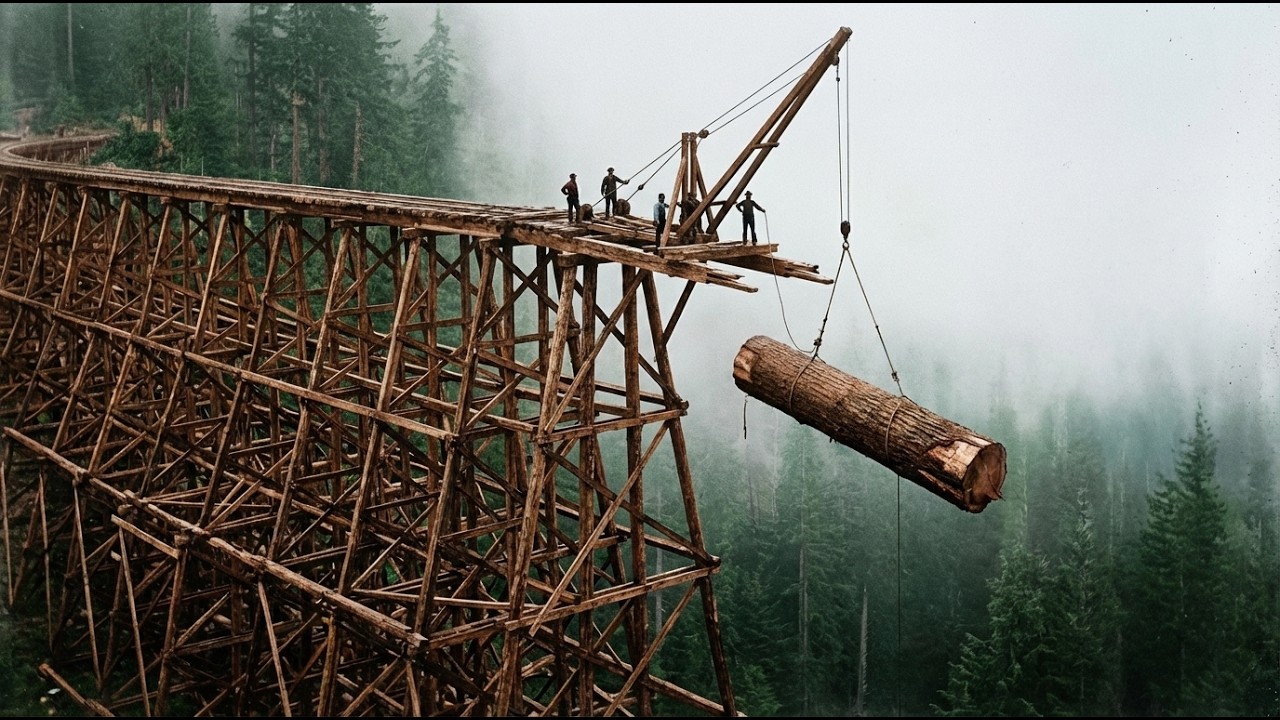
Each rail was aligned, held in place with a spike, and hammered down until the metal bit deep into the wood. The final blow was always the loudest, echoing off the walls of the cut. One hundred feet above the creek, the last spike was driven. The bridge stood complete, a latticework of pine and fir, born from sweat, muscle, and the logic of simple machines.
The crew stepped back, eyes scanning every joint and brace. All that remained was to test what their hands had built. Payroll ledgers from the 1870s spell out the numbers. A bridge crew ran lean and tight, often just twelve to twenty men, each with a defined role and a place in the line.
The foreman set the pace, eyes on the watch and the ledger, knowing that every lost hour ate into profit. Carpenters and sawyers shaped posts and caps with practiced swings of the axe. Riggers manned the gin pole and block and tackle, lifting bents into place with a rhythm that never broke. Laborers hauled timbers, reset falsework, and drove spikes until their arms ached.
Efficiency wasn’t just pride, it was survival. On the books, a hundred-foot trestle could be built in under two weeks, but the best crews cut that in half. In the Upper Midwest, a payroll note from 1874 records a hundred-foot span raised and decked in just six days: eighteen men, sunrise to dusk, no time for wasted motion. Each bent, each stringer, each spike was tracked in the daily tally.
The bridge rose in sequence: a dozen bents set by noon, stringers rolled out by supper, rails spiked before dark. Timing was everything. The train’s arrival was fixed. Wages depended on meeting it.
Miss the deadline and the mill sat idle, loggers lost pay, and the camp’s reputation took a hit that could last a season. The crew’s tempo was relentless. Measure, cut, haul, lift, spike. Every man knew his task and the cost of a mistake.
Pride ran deep. When the last spike was driven, the bridge stood as proof: a week’s work, a hundred feet long, built by hands that didn’t waste a minute. Steam hissed from the stack as the locomotive edged forward, its iron wheels biting into the freshly laid rails. The bridge, one hundred feet above the ravine floor, stood silent except for the nervous shuffle of boots on timber and the low murmur of men holding their breath.
Every eye followed the engine as it crept onto the decking, its weight settling onto the stringers and cap beams that had been squared, hoisted, and spiked together by hand just days before. A field book from a Northern Pacific crew in 1870 records the moment in a single line: “Locomotive placed on mid-span, settlement measured at 1. 3 inches. ” The bridge gave a deep living groan, timber fibers shifting, iron spikes flexing under the load.
Some men claimed they could feel the vibration in their boots. Others watched for the smallest sign of trouble, a split in a cap, a brace opening up, a post shifting out of square. An audible creak echoed down the ravine as the locomotive paused at the center. For a heartbeat, the only sound was the engine’s slow rhythmic chuff and the distant rush of water below.
Then the foreman, level in hand, called out the numbers. The bridge had settled, but not failed. The rails held true. A cheer broke out from the crew.
Relief, pride, and a touch of disbelief at what they had pulled off. In that instant, the structure was more than timber and sweat. It was proof that skill and teamwork could turn raw forest into a path for iron and steam. The locomotive rolled on, the bridge behind it now a tested link in the chain of progress, its scars and creaks a badge of survival.
Men climbed out onto the skeleton of the bridge with nothing but their boots and calloused hands between them and a sixty-foot drop. There were no harnesses, no nets, not even a rope tied around the waist. The only safety was a steady grip and a sure step. Each plank laid, each spike driven, happened with the wind tugging at shirts and the ground far below.
Accident ledgers from the era list broken bones, crushed fingers, and worse, names blotted out by a slip or a rotten timber. Some crews kept a tally of injuries in the camp ledger, a grim counterpoint to the daily tally of spikes driven. Falls were only part of the danger. A single ember from a locomotive’s firebox could turn the whole structure into a torch.
Dry pine soaked up sparks. Fires started in the decking or cap beams, and sometimes smoldered for hours before bursting into open flame. Crews tried to douse hotspots with buckets of creek water, but a gust of wind could undo their work in seconds. Payroll notes from the Northern Pacific mention entire spans lost to fire before the first train ever crossed.
Collapse haunted every job. Timber cut too thin, a cap beam split by a hidden knot, or a bent set crooked in the mud. Any flaw could bring a bridge down under the weight of a loaded train. There was no margin for error.
The men who built and maintained these trestles worked with the knowledge that one mistake could cost a life. Every crossing was a gamble. Every day spent at the edge a test of nerve and skill. The bridge might stand for a season or a single run, but the risk never left the men who kept the rails in the air.
A wooden trestle in the logging woods was always a short-term solution. These bridges were built fast, used hard, and moved on as soon as the timber ran out. Their lifespan was measured in seasons, sometimes just a few months. When the last log was hauled from a patch of forest, crews dismantled everything: rails, ties, and even the towering frames.
Nothing stayed behind. Each bent was built as a self-contained unit, pegged and spiked just strong enough for the job. When it was time to move, men pried up the rails, slid off the stringers, and set the heavy bents onto greased log rollers. With a block and tackle, a half-ton bent could be lowered, rolled forward, and set up at the next crossing.
The same timbers might serve in five or six bridges before rot or a split sent them to the firewood pile. The engineering was practical and efficient. Each bent acted as its own load path. If a post failed, cracked by a hidden knot or softened by rot, the bridge stood.
Redundancy was built in. If a bent was damaged, the load shifted to its neighbors. Calculations from the era allowed up to thirty percent of the vertical posts in a span to be lost before the bridge reached its safe limit. Salvaged stringers and caps were trimmed and reused, sometimes patched with iron straps.
Even the rollers, rough-hewn logs, were used season after season. These bridges were as temporary as the camps that built them, designed to move as fast as the forest fell. Standing where those timber giants once rose, you can still find iron spikes and weathered footings, silent proof of what hands and grit achieved. Today, most wooden bridges have vanished, replaced by steel, forgotten by time.
Yet their legacy endures in every rail and rural span built on necessity and ingenuity. The respect due to these builders is earned, not just remembered.






