The frozen cow pasture known locally as Hannah’s Cowpens lay in the remote backcountry of South Carolina, and just south of it, on the morning of January 17, 1781, one of the most astonishing reversals of the American Revolution was about to unfold. Daniel Morgan, an aging frontier general with no formal military education, stood with roughly a thousand men against Banastre Tarleton, the most feared cavalry officer in the British army. Tarleton had never lost a major battle. The mere mention of his name had scattered militia battalions before a single shot was fired.
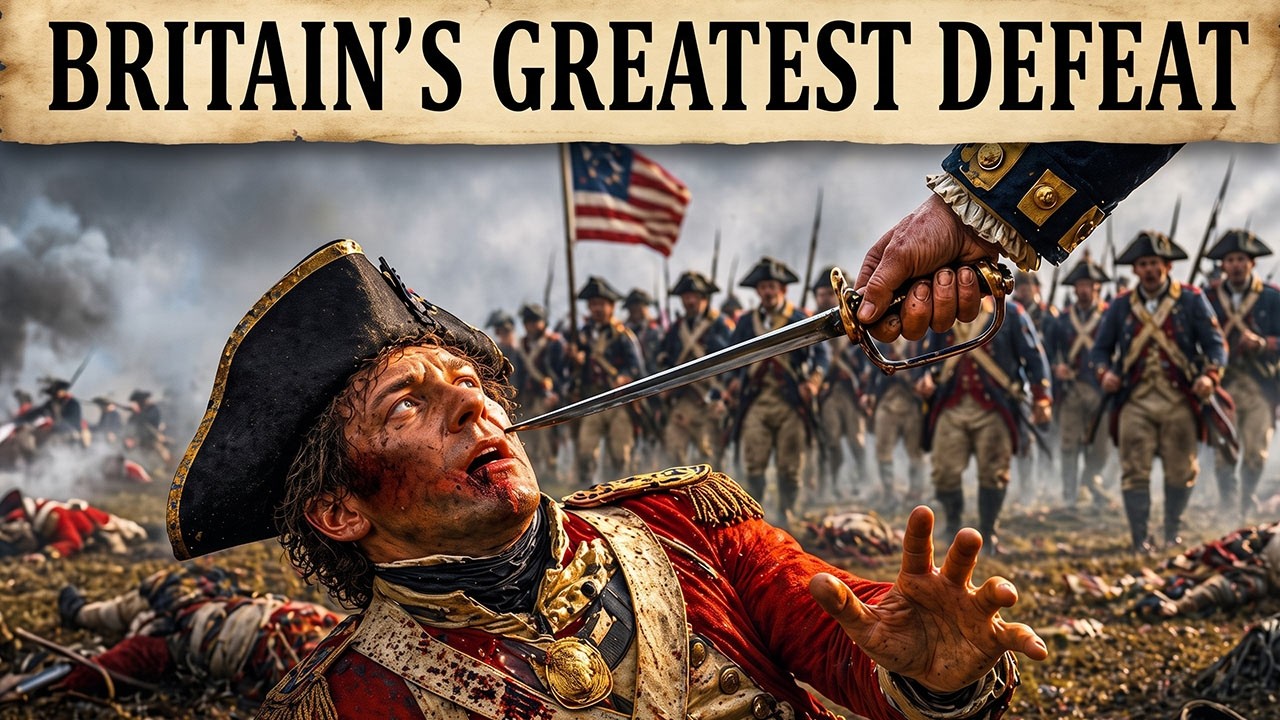
He was young, ruthless, and utterly convinced that the ragged American force before him was already beaten. What happened in the next hour would shatter that reputation forever, and with it, Britain’s grip on the American South. How could an army of farmers, riflemen, and exhausted regulars destroy one of the Crown’s most brutal commanders in under sixty minutes? To understand it, one must return to the winter of 1781, to a moment when the Revolution itself seemed to be fading.
By the beginning of that year, the war had already dragged on for nearly six brutal years. In the northern colonies, the conflict had settled into something close to stalemate. That stalemate was precisely what convinced the British high command to shift its focus south, toward Georgia and the Carolinas, where loyalist sentiment was believed to run deep, and where victory, at least on paper, seemed within reach. The British reasoned that if the South could be pacified, the rebellion in the North could eventually be strangled by isolation, cut off from supplies, recruits, and hope.
It was a strategy built on the assumption that southern loyalists, once properly supported by British arms, would rise up in great numbers and do most of the fighting themselves. That assumption was about to be tested in the most savage way imaginable. The southern campaign had opened with stunning success for the Crown. Savannah fell with barely a fight.
Charleston followed in the spring of 1780, surrendering after a siege that cost the Americans an entire field army, one of the largest losses of manpower the Continental cause suffered in the whole war. British forces under Cornwallis pushed into the interior, confident that the southern rebellion was effectively broken. Against this backdrop of seemingly total British success came the catastrophe of Camden in August 1780, a battle so lopsided and humiliating that it seemed to confirm every British assumption about the collapse of American resistance in the region. By the end of 1780, the American cause in the South lay in ruins.
Charleston, the region’s greatest port city, had fallen, and with it a complete American army trapped inside its walls. Camden was an even greater disaster, one of the worst defeats the Continental Army would ever suffer. General Horatio Gates, once celebrated as the hero of Saratoga, fled the battlefield on horseback, riding sixty miles before he finally stopped, leaving his army in total panic. At Camden, Gates made the fatal mistake of placing untried Virginia militia directly opposite Cornwallis’s most experienced troops, and when the British bayonets advanced through the morning fog, the militia scattered almost immediately, fleeing before a proper volley was even exchanged.
The Continental regulars who remained fought with desperate courage, but they were left isolated and ultimately destroyed. That defeat left a psychological wound Daniel Morgan would spend the coming months trying to heal. Morale among American forces in the Carolinas collapsed entirely after Camden. Militia units dissolved and went home rather than risk facing British regulars again.
Many believed the southern colonies were already lost, that it was only a matter of time before the entire region bowed to the Crown once more. British commanders spoke confidently of the South as a finished matter, a theater of war that could soon be handed over to loyalist governors while the army turned its sights northward. Into this collapse stepped a new commander: Nathanael Greene, a Quaker blacksmith turned trusted aide to George Washington, tasked somehow with rebuilding an army from the wreckage Gates had left behind. Greene arrived to find a force that existed more on paper than in reality, hungry, poorly equipped, and shattered in confidence.
Rather than trying to rebuild a unified army capable of meeting the British in open battle, Greene did something almost unthinkable by the standards of eighteenth-century warfare. He divided his already small force into two separate wings, a dangerous gamble that violated nearly every principle taught in European military academies, where a divided army could be destroyed piece by piece by a concentrated enemy. He kept one wing under his own direct command. The other, a smaller mobile force of about six hundred men, he placed under Daniel Morgan.
Morgan was an unusual choice for independent command. He was no aristocrat, no graduate of any formal military academy, but a former wagon driver turned artillery officer turned sharpshooter, a man perpetually wracked by sciatica and rheumatism that made simply sitting a horse an ordeal. Decades earlier, as a young wagoner during the French and Indian War, he had struck a British officer and was sentenced to five hundred lashes, a brutal punishment meant to kill him. He survived, and legend held that he counted every lash, vowing that if the British ever did that to him again, they would miscount by one, because he intended to stay alive to correct them.
That old grudge against the Crown had never faded. Now, decades later, he had been given the closest thing to independent command he had ever held, with orders to move west, threaten British positions, gather supplies, and rally the frightened backcountry militia. Greene’s decision to divide his already outnumbered forces reflected a broader strategic vision that would define the entire southern campaign. He understood that his small army could never defeat Cornwallis in a single decisive battle, not while the British held every material advantage in troops, supplies, and artillery.
Instead, he intended to wage a war of attrition and maneuver, forcing Cornwallis to chase multiple threats across vast distances. By sending Morgan west of the Catawba River while he himself operated to the east, Greene placed Cornwallis in an impossible dilemma. If the British commander concentrated his forces to crush one American wing, the other would roam freely behind his lines. If he divided his army to chase both threats at once, he risked exposing each wing to defeat in turn.
The British response was not long in coming. Lord Cornwallis, commander of all Crown forces in the southern colonies, could not allow an American force to roam freely behind his advancing army. So he sent his most lethal weapon to run Morgan down: Banastre Tarleton, commander of the British Legion. Tarleton was only twenty-six years old, yet his name inspired genuine terror throughout the Carolinas.
At the Battle of Waxhaws months earlier, his cavalry had slaughtered Continental soldiers who were trying to surrender, an event that gave rise to a grim rallying cry among American troops: “Tarleton’s quarter,” meaning that surrendering to his men promised no mercy. He was fast, aggressive, and contemptuous of American militia, and he had never lost a major battle. Cornwallis gave him a simple task: destroy Morgan’s force before it could escape north across the Broad River and rejoin Greene’s main army. Tarleton pursued with his characteristic ferocity, driving his men through freezing winter rains and thick mud, confident that speed alone would eventually trap the Americans at the swollen river with nowhere to run.
Tarleton’s reputation rested on a very specific formula: overwhelming speed combined with absolute brutality against opponents who lacked the training and discipline to withstand a sudden cavalry assault. It had worked at Waxhaws. It had worked in a dozen smaller engagements across the Carolina backcountry. Cornwallis trusted him precisely because he never hesitated and always struck first, before the enemy could organize a proper defense.
That merciless instinct was about to turn against a commander who understood exactly how to exploit it. By mid-January, Morgan realized he could not flee Tarleton forever. His men were exhausted after weeks of marching through hostile terrain. Morgan’s scouts reported the British column approaching rapidly.
If Morgan attempted to cross the Broad River while Tarleton’s cavalry was on his heels, his army would risk being caught mid-crossing and annihilated piecemeal. So Morgan made a decision that astonished even his own officers. He would not run any farther. He would turn and fight on ground of his choosing, in an open pasture known locally as the Cowpens, with the swollen river directly behind his army, deliberately cutting off his own line of retreat.
To many of his officers, this seemed like sheer madness. Every rule of traditional military wisdom called for keeping an escape route open. But Morgan understood something about his army that no European war manual accounted for. His militia, the very same men who had scattered and fled at Camden just months before, needed a battlefield where escape was no longer an option.
And Tarleton, filled with open contempt for American militia, would charge straight ahead exactly as Morgan expected, without pausing to reconnoiter the ground or rest his exhausted men. On the evening before the battle, Morgan did something almost unheard of among commanders of his era. Instead of simply issuing orders and retiring to his tent, he moved from campfire to campfire throughout the night, sitting with the militia companies he had never commanded before, listening to their fears and explaining in plain language exactly what he wanted from every man the next morning. He told them plainly that they would likely see the militia line receive an order to fall back, and that this retreat was not a failure but a deliberate part of the plan.
The soldiers who fought under Morgan at Cowpens would later recall those fireside talks as something they had never experienced under any other commander, a general treating the militia not as cannon fodder but as essential partners in a carefully designed plan. Morgan’s army on the morning of the battle was a heterogeneous force assembled from vastly different backgrounds and levels of experience. At the core stood about three hundred Continental regulars under the capable Colonel John Eager Howard, battle-hardened veterans from Delaware and Maryland who had survived the disasters of the previous year’s campaign. Alongside them stood a group of Virginia and Georgia riflemen, professional sharpshooters accustomed to hunting in the dense frontier forests.
Finally, the vast majority of the force consisted of hundreds of militia under leaders like Andrew Pickens, farmers and craftsmen who had never stood in a formal battle line in their lives. Opposing this makeshift formation marched Tarleton’s more organized and professional force of over a thousand men, including the elite cavalry of the British Legion, seasoned regular infantry from the famous 7th Royal Fusiliers, light infantry from the Highlands, and a pair of small “grasshopper” cannons capable of firing grapeshot into massed infantry at close range. On paper, the British were better trained, better equipped, and led by a commander who had never tasted defeat in his young and ferocious career. By every rule of traditional eighteenth-century warfare, the outcome of this encounter should not have been in serious doubt.
But Morgan possessed one advantage no rulebook could measure. He understood his opponent’s thinking with complete clarity, and he knew exactly what Tarleton expected to see on any battlefield that contained American militia. He built an elaborate trap around that certainty. The Continental soldiers of Colonel Howard deserved particular mention, for they represented one of the few reliable striking forces available to Morgan that morning.
Many of these men had marched with the army through the Camden disaster, had watched militia units on their flanks dissolve under pressure, and yet had maintained their discipline even as the wider campaign collapsed around them. When Morgan placed his trust in a third line to absorb the full weight of the British attack, he was betting on men who had proven under the worst possible circumstances that they would not break. Morgan arranged his army in three distinct lines, a formation unlike anything taught in European military academies. The first line consisted of skirmishers and professional riflemen who were given clear instructions to fire only two aimed shots each, targeting British officers whenever possible, before falling back in good order.
The second line held the militia, the very men everyone on both sides expected to run at the first sign of serious pressure. Morgan gave them explicit permission to do exactly that, but only after firing two full volleys, and only if they withdrew in a specific predetermined direction around the American left flank to regroup behind the third line. The third line held the Continental regulars, the disciplined and steady core that would receive the weight of any British attack, but only after it had been weakened and disorganized by the two advancing lines. It was a plan built almost entirely on expectations and psychology rather than raw firepower or numbers.
Morgan wanted Tarleton to see exactly what he expected to see: an American militia crumbling and retreating under fire, because Tarleton had witnessed precisely that scene many times before, at Camden and in countless smaller skirmishes throughout the southern campaign, and he would instinctively read it as a battle already decided. Morgan was betting everything on the certainty that a commander with such contempt for American fighting ability would not pause long to question a retreat that looked exactly like every other American collapse he had personally witnessed. The ground itself at Cowpens was chosen with the same care Morgan applied to every other aspect of his plan. It was an open pasture used by local farmers for grazing cattle, with gently rising terrain that gave Morgan’s rear lines a slight elevation advantage, allowing his Continentals to see the battle unfold completely.
Most importantly, the field was almost entirely free of underbrush, meaning Tarleton’s cavalry would find no immediate reason for caution. That open space, which seemed to favor a fast-moving cavalry commander hungry for a direct confrontation, was in fact the greatest trap of all, because it gave Tarleton no visual reason to suspect anything other than a straightforward attack against a supposedly disorganized enemy. At dawn on January 17, Tarleton’s exhausted men reached Cowpens after a grueling all-night march over cold, difficult terrain, having eaten almost nothing since the previous day. Tarleton, utterly confident of an easy and swift victory, refused to rest his men or allow time to reconnoiter the unfamiliar ground before him.
Instead, he ordered an immediate attack the moment his lead elements arrived, trusting that the speed and relentless aggression that had won him every previous engagement would end this battle just as quickly. The first American skirmish line opened fire exactly as ordered, dropping several British officers from their horses before falling back in disciplined order as planned. Tarleton dismissed this initial resistance as little more than an opening skirmish in what he expected to be an easy morning’s work. Then the militia line opened fire, delivering two disciplined volleys that tore through the advancing British ranks at close range.
And then, exactly as they had been pre-ordered, the militia began their withdrawal, moving around the American left flank in a maneuver that looked from a distance like the beginning of a total collapse. For Tarleton, this was the exact moment he had witnessed so many times before: the American militia dissolving under pressure and fleeing in chaos. He believed the battle was already won, and he pushed his men forward with even greater force, confident that one final push would turn the retreat into a rout. But this was not Camden.
This was no genuine panic-driven collapse. It was a carefully baited trap, and Tarleton swallowed it whole, exactly as Morgan had wagered. As the British infantry charged forward in pursuit, growing more disordered by their own haste, they slammed directly into Morgan’s waiting third line. The Continental regulars held their position, fully prepared, having watched the opening exchange unfold exactly as their commander had predicted.
The devastating volley that followed shredded the leading ranks of the advancing British and stopped their attack dead. At almost the same moment, the militia, which had only been pretending to flee, re-formed their lines seamlessly behind the American position and returned to the fight from a new direction. William Washington’s cavalry, held in reserve specifically for this moment, launched a violent charge against the exposed British flank, while Pickens’s re-formed militia simultaneously came around from the other side. Within a few chaotic minutes, Tarleton’s army, which moments before had believed itself on the verge of complete victory, found itself suddenly surrounded from three sides at once.
William Washington’s cavalry charge deserves particular attention, for it produced one of the most vivid personal moments of the entire battle. In the chaos of the final British collapse, Washington briefly became separated from his personal guard and found himself in a desperate sword duel against three British officers at once. His sword was twisted by the force of the engagement, and he nearly died before one of his troopers, a young bugler barely old enough to shave, spurred his horse forward and fired his pistol to save his commander’s life at the last possible moment. It was a small moment buried within a much larger collapse, but it captured something essential about the entire battle: a struggle decided again and again by narrow margins rather than any overwhelming superiority of numbers.
Panic spread through the British ranks with terrifying speed once the true situation became clear. Soldiers who had marched through a freezing night with empty stomachs, who had just watched their confident attack shattered at close range, began throwing down their weapons in increasing numbers. Whole companies surrendered in place, stunned by the sudden reversal of a battle they had been certain of winning only minutes before. Tarleton desperately tried to rally what remained of his cavalry for a final charge that might salvage the situation, but most of his men refused the order and fled the field, abandoning their infantry and their commander to their fate.
The man who had built his entire reputation on speed and terror had, in less than an hour, been transformed into a symbol of total military collapse. He himself escaped by a miracle, briefly trapped in a violent clash with Washington’s cavalry before managing to slip away with a few surviving officers, leaving the rest of his once-proud force scattered, captured, or dead on the frozen ground. The 7th Royal Fusiliers, a regiment with a proud history stretching back over a century of combat glory, met a particularly bitter fate that morning. Surrounded and cut off from any hope of rescue, the survivors of the regiment threw down their arms and surrendered as a single body, a result that had seemed impossible just one hour earlier when the battle began.
British officers who survived the engagement later wrote with genuine astonishment about the speed of the collapse, describing an army that entered the field expecting an easy task only to find itself disintegrating in chaos within a single hour. In less than sixty minutes, one of the most feared units in the British army was destroyed completely as a fighting force. Roughly one hundred British soldiers lay dead, more than two hundred were wounded, and over five hundred more were captured outright. It was an astonishing collapse of nearly Tarleton’s entire command in one short morning engagement.
By comparison, American losses were extremely light: only a small handful dead and a few dozen wounded. The militia, so widely expected to collapse and flee, had become the primary instrument of British destruction, executing Morgan’s plan exactly as he had laid it out to his officers the night before. The humiliation extended far beyond the battlefield itself. Tarleton, who had never before lost a major battle, returned to Lord Cornwallis having lost nearly his entire detachment to a militia force he had openly despised.
For the British high command, Cowpens was not a passing tactical defeat to be quietly forgotten. It was proof that the war in the American South, which had seemed settled only months before, was now slipping from their grasp with alarming speed. Cornwallis, furious and desperate to save his campaign, launched an immediate pursuit of the combined American forces, a move that would ultimately exhaust his depleted army and drive it steadily northward, deep into Virginia, toward a small tobacco port called Yorktown. Historians studying the southern campaign would later regard Cowpens as a turning point no less significant than Saratoga in the northern theater, though it rarely received the same popular fame.
While Saratoga convinced France to enter the war formally, Cowpens achieved something no less important on a smaller scale. It destroyed the cavalry force Cornwallis depended on for reconnaissance and rapid pursuit. Without Tarleton’s Legion as an effective fighting force, Cornwallis found himself operating in the dark in hostile territory, unable to track the movements of Greene’s reunited army. In this sense, the true cost of Cowpens to the British war effort extended far beyond the immediate losses of that January morning.
It crippled Cornwallis’s ability to wage the very kind of mobile, aggressive campaign that had brought him so much success across the Carolinas. Cornwallis’s response to the defeat revealed how seriously the British command took this setback. Rather than consolidating his position and waiting for reinforcements, he made the fateful decision to burn a large portion of his supply train, keeping only essentials in a desperate attempt to catch Greene’s forces and destroy them before they could escape into North Carolina. It was an extraordinary gamble, sacrificing supplies and logistical flexibility for pure speed, and it launched an exhausting pursuit across hundreds of miles that wore down the British army far more than it hurt the Americans.
Greene, employing the kind of strategic patience that had characterized his approach from the start, stayed just far enough ahead of Cornwallis to avoid a decisive battle on unfavorable terms. Daniel Morgan did not live to see the full outcome of the war he had so decisively changed at Cowpens. Plagued by chronic illness just a few weeks after the battle, he quietly retired from field command, his body finally giving out after years of pain he had borne silently throughout the southern campaign. But what he built in that single frozen hour lived on long after his brief service ended.
He had taken an army assembled from the wreckage of Camden, men humiliated and publicly doubted only months before, and turned their expected weaknesses into the very trap that destroyed one of Britain’s finest field commanders. The chain of consequences flowing from that single frozen morning at Cowpens was too vast for words. The exhausting pursuit that followed, in which Cornwallis burned his supplies to catch Greene, culminated months later in the costly and inconclusive Battle of Guilford Courthouse, where the British technically held the field but suffered losses so severe that Cornwallis judged his army too weak to continue the campaign as planned. Instead of remaining in the Carolinas, Cornwallis marched his exhausted forces north into Virginia, hoping for easier successes along the coast.
That decision led him directly to Yorktown, where he expected to resupply his army by sea. But a French fleet arrived first, sealing Chesapeake Bay, while Washington and Rochambeau marched their combined armies south to complete the siege. The ensuing siege forced Cornwallis to surrender his entire remaining army, effectively ending major British military operations in North America. It is no exaggeration to say that the chain of British misfortunes, stretching from that January morning to the surrender at Yorktown eight months later, began with a reckless cavalry charge across an open cattle pasture.
Cowpens itself did not end the Revolutionary War. Cornwallis continued fighting for months afterward, and the final reckoning between the armies still awaited them at Yorktown. But something essential had genuinely changed on that frozen morning. The British Crown had learned, in the most painful and public way, that American militia were not merely men destined to flee at the first sound of gunfire.
That an exhausted army built from repeated defeats could still be reshaped into a decisive weapon in the right hands. That even the most feared commander who had never lost in the service of the king could be broken by a plan built entirely on a precise understanding of how his mind worked. In the years that followed, military historians would remember Cowpens as one of the finest tactical performances of the entire Revolutionary War. A battle plan of such elegant simplicity and devastating execution that it was later studied and admired by professional soldiers who never fought a single day for American independence.
It offered a rare convergence of every element required for victory against a superior force: a commander who understood his army’s weaknesses well enough to transform them into strengths, an opponent whose greatest asset, his own overconfidence, became his greatest vulnerability, and a battlefield that left neither side an easy path to escape the consequences of the moment. Daniel Morgan, an aging man in constant physical pain, self-taught in the arts of war, achieved what few professionally trained generals of his era managed. He defeated his enemy not through superior numbers or equipment, but through a complete and precise understanding of what his opponent expected to see, and then deliberately giving him that expectation, volley after volley in carefully timed sequence, until the trap he had patiently built closed around an army utterly convinced of its own inevitable victory.
In the frozen fields of Cowpens on that January morning, a battle that began with British confidence and ended in British catastrophe, an old soldier with no formal military training, in less time than it takes to eat a quiet breakfast, changed the entire course of the American War of Independence.
