On September 2, 1945, at 8:56 in the morning, eleven Japanese representatives stepped onto the deck of the USS Missouri in Tokyo Bay. Foreign Minister Mamoru Shigemitsu moved forward slowly, leaning on a cane, his artificial leg making every step deliberate. Behind him walked General Yoshijiro Umezu, Chief of the Army General Staff, one of the senior officers who had resisted surrender until Emperor Hirohito’s decision ended the argument. Cameras were already rolling.
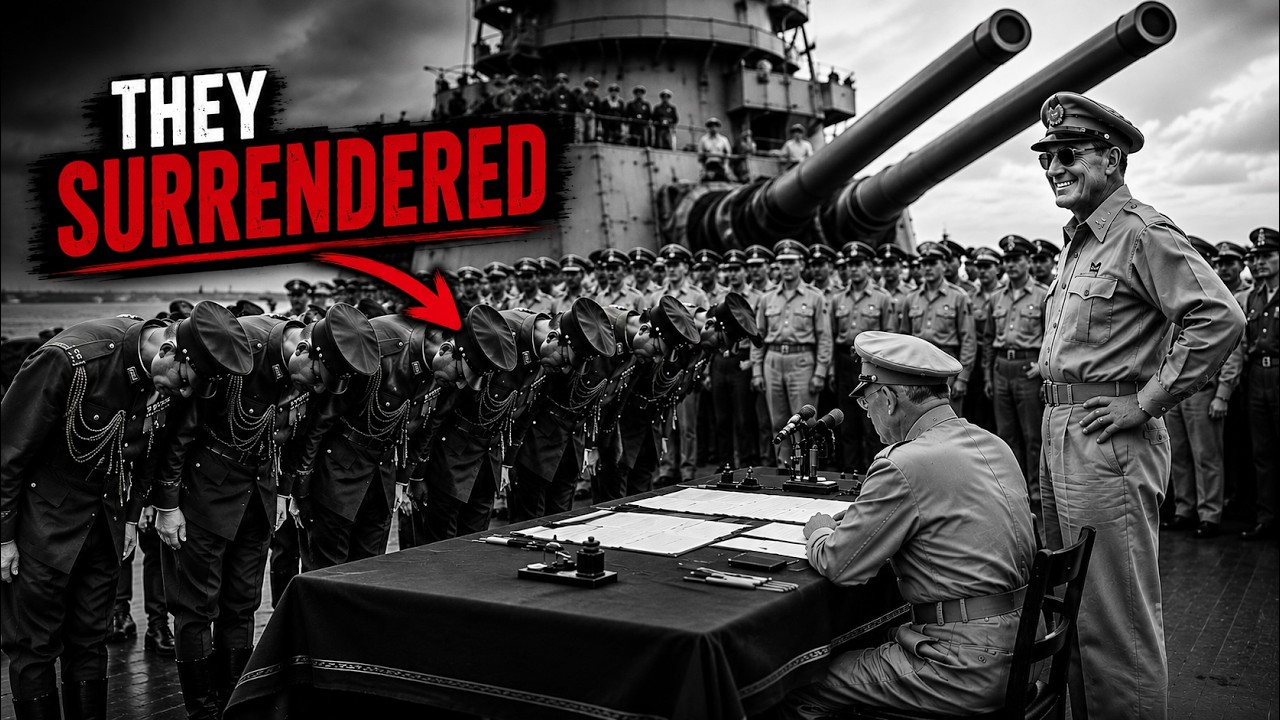
Sailors crowded every level of the battleship. Allied officers watched in silence, and one detail immediately stood out. No formal bow was offered to Douglas MacArthur. A more theatrical victor might have stopped the ceremony and demanded one.
MacArthur did not. He let the Japanese delegation stand straight, because he had already arranged the morning so that posture would not matter. The Japanese could hide every emotion, preserve every scrap of dignity, refuse every visible gesture of submission, and still, before they left the ship, Japan’s government and military would place their names on a document that said one thing permanently. The war was over.
Japan had lost. But MacArthur had done something else, something the photographs almost hide. Directly behind him stood two men Japan had once forced to surrender. Both had spent years as prisoners.
Both were now free. Japan’s representatives would have to sign with those men watching. That was the first clue to what the ceremony was really about. MacArthur was not trying to make Japan look defeated for one morning.
He was trying to make the defeat impossible to rewrite. By September 1945, the political decision had already been made. Emperor Hirohito had announced acceptance of the Allied terms. Weapons were being ordered silent.
Occupation forces were beginning to move. The ceremony aboard the Missouri was not needed to decide whether Japan would surrender. It was needed to decide what that surrender would mean. Wars do not end only when people stop shooting.
They end when the defeated, the victors, and the watching world can point to the same event and say, this is where the argument ended. A defeated officer could later claim he never felt defeated. A military could say it obeyed only its emperor. A generation could turn humiliation into grievance.
MacArthur did not need to control what the Japanese delegation felt. He needed to control what the world could prove. That is why the cameras mattered. The witnesses mattered.
The signatures mattered. And the location mattered most of all. This was not Guam, not Manila, not Pearl Harbor. This was Tokyo Bay.
The American fleet had crossed the Pacific and reached the waters of Japan itself. The surrender would happen on an American battleship in the harbor of the nation that could not keep that fleet away. The Japanese delegation could control its faces. It could not control the stage.
Even the table undercut the fantasy of Imperial ceremony. There was no throne, no elevated dais, no marble hall built to magnify a ruler. The surrender rested on an ordinary mess table, covered for the occasion with documents arranged on top of it. That simplicity was almost unsettling.
After years of carrier battles, amphibious landings, kamikaze attacks, submarine patrols, and strategic bombing, the Pacific war was being reduced to paper laid on naval furniture. Grand spectacle can make defeat feel theatrical. This felt administrative. Japan was not being invited to perform a final drama.
It was being processed into a new reality. At the center of the delegation were two men who represented the two halves of defeated Japan. Shigemitsu would sign for the emperor and the Japanese government. Umezu would sign for Imperial General Headquarters.
Shigemitsu was impossible to miss. His damaged leg made every step deliberate. He was not there as a battlefield commander. He was there as the state itself.
Umezu carried a different burden. He had resisted surrender during Japan’s final internal crisis. Once the emperor made the decision, he obeyed. That distinction mattered.
Umezu was not coming aboard the Missouri to negotiate with MacArthur. Nothing remained to negotiate. He was there because Japan’s supreme authority had ordered the military to stop fighting. That left him one thing he could still preserve, his bearing.
He could stand straight, keep his face controlled, tell himself he was carrying out an imperial order rather than personally submitting to an American general. MacArthur could have challenged that. He could have turned the morning into a contest over posture. Instead, he ignored it, because a contest would give Umezu something MacArthur did not want him to have, a role as an opponent.
MacArthur was about to reduce him to something much simpler. A signatory. Then MacArthur appeared. The contrast was immediate.
The Japanese representatives were formally dressed. MacArthur wore his familiar open-collar khaki uniform. He did not look like a monarch receiving conquered subjects. He almost looked casual.
Nothing around him was casual. The ship was American. The harbor was under Allied control. Sailors crowded the superstructure, rails, and turrets.
Representatives of the victorious powers surrounded the ceremony. Nearby was a small object carrying almost a century of history. A 31-star American flag associated with Commodore Matthew Perry’s expedition to Japan in 1853 had been displayed aboard the Missouri. Ninety-two years separated those moments.
Perry’s ships entering Japanese waters. Then the Missouri sitting in Tokyo Bay while the Japanese Empire surrendered. MacArthur did not need to explain the comparison. The flag did it for him.
Two men standing behind him carried the more recent memory. Jonathan Wainwright knew what surrender looked like from the other side. After MacArthur left the Philippines in 1942 under presidential order, Wainwright had continued the defense. Corregidor fell.
He surrendered. Then came more than three years in Japanese captivity. Arthur Percival carried a different history. He had commanded British forces at Singapore.
In February 1942, he surrendered one of Britain’s most important positions in Asia. Japan celebrated Singapore as proof that the British Empire could be broken. Three years later, the frame was reversed. Wainwright was free.
Percival was free. And MacArthur had both men standing directly behind him while Japan signed. They did not speak. They did not point.
They simply stood where the Japanese delegation could see them. Then MacArthur stepped toward the microphone. He could have listed atrocities. He could have mentioned Bataan, Corregidor, prison camps, burned cities, sunken ships.
He could have demanded public shame. Instead, he spoke of justice, tolerance, and the hope for peace. But there was no softness in the terms themselves. Japan was still required to comply fully.
Then he called Japan’s representatives forward. Shigemitsu approached first. The instrument of surrender was brief, but its effect was total. Japan accepted the Potsdam terms.
Its armed forces were ordered to cease hostilities. Allied prisoners and civilian internees were to be liberated. The authority of the emperor and government became subject to the Supreme Commander for the Allied Powers as required to carry out the surrender. Shigemitsu lowered himself into the chair, signed for the emperor and the Japanese government, and stepped back.
Half of the formal surrender was complete. But the military still had to place its own name on the page. Umezu moved forward. He leaned over the document and signed.
No formal bow to MacArthur. No dramatic collapse. No emotional surrender performed for the cameras. MacArthur did nothing, because he did not need Umezu to look defeated.
He needed Imperial General Headquarters to be surrendered. Umezu could straighten his back afterward. He could keep his expression unreadable. He could tell himself he acted only because the emperor commanded it.
None of that changed the ink. A bow might last five seconds. The signature would survive for generations. MacArthur sat to sign as Supreme Commander for the Allied Powers.
He did not use one pen. He used several. One was given to Wainwright. Another went to Percival.
The reversal was complete. Wainwright had once surrendered under Japanese victory. Percival had walked into surrender at Singapore while Japanese cameras recorded British defeat. Now both received pens connected to Japan’s surrender.
Then the Allied representatives began signing. Fleet Admiral Chester Nimitz for the United States. Then China, Britain, the Soviet Union, Australia, Canada, France, the Netherlands, New Zealand. Signature after signature.
Japan had already signed. Now the delegation stood while the victorious coalition accepted that surrender. Every name widened the defeat. Japan had not surrendered only to MacArthur, not only to the United States Navy.
The document now carried the names of the nations that had fought the war against it. And then, in the middle of one of the most carefully staged ceremonies of the entire conflict, something almost absurd happened. Someone signed in the wrong place. Canada’s representative, Colonel Lawrence Moore Cosgrave, put his signature one line too low on the Japanese copy.
That pushed the remaining signatures out of alignment. Japanese representatives objected. The page had to be corrected. It sounded ridiculous.
Four years of war, millions dead, cities destroyed, and now people were worried because a name was on the wrong line. But that tiny mistake proved something important. The document mattered. The surrender could not merely feel official for the cameras.
It had to survive afterward. It would be copied, filed, cited, preserved, and studied. A bow could be remembered differently. A facial expression could be interpreted differently.
The signatures had to be right. The mistake did not weaken the document. It proved the document mattered enough to correct. Once the error was handled, the ceremony moved toward its end.
No dramatic handshake with the Japanese delegation. No theatrical reconciliation. MacArthur closed with a hope that peace would now be restored and preserved. Then the sky changed.
Aircraft appeared over Tokyo Bay. Carrier planes. B-29 Superfortresses. Formation after formation moving over the fleet.
The sound spread across the harbor. The Japanese delegation had just surrendered aboard an American battleship inside Tokyo Bay, surrounded by Allied naval power. The men Japan had once defeated stood behind MacArthur while the ink dried. Now Allied air power filled the sky above them.
A forced bow would have created a story about coerced bodies and unconquered hearts. The ships were real. The aircraft were real. The signatures were real.
Wainwright and Percival were real. The important question was never whether the Japanese would bow. The important question was whether anything they did with their bodies could change what was happening to their country. The answer was no.
MacArthur also had another reason not to build the morning around humiliation. He had to govern Japan. Defeating a country and occupying one are different jobs. Japanese cities were devastated.
Food was scarce. Millions of soldiers and civilians were scattered across the former empire. Weapons had to be collected. Prisoners had to be liberated.
Troops had to be demobilized. A revenge spectacle might satisfy emotion for an afternoon, but humiliation could create resentment that lasted much longer. MacArthur wanted something harder. Make the defeat unmistakable without making vengeance the foundation of the peace.
Japan would not be allowed to pretend it had won, but losing the war did not have to mean the country had no future. Less than a month later, the same method appeared again. Emperor Hirohito met MacArthur. Again, there was no forced public bow, no carefully staged humiliation.
The famous photograph showed MacArthur relaxed in open-collar uniform beside the formally dressed emperor. The image communicated a changed relationship without a theatrical confrontation. What survived that morning was not Umezu’s exact expression, not Shigemitsu’s posture in one photograph. Those could still be argued over.
What survived were the documents, the signatures, the film, the photographs, the pens, the witnesses, the Perry flag, the order of names. If one image could be interpreted differently, there was another. If someone claimed Japan ended the war on equal terms, there was the document. If anyone forgot who Japan had once imprisoned, Wainwright and Percival were visible behind MacArthur.
MacArthur never owned the defeated men’s emotions. He owned the evidence. He let them stand. Then he made them sign.
He put former prisoners behind him. He used an American battleship inside Tokyo Bay as the stage. He turned pens into artifacts. He had the Allied coalition add its names.
Then Allied aircraft filled the sky. MacArthur did not defeat their posture. He made their posture meaningless. The men walked away.
The ink stayed.
