The morning began with fire. On West 139th Street in Harlem, a gray sedan rolled past a narrow storefront with green curtains. The sign read Morgan’s Social Club, but behind those curtains sat six tables where men connected to Vincent Morano played cards, ran numbers, and rolled dice. The sedan slowed, a rear window came down, and a brick flew through the front glass, followed by another, then a bottle of gasoline.
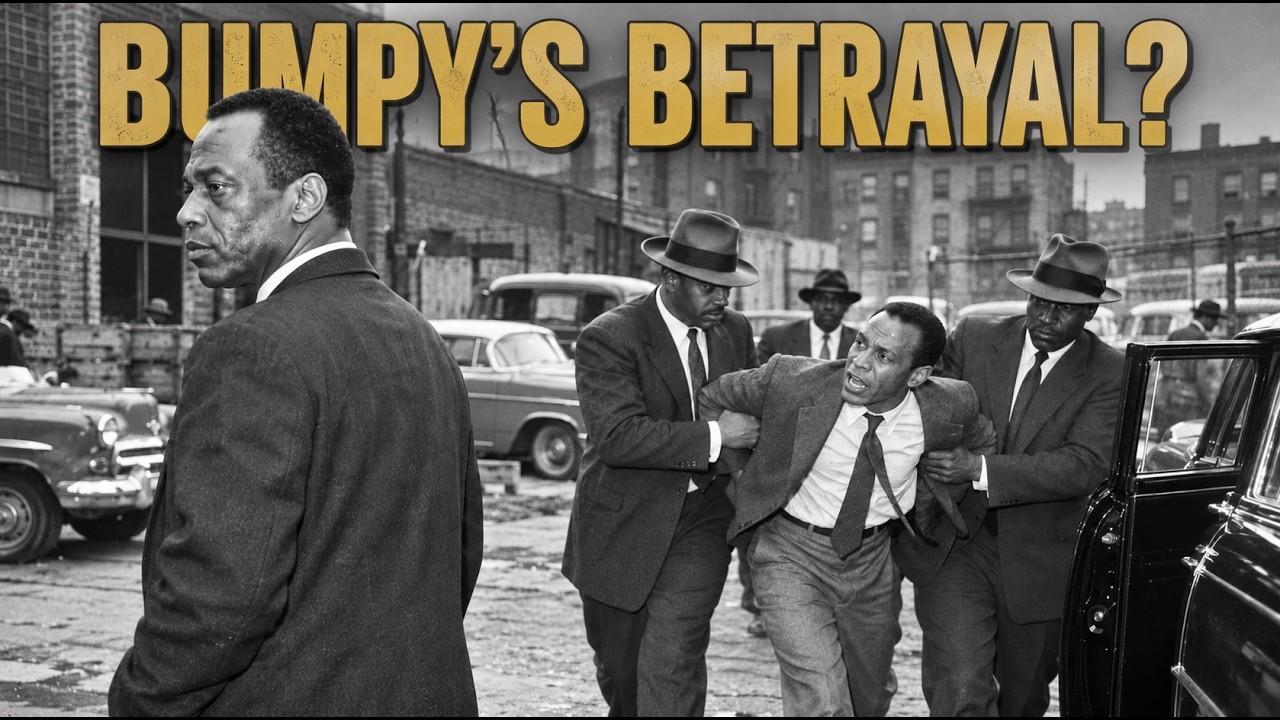
A match followed. By the time the curtains caught, the sedan was already moving. By 6:13 in the morning, someone had declared war without signing a name. The first man out was Joseph Corda, 43, shirt open, who had been sleeping in the back office because Morano had stopped trusting night watchmen three weeks earlier.
He stumbled onto the sidewalk carrying a metal cash box, dropped it, and watched coins scatter into the gutter. The fire was not large enough to destroy the building; that was never the purpose. A burned room sends a message. Corda found a telephone and called Morano with seven words: They hit Morgan.
We know who it was. Certainty is dangerous, especially when borrowed. Three blocks north, Bumpy Johnson sat alone in the rear booth of a small restaurant that had no gambling upstairs, downstairs, or behind the walls. That was why he liked it.
A man named Isaiah Bell entered, 39, careful eyes, the one who handled information. Muscle tells you what happened. Information tells you what happens next. He sat opposite Bumpy.
Morgan burned. Bumpy cut his eggs. How bad? Bad enough to close today.
Maybe tomorrow. Who? Looks like Dempsey’s people. Bumpy stopped cutting.
Looks like Morano thinks Dempsey. That wasn’t my question. A pause. Two witnesses saw a gray Plymouth.
Half Harlem owns a gray Plymouth. Bumpy wiped his fork. Find the car. Find it before Morano finds an excuse.
Vincent Morano did not wait. That was his first mistake of the morning. Near Lenox Avenue, a delivery warehouse belonging to Everett Dempsey’s organization collected money from three betting rooms. At 7:57, a produce truck stopped outside.
Four men stepped down, no masks. Today, witnesses were the point. The front door lasted six seconds. A desk turned over.
Two adding machines smashed onto the floor. One clerk tried to protect the safe and received a fist in the stomach. The men took the day’s envelopes, left the safe, and left one sentence: Tell Dempsey Morano sends its regards. Retaliation has a weakness.
It likes to introduce itself. By 8:31, Bumpy heard about the warehouse before he heard about the Plymouth. That told him enough. He stood beside the window of his office as Isaiah spoke.
Morano hit Dempsey. How long after Morgan? Hour and 43 minutes. Too fast.
He wanted witnesses, not answers. Bumpy reached for his coat. Now Dempsey needs witnesses, too. You stepping in?
Not yet. Because two men throwing punches don’t listen to the referee. They listen when they get tired. The gray Plymouth was found behind a laundromat on 145th Street.
Doors unlocked, keys gone, no gasoline cans, no bricks. Someone had broken the small vent window to steal it. The owner was a schoolteacher who reported it stolen sometime after midnight. Dempsey’s men could have stolen it.
So could anyone. A fact without a direction is just weight. Isaiah called Bumpy. Car’s stolen.
When? After midnight. Proof on Dempsey? None.
Bumpy paused. Then Morano just started a war over an assumption. Everett Dempsey received the warehouse report in a barber shop. He was 51, tall, with a scar beneath his left ear.
He had built his operation from bookmakers, card rooms, small loans, and patience. Patience made him rich. Pride makes patience expensive. Three men stood behind him, including Ellis Crowe, 34, with a fast temper.
Morgan. They said it. Anybody killed? No.
Anybody badly hurt? Calvin can’t stand straight. We can answer. We will.
Dempsey stood. He had decided: answer hard enough that they stop asking whether it was us. The answer came against money, not men. Two collectors working for Morano left a betting room carrying a leather satchel holding $8,400.
A panel truck turned into the street and three men jumped out. A shot entered a tire. The collectors were beaten quickly. The satchel disappeared.
One attacker bent over the first collector. Dempsey says hello. Then they were gone. One fire, one warehouse, one robbery.
Harlem was beginning to align itself around violence. At noon, Bumpy gathered his inner circle: Malcolm Bain, trusted for nine years; Isaiah Bell; Calvin Mercer, a former dock worker responsible for security at several gambling rooms; and Theodore Rusk, 41, lean, with a quiet smile. Theo had worked under Bumpy for six years. He was good at ending problems, which is different from solving them.
Bumpy marked four locations on a city map. Morena started it, Theo said. Isaiah shook his head. We don’t know that.
Dempsey burned his club. We don’t know that either. Everybody knows. Everybody knowing is how innocent men get buried, Bumpy replied.
No assumptions. A rule sounds simple before somebody has to obey it. The war continued through the afternoon. Dempsey lost a second property, a pool hall, raided in broad daylight.
Customers were ordered against the wall. The cash register was emptied. Men poured ink across betting ledgers. Destroying cash hurts today.
Destroying records hurts tomorrow. The manager was struck across the mouth. One attacker stopped at the entrance. Tell Dempsey we’re still counting.
By early evening, Bumpy had had enough. He arranged a meeting between Morano and Dempsey, a meeting nobody wanted to call a meeting. No guns on the table. Morano smiled.
Mine stays in my coat. Dempsey said the same. Bumpy laid out the facts: Morgan burned, warehouse hit, collectors robbed, pool hall destroyed. Four events in less than eleven hours.
If this continues, Bumpy said, tomorrow won’t belong to either of you. Morano leaned back. It belongs to me now. Dempsey smiled.
Then somebody forgot to tell the street. The meeting produced nothing. No agreement, no handshake, no peace. Morano insisted Dempsey burned Morgan.
Dempsey insisted Morano hit his warehouse. Neither had proof. Bumpy leaned forward. Neither one is proof.
Morano stood. In my world, it’s enough. Bumpy replied, No. In your world, it’s expensive.
That night, the violence spread. A Morano guard fired twice at a dark sedan, missed both times, and buried a bullet in the window of a tailor shop. Nobody was hit. But the tailor was 72, and his nine-year-old granddaughter was inside.
The bullet passed above her head and embedded itself in a wooden shelf. Bumpy stood in the shop later, touching the splintered wood. The guard was Morano’s man, Louis Ferrante. Pays for the window.
Wasn’t ours. I know. Then why? Because the bullet doesn’t care.
The war consumed a second day. A Dempsey-owned restaurant had every front window broken, with 52 dead fish scattered across the floor. Dempsey answered with trucks: two stolen trucks blocked both gates of Morano’s distribution yard. Men entered with clubs and axes.
Liquor ran across concrete. A message was painted across a windshield. Bumpy walked the yard with Malcolm afterward. Morano was there.
Morano insisted he was only escalating what Dempsey had started. Bumpy told him to stay neutral or choose an enemy. Morano stepped closer. Stay neutral long enough, Johnson, and somebody decides you’re weak.
Neutral means I haven’t chosen your enemy. Don’t make me choose you. The police began to notice. Captain Raymond Sutter entered Harlem with twelve officers and four detectives.
He had spent three years trying to close gambling rooms, and the war was making everybody careless. Police raided a Dempsey numbers office, six arrests. A Morano card room, nine arrests. Officers appeared outside one of Bumpy’s rooms but did not enter.
They watched. Sutter walked into Bumpy’s restaurant at lunchtime, no warrant, just lunch. Busy couple of days, so I’ve heard. Morena and Dempsey are making my job easy.
Congratulations. They’re making yours harder. When dogs fight, somebody eventually calls the catcher. Then bring a leash.
Sutter smiled, but his eyes did not. Cheap coffee, expensive warning. By the second afternoon, Dempsey’s men had beaten two Morano collectors, and reporters had arrived. The war now had photographs.
Private violence had become public embarrassment. Paper can close what bullets miss. Sutter saw his opportunity. People tolerate gambling.
They don’t tolerate this. He began planning raids, emergency inspections of everything. The war had given him political cover. By evening, Bumpy had three enemies: Morano, Dempsey, and the law.
Bumpy gathered his men. Reduce cash at every room. Move records. No guns visible.
What if Morano comes? Call. Dempsey? Call.
What if they don’t wait? Then survive long enough to call. That night, Morano’s men made the first serious mistake. A Dempsey driver was spotted outside a grocery.
Two men chased him, one fired, the bullet missed and struck a parked car. Police arrested one pursuer. Your enemy’s arrest feels like victory until police decide everybody is invited. Then Theo Rusk had an idea.
He waited until the others left, leaving only Bumpy and Malcolm. There’s a way to end this. Not Morano. Dempsey.
His reason. Dempsey can lose rooms, money, cars, men. He replaces all of it. You hit something he can’t replace.
Theo tapped the desk once. Family. Bumpy rose. You listen to me.
We burn their rooms. They burn ours. We take their money. They take ours.
They come for a man in the business. That man knows what business he’s in. He pointed toward the floor. But family does not belong on the board.
Theo said it would end the war. Bumpy’s voice was flat. It could. It would start something worse.
War still has borders. Not for Morano. Then Morano learns. Not for Dempsey.
Then Dempsey learns. And if they don’t, we deal with them. Theo pressed. How?
As men. Slow, clear, so everybody hears it once. He pointed at Theo. Wives are out.
Children are out. Parents are out. Family is a red line. Theo crossed it anyway.
The next morning, a 15-year-old boy who had never sat at their tables, never collected their money, never chosen his father’s business, was taken from school in the Bronx. The driver wasn’t there. The boy’s name was Marcus Dempsey. Everett Dempsey’s organization changed shape within minutes.
Cars moved. Weapons came out. Every crew asked the same question: who saw Marcus, who knew the school. A bookmaker remembered a man asking two weeks earlier whether Dempsey’s boy still went north for school.
He could not remember the man’s face, only that he was Black, mid-40s, well-dressed. That described thousands. Fear does not need precision. At the same time, Bumpy realized Theo was missing.
His car was found parked near a garage in the Bronx. Inside the garage, under a workbench, was a geometry book with the name Marcus Dempsey written in it. Rope lay on the floor, freshly cut. Pieces did not become proof because they fit together.
But sometimes they fit too well to ignore. Dempsey received a false lead that Morano’s men had taken Marcus. He prepared an ultimatum: if his son wasn’t home by eight in the morning, he would burn down everything connected to Morano, then anyone who helped protect the kidnapper. Morano prepared his own response.
Two organizations armed themselves while a father searched and a disobedient man sat with a kidnapped boy north of the city. Bumpy moved first. He found Theo and Marcus at a repair yard owned by Arthur Phelps, a former bookmaker who owed Theo a debt. Marcus was alive, wrists tied, trying not to look afraid.
Theo tried logic. He’s fine. He’ll end the war. Dempsey will trade anything for him.
Bumpy walked toward Marcus but did not untie him. Not yet. I told you no. Theo said Bumpy had told him to watch Harlem burn.
Bumpy answered: I told you how to end it. And I told you the price was too high. Theo called him sentimental. Wrong word.
Wrong morning. Bumpy pointed toward Marcus. He didn’t sit at the table. He didn’t make the bet.
So he doesn’t pay the loss. Theo still believed his plan could be saved. Bumpy left him there with instructions: nobody leaves until he decided otherwise. Malcolm drove south toward Harlem.
Behind them, the repair yard disappeared through the rear window. Marcus remained alive. Theo remained alive. A missing boy was still missing to his father.
Two organizations were still preparing to tear Harlem apart. Captain Sutter was still waiting for violence to give him permission. Bumpy called Dempsey without giving the address. He bought time, telling Ellis Crowe that Marcus was alive and that a source would not talk while Dempsey’s men were breaking doors.
It was a breadcrumb, not an address. Not yet. Buying time. No, Bumpy said.
Buying a decision. Dempsey delayed his attack. A living hostage creates possibility. But Morano stole Dempsey’s collection money, and the deadline died of a different wound.
Dempsey heard Theo Rusk’s name and began moving toward the correct house through the wrong door. He did not touch Bumpy yet. If Rusk did this without Johnson, I need Johnson. And if he did it for Johnson, Harlem changes tonight.
Dempsey prepared a new plan: eleven locations connected to Morano, to be cleared and burned at midnight. Bumpy heard of it and knew the time for silence had ended. He called Dempsey. I know he’s alive.
How? I have information. Put him on. I can’t.
Why? Bumpy said nothing. Dempsey’s voice changed. You know who took him.
The silence was neither confirmation nor denial. Sometimes both sound identical. That night, Bumpy drove back to the repair yard. He stood outside with Theo, beneath a weak yard light, no weapons drawn, no raised voices.
Theo asked if it had worked. Bumpy said no. Dempsey stopped for his son. Same result.
No. Eleven buildings were going to burn tonight. People who never met you. People who never met Marcus.
Theo argued they had leverage. Bumpy stepped closer. I spent my word cleaning your mess. Theo asked what happened to him now.
You going to kill me? No. Dempsey. Bumpy looked toward the repair building.
Theo understood. You’re giving him this place. You keep counting years, Bumpy said. They matter.
Then why? Because Marcus is 15. He gets those years, too. You don’t get to spend them because you worked for me six.
Theo’s face changed. You’re choosing Dempsey over me. No. I’m choosing the line over both of you.
Bumpy called Dempsey and told him the truth: Theo had acted without permission. He had been ordered against it twice. He gave Dempsey a name but not the address. Dempsey would find it soon enough.
Bumpy wanted Dempsey to find his son, not receive him from his own hands. That distinction mattered. In the final minutes, Malcolm stayed at the yard. Bumpy gave him one instruction: when Dempsey arrived, make sure he saw Marcus before anything else.
After Marcus was free, Malcolm was to leave. And Theo? Bumpy said nothing. You leave him.
Yes. The word landed. No disguise, no metaphor. The rule was the rule.
Dempsey arrived with six men, no shouting, no gasoline, no army. He had loaded his revolver, then stopped and removed the cartridges. His son came first. He knocked.
Malcolm opened the door. Marcus called out. Dempsey crossed the room and grabbed his son, checking his face, his shoulders, his arms. Are you hurt?
No. Did they hit you? No. Then Dempsey looked over Marcus’s shoulder and saw Theo Rusk sitting against the wall, hands empty, his revolver in Malcolm’s coat.
Dempsey sent Marcus outside with Ellis. Then he faced Theo alone with Malcolm present. Did Johnson order this? No.
Did he know? Not until after. Johnson tell you not to touch my family? Theo hesitated.
Twice. The fact settled. Not rumor, not Bumpy’s version, but Theo’s own mouth. Dempsey asked why.
To stop the war. You thought taking my boy would stop me? Theo did not have terms, only leverage. He had kidnapped a boy before deciding what the ransom meant.
You didn’t have a plan, Dempsey said. You had my son. That’s not a plan. Malcolm placed Theo’s revolver on a workbench, far from both men, and left.
Bumpy had not sent an executioner. He had withdrawn one. At 4:09 in the morning, Dempsey walked out alone. Marcus was in the car.
The six men drove away. No gunshot followed them. No scream, no body. Theo Rusk did not come outside.
The repair yard shrank in the rear window, a lit building with one man inside and no witness to what happened next. By dawn, Dempsey had spoken directly to Morano for the first time since the failed meeting. Neither apologized. But they agreed on three things: no families, no fires against occupied buildings, no attacks for forty-eight hours.
Not peace. A cooling period. Forty-eight hours is a small civilization. Sometimes that is how larger ones begin.
Marcus told his father the truth: Theo had been angry because Johnson told him not to do it. Bumpy had come and said family wasn’t on the board. Dempsey listened. The entire war had begun with certainty and neither side had known who started it.
A 15-year-old boy, sitting in an oversized coat, had repeated the fact nobody wanted to hear. They did not know. Bumpy called Morano and told him to stand down. Marcus is alive.
Dempsey found him. Morano asked who took him. One of mine. You ordered it?
No. I ordered against it. Dempsey knows. And his son is back.
Morano understood. If he moved first, the war would continue because he chose it. That responsibility was heavier than retaliation. He called his captains and told them to go home.
Cars away. Guns away. Gasoline dumped. War does not end with a treaty.
Sometimes it simply fails to leave the house. Theo vanished. No sightings, no hospital, no police report, no train station, no bus. His apartment remained closed.
His usual table stayed empty. His tailor never saw him again. His car sat in police storage. Nobody knew whether he was dead or alive, and Bumpy refused to help turn absence into legend.
On the street, probability often becomes legend. Bumpy refused to feed it. Theo’s missing. That’s all.
Anything beyond that belongs to rumor. Three of Bumpy’s men requested a meeting. Eddie Sloan, Martin Graves, and Wesley Boon stood before him. They understood why he had done what he did.
They said so plainly. Then they said they could not stay. If you panicked, that’s one thing. You didn’t.
If Dempsey forced you, he didn’t. If police forced you, they didn’t. You decided the rule mattered more than Theo. Bumpy looked at Theo’s empty chair.
Yes. No defense, no softer language. They placed keys and an address book on his desk, shook his hand, and walked out. Leaving is not betrayal unless somebody makes it one.
Bumpy refused. Three good men gone. Not dead. Not enemies.
Just elsewhere. Later, Malcolm asked the question he had been holding all day. If Theo walked through that door right now, what would you do? Bumpy thought longer than usual.
I’d ask where he’d been. Then depends on the answer. Would you take him back? No.
Kill him? No. You hope he lives. Bumpy looked at the whiskey.
Yes. He had not wanted Theo dead. He had wanted the rule intact. Those goals may have collided.
That does not make them identical. Harlem quieted. Marcus slept under his father’s roof. Morano’s men went home.
Dempsey’s men went home. Sutter’s officers kept watching. Nothing was solved forever. That was never available.
Bumpy got into his car. The driver asked, Home? Yes. The car moved through Harlem, past a card room, a restaurant, a tailor shop with new glass.
The neighborhood was still there in the morning. That was the proof. A boy came home. A war paused.
A rule survived. A man disappeared. Three others walked away, and Bumpy Johnson lost part of his own organization to preserve the reason an organization could still have rules at all.
