On December 20, 1943, at 8:42 in the morning, Lieutenant Charlie Brown nursed a crippled B-17 Flying Fortress across the German coast at 11,000 feet. The oxygen system was destroyed. The number two engine was dead. The number four engine was losing oil pressure.
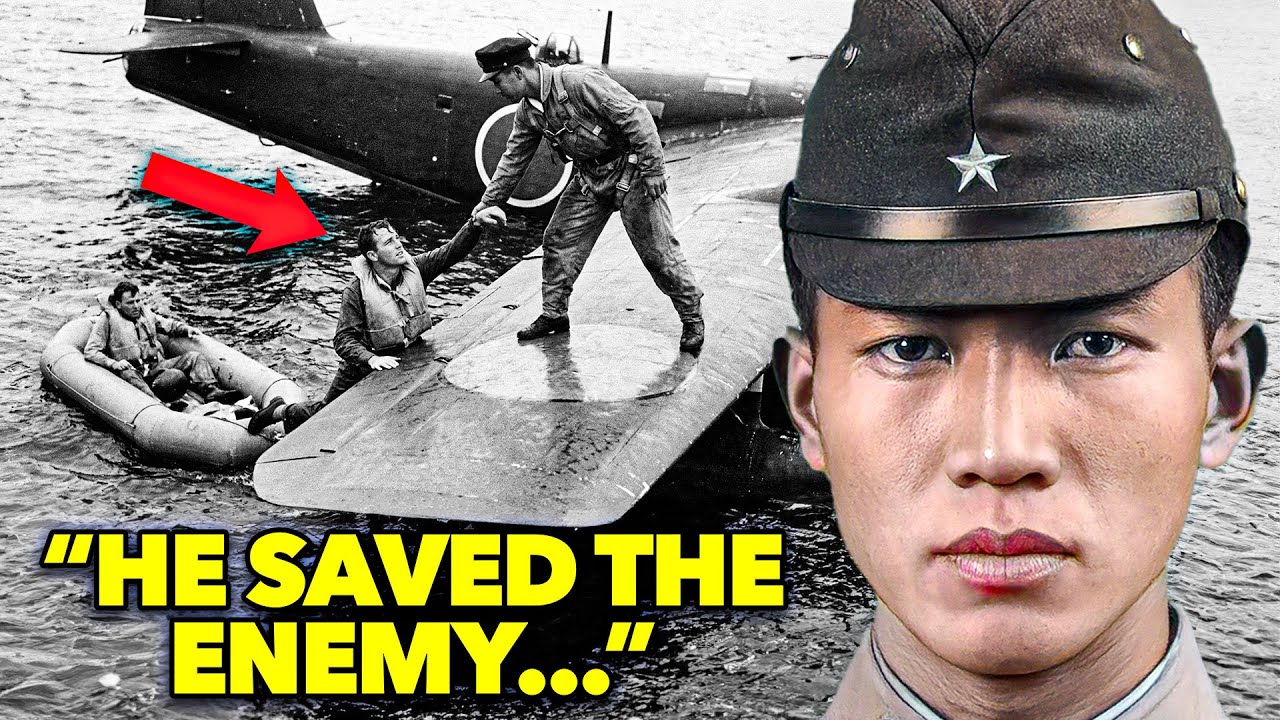
Half the tail had been shot away, and blood was freezing on the flight deck. The bomber had taken 27 major holes in its fuselage, five crew members were wounded, and one was dead. Brown had been flying combat missions for eight weeks. This was his first mission over Germany, and it threatened to be his last if the bomber could not make it across the North Sea.
Three hundred yards behind and slightly below, Oberleutnant Franz Stigler flew his Messerschmitt Bf 109 G-6 fighter. He was 28 years old, with 22 confirmed kills, and he was five missions away from receiving the Knight’s Cross. Stigler had a clear firing position. The B-17’s tail guns were destroyed, and the waist gunners were dead or wounded.
The bomber was defenseless. Stigler could see the American crew through the shattered fuselage. One shot would finish it. He did not fire.
The mission had started badly and gotten worse. The target was a Focke-Wulf aircraft factory in Bremen producing FW 190 fighters. The Eighth Air Force had sent 457 B-17 bombers, escorted by 355 P-47 Thunderbolt fighters, as part of Operation Point Blank, the strategic bombing campaign designed to destroy Germany’s aircraft production capacity. Second Lieutenant Charlie Brown commanded Ye Old Pub, a B-17F assigned to the 379th Bombardment Group stationed at Kimbolton, England.
Brown was 21 years old, a West Virginia farm boy who had joined the Army Air Forces in 1941. His crew had flown seven previous missions over France and Belgium with relatively light opposition and no casualties. Bremen was different. Heavy flak concentrations protected the city, and multiple Luftwaffe fighter bases surrounded the target area.
Intelligence estimated that 200 German fighters would oppose the raid. That estimate proved conservative. Ye Old Pub lifted off from Kimbolton at 6:15. The bomber carried ten crew members.
The formation assembled over England at 12,000 feet, with the B-17s organized into combat boxes of 18 to 21 aircraft flying in tight formation to create overlapping fields of defensive fire. At 7:30, the formation crossed the English coast heading east. The P-47 Thunderbolt fighters could accompany the bombers about 340 miles from England, not far enough to reach Bremen, not far enough to protect the bombers over the target, and not far enough to escort them home. The gap between where the fighters turned back and where the bombers reached the target was roughly 200 miles.
The Luftwaffe called it the death zone. At 8:15, the P-47s reached their fuel limit and turned back. At 8:22, German fighters appeared, Messerschmitt Bf 109s and Focke-Wulf FW 190s diving from 25,000 feet in waves of four to six aircraft. They attacked head-on, firing 20 mm cannons and 13 mm machine guns at closing speeds exceeding 500 mph.
B-17 gunners fired back, tracers filled the sky, and fighters and bombers fell. The formation tightened to maximize defensive fire, but some aircraft collided. At 8:35, Ye Old Pub took its first hit. A Focke-Wulf 190 attacked from high and hit the number two engine, which caught fire.
Brown feathered the propeller and activated the fire suppression system, extinguishing the blaze, but the engine was dead. At 8:38, a second fighter attacked from behind. Machine gun rounds walked up the fuselage from tail to waist. Tail gunner Bertron Coulombe took a round through his left shoulder but kept firing.
Waist gunner Richard Pethal took shrapnel in his leg and kept firing. The tail section was shredded, the vertical stabilizer half gone, and the rudder damaged but functional. At 8:40, the formation reached the initial point and turned toward the target. Flak batteries opened fire, and the bombers flew through the barrage.
At 8:42, Ye Old Pub released its 12 500-pound bombs, and the bombardier reported a good drop. The bomber turned left to exit the target area. A Messerschmitt Bf 109 dove on Ye Old Pub from directly ahead. The fighter opened fire at 800 yards, and the rounds converged on the bomber’s nose.
The bombardier’s compartment exploded. Lieutenant Al Sadok took multiple hits and died instantly. The rounds continued through the flight deck, wounding co-pilot Spencer Luke in the shoulder, and one round grazed Brown’s scalp. Blood poured into his eyes, and he could not see.
The oxygen system was destroyed. At 20,000 feet without oxygen, the crew would lose consciousness in minutes. Brown pushed the control yoke forward, and the bomber dove. Losing altitude meant losing formation, and losing formation meant isolation.
There was no choice. Ye Old Pub fell away from the formation and descended through 18,000, then 16,000, then 14,000 feet. The number four engine was losing oil pressure, and the temperature gauge climbed into the red. Two engines were dead, two were damaged.
At 12,000 feet, the bomber leveled off. Brown checked the crew. Five wounded, one dead. The intercom was damaged, and half the crew could not communicate.
The temperature inside the fuselage was minus 30 degrees Fahrenheit, and blood froze on the flight deck. Brown calculated the mathematics: 250 miles to England, 160 mph on two engines, 94 minutes of flight. They had approximately 400 gallons of fuel. The bomber might make it.
It probably would not. But the crew had to try. Meanwhile, 8,000 feet above and 12 miles south, Franz Stigler was hunting stragglers. Stigler had joined the Luftwaffe in 1935 after flying passenger routes for Lufthansa as a commercial pilot.
He had flown in France, North Africa, and Italy, accumulating 22 confirmed kills. On December 20, 1943, he was assigned to Jagdgeschwader 27, stationed at Oldenburg, with the unit’s primary mission being the defense of the Reich. He had already flown two sorties that morning, engaging P-47s over the Dutch coast and attacking bomber formations approaching Bremen. At 8:30, he took off for his third sorty of the day.
His Bf 109 carried enough ammunition for approximately 20 seconds of sustained fire, and German fighter doctrine emphasized short, accurate bursts. At 8:48, Stigler spotted Ye Old Pub, a single B-17 alone, 8,000 feet below, heading northwest, trailing smoke from one engine. He rolled inverted and dove, approaching from the bomber’s blind spot. He closed to 300 yards, then 200.
He saw the shredded tail section, the slumped waist gunners, and through the shattered nose, the wounded co-pilot and the pilot’s blood-covered face. The bomber was already dead. It just did not know it yet. Stigler could finish it with one burst and claim his 23rd kill, one more kill for the Knight’s Cross.
But he thought about his first flying instructor, who had told him in 1940, “You are fighter pilots first, last, always. If I ever hear of any of you shooting at a man in a parachute, I will shoot you myself. ” The B-17 in front of him was not a bomber anymore. It was a flying wreck full of wounded and dying men.
Shooting it down would not be combat. It would be murder. Stigler made his decision. He would not shoot, but he could not let the bomber fly alone.
Other German fighters would find it, and flak batteries would fire at it. He moved his fighter into formation on the B-17’s right wing, fifty feet away. Brown saw the German fighter and expected to die. The fighter did not fire.
Stigler gestured toward the north, toward neutral Sweden, where the crew could be interned and survive. Brown shook his head and pointed west, toward England. Stigler nodded. He would escort the bomber as far as the coast.
For the next twenty minutes, Stigler flew formation on Ye Old Pub. When other German fighters approached, he waved them off. When flak batteries began tracking the bomber, he waggled his wings, the universal signal for a friendly aircraft. The flak batteries held fire.
Brown ordered his tail gunner over the intercom: “Don’t shoot. The German pilot is helping us. ” At 9:08, Ye Old Pub crossed the German coast near Wilhelmshaven, with open water ahead and 120 miles to England. Stigler could go no further.
His fuel was low, and remaining overwater would mean ditching in the sea. He pulled alongside the bomber one last time, saluted Brown, and peeled away toward Germany. Alone again, Brown nursed the bomber across the North Sea. The number four engine seized at 9:45.
Three engines were dead, one was running. The bomber descended slowly, and the crew threw out everything they could to reduce weight. At 10:15, Ye Old Pub crossed the English coast at 1,500 feet on one engine. Brown spotted an RAF airfield at Seething, Norfolk, and called the tower for an emergency landing.
With no hydraulics, there were no flaps and no brakes. The bomber touched down at 120 mph and rolled 4,000 feet before stopping. Medics pulled the wounded crew out. Five of them survived.
Lieutenant Sadok’s body was removed from the bombardier’s compartment. The bomber was written off as damaged beyond repair and scrapped. Brown filed his mission report that afternoon. He described the damage and the casualties, then described the German fighter pilot who had escorted them to the coast.
The intelligence officer wrote it down, filed the report, and marked it classified. Nobody talked about it. German pilots did not help American bombers. The story made no sense, so it was filed and forgotten.
Brown flew 28 more combat missions, completed his tour in April 1944, and returned to the United States. He married, had children, and became an engineer. He never talked about the German pilot. Nobody would believe him.
Stigler returned to Oldenburg and never reported the incident or claimed the kill. He told his commander he had engaged bombers but scored no hits. He had saved ten American lives, and the secret stayed with him for 46 years. The war continued, and Stigler flew combat missions until March 1945.
He survived, immigrated to Canada after the war, settled in Vancouver, and built a life far from combat. In 1986, Charlie Brown was reading a book about air combat when he wondered if the pilot who saved his crew had survived. He wrote a letter describing the incident and sent it to a German fighter pilot association newsletter. The letter was published in January 1987.
Nothing came back for months. Then, in October 1987, Brown received a letter from Canada. It was from Franz Stigler. He had read Brown’s letter, and after 46 years of silence, he could finally tell the truth.
The two men began corresponding, then talking by phone, then meeting in person. In 1989, Brown flew to Vancouver, and the two former enemies embraced in Stigler’s living room. For the next 19 years, they remained close friends. They attended air shows together, spoke at military events, and told their story to audiences who found it hard to believe.
Stigler explained that he had done what honor required. Brown said he owed his life, his family, and his career to Stigler’s decision. The crew of Ye Old Pub confirmed the account. The story entered military history through the 2008 book A Higher Call, which became a bestseller.
Franz Stigler died on March 22, 2008, at age 92. Charlie Brown died on November 24, 2008, eight months later, at age 87. They are buried 3,000 miles apart, but they remained connected by the bond formed on December 20, 1943, when one man chose to save instead of kill. Stigler never received his Knight’s Cross.
Brown lived 65 more years. Ten men survived because one enemy refused to kill them.
