There are places a man can walk into on a bright morning with good boots and a full canteen and the sun warm on the back of his neck, and never walk back out of. Not because the ground is steep, not because the cold comes early, but because the place does not want to let him go, and it has learned over a long time exactly how to keep him. The story came to light in the winter of 1954, from a man who was dying when he told it. His name was Orin Ashmore, and he lay in a narrow bed in a town that was never named, with a country doctor named Dorance Holloway sitting up with him through the long nights because there was no one else to do it.
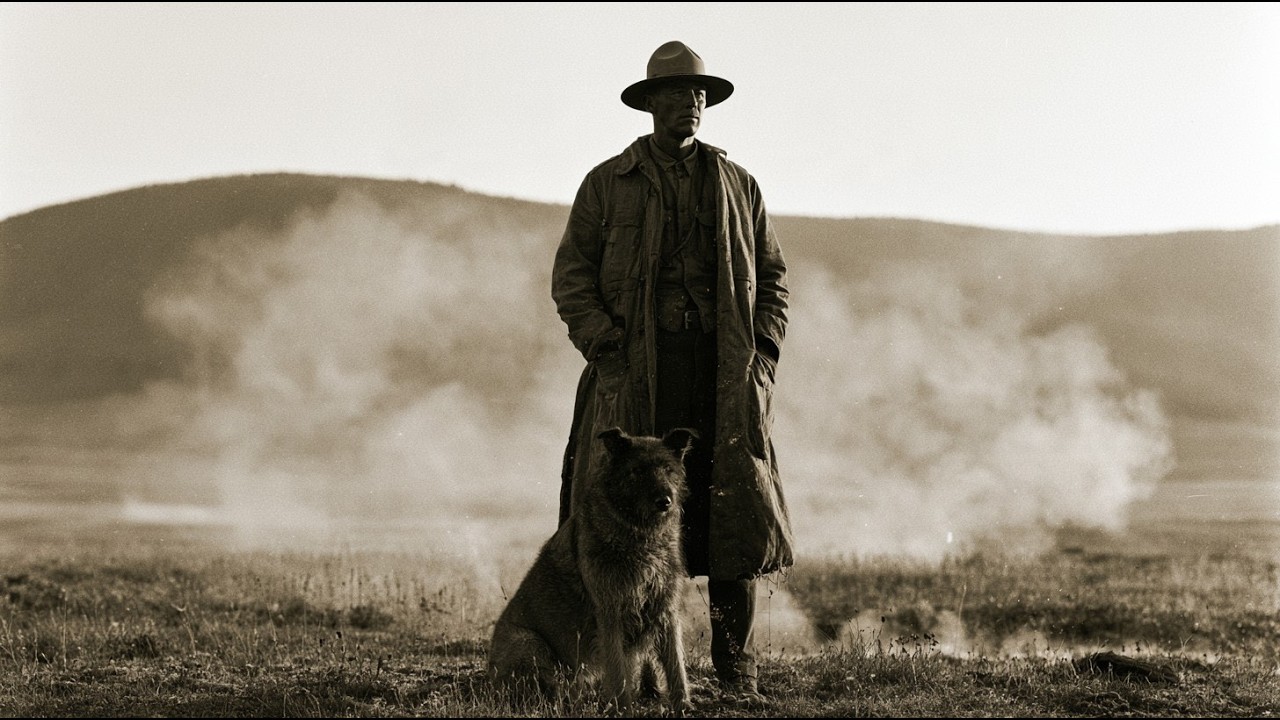
Ashmore was past seventy. His chest had gone bad, the way it does with men who spent their lives breathing cold air, and he knew the shape of what was coming. What he seemed, Holloway said later, was in a hurry—like a man who has carried a thing a long way and wants to set it down before his arms give out. On one of those nights, with the wind working at the window and the lamp turned low, Ashmore told the doctor about the autumn of 1927 and about the basin and about the thing that lived in it.
Ashmore was not a man given to stories. He had been a park ranger for most of his working life in the high country of Yellowstone, and a ranger learns early to say only what he can stand behind. He came to the park service late in his middle thirties, after a bad run of years doing other things he did not care to name even at the end. By the autumn of 1927 he was forty-three, lean through the middle but heavy in the shoulders from years of splitting wood and hauling packs over passes a horse would not take.
He was tall, taller than most, and stooped a little. His face had gone to leather from the wind. There was a white scar through one eyebrow where a mule had kicked him in his first season, and he had a habit of rubbing it slowly with one thumb when he was turning a thing over in his mind. His hands were what people remembered about him—big, flat, split at the knuckles, hard as the handles of the tools he used, and never quite clean no matter how long he scrubbed.
He had no wife by then, and did not say why, and the men he worked with had the sense not to ask. By 1927 he had nine seasons behind him, and he thought there was nothing left in those mountains that could surprise him. That was his mistake, and he would tell you so himself if he were here, which he is not. Yellowstone is not a park the way people picture a park—a tidy green square with a gate and a sign.
It is a wilderness with a boundary drawn around it, mile after mile of it, more miles than any one man could walk in a lifetime of trying. There are valleys back in there that see a human face perhaps once in ten years. There is hot ground and cold ground sitting side by side, steam coming up out of bare earth where there is no fire under it that anyone can find, water that runs warm in the dead of winter, and then a hundred steps on, a creek frozen hard as an iron bar. Ranger work in those days meant patrol, and patrol meant long rides alone into country where if you broke a leg, you would most likely die of it before anyone back at the station thought to come looking.
The men who did that work were a particular kind. They liked their own company better than most. They did not spook easy, and they took a quiet pride in not spooking. And every one of them, Ashmore said, knew that there were a few corners of that park the old hands did not ride into, did not talk about over the stove at night, and did not put on the duty rosters if there was any decent way around it.
One of those corners was a basin back in the southeast reaches, down a long drainage that the maps of the day left mostly blank—just a few hopeful pencil lines and then white paper where the country should have been. The old packers, the ones who had been running mule strings through that high country since before it was ever a park, had a name for it, though they did not say it loud, and they did not say it twice. They called it the Dre Basin. A dre is a kind of heavy low cart, built for hauling loads too big and too dead to carry any other way.
Nobody Ashmore ever asked could tell him why that name had fastened onto the place, only that it had, and that it was old, older than the park, older than the men saying it. There was a patrol cabin at the lip of that basin, at a bench of ground called Larch Flat—a one-room thing of squared logs with a tin stove, a plank bunk, and a single small window. It was supposed to be worked on a rotation the same as all the others, only it never quite was. The rotation had a way of stepping around it, the way your foot steps around a hole in the dark without your mind ever quite deciding to.
A man would be assigned to the Dre, and then the weather would turn hard early, or a bridge two drainages over would wash out and need him, or the chief ranger would find some reason the man was wanted somewhere else that week. And the Dre would sit empty another whole season, with the dust settling in it. Ashmore had noticed this over the years, the way you notice a crooked picture on a wall you pass every day. It bothered him for a moment, and then he stopped seeing it.
That is how a thing like that survives—by being just a little too dull to hold your eye. Then came the autumn of 1927, and the Dre came up on the roster with his own name penciled beside it, and this time nothing washed out and nothing turned. The chief ranger, a close-mouthed older man named Alton Price, looked at him across the plank desk in the station office with an expression Ashmore could not read, and said only that it was his turn, fair and square, and that he had best get on up there before the passes closed on him for the year. Ashmore asked him, plain, man to man, why the Dre always seemed to get skipped.
Price was quiet a long while, long enough that Ashmore thought he was not going to answer at all. Then Price said that the last fellow they had sent in there had not worked out. Ashmore asked him what that was supposed to mean, had not worked out. Price said the man had walked out of that cabin one morning and not been seen again by anybody, living or otherwise, and that the file on it had been closed, and that this was all he cared to say on the matter, and would Ashmore kindly pull the door to behind him on his way out.
The last man’s name was Ferris Coldwell. Ashmore had known him a little, the way rangers come to know each other—passing on a trail with a nod, a night or two sharing a cabin while a storm howled itself out against the logs. Coldwell had been a steady hand, maybe fifty years old, a widower, a man who kept a neat log and a clean rifle and a tidy camp, and never once gave anybody above him or below him a minute of trouble—the kind of man who does not simply walk off the side of a mountain and leave nothing behind. So Ashmore dug out the file before he left, because that was the kind of man he was, the kind who reads the thing all the way through.
The file was thin as a single sheet of ice. Ferris Coldwell reported overdue. A search made, such as it was. No sign recovered.
Presumed lost to weather and terrain. Signed off, stamped, filed. Lost to weather. In September, Ashmore thought, turning it over with the passes still wide open, and the man by every account in good health and good spirits.
He closed the folder and did not care for the feeling it left sitting in his chest. But he had a job of work in front of him, and the passes really were closing, and so he made his plans to ride. Before he rode up, Ashmore went out to borrow a second pack frame and a few lengths of good rope from an old packer who lived alone at the far edge of the valley—a man named Josiah Rasque. Rasque was somewhere past seventy; nobody knew just how far past.
He was small and bent nearly double with the years, with hands gone to knots and roots and one eye clouded over the color of pond ice. He had packed mules into every corner of that country for fifty years and more, back when it was still half wild and the soldiers ran it, and there was not a drainage or a pass or a bad ford he did not carry in his head. When Ashmore told him, by way of small talk while they sorted the gear, that he was bound up into the Dre on the rotation, the old man went still—just stopped with a coil of rope half looped over his arm and turned his good eye on Ashmore and held it there. Then Rasque set the rope down, careful, the way you set down something you do not want to drop, and asked Ashmore to sit a minute.
There was coffee. And over that coffee, the old packer told him a few things. He told him he had been into the Dre exactly twice in his long life, both times in daylight, both times in a hurry, and that he would not go a third time for any money a man could name. He said the basin had a trick to it that the young fellows laughed at until they did not.
He said it waited for the dark, and for a man to be alone, and for that man to be tired—which in that country every man always was. Then Josiah Rasque leaned across the little table with his clouded eye catching the lamplight, and he said the thing that Ashmore would carry to the end of his life. “If it calls, you do not answer. ”
Ashmore asked him what calls, what are you telling me?
And the old man only shook his head and said it again slower, as if slowness could push it through a young fool’s skull. “If it calls, you do not answer. It does not matter whose voice it wears. It does not matter what it says it needs.
You keep your mouth shut, and you wait for the sun, and you do not, for the love of your own soul, you do not answer it back. ”
Ashmore thanked him for the coffee and the rope and rode off, thinking the old man had gone a little soft in the head with age, the way they do. He was most of the way home before he admitted to himself that Josiah Rasque had not seemed soft in the head at all. He had seemed like a man telling the plain truth to someone he did not expect to see again.
There was one more thing Rasque said at the door, as Ashmore was loading the rope onto his saddle, and the old man said it low, almost to himself, looking off at the mountains going blue in the evening. He said the Dre had been taking men since before there was a word for what it was, and that the only ones who ever came back down were the ones who learned fast that the thing up there did not want to chase you, and did not need to. It only wanted you to come to it on your own two feet, of your own tired will, and say yes. That was all it had ever wanted.
That was all it was still waiting on. Ashmore took a dog with him up the trail, and the dog matters as much as any man in this. It was a rangy, rough-coated animal, part shepherd and part whatever, that had wandered through the station the year she was whelped, and her name was Juno. Ashmore had raised her from a fat, clumsy pup, and she had been at his heel four seasons.
She was, he always said, the best judge of country he ever owned—better than any map, better than his own two eyes. A dog like that will tell you things the land is too slow to say out loud. She will read a bend in the trail before you reach it, and the hair will stand up in a ridge along her back, and you learn, if you have any sense at all, to trust that ridge of hair before you trust anything else you are carrying. Juno rode along fine the whole first part of the way up the drainage, trotting out ahead and circling back, nose down, happy in her work.
It was a long two days in, the trees crowding closer over the trail the higher they climbed, the light going green and thick and strange the way it does deep in old timber that has never once heard an axe. And somewhere on the second afternoon, as they came down the last long grade toward Larch Flat and the whole basin opened out below them in the slanting light, Juno stopped. Just stopped dead in the middle of the trail, so sudden that the mule behind nearly walked up over the top of her. She stood there with all four legs braced, her head dropped low, and a sound coming up out of her chest that Ashmore had never once heard her make in four years.
Not a bark, not quite a growl. A kind of low, steady complaint pushed out between her teeth, aimed down the hill at the basin, at nothing he could see anywhere in it. He swung down off the mule and came up beside her and looked where she was looking. The Dre lay below them in the last of the day—a long green bowl of a valley with a creek threading down the middle of it, dark timber climbing both sides, and here and there across the floor of it pale smoke rising straight up where the hot ground vented through the grass.
Pretty in its way. Still. Very, very still. And Ashmore stood there a long moment with his hand on the dog’s trembling back, trying to put his finger on what exactly was wrong with the picture, because something was.
And then all at once he had it. There were no birds. You never notice bird song until the day it is gone, and then the lack of it is the loudest thing in the world. A healthy piece of mountain country is never truly silent—there is always a jay scolding off in the pines, a woodpecker hammering, the small constant busy racket of a living world getting on with its day.
The Dre had not one note of it. The creek made its small water noise, and the wind made its dry noise in the grass, and underneath those two thin sounds there was a silence so deep and so complete that it was almost a pressure, a weight, leaning in against the ears. Ashmore stood and listened to that silence until it brought the hair up on the back of his own neck the way it had brought it up on the dog’s. Then he told himself firmly that he was a grown man and a tired one, and that the light was going fast, and that a camp made in the dark is a cold camp.
He coaxed Juno down the last of the grade to the cabin. She came, but she came low to the ground the whole way, belly nearly in the dirt, and she would not take her eyes off the black line of the timber. Not once, not for a step. The cabin at Larch Flat was sound enough, as cabins go.
Somebody had split and stacked a good deal of firewood the season before, and then never burned a stick of it. That was the first small wrong thing, if you knew to count it—a full wood box in a cabin that nobody had wintered. And then there were Coldwell’s things, which was the second wrong thing, and far the worse of the two. Once Ashmore let himself stand still in the middle of that little room and look at it all square, he saw everything.
Coldwell’s heavy canvas coat was still hung on its nail by the door. His spare boots were set down neat and square beneath it, toes to the wall, the way a careful man leaves them of a night so he can step straight into them come morning. His razor and his strop lay on the shelf above the bunk. There was a tin cup standing on the plank table with a hand’s width of coffee gone to black dust in the bottom of it.
And his rifle—his good, clean government rifle—hung oiled and ready on its two pegs over the door, right where a man leaves the thing he would never in his life walk off a mountain without. Ashmore stood and looked at all of it a long time in the last of the daylight, and the simple arithmetic of it settled into him slow and cold. A man does not walk away from a cabin in open September weather and leave behind his coat and his boots and his razor and his loaded rifle. Not a man like Ferris Coldwell.
Unless, Ashmore thought, and then made himself think it the whole way through, unless he did not walk. Unless he was called out into the dark and the cold in his stocking feet—called so sudden and so deep that he did not stop for the coat on the nail or the boots by the door or the rifle over his head, because whatever was calling could not be made to wait one more breath, and he could not find it in himself at the last to make it. Ashmore gathered the dead man’s things together and set them in the far corner and put his back to them. He could not, through the whole of that first night, or any night after, stop seeing those boots standing empty and square against the wall, waiting on feet that were never coming back to them.
He lit the little tin stove, fed the dog, ate a cold supper without tasting much of it, and lay down on the plank bunk with his rifle leaned where his hand would fall on it—only good sense, up in that country, with the mule picketed outside and the bears not yet denned for the year. Juno would not settle. She lay down by the door with her long nose pressed to the cold gap underneath it, and every little while that low complaint would start up again somewhere deep in her chest. He would speak to her low, and she would quiet, and then it would start again.
Along toward the dead middle of the night, Ashmore came awake all at once—the way you do when some sound has reached down and pulled you up out of sleep but has stopped itself the half second before your waking mind could lay hold of what it was. He lay dead still. The stove had burned down to a low, dull red mouth. The dog was on her feet, not by the door now but standing out in the middle of the little room, stiff as a post, every hair up, facing the back wall—the blind wall, where there was no window and no door, nothing but squared logs, and behind them the black wet timber going up the slope.
And then he heard it, and he would carry the hearing of it with him into every night he had left on this earth. Somebody out there said his name. Out in the dark, past the back wall, a fair way off, but carrying clean and clear across all that unnatural quiet, a voice said, “Orin. ” Just that—his given name, which almost nobody living used anymore.
And it was said the way you would say it to wake a man you loved, gently, low, and even, and almost kind, with a little rising at the end—Orin—as if there were a question folded up inside it. He lay there in the dark with his heart slamming, and told himself it was only a scrap of dream that had ridden up out of sleep with him, the way they will. And then it came again. Orin, a little nearer this time.
And Juno—that steady dog, that best judge of country he ever owned—backed herself away from the sound step by stiff step until her haunches came up hard against the frame of the bunk, and she began very faintly to shake. Ashmore did not answer. That is the whole of the thing. It is the only lesson the dead up there ever managed to pass down.
He did not answer it. He lay still as the logs themselves, kept one hand flat on the cold rifle, and let that voice say his name into the dark three times, four times, each time from a little closer in, each time a little warmer and more patient. And each and every time he set his jaw like a trap and made not one sound back, until at last, toward the first gray smear of morning, it stopped. The birds did not start up, because there were no birds.
And the light came gray and flat and ordinary through the one small window, and he got up stiff and cold and sick to his stomach, and went out to see what had made the mule stand so quiet all night long. The mule was fine, standing hip-shot by the picket, dozing, one ear flicking. But the ground behind the cabin—out past that blind back wall, in the soft black earth where the hot vents kept the frost from ever taking hold—the ground was marked. Not with tracks exactly.
Ashmore had read track his whole life, man and horse and bear and cat, and these were none of them. They were long, shallow drag marks, two of them running side by side, as if something heavy and dead-weighted had been hauled across that soft ground, back and forth, back and forth, through the whole of the night, no more than a few feet out from the wall he had been lying against. A dre, he thought before he could stop the thought from coming. Those are the marks a heavy cart would leave dragged with nothing under it to roll.
And he stood there in the thin cold morning with that one word turning over in his head, and he understood, in a way he could never afterward explain to Price or to Holloway or to anyone, that the old name of the place was no accident at all, and that the men who first hung it on that basin had known something and had had their reasons for not saying it loud and not saying it twice. He did then the thing a sensible man does when the ground has gone out from under his understanding. He worked. He told himself there was an explanation for all of it, and that an explanation would turn up directly if he only kept his head and kept his feet moving and did his rounds like the job he was paid for.
He spent that whole first full day walking the basin in the honest daylight, the dog glued to his heel, the rifle on his shoulder, learning the shape of the ground. The ground was its own kind of wrong in the daylight just as much as in the dark, only quieter about it. The creek ran warm in some stretches and cold as snowmelt in others, side by side, with no change in the rock or the shade that could account for it. There was a smell that came and went on no wind at all—not quite the rotten egg reek of the hot springs that any ranger knew in his sleep, but something older lying underneath that smell, something that put him in mind, he told the doctor, of a root cellar locked up tight since a death in the house.
And twice, walking the edge of the timber where it met the meadow grass, he came upon the stones. Somebody had set them, and set them with care—fist-sized rocks, gray and lichened, laid out end to end in long straight lines that ran back in among the tree trunks. And here and there, where two of the lines came together, somebody had raised a little cairn, deliberate, patient, the lower stones gone green and furred with the moss of several years. Ferris Coldwell, Ashmore remembered, had been a tidy man.
He stood over those long lines of stone in the green timber light and thought about a tidy man alone in the silent basin through one long autumn, going out day after day to lay rock against rock in among the trees. There was no picture his mind could build around that work that he had any wish to keep. Twice more that day, out of the far corner of his eye, he caught a kind of movement at the treeline—a shifting, a lean of shadow, where the shadows had no business leaning. Both times, when he turned his head square to it, there was nothing there but trunks and the green dark between them, standing still as a held breath.
By the second morning he had walked the whole floor of the basin and most of the lower timber, and he had found no man and no grave and no track of boot or body—only the stones, the warm and cold water, that smell, the silence, and the drag marks fresh behind the cabin each dawn, a little closer in each time, as patient and regular as a chore. That second evening, poking the stove to life, he found Coldwell’s log. It had been left in the cabin after all, pushed down flat behind the woodbox against the logs, into the one gap where the search party, if there had truly ever been much of a search party, would not have thought to put a hand. It was a government field ledger, the very same kind Ashmore kept himself, bound in gray board.
The early pages were exactly what such a thing ought to be—weather, game counts, a note that a bridge plank down the trail wanted replacing before spring. Coldwell’s hand was square and level and patient. A tidy man’s hand. Then, maybe three weeks into his season, the entries began to change.
Not all at once. At first it was only a single line dropped in at the bottom of an ordinary day, almost an afterthought, the pencil pressed a shade harder. “Heard my own name in the night,” Coldwell had written. “Put it to the wind in the stovepipe.
” Then a few clean, ordinary days on from that: “Heard it again. It is not the wind. ”
And after that the entries stopped being about weather and game at all. They became page by page a record of the voice.
How it came in a little nearer every single night. How it learned. That was Coldwell’s own word for it, set down twice, underlined the second time. Learned.
It began with his name, the ledger said, in the voice of a stranger he did not know. Then night by night it found other voices to try on him. By the end of the third week it had found the voice of his late wife—a woman eleven years then in the ground—and it was calling to him across the dark in her exact voice, saying the small, worn, ordinary things she used to say to him of an evening. Asking him why he would not come out to her.
Asking him had he stopped loving her. Was that it, after all this time? And Ferris Coldwell had written, in that square patient hand gone ragged and slanting now across the page, that the hardest thing he had done in the whole course of his life was to lie still on that plank bunk night after night and not answer her. That he did not rightly know how many more nights he had it in him to keep from answering, because the thing out there in the dark had her voice so exactly—every catch and fall of it—and he was so tired, bone tired, soul tired, and all it ever asked so gently was for him to come out.
The last full entry in the ledger was four words long. “I counted the names. ” And below those four words, on the very next page, Coldwell had copied something out in a hand barely his own anymore—a list. Names with years set down beside each one, the years running back decade on decade.
Some of the names Ashmore knew or half knew: a pair of old packers, a government surveyor, a trapper who had gone missing out of that country back when Ashmore was no more than a green hand himself. Eleven of them. Eleven names. And every single one, Ashmore came to learn much later when he went digging through the old files, every one of the eleven was a person who had gone up into the southeast reaches of that park and never come down out of them again, everyone signed off in the record with that same tidy little lie—lost to weather, lost to terrain.
Eleven souls that the mountain had taken and kept, and a twelfth one now to set beside them, because Ferris Coldwell was not lost to any weather that ever blew. Ashmore knew it for a certainty, sitting there holding that gray ledger in the yellow lamplight, with the dark leaning its whole weight on the one small window and the dog gone rigid and silent by the door. That was the second night, and the voice came again, as he had known in his gut it would. And this time it did not say Orin.
This time, out past the blind back wall, in the thick, dead quiet, a voice that Ashmore knew began to talk to him. It was Coldwell. It was Ferris Coldwell’s own voice, mild and dry and tired, the exact voice of the man he had waited out a three-day blow with in a cabin two winters gone. And it said, “Ashmore.
That you in there? They sent you up after all, did they? Come on and open the door. It is all right now.
It is only me. I have been up here a long while waiting on a little company. ”
And Ashmore, who had held his nerve through the whole of that first long night, felt the nerve go thin and clear as paper in his hands. The thing out there had old Coldwell down to the bone—the exact dry, unhurried way the man had of putting his words together.
And every part of Ashmore that was tired and cold and alone and afraid wanted, with a terrible wanting, to believe that it truly was old Ferris out there in the dark, lost all this time and found again at last, and that all it would take to end this was to get up and lift the latch. He got up. He would own to that at the end, to the doctor. He got up off the bunk and crossed that little black room and laid his hand on the cold iron of the door latch.
And the voice just outside said, soft and glad, “There you are. I can hear you. That is it. Come on now.
”
And Juno, who through all of it had not made one single sound, came up off the floor and threw herself between Ashmore and that door, and set her teeth into the leg of his trousers, and hauled backward hard—a thing that dog had never done in four years of her life. The shock of it, the small bright pain of her teeth coming through the cloth to the skin, broke clean through whatever had got its hold on him. He let go the latch. He stepped back, and back again.
And on the far side of that door, not one foot of pine plank from his face, the voice of Ferris Coldwell stopped being mild. It did not shout. A shout he could have stood. It simply went flat and level and cold as the creek, and it said, in that same stolen dead man’s voice: “You will.
Not tonight, but you will. ”
And then there was nothing at all. And then toward morning, the drag marks again, right up tight against the base of the door this time, back and forth across the very sill, as if the heavy thing had been hauled over that threshold all the rest of the night, patient as a tide, waiting on the one morning it would open. He did not sleep again that night.
He sat up in the far corner, where the two log walls came together at his back, so nothing could come at him from behind, and he laid the rifle across his knees and kept the dog pressed warm and shaking against his hip. He watched the door, and he watched the blind back wall, and he listened to the thing out there go on working at him, softer now, almost idle, almost lazy, the way a man whittles at a stick. It was in no hurry to finish, because it knew he understood. It knew it had all the time there ever was.
It went back to his own name for a long stretch. Then it tried just the once, late, a voice he had not let himself so much as think of in more years than he could rightly count. He bit down hard on the inside of his own cheek until he tasted the salt of blood. And he did not answer that one either, though answering it was the thing his whole tired heart most wanted in the world.
Toward the first gray he heard it draw off at last, the long heavy drag of it fading back toward the black timber in no hurry. And he knew, with a plain cold certainty sitting there in the corner with the taste of blood in his mouth, that it had not given up and would not ever give up. Because giving up is a thing only the living know how to do, and whatever waited out there in the Dre had left the country of the living a long, long time ago, and had learned in all the patient years since that it never once had to. Ashmore was no kind of fool, and he knew by that second gray morning, past any arguing with himself, that he could not stay.
Rotation or no rotation, duty or no duty. A brave man and a living man are not always the same man, and the trick of a long life is knowing which one the day is asking you to be. But the passes—he kept circling back in his mind to the passes. It was a hard two days out the way he had come in, and the voice had told him, flat in Coldwell’s dead tone, “You will.
” He did not for a moment believe it meant to simply stand aside and let him ride off down the trail in the clean daylight. So he did not run, though every nerve he owned was screaming at him to run. He made himself wait for the full broad light of day, and he packed slow and careful, double-checking every strap, as if it were any ordinary morning. And before he left, he burned Ferris Coldwell’s ledger, every single page of it, feeding them one at a time into the little stove, because he had decided somewhere in the night that no other living man should ever sit in that cabin and read that list and start, God help him, to count.
He thought, too, if he was being honest with the doctor at the end, that the thing out there would not want its counting known, and that burning the count might be the one small blow he could land on it before he went. All the while the basin lay there in the morning stillness, patient, pale smoke rising straight up off its hot ground into the windless air, and it watched him work. He could feel it watching, the way a cat watches a thing it has already decided, with no hurry at all, that it can take down off the shelf whenever it finally cares to. He got the mule loaded.
He got Juno up onto the trail, and she went gladly, pulling toward the high ground and the way out. And then, because he was the kind of man he was, the kind who has to see the thing all the way to its bottom, he did one last thing before he left. He walked back along the treeline to the long lines of stone, the ones Coldwell had laid, and looked at them one more time in the flat daylight. Standing there, he understood them at last, all at once, the way you understand the shape in a puzzle picture the moment before you can ever unsee it.
They were not the idle work of a lonely man passing his hours. They were a wall. A boundary. Ferris Coldwell, in his careful, tidy, patient way, with the only materials and the only time the basin had left him, had been trying to wall the thing in, or else to wall himself out—laying one stone against the next in the single shape of defense he had left to make, night after night, line after line.
And the lines ran straight up toward the cabin, and stopped. And Ashmore saw that the last cairn—the newest one, the one raised at the very end of the nearest line, the one with no moss on it at all yet—had been knocked flat, scattered wide across the needles, as though something had walked out through the wall Coldwell built, from the inside, on the last night that Coldwell was alive and able to build it any higher. He did not stay there to think about that. He got himself up onto the trail and went, and he held himself to a steady walk, though it cost him everything he had.
Some old animal part of him, down below the thinking part, knew that to break and run was to say out loud, “I am prey,” and that saying it out loud might be the very thing that slipped the leash. The first day out was the hardest walking of his whole hard life. The basin did not want to let him go, and it came along after him. Not footsteps, though there were those, too—something keeping easy pace with him in the timber just off the trail, always a little behind, and a little to the side, out of sight, a heaviness pushing through brush that by rights should have cracked and snapped and did not make a sound.
And the voices all that first day out of the trees. It worked at him. It used Coldwell. It used Price, the chief ranger, calling to him to turn back, that he was wanted at the cabin, that there had been some mistake in the orders, and he was to come back now.
Toward the afternoon, as he climbed the long grade up towards the first high pass, with the basin at last beginning to fall away below and behind him, the thing reached down and found the cruelest voice in the whole of its stolen store. And it used that one. Ashmore would not tell the doctor, even dying, even then, whose voice that was. He would only say it was a voice up out of the bad years, the years before the park service that he did not name, a voice he had dug a grave for in himself a long time ago and buried deep.
To hear it come lilting and loving out of that cold green timber, saying the one single thing in all the world that still had the power to reach him and turn him, was as near as he ever came before or after to simply stopping and turning and walking off the trail into the trees. He put his head down. He rubbed his hand hard into the rough of the dog’s neck, kept her close against his leg, and he climbed. And here is the thing—the one thread of plain mercy in the whole dark account, the one thing that let Orin Ashmore live to be an old man in a narrow bed and tell it at all.
At the very top of that pass, at the height of land, the saddle of rock where the water falling on the one side runs back down into the Dre and the water falling on the other side runs away and away toward the rest of the living, breathing world—the voices stopped. All of them, all at once, like a heavy door swung shut on a hinge. One stride he was in it—in the pressure, and the stolen voices, and the heaviness pacing him in the trees. And the next stride, the very next, he was out of it.
And there was bird song. Actual bird song. A jay somewhere off down the far slope, scolding its head off at nothing at all. The most ordinary and the most beautiful sound in the whole wide world.
Orin Ashmore stood there at the top of that pass, with the mule blowing beside him and the dog pressed shaking against his leg, and he shook too—shook like a man down with fever—because he understood at last the shape of the whole thing. The thing had a reach, and the reach had an edge to it, and the edge was the rim of the basin it was bound down into, and could not cross. Ferris Coldwell and the surveyor and the two old packers and the trapper and the eleven before. Every last one of them had died inside that edge—called back over it in the dark in some voice they had loved once, coaxed one tired step too far in the wrong direction on some night when they were too worn down to remember the old packer’s one rule.
He looked back one time from the top of the pass. He said he should not have—that a wiser man would have kept his face to the far slope and walked. But he looked. And the Dre lay there below him in the long gold afternoon light, green and still and pretty as a painting, smoking gently from its hot ground, and there was nothing to see in all of it.
Nothing at all. Only, at the very edge of the lower timber, right down where the trail came up out of the basin, right at the line he himself had crossed not an hour before, the tall grass was pressed down flat in two long parallel tracks side by side, running up to the edge and stopping dead there. The marks of a heavy thing dragged all the way to the boundary of its own country and halted at the last inch of it—held back at the rim it could not pass, unable or unwilling to come that final step out into the world where the birds still sang. He turned his back on it then for good, and walked down the long far slope into the living country.
He did not look again, not once, not ever. Orin Ashmore never went back up into the Dre Basin. He told Price flat across the plank desk that he had found sign enough of Coldwell to know the man was dead, which was true enough as far as it went, and that the Dre ought to be struck off the rotation for good and all, and left blank on the paper the way it was blank on the map. Price, who Ashmore had come by then to believe had known the whole of it all along and had sent him up anyway, did not argue the point.
The cabin at Larch Flat was left to the weather and the years. The basin went back to being an empty place on the map that the old hands did not ride into and did not speak of over the stove, and the rotation went on quietly stepping around it the way it always had. Ashmore lived out the rest of his working years in easier, lower, louder country, country full of birds. He married late, a steady, kind woman who outlived him by a good many years.
He kept dogs the whole rest of his life, always, never once without one. He never again camped a night alone if there was any way under heaven around it. And he never told one word of this story to a single living soul—not his wife, not his oldest friend, not anybody—until that winter of 1954, when his chest had gone bad for the last time and the nights had got long, and he could feel the thing coming for him that comes in the end for every one of us. And he found lying there that he could not go out to meet it with that counted list still locked up and unspoken inside him.
Dr. Holloway wrote the last of it down close to the very end. He said Ashmore had gone very weak by then, and that he did not seem afraid. That was the strange thing.
He did not seem afraid at all. But he reached out and took the doctor’s hand in both of his—those big, flat, ruined hands gone soft and light now as paper—and he said a thing that Holloway set down that same night, word for word, and that Holloway never once, in all the years since, was able to shake loose from his own head. Ashmore said: “It is still up there. It did not go anywhere.
It does not go anywhere. It is patient, more patient than you can let yourself think about. And it has her voice, and it has mine now, too, most likely. And whoever it is they send up there next—you tell them the one thing.
You make them hear the one thing that matters. ”
Holloway leaned in close and asked him, “What thing, Orin? What do I tell them? ”
And Orin Ashmore looked at him and said: “If it calls, you do not answer.
”
Then he lay quiet a good while, and the winter wind worked and worried at the window glass. After a long time he said, soft, almost to himself: “I have wondered every single day of my life since, whether Ferris answered it at the last, or whether he only got too tired to keep from it. I do not know which of the two would be the worse.
”
And those were very near the last clear words that Orin Ashmore ever spoke in this world.
