At a small table in the rear room of the Piedmont Historical Society in Roanoke, during the autumn of 1938, Endicott Marshmount came upon something that had no business being there. He was forty-three, a tall man who without thinking hunched his shoulders whenever he stood up from his chair, thin with the particular thinness a man acquires when he skips meals because his thoughts are somewhere else. His hair was iron-gray, trimmed neatly around the ears, and he wore small round spectacles that he nudged up his nose whenever he told a lie, a habit he had no idea he had. His hands were long and pale and steady, and the skin along the sides of his thumbs had gone shiny from years of raising photographs one after another toward the light.
He earned his living at the Society cataloguing photographs. He had arrived there after the war, though he never discussed those years. By the time of this story, no one across three counties knew more about Virginia’s photographic cards than he did. He could name a studio from the curve of the painted ferns on its backdrop.
He could fix a year within the decade by how high a woman wore her collar. When estate donations came in, crate after crate of glass negatives and albumen prints bound with brown twine, Endicott was the man who sat with them, one at a time, restoring the dead to their names. He felt no sentiment about the task. If anyone asked, he said he did it because otherwise nobody would, and because it struck him as a plain and sensible obligation to people who had once stood motionless before a camera, hoping someone would remember them.
On the ninth of October, 1938, a plain wooden box arrived from a law office in Christiansburg. The lawyer’s letter stated only that the box had turned up among the belongings of one Ambrose Kettering, who had died that summer, a bachelor of ninety-two who had lived alone in a boarding house since roughly 1910. Ambrose Kettering left behind no will and no surviving family. The state took the money.
The papers went to the Society. Endicott opened the box on the eleventh. Within, wrapped in wool and bedded in pine shavings, lay forty-two glass plate negatives and roughly two hundred photographic prints. Cabinet cards, tintypes, and a handful of the old salted paper prints that seldom survived damp.
There was no inventory and no labels, only the photographs and a small leather notebook that proved to be a rent receipt ledger from a hardware store, worthless to anyone now. He went through them slowly, as he always did. A box this size took two or three days, sometimes a week. He made a card for each photograph and fastened it gently to the frame with a needle so it could be taken off without leaving a mark.
He noted the names when they were written, the dates when the photograph disclosed them, and the locations from the studio stamp on the back, or from the clothing, or from the trees in the yard. Most of the Kettering photographs were ordinary and forgettable. Wedding portraits of strangers, a line of railway workers posed before a locomotive, a grocer holding up a fish, a row of women in hats seated on a long bench in front of a white church, a solemn couple before a country store, the wife clutching a bolt of cloth. Endicott had seen ten thousand photographs like these and would see ten thousand more, and he cherished them the way one cherishes a garden one did not plant oneself.
On the third day, in the afternoon, he came to that photograph. He had been working since shortly before eight. He had eaten nothing since breakfast but a small dried apple someone had left on the shelf above the little sink. He was in the loose, elastic state of attention that settles over a person who has stared at the same thing all day and has given up trying to truly see it, and it is in that state, in his line of work, that the strange thing usually surfaces.
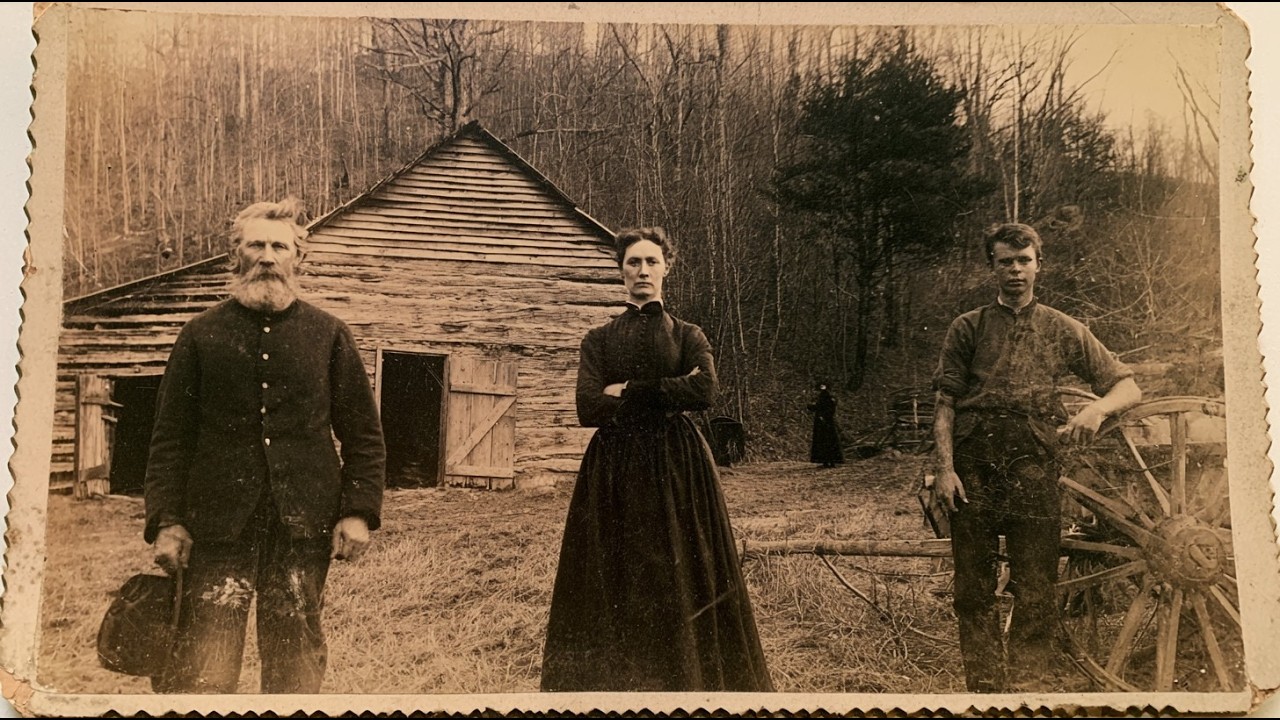
The photograph was a print on a stiff cabinet card, four and a quarter by six and a half inches, mounted on gray cardstock with wavy edges. On the back, in small brown copperplate script, someone had written: “Pruitt house, Wicker Hall Hollow, spring 1871.” Beneath that, in a different, shakier hand: “I don’t keep this photograph in a frame for a reason.”
Endicott flipped the card over.
The photograph showed three adults standing in the yard of a log cabin about twenty feet from the camera. Behind them and a little to the left stood a barn built the old way, from crossed planks. One door was open, one door was shut. Past the barn the ground climbed toward the tree line, where the hardwoods stood bare of branches with a few pines scattered among them.
It was afternoon light, to judge by the shadow of the porch post, and late March or early April, to judge by the look of the woods. The three people were arranged in the fashion of that era. A man on the left, holding his hat in his hand, his coat buttoned, his feet planted firmly apart. A woman in the middle, her hands folded over her waist, wearing a dark dress buttoned to the neck, her hair simply done.
A younger man on the right, bareheaded, sleeves rolled to the elbow, one hand resting on the rim of a wagon wheel. None of them was smiling. None of them was expected to. Photographs in 1871 resembled funerals, and people knew it.
Endicott studied the composition for about forty seconds. Then he wrote his card: “Three unidentified adults, log cabin, plank barn, hardwood hills, spring light, rural Virginia.” The mount and processing were consistent with an itinerant photographer, perhaps one of several who worked the mountain counties in the early seventies with a wagon and a portable darkroom. He set the card aside.
He should have moved on to the next photograph. On any other afternoon, he would have. But something in the photograph held him and would not let go, the way a thread caught on a nail stops you from moving forward. After a moment he sat down again and reached for the magnifying glass.
The magnifying glass was a heavy brass piece that had belonged to a botanist. He laid the photograph flat on the desk and moved the glass slowly over it, top to bottom, left to right, the way he had taught himself. He looked at each of the three faces. The man on the left had a heavy brow and close-set eyes and a mouth drawn in a straight line fixed by long habit, not by momentary effort.
The woman at the center had a face so plainly untroubled that it could have belonged to any one of five thousand women in that stretch of the state. Yet there was a faint twitch at one corner of her mouth that Endicott caught under the lens and recorded on a slip of paper. The younger man on the right shared her eyes, was the youngest of the three, and held his shoulders hunched as though he were keeping his breath in, which most people sitting for photographs in that era did regardless, given how long the exposure took. He looked at the shoe.
He looked at the porch. He looked at the horse tack draped across the wagon. Then he looked at the barn, at its two doors, one shut and one standing open. In the open doorway, naturally, there was nothing but darkness.
That much was only natural. What was not natural was this: when he slid the magnifying glass along the roofline and then down to the far corner of the barn, to the ground behind it, there was a form between the barn and the tree line that resembled neither barn nor tree nor shadow, nor anything else a shape of that size and that lightness ought to resemble. It was upright. It was tall.
As nearly as he could tell at that degree of magnification, it stood utterly motionless. Endicott put the magnifying glass down. He rubbed his eyes. He rose, walked to the window, and stared across the street at the courthouse until his eyes could judge distances again.
Then he came back to the desk and looked once more. The shape had not moved. He did what a cautious man does. He lit a second lamp.
He rotated the photograph a quarter turn, then another, then another. He raised it to the window with the late sun shining through the paper from behind, and he found nothing on the reverse. No crease, no thumbprint, no chemical haze that might account for it. He set the photograph back on the desk and passed the magnifying glass over it a second time, and then a third.
The shape had not gone. He felt no fear in that moment. He felt curiosity. He had been in the profession long enough to know that ninety-nine times out of a hundred, the shape behind the barn turns out to be a wheelbarrow, or a stack of feed sacks, or a hired man who strayed into the frame and never knew he had been in it.
Once in a hundred times, it is something the plate itself produced. An emulsion flaw, a defect in the glass, or a splash of fixer at the wrong instant inside a portable darkroom pitched on a wet spring afternoon in 1871. That was the accepted explanation for the remainder of that day and most of the next. He might have accepted it, filed the photograph away, and gone on.
But he had another habit, and that habit was his undoing. Whenever something in a photograph defied his understanding, he wanted to learn who the person in it was and what had become of them. Occasionally a granddaughter was still living who could name the figure and say it was her uncle in his good coat. Occasionally the granddaughter would say she had never heard of the man in the photograph and would beg him to stop calling.
So Endicott set out to find the Pruitt family. The name did not take long to locate. In the Society’s reading room there was a bound volume, a set of county histories written in the 1880s by a schoolteacher named Alvin Course. Endicott had consulted it so often that the second volume opened in his hands at the right page on its own.
Cassian Pruitt, born 1837 in the eastern part of the county, son of a smallholder who farmed sixty acres and kept a small orchard, died of influenza in the year Cassian turned nineteen. He married Verline Ash of the same neighborhood in 1864 on his way back from what the record termed his military leave, and settled in 1866 on a farm at the head of Wicker Hall Hollow, on land her father had held since 1830. The 1870 census listed him as a farmer, his wife Verline, and his brother-in-law Usher Ash, twenty-six, unmarried, residing in the household. The 1880 census listed the dwelling as vacant.
Between those two entries lay the whole truth Endicott had come looking for. He read on. The schoolteacher Alvin Course had permitted himself only a single paragraph. It ran as follows, and Endicott copied it into his notebook that evening in his small, tidy hand.
The Pruitt house in Wicker Hall Hollow stood empty from the spring of 1872 onward. Neighbors who came to check on Cassian, who had failed to appear at the mill on the second of April with the barrels he had promised, found the cabin door standing open and the animals still tied in the barn. The mare had cast a shoe in the stall and stood on it long enough to go lame. Inside the house, a table was set for three.
Nothing had been eaten from it. Nothing had been removed from the shelves. Mrs. Pruitt’s shawl lay across the back of a chair.
Her husband’s pipe rested on the mantel, filled with tobacco but never lit. Usher Ash’s boots stood beside the door. There was no note. There was no indication of violence.
Thorough searches of the surrounding country were carried out over the following weeks. No trace of any of the three was ever discovered. It is worth noting in this connection the earlier disappearance in the same hollow, mentioned in volume one, page 149. Endicott turned to the earlier volume.
Page 149 held a briefer paragraph. Two brothers by the name of Kettering, who had camped temporarily at the head of Wicker Hall Hollow in 1854 to cut timber, were found to have abandoned their camp between one visit of the supply wagon and the next, a span estimated at eleven days. Their tools were left where they had last been used. Their bedding lay inside the tent, and one of their two horses was still tied by its halter.
The second horse, meanwhile, had worked its tether loose and made its own way home, sixteen miles down the hollow, arriving alone, without a rider, and in a state of great distress. When it arrived the animal carried a long wound along its left flank that no one in the district could account for. No trace of the two brothers was ever discovered. For years afterward, no one lived at the head of the hollow until the Pruitts came twelve years later.
Endicott shut the book. He sat for a long while with his hand resting on the cover. Two disappearances, in the same hollow. Eighteen years between the Ketterings and the Pruitts.
And Ambrose Kettering, whose box now lay open on his desk, had been a young man back in 1854. A cousin, most likely, or perhaps a nephew. Someone, at any rate, near enough to those two lost brothers to hold onto a photograph of the second family that had disappeared from the very same spot. And near enough to write on its back, in a shaking hand, seventy years on, that he had not framed it for a reason.
The first thing Endicott did after that was write a letter. Two letters, in fact. The first went to a photographer in Richmond by the name of Wolston Halvorsen, who owned the only enlarger in that part of the state able to turn out a clean twenty-inch print from a cabinet-card negative. Endicott did not have the negative, naturally.
He had only the print. Even so, he wrote to ask whether the print might be re-photographed onto a fresh glass plate and then enlarged from that. Halvorsen answered inside a week, explaining that such a re-photograph would introduce another generation of grain, that this grain would devour the fine detail, and that if Endicott wished to see anything the size of a cabinet card, which was already at the limit of what the eye could resolve, he had best bring the print in person and let the enlargement be made under supervision, with several different exposures. The second letter went to the present postmaster of Wicker Hall, in the hope that someone in that country might recall whether the Pruitt cabin was still standing, and might perhaps be persuaded to say who held the land now, and what the road to the hollow was like in October.
While he waited on the two replies, he did the other thing a careful man does. He went back to the box. He had taken it for granted that the Pruitt photograph was unique, that Ambrose Kettering had somehow obtained it and set it apart, and that nothing else in the box bore any relation to it. That assumption was mistaken.
On his second pass through the box, working slowly and comparing corners, mounts and the cuts of the cardstock, Endicott found three more photographs taken by the same itinerant photographer who had made the Pruitt picture. Two were unremarkable. A wedding outside a country church, and a cluster of men beside a mill wheel. The third showed the same log cabin as the Pruitt picture, from almost the same angle, but with different people standing before it, and the trees behind it plainly smaller.
He turned it over. The writing on the back was old, faded nearly to brown. It was in a hand Endicott did not yet know, but would come to know later that autumn: “Ash place, Wicker Hall Hollow, summer 1866.” In the foreground stood a bearded man in his sixties, a woman perhaps ten years his junior, clearly his wife, and off to one side a young man in a coat a size too large, whom Endicott, comparing the faces under the glass, identified as Usher Ash in his younger years.
So here were the wife’s father, the wife’s mother and the wife’s brother, on the same land the Pruitts would occupy in the same year the photograph was taken. The younger woman of the 1871 picture, the wife, was absent from this one. Perhaps she was away, already married by then, or perhaps she was indoors making tea. Endicott laid the two photographs side by side on his desk.
Cabin here, cabin there, the same porch post, the same barn behind, the same hill behind the barn. He picked up the magnifying glass. He studied the hill in the 1866 picture. He studied the tree line.
He studied the gap between the corner of the barn and the trees. In that gap, in the same posture, in the same place, at the same height, stood the figure. This time he did not tell himself it was a flaw in the photographic plate. It was a different plate.
Made from a different exposure, at a different hour, in a different year, five years before the Pruitts crossed that gate. Five years before the Pruitts unpacked their china and set it on the wooden shelves and drove nails into the wall to hang Verline’s shawl. The figure had been there in 1866. The figure had been there in 1871.
The Pruitts had lived in that cabin for six years, and in all likelihood, at every dusk, that thing had stood between the far corner of their barn and the edge of the woods. And not one of them, as far as any surviving record showed, had said a single word about it aloud. Or perhaps they had. Perhaps that was why the parents had left the land to their married daughter and moved down the hollow.
Perhaps that was why the father-in-law in the 1866 photograph was not looking at the camera but slightly past it, toward the barn, with a face that Endicott could now see at magnification was not dignified in the way faces of that period usually were. It was the face of a man working hard to think of something else. There was one more piece of this matter that Endicott turned up in the week that followed. Among the papers that came in the Kettering box was a letter, folded once and tucked inside a small brown envelope with nothing written on the outside.
It was written in a hand Endicott did not recognize at first. It was addressed to a woman simply as “my sister,” with no name given. It was signed at the bottom, in a small and careful hand, with the name Verline. The letter was dated the sixth of March, 1872.
The writer said the winter had been long, arriving early and leaving slowly. She said Cassian was well but tired. She said Usher had gone silent in a way that was not usual even for his usual silence, and that he had taken to sitting on the porch after supper with his rifle across his knees, and when she asked him what he was watching for, he said only that he did not know, but he would know it when he saw it. And in the last paragraph she said there was something on the hill behind the barn.
She said she had first seen it in the second week of February, at dusk. She said she had seen it every dusk since. She said Cassian told her it was only a tree stump, a trick of the light and her nerves on edge. She said she had gone up there one morning with the dog to prove to herself he was right.
And when she reached the top of the hill, the dog would not follow her the last twenty yards. It planted its forelegs and hauled backward on the rope until she carried it in her arms and came back down. She said the dog would not eat that night. She said she would write again in April.
No letter dated April ever came. Endicott read the letter three times, then returned it to its envelope. Turning the envelope over in his hands, he noticed for the first time that it had never actually been mailed.
No stamp. No postmark. The letter had been written, folded, and sealed in an envelope, and as far as the evidence showed, it had never left the cabin where it was written. How it ended up in Ambrose Kettering’s hands, and how it came to be among his belongings when he died seventy years later in a Christiansburg boarding house, was a puzzle Endicott turned over in his mind all evening without finding an answer.
Wolston Halvorsen’s reply came by the second week of October. He would be free that Saturday and Sunday, he wrote, and Endicott should bring the photograph in person, along with any other photographs he wanted re-photographed for comparison. Halvorsen added that he was curious to know what had prompted Endicott to write at all. Endicott took the train on the eighteenth.
He had wrapped the two photographs—the 1871 print and the 1866 print—in three separate layers of tissue and cardboard, and carried them in a small leather bag on his lap the entire way. Only once, briefly, did he open the bag in the train’s washroom to check that the vibration had not damaged them. Halvorsen’s studio occupied the third floor of a commercial building near the tobacco warehouses in Richmond. It smelled of sodium thiosulfate, sweat, and the particular acidity of a room where hot lamps burn all day.
Halvorsen was a short man with a wide mustache and reddened knuckles—the hands of someone who had spent a lifetime in cold rinse water. He shook Endicott’s hand and led him directly into the enlarging room without ceremony. By mid-afternoon they had made a re-photographed glass plate of the 1871 print, and by evening they had begun enlarging it. At about ten times enlargement, the shape behind the barn was nothing more than a vertical blotch of tone, a shade darker than the trees and a shade lighter than the barn.
Halvorsen suggested it might be a fence post at the corner of a cattle pen. Endicott said no, because the older 1866 photograph showed no cattle pen. Halvorsen suggested a scarecrow. Endicott said no, because it was too tall.
Halvorsen suggested it might be a man who had walked into the frame during the exposure and failed to hold still. Endicott said no, because in that case the figure would be blurred, and it was not. And it stood in the same position and posture in a photograph taken five years earlier. At that, Halvorsen fell silent for a while, drew his chair a little closer to the enlarger, and adjusted the lamp.
At fifteen times enlargement, the vertical blotch acquired shoulders. At its top was a shape that could be a head. And hanging from the shoulders was something that could be a long dark coat, or the folds of shadow the figure cast on the trees behind it. Halvorsen stopped talking, adjusted the lamp, and made a second exposure, longer than the first.
At twenty times enlargement, they stopped making exposures for a while. The head had a face. The face was turned toward the camera. The head was tilted slightly, as if the thing behind the barn had heard the click of the shutter and turned its face toward the sound.
The shoulders were narrow. The coat, if it was a coat, reached almost to the ground. The hands, if there were hands, were not visible. The shape as a whole stood in a shallow patch of what might have been last winter’s leaves, and around the shoe, if there was a shoe, nothing was crushed or pressed down, and nothing suggested that this shape was standing on the ground the way human beings stand on the ground.
The leaves beneath it were flat and undisturbed. The leaves ten feet to either side were flat and undisturbed. If you had walked through that patch of ground on the afternoon of that spring in 1871 and looked down, you would have seen nothing you would walk around, and nothing you would step over. And yet you would have felt in your body, the way animals feel, that you should not walk on that particular patch of ground, and you would have taken the long way around it, and gone on with your day.
Above the face, where the hair should have been, there was hair, dark and long. It hung down the sides of the head and gave the shape, if one could say such a thing, the features of a middle-aged man of medium height, wearing an old coat of the kind a farm hand or a country doctor of that era might own. But the face. The face had no eyes.
Endicott did not mean the face had its eyes closed. He did not mean the face had its eyes turned away. He meant that where the eye sockets should have been, there were, at that enlargement, simply two long black smears running downward, as if the eye sockets were holes drilled straight through the head to the trees behind. And the afternoon light of that spring in 1871 had failed to enter them and had also failed to come out the other side.
Halvorsen cleared his throat. He said quietly that he had once, as a young man, seen a photograph of a soldier from the war years where the eyes appeared that way because the plate had caught movement, the man having turned his head at the last moment. He said, “That might be the reason.” He said it very carefully.
He said it the way a man says something he does not believe himself, but hopes the other man in the room will accept, so they can both go home and have dinner and not think about it anymore. Endicott did not answer him. He looked at the large print on the easel for another long moment, and tilted his head slightly to one side, the way one does when not sure whether one has heard a noise, and looked at the figure from a small angle, and the figure did not change, and did not become a fence post, and did not become a scarecrow, and did not become a young man in a coat a size too large. And without saying anything, Endicott took a soft lead pencil from his breast pocket, and on a spare sheet Halvorsen had set out for notes, he drew a small precise circle around the figure’s face and wrote beside it, in his neat and clear hand, two words: “No eyes.”
“
They then enlarged the 1866 photograph. It took them two more hours. When they had a twenty-times enlargement, they did not speak. The face was the same face.
The stance was identical. The coat was identical. When the second enlargement was finished, Halvorsen went to the sink and washed his hands for a long while in water so cold it turned his knuckles white. Then he wrapped the two large prints in wrapping paper and passed them to Endicott without meeting his eye, saying only that he would send the bill in the usual way.
That night, on the train back to Roanoke, Endicott turned it over in his mind at length. The answer from the postmaster of Wicker Hall came the next week. It was penciled on the back of a business invoice, in a hand that had not had much practice. The postmaster said the Pruitt cabin was still standing, more or less.
The roof was holding, after a fashion, and the barn had given way under the snow a few winters ago, and the land now belonged to a widow named Lucinda Merryweather who lived down the hollow and used the hollow only to graze a few head of cattle in summer, and she would not object to a man carrying a letter from the Society wandering about the place, as long as he shut the gate behind him. And the postmaster added, in smaller writing at the bottom, that most people in Wicker Hall did not like to go up to that hollow once the light was gone, and asked that if Endicott intended to visit the place, he do it in the morning. And below that, in smaller writing still, as though the postmaster had hesitated to add it and then decided to write it anyway, there was a brief note saying that his grandfather, who died in 1912 at the age of eighty-six, had once told him that a man had come out of that hollow in the autumn of 1872, walking on the road toward town, refusing to speak to any of the men who offered him a ride, and when someone finally stopped him and looked into his face, he walked straight on through the gathering and kept going out of the district and was never seen again, and the men who saw him said afterward that he reminded them of the younger of the two Pruitt men, but older somehow, and thinner somehow, and with an expression on his face that made a full-grown strong man take his hat off and put it back on again because there was nothing else to do with his hands. The postmaster closed by saying he did not know whether any of it was true.
Endicott meant to go regardless. He left Roanoke on the third of November on the early train, with two photographs in his leather bag, a third empty bag for the glass plates, and a small folding camera he had borrowed from Halvorsen for the purpose. He changed trains once in Christiansburg. He hired a horse from the nearest post station to the hollow and rode up in mid-morning while the sun was still low enough to throw long shadows across the bare hardwoods on either side of the road.
The road climbed, the hollow narrowed, the road became a track, and the track became a path through the woods that a man on horseback could follow only if he knew what he was looking for. For the last mile the horse would go no faster than a walk, and twice at bends in the path where the light through the bare trees fell in a certain slanting pattern on the leaves, the animal stopped altogether and would not go on until Endicott dismounted and walked ahead a few steps, leading it by the bridle. He had a rough sketch the postmaster had drawn on the back of a business invoice, and he reached the Pruitt place in the hollow a little after eleven. The yard was exactly as he had expected, overgrown with bergamot and juniper, and nothing was left but the old cabin and the collapsed barn to show that anyone had ever cut the trees there.
A vine had climbed the east wall of the cabin and reached the eaves, and over past winters had pulled loose a corner of the cedar shingles. A small walnut tree grew where the yard should have been, straight and slender and as tall as a man, standing almost exactly where Cassian Pruitt had once stood holding his hat in his hand for the 1871 photograph. Endicott, passing it, noticed this and did not stop to think about it. The cabin door hung on a single hinge, and the porch was gone.
Inside, where the wooden shelves had been, only the marks of the nails remained, and where the fireplace had been, a hearthstone that had split in two during some winter and would never be repaired. On the mantel above the hearthstone, in dust deep enough to write your name in, stood a small tin cup with a broken handle. Endicott did not touch it. He walked around the cabin first, then around the barn.
The barn, as the postmaster had said, had collapsed under the weight of snow. Nothing was left but the low outside walls and the great timbers that had once carried the roof, lying now on the ground in a rough square like the ribs of an animal that had died so long ago it had lost its shape. He walked around the barn. He walked to the far corner.
He turned as the photographer of 1871 had turned and looked back toward the cabin. From here one could see the porch clearly. One could see, if one closed one eye, the place where the three had stood. One could imagine the photographer under his black cloth with the camera on its tripod, the shutter ready and the light in exactly the right position.
One could imagine Cassian Pruitt with his hat in his hand, and Verline with her fingers laced over her waist, and Usher with his hand on the wheel of a wagon that no longer existed. Endicott turned again. He realized he was now standing on the very patch of ground where the figure had stood. He had come here to stand on this ground.
He had known on the train that he would end up doing this. He had brought Halvorsen’s little folding camera specifically for this purpose. And now that he was here, he realized two things at once. He realized first that the light in the hollow at eleven o’clock on a bright November morning was the friendliest light this land would ever give a human being.
And he realized second, that this place was not friendly, and had not been a friendly place for a very long time. The air where he stood was several degrees colder than the air ten steps away on the path he had come by. There was no wind. There were no birds.
He understood that no bird had made a sound since he left the road. He drew a breath. He mounted the camera on its little tripod. He framed the shot so that the ruined barn sat in the foreground and the cabin in the middle distance, so that whoever looked at the photograph afterward would see the very scene a person standing at the far corner of the barn would have seen in 1871.
He set the exposure. He stepped back. He pressed the shutter. He heard the click.
And at that same instant, from somewhere on the hill above and behind him, came the sound of a footfall set down with care on last year’s leaves. Endicott did not turn. He rotated the plate. He pressed the shutter a second time.
He heard the sound again. Now farther to his left. Closer. He rotated the plate.
He pressed the shutter a third time. This time nothing reached his ears, and that silence was worse than the sound had been. He folded the camera. He walked to the horse, which stood tied to a walnut tree at the edge of the clearing, its ears pressed flat against its skull, its eyes ringed with visible white.
He mounted. He rode out. He did not look back until he had covered three miles down the hollow, the sun stood overhead, and the road had widened enough for two men to pass. And when at last he turned, there was nothing behind him on the road and nothing on the hills to either side.
And the horse, which had been trembling beneath him the whole way, began to walk more quietly. He got back to Roanoke on the fifth. By then he was very tired. He did not develop the plates that night.
He placed them in the safe behind his room at the boarding house, ate a bowl of soup in the kitchen, and went to bed. He slept poorly. He dreamed he was walking down the middle of his own hallway carrying a lamp, and at the end of the hallway a shape stood at the door of his sitting room. And the shape had no eyes.
He woke in the dark and lay staring at the ceiling for a time. Then he rose, went to the safe, took out the plates, and carried them across the yard to the Society’s building, where the darkroom was. And he developed them at four in the morning on the sixth of November, alone, with the door bolted from within. The first plate showed the ruins of the barn in the foreground, the cabin in the middle distance, and far off in the background at the edge of the trees where the hill began to climb, a figure.
The figure was a little larger than it had been in the 1871 photograph. Only a little, but larger nonetheless. It held the same posture. It was turned toward the camera.
Its head was tilted slightly. The dark hair, the long dark coat, the face without eyes. The second plate showed the same scene, except that the figure had moved. It now stood some four or five yards nearer the collapsed barn.
It was still turned toward the camera. Its head was still tilted slightly. Had Endicott not known better, he would have said this was another man in a similar coat who had stepped into the frame between the two exposures and paused out of courtesy to face the photographer, and happened to have his eyes shut in an odd way. Endicott knew better.
The third plate, the one from the exposure after which he had heard nothing at all, showed the ruins of the barn in the foreground and the cabin in the middle distance, and in the space between the ruined barn and the camera, no figure of any kind appeared. Only the leaves, only the hollow, only the bright November morning light. He sat at the drying rack in the dark for a very long time with the red safety light falling across his hands, and he looked at that third plate more than at the other two, because that third plate was the one whose exposure had held no photographic subject to account for what it recorded, and because emptiness on a plate was not, in Endicott’s experience, ordinarily a thing to fear. And yet this emptiness frightened him, and he sat with that fact until his hands began to shake from the cold, and for a while after that.
Endicott returned the three plates to their sleeve. He placed the sleeve in the safe. He locked the safe. He went back to his room as the sky was starting to gray, and lay down on his bed fully dressed, and pulled the quilt up to his chin, and did not sleep.
From that morning onward, he kept every lamp in his room burning through the night. He asked the landlady for a second lock on his door and paid the locksmith out of his own pocket when she refused. He took the 1871 photograph and the 1866 photograph and the three plates from the hollow and Verline’s letter, wrapped them together in waxed cloth, placed them in a metal box, put the metal box in the deepest drawer of the deepest cabinet in the Society’s records room, and wrote across the front of the drawer, in his own hand, a single word: “Sealed.”
He kept working.
He kept cataloguing. In the spring of 1939 he wrote an account of the disappearance of the Pruitt family for a small Virginia history journal, and in the article he made no mention of the figure at all. He wrote that the family had vanished in April 1872. He wrote that the meal was on the table.
He wrote that the pipe had been taken from the mouth. He wrote that in the end the case was never solved, and that people in the region simply said the hollow was a place where strange things happened. He did not mention the photograph. He did not mention the enlargement of it.
And he did not mention, in any letter to any friend, the sound of a footstep touching leaves. He lived in his rooms in Roanoke for another eleven years. He kept the lamps burning. He never again traveled to Wicker Hall Hollow, nor to any of the neighboring counties.
Twice he turned down offers of promotion within the Society that would have required him to inventory records in that part of the state, and both times he gave a reason involving his eyes. Over those eleven years he aged more than any man of forty-three should age in eleven years. His hair grayed at the temples. His stoop grew worse.
He gave up eating his evening meal at the shared table in the boarding house and had it sent up to his room instead. On the wall facing his bed he hung a small round mirror in a plain wooden frame, and the landlady later reported that during the final two years of his life he turned that mirror to face the wall and asked her, whenever she came to change the linens, not to turn it back around. She did as he requested. She never asked him why.
In the spring of 1949 he passed away in his sleep at fifty-four years of age, and the physician who signed the death certificate listed the cause as cardiac arrest, which is the courteous wording the law employs when a man’s heart stops during the night and no one is present to explain it. The landlady who discovered him said only that every lamp in the room was still burning when she entered, and that his eyes were open, and that when she found him he was gazing at the wall opposite the foot of the bed, and there was nothing upon that wall for anyone to gaze at, and she pulled the curtain over him before going for the doctor because she did not wish the doctor to have to look at him as well. The metal box was discovered behind him in the sealed drawer at the Society, and per the note fastened to its front, the box went unopened for another twenty years. When it was finally opened in 1969, and the plates were raised to the light, the three exposures from November 1938 were still inside.
But the figure in every one of them had shifted. In the first plate, which Endicott had developed showing the figure at the tree line, the figure now stood on the near side of the collapsed barn. In the second plate, where the figure had been four or five yards closer, the figure now stood in the middle distance between the ruined barn and the cabin, its head slightly tilted, its face turned toward the camera. In the third plate, the one in which Endicott Marshmount in 1938 had seen no figure whatsoever, the figure now stood in the immediate foreground, filling the frame from the waist up, its face turned toward the camera, its eyes nothing but two long black smears running downward, where the light had failed to enter and failed to leave.
The assistant who opened the box was a young woman named Odalis Vessey, and she was not a gullible person. And when she saw what she saw, she told no one at the Society what she had seen. She placed the plates back into the metal box. She placed the box back into the drawer.
She placed the drawer back into the cabinet. And on the front of the drawer, beneath the word Endicott had written there thirty years earlier, she wrote a second word in her own hand: “Still.” She remained at the Society for another six years. She never opened that drawer again.
When she departed in the spring of 1975, she left a note fastened to the front, and an additional note in her own personnel file, stating that the box in the deepest drawer should not be opened by any member of the staff without written approval from the director, and that the director in question should think on it for a night or two before granting that approval, and that if the director granted it, the box should be examined in the morning in a well-lit room, and not alone. The box is still, so far as anyone knows, in that drawer in that cabinet in that records room in that quiet building on that quiet street in Roanoke. The cabin in Wicker Hall Hollow is still, so far as anyone knows, standing. And whatever that thing is that has stood behind the barn since sometime before 1866, since sometime before anyone in this story was born, it is still standing there too.
Closer now than it was when the Pruitt family posed for their photograph on that spring afternoon. Closer now than it was when Endicott Marshmount stood upon its ground and heard the leaves rustle. Closer, in all likelihood, this evening than any of us would care for.
