One child never drew a breath. Another, the heir to a German duchy, died at twenty-four in circumstances officially recorded as chronic cerebral disease, though rumours insisted a shot was fired during a family celebration. A third became the most beloved queen Romania ever had. A fourth married a Russian grand duke, lost everything to revolution, and watched her husband proclaim himself emperor in exile.
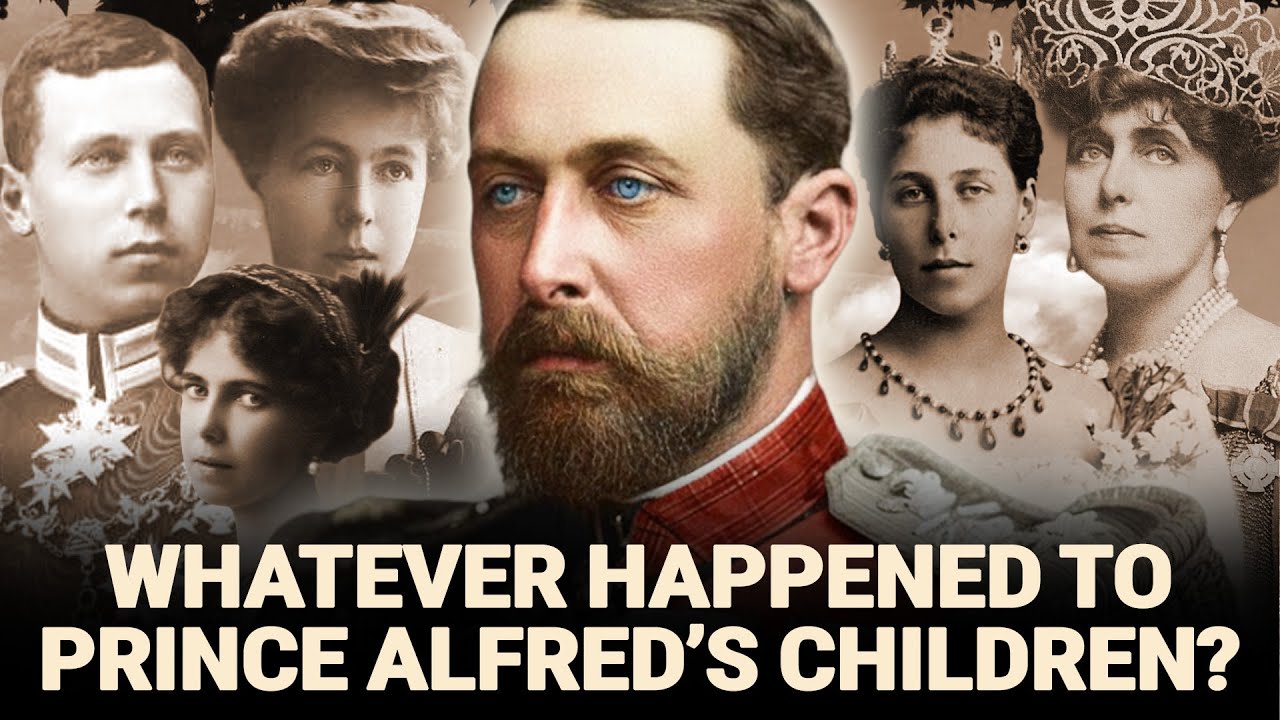
A fifth lived quietly inside the German aristocracy. A sixth carried the family line into Spain. The children of Alfred, Duke of Saxe-Coburg and Gotha, were born into the golden age of European monarchy, and they lived long enough to see its foundations collapse. Their father was the second son of Queen Victoria.
He was also, through marriage to Grand Duchess Maria Alexandrovna of Russia, son-in-law to Tsar Alexander II. That double inheritance of British and Russian blood shaped everything his children became. Alfred himself spent his early career as a naval officer, commanding the Mediterranean Fleet, and his later years as a German sovereign. His children were scattered across the map of Europe, and their fates tracked the fault lines of their era.
The eldest son, Prince Alfred Alexander William Ernest Albert, called Young Affie to distinguish him from his father, was born at Buckingham Palace on October 15, 1874. His birth secured the succession to the Duchy of Saxe-Coburg and Gotha, which his father stood to inherit from a childless uncle. Christened at Windsor with the Prince of Wales, Kaiser Wilhelm I, and the Tsarevich of Russia among his godparents, he seemed destined for a life of consequence. Instead, his childhood was itinerant and increasingly isolated.
He was raised by nurses and tutors under his mother’s strict discipline while his father served at sea. The family moved to Malta in 1886 when Prince Alfred took command of the Mediterranean station, and the warmth and freedom of San Anton Palace gave the boy some of the happiest years of his short life. In August 1893, Duke Ernst II died, and Prince Alfred inherited the duchy. The family abandoned Britain and moved permanently to Coburg in central Germany.
For the eighteen-year-old heir, the transition was brutal. He was no longer a British prince with a naval background but the hereditary prince of a German duchy, expected to master German court protocol, serve as an officer in the Prussian military, and take up responsibilities for which he had no aptitude and little appetite. He found himself caught between two identities, fully belonging to neither. His behaviour and health deteriorated through the mid-1890s.
Contemporary accounts suggest he turned to drink to escape the pressure. His parents tried to intervene, but nothing worked. In January 1899, Young Affie travelled to Meran in the Tyrol. Official accounts stated that he died of chronic cerebral disease on February 6, 1899.
Persistent rumours, however, claimed he had shot himself during the anniversary celebrations of his parents’ silver wedding. The true circumstances were never confirmed. He was buried in the Ducal Mausoleum at Coburg, and his father reportedly never recovered from the loss. His death created a succession crisis.
With no surviving sons, Duke Alfred would be the last of his line to rule the duchy. The succession eventually passed to Prince Charles Edward, Duke of Albany, the posthumous son of Queen Victoria’s youngest son, Leopold. Charles Edward had been raised in England as a British prince with no connection to Germany until he was summoned to assume the duchy. Young Affie’s brief and unhappy life thus altered the fate of Coburg itself.
The eldest daughter, Marie Alexandra Victoria, known as Missy, was born on October 29, 1875, at Eastwell Park in Kent. Her childhood moved between England, Malta, and finally Coburg, where she clashed with her mother’s rigid control. In January 1893, at the age of seventeen, she married Crown Prince Ferdinand of Romania, nephew and heir of King Carol I. She left the familiar courts of Britain and Germany for Bucharest, a country she barely knew, and a husband who was timid, reserved, and dominated by his uncle.
Missy approached her role with determination and charm. She learned Romanian, adopted Romanian dress, and cultivated genuine popularity. She had six children. When Ferdinand became king in 1914 upon Carol’s death, she became queen, and when Romania entered the First World War in 1916 on the Allied side, she threw herself into the national struggle.
She converted part of the royal palace into a hospital and worked as a nurse. She visited the front, corresponded with Allied leaders, and lobbied for Romania’s territorial claims. In 1919 she attended the Paris Peace Conference, where her efforts contributed substantially to the recognition of Greater Romania, incorporating Transylvania and Bessarabia. She became one of the most internationally celebrated queens of her era.
Her later years were troubled by the behaviour of her son, Carol II, who would become king despite his disastrous reign. She died in 1938, remembered as Romania’s most beloved queen, a national symbol long after the monarchy itself was abolished. The second daughter, Victoria Melita, called Ducky, was born on November 25, 1876, at San Anton Palace in Malta, and named after the Latin name for the island. She was closer in age and spirit to Missy, and the two sisters were inseparable in childhood.
Ducky, however, had a more intense and passionate nature. In April 1894 she married her first cousin, Grand Duke Ernest Louis of Hesse and by Rhine, a match strongly promoted by Queen Victoria. The marriage was a catastrophe from the start. The couple were fundamentally incompatible, and they separated in 1901, divorcing in December of that year, a scandal almost unheard of among reigning royalty.
Their only daughter, Elizabeth, died of typhoid fever in November 1903 at the age of eight, devastating Ducky. She found her second chance with Grand Duke Kirill Vladimirovich of Russia, her first cousin through her mother’s family. In October 1905 they married at Tegernsee in Bavaria without permission from Tsar Nicholas II. The marriage violated Russian Orthodox law, which forbade first cousins to wed.
Nicholas stripped Kirill of his titles, his rank, and his right to reside in Russia. The couple lived in exile until 1908, when the Tsar partially relented. Ducky converted to Orthodoxy and took the name Victoria Feodorovna. The marriage brought her the fulfilment she had sought.
When revolution broke out in 1917, the couple was living in St Petersburg. After the February and October Revolutions, they fled through Finland with their children and little else. They lost their wealth, their properties, and their position. In 1924, after the deaths of the Tsar and the male Romanovs ahead of him, Kirill controversially proclaimed himself emperor in exile.
The claim was disputed and never widely recognised. Ducky died in 1936 in Bavaria, having survived the destruction of the world into which she was born. Her son, Vladimir Kirillovich, born in 1917 just before the flight from Russia, was raised as heir to the imperial legacy, and her descendants continue to press claims to the Romanov inheritance. The third daughter, Alexandra Louise Olga Victoria, called Sandra, was born on September 1, 1878, at Rosenau Palace near Coburg.
She was quieter and more reserved than her sisters, and she adapted far more readily to German life. In April 1896 she married Ernst II, Prince of Hohenlohe-Langenburg, a small but respected German noble house. She settled into the stable, dutiful life of a minor princess. When her father died in 1900 and her young cousin Charles Edward succeeded, her husband served as regent of the duchy, giving Sandra an indirect connection to its governance.
She had five children and remained in Germany through the First World War, the abolition of the German monarchies, the Weimar Republic, and the rise of the Nazi era. She died on April 16, 1942, in Stuttgart, a quiet symbol of continuity amid her siblings’ turbulence. On October 13, 1879, Grand Duchess Maria gave birth to a stillborn son at Eastwell Park. The child was never named publicly.
The loss was private grief and dynastic disappointment, a reminder of the fragility that lurked beneath the ceremonies of royal life. The youngest child, Princess Beatrice Leopoldine Victoria, called Baby Bee, was born on April 20, 1884, at Eastwell Park. She was nine years old when the family moved permanently to Coburg, and she was raised fully within the German ducal world. In her early years she became romantically involved with Grand Duke Michael Alexandrovich of Russia, the youngest son of Tsar Alexander III and heir presumptive to Nicholas II.
The match foundered on religious and political obstacles. Michael later made a morganatic marriage and was removed from the succession. Beatrice instead married Infante Alfonso of Spain, Duke of Galliera, in July 1909, converting to Roman Catholicism and taking the Spanish form of her name, Beatriz. She had three sons and lived primarily in Spain.
The Spanish Civil War brought danger, exile, and the loss of estates. One of her sons, Álvaro, was killed in a car accident in 1938. She survived into the 1960s, and when she died on July 13, 1966, at the age of eighty-two, she was the last surviving child of Prince Alfred and Grand Duchess Maria. The children of Alfred and Maria were born into a world where dynastic marriage forged alliances and royal status conferred real power.
They lived to see that world swept away. Missy reshaped Romania’s national identity and left a legacy that outlasted the Romanian throne. Ducky survived revolution and exile and became matriarch to claimants of the Russian imperial house. Alexandra stayed within the German aristocracy and witnessed its end from the inside.
Beatriz carried the family line into Spain and lived to see the restoration of the Spanish monarchy. Even Young Affie, who died before any of those catastrophes, altered the succession of the duchy and brought a British prince to a German throne he never wanted. Together their lives were not merely the story of one family.
They were the story of a generation of royalty forced to adapt, survive, or be consumed by the forces of their age.
